child lock Seat Altea 2015 User Guide
[x] Cancel search | Manufacturer: SEAT, Model Year: 2015, Model line: Altea, Model: Seat Altea 2015Pages: 236, PDF Size: 4.23 MB
Page 75 of 236

Opening and closing
One-touch closing
– Pull up the window button briefly up to the
second position. The window closes fully.
One-touch opening
– Push down the window button briefly up to
the second position. The window opens
fully.
Restoring one-touch opening and closing
– Close all windows.
– Use the key to lock the vehicle from outside
and hold the key in the lock position for at
least one second. The one-touch function is
now ready for operation.
The buttons ››› Fig. 55 1 and
2 have two
levels for opening the window and two for
closing it. This makes it easier to open and
close windows to the desired position.
One-touch closing does not work when the
ignition has been switched off, even if the
key is in the ignition.
The automatic open and close function will
not work if the battery has been temporarily
disconnected, or if the battery is flat. The
function then has to be reactivated.
The one-touch function and roll-back function
will not work if there is a malfunction in the
electric windows. Contact a specialised work-
shop. Roll-back function The roll-back function reduces the risk of in-
jury when the electric windows close.
● If a window is obstructed when closing au-
tomatically, the window stops at this point
and lowers immediately ››› .
● If this happens, check immediately (within
10 seconds) why the window could not be
closed before attempting to close it again. Af-
ter 10 seconds the normal automatic func-
tion resumes.
● If the window is still obstructed, the win-
dow will stop at this point.
● If there is no obvious reason why the win-
dow cannot be closed, try to close it again
within 5 seconds.
If you wait longer than 10 seconds, the win-
dow will open again fully when you operate
one of the buttons. One-touch closing is reac-
tivated.
The one-touch function and roll-back function
will not work if there is a malfunction in the
electric windows. Contact a specialised work-
shop. WARNING
● Incorrect use of the electric windows can
result in injury.
● Always take the ignition key with you when
leaving the vehicle, even if you only intend to be gone for a short time. Please ensure that
children are never left alone inside the vehi-
cle.
●
The electric windows will work until the key
has been removed from the ignition and one
of the front doors has been opened.
● Never close the rear lid without observing
and ensuring it is clear, to do otherwise could
cause serious injury to you and third parties.
Make sure that no one is in the path of a win-
dow.
● Never allow people to remain in the vehicle
when you close the vehicle from the outside.
The windows cannot be opened even in an
emergency. Note
The roll-back function is deactivated if the
windows are closed from the outside of the
vehicle using the ignition key for convenience
closing ››› page 73. Convenience opening and closing*
Using the door lock
– Hold the key in the door lock of the driver
door in either the locking or the unlocking
position until all windows are either
opened or closed.
– Release the key to interrupt this function.
»
73Technical specifications
Advice
Operation
Safety
Page 76 of 236
Operation
Using the remote control
– Push the lock or unlock button on the re-
mote control for approximately 3 seconds.
All windows which function electrically will
be either opened or closed.
– Release the unlock button to interrupt the
function.
– Once the windows are completely closed,
the turn signals will flash.
Sliding/tilting sunroof* Opening and closing the
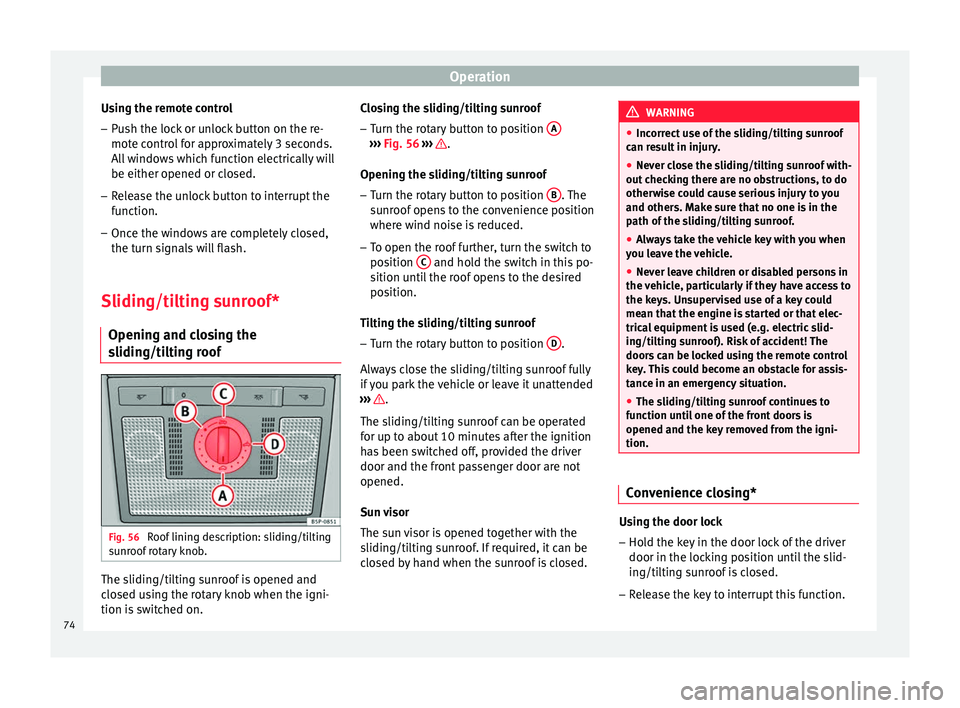
sliding/tilting roof Fig. 56
Roof lining description: sliding/tilting
sunroof rotary knob. The sliding/tilting sunroof is opened and
closed using the rotary knob when the igni-
tion is switched on. Closing the sliding/tilting sunroof
– Turn the rotary button to position A ›››
Fig. 56
›
›› .
Opening the sliding/tilting sunroof
– Turn the rotary button to position B . The
sunroof opens to the convenience position
where wind noise is reduced.
– To open the roof further, turn the switch to
position C and hold the switch in this po-
sition until the roof opens to the desired
position.
Tilting the sliding/tilting sunroof
– Turn the rotary button to position D .
Always close the sliding/tilting sunroof fully
if you park the vehicle or leave it unattended
››› .
The sliding/tilting sunroof can be operated
for up to about 10 minutes after the ignition
has been switched off, provided the driver
door and the front passenger door are not
opened.
Sun visor
The sun visor is opened together with the
sliding/tilting sunroof. If required, it can be
closed by hand when the sunroof is closed. WARNING
● Incorrect use of the sliding/tilting sunroof
can result in injury.
● Never close the sliding/tilting sunroof with-
out checking there are no obstructions, to do
otherwise could cause serious injury to you
and others. Make sure that no one is in the
path of the sliding/tilting sunroof.
● Always take the vehicle key with you when
you leave the vehicle.
● Never leave children or disabled persons in
the vehicle, particularly if they have access to
the keys. Unsupervised use of a key could
mean that the engine is started or that elec-
trical equipment is used (e.g. electric slid-
ing/tilting sunroof). Risk of accident! The
doors can be locked using the remote control
key. This could become an obstacle for assis-
tance in an emergency situation.
● The sliding/tilting sunroof continues to
function until one of the front doors is
opened and the key removed from the igni-
tion. Convenience closing*
Using the door lock
– Hold the key in the door lock of the driver
door in the locking position until the slid-
ing/tilting sunroof is closed.
– Release the key to interrupt this function.
74
Page 103 of 236
Transport and practical equipment
Luggage compartment Loading the luggage compartment All luggage and other loose objects must be
safely secured in the luggage compartment.
Unsecured objects which shift back and forth
could impair the driving safety or driving
characteristics of the vehicle by shifting the
centre of gravity.
– Distribute the load evenly in the luggage
compartment.
– Place heavy objects as far forward as possi-
ble in the luggage compartment.
– Place the heavy objects first.
– Secure heavy objects to the fitted fastening
rings ›››
page 103 . WARNING
● Loose luggage and other objects in the lug-
gage compartment could cause serious inju-
ries.
● Always stow objects in the luggage com-
partment and secure them on the fastening
rings.
● Use suitable straps to secure heavy ob-
jects.
● During sudden manoeuvres or accidents,
loose objects can be thrown forward, injuring
vehicle occupants or passers-by. This in-
creased risk of injury will be further increased if a loose object is struck by an inflating air-
bag. If this happens, objects can be trans-
formed into “missiles”. Risk of fatal injury.
●
Please note that the centre of gravity may
shift when transporting heavy objects; this
may affect vehicle handling and lead to an ac-
cident. Therefore, it is essential to adjust
your speed and driving style accordingly, to
avoid accidents.
● Never exceed the allowed axle weights or
allowed maximum weight. If said weights are
exceeded, the driving characteristics of the
vehicle may change, leading to accidents, in-
juries and damage to the vehicle.
● Never leave your vehicle unattended, espe-
cially when the rear lid is open. Children
could climb into the luggage compartment,
closing the door behind them; they will be
trapped and run the risk of death.
● Never allow children to play in or around
the vehicle. Close and lock all the doors and
rear lid when you leave the vehicle. Before
you lock the vehicle, make sure that there are
no adults or children in the vehicle. CAUTION
Hard objects on the boot cover could chafe
against the wires of the heating element in
the rear window and cause damage. Note
● Air circulation in the vehicle helps reduce
fogging of the windows. Used air escapes through ventilation slits in the side trim of
the luggage compartment. Ensure that these
ventilation slits are never covered.
● Straps for securing the load to the fasten-
ing rings are commercially available. Rear shelf
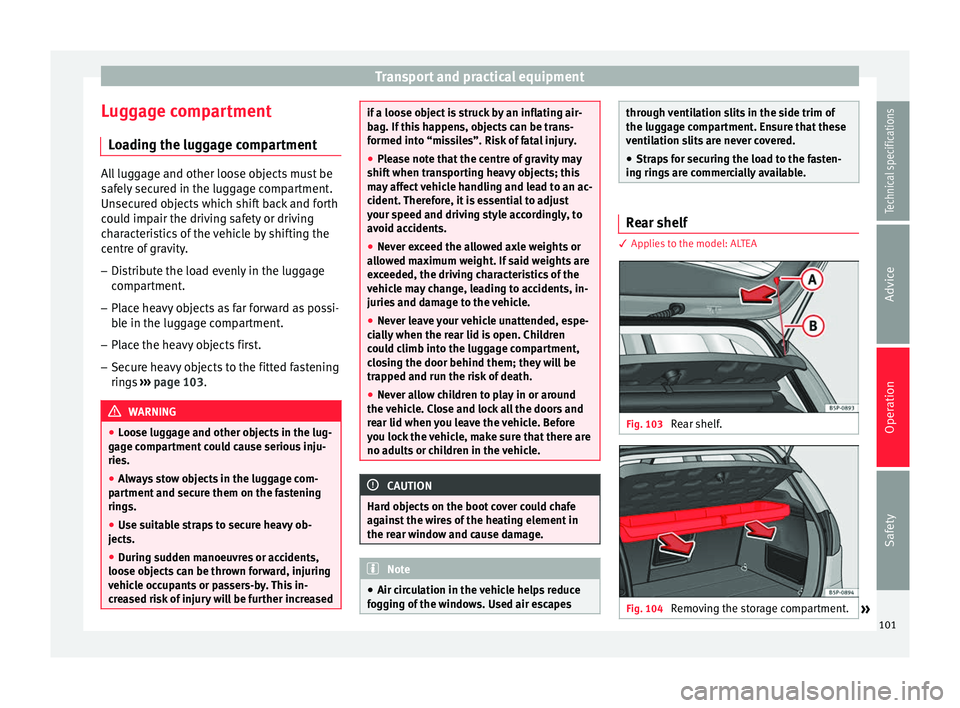
3 Applies to the model: ALTEA
Fig. 103
Rear shelf. Fig. 104
Removing the storage compartment.
» 101Technical specifications
Advice
Operation
Safety
Page 123 of 236
Driving
WARNING
● The ignition key must NOT be removed from
the lock until the vehicle comes to a stand-
still. Otherwise, the steering could be imme-
diately blocked- Risk of accident!
● Always remove the key from the ignition
when leaving the vehicle, even if only for a
short period. This is especially important if
children or disabled people are left alone in
the vehicle. They could accidentally start the
engine or work electrical equipment such as
the electric windows, resulting in an acci-
dent.
● Unsupervised use of the key could start the
engine or any electrical system, such as the
electric windows. This could result in serious
injury. CAUTION
The starter motor will only work when the en-
gine is stopped (ignition key position 2 ).
Electronic immobiliser
The electronic immobiliser prevents unau-
thorised persons from driving the vehicle.
Inside the key there is a chip that deactivates
the electronic immobiliser automatically
when the key is inserted into the ignition. The electronic immobiliser will be activated
again automatically as soon as you pull the
key out of the ignition lock.
The engine can only be started using a genu-
ine SEAT key with its correct code.
Note
A perfect operation of the vehicle is ensured
if genuine SEAT keys are used. Starting petrol engines
The engine can only be started using a genu-
ine SEAT key with its correct code.
– Move the gearbox lever to the neutral posi-
tion and depress the clutch pedal thor-
oughly and hold it in this position for the
starter to turn the engine on.
– Turn the ignition key to the starting posi-
tion ›››
page 120 .
– Let
go of the ignition key as soon as the en-
gine starts; the starter motor must not run
on with the engine.
After starting a very hot engine, you may
need to slightly press down the accelerator.
When starting a cold engine, it may be a little
noisy for the first few seconds until oil pres-
sure has built up in the hydraulic valve com-
pensators. This is quite normal, and no cause
for concern. If the engine does not start immediately,
switch the starter off after 10 seconds and try
again after half a minute. If the engine still
does not start, the fuel pump fuse should be
checked
››› page 196, Fuses. WARNING
● Never start or run the engine in unventila-
ted or closed rooms. The exhaust gases con-
tain carbon monoxide, an odourless and col-
ourless poisonous gas. Risk of fatal acci-
dents. Carbon monoxide can cause loss of
consciousness and result in death.
● Never leave the vehicle unattended if the
engine is running.
● Never use “cold start sprays”, they could
explode or cause the engine to run at high
revs. Risk of injury. CAUTION
● When the engine is cold, you should avoid
high engine speeds, driving at full throttle
and over-loading the engine. Risk of engine
damage.
● The vehicle should not be pushed or towed
more than 50 metres to start the engine. Un-
burnt fuel could enter the catalytic converter
and damage it.
● Before attempting to push-start or tow a ve-
hicle in order to start it, you should first try to
start it using the battery of another vehicle.
Note and follow the instructions in
››› page 189, Jump-starting.
» 121
Technical specifications
Advice
Operation
Safety
Page 127 of 236
Driving
●
If the handbrake is only partially released,
this will cause the rear brakes to overheat,
which can impair the function of the brake
system and could lead to an accident. This al-
so causes premature wear on the rear brake
pads. CAUTION
Always apply the handbrake before you leave
the vehicle. Put it in 1st gear as well. Parking
The handbrake should always be firmly ap-
plied when the vehicle is parked.
Always note the following points when park-
ing the vehicle:
– Use the brake pedal to stop the vehicle.
– Apply the handbrake.
– Put it in 1st gear.
– Switch the engine off and remove the key
from the ignition. Turn the steering wheel
slightly to engage the steering lock.
– Always take you keys with you when you
leave the vehicle ››› .Additional notes on parking the vehicle on
gradients:
Turn the steering wheel so that the vehicle
rolls against the kerb if it started to roll.
●
If the vehicle is parked facing downhill,
turn the front wheels so that they point to-
wards the kerb .
● If the vehicle is parked facing uphill, turn
the fr ont
wheels so that they point away from
the kerb
.
● Secure the vehicle as usual by applying the
handbrake firmly and putting it in 1st gear. WARNING
● Take measures to reduce the risk of injury
when you leave your vehicle unattended.
● Never park where the hot exhaust system
could ignite inflammable materials, such as
dry grass, low bushes, spilt fuel etc.
● Never allow vehicle occupants to remain in
the vehicle when it is locked. They would be
unable to open the vehicle from the inside,
and could become trapped in the vehicle in
an emergency. In the event of an emergency,
locked doors will delay assistance to vehicle
occupants.
● Never leave children alone in the vehicle.
They could set the vehicle in motion, for ex-
ample, by releasing the handbrake or the
gearbox lever. ●
Depending on weather conditions, it may
become extremely hot or cold inside the vehi-
cle. This can be fatal. Hill driving assistant*
This function is only included in vehicles with
ESC.
The hill driving assistant helps the driver to
move off and upward on a hill without rolling
backward.
The system maintains brake pressure for ap-
proximately 2 seconds after the driver takes
his foot off the brake pedal to prevent the ve-
hicle from rolling backward when starting off.
During these 2 seconds, the driver has
enough time to release the clutch pedal and
accelerate without the vehicle moving and
without having to use the handbrake, making
starting off easier, more comfortable and saf-
er.
These are the basic operation conditions:
● being on a ramp or hill/slope,
● closed doors,
● vehicle completely stationary,
● engine running and foot on the brake,
● besides having a gear engaged or being in
neutral for manual gear change and with the
selector lever at position S,
D
or R for an au-
tomatic gearbox. »
125
Technical specifications
Advice
Operation
Safety
Page 166 of 236
Advice
You should not do any work in the engine
compartment unless you know exactly how to
carry out the jobs and have the correct tools!
Have the work carried out by a specialised
workshop if you are uncertain.
All service fluids and consumables, e.g. cool-
ant, engine oil, spark plugs and batteries,
are under constant development. SEAT pro-
vides a constant flow of information to Tech-
nical Services concerning modifications. For
this reason, we recommend you have service
fluids and consumables replaced by a Techni-
cal Service. Please observe the relevant in-
structions ››› page 147 . The engine compart-
ment of
the vehicle is a hazardous area.
››› .
WARNING
All work on the engine or in the engine com-
partment, e.g. checking and refilling fluids,
involves the danger of injury and burns, acci-
dents and even fire.
● Never open the bonnet if you see steam,
smoke or coolant escaping from the engine
compartment. Otherwise, there is a risk of
sustaining burns. Wait until no more steam or
coolant is emitted, then allow the engine to
cool before carefully opening the bonnet.
● Switch off the engine and remove the key
from the ignition.
● Apply the handbrake and move the gear
lever to neutral or selector lever to position P.
● Keep children away from the vehicle. ●
Never touch hot engine parts. There is a
risk of burns.
● Never spill liquids on a hot engine or on a
hot exhaust gas system. This is a fire hazard.
● Avoid causing short-circuits in the electri-
cal system, particularly at the points where
the jump leads are attached ››› page 190. The
battery could explode.
● Never touch the radiator fan. It is tempera-
ture controlled and could start automatically,
even when the engine has been switched off
and the key removed from the ignition!
● Never cover the engine with additional in-
sulating materials such as a blanket. Risk of
fire!
● Do not unscrew the cap on the coolant ex-
pansion tank when the engine is hot. If the
coolant is hot, the cooling system will be
pressurised!
● Protect face, hands and arms by covering
the cap with a large, thick cloth to protect
against escaping coolant and steam.
● Always make sure you have not left any ob-
jects, such as cleaning cloths or tools, in the
engine compartment.
● If you have to work underneath the vehicle,
you must use suitable stands additionally to
support the vehicle, there is a risk of acci-
dent!. A hydraulic jack is insufficient for se-
curing the vehicle and there is a risk of injury.
● If any work has to be performed when the
engine is started or with the engine running,
there is an additional, potentially fatal, safety
risk from the rotating parts, such as the drive belts, alternator, radiator fan, etc., and from
the high-voltage ignition system. You should
also observe the following:
– Never touch the electrical wiring of the
ignition system.
– Ensure that jewellery, loose clothing and
long hair do not get trapped in rotating
engine parts. Danger of death. Before
starting any work remove jewellery, tie
back and cover hair, and wear tight-fit-
ting clothes.
– Never accelerate with a gear engaged
without taking the necessary precau-
tions. The vehicle could move, even if the
handbrake is applied. Danger of death.
● If work has to be carried out on the fuel
system or on electrical components, you
must observe the following safety notes in
addition to the above warnings:
– Always disconnect the battery from the
on-board network. The vehicle must be
unlocked when this is done, otherwise
the alarm will be triggered.
– Do not smoke.
– Never work near naked flames.
– Always have a fire extinguisher on hand. CAUTION
When topping up service fluids, make sure
not to mistake them. Using the wrong fluids
could cause serious malfunctions and engine
damage! 164
Page 174 of 236
Advice
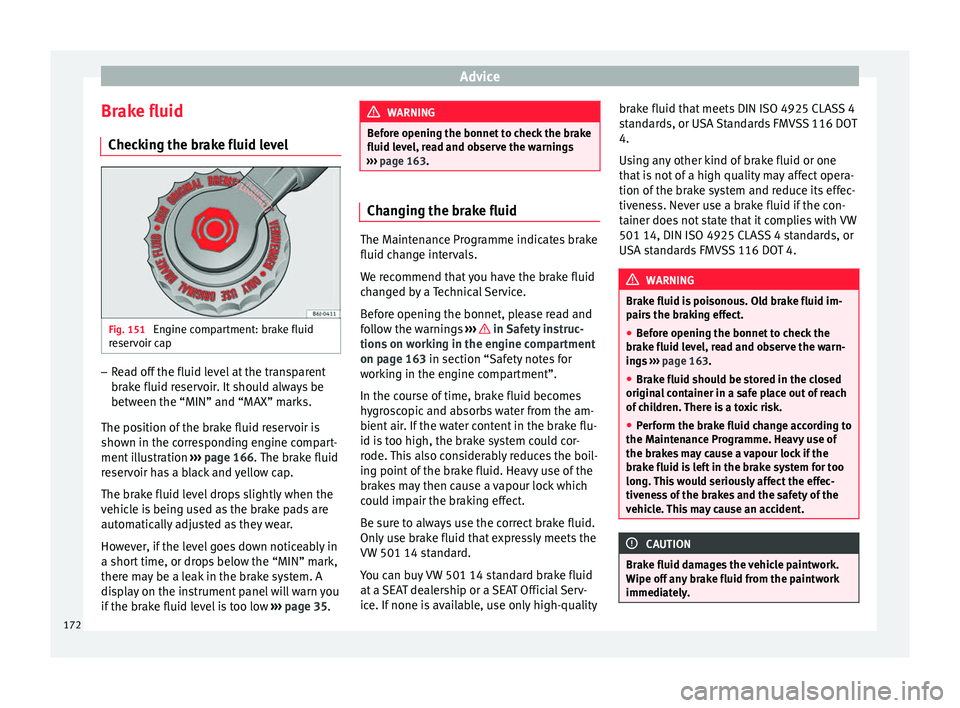
Brake fluid Checking the brake fluid level Fig. 151
Engine compartment: brake fluid
reservoir cap –
Read off the fluid level at the transparent
brake fluid reservoir. It should always be
between the “MIN” and “MAX” marks.
The position of the brake fluid reservoir is
shown in the corresponding engine compart-
ment illustration ››› page 166. The brake fluid
reservoir has a black and yellow cap.
The brake fluid level drops slightly when the
vehicle is being used as the brake pads are
automatically adjusted as they wear.
However, if the level goes down noticeably in
a short time, or drops below the “MIN” mark,
there may be a leak in the brake system. A
display on the instrument panel will warn you
if the brake fluid level is too low ››› page 35. WARNING
Before opening the bonnet to check the brake
fluid level, read and observe the warnings
››› page 163. Changing the brake fluid
The Maintenance Programme indicates brake
fluid change intervals.
We recommend that you have the brake fluid
changed by a Technical Service.
Before opening the bonnet, please read and
follow the warnings
››› in Safety instruc-
tions on working in the engine compartment
on page 163 in section “Safety notes for
w ork
ing in the engine compartment”.
In the course of time, brake fluid becomes
hygroscopic and absorbs water from the am-
bient air. If the water content in the brake flu-
id is too high, the brake system could cor-
rode. This also considerably reduces the boil-
ing point of the brake fluid. Heavy use of the
brakes may then cause a vapour lock which
could impair the braking effect.
Be sure to always use the correct brake fluid.
Only use brake fluid that expressly meets the
VW 501 14 standard.
You can buy VW 501 14 standard brake fluid
at a SEAT dealership or a SEAT Official Serv-
ice. If none is available, use only high-quality brake fluid that meets DIN ISO 4925 CLASS 4
standards, or USA Standards FMVSS 116 DOT
4.
Using any other kind of brake fluid or one
that is not of a high quality may affect opera-
tion of the brake system and reduce its effec-
tiveness. Never use a brake fluid if the con-
tainer does not state that it complies with VW
501 14, DIN ISO 4925 CLASS 4 standards, or
USA standards FMVSS 116 DOT 4.
WARNING
Brake fluid is poisonous. Old brake fluid im-
pairs the braking effect.
● Before opening the bonnet to check the
brake fluid level, read and observe the warn-
ings ››› page 163.
● Br ak
e fluid should be stored in the closed
original container in a safe place out of reach
of children. There is a toxic risk.
● Perform the brake fluid change according to
the Maintenance Programme. Heavy use of
the brakes may cause a vapour lock if the
brake fluid is left in the brake system for too
long. This would seriously affect the effec-
tiveness of the brakes and the safety of the
vehicle. This may cause an accident. CAUTION
Brake fluid damages the vehicle paintwork.
Wipe off any brake fluid from the paintwork
immediately. 172
Page 175 of 236
Checking and refilling levels
For the sake of the environment
The brake pads and brake fluid must be col-
lected and disposed of according the applica-
ble regulations. The SEAT Technical Service
network has the necessary equipment and
qualified personnel for collecting and dispos-
ing of this waste material. Vehicle battery
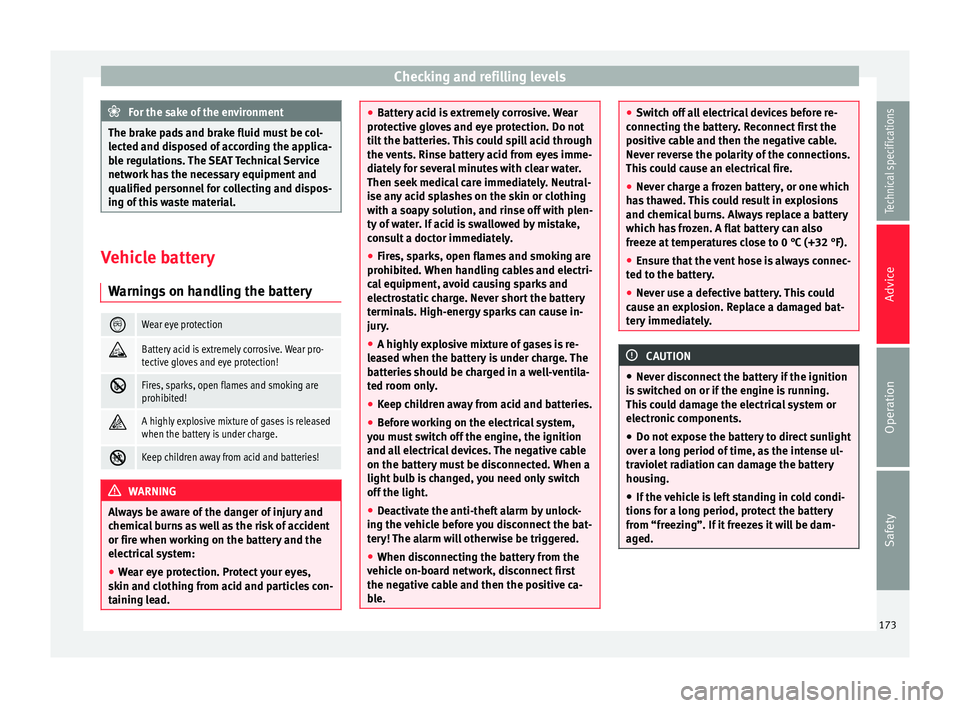
Warnings on handling the battery Wear eye protection
Battery acid is extremely corrosive. Wear pro-
tective gloves and eye protection!
Fires, sparks, open flames and smoking are
prohibited!
A highly explosive mixture of gases is released
when the battery is under charge.
Keep children away from acid and batteries!
WARNING
Always be aware of the danger of injury and
chemical burns as well as the risk of accident
or fire when working on the battery and the
electrical system:
● Wear eye protection. Protect your eyes,
skin and clothing from acid and particles con-
taining lead. ●
Battery acid is extremely corrosive. Wear
protective gloves and eye protection. Do not
tilt the batteries. This could spill acid through
the vents. Rinse battery acid from eyes imme-
diately for several minutes with clear water.
Then seek medical care immediately. Neutral-
ise any acid splashes on the skin or clothing
with a soapy solution, and rinse off with plen-
ty of water. If acid is swallowed by mistake,
consult a doctor immediately.
● Fires, sparks, open flames and smoking are
prohibited. When handling cables and electri-
cal equipment, avoid causing sparks and
electrostatic charge. Never short the battery
terminals. High-energy sparks can cause in-
jury.
● A highly explosive mixture of gases is re-
leased when the battery is under charge. The
batteries should be charged in a well-ventila-
ted room only.
● Keep children away from acid and batteries.
● Before working on the electrical system,
you must switch off the engine, the ignition
and all electrical devices. The negative cable
on the battery must be disconnected. When a
light bulb is changed, you need only switch
off the light.
● Deactivate the anti-theft alarm by unlock-
ing the vehicle before you disconnect the bat-
tery! The alarm will otherwise be triggered.
● When disconnecting the battery from the
vehicle on-board network, disconnect first
the negative cable and then the positive ca-
ble. ●
Switch off all electrical devices before re-
connecting the battery. Reconnect first the
positive cable and then the negative cable.
Never reverse the polarity of the connections.
This could cause an electrical fire.
● Never charge a frozen battery, or one which
has thawed. This could result in explosions
and chemical burns. Always replace a battery
which has frozen. A flat battery can also
freeze at temperatures close to 0 °C (+32 °F).
● Ensure that the vent hose is always connec-
ted to the battery.
● Never use a defective battery. This could
cause an explosion. Replace a damaged bat-
tery immediately. CAUTION
● Never disconnect the battery if the ignition
is switched on or if the engine is running.
This could damage the electrical system or
electronic components.
● Do not expose the battery to direct sunlight
over a long period of time, as the intense ul-
traviolet radiation can damage the battery
housing.
● If the vehicle is left standing in cold condi-
tions for a long period, protect the battery
from “freezing”. If it freezes it will be dam-
aged. 173
Technical specifications
Advice
Operation
Safety
Page 195 of 236
Emergencies
– Bolt the anchorage to its limit to the left, in
the dir ection of
the arrow ››› Fig. 165.
Re
ar towline anchorage
– Take the towline anchorage from the on-
board tool set.
– Remove the cover by pressing down on its
right-hand side.
– Bolt the anchorage to its limit to the left
, in
the direction of the arrow ››› Fig. 166.
Aft
er use, unscrew the towline anchorage
and put it back in the vehicle tool kit. Replace
the cover on the bumper. The towline anchor-
age should always be kept in the vehicle. Emergency locking and
unlocking
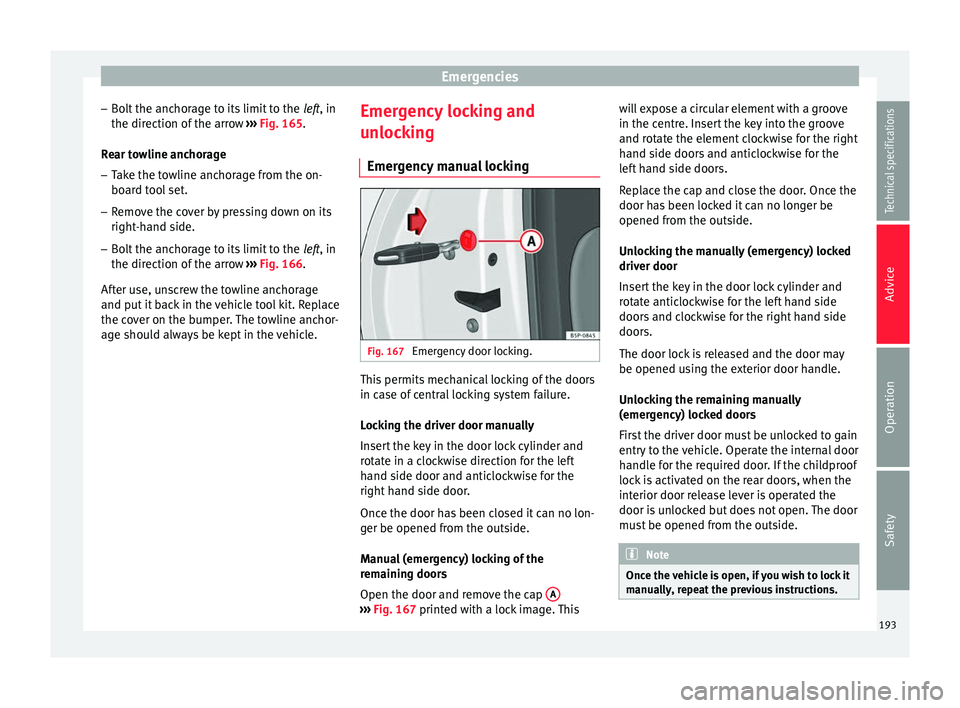
Emergency manual locking Fig. 167
Emergency door locking. This permits mechanical locking of the doors
in case of central locking system failure.
Locking the driver door manually
Insert the key in the door lock cylinder and
rotate in a clockwise direction for the left
hand side door and anticlockwise for the
right hand side door.
Once the door has been closed it can no lon-
ger be opened from the outside.
Manual (emergency) locking of the
remaining doors
Open the door and remove the cap
A ›››
Fig. 167 printed with a lock image. This w
i
ll expose a circular element with a groove
in the centre. Insert the key into the groove
and rotate the element clockwise for the right
hand side doors and anticlockwise for the
left hand side doors.
Replace the cap and close the door. Once the
door has been locked it can no longer be
opened from the outside.
Unlocking the manually (emergency) locked
driver door
Insert the key in the door lock cylinder and
rotate anticlockwise for the left hand side
doors and clockwise for the right hand side
doors.
The door lock is released and the door may
be opened using the exterior door handle.
Unlocking the remaining manually
(emergency) locked doors
First the driver door must be unlocked to gain
entry to the vehicle. Operate the internal door
handle for the required door. If the childproof
lock is activated on the rear doors, when the
interior door release lever is operated the
door is unlocked but does not open. The door
must be opened from the outside. Note
Once the vehicle is open, if you wish to lock it
manually, repeat the previous instructions. 193
Technical specifications
Advice
Operation
Safety
Page 226 of 236
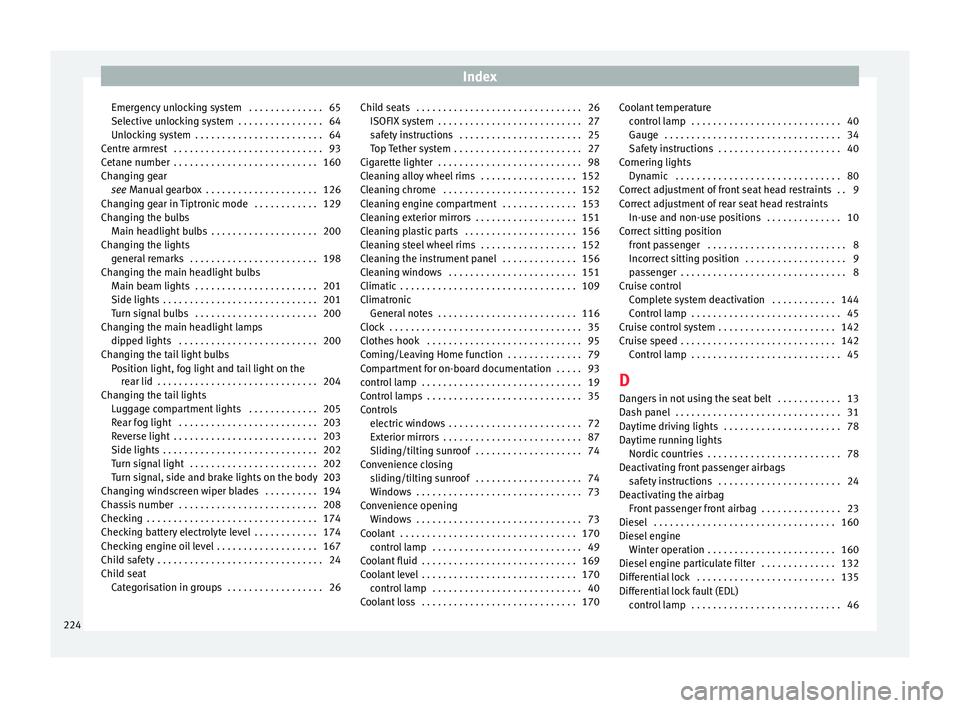
Index
Emergency unlocking system . . . . . . . . . . . . . . 65
Selective unlocking system . . . . . . . . . . . . . . . . 64
Unlocking system . . . . . . . . . . . . . . . . . . . . . . . . 64
Centre armrest . . . . . . . . . . . . . . . . . . . . . . . . . . . . 93
Cetane number . . . . . . . . . . . . . . . . . . . . . . . . . . . 160
Changing gear see Manual gearbox . . . . . . . . . . . . . . . . . . . . . 126
Ch an
ging gear in Tiptronic mode . . . . . . . . . . . . 129
Changing the bulbs Main headlight bulbs . . . . . . . . . . . . . . . . . . . . 200
Changing the lights general remarks . . . . . . . . . . . . . . . . . . . . . . . . 198
Changing the main headlight bulbs Main beam lights . . . . . . . . . . . . . . . . . . . . . . . 201
Side lights . . . . . . . . . . . . . . . . . . . . . . . . . . . . . 201
Turn signal bulbs . . . . . . . . . . . . . . . . . . . . . . . 200
Changing the main headlight lamps dipped lights . . . . . . . . . . . . . . . . . . . . . . . . . . 200
Changing the tail light bulbs Position light, fog light and tail light on therear lid . . . . . . . . . . . . . . . . . . . . . . . . . . . . . . 204
Changing the tail lights Luggage compartment lights . . . . . . . . . . . . . 205
Rear fog light . . . . . . . . . . . . . . . . . . . . . . . . . . 203
Reverse light . . . . . . . . . . . . . . . . . . . . . . . . . . . 203
Side lights . . . . . . . . . . . . . . . . . . . . . . . . . . . . . 202
Turn signal light . . . . . . . . . . . . . . . . . . . . . . . . 202
Turn signal, side and brake lights on the body . . .203
Changing windscreen wiper blades . . . . . . . . . . 194
Chassis number . . . . . . . . . . . . . . . . . . . . . . . . . . 208
Checking . . . . . . . . . . . . . . . . . . . . . . . . . . . . . . . . 174
Checking battery electrolyte level . . . . . . . . . . . . 174
Checking engine oil level . . . . . . . . . . . . . . . . . . . 167
Child safety . . . . . . . . . . . . . . . . . . . . . . . . . . . . . . . 24
Child seat Categorisation in groups . . . . . . . . . . . . . . . . . . 26 Child seats . . . . . . . . . . . . . . . . . . . . . . . . . . . . . . . 26
ISOFIX system . . . . . . . . . . . . . . . . . . . . . . . . . . . 27
safety instructions . . . . . . . . . . . . . . . . . . . . . . . 25
Top Tether system . . . . . . . . . . . . . . . . . . . . . . . . 27
Cigarette lighter . . . . . . . . . . . . . . . . . . . . . . . . . . . 98
Cleaning alloy wheel rims . . . . . . . . . . . . . . . . . . 152
Cleaning chrome . . . . . . . . . . . . . . . . . . . . . . . . . 152
Cleaning engine compartment . . . . . . . . . . . . . . 153
Cleaning exterior mirrors . . . . . . . . . . . . . . . . . . . 151
Cleaning plastic parts . . . . . . . . . . . . . . . . . . . . . 156
Cleaning steel wheel rims . . . . . . . . . . . . . . . . . . 152
Cleaning the instrument panel . . . . . . . . . . . . . . 156
Cleaning windows . . . . . . . . . . . . . . . . . . . . . . . . 151
Climatic . . . . . . . . . . . . . . . . . . . . . . . . . . . . . . . . . 109
Climatronic General notes . . . . . . . . . . . . . . . . . . . . . . . . . . 116
Clock . . . . . . . . . . . . . . . . . . . . . . . . . . . . . . . . . . . . 35
Clothes hook . . . . . . . . . . . . . . . . . . . . . . . . . . . . . 95
Coming/Leaving Home function . . . . . . . . . . . . . . 79
Compartment for on-board documentation . . . . . 93
control lamp . . . . . . . . . . . . . . . . . . . . . . . . . . . . . . 19
Control lamps . . . . . . . . . . . . . . . . . . . . . . . . . . . . . 35
Controls electric windows . . . . . . . . . . . . . . . . . . . . . . . . . 72
Exterior mirrors . . . . . . . . . . . . . . . . . . . . . . . . . . 87
Sliding/tilting sunroof . . . . . . . . . . . . . . . . . . . . 74
Convenience closing sliding/tilting sunroof . . . . . . . . . . . . . . . . . . . . 74
Windows . . . . . . . . . . . . . . . . . . . . . . . . . . . . . . . 73
Convenience opening Windows . . . . . . . . . . . . . . . . . . . . . . . . . . . . . . . 73
Coolant . . . . . . . . . . . . . . . . . . . . . . . . . . . . . . . . . 170 control lamp . . . . . . . . . . . . . . . . . . . . . . . . . . . . 49
Coolant fluid . . . . . . . . . . . . . . . . . . . . . . . . . . . . . 169
Coolant level . . . . . . . . . . . . . . . . . . . . . . . . . . . . . 170 control lamp . . . . . . . . . . . . . . . . . . . . . . . . . . . . 40
Coolant loss . . . . . . . . . . . . . . . . . . . . . . . . . . . . . 170 Coolant temperature
control lamp . . . . . . . . . . . . . . . . . . . . . . . . . . . . 40
Gauge . . . . . . . . . . . . . . . . . . . . . . . . . . . . . . . . . 34
Safety instructions . . . . . . . . . . . . . . . . . . . . . . . 40
Cornering lights Dynamic . . . . . . . . . . . . . . . . . . . . . . . . . . . . . . . 80
Correct adjustment of front seat head restraints . . 9
Correct adjustment of rear seat head restraints In-use and non-use positions . . . . . . . . . . . . . . 10
Correct sitting position front passenger . . . . . . . . . . . . . . . . . . . . . . . . . . 8
Incorrect sitting position . . . . . . . . . . . . . . . . . . . 9
passenger . . . . . . . . . . . . . . . . . . . . . . . . . . . . . . . 8
Cruise control Complete system deactivation . . . . . . . . . . . . 144
Control lamp . . . . . . . . . . . . . . . . . . . . . . . . . . . . 45
Cruise control system . . . . . . . . . . . . . . . . . . . . . . 142
Cruise speed . . . . . . . . . . . . . . . . . . . . . . . . . . . . . 142 Control lamp . . . . . . . . . . . . . . . . . . . . . . . . . . . . 45
D Dangers in not using the seat belt . . . . . . . . . . . . 13
Dash panel . . . . . . . . . . . . . . . . . . . . . . . . . . . . . . . 31
Daytime driving lights . . . . . . . . . . . . . . . . . . . . . . 78
Daytime running lights Nordic countries . . . . . . . . . . . . . . . . . . . . . . . . . 78
Deactivating front passenger airbags safety instructions . . . . . . . . . . . . . . . . . . . . . . . 24
Deactivating the airbag Front passenger front airbag . . . . . . . . . . . . . . . 23
Diesel . . . . . . . . . . . . . . . . . . . . . . . . . . . . . . . . . . 160
Diesel engine Winter operation . . . . . . . . . . . . . . . . . . . . . . . . 160
Diesel engine particulate filter . . . . . . . . . . . . . . 132
Differential lock . . . . . . . . . . . . . . . . . . . . . . . . . . 135
Differential lock fault (EDL) control lamp . . . . . . . . . . . . . . . . . . . . . . . . . . . . 46
224