open bonnet Seat Altea 2015 User Guide
[x] Cancel search | Manufacturer: SEAT, Model Year: 2015, Model line: Altea, Model: Seat Altea 2015Pages: 236, PDF Size: 4.23 MB
Page 167 of 236
Checking and refilling levels
For the sake of the environment
Service fluids leaks are harmful to the envi-
ronment. For this reason you should make
regular checks on the ground underneath
your vehicle. If you find spots of oil or other
fluids, have your vehicle inspected in a speci-
alised workshop. Opening the bonnet
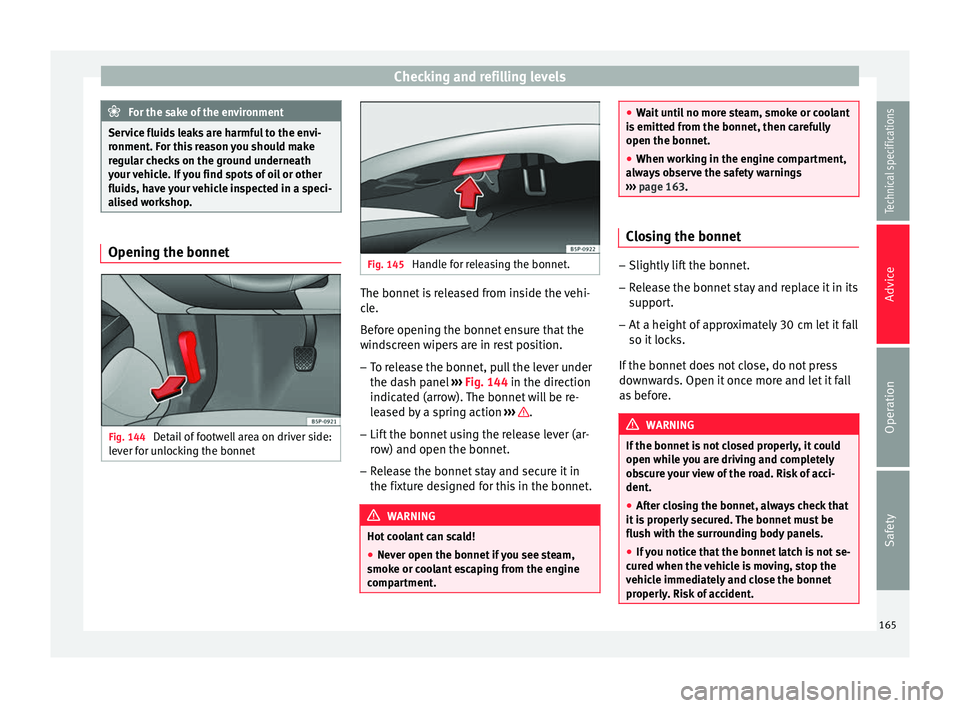
Fig. 144
Detail of footwell area on driver side:
lever for unlocking the bonnet Fig. 145
Handle for releasing the bonnet. The bonnet is released from inside the vehi-
cle.
Before opening the bonnet ensure that the
windscreen wipers are in rest position.
– To release the bonnet, pull the lever under
the dash panel ››› Fig. 144 in the direction
indic at
ed (arrow). The bonnet will be re-
leased by a spring action ››› .
– Lift the bonnet using the release lever (ar-
row) and open the bonnet.
– Release the bonnet stay and secure it in
the fixture designed for this in the bonnet. WARNING
Hot coolant can scald!
● Never open the bonnet if you see steam,
smoke or coolant escaping from the engine
compartment. ●
Wait until no more steam, smoke or coolant
is emitted from the bonnet, then carefully
open the bonnet.
● When working in the engine compartment,
always observe the safety warnings
››› page 163. Closing the bonnet
–
Slightly lift the bonnet.
– Release the bonnet stay and replace it in its
support.
– At a height of approximately 30 cm let it fall
so it locks.
If the bonnet does not close, do not press
downwards. Open it once more and let it fall
as before. WARNING
If the bonnet is not closed properly, it could
open while you are driving and completely
obscure your view of the road. Risk of acci-
dent.
● After closing the bonnet, always check that
it is properly secured. The bonnet must be
flush with the surrounding body panels.
● If you notice that the bonnet latch is not se-
cured when the vehicle is moving, stop the
vehicle immediately and close the bonnet
properly. Risk of accident. 165
Technical specifications
Advice
Operation
Safety
Page 170 of 236
Advice
– Pull out the dipstick. Wipe the dipstick with
a clean cloth and insert it again, pushing it
in as far as it will go.
– Then pull it out once more and check the oil
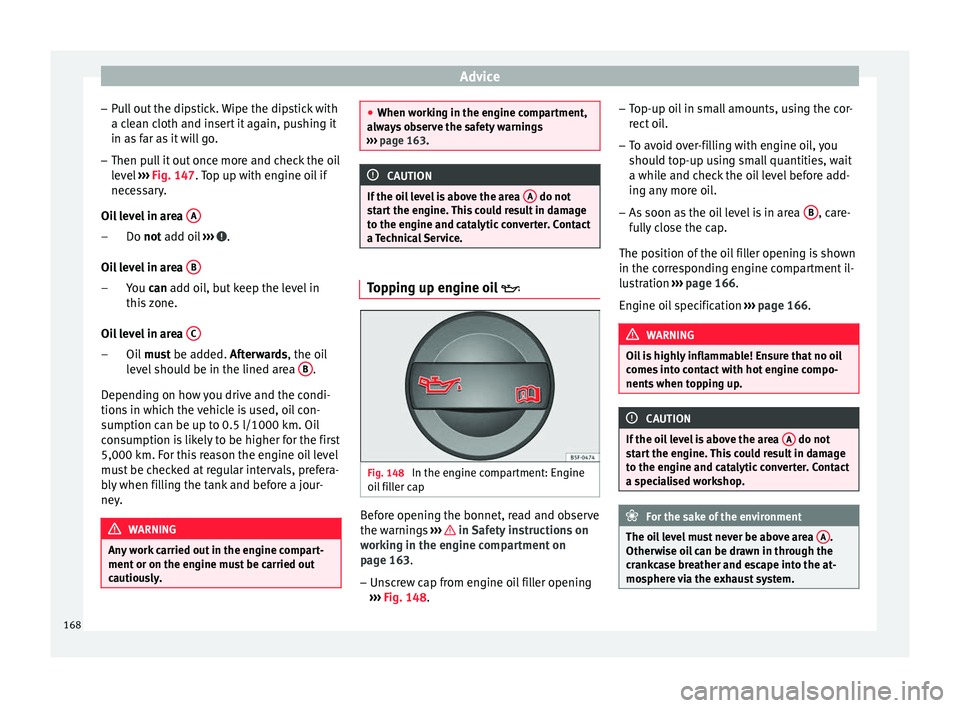
level ››› Fig. 147 . Top up with engine oil if
nec e
ssary.
Oil level in area ADo
not
add oil ›
›› .
Oil level in area BYou
can
add oil, but keep the level in
thi
s zone.
Oil level in area COil
must be added.
Afterwards
, the oil
level should be in the lined area B .
Depending on how you drive and the condi-
tions in which the vehicle is used, oil con-
sumption can be up to 0.5 l/1000 km. Oil
consumption is likely to be higher for the first
5,000 km. For this reason the engine oil level
must be checked at regular intervals, prefera-
bly when filling the tank and before a jour-
ney. WARNING
Any work carried out in the engine compart-
ment or on the engine must be carried out
cautiously. –
–
– ●
When working in the engine compartment,
always observe the safety warnings
››› page 163. CAUTION
If the oil level is above the area A do not
start the engine. This could result in damage
to the engine and catalytic converter. Contact
a Technical Service. Topping up engine oil
Fig. 148
In the engine compartment: Engine
oil filler cap Before opening the bonnet, read and observe
the warnings
››› in Safety instructions on
working in the engine compartment on
page 163 .
– Un s
crew cap from engine oil filler opening
››› Fig. 148. –
Top-up oi
l in small amounts, using the cor-
rect oil.
– To avoid over-filling with engine oil, you
should top-up using small quantities, wait
a while and check the oil level before add-
ing any more oil.
– As soon as the oil level is in area B , care-
fully close the cap.
The position of the oil filler opening is shown
in the corresponding engine compartment il-
lustration ››› page 166 .
En gine oi
l specification ››› page 166. WARNING
Oil is highly inflammable! Ensure that no oil
comes into contact with hot engine compo-
nents when topping up. CAUTION
If the oil level is above the area A do not
start the engine. This could result in damage
to the engine and catalytic converter. Contact
a specialised workshop. For the sake of the environment
The oil level must never be above area A .
Otherwise oil can be drawn in through the
crankcase breather and escape into the at-
mosphere via the exhaust system. 168
Page 171 of 236
Checking and refilling levels
Changing engine oil The engine oil must be changed at the inter-
vals given in the service schedule.
We recommend that you have the engine oil
changed by a Technical Service.
The oil change intervals are shown in the
Maintenance Programme.
WARNING
Only change the engine oil yourself if you
have the specialist knowledge required!
● Before opening the bonnet, read and ob-
serve the warnings ››› page 163, Safety in-
structions on working in the engine compart-
ment.
● Wait
for the engine to cool down. Hot oil
may cause burn injuries.
● Wear eye protection to avoid injuries, such
as acid burns, caused by splashes of oil.
● When removing the oil drain plug with your
fingers, keep your arm horizontal to help pre-
vent oil from running down your arm.
● Wash your skin thoroughly if it comes into
contact with engine oil.
● Engine oil is poisonous! Used oil must be
stored in a safe place out of the reach of chil-
dren. CAUTION
No additives should be used with engine oil.
This could result in engine damage. Any dam-
age caused by the use of such additives
would not be covered by the factory warranty. For the sake of the environment
● Because of disposal problems and the spe-
cial tools and specialist knowledge required,
we recommend that you have the engine oil
and filter changed by a Technical Service.
● Never pour oil down drains or into the
ground.
● Use a suitable container when draining the
used oil. It must be large enough to hold all
the engine oil. Cooling system
Engine coolant specifications The engine cooling system is supplied from
the factory with a specially treated mixture of
water and, at least, 40 % of the additive
G 13
(TLVW 774 J). The engine coolant additive is
recognisable by its purple colour. This mix-
ture of water and additive gives the necessa-
ry frost protection down to -25°C (-13 F) and
protects the light alloy parts of the cooling
system against corrosion. It also prevents scaling and considerably raises the boiling
point of the coolant.
To protect the engine cooling system, the
percentage of additive must
always be at
l e
ast 40 %, even in warm climates where an-
ti-freeze protection is not required.
If greater frost protection is required in very
cold climates, the proportion of additive can
be increased. However, the percentage of ad-
ditive should not exceed 60%, as this would
reduce frost protection and, in turn, decrease
cooling capacity.
When the coolant is topped up, use a mixture
of distilled water and, at least, 40 % of the G
13 or G 12 plu
s-plus (TL-VW 774 G) additive
(both are purple) to obtain an optimum anti-
corrosion protection ››› . The mixture of G
13 with G 12 plus (TL-VW 774 F), G 12 (red) or
G 11 (green-blue) engine coolants will signifi-
cantly reduce the anticorrosion protection
and should, therefore be avoided ››› .
WARNING
If there is not enough anti-freeze in the cool-
ant system, the engine may fail leading to se-
rious damage.
● Please make sure that the percentage of
additive is correct with respect to the lowest
expected ambient temperature in the zone
where the vehicle is to be used.
● When the outside temperature is very low,
the coolant could freeze and the vehicle » 169
Technical specifications
Advice
Operation
Safety
Page 172 of 236
Advice
would be immobilised. In this case, the heat-
ing would not work either and inadequately
dressed passengers could die of cold.
CAUTION
The original additives should never be mixed
with coolants which are not approved by
SEAT. Otherwise, you run the risk of causing
severe damage to the engine and the engine
cooling system. ● If the fluid in the expansion tank is not pur-
ple but is, for example, brown, this indicates
that the G 13 additive has been mixed with
an inadequate coolant. The coolant must be
changed as soon as possible if this is the
case! This could result in serious faults and
engine damage. For the sake of the environment
Coolants and additives can contaminate the
environment. If any fluids are spilled, they
should be collected and correctly disposed
of, with respect to the environment. Checking the coolant level and
topping up
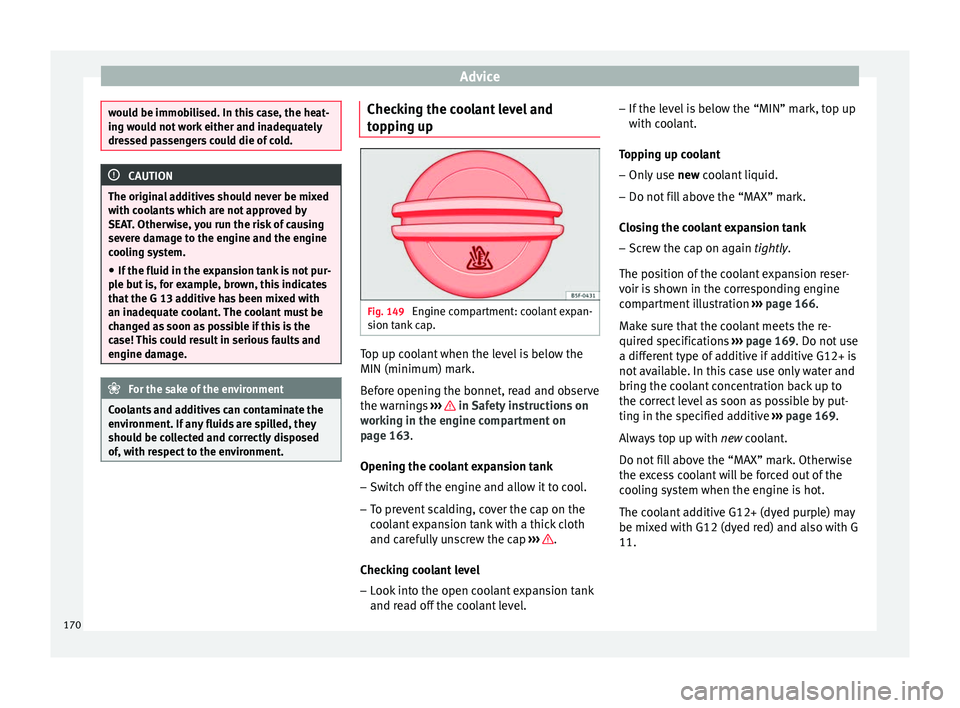
Fig. 149
Engine compartment: coolant expan-
sion tank cap. Top up coolant when the level is below the
MIN (minimum) mark.
Before opening the bonnet, read and observe
the warnings
››› in Safety instructions on
working in the engine compartment on
page 163 .
Openin g the c
oolant expansion tank
– Switch off the engine and allow it to cool.
– To prevent scalding, cover the cap on the
coolant expansion tank with a thick cloth
and carefully unscrew the cap ››› .
Checking coolant level
– Look into the open coolant expansion tank
and read off the coolant level. –
If the level is below the “MIN” mark, top up
with coolant.
Topping up coolant – Only use new coolant liquid.
– Do not fi
ll above the “MAX” mark.
Closing the coolant expansion tank – Screw the cap on again tightly.
The position of the coolant expansion reser-
voir is shown in the corresponding engine
compartment illustration ››› page 166.
Make sure that the coolant meets the re-
quired specifications ››› page 169. Do not use
a different type of additive if additive G12+ is
not available. In this case use only water and
bring the coolant concentration back up to
the correct level as soon as possible by put-
ting in the specified additive ››› page 169.
Always top up with new coolant.
Do not fi
ll above the “MAX” mark. Otherwise
the excess coolant will be forced out of the
cooling system when the engine is hot.
The coolant additive G12+ (dyed purple) may
be mixed with G12 (dyed red) and also with G
11.
170
Page 174 of 236
Advice
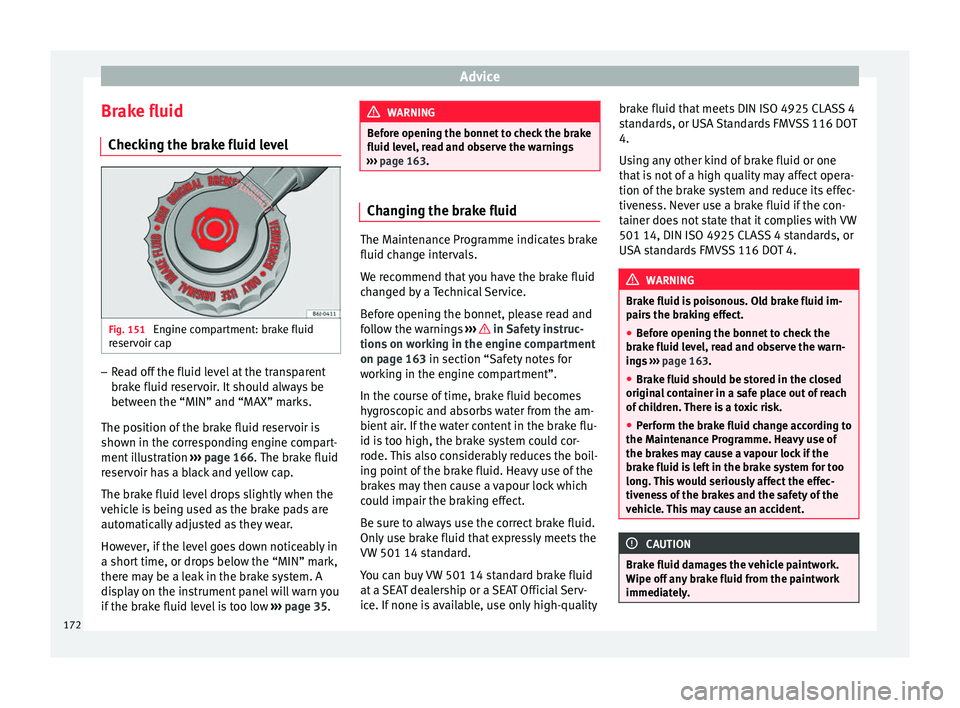
Brake fluid Checking the brake fluid level Fig. 151
Engine compartment: brake fluid
reservoir cap –
Read off the fluid level at the transparent
brake fluid reservoir. It should always be
between the “MIN” and “MAX” marks.
The position of the brake fluid reservoir is
shown in the corresponding engine compart-
ment illustration ››› page 166. The brake fluid
reservoir has a black and yellow cap.
The brake fluid level drops slightly when the
vehicle is being used as the brake pads are
automatically adjusted as they wear.
However, if the level goes down noticeably in
a short time, or drops below the “MIN” mark,
there may be a leak in the brake system. A
display on the instrument panel will warn you
if the brake fluid level is too low ››› page 35. WARNING
Before opening the bonnet to check the brake
fluid level, read and observe the warnings
››› page 163. Changing the brake fluid
The Maintenance Programme indicates brake
fluid change intervals.
We recommend that you have the brake fluid
changed by a Technical Service.
Before opening the bonnet, please read and
follow the warnings
››› in Safety instruc-
tions on working in the engine compartment
on page 163 in section “Safety notes for
w ork
ing in the engine compartment”.
In the course of time, brake fluid becomes
hygroscopic and absorbs water from the am-
bient air. If the water content in the brake flu-
id is too high, the brake system could cor-
rode. This also considerably reduces the boil-
ing point of the brake fluid. Heavy use of the
brakes may then cause a vapour lock which
could impair the braking effect.
Be sure to always use the correct brake fluid.
Only use brake fluid that expressly meets the
VW 501 14 standard.
You can buy VW 501 14 standard brake fluid
at a SEAT dealership or a SEAT Official Serv-
ice. If none is available, use only high-quality brake fluid that meets DIN ISO 4925 CLASS 4
standards, or USA Standards FMVSS 116 DOT
4.
Using any other kind of brake fluid or one
that is not of a high quality may affect opera-
tion of the brake system and reduce its effec-
tiveness. Never use a brake fluid if the con-
tainer does not state that it complies with VW
501 14, DIN ISO 4925 CLASS 4 standards, or
USA standards FMVSS 116 DOT 4.
WARNING
Brake fluid is poisonous. Old brake fluid im-
pairs the braking effect.
● Before opening the bonnet to check the
brake fluid level, read and observe the warn-
ings ››› page 163.
● Br ak
e fluid should be stored in the closed
original container in a safe place out of reach
of children. There is a toxic risk.
● Perform the brake fluid change according to
the Maintenance Programme. Heavy use of
the brakes may cause a vapour lock if the
brake fluid is left in the brake system for too
long. This would seriously affect the effec-
tiveness of the brakes and the safety of the
vehicle. This may cause an accident. CAUTION
Brake fluid damages the vehicle paintwork.
Wipe off any brake fluid from the paintwork
immediately. 172
Page 176 of 236
Advice
Checking the electrolyte level The electrolyte level should be checked regu-
larly in high-mileage vehicles, in hot coun-
tries and in older batteries.
– Open the bonnet and open the battery cov-
er at the front ››› in Safety instructions
on working in the engine compartment on
page 164 ››› in Warnings on handling
the battery on page 173.
– Check the colour display in the "magic eye"
on the top of the battery.
– If there are air bubbles in the window, tap
the window gently until they disperse.
The position of the battery is shown in the
corresponding engine compartment diagram
››› page 166 .
The “m agic
eye” indicator, located on the top
of the battery changes colour, depending on
the charge state and electrolyte level of the
battery.
There are two different colours:
● Black: correct charge status.
● Transparent/clear yellow: the battery must
be replaced. Contact a specialised workshop. Charging and changing the vehicle
battery The battery is maintenance-free and is
checked during the inspection service. All
work on the vehicle battery requires special-
ist knowledge.
If you often drive short distances or if the ve-
hicle is not driven for long periods, the bat-
tery should be checked by a specialised
workshop between the scheduled services.
If the battery has discharged and you have
problems starting the vehicle, the battery
might be damaged. If this happens, we rec-
ommend you have the vehicle battery
checked by a Technical Service where it will
be re-charged or replaced.
Charging the battery
The vehicle battery should be charged by a
specialised workshop only, as batteries us-
ing special technology have been installed
and they must be charged in a controlled en-
vironment.
Replacing a vehicle battery
The battery has been developed to suit the
conditions of its location and has special
safety features.
Genuine SEAT batteries meet the mainte-
nance, performance and safety specifications
of your vehicle. WARNING
● We recommend you use only maintenance-
free or cycle free leak-proof batteries which
comply with standards T 825 06 and
VW 7 50 73. This standard applies as of
2001.
● Before starting any work on the batteries,
you must read and observe the warnings
››› in Warnings on handling the battery on
page 173. For the sake of the environment
Batteries contain toxic substances such as
sulphuric acid and lead. They must be dis-
posed of appropriately and must not be dis-
posed of with ordinary household waste. 174
Page 200 of 236
AdviceColourAmp rating
Orange40
Opening and closing the fuse box situated
below the dash panel
●
Opening: fold the cover down ››
› Fig. 173.
● Closing:
push back the cover it in until it
clicks into place.
To open the engine compartment fuse box
● Open the bonnet ›››
page 163.
● Press the locking tabs in the direction indi-
cated by the arrows to release the fuse box
cover ›››
Fig. 174.
● Then lif t
the cover out.
● To
fit the cover, place it on the fuse box.
Push the locking tabs down, in the opposite
direction to that indicated by the arrows, un-
til you hear them click into place. CAUTION
● Always carefully remove the fuse box cov-
ers and refit them correctly to avoid problems
with your vehicle.
● Protect the fuse boxes when open to avoid
the entry of dust or humidity. Dirt and humid-
ity inside fuse boxes can cause damage to
the electrical system. Note
In the vehicle, there are more fuses than
those indicated in this chapter. These should
only be changed by a specialised workshop. Replacing a blown fuse
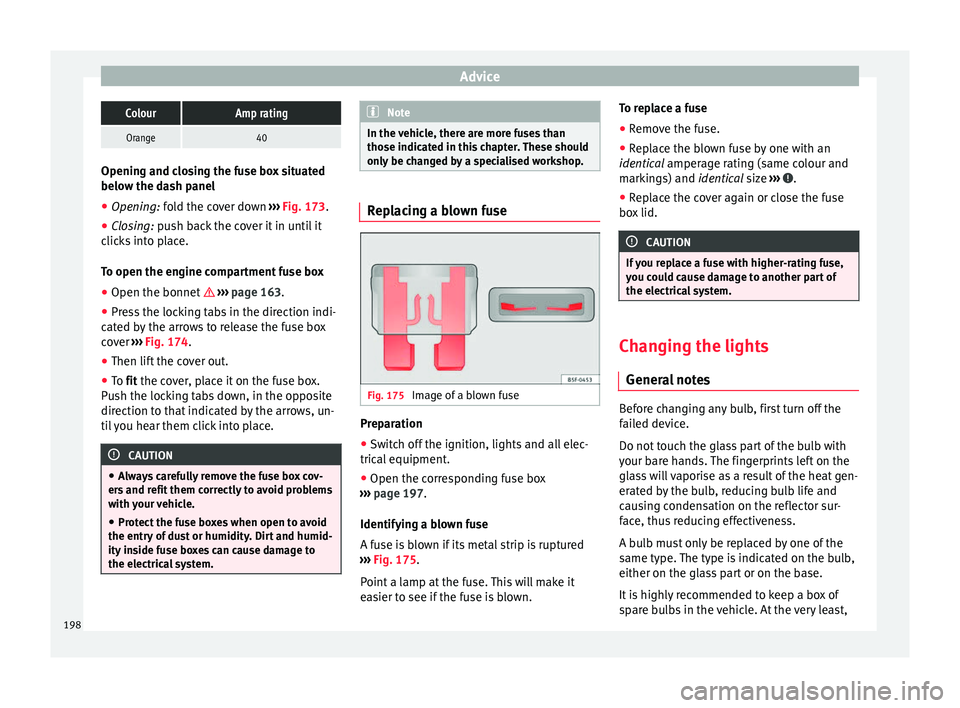
Fig. 175
Image of a blown fuse Preparation
● Switch off the ignition, lights and all elec-
trical equipment.
● Open the corresponding fuse box
››› page 197 .
Identif y
ing a blown fuse
A fuse is blown if its metal strip is ruptured
››› Fig. 175
.
Point a lamp at the fuse. This will make it
easier to see if the fuse is blown. To replace a fuse
● Remove the fuse.
● Replace the blown fuse by one with an
identical amperage rating (same colour and
mark
ings) and identical size ››› .
● Replace the cover again or close the fuse
box lid. CAUTION
If you replace a fuse with higher-rating fuse,
you could cause damage to another part of
the electrical system. Changing the lights
General notes Before changing any bulb, first turn off the
failed device.
Do not touch the glass part of the bulb with
your bare hands. The fingerprints left on the
glass will vaporise as a result of the heat gen-
erated by the bulb, reducing bulb life and
causing condensation on the reflector sur-
face, thus reducing effectiveness.
A bulb must only be replaced by one of the
same type. The type is indicated on the bulb,
either on the glass part or on the base.
It is highly recommended to keep a box of
spare bulbs in the vehicle. At the very least,
198
Page 225 of 236
Index
Index
A
ABS . . . . . . . . . . . . . . . . . . . . . . . . . . . . . . . . . . . . 136 control lamp . . . . . . . . . . . . . . . . . . . . . . . . . . . . 41
Accessories . . . . . . . . . . . . . . . . . . . . . . . . . . . . . . 147
Acoustic warning . . . . . . . . . . . . . . . . . . . . . . . . . 120
Adaptive headlights . . . . . . . . . . . . . . . . . . . . . . . . 80
Adjusting the seat belt height . . . . . . . . . . . . . . . . 16
AFS (cornering lights) . . . . . . . . . . . . . . . . . . . . . . 80
Airbag covers . . . . . . . . . . . . . . . . . . . . . . . . . . . . . 20
Airbags description . . . . . . . . . . . . . . . . . . . . . . . . . . . . . 18
Airbag system . . . . . . . . . . . . . . . . . . . . . . . . . . 17, 20 activation . . . . . . . . . . . . . . . . . . . . . . . . . . . . . . 18
control lamp . . . . . . . . . . . . . . . . . . . . . . . . . . . . 19
functioning . . . . . . . . . . . . . . . . . . . . . . . . . . . . . 18
head-protection airbags . . . . . . . . . . . . . . . . . . 22
side airbags . . . . . . . . . . . . . . . . . . . . . . . . . . . . 21
Air conditioner 2C-Climatronic . . . . . . . . . . . . . . . . . . . . . . . . . 112
General notes . . . . . . . . . . . . . . . . . . . . . . . . . . 116
Air conditioner automatic mode 2C-Climatronic . . . . . . . . . . . . . . . . . . . . . . . . . 113
Air conditioning . . . . . . . . . . . . . . . . . . . . . . . . . . 109
Air recirculation mode 2C-Climatronic . . . . . . . . . . . . . . . . . . . . . . . . . 115
Manual air conditioner . . . . . . . . . . . . . . . . . . . 111
Alarm system Switching off . . . . . . . . . . . . . . . . . . . . . . . . . . . . 69
Alcantara . . . . . . . . . . . . . . . . . . . . . . . . . . . . . . . . 154
All-wheel drive . . . . . . . . . . . . . . . . . . . . . . . . . . . 117
Alternator Warning lamp . . . . . . . . . . . . . . . . . . . . . . . . . . . 42
Anti-lock brake system . . . . . . . . . . . . . . . . . . . . . 136 control lamp . . . . . . . . . . . . . . . . . . . . . . . . . . . . 41 Anti-theft alarm system . . . . . . . . . . . . . . . . . . . . . 68
Interior monitoring . . . . . . . . . . . . . . . . . . . . . . . 70
Switching off . . . . . . . . . . . . . . . . . . . . . . . . . . . . 69
Tow-away protection . . . . . . . . . . . . . . . . . . . . . . 70
Anti-theft wheel bolts . . . . . . . . . . . . . . . . . . . . . 184
Antifreeze . . . . . . . . . . . . . . . . . . . . . . . . . . . . . . . 169
Aquaplaning . . . . . . . . . . . . . . . . . . . . . . . . . . . . . 177
Ashtray . . . . . . . . . . . . . . . . . . . . . . . . . . . . . . . . . . 98
Aspects to note before setting off . . . . . . . . . . . . . . 5
ASR . . . . . . . . . . . . . . . . . . . . . . . . . . . . . . . . . . . . 137 Control lamp . . . . . . . . . . . . . . . . . . . . . . . . . . . . 46
Audible warning . . . . . . . . . . . . . . . . . . . . . . . . . . . 12
Automatic anti-dazzle interior rear vision mirror Activating the anti-dazzle function . . . . . . . . . . 86
Deactivating the anti-dazzle function . . . . . . . . 86
Automatic car wash tunnel . . . . . . . . . . . . . . . . . 149
Automatic gearbox Kick-down feature . . . . . . . . . . . . . . . . . . . . . . . 130
Automatic gearbox/DSG automatic gearbox . . . 127
Automatic lighting . . . . . . . . . . . . . . . . . . . . . . . . . 76
Automatic windscreen wiping . . . . . . . . . . . . . . . . 84
Automatic wipe with rain sensor . . . . . . . . . . . . . . 84
Auxiliary audio input: AUX-IN . . . . . . . . . . . . . . . . 99
B Ball coupling . . . . . . . . . . . . . . . . . . . . . . . . . . . . . 145
Battery . . . . . . . . . . . . . . . . . . . . . . . . . . . . . . . . . . . 68 Changing . . . . . . . . . . . . . . . . . . . . . . . . . . . . . . 174
Charging . . . . . . . . . . . . . . . . . . . . . . . . . . . . . . 174
Winter conditions . . . . . . . . . . . . . . . . . . . . . . . 173
Before setting off . . . . . . . . . . . . . . . . . . . . . . . . . . . 5
Belt tightening . . . . . . . . . . . . . . . . . . . . . . . . . . . . 16
Biodiesel . . . . . . . . . . . . . . . . . . . . . . . . . . . . . . . . 160
Biodiesel fuel . . . . . . . . . . . . . . . . . . . . . . . . . . . . 160
Bonnet . . . . . . . . . . . . . . . . . . . . . . . . . . . . . . . . . 165 Boot hatch . . . . . . . . . . . . . . . . . . . . . . . . . . . . . . . 71
control lamp . . . . . . . . . . . . . . . . . . . . . . . . . . . . 45
Emergency opening . . . . . . . . . . . . . . . . . . . . . 194
Boot lid . . . . . . . . . . . . . . . . . . . . . . . . . . . . . . . . . . 71 Emergency opening . . . . . . . . . . . . . . . . . . . . . 194
Brake fluid . . . . . . . . . . . . . . . . . . . . . . . . . . . . . . 172 Changing . . . . . . . . . . . . . . . . . . . . . . . . . . . . . . 172
control lamp . . . . . . . . . . . . . . . . . . . . . . . . . . . . 49
Brake pads . . . . . . . . . . . . . . . . . . . . . . . . . . . . . . 123
Brake pedal Control lamp . . . . . . . . . . . . . . . . . . . . . . . . . . . . 46
Brakes . . . . . . . . . . . . . . . . . . . . . . . . . . . . . . . . . . 123 Worn brake pads . . . . . . . . . . . . . . . . . . . . . . . . . 42
Brake servo . . . . . . . . . . . . . . . . . . . . . . . . . 123, 138
Brake system . . . . . . . . . . . . . . . . . . . . . . . . . . . . 172 Brakes . . . . . . . . . . . . . . . . . . . . . . . . . . . . . . . . 123
Brake servo . . . . . . . . . . . . . . . . . . . . . . . . . . . . 123
warning lamp . . . . . . . . . . . . . . . . . . . . . . . . . . . 44
Bulb defect Control lamp . . . . . . . . . . . . . . . . . . . . . . . . . . . . 44
Buzzer . . . . . . . . . . . . . . . . . . . . . . . . . . . . . . 77, 120
C
Car care Exterior . . . . . . . . . . . . . . . . . . . . . . . . . . . . . . . 149
Car care products . . . . . . . . . . . . . . . . . . . . . . . . . 148
Catalytic converter . . . . . . . . . . . . . . . . . . . . . . . . 131
CCS . . . . . . . . . . . . . . . . . . . . . . . . . . . . . . . . . . . . 142
CD changer . . . . . . . . . . . . . . . . . . . . . . . . . . . . . . . 93
Central lock button Locking . . . . . . . . . . . . . . . . . . . . . . . . . . . . . . . . 65
Unlocking . . . . . . . . . . . . . . . . . . . . . . . . . . . . . . 65
Central locking . . . . . . . . . . . . . . . . . . . . . . . . . . . . 63 Automatic locking system for involuntary un-locking . . . . . . . . . . . . . . . . . . . . . . . . . . . . . . . 65
Automatic speed-dependent locking and un- locking system . . . . . . . . . . . . . . . . . . . . . . . . 64
223