change time Seat Altea 2015 Owner's Guide
[x] Cancel search | Manufacturer: SEAT, Model Year: 2015, Model line: Altea, Model: Seat Altea 2015Pages: 236, PDF Size: 4.23 MB
Page 174 of 236
Advice
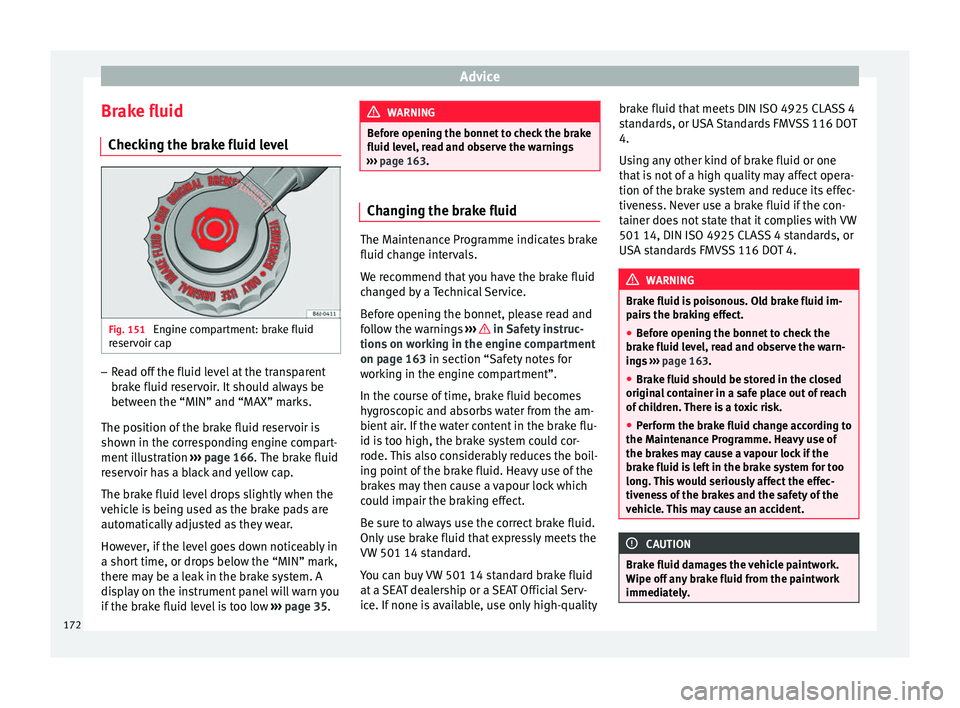
Brake fluid Checking the brake fluid level Fig. 151
Engine compartment: brake fluid
reservoir cap –
Read off the fluid level at the transparent
brake fluid reservoir. It should always be
between the “MIN” and “MAX” marks.
The position of the brake fluid reservoir is
shown in the corresponding engine compart-
ment illustration ››› page 166. The brake fluid
reservoir has a black and yellow cap.
The brake fluid level drops slightly when the
vehicle is being used as the brake pads are
automatically adjusted as they wear.
However, if the level goes down noticeably in
a short time, or drops below the “MIN” mark,
there may be a leak in the brake system. A
display on the instrument panel will warn you
if the brake fluid level is too low ››› page 35. WARNING
Before opening the bonnet to check the brake
fluid level, read and observe the warnings
››› page 163. Changing the brake fluid
The Maintenance Programme indicates brake
fluid change intervals.
We recommend that you have the brake fluid
changed by a Technical Service.
Before opening the bonnet, please read and
follow the warnings
››› in Safety instruc-
tions on working in the engine compartment
on page 163 in section “Safety notes for
w ork
ing in the engine compartment”.
In the course of time, brake fluid becomes
hygroscopic and absorbs water from the am-
bient air. If the water content in the brake flu-
id is too high, the brake system could cor-
rode. This also considerably reduces the boil-
ing point of the brake fluid. Heavy use of the
brakes may then cause a vapour lock which
could impair the braking effect.
Be sure to always use the correct brake fluid.
Only use brake fluid that expressly meets the
VW 501 14 standard.
You can buy VW 501 14 standard brake fluid
at a SEAT dealership or a SEAT Official Serv-
ice. If none is available, use only high-quality brake fluid that meets DIN ISO 4925 CLASS 4
standards, or USA Standards FMVSS 116 DOT
4.
Using any other kind of brake fluid or one
that is not of a high quality may affect opera-
tion of the brake system and reduce its effec-
tiveness. Never use a brake fluid if the con-
tainer does not state that it complies with VW
501 14, DIN ISO 4925 CLASS 4 standards, or
USA standards FMVSS 116 DOT 4.
WARNING
Brake fluid is poisonous. Old brake fluid im-
pairs the braking effect.
● Before opening the bonnet to check the
brake fluid level, read and observe the warn-
ings ››› page 163.
● Br ak
e fluid should be stored in the closed
original container in a safe place out of reach
of children. There is a toxic risk.
● Perform the brake fluid change according to
the Maintenance Programme. Heavy use of
the brakes may cause a vapour lock if the
brake fluid is left in the brake system for too
long. This would seriously affect the effec-
tiveness of the brakes and the safety of the
vehicle. This may cause an accident. CAUTION
Brake fluid damages the vehicle paintwork.
Wipe off any brake fluid from the paintwork
immediately. 172
Page 175 of 236
Checking and refilling levels
For the sake of the environment
The brake pads and brake fluid must be col-
lected and disposed of according the applica-
ble regulations. The SEAT Technical Service
network has the necessary equipment and
qualified personnel for collecting and dispos-
ing of this waste material. Vehicle battery
Warnings on handling the battery Wear eye protection
Battery acid is extremely corrosive. Wear pro-
tective gloves and eye protection!
Fires, sparks, open flames and smoking are
prohibited!
A highly explosive mixture of gases is released
when the battery is under charge.
Keep children away from acid and batteries!
WARNING
Always be aware of the danger of injury and
chemical burns as well as the risk of accident
or fire when working on the battery and the
electrical system:
● Wear eye protection. Protect your eyes,
skin and clothing from acid and particles con-
taining lead. ●
Battery acid is extremely corrosive. Wear
protective gloves and eye protection. Do not
tilt the batteries. This could spill acid through
the vents. Rinse battery acid from eyes imme-
diately for several minutes with clear water.
Then seek medical care immediately. Neutral-
ise any acid splashes on the skin or clothing
with a soapy solution, and rinse off with plen-
ty of water. If acid is swallowed by mistake,
consult a doctor immediately.
● Fires, sparks, open flames and smoking are
prohibited. When handling cables and electri-
cal equipment, avoid causing sparks and
electrostatic charge. Never short the battery
terminals. High-energy sparks can cause in-
jury.
● A highly explosive mixture of gases is re-
leased when the battery is under charge. The
batteries should be charged in a well-ventila-
ted room only.
● Keep children away from acid and batteries.
● Before working on the electrical system,
you must switch off the engine, the ignition
and all electrical devices. The negative cable
on the battery must be disconnected. When a
light bulb is changed, you need only switch
off the light.
● Deactivate the anti-theft alarm by unlock-
ing the vehicle before you disconnect the bat-
tery! The alarm will otherwise be triggered.
● When disconnecting the battery from the
vehicle on-board network, disconnect first
the negative cable and then the positive ca-
ble. ●
Switch off all electrical devices before re-
connecting the battery. Reconnect first the
positive cable and then the negative cable.
Never reverse the polarity of the connections.
This could cause an electrical fire.
● Never charge a frozen battery, or one which
has thawed. This could result in explosions
and chemical burns. Always replace a battery
which has frozen. A flat battery can also
freeze at temperatures close to 0 °C (+32 °F).
● Ensure that the vent hose is always connec-
ted to the battery.
● Never use a defective battery. This could
cause an explosion. Replace a damaged bat-
tery immediately. CAUTION
● Never disconnect the battery if the ignition
is switched on or if the engine is running.
This could damage the electrical system or
electronic components.
● Do not expose the battery to direct sunlight
over a long period of time, as the intense ul-
traviolet radiation can damage the battery
housing.
● If the vehicle is left standing in cold condi-
tions for a long period, protect the battery
from “freezing”. If it freezes it will be dam-
aged. 173
Technical specifications
Advice
Operation
Safety
Page 179 of 236
Wheels
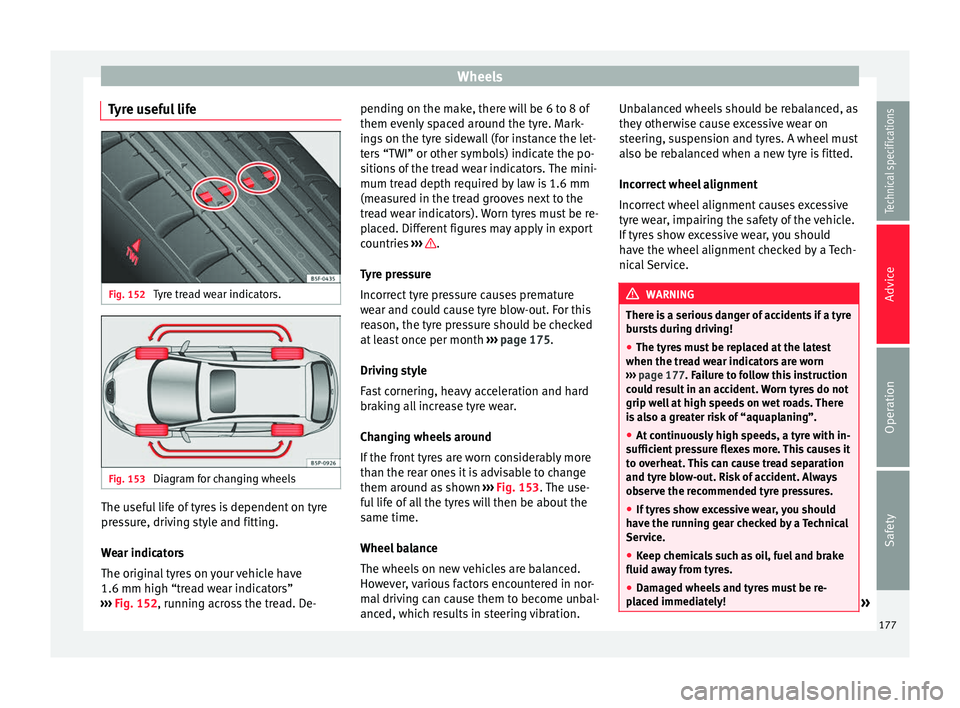
Tyre useful life Fig. 152
Tyre tread wear indicators. Fig. 153
Diagram for changing wheels The useful life of tyres is dependent on tyre
pressure, driving style and fitting.
Wear indicators
The original tyres on your vehicle have
1.6 mm high “tread wear indicators”
››› Fig. 152 , running across the tread. De- pendin
g on the m ake, there will be 6 to 8 of
them evenly spaced around the tyre. Mark-
ings on the tyre sidewall (for instance the let-
ters “TWI” or other symbols) indicate the po-
sitions of the tread wear indicators. The mini-
mum tread depth required by law is 1.6 mm
(measured in the tread grooves next to the
tread wear indicators). Worn tyres must be re-
placed. Different figures may apply in export
countries ››› .
Tyre pressure
Incorrect tyre pressure causes premature
wear and could cause tyre blow-out. For this
reason, the tyre pressure should be checked
at least once per month ››› page 175.
Driving style
Fast cornering, heavy acceleration and hard
braking all increase tyre wear.
Changing wheels around
If the front tyres are worn considerably more
than the rear ones it is advisable to change
them around as shown ››› Fig. 153 . The use-
f u
l life of all the tyres will then be about the
same time.
Wheel balance
The wheels on new vehicles are balanced.
However, various factors encountered in nor-
mal driving can cause them to become unbal-
anced, which results in steering vibration. Unbalanced wheels should be rebalanced, as
they otherwise cause excessive wear on
steering, suspension and tyres. A wheel must
also be rebalanced when a new tyre is fitted.
Incorrect wheel alignment
Incorrect wheel alignment causes excessive
tyre wear, impairing the safety of the vehicle.
If tyres show excessive wear, you should
have the wheel alignment checked by a Tech-
nical Service.
WARNING
There is a serious danger of accidents if a tyre
bursts during driving!
● The tyres must be replaced at the latest
when the tread wear indicators are worn
››› page 177. Failure to follow this instruction
could result in an accident. Worn tyres do not
grip well at high speeds on wet roads. There
is also a greater risk of “aquaplaning”.
● At continuously high speeds, a tyre with in-
sufficient pressure flexes more. This causes it
to overheat. This can cause tread separation
and tyre blow-out. Risk of accident. Always
observe the recommended tyre pressures.
● If tyres show excessive wear, you should
have the running gear checked by a Technical
Service.
● Keep chemicals such as oil, fuel and brake
fluid away from tyres.
● Damaged wheels and tyres must be re-
placed immediately! » 177
Technical specifications
Advice
Operation
Safety
Page 182 of 236
Advice
For the sake of the environment
Old tyres must be disposed of according to
the laws in the country concerned. Note
● For technical reasons, it is not generally
possible to use the wheels from other vehi-
cles. This can also apply to wheels of the
same model. The use of wheels or tyres
which have not been approved by SEAT for
use with your model may invalidate the vehi-
cle's type approval for use on public roads.
● If the spare tyre is not the same as the
tyres that are mounted on the vehicle (e.g.
winter tyres) you should only use the spare
tyre for a short period of time and drive with
extra care. Refit the normal road wheel as
soon as possible. Wheel bolts
The design of wheel bolts is matched to the
rims. If different wheel rims are fitted, the
correct wheel bolts with the right length and
correctly shaped bolt heads must be used.
This ensures that wheels are fitted securely
and that the brake system functions correctly.
In certain circumstances, you should not use
wheel bolts from a different vehicle, even if it
is the same model
›››
page 147. After the wheels have been changed, the
tightening torque of the wheel bolts should
be checked as soon as possible with a torque
wrench
››› . The tightening torque for steel
and alloy wheels is 120 Nm. WARNING
If the wheel bolts are not tightened correctly,
the wheel could become loose while driving.
Risk of accident.
● The wheel bolts must be clean and turn
easily. Never apply grease or oil to them.
● Use only wheel bolts which belong to the
wheel.
● If the tightening torque of the wheel bolts
is too low, they could loosen whilst the vehi-
cle is in motion. Risk of accident! If the tight-
ening torque is too high, the wheel bolts and
threads can be damaged. CAUTION
The prescribed tightening torque for wheel
bolts for steel and alloy wheels is 120 Nm. Winter service
Winter tyres In winter conditions winter tyres will consid-
erably improve the vehicle's handling. Sum-mer tyres (width, rubber compound, tread
pattern) provide less grip on ice and snow.
Winter tyres must be inflated to a
pressure of
0.2 bar (2.9 psi/20 kPa) higher than the pres-
sures specified for summer tyres (see sticker
on fuel tank flap).
Winter tyres must be fitted on all four wheels.
Information on permitted winter tyre sizes
can be found in the vehicle's registration
documentation. Use only radial winter tyres.
All tyre sizes listed in the vehicle documenta-
tion also apply to winter tyres.
Winter tyres lose their effectiveness when the
tread is worn down to a depth of 4 mm.
The speed rating code ››› page 179, New
tyres and wheels determines the following
speed limits for winter tyres:
›
› › max. 160 km/h
max. 180 km/h
max. 190 km/h
max. 210 km/h
In some countries, vehicles which can exceed
the speed rating of the fitted tyre must have
an appropriate sticker in the driver's field of
view. These stickers are available from your
technical service. The legal requirements of
each country must be followed.
Do not have winter tyres fitted for unnecessa-
rily long periods. Vehicles with summer tyres Q
S
T
H
180
Page 184 of 236
Advice
●
Never start the engine when the vehicle is
on the jack. Risk of accident.
● If work is to be carried out underneath the
vehicle, this must be secured by suitable
stands. Otherwise, there is a risk of injury. Note
The jack does not generally require any main-
tenance. If required, it should be greased us-
ing universal-type grease. Compact spare wheel* (temporary
spare wheel)
Fig. 154
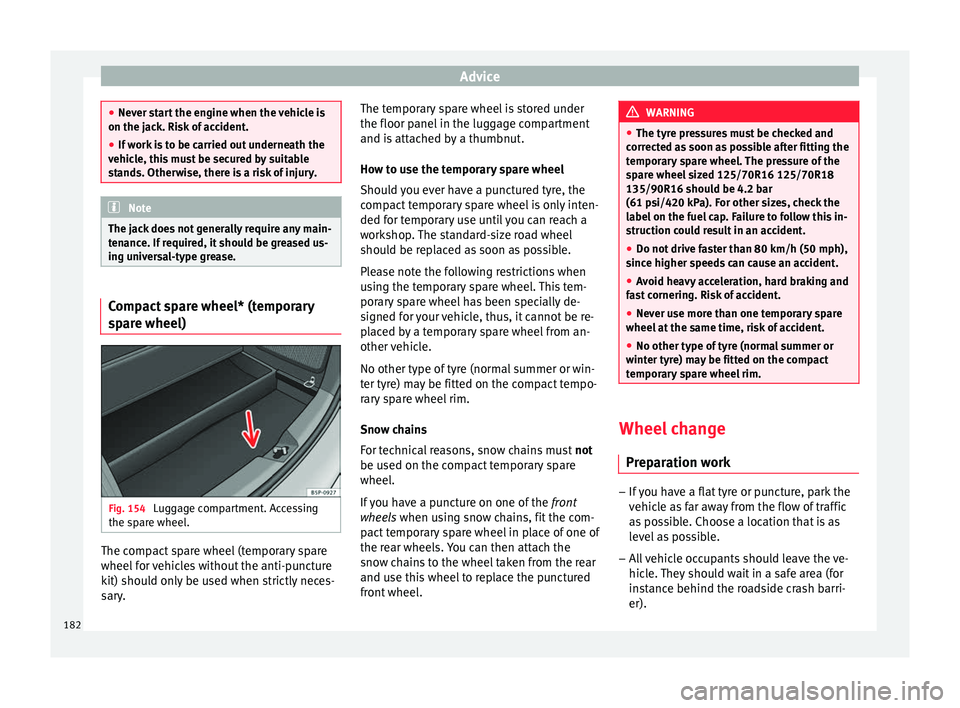
Luggage compartment. Accessing
the spare wheel. The compact spare wheel (temporary spare
wheel for vehicles without the anti-puncture
kit) should only be used when strictly neces-
sary. The temporary spare wheel is stored under
the floor panel in the luggage compartment
and is attached by a thumbnut.
How to use the temporary spare wheel
Should you ever have a punctured tyre, the
compact temporary spare wheel is only inten-
ded for temporary use until you can reach a
workshop. The standard-size road wheel
should be replaced as soon as possible.
Please note the following restrictions when
using the temporary spare wheel. This tem-
porary spare wheel has been specially de-
signed for your vehicle, thus, it cannot be re-
placed by a temporary spare wheel from an-
other vehicle.
No other type of tyre (normal summer or win-
ter tyre) may be fitted on the compact tempo-
rary spare wheel rim.
Snow chains
For technical reasons, snow chains must
not
be used on the compact temporary spare
wheel.
If you have a puncture on one of the front
wheels when using snow chains, fit the com-
p act
temporary spare wheel in place of one of
the rear wheels. You can then attach the
snow chains to the wheel taken from the rear
and use this wheel to replace the punctured
front wheel. WARNING
● The tyre pressures must be checked and
corrected as soon as possible after fitting the
temporary spare wheel. The pressure of the
spare wheel sized 125/70R16 125/70R18
135/90R16 should be 4.2 bar
(61 psi/420 kPa). For other sizes, check the
label on the fuel cap. Failure to follow this in-
struction could result in an accident.
● Do not drive faster than 80 km/h (50 mph),
since higher speeds can cause an accident.
● Avoid heavy acceleration, hard braking and
fast cornering. Risk of accident.
● Never use more than one temporary spare
wheel at the same time, risk of accident.
● No other type of tyre (normal summer or
winter tyre) may be fitted on the compact
temporary spare wheel rim. Wheel change
Preparation work –
If you have a flat tyre or puncture, park the
vehicle as far away from the flow of traffic
as possible. Choose a location that is as
level as possible.
– All vehicle occupants should leave the ve-
hicle. They should wait in a safe area (for
instance behind the roadside crash barri-
er).
182
Page 193 of 236
Emergencies
after the battery has thawed, battery acid
could leak and cause chemical burns. If a bat-
tery freezes, it should be replaced.
●
Keep sparks, flames and lighted cigarettes
away from batteries, danger of explosion.
Failure to comply could result in an explo-
sion.
● Observe the instructions provided by the
manufacturer of the jump leads.
● Do not connect the negative cable from the
other vehicle directly to the negative terminal
of the flat battery. The gas emitted from the
battery could be ignited by sparks. Danger of
explosion.
● Do not attach the negative cable from the
other vehicle to parts of the fuel system or to
the brake line.
● The non-insulated parts of the battery
clamps must not be allowed to touch. The
jump lead attached to the positive battery
terminal must not touch metal parts of the ve-
hicle, this can cause a short circuit.
● Position the leads in such a way that they
cannot come into contact with any moving
parts in the engine compartment.
● Do not lean on the batteries. This could re-
sult in chemical burns. Note
The vehicles must not touch each other, oth-
erwise electricity could flow as soon as the
positive terminals are connected. Towing and tow-starting
Tow-starting We recommend that you do
not tow-start your
v ehic
le. Jump-starting is preferable
››› page 189.
How
ever, if your vehicle has to be tow-
started:
– Engage 2 nd
or 3 rd
gear.
– Keep the clutch pressed down.
– Switch the ignition on.
– Once both vehicles are moving, release the
clutch.
– As soon as the engine starts, press the
clutch and move the gear lever into neutral.
This helps to prevent driving into the tow-
ing vehicle. WARNING
The risk of accidents is high when tow-start-
ing. The vehicle being towed can easily col-
lide with the towing vehicle. CAUTION
When tow-starting, fuel could enter the cata-
lytic converter and damage it. General notes
Please observe the following points if you
use a tow rope:
Notes for the driver of the towing vehicle
– Drive slowly at first until the tow rope is
taut. Then accelerate gradually.
– Begin and change gears cautiously. If you
are driving an automatic vehicle, accelerate
gently.
– Remember that the brake servo and power
steering are not working in the vehicle you
are towing. Brake sooner than normal and
pressing the pedal gently.
Notes for the driver of the towed vehicle
– Ensure that the tow rope remains taut at all
times when towing.
Tow rope or tow bar
It is easier and safer for the vehicle to be tow-
ed using a tow bar. You should only use a
tow-rope if you do not have a tow-bar.
A tow rope should be slightly elastic to re-
duce the loading on both vehicles. It is advis-
able to use a tow rope made of synthetic fi-
bre or similarly elastic material.
Attach the tow rope or the tow bar only to the
towline anchorages provided or a towing
bracket. »
191Technical specifications
Advice
Operation
Safety
Page 198 of 236
Advice
Changing the rear wiper blade 3 Applies to the model: ALTEA XL/ALTEA FREETRACK
Fig. 172
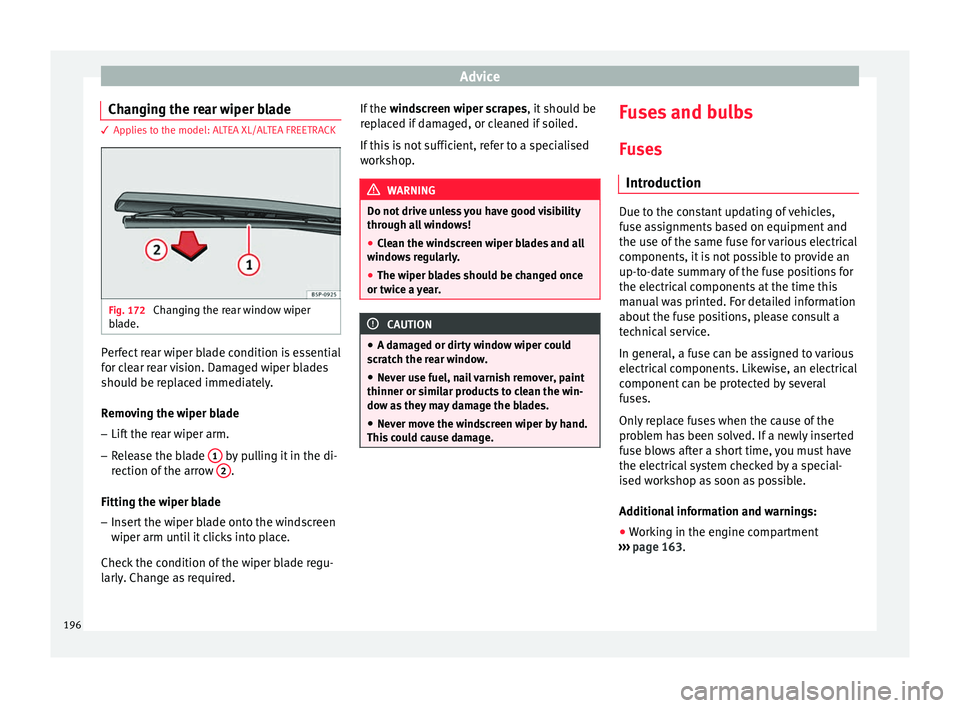
Changing the rear window wiper
blade. Perfect rear wiper blade condition is essential
for clear rear vision. Damaged wiper blades
should be replaced immediately.
Removing the wiper blade
– Lift the rear wiper arm.
– Release the blade 1 by pulling it in the di-
rection of the arrow 2 .
Fitting the wiper blade – Insert the wiper blade onto the windscreen
wiper arm until it clicks into place.
Check the condition of the wiper blade regu-
larly. Change as required. If the
windscreen wiper scrapes, it should be
replaced if damaged, or cleaned if soiled.
If this is not sufficient, refer to a specialised
workshop. WARNING
Do not drive unless you have good visibility
through all windows!
● Clean the windscreen wiper blades and all
windows regularly.
● The wiper blades should be changed once
or twice a year. CAUTION
● A damaged or dirty window wiper could
scratch the rear window.
● Never use fuel, nail varnish remover, paint
thinner or similar products to clean the win-
dow as they may damage the blades.
● Never move the windscreen wiper by hand.
This could cause damage. Fuses and bulbs
Fuses Introduction Due to the constant updating of vehicles,
fuse assignments based on equipment and
the use of the same fuse for various electrical
components, it is not possible to provide an
up-to-date summary of the fuse positions for
the electrical components at the time this
manual was printed. For detailed information
about the fuse positions, please consult a
technical service.
In general, a fuse can be assigned to various
electrical components. Likewise, an electrical
component can be protected by several
fuses.
Only replace fuses when the cause of the
problem has been solved. If a newly inserted
fuse blows after a short time, you must have
the electrical system checked by a special-
ised workshop as soon as possible.
Additional information and warnings:
● Working in the engine compartment
››› page 163 .
196
Page 201 of 236
Fuses and bulbs
the following spare bulbs, which are essen-
tial for road safety, should be kept in the ve-
hicle.
Main headlights - H7
- H1
- W5W - PY21W
Xenon headlights 1)
/adaptive*
- D1S 2)
- P21W SLL
- W5W - PY21W
Front fog light - H3
Dipped beam
Main beam
Position
Turn signal
Dipped and full beam
Daylight
Position
Turn signals
Front fog light Upper tail light (ALTEA)
- P21W3)
- R10W
Lower tail light (ALTEA) - P21W- P21W
Fixed tail light (ALTEA XL / ALTEA FREETRACK) - P21W3)
- P21W
Mobile tail light (ALTEA XL / ALTEA
FREETRACK) - P21W- P21W
- W5W
Stop/Position
Turn signal
Fog light
Reverse light
Stop/Position
Turn signal
Fog light (driver side)
Reverse (passenger side)
Position Side turn signal
- W5W
Number plate light - C5W Note
● Depending on weather conditions (cold or
wet), the headlights, the fog lights, the tail
lights and the turn signals may be temporari-
ly misted. This has no influence on the useful
life of the lighting system. By switching on
the lights, the area through which the beam
of light is projected will quickly be demisted.
However, the edges may continue to be mis-
ted.
● Please check at regular intervals that all
lighting (especially the exterior lighting) on
your vehicle is functioning properly. This is » Side turn signal
Number plate light
1)
On this type of headlight, the bulb changes must
be made by the technical service, given that complex
elements must be removed from the vehicle and the
incorporated automatic control system must be re-
set.
2) The Xenon bulbs discharge 2.5 times the light flux
and have an average lifespan of 5 times more than
that of halogen bulbs, this means that, except due to
unusual circumstances, there is no need to change
the bulbs for the whole life of the vehicle.
3) Electronically controlled single filament bulb for
Stop/side bulbs. If the bulb blows it will not work in
either position or Stop. 199Technical specifications
Advice
Operation
Safety
Page 202 of 236
Advice
not only in the interest of your own safety,
but also that of all other road users.
● Due to difficulty of access to some of the
bulbs, any replacement work should be done
by a technical service. However, the following
is a description of how to change the lamps
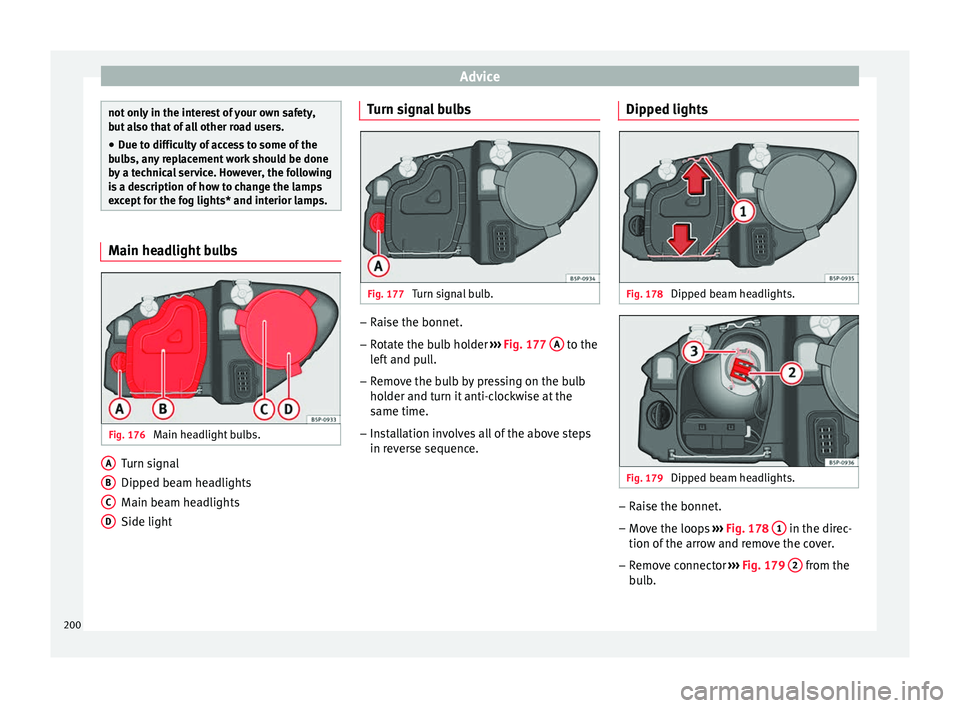
except for the fog lights* and interior lamps. Main headlight bulbs
Fig. 176
Main headlight bulbs. Turn signal
Dipped beam headlights
Main beam headlights
Side light
A B
C
D Turn signal bulbs
Fig. 177
Turn signal bulb. –
Raise the bonnet.
– Rotate the bulb holder ››› Fig. 177 A to the
left and pull.
– Remove the bulb by pressing on the bulb
holder and turn it anti-clockwise at the
same time.
– Installation involves all of the above steps
in reverse sequence. Dipped lights Fig. 178
Dipped beam headlights. Fig. 179
Dipped beam headlights. –
Raise the bonnet.
– Move the loops ››› Fig. 178 1 in the direc-
tion of the arrow and remove the cover.
– Remove connector ››› Fig. 179 2 from the
bulb.
200
Page 205 of 236
Fuses and bulbs
– Pull out the turn signal bulb holder using a
screw driver in the direction of the arrow
››› Fig. 187 .
– Fit the r
eplacement bulb by pressing it
down and rotating to the left.
– Installation involves all of the above steps
in reverse sequence.
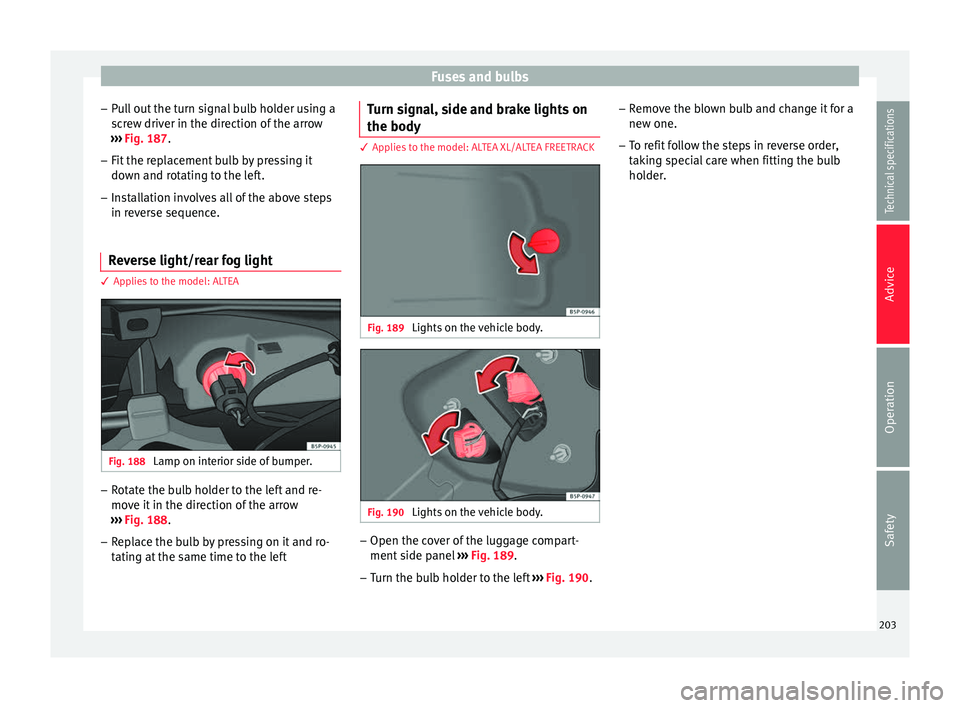
Reverse light/rear fog light 3 Applies to the model: ALTEA
Fig. 188
Lamp on interior side of bumper. –
Rotate the bulb holder to the left and re-
move it in the direction of the arrow
››› Fig. 188.
– Replace the bulb by pressing on it and ro-
tating at the same time to the left Turn signal, side and brake lights on
the body 3 Applies to the model: ALTEA XL/ALTEA FREETRACK
Fig. 189
Lights on the vehicle body. Fig. 190
Lights on the vehicle body. –
Open the cover of the luggage compart-
ment side panel ››› Fig. 189 .
– Turn the b
ulb holder to the left ››› Fig. 190. –
Remove the blown bulb and change it for a
new one.
– To refit follow the steps in reverse order,
taking special care when fitting the bulb
holder.
203
Technical specifications
Advice
Operation
Safety