oil Seat Altea 2015 Owner's Guide
[x] Cancel search | Manufacturer: SEAT, Model Year: 2015, Model line: Altea, Model: Seat Altea 2015Pages: 236, PDF Size: 4.23 MB
Page 168 of 236
Advice
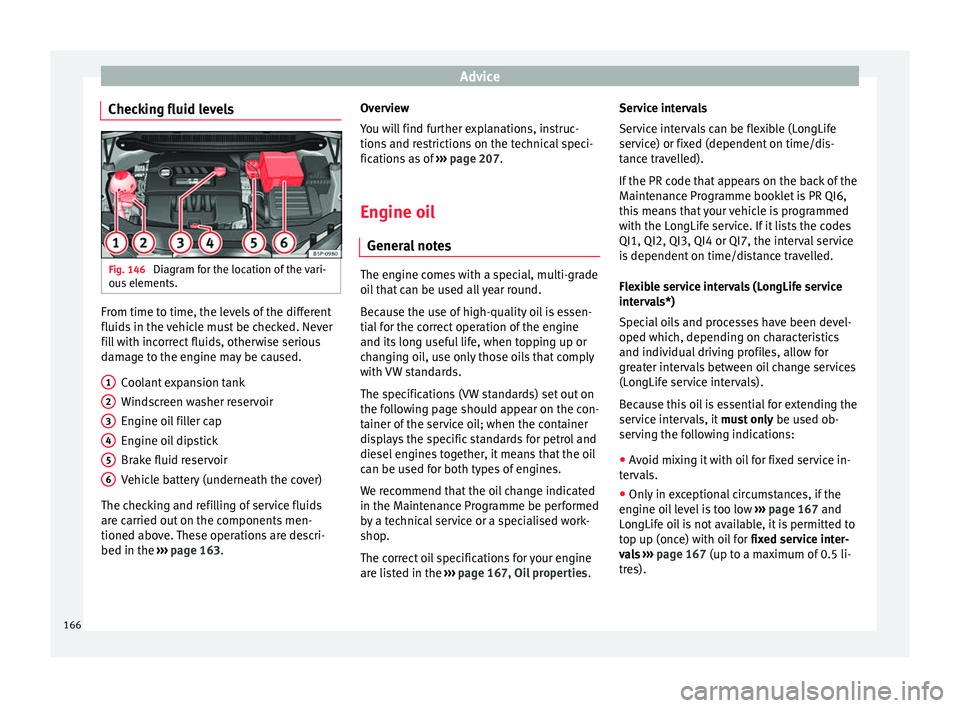
Checking fluid levels Fig. 146
Diagram for the location of the vari-
ous elements. From time to time, the levels of the different
fluids in the vehicle must be checked. Never
fill with incorrect fluids, otherwise serious
damage to the engine may be caused.
Coolant expansion tank
Windscreen washer reservoir
Engine oil filler cap
Engine oil dipstick
Brake fluid reservoir
Vehicle battery (underneath the cover)
The checking and refilling of service fluids
are carried out on the components men-
tioned above. These operations are descri-
bed in the ››› page 163 .
1 2
3
4
5
6 Overview
You will find further explanations, instruc-
tions and restrictions on the technical speci-
fications as of
››› page 207 .
En gine oi
l
General notes The engine comes with a special, multi-grade
oil that can be used all year round.
Because the use of high-quality oil is essen-
tial for the correct operation of the engine
and its long useful life, when topping up or
changing oil, use only those oils that comply
with VW standards.
The specifications (VW standards) set out on
the following page should appear on the con-
tainer of the service oil; when the container
displays the specific standards for petrol and
diesel engines together, it means that the oil
can be used for both types of engines.
We recommend that the oil change indicated
in the Maintenance Programme be performed
by a technical service or a specialised work-
shop.
The correct oil specifications for your engine
are listed in the
›››
page 167, Oil properties .Service intervals
Service intervals can be flexible (LongLife
service) or fixed (dependent on time/dis-
tance travelled).
If the PR code that appears on the back of the
Maintenance Programme booklet is PR QI6,
this means that your vehicle is programmed
with the LongLife service. If it lists the codes
QI1, QI2, QI3, QI4 or QI7, the interval service
is dependent on time/distance travelled.
Flexible service intervals (LongLife service
intervals*)
Special oils and processes have been devel-
oped which, depending on characteristics
and individual driving profiles, allow for
greater intervals between oil change services
(LongLife service intervals).
Because this oil is essential for extending the
service intervals, it
must only be used ob-
serving the following indications:
● Avoid mixing it with oil for fixed service in-
tervals.
● Only in exceptional circumstances, if the
engine oil level is too low ››› page 167 and
LongLife oil is not available, it is permitted to
top up (once) with oil for fixed service inter-
vals › ›
›
page 167 (up to a maximum of 0.5 li-
tres).
166
Page 169 of 236
Checking and refilling levels
Fixed service intervals*
If your vehicle does not have the “LongLife
service interval” or it has been disabled (by
request), you may use oils for fixed service
intervals , which also appear in
›
› › page 167,
Oil properties . In this case, your vehicle must
be serviced after a fixed interval of 1
year/15 000 km (10 000 miles)(whatever
comes first) ››› Booklet Maintenance Pro-
gramme.
● In ex
ceptional circumstances, if the engine
oil level is too low ››› page 167 and you can-
not o
btain the oil specified for your vehicle,
you can put in a small quantity of oil con-
forming to the specification ACEA A2 or
ACEA A3 (petrol engines) or ACEA B3 or
ACEA B4 (diesel engines) (up to 0.5 l).
Vehicles with a diesel particulate filter*
The Maintenance Programme states whether
your vehicle is fitted with a diesel particulate
filter.
Only VW 507 00 engine oil, with reduced ash
formation, may be used in diesel engines
equipped with particulate filter. Using other
types of oil will cause a higher soot concen-
tration and reduce the life of the DPF. There-
fore:
● Avoid mixing this oil with other engine oils.
● Only in exceptional circumstances, if the
engine oil level is too low ››› page 167 and you cannot obtain the oil specified for your
vehicle, you can use a small quantity of oil
(once) conforming to the VW 506 00,
VW 506 01, VW 505 00, VW 505 01 or
ACEA B3/ACEA B4 specification. (up to 0.5 l).
Oil properties
Engine typeSpecification
Petrol without flexible
service intervalVW 502 00/VW 504 00
Petrol with flexible serv-
ice interval (LongLife)VW 504 00
Diesel. Engines without
Particulate filter (DPF)VW 505 01/VW 506 01/VW
507 00
Diesel. Particulate Filter
Engines (DPF).
With or without flexible
service interval (with
and without LongLife) a)VW 507 00
a)
Only use recommended oils, otherwise you may damage the
engine.
Engine oil additives
No type of additive should be mixed with the
engine oil. The deterioration caused by these
additives is not covered by the warranty. Note
Before a long trip, we recommend finding an
engine oil that conforms to the correspond-
ing VW specifications and recommend keep-
ing it in the vehicle. This way, the correct en-
gine oil will always be available for a top-up if
needed. Checking the engine oil level
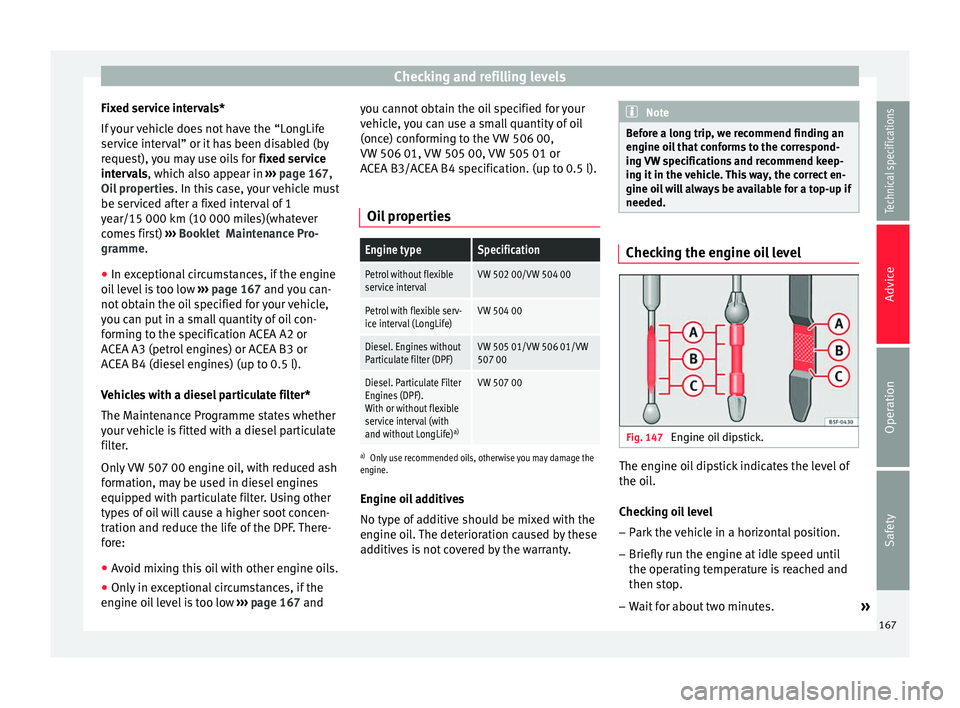
Fig. 147
Engine oil dipstick. The engine oil dipstick indicates the level of
the oil.
Checking oil level
– Park the vehicle in a horizontal position.
– Briefly run the engine at idle speed until
the operating temperature is reached and
then stop.
– Wait for about two minutes.
»
167
Technical specifications
Advice
Operation
Safety
Page 170 of 236
Advice
– Pull out the dipstick. Wipe the dipstick with
a clean cloth and insert it again, pushing it
in as far as it will go.
– Then pull it out once more and check the oil
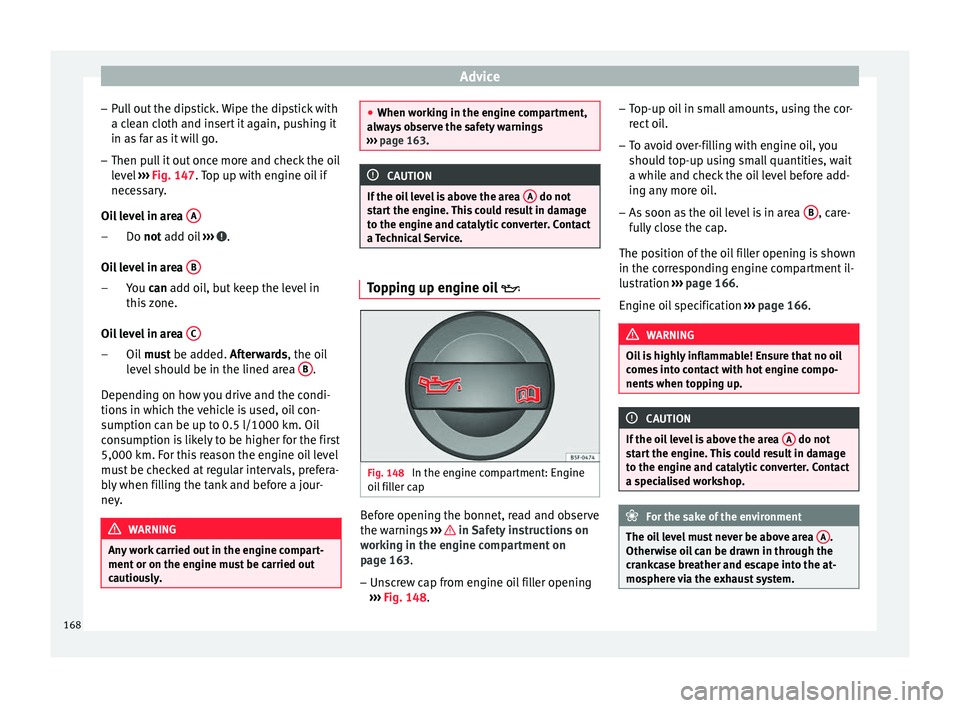
level ››› Fig. 147 . Top up with engine oil if
nec e
ssary.
Oil level in area ADo
not
add oil ›
›› .
Oil level in area BYou
can
add oil, but keep the level in
thi
s zone.
Oil level in area COil
must be added.
Afterwards
, the oil
level should be in the lined area B .
Depending on how you drive and the condi-
tions in which the vehicle is used, oil con-
sumption can be up to 0.5 l/1000 km. Oil
consumption is likely to be higher for the first
5,000 km. For this reason the engine oil level
must be checked at regular intervals, prefera-
bly when filling the tank and before a jour-
ney. WARNING
Any work carried out in the engine compart-
ment or on the engine must be carried out
cautiously. –
–
– ●
When working in the engine compartment,
always observe the safety warnings
››› page 163. CAUTION
If the oil level is above the area A do not
start the engine. This could result in damage
to the engine and catalytic converter. Contact
a Technical Service. Topping up engine oil
Fig. 148
In the engine compartment: Engine
oil filler cap Before opening the bonnet, read and observe
the warnings
››› in Safety instructions on
working in the engine compartment on
page 163 .
– Un s
crew cap from engine oil filler opening
››› Fig. 148. –
Top-up oi
l in small amounts, using the cor-
rect oil.
– To avoid over-filling with engine oil, you
should top-up using small quantities, wait
a while and check the oil level before add-
ing any more oil.
– As soon as the oil level is in area B , care-
fully close the cap.
The position of the oil filler opening is shown
in the corresponding engine compartment il-
lustration ››› page 166 .
En gine oi
l specification ››› page 166. WARNING
Oil is highly inflammable! Ensure that no oil
comes into contact with hot engine compo-
nents when topping up. CAUTION
If the oil level is above the area A do not
start the engine. This could result in damage
to the engine and catalytic converter. Contact
a specialised workshop. For the sake of the environment
The oil level must never be above area A .
Otherwise oil can be drawn in through the
crankcase breather and escape into the at-
mosphere via the exhaust system. 168
Page 171 of 236
Checking and refilling levels
Changing engine oil The engine oil must be changed at the inter-
vals given in the service schedule.
We recommend that you have the engine oil
changed by a Technical Service.
The oil change intervals are shown in the
Maintenance Programme.
WARNING
Only change the engine oil yourself if you
have the specialist knowledge required!
● Before opening the bonnet, read and ob-
serve the warnings ››› page 163, Safety in-
structions on working in the engine compart-
ment.
● Wait
for the engine to cool down. Hot oil
may cause burn injuries.
● Wear eye protection to avoid injuries, such
as acid burns, caused by splashes of oil.
● When removing the oil drain plug with your
fingers, keep your arm horizontal to help pre-
vent oil from running down your arm.
● Wash your skin thoroughly if it comes into
contact with engine oil.
● Engine oil is poisonous! Used oil must be
stored in a safe place out of the reach of chil-
dren. CAUTION
No additives should be used with engine oil.
This could result in engine damage. Any dam-
age caused by the use of such additives
would not be covered by the factory warranty. For the sake of the environment
● Because of disposal problems and the spe-
cial tools and specialist knowledge required,
we recommend that you have the engine oil
and filter changed by a Technical Service.
● Never pour oil down drains or into the
ground.
● Use a suitable container when draining the
used oil. It must be large enough to hold all
the engine oil. Cooling system
Engine coolant specifications The engine cooling system is supplied from
the factory with a specially treated mixture of
water and, at least, 40 % of the additive
G 13
(TLVW 774 J). The engine coolant additive is
recognisable by its purple colour. This mix-
ture of water and additive gives the necessa-
ry frost protection down to -25°C (-13 F) and
protects the light alloy parts of the cooling
system against corrosion. It also prevents scaling and considerably raises the boiling
point of the coolant.
To protect the engine cooling system, the
percentage of additive must
always be at
l e
ast 40 %, even in warm climates where an-
ti-freeze protection is not required.
If greater frost protection is required in very
cold climates, the proportion of additive can
be increased. However, the percentage of ad-
ditive should not exceed 60%, as this would
reduce frost protection and, in turn, decrease
cooling capacity.
When the coolant is topped up, use a mixture
of distilled water and, at least, 40 % of the G
13 or G 12 plu
s-plus (TL-VW 774 G) additive
(both are purple) to obtain an optimum anti-
corrosion protection ››› . The mixture of G
13 with G 12 plus (TL-VW 774 F), G 12 (red) or
G 11 (green-blue) engine coolants will signifi-
cantly reduce the anticorrosion protection
and should, therefore be avoided ››› .
WARNING
If there is not enough anti-freeze in the cool-
ant system, the engine may fail leading to se-
rious damage.
● Please make sure that the percentage of
additive is correct with respect to the lowest
expected ambient temperature in the zone
where the vehicle is to be used.
● When the outside temperature is very low,
the coolant could freeze and the vehicle » 169
Technical specifications
Advice
Operation
Safety
Page 174 of 236
Advice
Brake fluid Checking the brake fluid level Fig. 151
Engine compartment: brake fluid
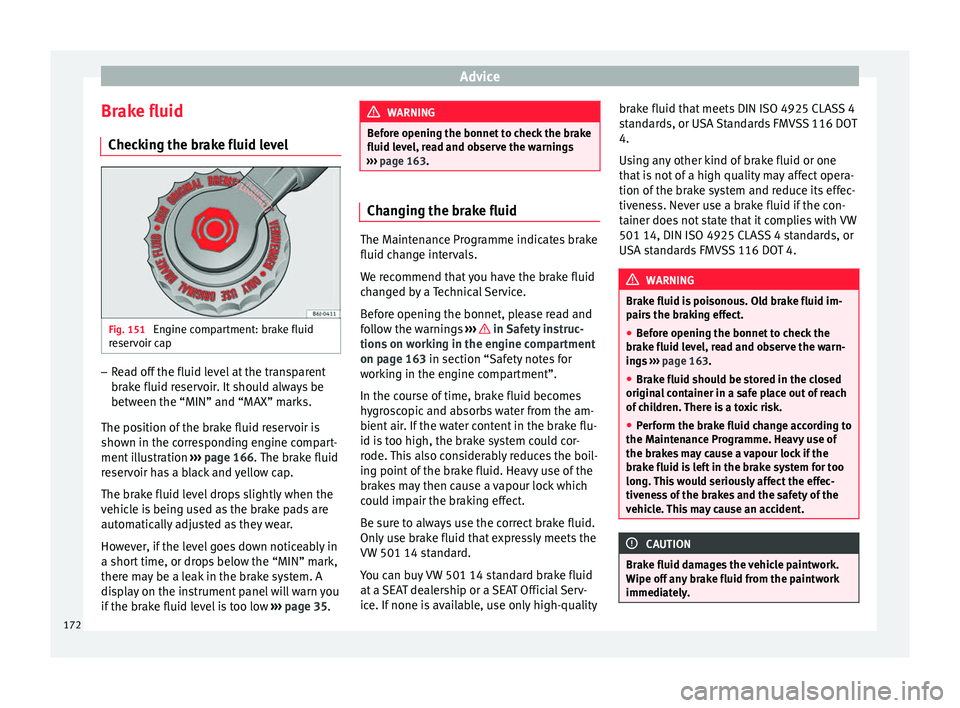
reservoir cap –
Read off the fluid level at the transparent
brake fluid reservoir. It should always be
between the “MIN” and “MAX” marks.
The position of the brake fluid reservoir is
shown in the corresponding engine compart-
ment illustration ››› page 166. The brake fluid
reservoir has a black and yellow cap.
The brake fluid level drops slightly when the
vehicle is being used as the brake pads are
automatically adjusted as they wear.
However, if the level goes down noticeably in
a short time, or drops below the “MIN” mark,
there may be a leak in the brake system. A
display on the instrument panel will warn you
if the brake fluid level is too low ››› page 35. WARNING
Before opening the bonnet to check the brake
fluid level, read and observe the warnings
››› page 163. Changing the brake fluid
The Maintenance Programme indicates brake
fluid change intervals.
We recommend that you have the brake fluid
changed by a Technical Service.
Before opening the bonnet, please read and
follow the warnings
››› in Safety instruc-
tions on working in the engine compartment
on page 163 in section “Safety notes for
w ork
ing in the engine compartment”.
In the course of time, brake fluid becomes
hygroscopic and absorbs water from the am-
bient air. If the water content in the brake flu-
id is too high, the brake system could cor-
rode. This also considerably reduces the boil-
ing point of the brake fluid. Heavy use of the
brakes may then cause a vapour lock which
could impair the braking effect.
Be sure to always use the correct brake fluid.
Only use brake fluid that expressly meets the
VW 501 14 standard.
You can buy VW 501 14 standard brake fluid
at a SEAT dealership or a SEAT Official Serv-
ice. If none is available, use only high-quality brake fluid that meets DIN ISO 4925 CLASS 4
standards, or USA Standards FMVSS 116 DOT
4.
Using any other kind of brake fluid or one
that is not of a high quality may affect opera-
tion of the brake system and reduce its effec-
tiveness. Never use a brake fluid if the con-
tainer does not state that it complies with VW
501 14, DIN ISO 4925 CLASS 4 standards, or
USA standards FMVSS 116 DOT 4.
WARNING
Brake fluid is poisonous. Old brake fluid im-
pairs the braking effect.
● Before opening the bonnet to check the
brake fluid level, read and observe the warn-
ings ››› page 163.
● Br ak
e fluid should be stored in the closed
original container in a safe place out of reach
of children. There is a toxic risk.
● Perform the brake fluid change according to
the Maintenance Programme. Heavy use of
the brakes may cause a vapour lock if the
brake fluid is left in the brake system for too
long. This would seriously affect the effec-
tiveness of the brakes and the safety of the
vehicle. This may cause an accident. CAUTION
Brake fluid damages the vehicle paintwork.
Wipe off any brake fluid from the paintwork
immediately. 172
Page 177 of 236
Wheels
Wheels
Wheels and tyres General notes Avoiding damage
– If you have to drive over a kerb or similar
obstacle, drive very slowly and at a right
angle.
– Keep grease, oil and fuel off the tyres.
– Inspect the tyres regularly for damage
(cuts, cracks or blisters, etc.). Remove any
foreign objects embedded in the treads.
Storing tyres
– When you remove the tyres, mark them in
order to maintain the same direction of ro-
tation when they are installed again.
– When removed, the wheels and/or tyres
should be stored in a cool, dry and prefera-
bly dark location.
– Store tyres in a vertical position if they are
not fitted on wheel rims.
New tyres
New tyres must be run in ›››
page 130.
The tread depth of new tyres may vary, ac-
cording to the type and make of tyre and the
tread pattern. Concealed damage
Damage to tyres and rims is often not readily
visible. If you notice unusual vibrations or the
vehicle pulling to one side, this may indicate
that one of the tyres is damaged. They
should be checked immediately by a Techni-
cal Service.
Tyres with directional tread pattern
An arrow on the tyre sidewall indicates the di-
rection of rotation on tyres with directional
tread. Always observe the direction of rota-
tion indicated when fitting the wheel. This
guarantees optimum grip and helps to avoid
aquaplaning, excessive noise and wear.
WARNING
● New tyres do not have maximum grip dur-
ing the first 500 km (300 miles). Drive partic-
ularly carefully to avoid possible accidents.
● Never drive with damaged tyres. This may
cause an accident.
● If you notice unusual vibrations or if the ve-
hicle pulls to one side when driving, stop the
vehicle immediately and check the tyres for
damage. Checking tyre pressure
The correct tyre pressure can be seen on the
sticker on the inside of the fuel tank flap.1. Read the required tyre inflation pressure
from the sticker. The values refer to Sum-
mer tyres. For winter tyres, you must add
0.2 bar (2.9 psi / 20 kPa) to the values
given for summer tyres.
2. The tyre pressures should only be checked when the tyres are cold. The slightly raised
pressures of warm tyres must not be re-
duced.
3. Adjust the tyre pressure to the load you are carrying.
Tyre pressure
The correct tyre pressure is especially impor-
tant at high speeds. The pressure should
therefore be checked at least once a month
and before starting a journey.
The sticker with the tyre pressure values can
be found on the inside of the fuel tank flap.
The tyre pressure values given are for cold
tyres. Do not reduce the slightly raised pres-
sures of warm tyres ››› .
WARNING
● Check the tyre pressure at least once per
month. Checking the tyre pressure is very im-
portant. If the tyre pressure is too high or too
low, there is an increased danger of accidents
- particularly at high speeds.
● A tyre can easily burst if the pressure is too
low, causing an accident! » 175Technical specifications
Advice
Operation
Safety
Page 179 of 236
Wheels
Tyre useful life Fig. 152
Tyre tread wear indicators. Fig. 153
Diagram for changing wheels The useful life of tyres is dependent on tyre
pressure, driving style and fitting.
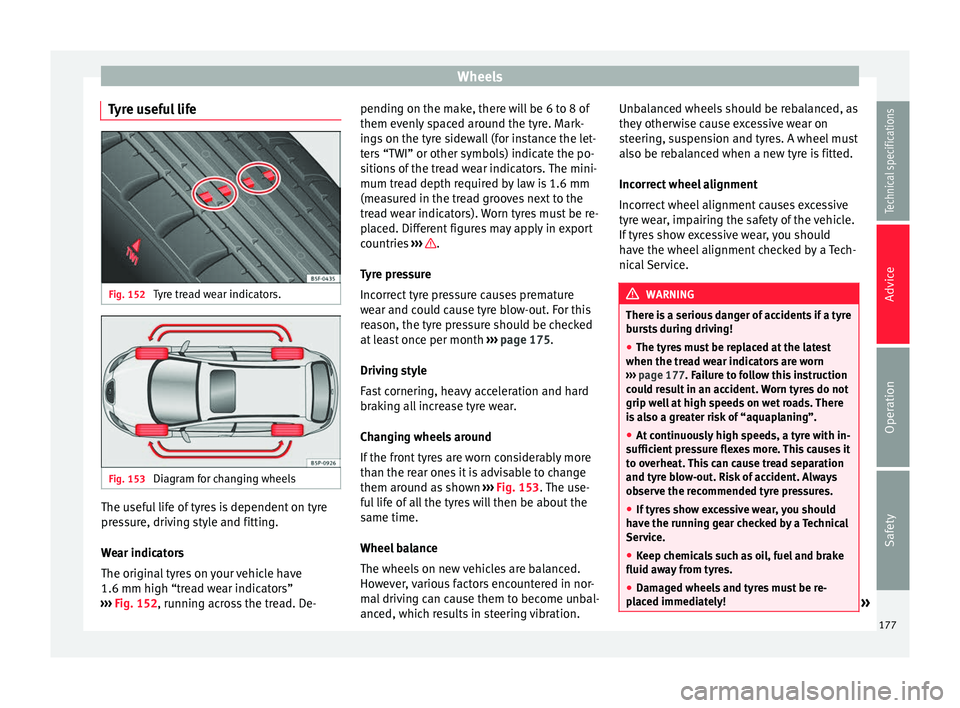
Wear indicators
The original tyres on your vehicle have
1.6 mm high “tread wear indicators”
››› Fig. 152 , running across the tread. De- pendin
g on the m ake, there will be 6 to 8 of
them evenly spaced around the tyre. Mark-
ings on the tyre sidewall (for instance the let-
ters “TWI” or other symbols) indicate the po-
sitions of the tread wear indicators. The mini-
mum tread depth required by law is 1.6 mm
(measured in the tread grooves next to the
tread wear indicators). Worn tyres must be re-
placed. Different figures may apply in export
countries ››› .
Tyre pressure
Incorrect tyre pressure causes premature
wear and could cause tyre blow-out. For this
reason, the tyre pressure should be checked
at least once per month ››› page 175.
Driving style
Fast cornering, heavy acceleration and hard
braking all increase tyre wear.
Changing wheels around
If the front tyres are worn considerably more
than the rear ones it is advisable to change
them around as shown ››› Fig. 153 . The use-
f u
l life of all the tyres will then be about the
same time.
Wheel balance
The wheels on new vehicles are balanced.
However, various factors encountered in nor-
mal driving can cause them to become unbal-
anced, which results in steering vibration. Unbalanced wheels should be rebalanced, as
they otherwise cause excessive wear on
steering, suspension and tyres. A wheel must
also be rebalanced when a new tyre is fitted.
Incorrect wheel alignment
Incorrect wheel alignment causes excessive
tyre wear, impairing the safety of the vehicle.
If tyres show excessive wear, you should
have the wheel alignment checked by a Tech-
nical Service.
WARNING
There is a serious danger of accidents if a tyre
bursts during driving!
● The tyres must be replaced at the latest
when the tread wear indicators are worn
››› page 177. Failure to follow this instruction
could result in an accident. Worn tyres do not
grip well at high speeds on wet roads. There
is also a greater risk of “aquaplaning”.
● At continuously high speeds, a tyre with in-
sufficient pressure flexes more. This causes it
to overheat. This can cause tread separation
and tyre blow-out. Risk of accident. Always
observe the recommended tyre pressures.
● If tyres show excessive wear, you should
have the running gear checked by a Technical
Service.
● Keep chemicals such as oil, fuel and brake
fluid away from tyres.
● Damaged wheels and tyres must be re-
placed immediately! » 177
Technical specifications
Advice
Operation
Safety
Page 182 of 236
Advice
For the sake of the environment
Old tyres must be disposed of according to
the laws in the country concerned. Note
● For technical reasons, it is not generally
possible to use the wheels from other vehi-
cles. This can also apply to wheels of the
same model. The use of wheels or tyres
which have not been approved by SEAT for
use with your model may invalidate the vehi-
cle's type approval for use on public roads.
● If the spare tyre is not the same as the
tyres that are mounted on the vehicle (e.g.
winter tyres) you should only use the spare
tyre for a short period of time and drive with
extra care. Refit the normal road wheel as
soon as possible. Wheel bolts
The design of wheel bolts is matched to the
rims. If different wheel rims are fitted, the
correct wheel bolts with the right length and
correctly shaped bolt heads must be used.
This ensures that wheels are fitted securely
and that the brake system functions correctly.
In certain circumstances, you should not use
wheel bolts from a different vehicle, even if it
is the same model
›››
page 147. After the wheels have been changed, the
tightening torque of the wheel bolts should
be checked as soon as possible with a torque
wrench
››› . The tightening torque for steel
and alloy wheels is 120 Nm. WARNING
If the wheel bolts are not tightened correctly,
the wheel could become loose while driving.
Risk of accident.
● The wheel bolts must be clean and turn
easily. Never apply grease or oil to them.
● Use only wheel bolts which belong to the
wheel.
● If the tightening torque of the wheel bolts
is too low, they could loosen whilst the vehi-
cle is in motion. Risk of accident! If the tight-
ening torque is too high, the wheel bolts and
threads can be damaged. CAUTION
The prescribed tightening torque for wheel
bolts for steel and alloy wheels is 120 Nm. Winter service
Winter tyres In winter conditions winter tyres will consid-
erably improve the vehicle's handling. Sum-mer tyres (width, rubber compound, tread
pattern) provide less grip on ice and snow.
Winter tyres must be inflated to a
pressure of
0.2 bar (2.9 psi/20 kPa) higher than the pres-
sures specified for summer tyres (see sticker
on fuel tank flap).
Winter tyres must be fitted on all four wheels.
Information on permitted winter tyre sizes
can be found in the vehicle's registration
documentation. Use only radial winter tyres.
All tyre sizes listed in the vehicle documenta-
tion also apply to winter tyres.
Winter tyres lose their effectiveness when the
tread is worn down to a depth of 4 mm.
The speed rating code ››› page 179, New
tyres and wheels determines the following
speed limits for winter tyres:
›
› › max. 160 km/h
max. 180 km/h
max. 190 km/h
max. 210 km/h
In some countries, vehicles which can exceed
the speed rating of the fitted tyre must have
an appropriate sticker in the driver's field of
view. These stickers are available from your
technical service. The legal requirements of
each country must be followed.
Do not have winter tyres fitted for unnecessa-
rily long periods. Vehicles with summer tyres Q
S
T
H
180
Page 197 of 236
Emergencies
If the windscreen wipers scratch , they should
be replaced if they are damaged, or cleaned
if they are soiled.
If this does not produce the desired results,
the setting angle of the windscreen wiper
arms might be incorrect. They should be
checked by a specialised workshop and cor-
rected if necessary. WARNING
Do not drive unless you have good visibility
through all windows!
● Clean the windscreen wiper blades and all
windows regularly.
● The wiper blades should be changed once
or twice a year. CAUTION
● Damaged or dirty windscreen wipers could
scratch the windscreen.
● Never use fuel, nail varnish remover, paint
thinner or similar products to clean the win-
dows. This could damage the windscreen
wiper blades.
● Never move the windscreen wiper or wind-
screen wiper arm manually. This could cause
damage.
● To prevent damage to the bonnet and the
windscreen wiper arms, the latter should only
be lifted off the windscreen when in service
position. Note
● The windscreen wiper arms can be moved
to the service position only when the bonnet
is properly closed. Changing the rear wiper blade
3 Applies to the model: ALTEA
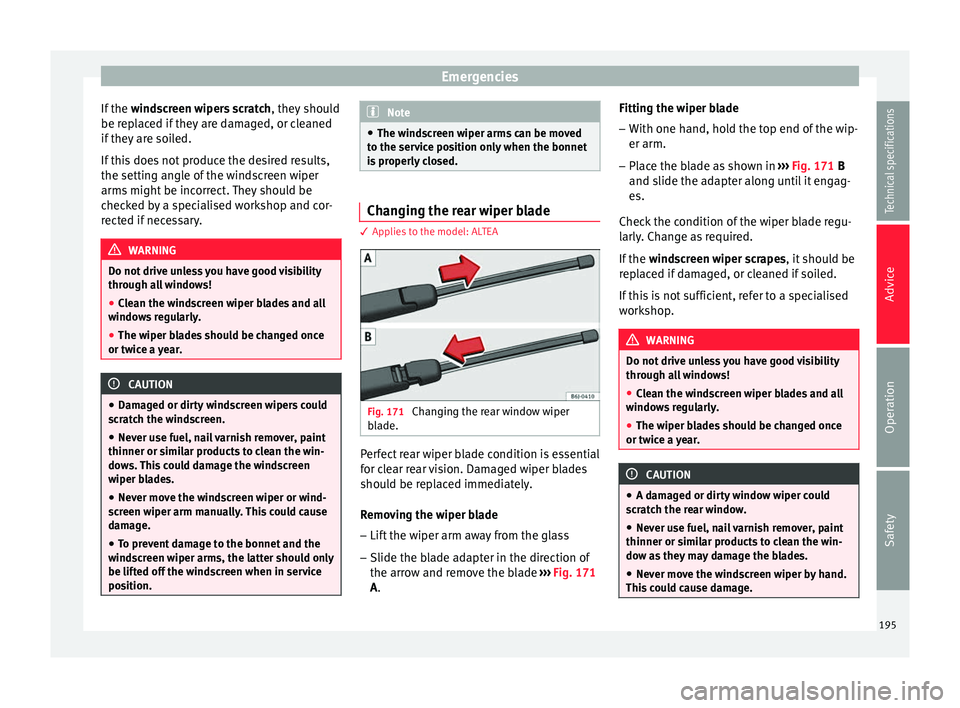
Fig. 171
Changing the rear window wiper
blade. Perfect rear wiper blade condition is essential
for clear rear vision. Damaged wiper blades
should be replaced immediately.
Removing the wiper blade
– Lift the wiper arm away from the glass
– Slide the blade adapter in the direction of
the arrow and remove the blade ››› Fig. 171
A . Fittin
g the w iper blade
– With one hand, hold the top end of the wip-
er arm.
– Place the blade as shown in ››› Fig. 171
B
and slide the adapter along until it engag-
es.
Check the condition of the wiper blade regu-
larly. Change as required.
If the windscreen wiper scrapes, it should be
replaced if damaged, or cleaned if soiled.
If this is not sufficient, refer to a specialised
workshop. WARNING
Do not drive unless you have good visibility
through all windows!
● Clean the windscreen wiper blades and all
windows regularly.
● The wiper blades should be changed once
or twice a year. CAUTION
● A damaged or dirty window wiper could
scratch the rear window.
● Never use fuel, nail varnish remover, paint
thinner or similar products to clean the win-
dow as they may damage the blades.
● Never move the windscreen wiper by hand.
This could cause damage. 195
Technical specifications
Advice
Operation
Safety
Page 198 of 236
Advice
Changing the rear wiper blade 3 Applies to the model: ALTEA XL/ALTEA FREETRACK
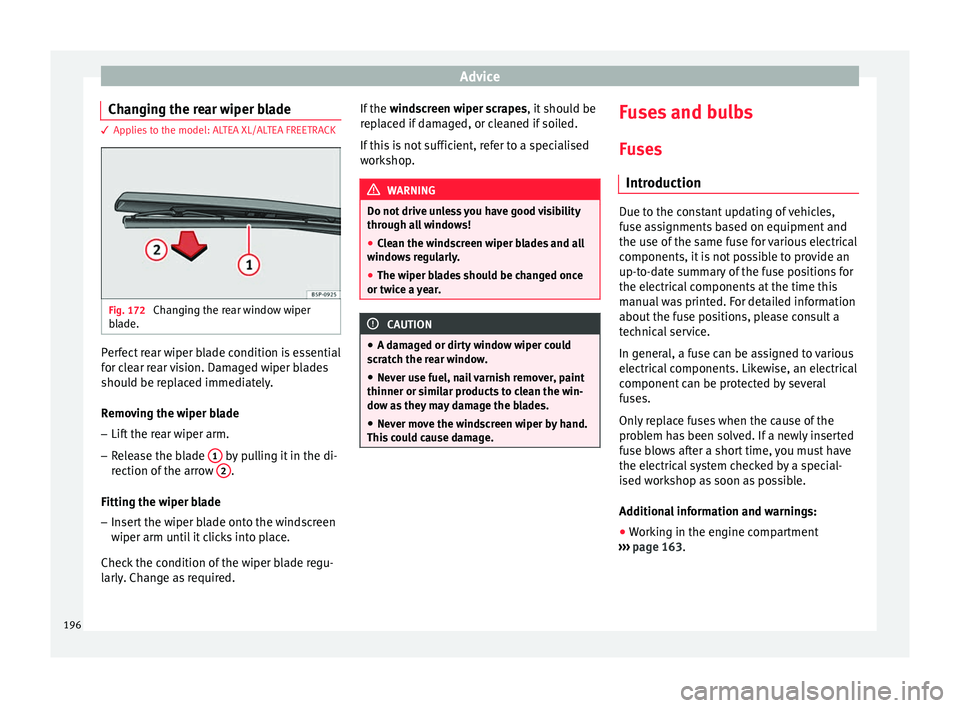
Fig. 172
Changing the rear window wiper
blade. Perfect rear wiper blade condition is essential
for clear rear vision. Damaged wiper blades
should be replaced immediately.
Removing the wiper blade
– Lift the rear wiper arm.
– Release the blade 1 by pulling it in the di-
rection of the arrow 2 .
Fitting the wiper blade – Insert the wiper blade onto the windscreen
wiper arm until it clicks into place.
Check the condition of the wiper blade regu-
larly. Change as required. If the
windscreen wiper scrapes, it should be
replaced if damaged, or cleaned if soiled.
If this is not sufficient, refer to a specialised
workshop. WARNING
Do not drive unless you have good visibility
through all windows!
● Clean the windscreen wiper blades and all
windows regularly.
● The wiper blades should be changed once
or twice a year. CAUTION
● A damaged or dirty window wiper could
scratch the rear window.
● Never use fuel, nail varnish remover, paint
thinner or similar products to clean the win-
dow as they may damage the blades.
● Never move the windscreen wiper by hand.
This could cause damage. Fuses and bulbs
Fuses Introduction Due to the constant updating of vehicles,
fuse assignments based on equipment and
the use of the same fuse for various electrical
components, it is not possible to provide an
up-to-date summary of the fuse positions for
the electrical components at the time this
manual was printed. For detailed information
about the fuse positions, please consult a
technical service.
In general, a fuse can be assigned to various
electrical components. Likewise, an electrical
component can be protected by several
fuses.
Only replace fuses when the cause of the
problem has been solved. If a newly inserted
fuse blows after a short time, you must have
the electrical system checked by a special-
ised workshop as soon as possible.
Additional information and warnings:
● Working in the engine compartment
››› page 163 .
196