warning lights Seat Altea XL 2009 User Guide
[x] Cancel search | Manufacturer: SEAT, Model Year: 2009, Model line: Altea XL, Model: Seat Altea XL 2009Pages: 297, PDF Size: 9.36 MB
Page 79 of 297

Cockpit
78wheels to lock quickly when you brake. This could cause the rear to break
away. Risk of skidding. Stop the vehicle and seek technical assistance.Washer fluid
This warning lamp lights up to indicate that the windscreen
washer level is too low.This serves as a reminder to fill up the reservoir at the earliest opportunity
⇒ page 222.
The following message is shown on the instrument panel display*
11): REFILL
WINDSCREEN WASHER FLUID .
Alternator
This warning lamp signals a fault in the alternator.
The warning lamp
lights up when the ignition is switched on. It should go
out when the engine has started running.
If the warning lamp lights up while driving, the alternator is no longer
charging the battery. You should immediately drive to the nearest qualified
workshop.
You should avoid using electrical equipm ent that is not absolutely necessary
because this will drain the battery.
Tyre pressure*
The tyre pressure control system controls the tyre speed and
the frequency spectrum of each tyre.The tyre monitor
12) compares wheel revolutions and with this information,
the diameter of each wheel using the ESP sensors. If the diameter of a wheel
changes, the tyre monitor indicator lights . The wheel diameter changes
when:
•
Tyre pressure is insufficient.
•
The tyre structure is damaged.
•
The vehicle is unbalanc ed because of a load.
•
The wheels of one axle are under more pressure (for example, driving with
a trailer or on extreme slopes).
•
The vehicle is fitted with snow chains.
•
The emergency wheel is fitted.
11)Depending on the version of the model.WARNING (continued)
12)Depending on the model version
Fig. 49 Centre console:
tyre monitor system
button
AlteaXL_EN.book Seite 78 M ontag, 2. Februar 2009 12:26 12
Page 80 of 297
Cockpit79
Safety First
Operating instructions
Practical tips
Te c h n i c a l D a t a
•
The wheel on one axle is changed.
Tyre pressure adjustment
Following the modification to tyre pressure or after changing one or more
wheels, the button ⇒page 78, fig. 49 must be kept pressed while the igni-
tion is on until an acoustic signal is heard and the warning lamp goes out.
If the wheels are under excessive load (for example, driving with a trailer or
heavy load), the tire pressure must be increased to the recommended value
for a full load (see the sticker on the inside of the fuel flap). If the tyre monitor
system button is pressed down, the new tyre pressures are confirmed.
The tyre pressure monitor indicator
lights up
If the tyre pressure of one or more wheels is much lower than the value set by
the driver, then the tyre co ntrol warning lamp lights up ⇒.
The tyre pressure monitor indicator flashes
If the tyre pressure indicator flashes, this indicates a fault. Go to the nearest
specialist workshop.
WARNING
•
When the tyre pressure indicator l ights, reduce speed immediately and
avoid any sudden manoeuvre or braking. Stop when possible, and check
the tyre pressure and status.
•
The driver is responsible for correct tyre pressure. For this reason, tyre
pressure must be regularly checked.
•
Under certain circumstances (for exam ple, in a sports situation, in
winter conditions or on a dirt track) the tyre monitor indicator may light or
function incorrectly.Note
If the battery is disconne cted, the yellow indicator
lights up after turning
the ignition on. This should turn off after a brief journey.
Bulb defect
The warning lamp lights up when a bulb in the vehicle's exte-
rior lighting is defective.The warning lamp
lights up when a bulb in the vehicle's exterior lighting
(e.g. left-hand main beam) is defective.
The instrument panel disp lays the following message
13): LEFT FULL BEAM
FAULTY .
Brake system* / handbrake
The warning lamp lights up if the handbrake is applied, if the
brake fluid level falls too low or if there is a fault in the brake
system.
This warning lamp
lights up if
•
If the handbrake is on.
If you drive faster than 6 km/h with the handbrake on, the following message
will appear on the instrument panel display
14): HANDBRAKE ON. Also, an
audible warning is given.
•
If the brake fluid level is too low ⇒page 226.
The instrument panel disp lays the following message
14): STOP BRAKE FLUID
INSTRUCTION MANUAL .
•
If there is a fault in the brake system.
The instrument panel disp lays the following message
14): BRAKE SYSTEM
FAULT INSTRUCTIONS MANUAL .
13)Depending on the version of the model.14)Depending on the version of the model.
AlteaXL_EN.book Seite 79 Montag, 2. Februar 2009 12:26 12
Page 81 of 297
Cockpit
80This warning lamp can light up together with the anti-lock brake system
warning lamp.
WARNING
•
Before opening the bonnet, read and observe the warnings on
⇒ page 213.
•
If the brake warning lamp does not go out, or if it lights up when
driving, the brake fluid level ⇒page 226, “Brake fluid” in the reservoir is
too low. Risk of accident. Stop the ve hicle and do not drive on. Obtain tech-
nical assistance.
•
If the brake warning lamp
lights up together with the ABS warning
lamp
, the control function of the ABS could be out of action. This could
cause the rear wheels to lock quickly when you brake. This could cause the
rear to break away. Risk of skidding. Stop the vehicle and seek technical
assistance.
Engine oil pressure
This warning lamp indicates that the engine oil pressure is
too low.If this warning symbol starts to flash, and is accompanied by three audible
warnings, switch off the engine and check the oil level. If the oil level is too
low, add more engine oil ⇒page 216.
The instrument panel displays the following message
15): STOP ENGINE OIL
PRESSURE INSTRUCTIONS MANUAL .
If the symbol flashes although the oil level is correct, do not drive on. The
engine must not even run at idle speed. Obtain technical assistance.
Cruise control system*
The warning lamp comes on when the cruise control system
is switched on.The warning lamp
lights up when the cruise control system is switched on.
Further notes on the cruise control system ⇒page 179.
Indicator for open doors or tailgate*
This indicator lights if one of th e doors or the tailgate is open.The warning light
should go off when all the doors are closed correctly.
The system also works when the ignition is switched off. It should go off
approx. 15 seconds after the vehicle is locked.
Power steering system*
For vehicles with power steering, the level of steering assistance depends on
the vehicle's speed and on the steering angle.
The warning lamp should li ght up for a few seconds when the ignition is
switched on. It should go out once the engine is started.
If the battery is disconnected, the indicator remains lit, even with the engine
running. The warning light only goes of f after a distance of approx. 50 m.
There is a fault in the electromechanical steering system if the lamp does not
go out or lights up whilst the vehicle is in motion. The indicator may appear
in two different colours to indicate faults . If it lights yellow, this indicates a
minor fault. If it lights red, seek workshop assistance immediately, if no
assistance is available stop driving. Stop the vehicle and seek technical
15)Depending on the version of the model.
AlteaXL_EN.book Seite 80 M ontag, 2. Februar 2009 12:26 12
Page 82 of 297
Cockpit81
Safety First
Operating instructions
Practical tips
Te c h n i c a l D a t a
assistance. The power steering does not work if the battery is flat or if the
engine is off (for example, for towing). You should take into account that you
will need considerably more power than
normal to steer the vehicle if the
steering assistance is reduced or has failed completely.
For those vehicles fitted with ESP* the function “Recommended steering
manoeuvre” is included. See ⇒page 185.
Emission control system*
This warning lamp monito rs the exhaust system.
Warning lamp
flashes:
When there is misfiring that can damage the catalytic converter. Reduce
speed and drive carefully to the nearest qualified workshop to have the
engine checked.
The instrument panel displa ys the following message
16): EXHAUST GAS SEE
WORKSHOP
Warning lamp
is lit:
If a fault has developed during drivi ng which has reduced the quality of the
exhaust gas (e.g. lambda probe fault). Reduce speed and drive carefully to
the nearest qualified workshop to have the engine checked.
The following information text displaye d in the instrument panel display :
EXHAUST GAS SEE WORKSHOP .
Electronic stabilisation programme (ESP)*
This warning lamp monitors the electronic stabilisation
programme.
This programme includes the ABS, EDL and TCS. This also includes the brake
assist system (BAS), automatic cleaning of the brake discs and the trailer
stability programme (TSP).
The warning lamp
has the following functions:
•
It will light for about 2 seconds when the ignition is switched on while a
test of the function is carried out.
•
It flashes when the ESP is activated when driving.
•
It will light up continuously if there is a malfunction in the ESP.
•
It will also come on if a fault should occur in the ABS because the ESP
operates in conjunction with the ABS.
If the ESP warning lamp
lights up and stays on after the engine is started,
this may mean that the control system has temporarily switched off the ESP.
In this case the ESP can be reactivated by switching the ignition off and then
on again. If the warning lamp goes out, this means the system is fully func-
tional.
If the ESP button is activated, the TCS function deactivates and the warning
lamp flashes.
16)Depending on the version of the model.
AlteaXL_EN.book Seite 81 M ontag, 2. Februar 2009 12:26 12
Page 83 of 297
Cockpit
82Differential lock fault (EDL)*
EDL operates along with the ABS in vehicles equipped with an
Electronic Stabilisation Program (ESP)*A malfunction in the EDL is indicated by the ABS warning lamp
. Please
take the vehicle to a qualified workshop as soon as possible. For further infor-
mation on the EDL ⇒page 186, “Electronic differential lock (EDL)*”.
Traction control system (TCS)*
The traction control system prevents the driven wheels from
spinning when the vehicle is acceleratingThe warning lamp lights up when the ignition is switched on and should turn
out after about 2 seconds.
When the TCS is operating while drivi ng, the warning lamp flashes. If the
system is deactivated or if there is any fault in the same, the warning lamp will
remain lit.
It will also come on if a fault should occur in the ABS because the TCS oper-
ates in conjunction with the ABS. For further information, see ⇒page 183,
“Brakes”.
If the TCS button is activated, the TC S function deactivates and the warning
lamp remains lit.
By pressing again, TCS function is reactivated and the warning lamp switched
off.
Operating the foot brake
The footbrake must be depressed when this warning lamp lights up. This is
necessary when the automatic gearbox* selector lever is moved out of the
positions P or N.Electronic immobiliser* “Safe”
This warning lamp flashes if an unauthorised key is used.Inside the key there is a chip that deac tivates the electronic immobiliser auto-
matically when the key is inserted into the ignition. The immobiliser will be
activated again automatically as soon as you pull the key out of the ignition
lock.
The instrument panel displays the following message
17): SAFE . The vehicle
cannot be used in that case ⇒page 166.
The engine can, however, be started if the appropriate coded SEAT genuine
key is used.
Note
A perfect operation of the vehicle is ensured if genuine SEAT keys are used.17)Depending on the version of the model.
AlteaXL_EN.book Seite 82 M ontag, 2. Februar 2009 12:26 12
Page 104 of 297
Unlocking and locking103
Safety First
Operating instructions
Practical tips
Te c h n i c a l D a t a
WARNING
•
Always close the tailgate properly. Risk of accident or injury.
•
The tailgate must not be opened when the reverse or rear fog lights are
lit. This may damage the lighting units.
•
Do not close the tailgate by pushing it down with your hand on the rear
window. The glass could smash. Risk of injury!
•
Ensure the tailgate is locked after closing it. If not, it may open unex-
pectedly while driving.
•
If the tailgate is not fully closed, open it with the handle and close it
again correctly. Do not try to close it by pressing on the surface of the tail-
gate, as this may damage the surface.
•
Never allow children to play in or ar ound the vehicle. A locked vehicle
can be subjected to extremely high and low temperatures, depending on
the time of year, thus causing serious injuries/illness. It could even have
fatal consequences. Close and lock both the tailgate and all the other doors
when you are not using the vehicle.
•
Closing the tailgate without observing and ensuring it is clear could
cause serious injury to you and to third parties. Make sure that no one is in
the path of the tailgate.
•
Never drive with the tailgate open or half-closed, exhaust gases may
penetrate into the interior of th e vehicle. Danger of poisoning!
•
If you only open the tailgate, do not leave the key inside. The vehicle
will not be opened if the key is left inside.
Emergency opening
This allows the vehicle to be opened if the central locking
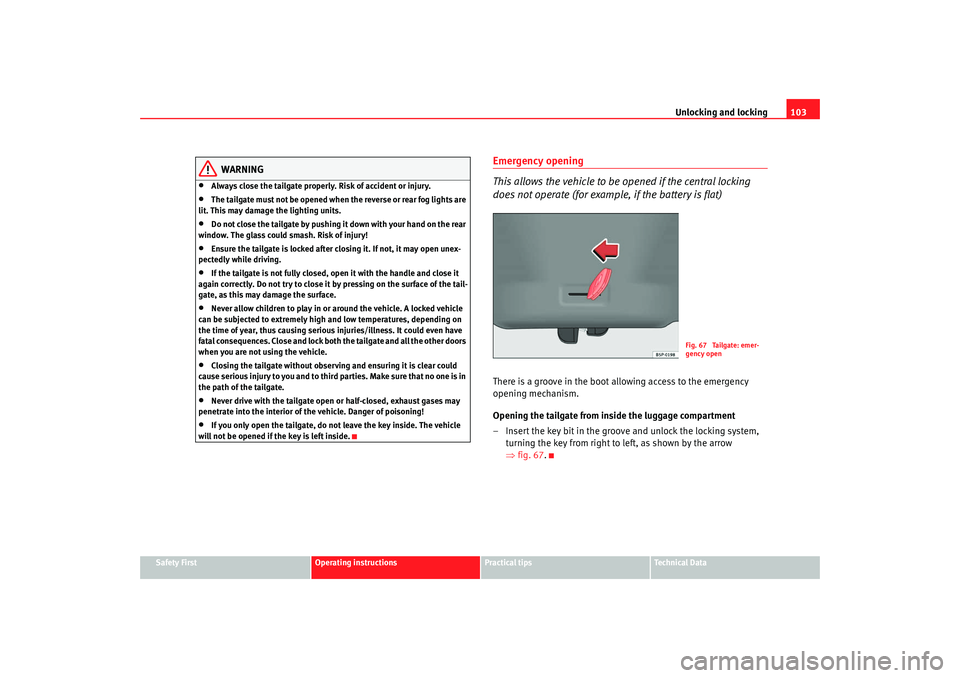
does not operate (for example, if the battery is flat)There is a groove in the boot allowing access to the emergency
opening mechanism.
Opening the tailgate from inside the luggage compartment
– Insert the key bit in the groove and unlock the locking system, turning the key from right to left, as shown by the arrow
⇒fig. 67 .
Fig. 67 Tailgate: emer-
gency open
AlteaXL_EN.book Seite 103 M ontag, 2. Februar 2009 12:26 12
Page 110 of 297
Lights and visibility109
Safety First
Operating instructions
Practical tips
Te c h n i c a l D a t a
Lights and visibilityLightsSwitching lights on and off
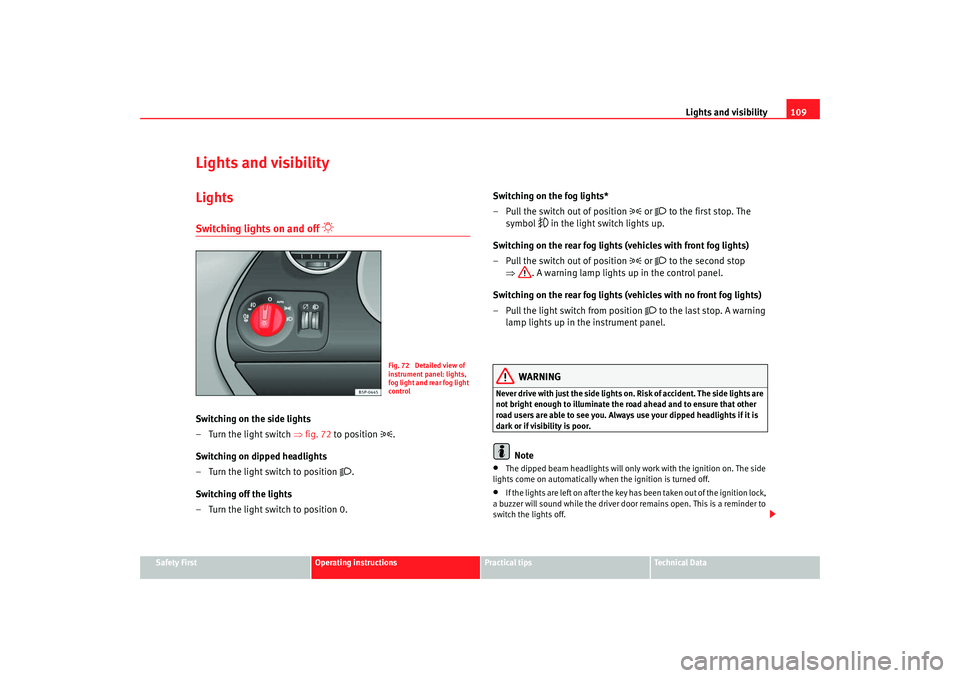
Switching on the side lights
– Turn the light switch ⇒ fig. 72 to position
.
Switching on dipped headlights
– Turn the light switch to position
.
Switching off the lights
– Turn the light switch to position 0. Switching on the fog lights*
– Pull the switch out of position
or
to the first stop. The
symbol
in the light switch lights up.
Switching on the rear fog lights (vehicles with front fog lights)
– Pull the switch out of position
or
to the second stop
⇒ . A warning lamp lights up in the control panel.
Switching on the rear fog lights (vehicles with no front fog lights)
– Pull the light switch from position
to the last stop. A warning
lamp lights up in the instrument panel.
WARNING
Never drive with just the side lights on . Risk of accident. The side lights are
not bright enough to illuminate the road ahead and to ensure that other
road users are able to see you. Always use your dipped headlights if it is
dark or if visibility is poor.
Note
•
The dipped beam headlights will only work with the ignition on. The side
lights come on automatically when the ignition is turned off.
•
If the lights are left on after the key has been taken out of the ignition lock,
a buzzer will sound while the driver door remains open. This is a reminder to
switch the lights off.
Fig. 72 Detailed view of
instrument panel: lights,
fog light and rear fog light
control
AlteaXL_EN.book Seite 109 M ontag, 2. Februar 2009 12:26 12
Page 111 of 297

Lights and visibility
110•
The rear fog light is so bright that it can dazzle drivers behind you. You
should use the rear fog light only when visibility is very poor.
•
If you are towing a trailer equipped with a rear fog light on a vehicle with
a factory-fitted towing bracket, the rear fog light on the car will automatically
be switched off.
•
The use of the lighting described here is subject to the relevant statutory
requirements.
•
Depending on weather conditions (very cold or wet), the front and rear
lights and the indicators may be temporarily misted. This has no influence on
the life expectancy of the lighting system . The lights will soon demist when
they are switched on.
Automatic lighting*Activation
– Rotate the switch to the position “Auto”, this indication will light up. Deactivation
– Turn the light switch to 0.
Automatic lighting
If automatic headlight control is switched on, dipped headlights are automat-
ically switched on by a light-sensitive sensor if you drive into a tunnel, for
example.
The motorway function switches on the dipped headlights when the vehicle
is driven at over 140 km/h for a few sec
onds and it switches the lights off
when the vehicle is driven at less than 65 km/h for a few minutes.
The rain sensor switches on the dipped headlights when the windscreen
wipers have been operating continuously for a few seconds and it switches
the lights off when the continuous or intermittent wipe is switched off for
some minutes ⇒page 123.
When the automatic dipped light control is connected but the dipped lights
are off, the warning lamp
lights up on the light control ⇒fig. 73 . If the
automatic control switches on the dipped lights, the instrument and control
lighting is also switched on.
WARNING
•
If automatic headlight control is switched on, the headlights will not be
switched on in fog or heavy rain. Therefore, the dipped beam must be
switched on manually.Note
•
For those vehicles with the automatic headlight system, when the key is
removed from the ignition, the acoustic signal will only sound if the light
control is in the position
or if the vehicle is not fitted with the coming
home function.
Fig. 73 Automatic
lighting
AlteaXL_EN.book Seite 110 M ontag, 2. Februar 2009 12:26 12
Page 115 of 297
Lights and visibility
114A fault in the system is indicated via the flashing of the control lamp
on the
instrument panel. At the same time, a text message with information or
instructions to perform necessary oper ations may appear on the instrument
panel display. Take the vehicle to a qualified workshop and have the fault
repaired.
If the control lamp
lights up on the instrument panel but all the lamps are
operating correctly ⇒page 253, there may still be a fault in the dynamic
curve lighting system (AFS). Take the vehicle to a qualified workshop and
have the fault repaired.
WARNING
If the “automatic dipped light control” is switched on, the dipped head-
lights will not be switched on in fog. They should be switched on manually
using the light switch. The driver is personally responsible for the correct
use of lights in all situations. “Autom atic headlight control” is merely a
system to support the driver. Where necessary, switch on the lights manu-
ally using the light switch.Turning light* When the indicator is switched on to turn or on very tight bends, the right or
left fog lamp automatically comes on to function as a turning light. The
turning light only operates if the dipped lights are on.
WARNING
If the “automatic dipped light control” is switched on, the dipped head-
lights will not be switched on in fog. They should be switched on manually
using the light switch. The driver is personally responsible for the correct
use of lights in all situations. “Automatic headlight control” is merely a
system to support the dr iver. Where necessary, switch on the lights manu-
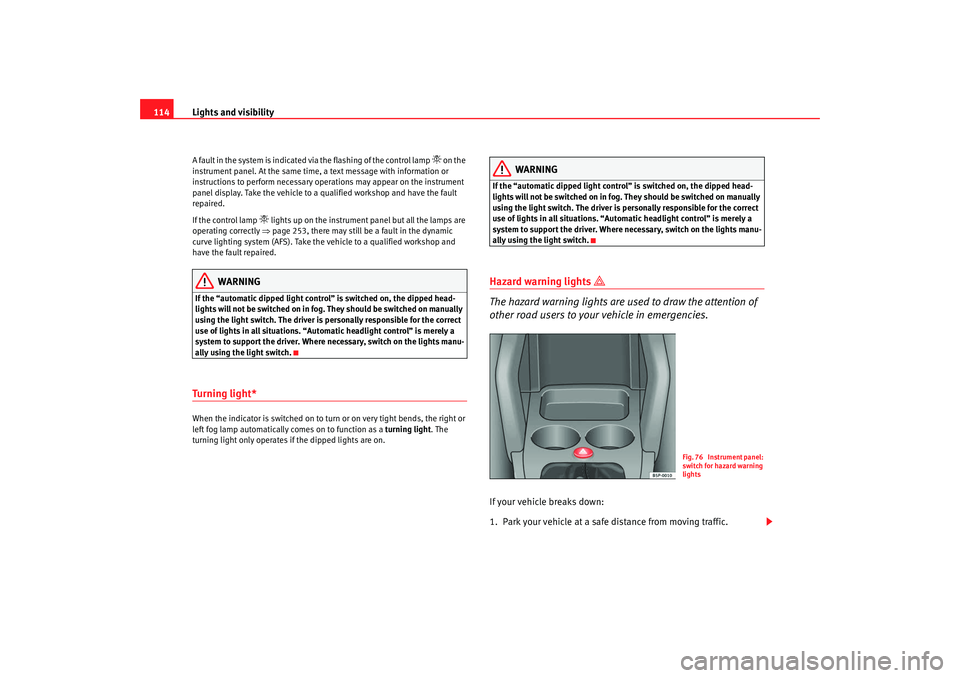
ally using the light switch.Hazard warning lights
The hazard warning lights are used to draw the attention of
other road users to your vehicle in emergencies.
If your vehicle breaks down:
1. Park your vehicle at a safe distance from moving traffic.
Fig. 76 Instrument panel:
switch for hazard warning
lights
AlteaXL_EN.book Seite 114 M ontag, 2. Februar 2009 12:26 12
Page 116 of 297
Lights and visibility115
Safety First
Operating instructions
Practical tips
Te c h n i c a l D a t a
2. Press the button to switch on the hazard warning lights ⇒.
3. Switch the engine off.
4. Apply the handbrake.
5. On a manual gearbox engage 1st gear, and for an automatic move the selector lever to P.
6. Use the warning triangle to draw the attention of other road users
to your vehicle.
7. Always take the vehicle key wi th you when you leave the vehicle.You should switch on the hazard warning lights to warn other road users, for
instance when:•
reaching the tail end of a traffic jam,
•
there is an emergency
•
your vehicle breaks down due to a technical fault,
•
you are towing another vehicle or your vehicle is being towed.
All turn signals flash simultaneously when the hazard warning lights are
switched on. That is that the two turn signal indicator lamps
and the
indicator lamp in the switch
will flash at the same time. The hazard
warning lights also work when the ignition is switched off.
Emergency braking function
When the vehicle detects sudden brakin g, the hazard warning lights auto-
matically come on to warn vehicles behind. The hazard warning lights go off
when the vehicle accelerates or the hazard warning light switch is pressed.
WARNING
•
The risk of an accident increases if your vehicle breaks down. Always
use the hazard warning lights and a wa rning triangle to draw the attention
of other road users to your stationary vehicle.
•
Never park where the catalytic converter could come into contact with
inflammable materials under the vehicle, for example dry grass or spilt
petrol. This could start a fire!Note
•
The battery will run down if the hazard warning lights are left on for a long
time, even if the ignition is switched off.
•
The use of the hazard warning lights de scribed here is subject to the rele-
vant statutory requirements.
AlteaXL_EN.book Seite 115 M ontag, 2. Februar 2009 12:26 12