light Seat Altea XL 2011 Owners Manual
[x] Cancel search | Manufacturer: SEAT, Model Year: 2011, Model line: Altea XL, Model: Seat Altea XL 2011Pages: 319, PDF Size: 8.92 MB
Page 249 of 319
Checking and refilling levels247
Safety First
Operating Instructions
Practical Tips
Technical Specifications
Vehicle batteryWarnings on handling the battery
WARNING
Always be aware of the danger of injury and chemical burns as well as the
risk of accident or fire when working on the battery and the electrical
system:•Wear eye protection. Protect your eyes, skin and clothing from acid and
particles containing lead.•Battery acid is very corrosive and caustic. Wear protective gloves and
eye protection. Do not tilt the batteries. This could spill acid through the
vents. Rinse battery acid from eyes immediately for several minutes with
clear water. Then seek medical care immediately. Neutralise any acid
splashes on the skin or clothing with a soapy solution, and rinse off with
plenty of water. If acid is swallowed by mistake, consult a doctor immedi-
ately.•Fires, sparks, open flames and smoking are prohibited. When handling
cables and electrical equipment, avoid causing sparks and electrostatic charge. Never short the battery terminals. High-energy sparks can cause
injury.
•A highly explosive mixture of gases is released when the battery is
under charge. The batteries should be charged in a well-ventilated room
only.•Keep children away from acid and batteries.•Before working on the electrical system, you must switch off the
engine, the ignition and all consumers. The negative cable on the battery
must be disconnected. When a light bulb is changed, you need only switch
off the light.•Deactivate the anti-theft alarm by unlocking the vehicle before you
disconnect the battery! The alarm will otherwise be triggered.•When disconnecting the battery from the vehicle electrical system,
disconnect first the negative cable and then the positive cable.•Switch off all electrical consumers before reconnecting the battery.
Reconnect first the positive cable and then the negative cable. Never
reverse the polarity of the connections. This could cause an electrical fire.•Never charge a frozen battery, or one which has thawed. This could
result in explosions and chemical burns. Always replace a battery which
has frozen. A flat battery can freeze at temperatures around 0 °C.•Ensure that the vent hose is always connected to the battery.•Never use a defective battery. This could cause an explosion. Replace a
damaged battery immediately.Caution
•Never disconnect the battery if the ignition is switched on or if the engine
is running. This could damage the electrical system or electronic compo-
nents.•Do not expose the battery to direct sunlight over a long period of time, as
the intense ultraviolet radiation can damage the battery housing.
Wear eye protection
Battery acid is very corrosive and caustic. Wear protective
gloves and eye protection!
Ž
Fires, sparks, open flames and smoking are prohibited!
Ÿ
A highly explosive mixture of gases is released when the
battery is under charge.
Keep children away from acid and batteries!
WARNING (continued)
AlteaXL_EN.book Seite 247 Donnerstag, 9. September 2010 12:13 12
Page 253 of 319
Wheels and tyres251
Safety First
Operating Instructions
Practical Tips
Technical Specifications
2. The tyre pressures should only be checked when the tyres are
cold. The slightly raised pressures of warm tyres must not be
reduced.
3. Adjust the tyre pressure to the load you are carrying.Tyre pressure
The correct tyre pressure is especially important at high speeds. The pressure
should therefore be checked at least once a month and before starting a
journey.
The sticker with the tyre pressure values can be found on the inside of the
tank flap. The tyre pressure values given are for cold tyres. Do not reduce the
slightly raised pressures of warm tyres ⇒.
WARNING
•Check the tyre pressure at least once per month. Checking the tyre
pressure is very important. If the tyre pressure is too high or too low, there
is an increased danger of accidents - particularly at high speeds.•A tyre can easily burst if the pressure is too low, causing an accident!•At continuously high speeds, a tyre with insufficient pressure flexes
more. In this way it becomes too hot, and this can cause tread separation
and tyre blow-out. Always observe the recommended tyre pressures.•If the tyre pressure is too low or too high, the tyres will wear prema-
turely and the vehicle will not handle well. Risk of accident!For the sake of the environment
Under-inflated tyres will increase fuel consumption.
Tyre pressure monitoring
The tyre pressure monitoring system constantly checks the
pressure of the tyres.The system uses the speed sensors of the ABS wheels. It operates by
analysing the speed and frequency spectrum of each wheel.
For optimum performance, use genuine SEAT tyres. In addition, check and
adjust tyre pressures regularly.
Whenever the tyre pressures are changed or one or more tyres are changed,
the system should be Reset by pressing the SET switch on the centre console.
The system warns the driver in the event of a loss of pressure by means of
symbols and messages in the instrument panel display. The system uses ESP
⇒ page 199.
Note that tyre pressure also depends on tyre temperature. Tyre pressure
increases about 0.1 bar for each 10 °C in tyre temperature increase. The tyre
heats up while the vehicle is being driven and the tyre pressure will rise
accordingly. For this reason, you should only adjust the tyre pressures when
they are cold (i.e. approximately at ambient temperature).
To ensure that the tyre pressure monitoring system works reliably, you should
check and, if necessary, adjust the tyre pressures at regular intervals and
store the correct pressures (reference values) in the system.
A tyre pr essure i nfor ma ti on lab e l is a tta che d to t he insi de o f the fu el ta nk f lap.
WARNING
•Never adjust tyre pressure when the tyres are hot. This may damage or
even burst the tyres. Risk of accident!•An insufficiently inflated tyre flexes a lot more at high speeds and
causes significant heating of the tyre. Under these conditions, the tyre
bead may be released or the tyre may burst. Risk of accident!
AlteaXL_EN.book Seite 251 Donnerstag, 9. September 2010 12:13 12
Page 262 of 319
If and when
260reliably seal punctures up to a size of about 4 mm caused by the penetration
of a foreign body into the tyre.
Note
•Seek professional assistance if the repair of a tyre puncture is not
possible with the sealing compound.Changing a wheelPreparation work
What you must do before changing a wheel.– If you have a flat tyre or puncture, park the vehicle as far away from the flow of traffic as possible. Choose a location that is as
level as possible.
– All passengers should leave the vehicle. They should wait in a safe area (for instance behind the roadside crash barrier).
– Switch off the engine. Switch on the hazard warning lights.
–Apply the handbrake firmly.
– Engage the first gear, or put the selector lever to position P for
those vehicles with an automatic gearbox.
– If you are towing a trailer, unhitch it from your vehicle.
–Take the vehicle tools and the spare wheel out of the luggage
compartment.
WARNING
Put the hazard warning lights on and place the warning triangle in position.
This is for your own safety and also warns other road users.
Caution
If you have to change the tyre on a gradient, block the wheel opposite the
wheel being changed by placing a stone or similar object under it to prevent
the vehicle from rolling away.
Note
Please observe legal requirements when doing so.Changing a wheelChange the wheel as described below
– Pull off the hub cap . Also see ⇒page 261.
– Slacken the wheel bolts.
– Raise the car with the jack at the corresponding point.
– Remove the wheel and then mount the spare wheel
– Lower the vehicle.
– Tighten the wheel bolts firmly with the box spanner.
–Replace the hub cap .
AlteaXL_EN.book Seite 260 Donnerstag, 9. September 2010 12:13 12
Page 267 of 319
If and when265
Safety First
Operating Instructions
Practical Tips
Technical Specifications
Jack position points for vehicles with sill panel trim* Vehicles with plastic sill panel trim, with cover*
– Remove the cap to access the anchor point for the vehicle jack
⇒fig. 181 .
–Pull on the cover and remove it fr om its allotment in the direction
of the arrow ⇒fig. 181 .
– Once the cover has been released, it will remain connected to its strap so that is not lost.
Removing and fitting the wheel
For removal and fitting the wheel, the following tasks must be
completed.After loosening the wheel bolts and raising the vehicle with the jack,
change the wheel as described below:
Removing a wheel
– Unscrew the bolts using the hexagonal tool in the handle of the
screwdriver (vehicle tool) and place them on a clean surface
⇒ fig. 182 .
Fitting a wheel
– Screw in the wheel bolts and tighten them lightly using the hexagonal socket in the screwdriver handle.
Fig. 181 Plastic sill panel
trim with jack allotment
cover
AA
Fig. 182 Changing the
wheel: Hexagonal socket
in screwdriver handle to
turn the wheel bolts
AlteaXL_EN.book Seite 265 Donnerstag, 9. September 2010 12:13 12
Page 270 of 319
If and when
268
–Take the tyre repair kit out of the luggage compartment.
WARNING
Put the hazard warning lights on and place the warning triangle in position.
This is for your own safety and also warns other road users.
Caution
Take special care if you have to repair a tyre on a slope.
Note
Please observe legal requirements when doing so.Tyre repair
The following sections describe the procedures for repairing
a tyre.Using the sealing compound
– The instructions on the containe r give detailed information on
how to use the sealing compound.
Inflating the tyre.
– Remove the air compressor and hose from the container.
– Screw the retaining nut onto the valve.
– Plug the compressor cable into a 12 volt power socket. – Turn on compressor and monitor the pressure shown on the pres-
sure gauge.
Completing the repair
– Remove the compressor hose from the valve.
– Fit the valve cap.
– Unplug the compressor from the socket.
– Return all tools to their proper storing location.
Note
•If the vehicle is equipped with tyre pressure control, enter the new tyre
pressures using the SET button on the centre console.•The compressor should never be allowed to run for longer than 6
minutes.
AlteaXL_EN.book Seite 268 Donnerstag, 9. September 2010 12:13 12
Page 272 of 319
If and when
270The electric windows are protected by circuit breakers . These reset automat-
ically after a few seconds when the overload (caused for example by frozen
windows) has been corrected.
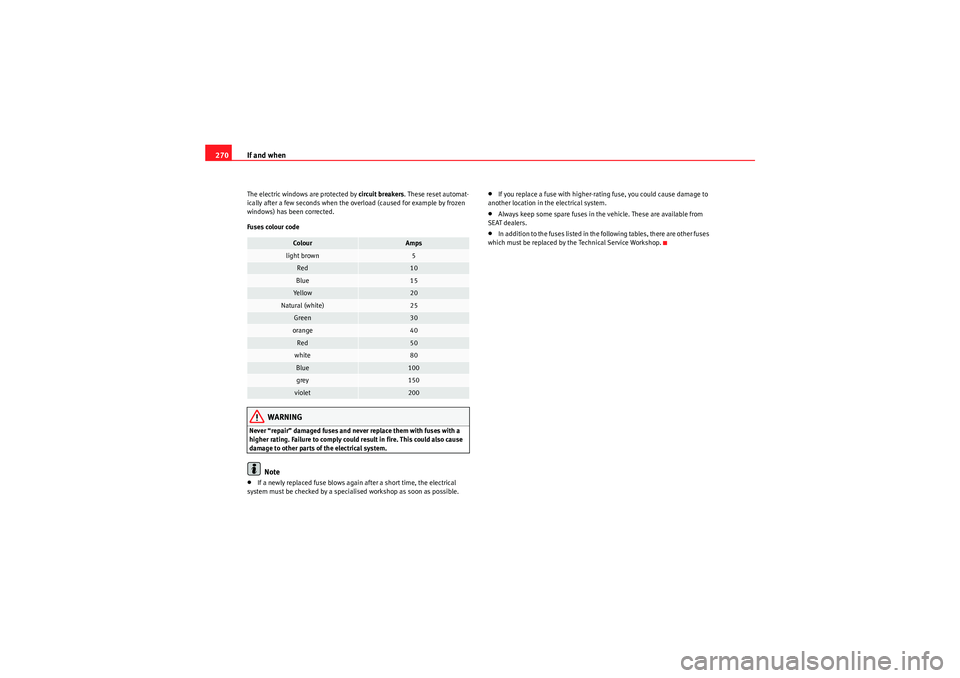
Fuses colour code
WARNING
Never “repair” damaged fuses and never replace them with fuses with a
higher rating. Failure to comply could result in fire. This could also cause
damage to other parts of the electrical system.
Note
•If a newly replaced fuse blows again after a short time, the electrical
system must be checked by a specialised workshop as soon as possible.
•If you replace a fuse with higher-rating fuse, you could cause damage to
another location in the electrical system.•Always keep some spare fuses in the vehicle. These are available from
SEAT dealers.•In addition to the fuses listed in the following tables, there are other fuses
which must be replaced by the Technical Service Workshop.
Colour
Amps
light brown
5
Red
10
Blue
15
Ye ll ow
20
Natural (white)
25
Green
30
orange
40
Red
50
white
80
Blue
100
grey
150
violet
200
AlteaXL_EN.book Seite 270 Donnerstag, 9. September 2010 12:13 12
Page 273 of 319
If and when271
Safety First
Operating Instructions
Practical Tips
Technical Specifications
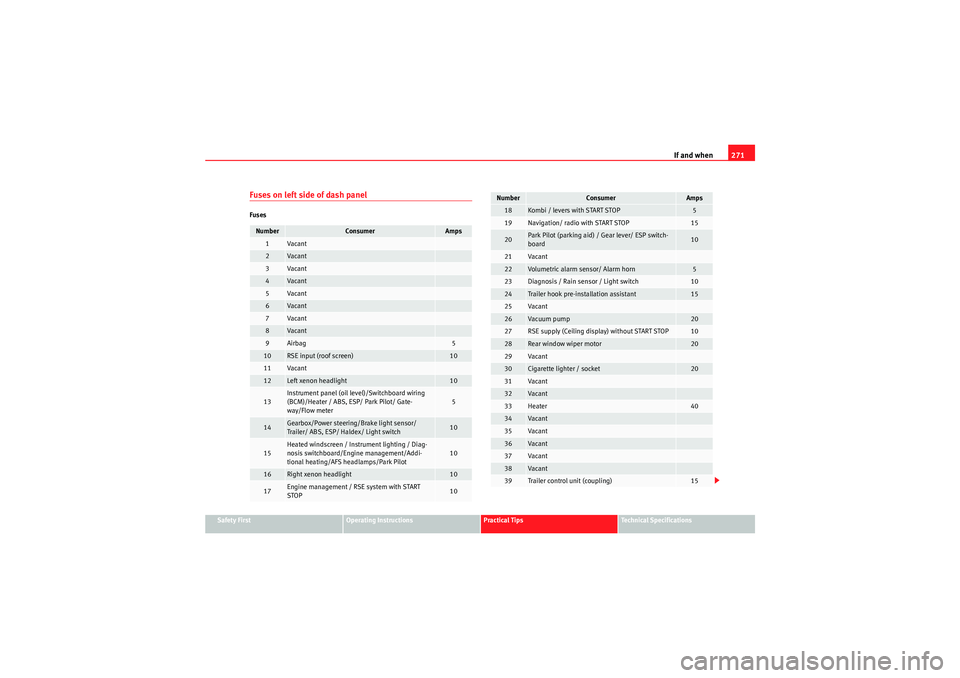
Fuses on left side of dash panelFusesNumber
Consumer
Amps
1
Va can t
2
Va can t
3
Va can t
4
Va can t
5
Va can t
6
Va can t
7
Va can t
8
Va can t
9
Airbag
5
10
RSE input (roof screen)
10
11
Va can t
12
Left xenon headlight
10
13
Instrument panel (oil level)/Switchboard wiring
(BCM)/Heater / ABS, ESP/ Park Pilot/ Gate-
way/Flow meter
5
14
Gearbox/Power steering/Brake light sensor/
Trailer/ ABS, ESP/ Haldex/ Light switch
10
15
Heated windscreen / Instrument lighting / Diag-
nosis switchboard/Engine management/Addi-
tional heating/AFS headlamps/Park Pilot
10
16
Right xenon headlight
10
17
Engine management / RSE system with START
STOP
10
18
Kombi / levers with START STOP
5
19
Navigation/ radio with START STOP
15
20
Park Pilot (parking aid) / Gear lever/ ESP switch-
board
10
21
Va can t
22
Volumetric alarm sensor/ Alarm horn
5
23
Diagnosis / Rain sensor / Light switch
10
24
Trailer hook pre-installation assistant
15
25
Va can t
26
Vacuum pump
20
27
RSE supply (Ceiling display) without START STOP
10
28
Rear window wiper motor
20
29
Va can t
30
Cigarette lighter / socket
20
31
Va can t
32
Va can t
33
Heater
40
34
Va can t
35
Va can t
36
Va can t
37
Va can t
38
Va can t
39
Trailer control unit (coupling)
15
Number
Consumer
Amps
AlteaXL_EN.book Seite 271 Donnerstag, 9. September 2010 12:13 12
Page 274 of 319
If and when
272Some of the electrical items listed in the table are only fitted on certain
models or are optional extras. Please note that the above list, while correct at the time of printing, is subject
to alterations. If discrepancies should occur, please refer to the sticker on the
inside of the fuse cover for the correct information for your model.
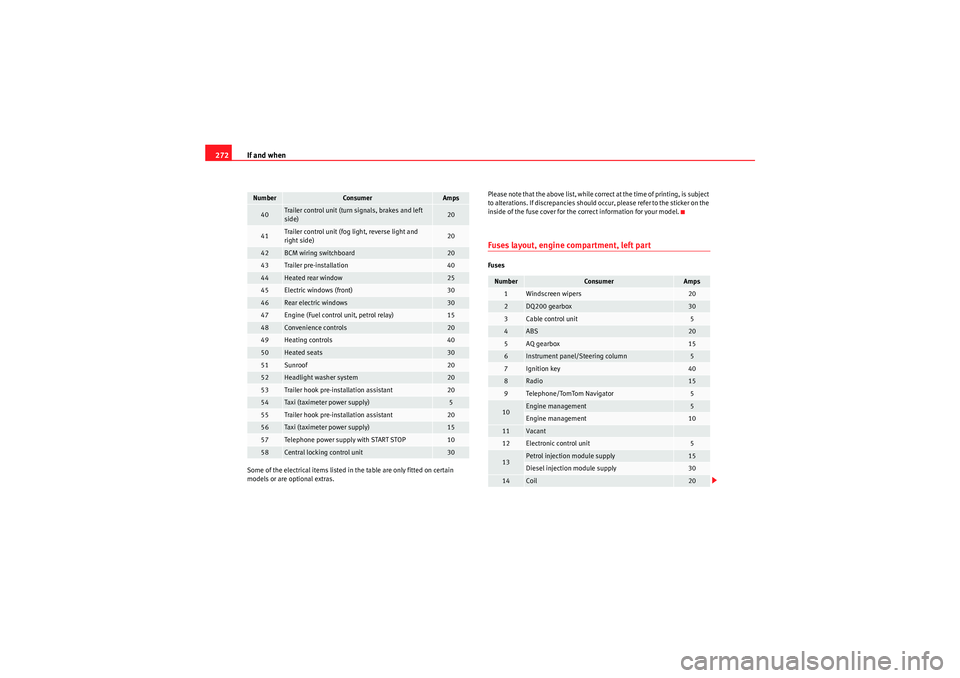
Fuses layout, engine compartment, left partFuses
40
Trailer control unit (turn signals, brakes and left
side)
20
41
Trailer control unit (fog light, reverse light and
right side)
20
42
BCM wiring switchboard
20
43
Trailer pre-installation
40
44
Heated rear window
25
45
Electric windows (front)
30
46
Rear electric windows
30
47
Engine (Fuel control unit, petrol relay)
15
48
Convenience controls
20
49
Heating controls
40
50
Heated seats
30
51
Sunroof
20
52
Headlight washer system
20
53
Trailer hook pre-installation assistant
20
54
Taxi (taximeter power supply)
5
55
Trailer hook pre-installation assistant
20
56
Taxi (taximeter power supply)
15
57
Telephone power supply with START STOP
10
58
Central locking control unit
30
Number
Consumer
Amps
Number
Consumer
Amps
1
Windscreen wipers
20
2
DQ200 gearbox
30
3
Cable control unit
5
4
ABS
20
5
AQ gearbox
15
6
Instrument panel/Steering column
5
7
Ignition key
40
8
Radio
15
9
Telephone/TomTom Navigator
5
10
Engine management
5
Engine management
10
11
Vacant
12
Electronic control unit
5
13
Petrol injection module supply
15
Diesel injection module supply
30
14
Coil
20
AlteaXL_EN.book Seite 272 Donnerstag, 9. September 2010 12:13 12
Page 275 of 319
If and when273
Safety First
Operating Instructions
Practical Tips
Technical Specifications
Bulb changeGeneral notesBefore changing any bulb, first turn off the failed component.
Do not touch the bulb glass. Fingerprints vaporise in the heat, causing a
reduction in the bulb life and condensation on the mirror surface, thus
reducing efficiency.
A bulb should only be replaced by one of the sam e type. The type is inscribed
on the bulb, either on the glass part or on the base.
It is highly recommended to keep a box of spare bulbs in the vehicle. At the
very least, the following spare bulbs, which are essential for road safety,
should be kept in the vehicle.
Main headlights
Dipped beam - H7
Main beam - H1
Position - W5W
Turn signal - PY21W
Xenon
26)/adaptive headlights
Dipped and full beam - D1S
27)
Daylight - P21W SLL
Position W5W
Turn signals PY21W
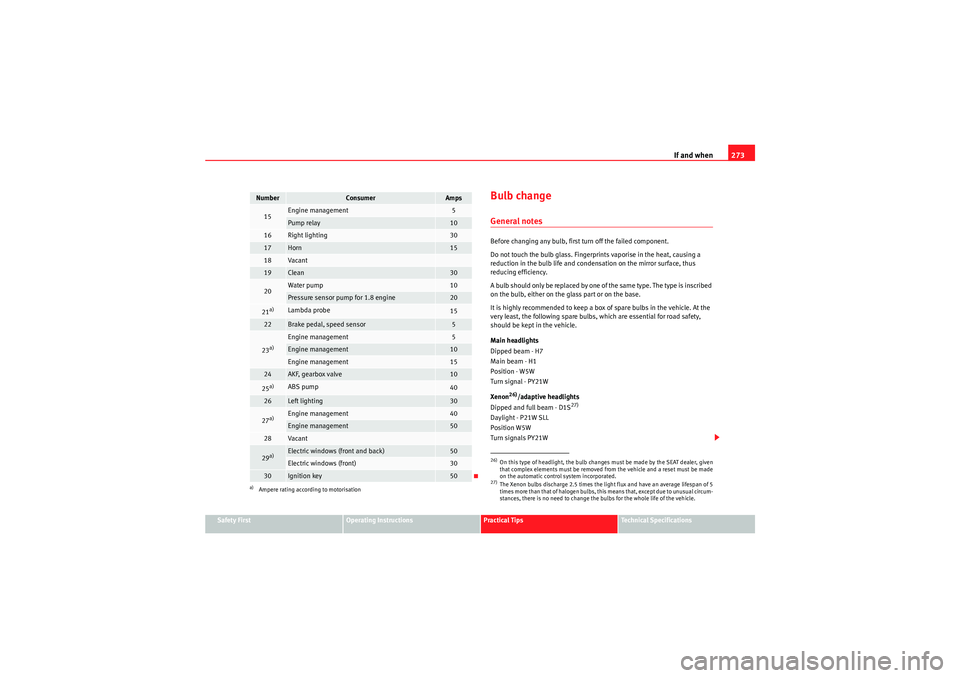
15
Engine management
5
Pump relay
10
16
Right lighting
30
17
Horn
15
18
Vaca n t
19
Clean
30
20
Water pump
10
Pressure sensor pump for 1.8 engine
20
21a)
Lambda probe
15
22
Brake pedal, speed sensor
5
23a)
Engine management
5
Engine management
10
Engine management
15
24
AKF, gearbox valve
10
25a)
ABS pump
40
26
Left lighting
30
27a)
Engine management
40
Engine management
50
28
Vaca n t
29a)
Electric windows (front and back)
50
Electric windows (front)
30
30
Ignition key
50
a)Ampere rating according to motorisationNumber
Consumer
Amps
26)On this type of headlight, the bulb changes must be made by the SEAT dealer, given
that complex elements must be removed from the vehicle and a reset must be made
on the automatic control system incorporated.27)The Xenon bulbs discharge 2.5 times the light flux and have an average lifespan of 5
times more than that of halogen bulbs, this means that, except due to unusual circum-
stances, there is no need to change the bulbs for the whole life of the vehicle.
AlteaXL_EN.book Seite 273 Donnerstag, 9. September 2010 12:13 12
Page 276 of 319
If and when
274Fog lights
Fog lights - H3
Fixed tail light
Stop/Position - P21W
28)
Turn signal - P21W
Mobile tailgate light
Fog light (driver side) - P21W
Reverse (passenger side) - P21W
Position - W5W
Side turn signal
Side turn signal - W5W
Number plate light
Number plate light - C5W
Note
•Depending on weather conditions (cold or wet), the front lights, the fog
lights, the tail lights and the turn signals may be temporarily misted. This has
no influence on the useful life of the lighting system. By switching on the
lights, the area through which the beam of light is projected will quickly be
demisted. However, the edges may continue to be misted.•Please check at regular intervals that all lighting (especially the exterior
lighting) on your vehicle is functioning properly. This is not only in the interest
of your own safety, but also that of all other road users.•Due to the difficulty in accessing some of the bulbs, any replacement work
should be done by a SEAT dealer. However, the following is a description of
how to change the lamps except for the fog lights* and interior lamps.
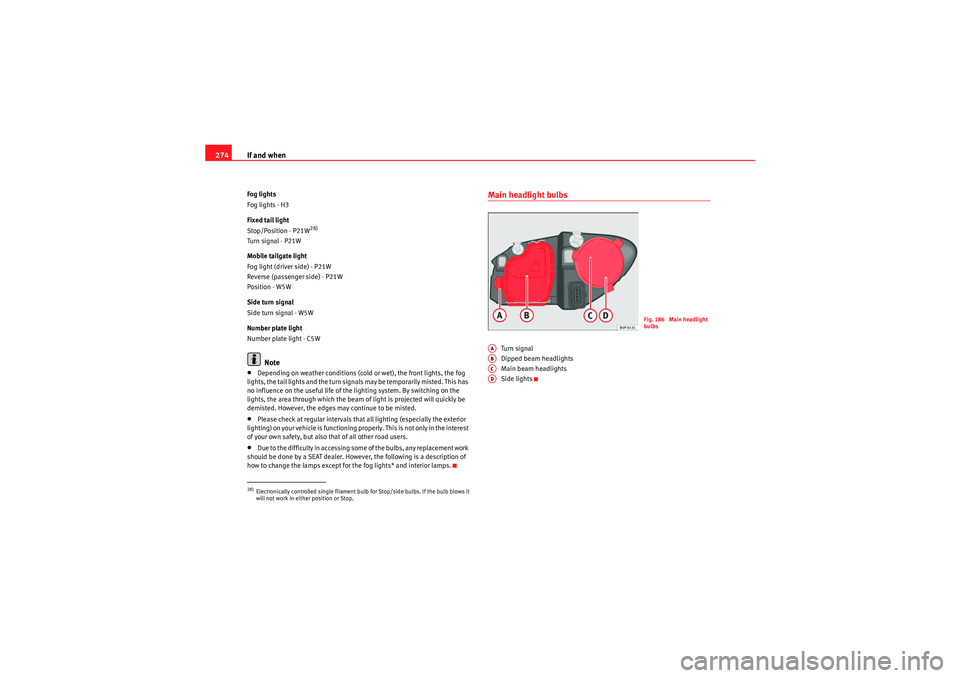
Main headlight bulbs
Turn signal
Dipped beam headlights
Main beam headlights
Side lights
28)Electronically controlled single filament bulb for Stop/side bulbs. If the bulb blows it
will not work in either position or Stop.
Fig. 186 Main headlight
bulbs
AAABACAD
AlteaXL_EN.book Seite 274 Donnerstag, 9. September 2010 12:13 12