height Seat Altea XL 2012 User Guide
[x] Cancel search | Manufacturer: SEAT, Model Year: 2012, Model line: Altea XL, Model: Seat Altea XL 2012Pages: 315, PDF Size: 4.51 MB
Page 137 of 315
135
Seats and storage compartments
Head restraints Correct adjustment of head restraints
Properly adjusted head restraints are an important part of
passenger protection and can reduce the risk of injuries in
most accident situations.
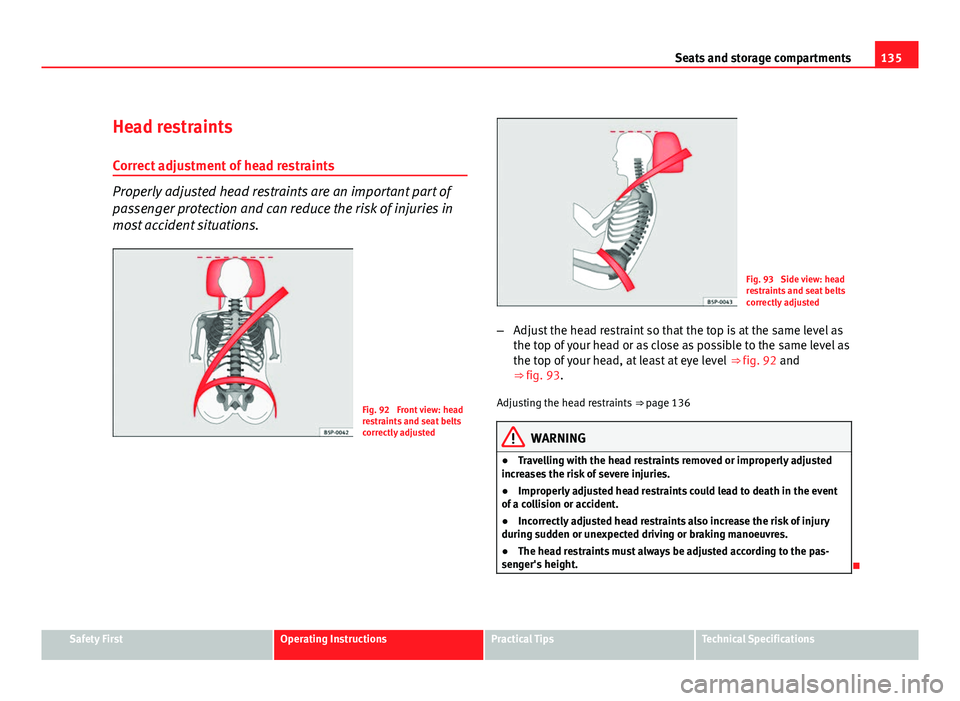
Fig. 92 Front view: head
restraints and seat belts
correctly adjusted
Fig. 93 Side view: head
restraints and seat belts
correctly adjusted
– Adjust the head restraint so that the top is at the same level as
the top of your head or as close as possible to the same level as
the top of your head, at least at eye level ⇒ fig. 92 and
⇒ fig. 93.
Adjusting the head restraints ⇒ page 136
WARNING
● Travelling with the head restraints removed or improperly adjusted
increases the risk of severe injuries.
● Improperly adjusted head restraints could lead to death in the event
of a collision or accident.
● Incorrectly adjusted head restraints also increase the risk of injury
during sudden or unexpected driving or braking manoeuvres.
● The head restraints must always be adjusted according to the pas-
senger's height.
Safety FirstOperating InstructionsPractical TipsTechnical Specifications
Page 138 of 315
136Seats and storage compartments
Removing or adjusting head restraints
The head restraints can be adjusted by moving them up and
down.
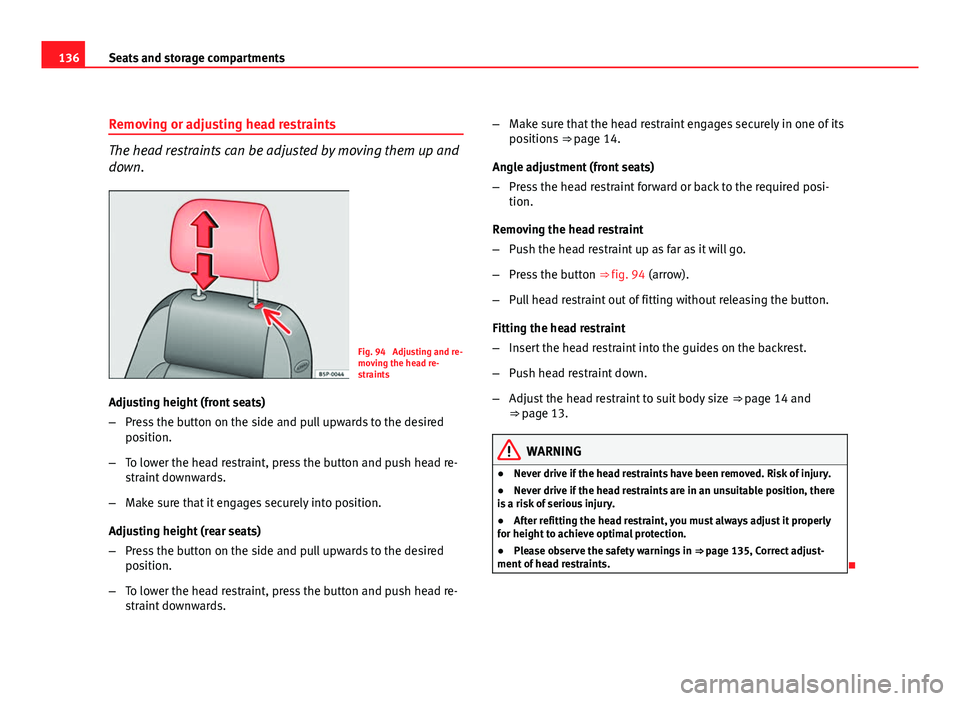
Fig. 94 Adjusting and re-
moving the head re-
straints
Adjusting height (front seats)
– Press the button on the side and pull upwards to the desired
position.
– To lower the head restraint, press the button and push head re-
straint downwards.
– Make sure that it engages securely into position.
Adjusting height (rear seats)
– Press the button on the side and pull upwards to the desired
position.
– To lower the head restraint, press the button and push head re-
straint downwards. –
Make sure that the head restraint engages securely in one of its
positions ⇒ page 14.
Angle adjustment (front seats)
– Press the head restraint forward or back to the required posi-
tion.
Removing the head restraint
– Push the head restraint up as far as it will go.
– Press the button ⇒ fig. 94 (arrow).
– Pull head restraint out of fitting without releasing the button.
Fitting the head restraint
– Insert the head restraint into the guides on the backrest.
– Push head restraint down.
– Adjust the head restraint to suit body size ⇒ page 14 and
⇒ page 13.
WARNING
● Never drive if the head restraints have been removed. Risk of injury.
● Never drive if the head restraints are in an unsuitable position, there
is a risk of serious injury.
● After refitting the head restraint, you must always adjust it properly
for height to achieve optimal protection.
● Please observe the safety warnings in ⇒ page 135, Correct adjust-
ment of head restraints.
Page 139 of 315
137
Seats and storage compartments
Front seats
Adjustment of the front seats
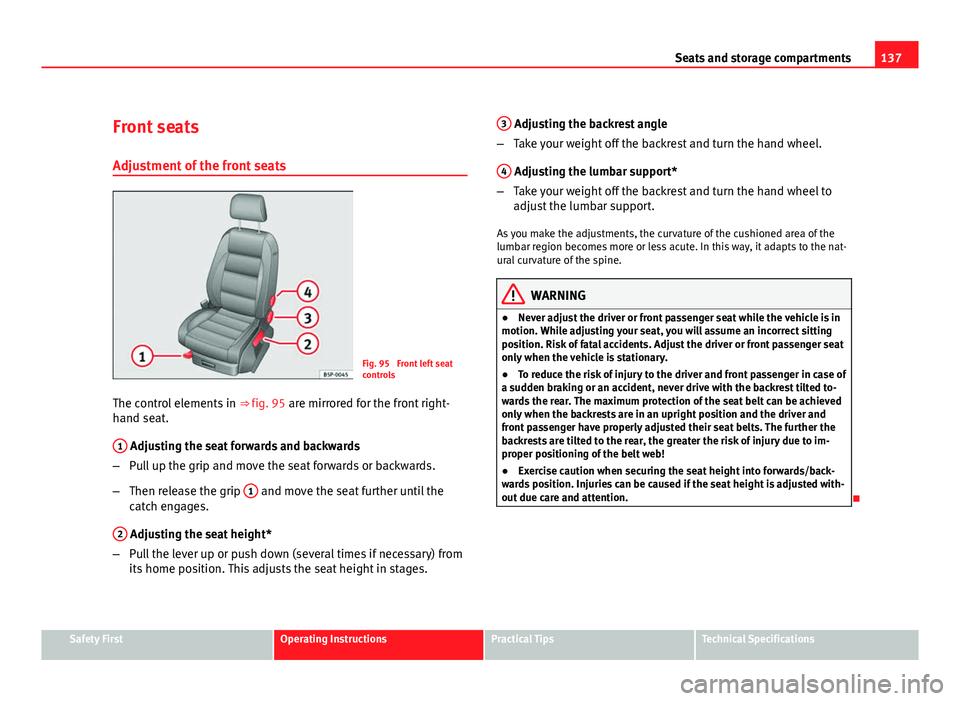
Fig. 95 Front left seat
controls
The control elements in ⇒ fig. 95 are mirrored for the front right-
hand seat.
1
Adjusting the seat forwards and backwards
– Pull up the grip and move the seat forwards or backwards.
– Then release the grip 1
and move the seat further until the
catch engages.
2
Adjusting the seat height*
– Pull the lever up or push down (several times if necessary) from
its home position. This adjusts the seat height in stages. 3
Adjusting the backrest angle
– Take your weight off the backrest and turn the hand wheel.
4
Adjusting the lumbar support*
– Take your weight off the backrest and turn the hand wheel to
adjust the lumbar support.
As you make the adjustments, the curvature of the cushioned area of the
lumbar region becomes more or less acute. In this way, it adapts to the nat-
ural curvature of the spine.
WARNING
● Never adjust the driver or front passenger seat while the vehicle is in
motion. While adjusting your seat, you will assume an incorrect sitting
position. Risk of fatal accidents. Adjust the driver or front passenger seat
only when the vehicle is stationary.
● To reduce the risk of injury to the driver and front passenger in case of
a sudden braking or an accident, never drive with the backrest tilted to-
wards the rear. The maximum protection of the seat belt can be achieved
only when the backrests are in an upright position and the driver and
front passenger have properly adjusted their seat belts. The further the
backrests are tilted to the rear, the greater the risk of injury due to im-
proper positioning of the belt web!
● Exercise caution when securing the seat height into forwards/back-
wards position. Injuries can be caused if the seat height is adjusted with-
out due care and attention.
Safety FirstOperating InstructionsPractical TipsTechnical Specifications
Page 171 of 315
169
Driving
Driving SteeringAdjusting the steering wheel position
The height and reach of the steering wheel can be freely ad-
justed to suit the driver.
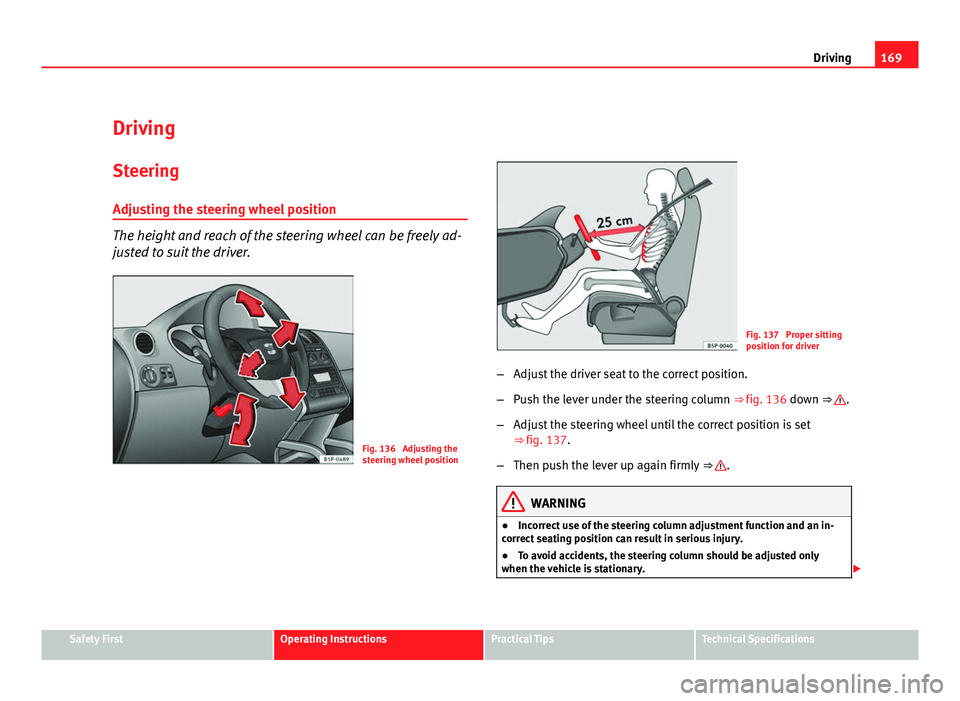
Fig. 136 Adjusting the
steering wheel position
Fig. 137 Proper sitting
position for driver
– Adjust the driver seat to the correct position.
– Push the lever under the steering column ⇒ fig. 136 down ⇒
.
– Adjust the steering wheel until the correct position is set
⇒ fig. 137.
– Then push the lever up again firmly ⇒
.
WARNING
● Incorrect use of the steering column adjustment function and an in-
correct seating position can result in serious injury.
● To avoid accidents, the steering column should be adjusted only
when the vehicle is stationary.
Safety FirstOperating InstructionsPractical TipsTechnical Specifications
Page 235 of 315
233
Checking and refilling levels
WARNING (Continued)
● Wait until no more steam, smoke or coolant is emitted from the bon-
net, then carefully open the bonnet.
● When working in the engine compartment, always observe the safety
warnings ⇒ page 230.
Closing the bonnet
– Raise the bonnet slightly.
– Release the bonnet stay and replace it in its support.
– At a height of about 30 cm let it fall so it is locked.
If the bonnet does not close, do not press downwards. Open it once more
and let it fall as before.
WARNING
If the bonnet is not closed properly, it could open while you are driving
and completely obscure your view of the road. Risk of accident.
● After closing the bonnet, always check that it is properly secured. The
bonnet must be flush with the surrounding body panels.
● If you notice that the bonnet latch is not secured when the vehicle is
moving, stop the vehicle immediately and close the bonnet properly.
Risk of accident.
Engine oil
General notes
The engine comes with a special, high quality, multi grade oil that can be
used in all seasons of the year except for those regions affected by extreme
cold.
As the use of good quality oil is necessary for the correct operation and long
service life of the engine, when it becomes necessary to replenish or
change the oil, always use an oil that complies to the VW standards.
The specifications (VW standards) set out in the following page should ap-
pear on the container of the service oil; when the container displays the
specific standards for petrol and diesel engines together, it means that the
oil can be used for both types of engines.
We recommend that the oil change, indicated in the Maintenance Pro-
gramme, be performed by an Authorised Service Centre or a specialised
workshop.
The correct oil specifications for your engine are listed in ⇒ page 234, Oil
properties.
Service intervals
Service intervals can be flexible (LongLife service) or fixed (dependent on
time/distance travelled).
If the PR code that appears on the back of the Maintenance Programme
booklet is QG1, this means that your vehicle has the LongLife service pro-
grammed. If it has the codes QG0 or QG2 the interval service is dependent
on time/distance travelled.
Flexible service intervals (LongLife*)
Special oils and processes have been developed which, depending on the
characteristics and individual driving profiles, allow to extend the oil
change service (LongLife service intervals).
Safety FirstOperating InstructionsPractical TipsTechnical Specifications
Page 254 of 315
252Wheels and tyres
WARNING (Continued)
● Avoid driving over obstacles (for example kerbs) or potholes.
● If one or more tyres are being driven in emergency conditions, the
driving quality of the vehicle is impaired and there is a risk of accident.
Note
● The run-flat tyres do not “deflate” on losing pressure because they are
supported on the reinforced sides. Therefore defects in the tyre cannot be
detected with a visual inspection.
● Snow chains must not be used on front tyres used in emergency condi-
tions.
New tyres and wheels
New tyres and wheels have to be run in.
The tyres and wheel rims are an essential part of the vehicle's design. The
tyres and rims approved by SEAT are specially matched to the characteris-
tics of the vehicle and make a major contribution to good road holding and
safe handling ⇒
.
Tyres should be replaced at least in pairs and not individually (i.e. both front
tyres or both rear tyres together). A knowledge of tyre designations makes it
easier to choose the correct tyres. Radial tyres have the tyre designations
marked on the sidewall, for example: 195/65 R15 91T
This contains the following information: Tyre width in mm
Height/width ratio in %
Tyre construction: Radial
195
65
R Rim diameter in inches
Load rating code
Speed rating
The tyres could also have the following information:
● A direction of rotation symbol
● “Reinforced” denotes heavy-duty tyres.
The manufacturing date is also indicated on the tyre sidewall (possibly only
on the inner side of the wheel).
“DOT ... 1103...” means, for example, that the tyre was produced in the 11th
week of 2003.
We recommend that work on tyres and wheels be carried out by an Author-
ised Service Centre. They are familiar with the procedure and have the nec-
essary special tools and spare parts as well as the proper facilities for dis-
posing of the old tyres.
Any Authorised Service Centre has full information on the technical require-
ments when installing or changing tyres, wheels or wheel trims.
On vehicles with all-wheel drive, all four tyres must always be fitted with
tyres of the same type, make and tread pattern, as otherwise the driveline
can be damaged by continuous differences in the wheel speeds. For the
same reason, only use a spare wheel with the same tyre dimensions as the
normal road wheels. You may also use the factory-supplied compact tempo-
rary spare wheel.
15
91
T
Page 304 of 315
302Technical specifications
Dimensions and capacities
Dimensions
Length, width 4467 mm/ 1768 mm
Height at kerb weight 1575 mm
Front and rear projection 913 mm/ 976 mm
Wheelbase 2578 mm
Turning circle 10.7 m
Track width a) Front
Rear
1527 mm 1506 mm
1541 mm 1520 mm
Capacities
Fuel tank 55 l. Reserve 7 l.
Windscreen washer fluid container with headlight washer 3 l/ 5.5 l
Tyre pressure
Summer-grade tyres:
The correct tyre pressure can be seen on the sticker on the inside of the tank flap.
Winter tyres:
The pressure of these tyres is the same as the summer tyre pressure plus 0.2 bar.
a) This data will change depending on the type of wheel rim.
Page 305 of 315
Index
A
ABS . . . . . . . . . . . . . . . . . . . . . . . . . . . . . . . . . . 195Warning lamp . . . . . . . . . . . . . . . . . . . . . . . . 84
Accessories . . . . . . . . . . . . . . . . . . . . . . . . . . . . 221
Acoustic signal . . . . . . . . . . . . . . . . . . . . . . . . . . 20
Acoustic warning . . . . . . . . . . . . . . . . . . . . . . . 171
Adaptive headlights . . . . . . . . . . . . . . . . . . . . . 119
Adjusting the seat belt height . . . . . . . . . . . . . . 28
AFS (cornering lights) . . . . . . . . . . . . . . . . . . . 120
Airbag covers . . . . . . . . . . . . . . . . . . . . . . . . . . . 36
Airbag system . . . . . . . . . . . . . . . . . . . . . . . . . . . 30 Curtain airbags . . . . . . . . . . . . . . . . . . . . . . . 41
Front airbags . . . . . . . . . . . . . . . . . . . . . . . . 34
Side airbags . . . . . . . . . . . . . . . . . . . . . . . . . 38
Warning lamp . . . . . . . . . . . . . . . . . . . . . . . . 32
Air conditioner General notes . . . . . . . . . . . . . . . . . . . . . . . 167
Air conditioner automatic mode 2C-Climatronic . . . . . . . . . . . . . . . . . . . . . . 165
Air conditioner* 2C-Climatronic* . . . . . . . . . . . . . . . . . . . . . 163
Air conditioning* . . . . . . . . . . . . . . . . . . . . . . . 159
Air recirculation mode 2C-Climatronic . . . . . . . . . . . . . . . . . . . . . . 167
Manual air conditioner . . . . . . . . . . . . . . . . 161
Alarm system Switching off . . . . . . . . . . . . . . . . . . . . . . . . 106
All-wheel drive . . . . . . . . . . . . . . . . . . . . . . . . . 198 Alternator
Warning lamp . . . . . . . . . . . . . . . . . . . . . . . . 85
Anti-freeze . . . . . . . . . . . . . . . . . . . . . . . . . . . . 237
Anti-lock brake system . . . . . . . . . . . . . . . . . . . 195 Warning lamp . . . . . . . . . . . . . . . . . . . . . . . . 84
Anti-theft alarm system . . . . . . . . . . . . . . . . . . 106 Switching off . . . . . . . . . . . . . . . . . . . . . . . . 106
Anti-theft wheel bolts . . . . . . . . . . . . . . . . . . . 260
Aquaplaning . . . . . . . . . . . . . . . . . . . . . . . . . . . 250
Ashtray* . . . . . . . . . . . . . . . . . . . . . . . . . . . . . . 149
Aspects to note before setting off . . . . . . . . . . . . 8
ASR . . . . . . . . . . . . . . . . . . . . . . . . . . . . . . . . . . 195 Control lamp . . . . . . . . . . . . . . . . . . . . . . . . . 89
Automatic anti-dazzle interior mirror* Activating the anti-dazzle function . . . . . . 131
Deactivating anti-dazzle function . . . . . . . 131
Automatic car wash tunnel . . . . . . . . . . . . . . . 213
Automatic gearbox Kick-down feature . . . . . . . . . . . . . . . . . . . . 184
Automatic gearbox / DSG automatic gearbox 180
Automatic lighting . . . . . . . . . . . . . . . . . . . . . . 116
Automatic windscreeen wiper/washer . . . . . . 127
Auxiliary audio connection: AUX-IN . . . . . . . . 151
B
Ball coupling . . . . . . . . . . . . . . . . . . . . . . . . . . . 209 Battery
Changing . . . . . . . . . . . . . . . . . . . . . . . . . . 246
Charging . . . . . . . . . . . . . . . . . . . . . . . . . . . 246
Winter conditions . . . . . . . . . . . . . . . . . . . . 244
Before setting off . . . . . . . . . . . . . . . . . . . . . . . . . 8
Biodiesel . . . . . . . . . . . . . . . . . . . . . . . . . . . . . . 230
Biodiesel fuel . . . . . . . . . . . . . . . . . . . . . . . . . . 230
Bonnet . . . . . . . . . . . . . . . . . . . . . . . . . . . . . . . 232
Brake fluid . . . . . . . . . . . . . . . . . . . . . . . . . . . . 243 Changing . . . . . . . . . . . . . . . . . . . . . . . . . . 243
Warning lamp . . . . . . . . . . . . . . . . . . . . . . . . 66
Brake pads . . . . . . . . . . . . . . . . . . . . . . . . . . . . 202
Brake pedal warning lamp . . . . . . . . . . . . . . . . . . . . . . . . 90
Brakes . . . . . . . . . . . . . . . . . . . . . . . . . . . . . . . . 202 Worn brake pads . . . . . . . . . . . . . . . . . . . . . 85
Brake servo . . . . . . . . . . . . . . . . . . . . . . . . 194, 202
Brake system . . . . . . . . . . . . . . . . . . . . . . . . . . 243 Brakes . . . . . . . . . . . . . . . . . . . . . . . . . . . . . 199
Brake servo . . . . . . . . . . . . . . . . . . . . . . . . . 199
Warning lamp . . . . . . . . . . . . . . . . . . . . . . . . 86
Braking distance . . . . . . . . . . . . . . . . . . . . . . . 202
Bulb changes General notes . . . . . . . . . . . . . . . . . . . . . . . 270
Bulb defect warning lamp . . . . . . . . . . . . . . . . . . . . . . . . 86
Buzzer . . . . . . . . . . . . . . . . . . . . . . . . . . . . 122, 171
303
Index
Page 311 of 315
SSafe driving . . . . . . . . . . . . . . . . . . . . . . . . . . . . . 7
Safety . . . . . . . . . . . . . . . . . . . . . . . . . . . . . . . . . . 8
Safety equipment . . . . . . . . . . . . . . . . . . . . . . . . . 7
Safety instructions Coolant temperature . . . . . . . . . . . . . . . . . . 82
Safety notes Airbags . . . . . . . . . . . . . . . . . . . . . . . . . . . . . 32
Curtain airbags . . . . . . . . . . . . . . . . . . . . . . . 42
Deactivating front passenger airbag . . . . . . 45
Front airbags . . . . . . . . . . . . . . . . . . . . . . . . 37
Seat belt tensioners . . . . . . . . . . . . . . . . . . . 29
Side airbags . . . . . . . . . . . . . . . . . . . . . . . . . 40
Using child seats . . . . . . . . . . . . . . . . . . . . . 46
Using seat belts . . . . . . . . . . . . . . . . . . . . . . 23
Safety system - Safe . . . . . . . . . . . . . . . . . . . . . . 98
Seals . . . . . . . . . . . . . . . . . . . . . . . . . . . . . . . . . 216
Seat adjustment . . . . . . . . . . . . . . . 134, 137, 139
Seat belt cleaning . . . . . . . . . . . . . . . . . . . . . . 220
Seat belt position Pregnant women . . . . . . . . . . . . . . . . . . . . . 27
Seat belts . . . . . . . . . . . . . . . . . . . . . . . . . . . 26
Seat belt protection . . . . . . . . . . . . . . . . . . . . . . 23
Seat belt release . . . . . . . . . . . . . . . . . . . . . . . . 27
Seat belts . . . . . . . . . . . . . . . . . . . . . . . . . . . . . . 19 Adjustment . . . . . . . . . . . . . . . . . . . . . . . . . . 25
Incorrectly fastened . . . . . . . . . . . . . . . . . . . 28
Not worn . . . . . . . . . . . . . . . . . . . . . . . . . . . . 22
Safety notes . . . . . . . . . . . . . . . . . . . . . . . . . 23
Warning lamp . . . . . . . . . . . . . . . . . . . . . . . . 19 Seat belt tensioner
Warning lamp . . . . . . . . . . . . . . . . . . . . . . . . 32
Seat belt tensioners . . . . . . . . . . . . . . . . . . . . . . 29
Seat belt warning lamp . . . . . . . . . . . . . . . . . . . 19
Seat heating . . . . . . . . . . . . . . . . . . . . . . . . . . . 138
Selective opening* . . . . . . . . . . . . . . . . . . . . . . . 98
Selector lever locking . . . . . . . . . . . . . . . . . . . . 181
Selector lever positions . . . . . . . . . . . . . . . . . . 180
servotronic . . . . . . . . . . . . . . . . . . . . . . . . . . . . 200
Side airbags . . . . . . . . . . . . . . . . . . . . . . . . . . . . 38 Description . . . . . . . . . . . . . . . . . . . . . . . . . . 38
Operation . . . . . . . . . . . . . . . . . . . . . . . . . . . 39
Safety notes . . . . . . . . . . . . . . . . . . . . . . . . . 40
Side lights . . . . . . . . . . . . . . . . . . . . . . . . . . . . . 115
Sitting position Driver . . . . . . . . . . . . . . . . . . . . . . . . . . . . . . . 10
Front passenger . . . . . . . . . . . . . . . . . . . . . . 11
Sitting position, occupants . . . . . . . . . . . . . . . . 10
Sliding/tilting sunroof . . . . . . . . . . . . . . . . . . . 112
Snow chains . . . . . . . . . . . . . . . . . . . . . . . . . . . 254
Soot accumulation in the diesel engine particu- late filter *
Indicator . . . . . . . . . . . . . . . . . . . . . . . . . . . . 83
Spare parts . . . . . . . . . . . . . . . . . . . . . . . . . . . . 221
Spare wheel* . . . . . . . . . . . . . . . . . . . . . . . . . . 256
Start-Stop Activating and deactivating . . . . . . . . . . . . 177
Function . . . . . . . . . . . . . . . . . . . . . . . . . . . 176
Starting petrol engines . . . . . . . . . . . . . . . . . . 172
Starting Petrol engines . . . . . . . . . . . . . . . . . . 173
Starting the engine . . . . . . . . . . . . . . . . . 172, 173 After the fuel tank has been run dry . . . . . 173 Steam jets . . . . . . . . . . . . . . . . . . . . . . . . . . . . . 214
Steering . . . . . . . . . . . . . . . . . . . . . . . . . . . . . . 169
Steering lock . . . . . . . . . . . . . . . . . . . . . . . . 171
Steering wheel audio controls Audio version . . . . . . . . . . . . . . . . . . . . . . . . 91
Audio + telephone version . . . . . . . . . . . . . . 91
Steering wheel height adjustment . . . . . . . . . 169
Storage compartment Centre armrest . . . . . . . . . . . . . . . . . . . . . . 141
Front passenger side . . . . . . . . . . . . . . . . . 141
Other storage compartments . . . . . . . . . . 144
Storage in the luggage compartment . . . . . . . 143
Stowage area Front seats . . . . . . . . . . . . . . . . . . . . . . . . . 142
Sun blind . . . . . . . . . . . . . . . . . . . . . . . . . . . . . 126
Sun visor Sliding/tilting sunroof . . . . . . . . . . . . . . . . 113
Sun visors . . . . . . . . . . . . . . . . . . . . . . . . . . . . . 126
Switch Hazard warning lights . . . . . . . . . . . . . . . . 120
Light switch . . . . . . . . . . . . . . . . . . . . . . . . 115
Switches electric windows . . . . . . . . . . . . . . . . . . . . . 110
Switching off the engine . . . . . . . . . . . . . . . . . 174
T Tailgate . . . . . . . . . . . . . . . . . . . . . . . . . . . . . . . 108 Emergency opening . . . . . . . . . . . . . . . . . . 109
warning lamp . . . . . . . . . . . . . . . . . . . . . . . . 88
Tail lights . . . . . . . . . . . . . . . . . . . . . . . . . . . . . 274
309
Index