ESP Seat Altea XL 2012 Repair Manual
[x] Cancel search | Manufacturer: SEAT, Model Year: 2012, Model line: Altea XL, Model: Seat Altea XL 2012Pages: 315, PDF Size: 4.51 MB
Page 268 of 315
266If and when
Fuses
Changing a fuse
Blown fuses must be replaced
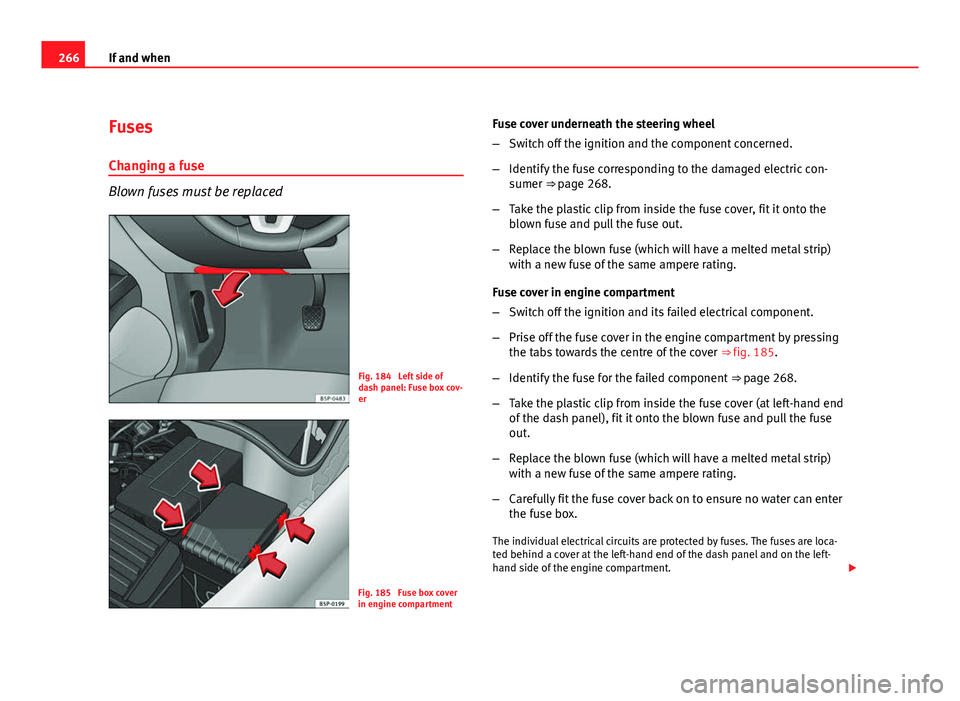
Fig. 184 Left side of
dash panel: Fuse box cov-
er
Fig. 185 Fuse box cover
in engine compartment Fuse cover underneath the steering wheel
–
Switch off the ignition and the component concerned.
– Identify the fuse corresponding to the damaged electric con-
sumer ⇒ page 268.
– Take the plastic clip from inside the fuse cover, fit it onto the
blown fuse and pull the fuse out.
– Replace the blown fuse (which will have a melted metal strip)
with a new fuse of the same ampere rating.
Fuse cover in engine compartment
– Switch off the ignition and its failed electrical component.
– Prise off the fuse cover in the engine compartment by pressing
the tabs towards the centre of the cover ⇒ fig. 185.
– Identify the fuse for the failed component ⇒ page 268.
– Take the plastic clip from inside the fuse cover (at left-hand end
of the dash panel), fit it onto the blown fuse and pull the fuse
out.
– Replace the blown fuse (which will have a melted metal strip)
with a new fuse of the same ampere rating.
– Carefully fit the fuse cover back on to ensure no water can enter
the fuse box.
The individual electrical circuits are protected by fuses. The fuses are loca-
ted behind a cover at the left-hand end of the dash panel and on the left-
hand side of the engine compartment.
Page 270 of 315
268If and when
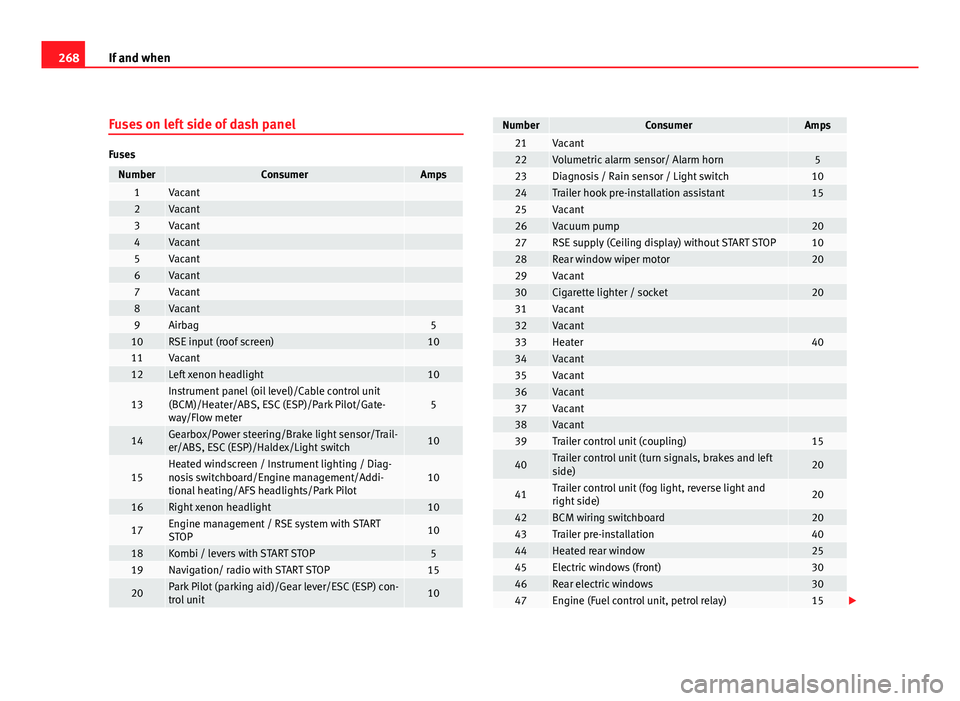
Fuses on left side of dash panel
Fuses
NumberConsumerAmps1Vacant 2Vacant 3Vacant 4Vacant 5Vacant 6Vacant 7Vacant 8Vacant 9Airbag510RSE input (roof screen)1011Vacant 12Left xenon headlight10
13Instrument panel (oil level)/Cable control unit
(BCM)/Heater/ABS, ESC (ESP)/Park Pilot/Gate-
way/Flow meter5
14Gearbox/Power steering/Brake light sensor/Trail-
er/ABS, ESC (ESP)/Haldex/Light switch10
15Heated windscreen / Instrument lighting / Diag-
nosis switchboard/Engine management/Addi-
tional heating/AFS headlights/Park Pilot10
16Right xenon headlight10
17Engine management / RSE system with START
STOP10
18Kombi / levers with START STOP519Navigation/ radio with START STOP15
20Park Pilot (parking aid)/Gear lever/ESC (ESP) con-
trol unit10
NumberConsumerAmps21Vacant 22Volumetric alarm sensor/ Alarm horn523Diagnosis / Rain sensor / Light switch1024Trailer hook pre-installation assistant1525Vacant 26Vacuum pump2027RSE supply (Ceiling display) without START STOP1028Rear window wiper motor2029Vacant 30Cigarette lighter / socket2031Vacant 32Vacant 33Heater4034Vacant 35Vacant 36Vacant 37Vacant 38Vacant 39Trailer control unit (coupling)15
40Trailer control unit (turn signals, brakes and left
side)20
41Trailer control unit (fog light, reverse light and
right side)20
42BCM wiring switchboard2043Trailer pre-installation4044Heated rear window2545Electric windows (front)3046Rear electric windows3047Engine (Fuel control unit, petrol relay)15
Page 272 of 315
270If and when
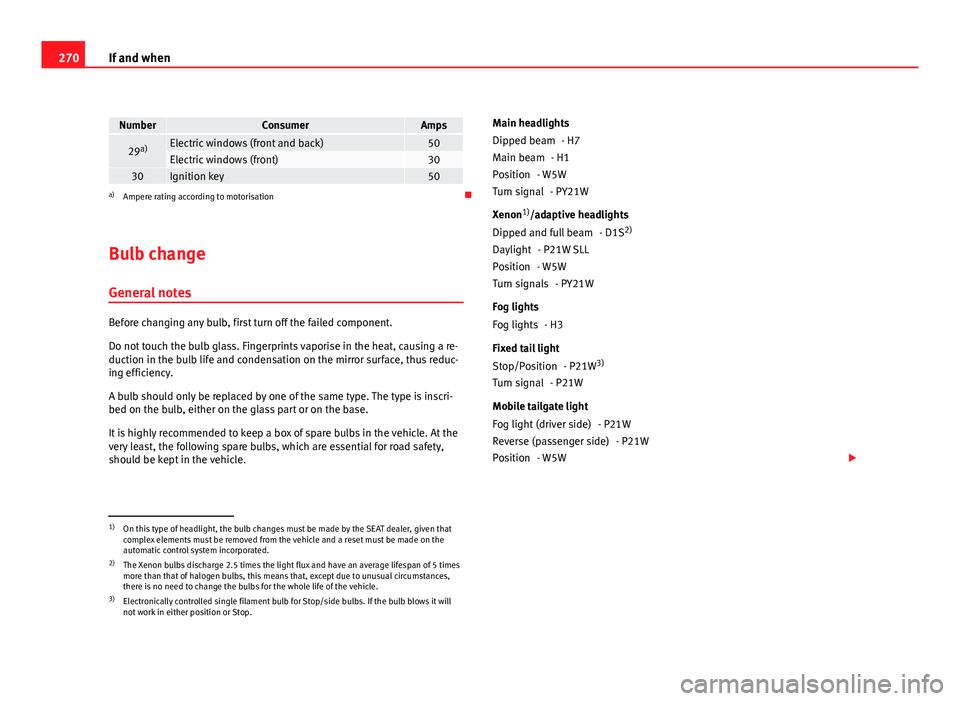
NumberConsumerAmps
29a)Electric windows (front and back)50Electric windows (front)3030Ignition key50a)
Ampere rating according to motorisation
Bulb change General notes
Before changing any bulb, first turn off the failed component.
Do not touch the bulb glass. Fingerprints vaporise in the heat, causing a re-
duction in the bulb life and condensation on the mirror surface, thus reduc-
ing efficiency.
A bulb should only be replaced by one of the same type. The type is inscri-
bed on the bulb, either on the glass part or on the base.
It is highly recommended to keep a box of spare bulbs in the vehicle. At the
very least, the following spare bulbs, which are essential for road safety,
should be kept in the vehicle. Main headlights
- H7
- H1
- W5W - PY21W
Xenon 1)
/adaptive headlights
- D1S2)
- P21W SLL
- W5W - PY21W
Fog lights - H3
Fixed tail light - P21W3)
- P21W
Mobile tailgate light - P21W- P21W
- W5W
Dipped beam
Main beam
Position
Turn signal
Dipped and full beam
Daylight
Position
Turn signals
Fog lights
Stop/Position
Turn signal
Fog light (driver side)
Reverse (passenger side)
Position
1)
On this type of headlight, the bulb changes must be made by the SEAT dealer, given that
complex elements must be removed from the vehicle and a reset must be made on the
automatic control system incorporated.
2) The Xenon bulbs discharge 2.5 times the light flux and have an average lifespan of 5 times
more than that of halogen bulbs, this means that, except due to unusual circumstances,
there is no need to change the bulbs for the whole life of the vehicle.
3) Electronically controlled single filament bulb for Stop/side bulbs. If the bulb blows it will
not work in either position or Stop.
Page 273 of 315
271
If and when
Side turn signal - W5W
Number plate light - C5W
Note
● Depending on weather conditions (cold or wet), the front lights, the fog
lights, the tail lights and the turn signals may be temporarily misted. This
has no influence on the useful life of the lighting system. By switching on
the lights, the area through which the beam of light is projected will quickly
be demisted. However, the edges may continue to be misted.
● Please check at regular intervals that all lighting (especially the exterior
lighting) on your vehicle is functioning properly. This is not only in the inter-
est of your own safety, but also that of all other road users.
● Due to the difficulty in accessing some of the bulbs, any replacement
work should be done by a SEAT dealer. However, the following is a descrip-
tion of how to change the lamps except for the fog lights* and interior
lamps.
Side turn signal
Number plate light
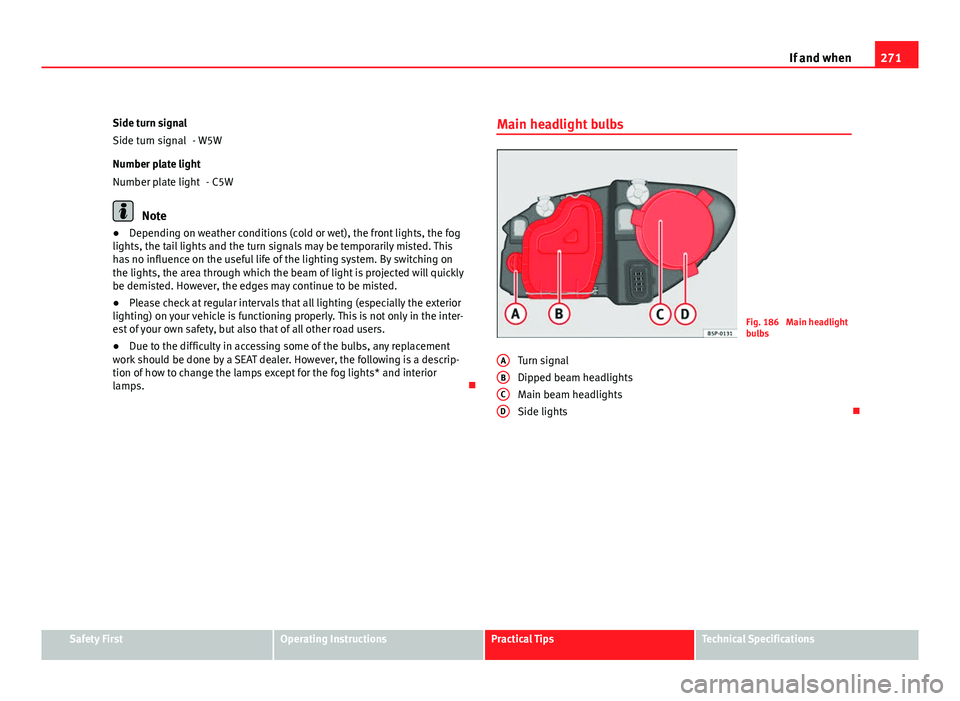
Main headlight bulbs
Fig. 186 Main headlight
bulbs
Turn signal
Dipped beam headlights
Main beam headlights
Side lights
A
BCD
Safety FirstOperating InstructionsPractical TipsTechnical Specifications
Page 284 of 315
282If and when
Towing and tow-starting
Tow-starting
The use of jump leads is preferable to tow-starting.
We recommend that you do not tow-start your vehicle. Jump-start-
ing is preferable ⇒ page 279.
However, if your vehicle has to be tow-started:
– Engage the 2nd or the 3rd gear.
– Keep the clutch pressed down.
– Switch the ignition on.
– Once both vehicles are moving, release the clutch.
– As soon as the engine starts, press the clutch and move the
gear lever into neutral. This helps to prevent driving into the
towing vehicle.
WARNING
The risk of accidents is high when tow-starting. The vehicle being towed
can easily collide with the towing vehicle.
CAUTION
When tow-starting, fuel could enter the catalytic converter and damage it. General notes
Please observe the following points if you use a tow-rope:
Notes for the driver of the towing vehicle
–
Drive slowly at first until the tow-rope is taut. Then accelerate
gradually.
– Begin and change gears cautiously. If you are driving an auto-
matic vehicle, accelerate gently.
– Remember that the brake servo and power steering are not
working in the vehicle you are towing. Brake sooner than nor-
mal and pressing the pedal gently.
Notes for the driver of the towed vehicle
– Ensure that the tow-rope remains taut at all times when towing.
Tow-rope or tow-bar
It is easier and safer to tow a vehicle with a tow-bar. You should only use a
tow-rope if you do not have a tow-bar.
A tow-rope should be slightly elastic to reduce the loading on both vehicles.
It is advisable to use a tow-rope made of synthetic fibre or similarly elastic
material.
Attach the tow-rope or the tow-bar only to the towing eyes provided or a
towing bracket.
Driving style
Towing requires some experience, especially when using a tow-rope. Both
drivers should be familiar with the technique required for towing. Inexper-
ienced drivers should not attempt to tow.
Page 290 of 315
288Description of specifications
Drawbar load
The maximum permitted drawbar load on the ball joint of the towing bracket
must not exceed 75 kg.
In the interest of road safety, we recommend that you always tow approach-
ing the maximum drawbar load. The response of the trailer on the road will
be poor if the drawbar load is too small.
If the maximum permissible drawbar load cannot be met (e.g. with small,
empty and light-weight single axle trailers or tandem axle trailers with a
wheelbase of less than 1 metre), a minimum of 4% of the actual trailer
weight is legally required for the drawbar load.
WARNING
● For safety reasons, do not exceed the 80 km/h limit. This is also valid
in countries where higher speeds are permitted.
● Never exceed the maximum trailer weights or the drawbar load. If the
permissible axle load or the permissible total weight is exceeded, the
driving characteristics of the vehicle may change, leading to accidents,
injuries and damage to the vehicle.
Page 308 of 315
Engine managementWarning lamp . . . . . . . . . . . . . . . . . . . . . . . . 83
Engine oil . . . . . . . . . . . . . . . . . . . . . . . . . . . . . 233 Changing . . . . . . . . . . . . . . . . . . . . . . . . . . 236
Checking engine oil level . . . . . . . . . . . . . . 235
Oil properties . . . . . . . . . . . . . . . . . . . . . . . 234
Specifications . . . . . . . . . . . . . . . . . . . . . . . 233
Topping up . . . . . . . . . . . . . . . . . . . . . . . . . 236
Engine oil dipstick . . . . . . . . . . . . . . . . . . . . . . 235
Engine oil pressure Warning lamp . . . . . . . . . . . . . . . . . . . . . 66, 87
Environment . . . . . . . . . . . . . . . . . . . . . . . . . . . 204 Environmental friendliness . . . . . . . . . . . . 206
Environmentally friendly driving . . . . . . . . . . . 204
Environmental tip Avoiding pollution . . . . . . . . . . . . . . . . . . . 224
ESC . . . . . . . . . . . . . . . . . . . . . . . . . . 89, 170, 196 see also Electronic Stability Control . . . . . 170
ESP see ESC . . . . . . . . . . . . . . . . . . . . 89, 170, 196
Example of menu use Program a speed limit warning . . . . . . . . . . 69
To activate and deactivate the speed limitwarning . . . . . . . . . . . . . . . . . . . . . . . . . . . 69
Example of the use of the menus Open the Configuration menu with the MFIlever . . . . . . . . . . . . . . . . . . . . . . . . . . . . . . 68
Open the Configuration menu with the steering wheel controls . . . . . . . . . . . . . . 69
Examples of menu use Open the main menu . . . . . . . . . . . . . . . . . . 68
Open the winter tyres menu . . . . . . . . . . . . 69
To close the winter tyres menu . . . . . . . . . . 69 Exhaust gas purification system . . . . . . . . . . . 203
Exterior mirrors . . . . . . . . . . . . . . . . . . . . . . . . . 215
F
Fabric trim cleaning . . . . . . . . . . . . . . . . . . . . . 219
Fire extinguisher* . . . . . . . . . . . . . . . . . . . . . . . 153
Flexible service interval display . . . . . . . . . . . . 62
Floor mats . . . . . . . . . . . . . . . . . . . . . . . . . . . . . . 16
Fog lights . . . . . . . . . . . . . . . . . . . . . . . . . . . . . 115
Fog lights with cornering function . . . . . . . . . 120
Folding the seat backrests down . . . . . . . . . . 140
Folding tray* . . . . . . . . . . . . . . . . . . . . . . . . . . . 142
Front airbags . . . . . . . . . . . . . . . . . . . . . . . . . . . 34 Description . . . . . . . . . . . . . . . . . . . . . . . . . . 34
Operation . . . . . . . . . . . . . . . . . . . . . . . . . . . 35
Safety notes . . . . . . . . . . . . . . . . . . . . . . . . . 37
Front drinks holders . . . . . . . . . . . . . . . . . . . . . 145
Front interior light type 1 Switching light off . . . . . . . . . . . . . . . . . . . 123
Switching light on . . . . . . . . . . . . . . . . . . . 123
Front interior light type 2 Switching light off . . . . . . . . . . . . . . . . . . . 124
Switching light on . . . . . . . . . . . . . . . . . . . 124
Front passenger airbag deactivation . . . . . . . . 44
Front reading lights . . . . . . . . . . . . . . . . . . . . . 125
Front seat adjustment Lumbar support . . . . . . . . . . . . . . . . . . . . . 137
Fuel Diesel . . . . . . . . . . . . . . . . . . . . . . . . . . . . . 229
Petrol . . . . . . . . . . . . . . . . . . . . . . . . . . . . . . 229
Fuel consumption . . . . . . . . . . . . . . . . . . . . . . . 286 Fuel level
Indicator . . . . . . . . . . . . . . . . . . . . . . . . . . . . 58
Fuel reserve . . . . . . . . . . . . . . . . . . . . . . . . . . . . 81 Warning message . . . . . . . . . . . . . . . . . . . . . 67
Fuel tank see Fuel reserve . . . . . . . . . . . . . . . . . . . . . . 81
Fuel Tank Opening the fuel tank flap . . . . . . . . . . . . . 223
Fuel: save . . . . . . . . . . . . . . . . . . . . . . . . . . . . . 204
Fuses . . . . . . . . . . . . . . . . . . . . . . . . . . . . . . . . . 266
G
G 12 . . . . . . . . . . . . . . . . . . . . . . . . . . . . . . . . . . 237
Gear shift pattern . . . . . . . . . . . . . . . . . . . . . . . 179
General overview of the engine compartment 289
Glove compartment . . . . . . . . . . . . . . . . . . . . . 141
Glow plug system . . . . . . . . . . . . . . . . . . . . . . . 173 Warning lamp . . . . . . . . . . . . . . . . . . . . . . . . 83
H
Handbrake . . . . . . . . . . . . . . . . . . . . . . . . . . . . 185 Control lamp . . . . . . . . . . . . . . . . . . . . . . . . . 87
Warning lamp . . . . . . . . . . . . . . . . . . . . . . . 185
Hazard warning lights . . . . . . . . . . . . . . . . . . . 120
HBA . . . . . . . . . . . . . . . . . . . . . . . . . . . . . . . . . . 194
Headlight flashers . . . . . . . . . . . . . . . . . . . . . . 122
Headlight range control . . . . . . . . . . . . . . . . . . 119
306 Index