ignition Seat Altea XL 2012 Manual Online
[x] Cancel search | Manufacturer: SEAT, Model Year: 2012, Model line: Altea XL, Model: Seat Altea XL 2012Pages: 315, PDF Size: 4.51 MB
Page 272 of 315
270If and when
NumberConsumerAmps
29a)Electric windows (front and back)50Electric windows (front)3030Ignition key50a)
Ampere rating according to motorisation
Bulb change General notes
Before changing any bulb, first turn off the failed component.
Do not touch the bulb glass. Fingerprints vaporise in the heat, causing a re-
duction in the bulb life and condensation on the mirror surface, thus reduc-
ing efficiency.
A bulb should only be replaced by one of the same type. The type is inscri-
bed on the bulb, either on the glass part or on the base.
It is highly recommended to keep a box of spare bulbs in the vehicle. At the
very least, the following spare bulbs, which are essential for road safety,
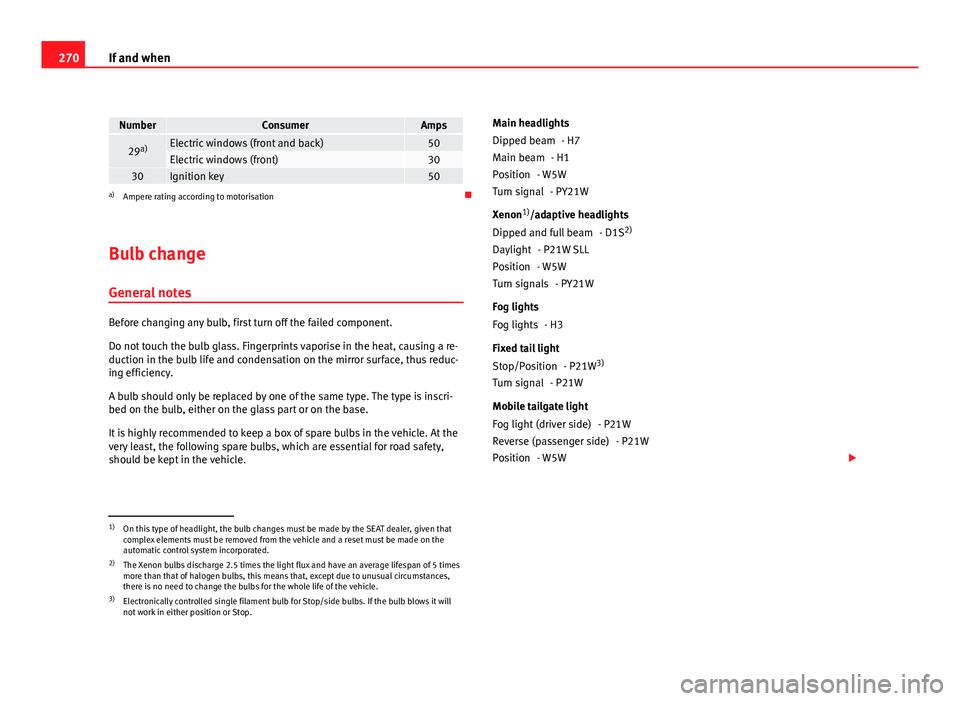
should be kept in the vehicle. Main headlights
- H7
- H1
- W5W - PY21W
Xenon 1)
/adaptive headlights
- D1S2)
- P21W SLL
- W5W - PY21W
Fog lights - H3
Fixed tail light - P21W3)
- P21W
Mobile tailgate light - P21W- P21W
- W5W
Dipped beam
Main beam
Position
Turn signal
Dipped and full beam
Daylight
Position
Turn signals
Fog lights
Stop/Position
Turn signal
Fog light (driver side)
Reverse (passenger side)
Position
1)
On this type of headlight, the bulb changes must be made by the SEAT dealer, given that
complex elements must be removed from the vehicle and a reset must be made on the
automatic control system incorporated.
2) The Xenon bulbs discharge 2.5 times the light flux and have an average lifespan of 5 times
more than that of halogen bulbs, this means that, except due to unusual circumstances,
there is no need to change the bulbs for the whole life of the vehicle.
3) Electronically controlled single filament bulb for Stop/side bulbs. If the bulb blows it will
not work in either position or Stop.
Page 282 of 315
280If and when
How to jump start: description
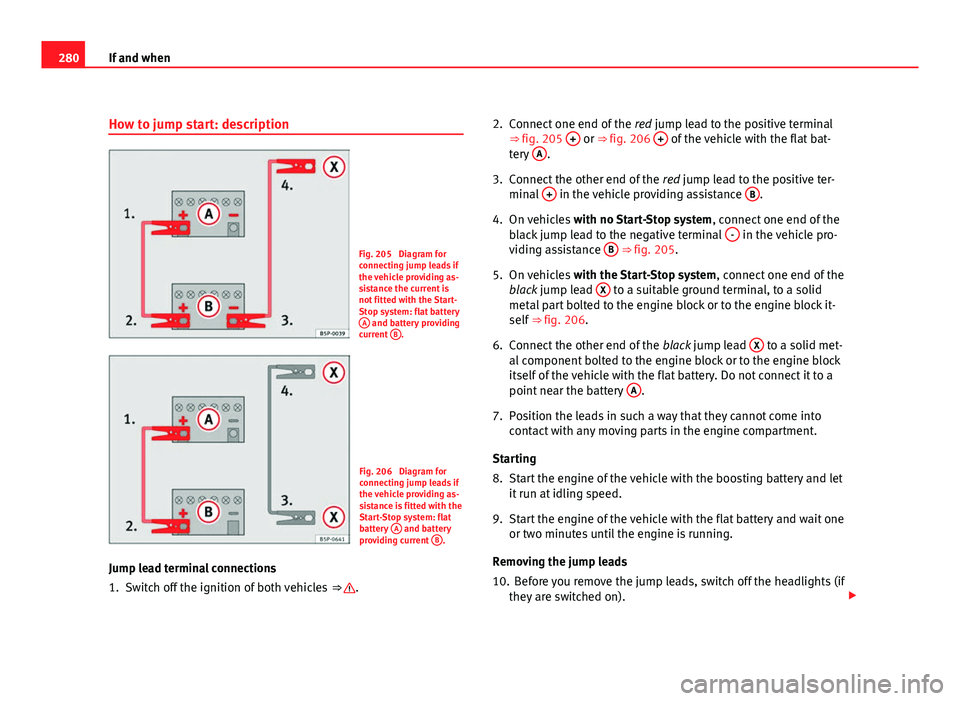
Fig. 205 Diagram for
connecting jump leads if
the vehicle providing as-
sistance the current is
not fitted with the Start-
Stop system: flat battery
A
and battery providing
current B.
Fig. 206 Diagram for
connecting jump leads if
the vehicle providing as-
sistance is fitted with the
Start-Stop system: flat
battery A
and battery
providing current B.
Jump lead terminal connections
1. Switch off the ignition of both vehicles ⇒
.2. Connect one end of the
red jump lead to the positive terminal
⇒ fig. 205 +
or ⇒
fig. 206 + of the vehicle with the flat bat-
tery A.
3. Connect the other end of the red jump lead to the positive ter-
minal +
in the vehicle providing assistance B.
4. On vehicles with no Start-Stop system , connect one end of the
black jump lead to the negative terminal -
in the vehicle pro-
viding assistance B ⇒ fig. 205.
5. On vehicles with the Start-Stop system , connect one end of the
black jump lead X
to a suitable ground terminal, to a solid
metal part bolted to the engine block or to the engine block it-
self ⇒ fig. 206.
6. Connect the other end of the black jump lead X
to a solid met-
al component bolted to the engine block or to the engine block
itself of the vehicle with the flat battery. Do not connect it to a
point near the battery A
.
7. Position the leads in such a way that they cannot come into contact with any moving parts in the engine compartment.
Starting
8. Start the engine of the vehicle with the boosting battery and let it run at idling speed.
9. Start the engine of the vehicle with the flat battery and wait one or two minutes until the engine is running.
Removing the jump leads
10. Before you remove the jump leads, switch off the headlights (if they are switched on).
Page 284 of 315
282If and when
Towing and tow-starting
Tow-starting
The use of jump leads is preferable to tow-starting.
We recommend that you do not tow-start your vehicle. Jump-start-
ing is preferable ⇒ page 279.
However, if your vehicle has to be tow-started:
– Engage the 2nd or the 3rd gear.
– Keep the clutch pressed down.
– Switch the ignition on.
– Once both vehicles are moving, release the clutch.
– As soon as the engine starts, press the clutch and move the
gear lever into neutral. This helps to prevent driving into the
towing vehicle.
WARNING
The risk of accidents is high when tow-starting. The vehicle being towed
can easily collide with the towing vehicle.
CAUTION
When tow-starting, fuel could enter the catalytic converter and damage it. General notes
Please observe the following points if you use a tow-rope:
Notes for the driver of the towing vehicle
–
Drive slowly at first until the tow-rope is taut. Then accelerate
gradually.
– Begin and change gears cautiously. If you are driving an auto-
matic vehicle, accelerate gently.
– Remember that the brake servo and power steering are not
working in the vehicle you are towing. Brake sooner than nor-
mal and pressing the pedal gently.
Notes for the driver of the towed vehicle
– Ensure that the tow-rope remains taut at all times when towing.
Tow-rope or tow-bar
It is easier and safer to tow a vehicle with a tow-bar. You should only use a
tow-rope if you do not have a tow-bar.
A tow-rope should be slightly elastic to reduce the loading on both vehicles.
It is advisable to use a tow-rope made of synthetic fibre or similarly elastic
material.
Attach the tow-rope or the tow-bar only to the towing eyes provided or a
towing bracket.
Driving style
Towing requires some experience, especially when using a tow-rope. Both
drivers should be familiar with the technique required for towing. Inexper-
ienced drivers should not attempt to tow.
Page 285 of 315
283
If and when
Do not pull too hard with the towing vehicle and take care to avoid jerking
the tow-rope. When towing on an unpaved road, there is always a risk of
overloading and damaging the anchorage points.
The ignition of the vehicle being towed must be switched on to prevent the
steering wheel from locking and also to allow the use of the turn signals,
horn, windscreen wipers and washers.
As the brake servo does not work if the engine is not running, you must ap-
ply considerably more pressure to the brake pedal than you normally would.
As the power assisted steering does not work if the engine is not running,
you will need more strength to steer than you normally would.
● The vehicle must not be towed faster than 50 km/h.
● The vehicle must not be towed faster than 50 km/h.
Towing vehicles with an automatic gearbox
● Put the selector lever into position “N”.
● Do not drive faster than 50 km/h.
● Do not tow further than 50 km.
● If a breakdown vehicle is used, the vehicle must be towed with the front
wheels raised.
Note
● Observe legal requirements when towing or tow-starting.
● Switch on the hazard warning lights of both vehicles. However, observe
any regulations to the contrary.
● For technical reasons, vehicles with an automatic gearbox must not be
tow-started.
● If damage to your vehicle means that there is no lubricant in the gear-
box, you must raise the drive wheels while the vehicle is being towed.
● If the vehicle has to be towed more than 50 km, the front wheels should
be raised during towing, and towing should be carried out by a qualified
person. ●
The steering wheel is locked when the vehicle has no electrical power.
The vehicle must then be towed with the front wheels raised. Towing should
be carried out by a qualified person.
● The towing eye should always be kept in the vehicle.
Safety FirstOperating InstructionsPractical TipsTechnical Specifications
Page 309 of 315
HeadlightsDriving abroad . . . . . . . . . . . . . . . . . . . . . . 207
Fog lights . . . . . . . . . . . . . . . . . . . . . . . . . . 115
Headlight washer . . . . . . . . . . . . . . . . . . . . 130
Head restraints Adjusting . . . . . . . . . . . . . . . . . . . . . . 135, 136
Adjustment of the head restraint angle . . 136
Removing . . . . . . . . . . . . . . . . . . . . . . . . . . 136
Heated front seats . . . . . . . . . . . . . . . . . . . . . . 138
Heated rear window 2C-Climatronic . . . . . . . . . . . . . . . . . . . . . . 164
Heating element wires . . . . . . . . . . . . . . . . 216
Heating . . . . . . . . . . . . . . . . . . . . . . . . . . . . . . . 157
High pressure cleaners . . . . . . . . . . . . . . . . . . 214
Hill-start aid . . . . . . . . . . . . . . . . . . . . . . . . . . . 186
Horn . . . . . . . . . . . . . . . . . . . . . . . . . . . . . . . . . . 55
How to jump start description . . . . . . . . . . . . . 280
Hydraulic Brake Assist . . . . . . . . . . . . . . . . . . . 194
I
Identification number . . . . . . . . . . . . . . . . . . . 286
Identification plate . . . . . . . . . . . . . . . . . . . . . . 286
Ignition key . . . . . . . . . . . . . . . . . . . . . . . . . . . . 171
Ignition lock . . . . . . . . . . . . . . . . . . . . . . . . . . . 171
Information in the multifunction display Memory displays . . . . . . . . . . . . . . . . . . . . . 64
Information messages in the display . . . . . . . . 66
Instrument and switch lighting . . . . . . . . . . . . 119
Instrument lighting . . . . . . . . . . . . . . . . . . . . . . 55
Instrument panel menu Lights and visibility menu . . . . . . . . . . . . . . 76 Instrument panel menus
Configuration menu . . . . . . . . . . . . . . . . . . . 74
Example of menu use . . . . . . . . . . . . . . . . . . 68
Main menu . . . . . . . . . . . . . . . . . . . . . . . . . . 68
Vehicle status menu . . . . . . . . . . . . . . . . . . . 74
Instruments . . . . . . . . . . . . . . . . . . . . . . . . . . . . 57
Interior lights . . . . . . . . . . . . . . . . . . . . . . . . . . 123
Interior mirror . . . . . . . . . . . . . . . . . . . . . . . . . . 131
Intermittent wipe, windscreen . . . . . . . . . . . . . 127
ISOFIX system . . . . . . . . . . . . . . . . . . . . . . . . . . . 52
J
Jack position points Sill panel trim with cover . . . . . . . . . . . . . . 262
Jump-starting . . . . . . . . . . . . . . . . . . . . . . . . . . 279
Jump leads . . . . . . . . . . . . . . . . . . . . . . . . . . . . 279
K
Keys . . . . . . . . . . . . . . . . . . . . . . . . . . . . . . . . . . 103
L
Leather cleaning . . . . . . . . . . . . . . . . . . . . . . . . 219
Lights . . . . . . . . . . . . . . . . . . . . . . . . . . . . . . . . 115
Load compartment in the luggage compart- ment
see Loading the luggage compartment . . . 17
Loading the luggage compartment . . . . . . . . . . 17
Locks . . . . . . . . . . . . . . . . . . . . . . . . . . . . . . . . . 216
LPG . . . . . . . . . . . . . . . . . . . . . . . . . . 60, 175, 225 LPG system
Driving . . . . . . . . . . . . . . . . . . . . . . . . . . . . . 175
Filler neck adapter . . . . . . . . . . . . . . . . . . . 227
Level indicator . . . . . . . . . . . . . . . . . . . . . . . 60
Refuelling . . . . . . . . . . . . . . . . . . . . . . . . . . 225
Luggage compartment . . . . . . . . . . . . . . . . . . . 153 see also Loading the luggage compartment . .17
Luggage compartment net . . . . . . . . . . . . . . . 144
M
Main beam . . . . . . . . . . . . . . . . . . . . . . . . 115, 122
Main beam headlights Indicator lamp . . . . . . . . . . . . . . . . . . . . . . . 83
Main headlight bulbs . . . . . . . . . . . . . . . . . . . . 271
Maintenance Airbags . . . . . . . . . . . . . . . . . . . . . . . . . . . . . 32
Maintenance and cleaning . . . . . . . . . . . . . . . 212
Manual gearbox . . . . . . . . . . . . . . . . . . . . . . . . 179
Manual mode 2C-Climatronic . . . . . . . . . . . . . . . . . . . . . . 166
MEDIA-IN connector* . . . . . . . . . . . . . . . . . . . . 152
MFI . . . . . . . . . . . . . . . . . . . . . . . . . . . . . . . . . . . . 63
Mirrors Exterior mirrors . . . . . . . . . . . . . . . . . . . . . . 132
Interior mirror . . . . . . . . . . . . . . . . . . . . . . . 131
Vanity mirrors . . . . . . . . . . . . . . . . . . . . . . . 126
Mobile phone . . . . . . . . . . . . . . . . . . . . . . . . . . 222
Multi-purpose mobile storage compartment* 148 Closing . . . . . . . . . . . . . . . . . . . . . . . . . . . . 148
Fitting . . . . . . . . . . . . . . . . . . . . . . . . . . . . . 147
Opening . . . . . . . . . . . . . . . . . . . . . . . . . . . 148
307
Index