warning light Seat Altea XL 2012 Manual Online
[x] Cancel search | Manufacturer: SEAT, Model Year: 2012, Model line: Altea XL, Model: Seat Altea XL 2012Pages: 315, PDF Size: 4.51 MB
Page 260 of 315
258If and when
–Engage the first gear , or put the selector lever to position P for
those vehicles with an automatic gearbox.
– If you are towing a trailer, unhitch it from your vehicle.
– Take the vehicle tools and the spare wheel out of the luggage
compartment.
WARNING
Put the hazard warning lights on and place the warning triangle in posi-
tion. This is for your own safety and also warns other road users.
CAUTION
If you have to change the tyre on a gradient, block the wheel opposite the
wheel being changed by placing a stone or similar object under it to prevent
the vehicle from rolling away.
Note
Please observe legal requirements when doing so.
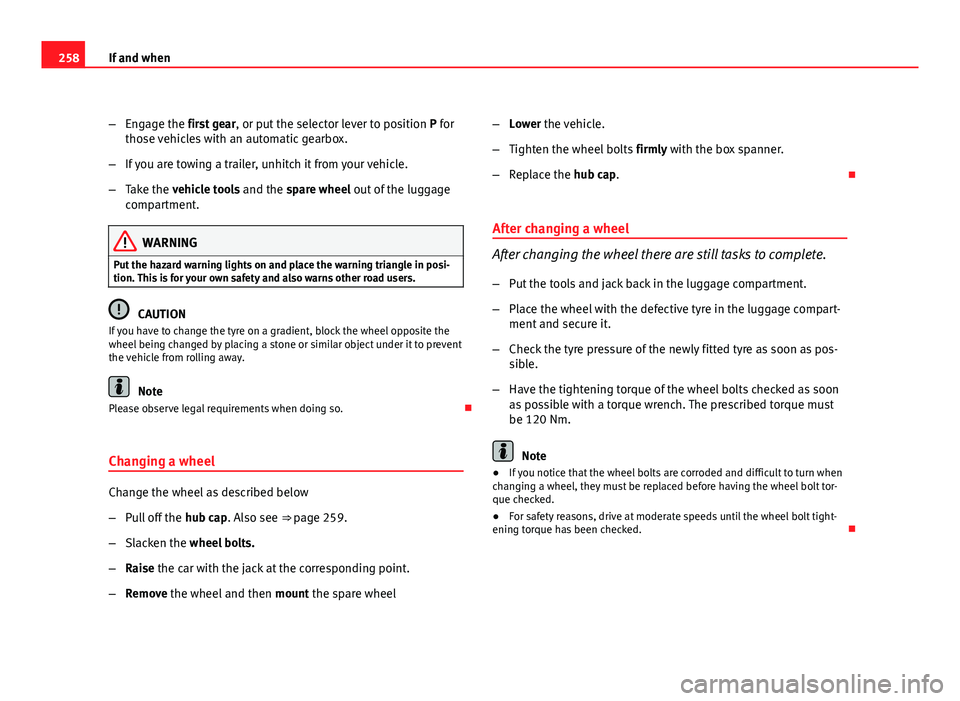
Changing a wheel
Change the wheel as described below
– Pull off the hub cap. Also see ⇒ page 259.
– Slacken the wheel bolts.
– Raise the car with the jack at the corresponding point.
– Remove the wheel and then mount the spare wheel –
Lower the vehicle.
– Tighten the wheel bolts firmly with the box spanner.
– Replace the hub cap.
After changing a wheel
After changing the wheel there are still tasks to complete. – Put the tools and jack back in the luggage compartment.
– Place the wheel with the defective tyre in the luggage compart-
ment and secure it.
– Check the tyre pressure of the newly fitted tyre as soon as pos-
sible.
– Have the tightening torque of the wheel bolts checked as soon
as possible with a torque wrench. The prescribed torque must
be 120 Nm.
Note
● If you notice that the wheel bolts are corroded and difficult to turn when
changing a wheel, they must be replaced before having the wheel bolt tor-
que checked.
● For safety reasons, drive at moderate speeds until the wheel bolt tight-
ening torque has been checked.
Page 266 of 315
264If and when
You will also find instructions for operating the compressor.
WARNING
● Do not attempt to repair a puncture with the sealing compound if the
tyre has been damaged by driving the vehicle after the tyre has lost its
air.
● Always observe warnings and follow instructions concerning com-
pressor and sealing compound carefully.
● Do not drive faster than 80 km/h, avoid heavy acceleration, hard
braking and fast cornering.
● Tyres which have been repaired with sealing compound are only suit-
able for temporary use over a short period. Therefore, please drive care-
fully to the next available specialised workshop.
For the sake of the environment
If you have to dispose of a sealant can, go to a specialised waste service or
to a SEAT Technical Service, where the product can be recycled in an appro-
priate waste container.
Note
● If sealant should leak out, leave it to dry. This way you can pull it off like
a piece of foil.
● Observe the expiry date stated on the sealing compound can. Have the
sealing compound exchanged by a specialised workshop.
● Seek professional assistance if the repair of a tyre puncture is not possi-
ble with the sealing compound. Preparation work
Certain steps must be taken before repairing a tyre.
–
If you have a flat tyre or puncture, park the vehicle as far away
from the flow of traffic as possible.
– Apply the handbrake firmly.
– Engage first gear , or put the selector lever to position P.
– All passengers should leave the vehicle. They should wait in a
safe area (for instance behind the roadside crash barrier).
– Check whether a repair is possible using the Tyre Mobility Sys-
tem “General information and safety notes.”
– Unscrew inflation cap from the affected wheel.
– Take the tyre repair kit out of the luggage compartment.
WARNING
Put the hazard warning lights on and place the warning triangle in posi-
tion. This is for your own safety and also warns other road users.
CAUTION
Take special care if you have to repair a tyre on a slope.
Note
Please observe legal requirements when doing so.
Page 269 of 315
267
If and when
The electric windows are protected by circuit breakers. These reset automat-
ically after a few seconds when the overload (caused for example by frozen
windows) has been corrected.
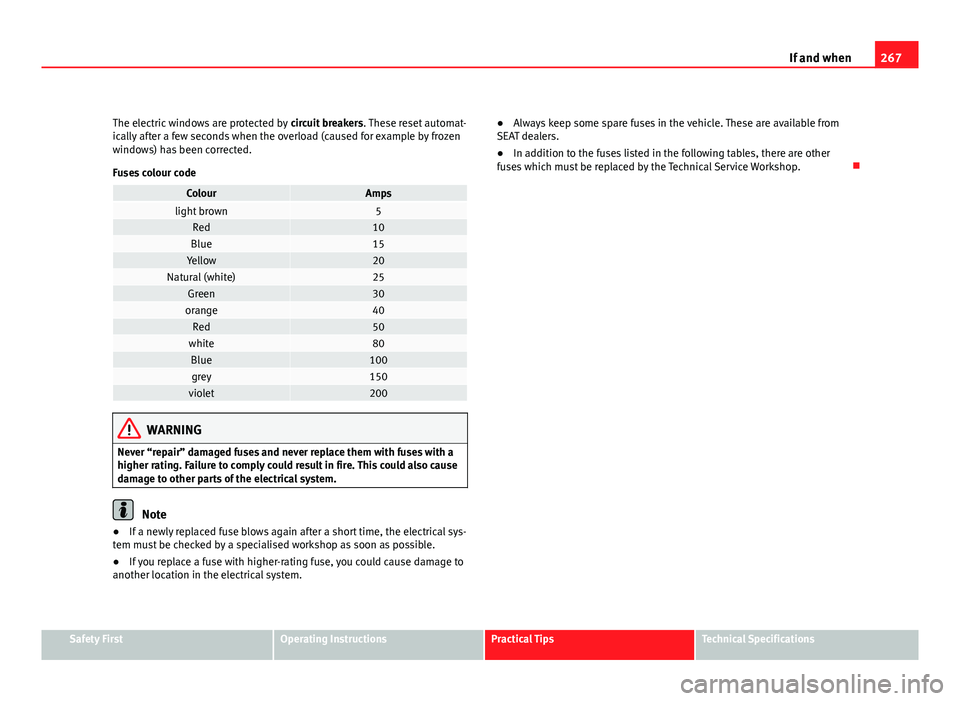
Fuses colour code
ColourAmpslight brown5Red10Blue15Yellow20Natural (white)25Green30orange40Red50white80Blue100grey150violet200
WARNING
Never “repair” damaged fuses and never replace them with fuses with a
higher rating. Failure to comply could result in fire. This could also cause
damage to other parts of the electrical system.
Note
● If a newly replaced fuse blows again after a short time, the electrical sys-
tem must be checked by a specialised workshop as soon as possible.
● If you replace a fuse with higher-rating fuse, you could cause damage to
another location in the electrical system. ●
Always keep some spare fuses in the vehicle. These are available from
SEAT dealers.
● In addition to the fuses listed in the following tables, there are other
fuses which must be replaced by the Technical Service Workshop.
Safety FirstOperating InstructionsPractical TipsTechnical Specifications
Page 283 of 315
281
If and when
11. Turn on the heater blower and heated rear window in the vehi- cle with the flat battery. This helps minimise voltage peaks
which are generated when the leads are disconnected.
12. When the engine is running, disconnect the leads in reverse order to the details given above.
Connect the battery clamps so they have good metal-to-metal contact with
the battery terminals.
If the engine fails to start, switch off the starter after about 10 seconds and
try again after about half a minute.
WARNING
● Please note the safety warnings referring to working in the engine
compartment ⇒ page 230, Working in the engine compartment.
● The battery providing assistance must have the same voltage as the
flat battery (12V) and approximately the same capacity (see imprint on
battery). Failure to comply could result in an explosion.
● Never use jump leads when one of the batteries is frozen. Danger of
explosion! Even after the battery has thawed, battery acid could leak and
cause chemical burns. If a battery freezes, it should be replaced.
● Keep sparks, flames and lighted cigarettes away from batteries, dan-
ger of explosion. Failure to comply could result in an explosion.
● Observe the instructions provided by the manufacturer of the jump
leads.
● Do not connect the negative cable from the other vehicle directly to
the negative terminal of the flat battery. The gas emitted from the battery
could be ignited by sparks. Danger of explosion.
● Do not attach the negative cable from the other vehicle to parts of the
fuel system or to the brake line.
WARNING (Continued)
● The non-insulated parts of the battery clamps must not be allowed to
touch. The jump lead attached to the positive battery terminal must not
touch metal parts of the vehicle, this can cause a short circuit.
● Position the leads in such a way that they cannot come into contact
with any moving parts in the engine compartment.
● Do not bend over the batteries. This could result in chemical burns.
Note
The vehicles must not touch each other, otherwise electricity could flow as
soon as the positive terminals are connected.
Safety FirstOperating InstructionsPractical TipsTechnical Specifications
Page 284 of 315
282If and when
Towing and tow-starting
Tow-starting
The use of jump leads is preferable to tow-starting.
We recommend that you do not tow-start your vehicle. Jump-start-
ing is preferable ⇒ page 279.
However, if your vehicle has to be tow-started:
– Engage the 2nd or the 3rd gear.
– Keep the clutch pressed down.
– Switch the ignition on.
– Once both vehicles are moving, release the clutch.
– As soon as the engine starts, press the clutch and move the
gear lever into neutral. This helps to prevent driving into the
towing vehicle.
WARNING
The risk of accidents is high when tow-starting. The vehicle being towed
can easily collide with the towing vehicle.
CAUTION
When tow-starting, fuel could enter the catalytic converter and damage it. General notes
Please observe the following points if you use a tow-rope:
Notes for the driver of the towing vehicle
–
Drive slowly at first until the tow-rope is taut. Then accelerate
gradually.
– Begin and change gears cautiously. If you are driving an auto-
matic vehicle, accelerate gently.
– Remember that the brake servo and power steering are not
working in the vehicle you are towing. Brake sooner than nor-
mal and pressing the pedal gently.
Notes for the driver of the towed vehicle
– Ensure that the tow-rope remains taut at all times when towing.
Tow-rope or tow-bar
It is easier and safer to tow a vehicle with a tow-bar. You should only use a
tow-rope if you do not have a tow-bar.
A tow-rope should be slightly elastic to reduce the loading on both vehicles.
It is advisable to use a tow-rope made of synthetic fibre or similarly elastic
material.
Attach the tow-rope or the tow-bar only to the towing eyes provided or a
towing bracket.
Driving style
Towing requires some experience, especially when using a tow-rope. Both
drivers should be familiar with the technique required for towing. Inexper-
ienced drivers should not attempt to tow.
Page 285 of 315
283
If and when
Do not pull too hard with the towing vehicle and take care to avoid jerking
the tow-rope. When towing on an unpaved road, there is always a risk of
overloading and damaging the anchorage points.
The ignition of the vehicle being towed must be switched on to prevent the
steering wheel from locking and also to allow the use of the turn signals,
horn, windscreen wipers and washers.
As the brake servo does not work if the engine is not running, you must ap-
ply considerably more pressure to the brake pedal than you normally would.
As the power assisted steering does not work if the engine is not running,
you will need more strength to steer than you normally would.
● The vehicle must not be towed faster than 50 km/h.
● The vehicle must not be towed faster than 50 km/h.
Towing vehicles with an automatic gearbox
● Put the selector lever into position “N”.
● Do not drive faster than 50 km/h.
● Do not tow further than 50 km.
● If a breakdown vehicle is used, the vehicle must be towed with the front
wheels raised.
Note
● Observe legal requirements when towing or tow-starting.
● Switch on the hazard warning lights of both vehicles. However, observe
any regulations to the contrary.
● For technical reasons, vehicles with an automatic gearbox must not be
tow-started.
● If damage to your vehicle means that there is no lubricant in the gear-
box, you must raise the drive wheels while the vehicle is being towed.
● If the vehicle has to be towed more than 50 km, the front wheels should
be raised during towing, and towing should be carried out by a qualified
person. ●
The steering wheel is locked when the vehicle has no electrical power.
The vehicle must then be towed with the front wheels raised. Towing should
be carried out by a qualified person.
● The towing eye should always be kept in the vehicle.
Safety FirstOperating InstructionsPractical TipsTechnical Specifications
Page 290 of 315
288Description of specifications
Drawbar load
The maximum permitted drawbar load on the ball joint of the towing bracket
must not exceed 75 kg.
In the interest of road safety, we recommend that you always tow approach-
ing the maximum drawbar load. The response of the trailer on the road will
be poor if the drawbar load is too small.
If the maximum permissible drawbar load cannot be met (e.g. with small,
empty and light-weight single axle trailers or tandem axle trailers with a
wheelbase of less than 1 metre), a minimum of 4% of the actual trailer
weight is legally required for the drawbar load.
WARNING
● For safety reasons, do not exceed the 80 km/h limit. This is also valid
in countries where higher speeds are permitted.
● Never exceed the maximum trailer weights or the drawbar load. If the
permissible axle load or the permissible total weight is exceeded, the
driving characteristics of the vehicle may change, leading to accidents,
injuries and damage to the vehicle.
Page 305 of 315
Index
A
ABS . . . . . . . . . . . . . . . . . . . . . . . . . . . . . . . . . . 195Warning lamp . . . . . . . . . . . . . . . . . . . . . . . . 84
Accessories . . . . . . . . . . . . . . . . . . . . . . . . . . . . 221
Acoustic signal . . . . . . . . . . . . . . . . . . . . . . . . . . 20
Acoustic warning . . . . . . . . . . . . . . . . . . . . . . . 171
Adaptive headlights . . . . . . . . . . . . . . . . . . . . . 119
Adjusting the seat belt height . . . . . . . . . . . . . . 28
AFS (cornering lights) . . . . . . . . . . . . . . . . . . . 120
Airbag covers . . . . . . . . . . . . . . . . . . . . . . . . . . . 36
Airbag system . . . . . . . . . . . . . . . . . . . . . . . . . . . 30 Curtain airbags . . . . . . . . . . . . . . . . . . . . . . . 41
Front airbags . . . . . . . . . . . . . . . . . . . . . . . . 34
Side airbags . . . . . . . . . . . . . . . . . . . . . . . . . 38
Warning lamp . . . . . . . . . . . . . . . . . . . . . . . . 32
Air conditioner General notes . . . . . . . . . . . . . . . . . . . . . . . 167
Air conditioner automatic mode 2C-Climatronic . . . . . . . . . . . . . . . . . . . . . . 165
Air conditioner* 2C-Climatronic* . . . . . . . . . . . . . . . . . . . . . 163
Air conditioning* . . . . . . . . . . . . . . . . . . . . . . . 159
Air recirculation mode 2C-Climatronic . . . . . . . . . . . . . . . . . . . . . . 167
Manual air conditioner . . . . . . . . . . . . . . . . 161
Alarm system Switching off . . . . . . . . . . . . . . . . . . . . . . . . 106
All-wheel drive . . . . . . . . . . . . . . . . . . . . . . . . . 198 Alternator
Warning lamp . . . . . . . . . . . . . . . . . . . . . . . . 85
Anti-freeze . . . . . . . . . . . . . . . . . . . . . . . . . . . . 237
Anti-lock brake system . . . . . . . . . . . . . . . . . . . 195 Warning lamp . . . . . . . . . . . . . . . . . . . . . . . . 84
Anti-theft alarm system . . . . . . . . . . . . . . . . . . 106 Switching off . . . . . . . . . . . . . . . . . . . . . . . . 106
Anti-theft wheel bolts . . . . . . . . . . . . . . . . . . . 260
Aquaplaning . . . . . . . . . . . . . . . . . . . . . . . . . . . 250
Ashtray* . . . . . . . . . . . . . . . . . . . . . . . . . . . . . . 149
Aspects to note before setting off . . . . . . . . . . . . 8
ASR . . . . . . . . . . . . . . . . . . . . . . . . . . . . . . . . . . 195 Control lamp . . . . . . . . . . . . . . . . . . . . . . . . . 89
Automatic anti-dazzle interior mirror* Activating the anti-dazzle function . . . . . . 131
Deactivating anti-dazzle function . . . . . . . 131
Automatic car wash tunnel . . . . . . . . . . . . . . . 213
Automatic gearbox Kick-down feature . . . . . . . . . . . . . . . . . . . . 184
Automatic gearbox / DSG automatic gearbox 180
Automatic lighting . . . . . . . . . . . . . . . . . . . . . . 116
Automatic windscreeen wiper/washer . . . . . . 127
Auxiliary audio connection: AUX-IN . . . . . . . . 151
B
Ball coupling . . . . . . . . . . . . . . . . . . . . . . . . . . . 209 Battery
Changing . . . . . . . . . . . . . . . . . . . . . . . . . . 246
Charging . . . . . . . . . . . . . . . . . . . . . . . . . . . 246
Winter conditions . . . . . . . . . . . . . . . . . . . . 244
Before setting off . . . . . . . . . . . . . . . . . . . . . . . . . 8
Biodiesel . . . . . . . . . . . . . . . . . . . . . . . . . . . . . . 230
Biodiesel fuel . . . . . . . . . . . . . . . . . . . . . . . . . . 230
Bonnet . . . . . . . . . . . . . . . . . . . . . . . . . . . . . . . 232
Brake fluid . . . . . . . . . . . . . . . . . . . . . . . . . . . . 243 Changing . . . . . . . . . . . . . . . . . . . . . . . . . . 243
Warning lamp . . . . . . . . . . . . . . . . . . . . . . . . 66
Brake pads . . . . . . . . . . . . . . . . . . . . . . . . . . . . 202
Brake pedal warning lamp . . . . . . . . . . . . . . . . . . . . . . . . 90
Brakes . . . . . . . . . . . . . . . . . . . . . . . . . . . . . . . . 202 Worn brake pads . . . . . . . . . . . . . . . . . . . . . 85
Brake servo . . . . . . . . . . . . . . . . . . . . . . . . 194, 202
Brake system . . . . . . . . . . . . . . . . . . . . . . . . . . 243 Brakes . . . . . . . . . . . . . . . . . . . . . . . . . . . . . 199
Brake servo . . . . . . . . . . . . . . . . . . . . . . . . . 199
Warning lamp . . . . . . . . . . . . . . . . . . . . . . . . 86
Braking distance . . . . . . . . . . . . . . . . . . . . . . . 202
Bulb changes General notes . . . . . . . . . . . . . . . . . . . . . . . 270
Bulb defect warning lamp . . . . . . . . . . . . . . . . . . . . . . . . 86
Buzzer . . . . . . . . . . . . . . . . . . . . . . . . . . . . 122, 171
303
Index
Page 306 of 315
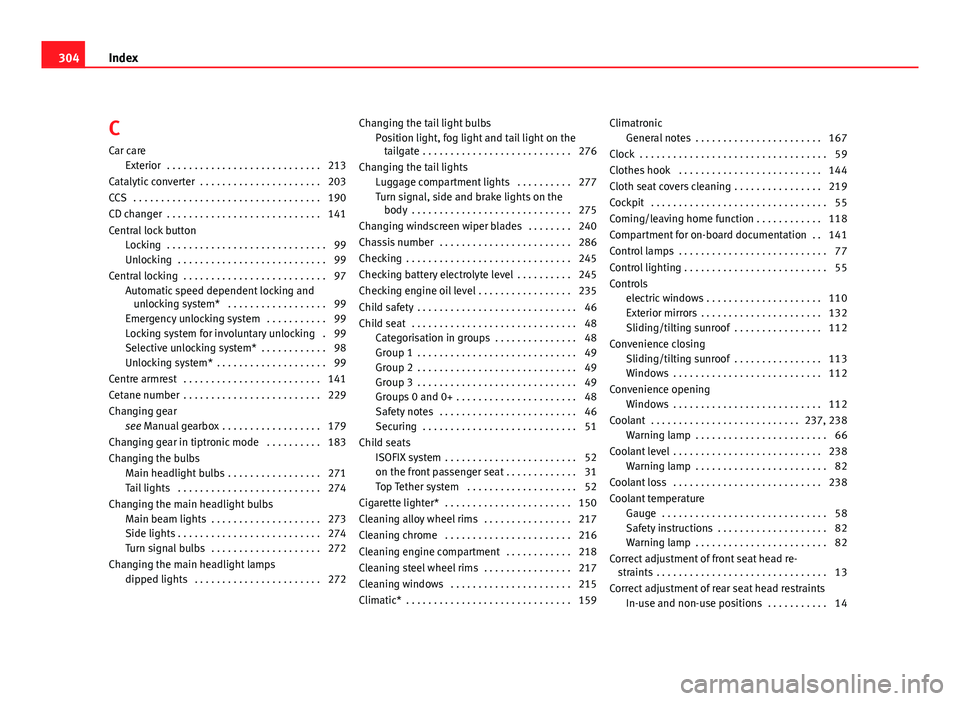
C
Car care Exterior . . . . . . . . . . . . . . . . . . . . . . . . . . . . 213
Catalytic converter . . . . . . . . . . . . . . . . . . . . . . 203
CCS . . . . . . . . . . . . . . . . . . . . . . . . . . . . . . . . . . 190
CD changer . . . . . . . . . . . . . . . . . . . . . . . . . . . . 141
Central lock button Locking . . . . . . . . . . . . . . . . . . . . . . . . . . . . . 99
Unlocking . . . . . . . . . . . . . . . . . . . . . . . . . . . 99
Central locking . . . . . . . . . . . . . . . . . . . . . . . . . . 97 Automatic speed dependent locking andunlocking system* . . . . . . . . . . . . . . . . . . 99
Emergency unlocking system . . . . . . . . . . . 99
Locking system for involuntary unlocking . 99
Selective unlocking system* . . . . . . . . . . . . 98
Unlocking system* . . . . . . . . . . . . . . . . . . . . 99
Centre armrest . . . . . . . . . . . . . . . . . . . . . . . . . 141
Cetane number . . . . . . . . . . . . . . . . . . . . . . . . . 229
Changing gear see Manual gearbox . . . . . . . . . . . . . . . . . . 179
Changing gear in tiptronic mode . . . . . . . . . . 183
Changing the bulbs Main headlight bulbs . . . . . . . . . . . . . . . . . 271
Tail lights . . . . . . . . . . . . . . . . . . . . . . . . . . 274
Changing the main headlight bulbs Main beam lights . . . . . . . . . . . . . . . . . . . . 273
Side lights . . . . . . . . . . . . . . . . . . . . . . . . . . 274
Turn signal bulbs . . . . . . . . . . . . . . . . . . . . 272
Changing the main headlight lamps dipped lights . . . . . . . . . . . . . . . . . . . . . . . 272 Changing the tail light bulbs
Position light, fog light and tail light on thetailgate . . . . . . . . . . . . . . . . . . . . . . . . . . . 276
Changing the tail lights Luggage compartment lights . . . . . . . . . . 277
Turn signal, side and brake lights on thebody . . . . . . . . . . . . . . . . . . . . . . . . . . . . . 275
Changing windscreen wiper blades . . . . . . . . 240
Chassis number . . . . . . . . . . . . . . . . . . . . . . . . 286
Checking . . . . . . . . . . . . . . . . . . . . . . . . . . . . . . 245
Checking battery electrolyte level . . . . . . . . . . 245
Checking engine oil level . . . . . . . . . . . . . . . . . 235
Child safety . . . . . . . . . . . . . . . . . . . . . . . . . . . . . 46
Child seat . . . . . . . . . . . . . . . . . . . . . . . . . . . . . . 48 Categorisation in groups . . . . . . . . . . . . . . . 48
Group 1 . . . . . . . . . . . . . . . . . . . . . . . . . . . . . 49
Group 2 . . . . . . . . . . . . . . . . . . . . . . . . . . . . . 49
Group 3 . . . . . . . . . . . . . . . . . . . . . . . . . . . . . 49
Groups 0 and 0+ . . . . . . . . . . . . . . . . . . . . . . 48
Safety notes . . . . . . . . . . . . . . . . . . . . . . . . . 46
Securing . . . . . . . . . . . . . . . . . . . . . . . . . . . . 51
Child seats ISOFIX system . . . . . . . . . . . . . . . . . . . . . . . . 52
on the front passenger seat . . . . . . . . . . . . . 31
Top Tether system . . . . . . . . . . . . . . . . . . . . 52
Cigarette lighter* . . . . . . . . . . . . . . . . . . . . . . . 150
Cleaning alloy wheel rims . . . . . . . . . . . . . . . . 217
Cleaning chrome . . . . . . . . . . . . . . . . . . . . . . . 216
Cleaning engine compartment . . . . . . . . . . . . 218
Cleaning steel wheel rims . . . . . . . . . . . . . . . . 217
Cleaning windows . . . . . . . . . . . . . . . . . . . . . . 215
Climatic* . . . . . . . . . . . . . . . . . . . . . . . . . . . . . . 159 Climatronic
General notes . . . . . . . . . . . . . . . . . . . . . . . 167
Clock . . . . . . . . . . . . . . . . . . . . . . . . . . . . . . . . . . 59
Clothes hook . . . . . . . . . . . . . . . . . . . . . . . . . . 144
Cloth seat covers cleaning . . . . . . . . . . . . . . . . 219
Cockpit . . . . . . . . . . . . . . . . . . . . . . . . . . . . . . . . 55
Coming/leaving home function . . . . . . . . . . . . 118
Compartment for on-board documentation . . 141
Control lamps . . . . . . . . . . . . . . . . . . . . . . . . . . . 77
Control lighting . . . . . . . . . . . . . . . . . . . . . . . . . . 55
Controls electric windows . . . . . . . . . . . . . . . . . . . . . 110
Exterior mirrors . . . . . . . . . . . . . . . . . . . . . . 132
Sliding/tilting sunroof . . . . . . . . . . . . . . . . 112
Convenience closing Sliding/tilting sunroof . . . . . . . . . . . . . . . . 113
Windows . . . . . . . . . . . . . . . . . . . . . . . . . . . 112
Convenience opening Windows . . . . . . . . . . . . . . . . . . . . . . . . . . . 112
Coolant . . . . . . . . . . . . . . . . . . . . . . . . . . . 237, 238 Warning lamp . . . . . . . . . . . . . . . . . . . . . . . . 66
Coolant level . . . . . . . . . . . . . . . . . . . . . . . . . . . 238 Warning lamp . . . . . . . . . . . . . . . . . . . . . . . . 82
Coolant loss . . . . . . . . . . . . . . . . . . . . . . . . . . . 238
Coolant temperature Gauge . . . . . . . . . . . . . . . . . . . . . . . . . . . . . . 58
Safety instructions . . . . . . . . . . . . . . . . . . . . 82
Warning lamp . . . . . . . . . . . . . . . . . . . . . . . . 82
Correct adjustment of front seat head re- straints . . . . . . . . . . . . . . . . . . . . . . . . . . . . . . . 13
Correct adjustment of rear seat head restraints In-use and non-use positions . . . . . . . . . . . 14
304 Index
Page 307 of 315
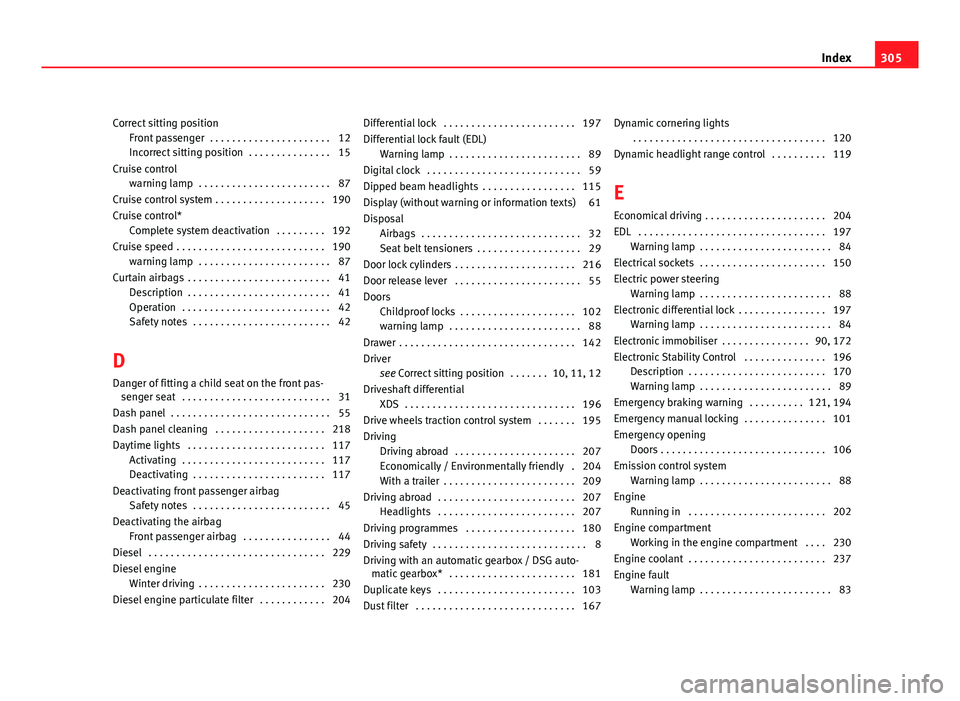
Correct sitting positionFront passenger . . . . . . . . . . . . . . . . . . . . . . 12
Incorrect sitting position . . . . . . . . . . . . . . . 15
Cruise control warning lamp . . . . . . . . . . . . . . . . . . . . . . . . 87
Cruise control system . . . . . . . . . . . . . . . . . . . . 190
Cruise control* Complete system deactivation . . . . . . . . . 192
Cruise speed . . . . . . . . . . . . . . . . . . . . . . . . . . . 190 warning lamp . . . . . . . . . . . . . . . . . . . . . . . . 87
Curtain airbags . . . . . . . . . . . . . . . . . . . . . . . . . . 41 Description . . . . . . . . . . . . . . . . . . . . . . . . . . 41
Operation . . . . . . . . . . . . . . . . . . . . . . . . . . . 42
Safety notes . . . . . . . . . . . . . . . . . . . . . . . . . 42
D Danger of fitting a child seat on the front pas- senger seat . . . . . . . . . . . . . . . . . . . . . . . . . . . 31
Dash panel . . . . . . . . . . . . . . . . . . . . . . . . . . . . . 55
Dash panel cleaning . . . . . . . . . . . . . . . . . . . . 218
Daytime lights . . . . . . . . . . . . . . . . . . . . . . . . . 117 Activating . . . . . . . . . . . . . . . . . . . . . . . . . . 117
Deactivating . . . . . . . . . . . . . . . . . . . . . . . . 117
Deactivating front passenger airbag Safety notes . . . . . . . . . . . . . . . . . . . . . . . . . 45
Deactivating the airbag Front passenger airbag . . . . . . . . . . . . . . . . 44
Diesel . . . . . . . . . . . . . . . . . . . . . . . . . . . . . . . . 229
Diesel engine Winter driving . . . . . . . . . . . . . . . . . . . . . . . 230
Diesel engine particulate filter . . . . . . . . . . . . 204 Differential lock . . . . . . . . . . . . . . . . . . . . . . . . 197
Differential lock fault (EDL)
Warning lamp . . . . . . . . . . . . . . . . . . . . . . . . 89
Digital clock . . . . . . . . . . . . . . . . . . . . . . . . . . . . 59
Dipped beam headlights . . . . . . . . . . . . . . . . . 115
Display (without warning or information texts) 61
Disposal Airbags . . . . . . . . . . . . . . . . . . . . . . . . . . . . . 32
Seat belt tensioners . . . . . . . . . . . . . . . . . . . 29
Door lock cylinders . . . . . . . . . . . . . . . . . . . . . . 216
Door release lever . . . . . . . . . . . . . . . . . . . . . . . 55
Doors Childproof locks . . . . . . . . . . . . . . . . . . . . . 102
warning lamp . . . . . . . . . . . . . . . . . . . . . . . . 88
Drawer . . . . . . . . . . . . . . . . . . . . . . . . . . . . . . . . 142
Driver see Correct sitting position . . . . . . . 10, 11, 12
Driveshaft differential XDS . . . . . . . . . . . . . . . . . . . . . . . . . . . . . . . 196
Drive wheels traction control system . . . . . . . 195
Driving Driving abroad . . . . . . . . . . . . . . . . . . . . . . 207
Economically / Environmentally friendly . 204
With a trailer . . . . . . . . . . . . . . . . . . . . . . . . 209
Driving abroad . . . . . . . . . . . . . . . . . . . . . . . . . 207 Headlights . . . . . . . . . . . . . . . . . . . . . . . . . 207
Driving programmes . . . . . . . . . . . . . . . . . . . . 180
Driving safety . . . . . . . . . . . . . . . . . . . . . . . . . . . . 8
Driving with an automatic gearbox / DSG auto- matic gearbox* . . . . . . . . . . . . . . . . . . . . . . . 181
Duplicate keys . . . . . . . . . . . . . . . . . . . . . . . . . 103
Dust filter . . . . . . . . . . . . . . . . . . . . . . . . . . . . . 167 Dynamic cornering lights
. . . . . . . . . . . . . . . . . . . . . . . . . . . . . . . . . . . 120
Dynamic headlight range control . . . . . . . . . . 119
E
Economical driving . . . . . . . . . . . . . . . . . . . . . . 204
EDL . . . . . . . . . . . . . . . . . . . . . . . . . . . . . . . . . . 197 Warning lamp . . . . . . . . . . . . . . . . . . . . . . . . 84
Electrical sockets . . . . . . . . . . . . . . . . . . . . . . . 150
Electric power steering Warning lamp . . . . . . . . . . . . . . . . . . . . . . . . 88
Electronic differential lock . . . . . . . . . . . . . . . . 197 Warning lamp . . . . . . . . . . . . . . . . . . . . . . . . 84
Electronic immobiliser . . . . . . . . . . . . . . . . 90, 172
Electronic Stability Control . . . . . . . . . . . . . . . 196 Description . . . . . . . . . . . . . . . . . . . . . . . . . 170
Warning lamp . . . . . . . . . . . . . . . . . . . . . . . . 89
Emergency braking warning . . . . . . . . . . 121, 194
Emergency manual locking . . . . . . . . . . . . . . . 101
Emergency opening Doors . . . . . . . . . . . . . . . . . . . . . . . . . . . . . . 106
Emission control system Warning lamp . . . . . . . . . . . . . . . . . . . . . . . . 88
Engine Running in . . . . . . . . . . . . . . . . . . . . . . . . . 202
Engine compartment Working in the engine compartment . . . . 230
Engine coolant . . . . . . . . . . . . . . . . . . . . . . . . . 237
Engine fault Warning lamp . . . . . . . . . . . . . . . . . . . . . . . . 83
305
Index