coolant level Seat Altea XL 2012 Owner's Manual
[x] Cancel search | Manufacturer: SEAT, Model Year: 2012, Model line: Altea XL, Model: Seat Altea XL 2012Pages: 315, PDF Size: 4.51 MB
Page 6 of 315
Trailer towing . . . . . . . . . . . . . . . . . . . . . . . . . . . . . . 208
Instructions to follow . . . . . . . . . . . . . . . . . . . . . . 208
Ball coupling of towing bracket* . . . . . . . . . . . . . 209
Driving tips . . . . . . . . . . . . . . . . . . . . . . . . . . . . . . 209
Fitting a towing bracket* . . . . . . . . . . . . . . . . . . . 209
Vehicle maintenance and cleaning . . . . . . . . . 212
General notes . . . . . . . . . . . . . . . . . . . . . . . . . . . . 212
Care of the vehicle exterior . . . . . . . . . . . . . . . . . . 213
Vehicle interior maintenance . . . . . . . . . . . . . . . . 218
Accessories, parts replacement and
modifications . . . . . . . . . . . . . . . . . . . . . . . . . . . . . 221
Accessories and spare parts . . . . . . . . . . . . . . . . 221
Technical modifications . . . . . . . . . . . . . . . . . . . . 221
Roof aerial* . . . . . . . . . . . . . . . . . . . . . . . . . . . . . . 222
Mobile phones and two-way radios . . . . . . . . . . . 222
Checking and refilling levels . . . . . . . . . . . . . . . 223
Refuelling . . . . . . . . . . . . . . . . . . . . . . . . . . . . . . . 223
LPG system* . . . . . . . . . . . . . . . . . . . . . . . . . . . . . 225
Petrol . . . . . . . . . . . . . . . . . . . . . . . . . . . . . . . . . . . 229
Diesel . . . . . . . . . . . . . . . . . . . . . . . . . . . . . . . . . . . 229
Working in the engine compartment . . . . . . . . . . 230
Engine oil . . . . . . . . . . . . . . . . . . . . . . . . . . . . . . . . 233
Coolant . . . . . . . . . . . . . . . . . . . . . . . . . . . . . . . . . 237
Washer fluid and windscreen wiper blades . . . . 239
Brake fluid . . . . . . . . . . . . . . . . . . . . . . . . . . . . . . . 243
Vehicle battery . . . . . . . . . . . . . . . . . . . . . . . . . . . 244
Wheels and tyres . . . . . . . . . . . . . . . . . . . . . . . . . . 247
Wheels . . . . . . . . . . . . . . . . . . . . . . . . . . . . . . . . . . 247
If and when . . . . . . . . . . . . . . . . . . . . . . . . . . . . . . . 256
Tools, tyre repair kit and spare wheel . . . . . . . . . 256
Wheel change . . . . . . . . . . . . . . . . . . . . . . . . . . . . 257
Tyre repair kit (Tyre Mobility System)* . . . . . . . . . 263
Fuses . . . . . . . . . . . . . . . . . . . . . . . . . . . . . . . . . . . 266
Bulb change . . . . . . . . . . . . . . . . . . . . . . . . . . . . . 270
Jump-starting . . . . . . . . . . . . . . . . . . . . . . . . . . . . . 279
Towing and tow-starting . . . . . . . . . . . . . . . . . . . . 282 Technical Specifications
. . . . . . . . . . . 285
Description of specifications . . . . . . . . . . . . . . . 285
Important information . . . . . . . . . . . . . . . . . . . . . 285
Information on fuel consumption . . . . . . . . . . . . 287
Towing a trailer . . . . . . . . . . . . . . . . . . . . . . . . . . . 287
Technical specifications . . . . . . . . . . . . . . . . . . . . 289
Checking fluid levels . . . . . . . . . . . . . . . . . . . . . . . 289
Petrol engine 1.4 63 kW (85 PS) . . . . . . . . . . . . . 290
Petrol engine 1.6 75 kW (102 PS) . . . . . . . . . . . . 291
Petrol engine 1.2 77 kW (105 PS) . . . . . . . . . . . . 292
Petrol engine 1.4 92 kW (125 PS) . . . . . . . . . . . . 293
Petrol engine 1.8 118 kW (160 PS) . . . . . . . . . . . 294
Diesel engine 1.6 TDI CR 66 kW (90 PS) with/
without DPF . . . . . . . . . . . . . . . . . . . . . . . . . . . . . . 296
Diesel engine 1.6 TDI CR 77 kW (105 PS) with/
without DPF . . . . . . . . . . . . . . . . . . . . . . . . . . . . . . 297
Diesel engine 1.6 TDI CR 77 kW (105 PS) Start-
Stop . . . . . . . . . . . . . . . . . . . . . . . . . . . . . . . . . . . . 298
Diesel engine 2.0 TDI CR 103 kW (140 PS) . . . . . 299
Diesel engine 2.0 TDI CR 103 kW (140 PS) 4-
wheel drive . . . . . . . . . . . . . . . . . . . . . . . . . . . . . . 300
Dimensions and capacities . . . . . . . . . . . . . . . . . 302
Index . . . . . . . . . . . . . . . . . . . . . . . . . . . . . . . . . . . 303
4Table of Contents
Page 61 of 315
59
Cockpit
Needle in warning zone C
The warning lamp* ⇒ fig. 50 2 will light up if the needle is in the warning
zone. The following warning message appears on the instrument panel dis-
play 1)
. Stop the vehicle and switch off the engine. Check the coolant level
⇒ page 237 ⇒
.
Even if the coolant level is correct do not continue driving. You should ob-
tain technical assistance.
WARNING
When working in the engine compartment, always observe the safety
warnings ⇒ page 230.
CAUTION
Accessories in front of the air inlet reduce the cooling effect of the coolant.
At high outside temperatures and high engine loads, there is a risk of the
engine overheating.
Rev counter
The rev counter displays the engine speed in revolutions per
minute. The start of the red zone ⇒ fig. 34 4
indicates the maximum engine speed
operating at service temperature. However, it is advisable to change up a in-
to a higher gear, move the selector lever to D or lift your foot off the acceler-
ator before the needle reaches the red zone.
CAUTION
The rev counter needle must never enter the red zone on the scale. Risk of
engine damage.
For the sake of the environment
Changing up into higher gears sooner, following the recommended gear in-
dications ⇒ fig. 40 will help you to reduce fuel consumption, emissions and
also engine noise.
Speedometer
The speedometer is equipped with a digital odometer and a trip recorder, in
addition to a service intervals display.
During the running-in period, the instructions shown on ⇒ page 202
should be followed.
Setting the digital clock*
The digital clock is located in the instrument panel display.
– Turn the setting knob ⇒ fig. 34 5
clockwise until the first
“click” to set the hour. The hour will flash. To change the hour,
press the button.
– Turn the setting knob clockwise to the second “click” to set the
minutes. The minutes will flash. To change the minutes, press
the button.
1)
Depending on the model version
Safety FirstOperating InstructionsPractical TipsTechnical Specifications
Page 80 of 315
78Cockpit
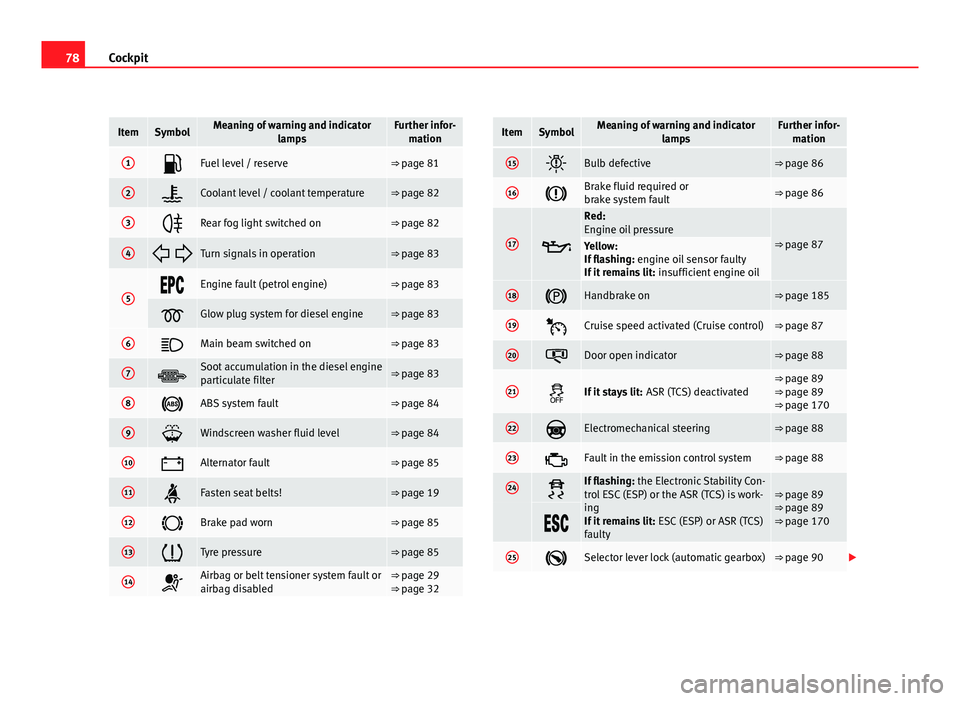
ItemSymbolMeaning of warning and indicator
lampsFurther infor-mation
1Fuel level / reserve⇒ page 81
2Coolant level / coolant temperature⇒ page 82
3Rear fog light switched on⇒ page 82
4 Turn signals in operation⇒ page 83
5Engine fault (petrol engine)⇒ page 83
Glow plug system for diesel engine⇒ page 83
6Main beam switched on⇒ page 83
7Soot accumulation in the diesel engine
particulate filter⇒ page 83
8ABS system fault⇒ page 84
9Windscreen washer fluid level⇒ page 84
10Alternator fault⇒ page 85
11Fasten seat belts!⇒ page 19
12Brake pad worn⇒ page 85
13Tyre pressure⇒ page 85
14Airbag or belt tensioner system fault or
airbag disabled⇒ page 29
⇒ page 32
ItemSymbolMeaning of warning and indicator
lampsFurther infor-mation
15Bulb defective⇒ page 86
16Brake fluid required or
brake system fault⇒ page 86
17
Red:
Engine oil pressure
⇒ page 87Yellow:
If flashing: engine oil sensor faulty
If it remains lit: insufficient engine oil
18Handbrake on⇒ page 185
19Cruise speed activated (Cruise control)⇒ page 87
20Door open indicator⇒ page 88
21If it stays lit: ASR (TCS) deactivated⇒ page 89
⇒ page 89
⇒ page 170
22Electromechanical steering⇒ page 88
23Fault in the emission control system⇒ page 88
24If flashing: the Electronic Stability Con-
trol ESC (ESP) or the ASR (TCS) is work-
ing
If it remains lit: ESC (ESP) or ASR (TCS)
faulty⇒ page 89
⇒ page 89
⇒ page 170
25Selector lever lock (automatic gearbox)⇒ page 90
Page 81 of 315
79
Cockpit
WARNING
● Failure to observe warning lamps and warning messages can result in
serious personal injury or damage to your vehicle.
● The risk of an accident increases if your vehicle breaks down. Use a
warning triangle to draw the attention of other road users in order to pre-
vent danger to third parties.
● The engine compartment is a dangerous area! Before you open the
bonnet to work on the engine or in the engine compartment, you must
switch the engine off and allow it to cool to reduce the risk of scalding or
other injuries. Read and observe the relevant warnings ⇒ page 230.
Note
● The appropriate warning lamp for a fault will light up in vehicles without
warning or information messages in the display.
● In vehicles with warning or information texts on the screen, the appro-
priate warning lamp for a fault will light up and a warning or information
message will also appear on the screen. Overview of indicator and warning lamps (vehicles with
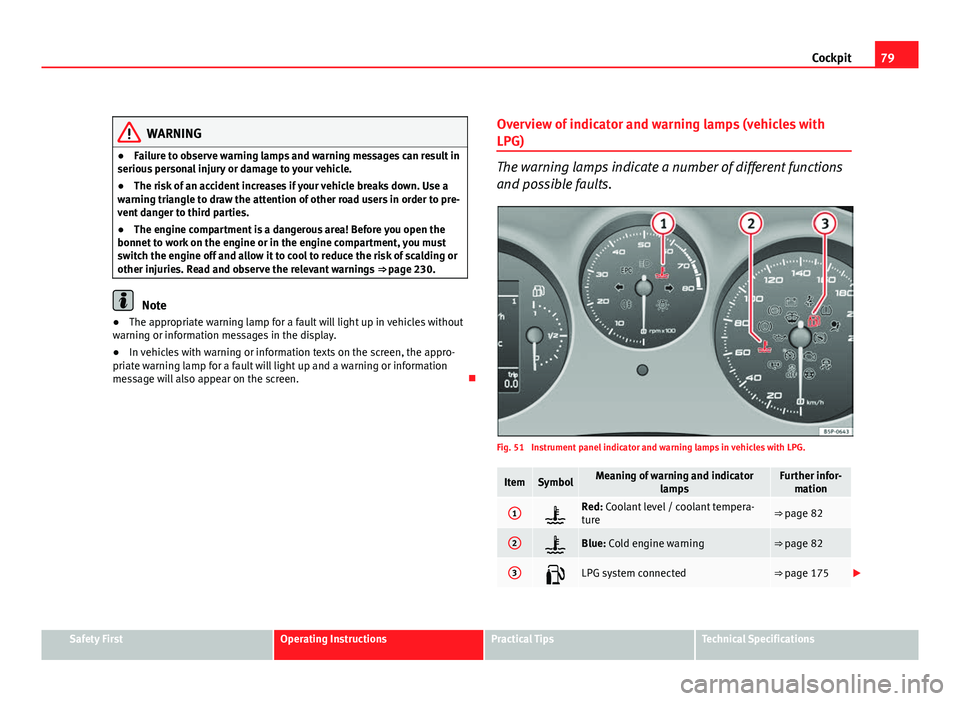
LPG)
The warning lamps indicate a number of different functions
and possible faults.
Fig. 51 Instrument panel indicator and warning lamps in vehicles with LPG.
ItemSymbolMeaning of warning and indicator
lampsFurther infor-mation
1Red: Coolant level / coolant tempera-
ture⇒ page 82
2Blue: Cold engine warning⇒ page 82
3LPG system connected⇒ page 175
Safety FirstOperating InstructionsPractical TipsTechnical Specifications
Page 82 of 315
80Cockpit
WARNING
● Failure to observe warning lamps and warning messages can result in
serious personal injury or damage to your vehicle.
● The risk of an accident increases if your vehicle breaks down. Use a
warning triangle to draw the attention of other road users in order to pre-
vent danger to third parties.
● The engine compartment is a dangerous area! Before you open the
bonnet to work on the engine or in the engine compartment, you must
switch the engine off and allow it to cool to reduce the risk of scalding or
other injuries. Read and observe the relevant warnings ⇒ page 230.
Note
● The appropriate warning lamp for a fault will light up in vehicles without
warning or information messages in the display.
● In vehicles with warning or information texts on the screen, the appro-
priate warning lamp for a fault will light up and a warning or information
message will also appear on the screen.
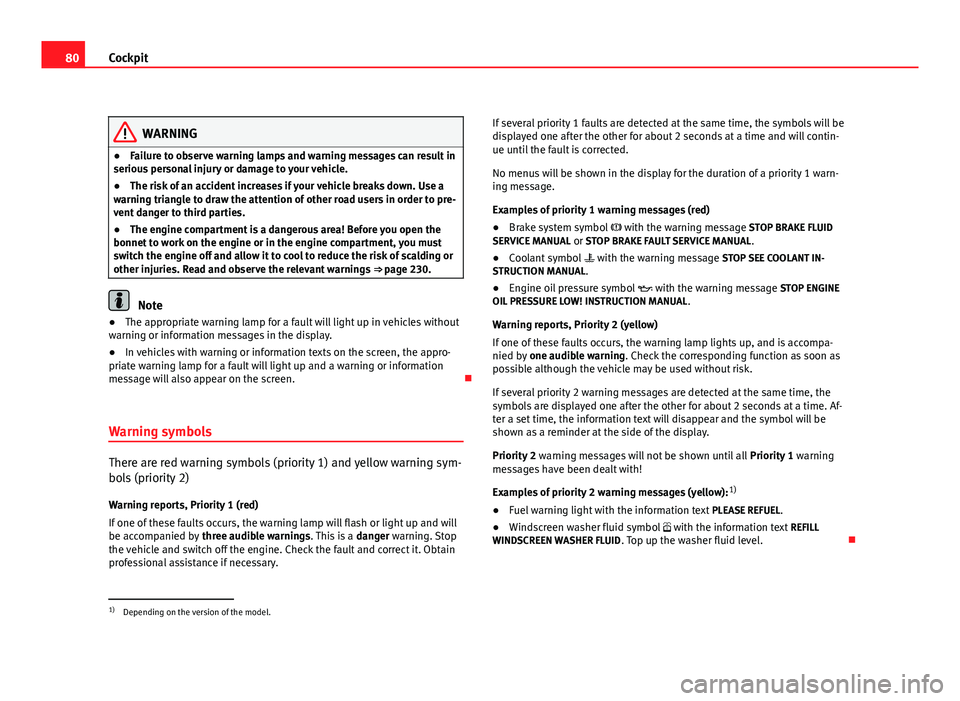
Warning symbols
There are red warning symbols (priority 1) and yellow warning sym-
bols (priority 2) Warning reports, Priority 1 (red)
If one of these faults occurs, the warning lamp will flash or light up and will
be accompanied by three audible warnings. This is a danger warning. Stop
the vehicle and switch off the engine. Check the fault and correct it. Obtain
professional assistance if necessary. If several priority 1 faults are detected at the same time, the symbols will be
displayed one after the other for about 2 seconds at a time and will contin-
ue until the fault is corrected.
No menus will be shown in the display for the duration of a priority 1 warn-
ing message.
Examples of priority 1 warning messages (red)
●
Brake system symbol with the warning message STOP BRAKE FLUID
SERVICE MANUAL or STOP BRAKE FAULT SERVICE MANUAL .
● Coolant symbol with the warning message STOP SEE COOLANT IN-
STRUCTION MANUAL.
● Engine oil pressure symbol with the warning message STOP ENGINE
OIL PRESSURE LOW! INSTRUCTION MANUAL .
Warning reports, Priority 2 (yellow)
If one of these faults occurs, the warning lamp lights up, and is accompa-
nied by one audible warning. Check the corresponding function as soon as
possible although the vehicle may be used without risk.
If several priority 2 warning messages are detected at the same time, the
symbols are displayed one after the other for about 2 seconds at a time. Af-
ter a set time, the information text will disappear and the symbol will be
shown as a reminder at the side of the display.
Priority 2 warning messages will not be shown until all Priority 1 warning
messages have been dealt with!
Examples of priority 2 warning messages (yellow): 1)
● Fuel warning light with the information text PLEASE REFUEL.
● Windscreen washer fluid symbol with the information text REFILL
WINDSCREEN WASHER FLUID . Top up the washer fluid level.
1)
Depending on the version of the model.
Page 84 of 315
82Cockpit
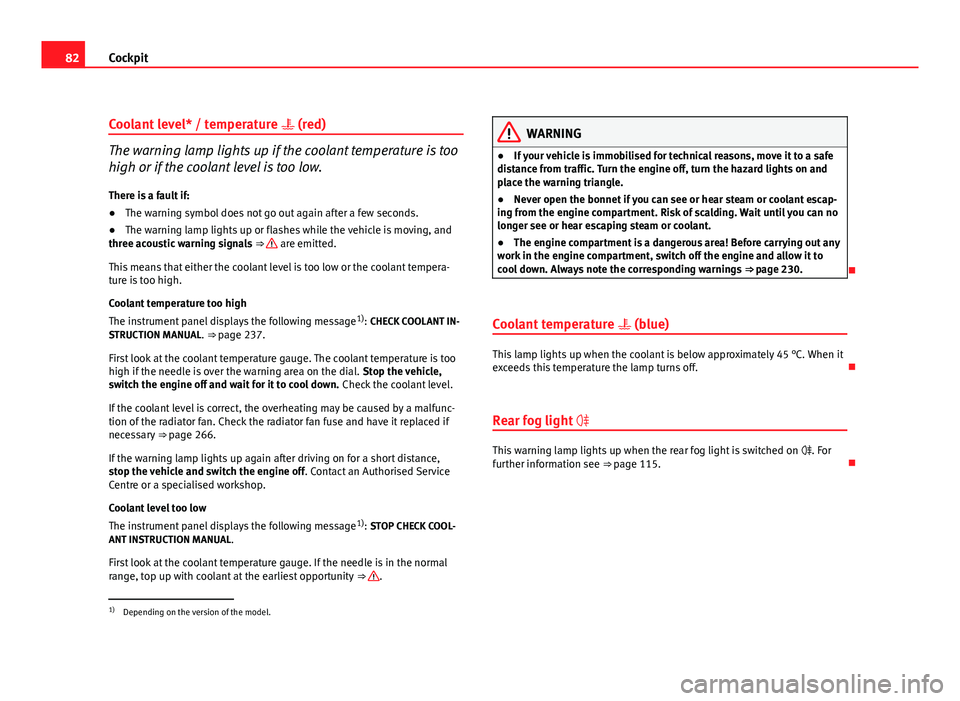
Coolant level* / temperature (red)
The warning lamp lights up if the coolant temperature is too
high or if the coolant level is too low.
There is a fault if:
● The warning symbol does not go out again after a few seconds.
● The warning lamp lights up or flashes while the vehicle is moving, and
three acoustic warning signals ⇒
are emitted.
This means that either the coolant level is too low or the coolant tempera-
ture is too high.
Coolant temperature too high
The instrument panel displays the following message 1)
: CHECK COOLANT IN-
STRUCTION MANUAL. ⇒ page 237.
First look at the coolant temperature gauge. The coolant temperature is too
high if the needle is over the warning area on the dial. Stop the vehicle,
switch the engine off and wait for it to cool down. Check the coolant level.
If the coolant level is correct, the overheating may be caused by a malfunc-
tion of the radiator fan. Check the radiator fan fuse and have it replaced if
necessary ⇒ page 266.
If the warning lamp lights up again after driving on for a short distance,
stop the vehicle and switch the engine off . Contact an Authorised Service
Centre or a specialised workshop.
Coolant level too low
The instrument panel displays the following message 1)
: STOP CHECK COOL-
ANT INSTRUCTION MANUAL.
First look at the coolant temperature gauge. If the needle is in the normal
range, top up with coolant at the earliest opportunity ⇒
.
WARNING
● If your vehicle is immobilised for technical reasons, move it to a safe
distance from traffic. Turn the engine off, turn the hazard lights on and
place the warning triangle.
● Never open the bonnet if you can see or hear steam or coolant escap-
ing from the engine compartment. Risk of scalding. Wait until you can no
longer see or hear escaping steam or coolant.
● The engine compartment is a dangerous area! Before carrying out any
work in the engine compartment, switch off the engine and allow it to
cool down. Always note the corresponding warnings ⇒ page 230.
Coolant temperature (blue)
This lamp lights up when the coolant is below approximately 45 °C. When it
exceeds this temperature the lamp turns off.
Rear fog light
This warning lamp lights up when the rear fog light is switched on . For
further information see ⇒ page 115.
1)
Depending on the version of the model.
Page 233 of 315
231
Checking and refilling levels
You should not do any work in the engine compartment unless you know ex-
actly how to carry out the jobs and have the correct tools! Have the work car-
ried out by a specialised workshop if you are uncertain.
All service fluids and consumables, e.g. coolant, engine oil, spark plugs
and batteries, are under constant development. SEAT provides a constant
flow of information to the Authorised Service Centres concerning modifica-
tions. For this reason, we recommend you to have service fluids and con-
sumables replaced by an Authorised Service Centre. Please observe the rel-
evant instructions ⇒ page 221. The engine compartment of the vehicle is a
hazardous area ⇒
.
WARNING
All work on the engine or in the engine compartment, e.g. checking and
refilling fluids, involves the danger of injury and scalding as well as the
risk of accident or fire.
● Never open the bonnet if you see steam, smoke or coolant escaping
from the engine compartment. Otherwise, there is a risk of sustaining
burns. Wait until no more steam or coolant is emitted, then allow the en-
gine to cool before carefully opening the bonnet.
● Switch off the engine and remove the key from the ignition.
● Apply the handbrake and move the gear lever to neutral or selector
lever to position P.
● Keep children away from the vehicle.
● Never touch hot engine parts. There is a risk of burns.
● Never spill liquids on a hot engine or on a hot exhaust gas system.
This is a fire hazard.
● Avoid causing short-circuits in the electrical system, particularly at
the points where the jump leads are attached ⇒ page 280. The battery
could explode.
WARNING (Continued)
● Never touch the radiator fan. It is temperature controlled and could
start automatically, even when the engine has been switched off and the
key removed from the ignition!
● Do not unscrew the cap on the expansion tank when the engine is
hot. If the coolant is hot, the cooling system will be pressurised!
● Protect face, hands and arms by covering the cap with a large, thick
cloth to protect against escaping coolant and steam.
● Always make sure you have not left any objects, such as cleaning
cloths and tools, in the engine compartment.
● If you have to work underneath the vehicle, you must use suitable
stands additionally to support the vehicle, there is a risk of accident!. A
hydraulic jack is insufficient for securing the vehicle and there is a risk of
injury.
● If any work has to be performed when the engine is started or with
the engine running, there is an additional, potentially fatal, safety risk
from the rotating parts, such as the drive belts, alternator, radiator fan,
etc., and from the high-voltage ignition system. You should also observe
the following points:
–Never touch the electrical wiring of the ignition system.
– Ensure that jewellery, loose clothing and long hair do not get trap-
ped in rotating engine parts. Danger of death. Before starting any
work remove jewellery, tie back and cover hair, and wear tight-fitting
clothes.
– Never accelerate with a gear engaged without taking the necessary
precautions. The vehicle could move, even if the handbrake is ap-
plied. Danger of death.
● If work has to be carried out on the fuel system or on electrical com-
ponents, you must observe the following safety notes in addition to the
above warnings:
–Always disconnect the battery. The vehicle must be unlocked when
this is done, otherwise the alarm will be triggered.
– Do not smoke.
Safety FirstOperating InstructionsPractical TipsTechnical Specifications
Page 234 of 315
232Checking and refilling levels
WARNING (Continued)
– Never work near naked flames.
– Always have a fire extinguisher on hand.
CAUTION
When topping up service fluids, make sure not to mistake them. Using the
wrong fluids could cause serious malfunctions and engine damage!
For the sake of the environment
Service fluids leaks are harmful to the environment. For this reason you
should make regular checks on the ground underneath your vehicle. If you
find spots of oil or other fluids, have your vehicle inspected in a specialised
workshop.
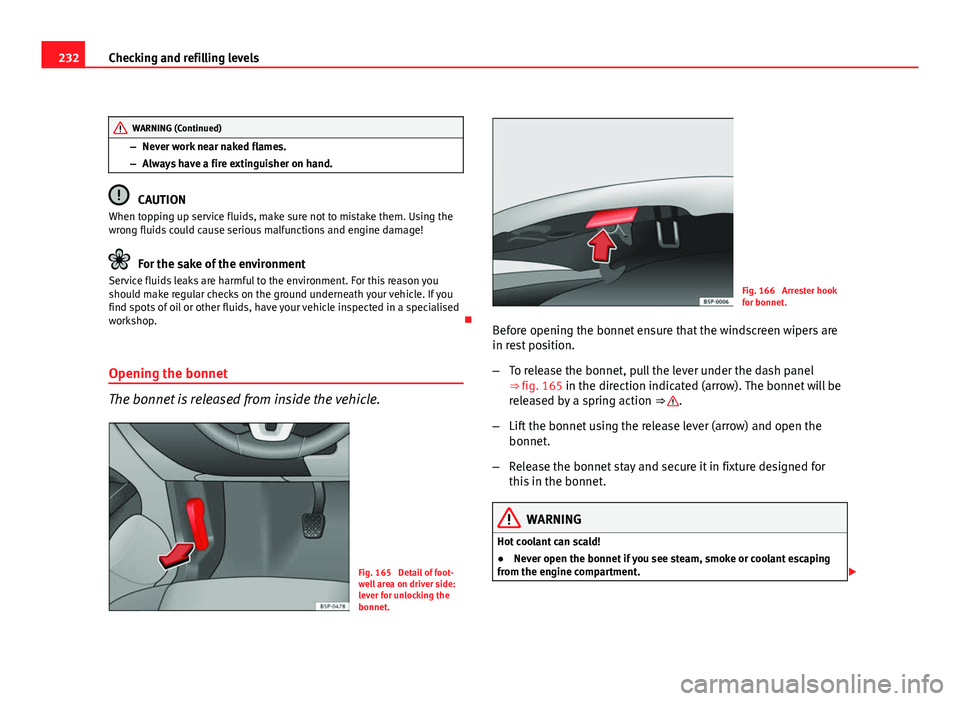
Opening the bonnet
The bonnet is released from inside the vehicle.
Fig. 165 Detail of foot-
well area on driver side:
lever for unlocking the
bonnet.
Fig. 166 Arrester hook
for bonnet.
Before opening the bonnet ensure that the windscreen wipers are
in rest position.
– To release the bonnet, pull the lever under the dash panel
⇒ fig. 165 in the direction indicated (arrow). The bonnet will be
released by a spring action ⇒
.
– Lift the bonnet using the release lever (arrow) and open the
bonnet.
– Release the bonnet stay and secure it in fixture designed for
this in the bonnet.
WARNING
Hot coolant can scald!
● Never open the bonnet if you see steam, smoke or coolant escaping
from the engine compartment.
Page 235 of 315
233
Checking and refilling levels
WARNING (Continued)
● Wait until no more steam, smoke or coolant is emitted from the bon-
net, then carefully open the bonnet.
● When working in the engine compartment, always observe the safety
warnings ⇒ page 230.
Closing the bonnet
– Raise the bonnet slightly.
– Release the bonnet stay and replace it in its support.
– At a height of about 30 cm let it fall so it is locked.
If the bonnet does not close, do not press downwards. Open it once more
and let it fall as before.
WARNING
If the bonnet is not closed properly, it could open while you are driving
and completely obscure your view of the road. Risk of accident.
● After closing the bonnet, always check that it is properly secured. The
bonnet must be flush with the surrounding body panels.
● If you notice that the bonnet latch is not secured when the vehicle is
moving, stop the vehicle immediately and close the bonnet properly.
Risk of accident.
Engine oil
General notes
The engine comes with a special, high quality, multi grade oil that can be
used in all seasons of the year except for those regions affected by extreme
cold.
As the use of good quality oil is necessary for the correct operation and long
service life of the engine, when it becomes necessary to replenish or
change the oil, always use an oil that complies to the VW standards.
The specifications (VW standards) set out in the following page should ap-
pear on the container of the service oil; when the container displays the
specific standards for petrol and diesel engines together, it means that the
oil can be used for both types of engines.
We recommend that the oil change, indicated in the Maintenance Pro-
gramme, be performed by an Authorised Service Centre or a specialised
workshop.
The correct oil specifications for your engine are listed in ⇒ page 234, Oil
properties.
Service intervals
Service intervals can be flexible (LongLife service) or fixed (dependent on
time/distance travelled).
If the PR code that appears on the back of the Maintenance Programme
booklet is QG1, this means that your vehicle has the LongLife service pro-
grammed. If it has the codes QG0 or QG2 the interval service is dependent
on time/distance travelled.
Flexible service intervals (LongLife*)
Special oils and processes have been developed which, depending on the
characteristics and individual driving profiles, allow to extend the oil
change service (LongLife service intervals).
Safety FirstOperating InstructionsPractical TipsTechnical Specifications
Page 239 of 315
237
Checking and refilling levels
WARNING
Only change the oil yourself if you have the specialist knowledge re-
quired!
● Before opening the bonnet, read and observe the warnings
⇒ page 230, Safety instructions on working in the engine compartment.
● Wait for the engine to cool down. Hot oil may cause burn injuries.
● Wear eye protection to avoid injuries caused by splashes of oil.
● When removing the oil drain plug with your fingers, keep your arm
horizontal to help prevent oil from running down your arm.
● Wash your skin thoroughly if it comes into contact with engine oil.
● Engine oil is poisonous! Used oil must be stored in a safe place out of
the reach of children.
CAUTION
No additives should be used with engine oil. This could result in engine
damage. Any damage caused by the use of such additives would not be
covered by the factory warranty.
For the sake of the environment
● Because of the disposal problems, the necessary special tools and spe-
cialist knowledge required, we recommend that you have the engine oil and
filter changed by an Authorised Service Centre.
● Never pour oil down drains or into the ground.
● Use a suitable container when draining the used oil. It must be large
enough to hold all the engine oil. Coolant
Coolant specifications
Coolant is a mixture of water and at least 40% coolant addi-
tive. The cooling system must be filled with a mixture of water and at least 40 %
of our coolant additive G12+ or an additive with the specification TT-VW 774
F (it is dyed purple). This mixture provides the necessary freeze protection
down to -25 °C and protects the alloy parts of the cooling system against
corrosion. It also prevents scaling and raises the boiling point of the cool-
ant.
The concentration of coolant must always be at least 40% - even if freeze
protection is not required.
If greater freeze protection is required in very cold climates, the proportion
of the antifreeze additive G12+ can be increased. However, the percentage
of coolant additives should not exceed 60%, as this would reduce the
freeze protection. It would also reduce the cooling effect. A mixture with
60% additive will give antifreeze protection to approx. -40 °C.
WARNING
● The coolant additive is toxic. There is a toxic risk. Always keep the
coolant additive in the original container which should be stored out of
the reach of children. The same applies to coolant which you have
drained off.
● The coolant additive G12+ must be added in sufficient quantities to
provide anti-freeze protection at the coldest ambient temperatures that
can be expected. At extremely cold outside temperatures, the coolant
could freeze, causing the vehicle to breakdown. As the heater would not
work either, there is a risk of freezing to death.
Safety FirstOperating InstructionsPractical TipsTechnical Specifications