wiper blades Seat Altea XL 2012 Owner's Manual
[x] Cancel search | Manufacturer: SEAT, Model Year: 2012, Model line: Altea XL, Model: Seat Altea XL 2012Pages: 315, PDF Size: 4.51 MB
Page 6 of 315
Trailer towing . . . . . . . . . . . . . . . . . . . . . . . . . . . . . . 208
Instructions to follow . . . . . . . . . . . . . . . . . . . . . . 208
Ball coupling of towing bracket* . . . . . . . . . . . . . 209
Driving tips . . . . . . . . . . . . . . . . . . . . . . . . . . . . . . 209
Fitting a towing bracket* . . . . . . . . . . . . . . . . . . . 209
Vehicle maintenance and cleaning . . . . . . . . . 212
General notes . . . . . . . . . . . . . . . . . . . . . . . . . . . . 212
Care of the vehicle exterior . . . . . . . . . . . . . . . . . . 213
Vehicle interior maintenance . . . . . . . . . . . . . . . . 218
Accessories, parts replacement and
modifications . . . . . . . . . . . . . . . . . . . . . . . . . . . . . 221
Accessories and spare parts . . . . . . . . . . . . . . . . 221
Technical modifications . . . . . . . . . . . . . . . . . . . . 221
Roof aerial* . . . . . . . . . . . . . . . . . . . . . . . . . . . . . . 222
Mobile phones and two-way radios . . . . . . . . . . . 222
Checking and refilling levels . . . . . . . . . . . . . . . 223
Refuelling . . . . . . . . . . . . . . . . . . . . . . . . . . . . . . . 223
LPG system* . . . . . . . . . . . . . . . . . . . . . . . . . . . . . 225
Petrol . . . . . . . . . . . . . . . . . . . . . . . . . . . . . . . . . . . 229
Diesel . . . . . . . . . . . . . . . . . . . . . . . . . . . . . . . . . . . 229
Working in the engine compartment . . . . . . . . . . 230
Engine oil . . . . . . . . . . . . . . . . . . . . . . . . . . . . . . . . 233
Coolant . . . . . . . . . . . . . . . . . . . . . . . . . . . . . . . . . 237
Washer fluid and windscreen wiper blades . . . . 239
Brake fluid . . . . . . . . . . . . . . . . . . . . . . . . . . . . . . . 243
Vehicle battery . . . . . . . . . . . . . . . . . . . . . . . . . . . 244
Wheels and tyres . . . . . . . . . . . . . . . . . . . . . . . . . . 247
Wheels . . . . . . . . . . . . . . . . . . . . . . . . . . . . . . . . . . 247
If and when . . . . . . . . . . . . . . . . . . . . . . . . . . . . . . . 256
Tools, tyre repair kit and spare wheel . . . . . . . . . 256
Wheel change . . . . . . . . . . . . . . . . . . . . . . . . . . . . 257
Tyre repair kit (Tyre Mobility System)* . . . . . . . . . 263
Fuses . . . . . . . . . . . . . . . . . . . . . . . . . . . . . . . . . . . 266
Bulb change . . . . . . . . . . . . . . . . . . . . . . . . . . . . . 270
Jump-starting . . . . . . . . . . . . . . . . . . . . . . . . . . . . . 279
Towing and tow-starting . . . . . . . . . . . . . . . . . . . . 282 Technical Specifications
. . . . . . . . . . . 285
Description of specifications . . . . . . . . . . . . . . . 285
Important information . . . . . . . . . . . . . . . . . . . . . 285
Information on fuel consumption . . . . . . . . . . . . 287
Towing a trailer . . . . . . . . . . . . . . . . . . . . . . . . . . . 287
Technical specifications . . . . . . . . . . . . . . . . . . . . 289
Checking fluid levels . . . . . . . . . . . . . . . . . . . . . . . 289
Petrol engine 1.4 63 kW (85 PS) . . . . . . . . . . . . . 290
Petrol engine 1.6 75 kW (102 PS) . . . . . . . . . . . . 291
Petrol engine 1.2 77 kW (105 PS) . . . . . . . . . . . . 292
Petrol engine 1.4 92 kW (125 PS) . . . . . . . . . . . . 293
Petrol engine 1.8 118 kW (160 PS) . . . . . . . . . . . 294
Diesel engine 1.6 TDI CR 66 kW (90 PS) with/
without DPF . . . . . . . . . . . . . . . . . . . . . . . . . . . . . . 296
Diesel engine 1.6 TDI CR 77 kW (105 PS) with/
without DPF . . . . . . . . . . . . . . . . . . . . . . . . . . . . . . 297
Diesel engine 1.6 TDI CR 77 kW (105 PS) Start-
Stop . . . . . . . . . . . . . . . . . . . . . . . . . . . . . . . . . . . . 298
Diesel engine 2.0 TDI CR 103 kW (140 PS) . . . . . 299
Diesel engine 2.0 TDI CR 103 kW (140 PS) 4-
wheel drive . . . . . . . . . . . . . . . . . . . . . . . . . . . . . . 300
Dimensions and capacities . . . . . . . . . . . . . . . . . 302
Index . . . . . . . . . . . . . . . . . . . . . . . . . . . . . . . . . . . 303
4Table of Contents
Page 129 of 315
127
Lights and visibility
Rear door sun blind*
– Pull out the visor and hook it onto the hooks at the top of the
door frame ⇒ fig. 85.
Windscreen wipers
Front windscreen wipers
The windscreen wiper lever controls the windscreen wipers
and the automatic wash and wipe.
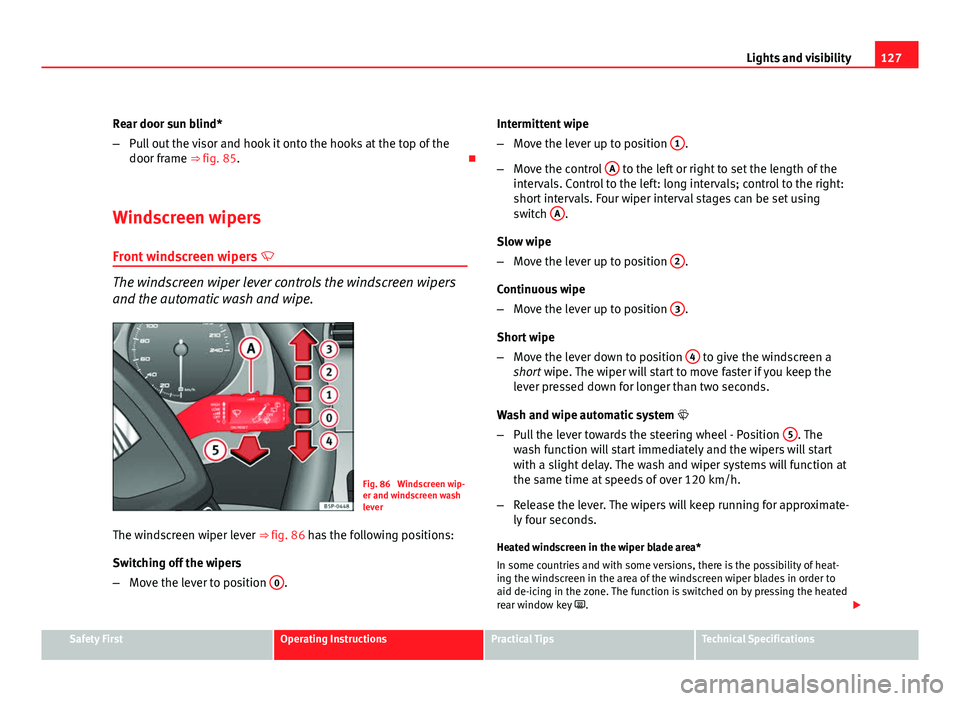
Fig. 86 Windscreen wip-
er and windscreen wash
lever
The windscreen wiper lever ⇒ fig. 86 has the following positions:
Switching off the wipers
– Move the lever to position 0
. Intermittent wipe
–
Move the lever up to position 1
.
– Move the control A
to the left or right to set the length of the
intervals. Control to the left: long intervals; control to the right:
short intervals. Four wiper interval stages can be set using
switch A
.
Slow wipe
– Move the lever up to position 2
.
Continuous wipe
– Move the lever up to position 3
.
Short wipe
– Move the lever down to position 4
to give the windscreen a
short wipe. The wiper will start to move faster if you keep the
lever pressed down for longer than two seconds.
Wash and wipe automatic system
– Pull the lever towards the steering wheel - Position 5
. The
wash function will start immediately and the wipers will start
with a slight delay. The wash and wiper systems will function at
the same time at speeds of over 120 km/h.
– Release the lever. The wipers will keep running for approximate-
ly four seconds.
Heated windscreen in the wiper blade area*
In some countries and with some versions, there is the possibility of heat-
ing the windscreen in the area of the windscreen wiper blades in order to
aid de-icing in the zone. The function is switched on by pressing the heated
rear window key .
Safety FirstOperating InstructionsPractical TipsTechnical Specifications
Page 130 of 315
128Lights and visibility
WARNING
● Worn and dirty wiper blades reduce visibility and safety levels while
driving.
● In cold conditions, you should not use the wash / wipe system unless
you have warmed the windscreen with the heating and ventilation sys-
tem. The washer fluid could otherwise freeze on the windscreen and ob-
scure your view of the road.
● Always note the corresponding warnings on ⇒ page 240, Changing
windscreen wiper blades.
CAUTION
In icy conditions, always check that the wiper blades are not frozen to the
glass before using the wipers for the first time. If you switch on the wipers
when the wiper blades are frozen to the windscreen, you could damage
both the wiper blades and the wiper motor.
Note
● The windscreen wipers will only work when the ignition is switched on.
● In certain versions of vehicles with alarms, the windscreen wiper will on-
ly work when the ignition is on and the bonnet closed.
● When in use, the wipers do not go as far as the rest position. When the
lever is moved to position 0, they are totally hidden.
● The next speed down will automatically be selected if speed ⇒ fig. 86
2
or 3 is selected when the vehicle stops. The set speed will be resumed
when the vehicle starts again
● The windscreen will be wiped again after approximately five seconds
once the “automatic wipe/wash system” has been operated, provided the
vehicle is in transit (drip function). If you activate the wipers less than three
seconds after the drip function, a new wash sequence will begin without the
last wipe. For the “drip” function to work again, you have to turn the ignition
off and then on again. ●
When the “intermittent wipe function” is on, the intervals are directly
proportional to the speed. This way, the higher the vehicle speed the short-
er the intervals.
● The wiper will try to wipe away any obstacles that are on the windscreen.
The wiper will stop moving if the obstacle blocks its path. Remove the ob-
stacle and switch the wiper back on again.
● Before removing any objects that may be trapped in the side areas of
the windscreen, always move the wiper arms to the service position (hori-
zontal).
● The heat output of the heated jets is controlled automatically when the
ignition is switched on, depending upon the outside temperature.
Page 132 of 315
130Lights and visibility
Rear window wiper
The windscreen wiper lever operates the windscreen wiper
and the wash and wipe system for the rear window.
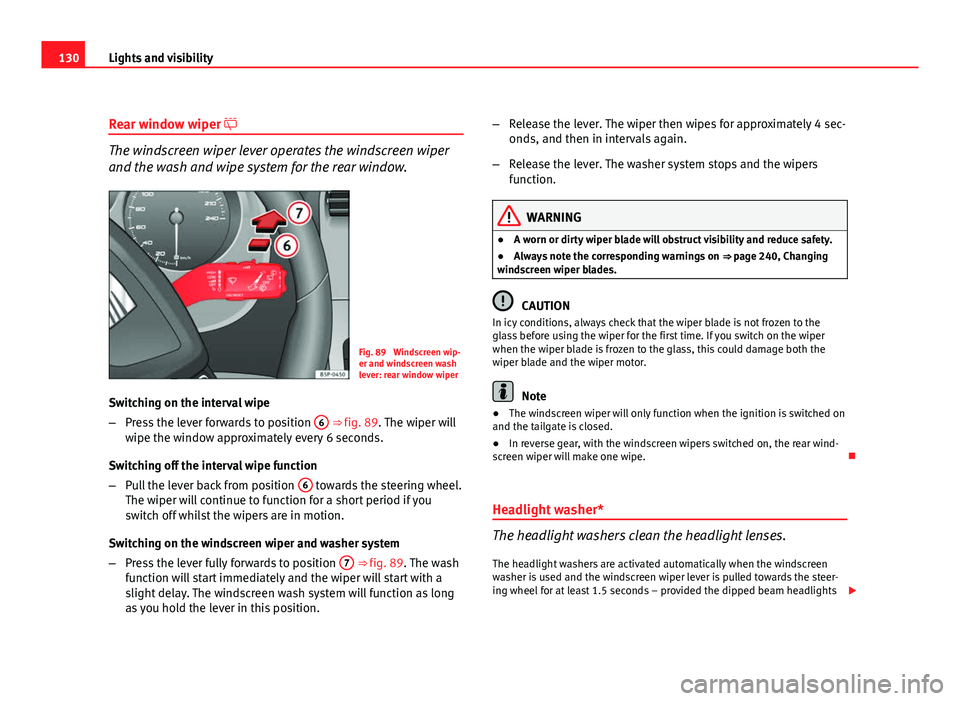
Fig. 89 Windscreen wip-
er and windscreen wash
lever: rear window wiper
Switching on the interval wipe
– Press the lever forwards to position 6
⇒ fig. 89. The wiper will
wipe the window approximately every 6 seconds.
Switching off the interval wipe function
– Pull the lever back from position 6
towards the steering wheel.
The wiper will continue to function for a short period if you
switch off whilst the wipers are in motion.
Switching on the windscreen wiper and washer system
– Press the lever fully forwards to position 7
⇒ fig. 89. The wash
function will start immediately and the wiper will start with a
slight delay. The windscreen wash system will function as long
as you hold the lever in this position. –
Release the lever. The wiper then wipes for approximately 4 sec-
onds, and then in intervals again.
– Release the lever. The washer system stops and the wipers
function.
WARNING
● A worn or dirty wiper blade will obstruct visibility and reduce safety.
● Always note the corresponding warnings on ⇒ page 240, Changing
windscreen wiper blades.
CAUTION
In icy conditions, always check that the wiper blade is not frozen to the
glass before using the wiper for the first time. If you switch on the wiper
when the wiper blade is frozen to the glass, this could damage both the
wiper blade and the wiper motor.
Note
● The windscreen wiper will only function when the ignition is switched on
and the tailgate is closed.
● In reverse gear, with the windscreen wipers switched on, the rear wind-
screen wiper will make one wipe.
Headlight washer*
The headlight washers clean the headlight lenses. The headlight washers are activated automatically when the windscreen
washer is used and the windscreen wiper lever is pulled towards the steer-
ing wheel for at least 1.5 seconds – provided the dipped beam headlights
Page 218 of 315
216Vehicle maintenance and cleaning
If possible, use a de-icing spray to remove ice. If you use an ice scraper,
push it in one direction only without swinging it.
Use window cleaner or a silicone remover to clean rubber, oil, grease and
silicone deposits off.
Wax deposits can be removed with a special cleaner available in your Au-
thorised Service Centre. Wax deposits on the windscreen could cause the
wiper blades to judder. Adding a window cleaner that dissolves wax to the
windscreen washer fluid prevents wiper blades from juddering, but wax de-
posits are not removed.
CAUTION
● Never use warm or hot water to remove snow and ice from windows and
mirrors. This could cause the glass to crack!
● The heating element for the rear window is located on the inner side of
the window. To prevent damage, do not put stickers on the heating ele-
ments inside the window.
Cleaning windscreen wiper blades
Clean wiper blades improve visibility.
1. Use a soft cloth to remove dust and dirt from the windscreen wiper blades.
2. Use window cleaner to clean the windscreen wiper blades. Use a sponge or a cloth to remove stubborn dirt. Rubber seals maintenance
If rubber seals are well looked after, they will not freeze so
quickly.
1. Use a soft cloth to remove dust and dirt from the rubber seals.
2. Apply a specialist care product to the rubber seals.
The rubber strips on the doors, windows, bonnet and tailgate will remain
pliable and last longer if they are treated with a suitable care product (for
example silicone spray).
Caring for rubber seals will also prevent premature ageing and leaks. The
doors will be easier to open. If rubber seals are well looked after, they will
not freeze so quickly in winter.
Door lock cylinders
The door lock cylinders can freeze up in winter.
To de-ice the lock cylinders you should only use spray with lubricating and
anti-corrosive properties.
Cleaning chrome parts
1. Clean chrome parts with a damp cloth.
2. Polish chrome parts with a soft, dry cloth. If this does not provide satisfying results, use a specialist chrome cleaning
product. Chrome cleaning products will remove stains from the surface.
Page 241 of 315
239
Checking and refilling levels
WARNING
Any work carried out in the engine compartment or on the engine must
be carried out cautiously.
● When working in the engine compartment, always observe the safety
warnings ⇒ page 230.
● When the engine is warm or hot, the cooling system is pressurised!
Do not unscrew the cap on the expansion tank when the engine is hot.
This is a burn injury risk.
CAUTION
● When mixed with other additives the colour of G12 will change to brown.
If this occurs you should have the coolant changed immediately. Failure to
do so will result in engine damage!
● If a lot of coolant fluid has been lost, wait for the engine to cool down
before putting in cold coolant. This avoids damaging the engine. Large cool-
ant losses are an indication of leaks in the cooling system. See a special-
ised workshop immediately and have the cooling system checked. Other-
wise, there is a risk of engine damage. Washer fluid and windscreen wiper blades
Topping up washer fluid
The water for cleaning the windscreen should always be
mixed with washer fluid.
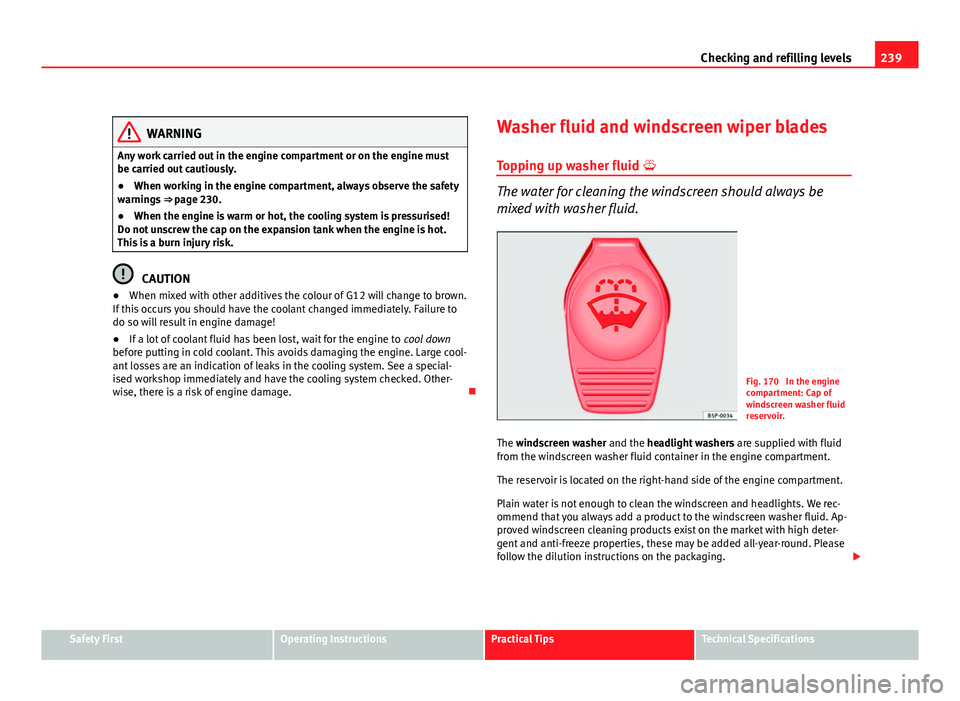
Fig. 170 In the engine
compartment: Cap of
windscreen washer fluid
reservoir.
The windscreen washer and the headlight washers are supplied with fluid
from the windscreen washer fluid container in the engine compartment.
The reservoir is located on the right-hand side of the engine compartment.
Plain water is not enough to clean the windscreen and headlights. We rec-
ommend that you always add a product to the windscreen washer fluid. Ap-
proved windscreen cleaning products exist on the market with high deter-
gent and anti-freeze properties, these may be added all-year-round. Please
follow the dilution instructions on the packaging.
Safety FirstOperating InstructionsPractical TipsTechnical Specifications
Page 242 of 315
240Checking and refilling levels
WARNING
Any work carried out in the engine compartment or on the engine must
be carried out cautiously.
● When working in the engine compartment, always observe the safety
warnings ⇒ page 230.
CAUTION
● Never put radiator anti-freeze or other additives into the windscreen
washer fluid.
● Always use approved windscreen cleansing products diluted as per in-
structions. If you use other washer fluids or soap solutions, the tiny holes in
the fan-shaped nozzles could become blocked. Changing windscreen wiper blades
If the windscreen wiper blades are in perfect condition, you
will benefit from an improved visibility. Damaged wiper
blades should be replaced immediately.
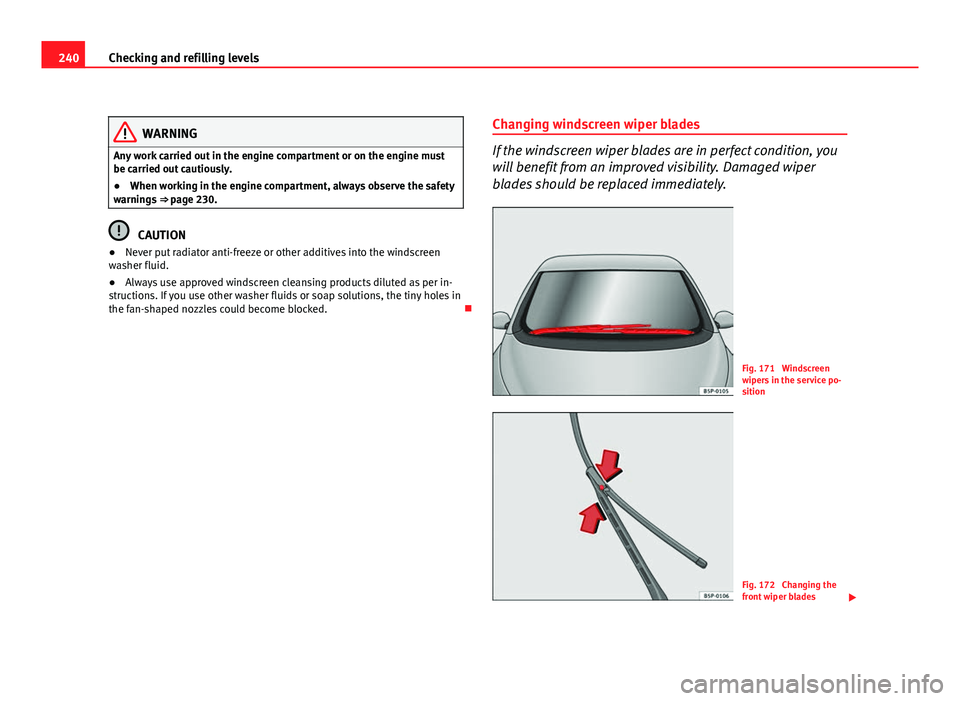
Fig. 171 Windscreen
wipers in the service po-
sition
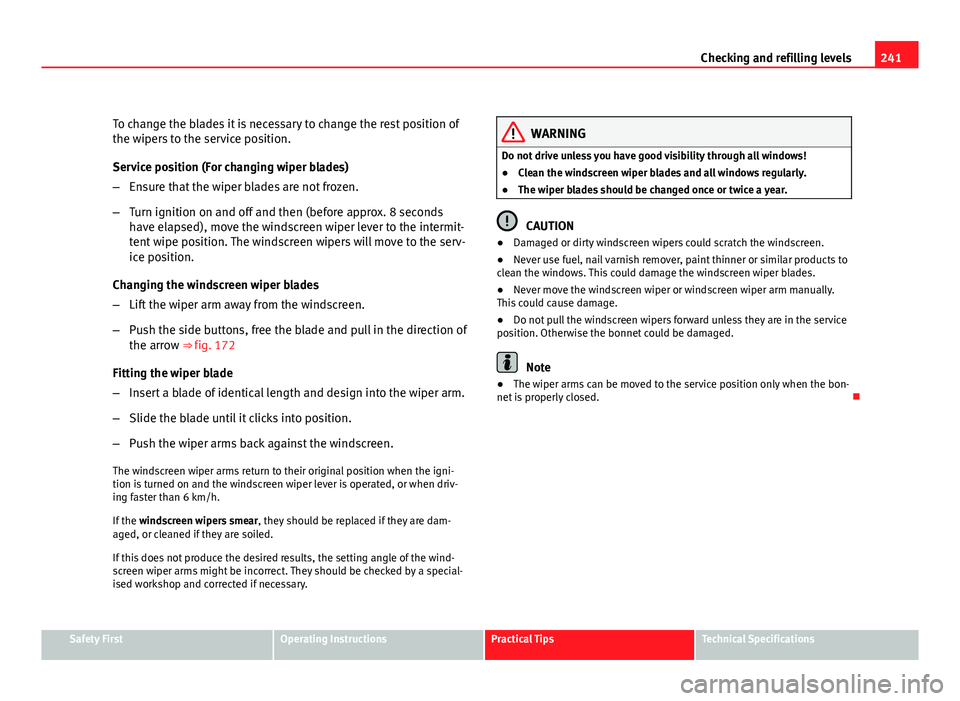
Fig. 172 Changing the
front wiper blades
Page 243 of 315
241
Checking and refilling levels
To change the blades it is necessary to change the rest position of
the wipers to the service position.
Service position (For changing wiper blades)
– Ensure that the wiper blades are not frozen.
– Turn ignition on and off and then (before approx. 8 seconds
have elapsed), move the windscreen wiper lever to the intermit-
tent wipe position. The windscreen wipers will move to the serv-
ice position.
Changing the windscreen wiper blades
– Lift the wiper arm away from the windscreen.
– Push the side buttons, free the blade and pull in the direction of
the arrow ⇒ fig. 172
Fitting the wiper blade
– Insert a blade of identical length and design into the wiper arm.
– Slide the blade until it clicks into position.
– Push the wiper arms back against the windscreen.
The windscreen wiper arms return to their original position when the igni-
tion is turned on and the windscreen wiper lever is operated, or when driv-
ing faster than 6 km/h.
If the windscreen wipers smear , they should be replaced if they are dam-
aged, or cleaned if they are soiled.
If this does not produce the desired results, the setting angle of the wind-
screen wiper arms might be incorrect. They should be checked by a special-
ised workshop and corrected if necessary.
WARNING
Do not drive unless you have good visibility through all windows!
● Clean the windscreen wiper blades and all windows regularly.
● The wiper blades should be changed once or twice a year.
CAUTION
● Damaged or dirty windscreen wipers could scratch the windscreen.
● Never use fuel, nail varnish remover, paint thinner or similar products to
clean the windows. This could damage the windscreen wiper blades.
● Never move the windscreen wiper or windscreen wiper arm manually.
This could cause damage.
● Do not pull the windscreen wipers forward unless they are in the service
position. Otherwise the bonnet could be damaged.
Note
● The wiper arms can be moved to the service position only when the bon-
net is properly closed.
Safety FirstOperating InstructionsPractical TipsTechnical Specifications
Page 244 of 315
242Checking and refilling levels
Changing the rear wiper blade
A good rear wiper blade is essential for clear rear vision.
Damaged wiper blades should be replaced immediately.
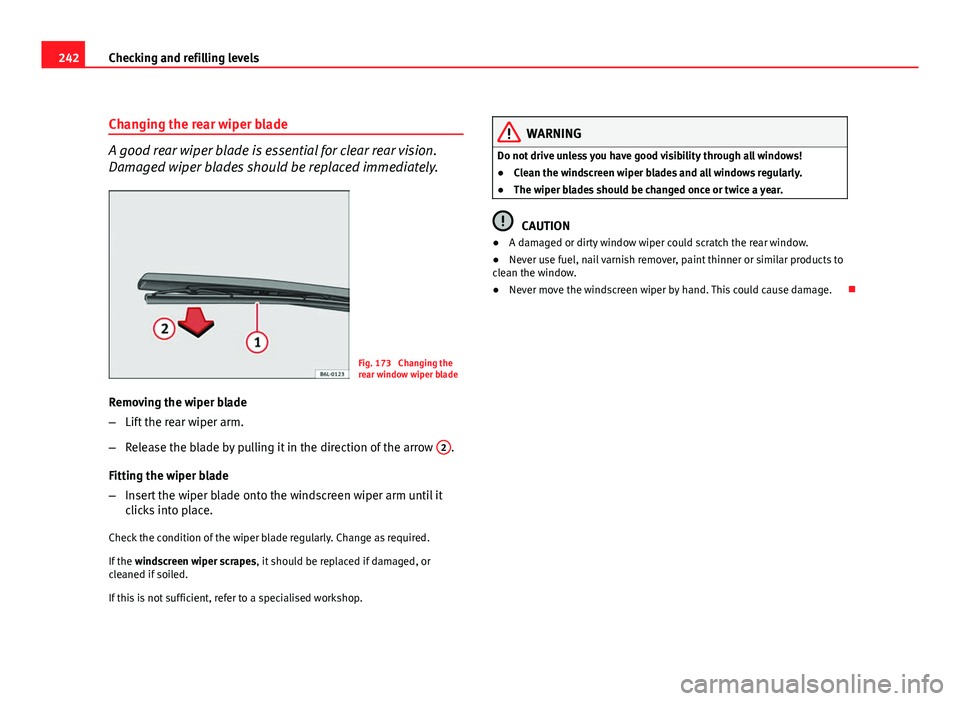
Fig. 173 Changing the
rear window wiper blade
Removing the wiper blade
– Lift the rear wiper arm.
– Release the blade by pulling it in the direction of the arrow 2
.
Fitting the wiper blade
– Insert the wiper blade onto the windscreen wiper arm until it
clicks into place.
Check the condition of the wiper blade regularly. Change as required.
If the windscreen wiper scrapes, it should be replaced if damaged, or
cleaned if soiled.
If this is not sufficient, refer to a specialised workshop.
WARNING
Do not drive unless you have good visibility through all windows!
● Clean the windscreen wiper blades and all windows regularly.
● The wiper blades should be changed once or twice a year.
CAUTION
● A damaged or dirty window wiper could scratch the rear window.
● Never use fuel, nail varnish remover, paint thinner or similar products to
clean the window.
● Never move the windscreen wiper by hand. This could cause damage.
Page 306 of 315
C
Car care Exterior . . . . . . . . . . . . . . . . . . . . . . . . . . . . 213
Catalytic converter . . . . . . . . . . . . . . . . . . . . . . 203
CCS . . . . . . . . . . . . . . . . . . . . . . . . . . . . . . . . . . 190
CD changer . . . . . . . . . . . . . . . . . . . . . . . . . . . . 141
Central lock button Locking . . . . . . . . . . . . . . . . . . . . . . . . . . . . . 99
Unlocking . . . . . . . . . . . . . . . . . . . . . . . . . . . 99
Central locking . . . . . . . . . . . . . . . . . . . . . . . . . . 97 Automatic speed dependent locking andunlocking system* . . . . . . . . . . . . . . . . . . 99
Emergency unlocking system . . . . . . . . . . . 99
Locking system for involuntary unlocking . 99
Selective unlocking system* . . . . . . . . . . . . 98
Unlocking system* . . . . . . . . . . . . . . . . . . . . 99
Centre armrest . . . . . . . . . . . . . . . . . . . . . . . . . 141
Cetane number . . . . . . . . . . . . . . . . . . . . . . . . . 229
Changing gear see Manual gearbox . . . . . . . . . . . . . . . . . . 179
Changing gear in tiptronic mode . . . . . . . . . . 183
Changing the bulbs Main headlight bulbs . . . . . . . . . . . . . . . . . 271
Tail lights . . . . . . . . . . . . . . . . . . . . . . . . . . 274
Changing the main headlight bulbs Main beam lights . . . . . . . . . . . . . . . . . . . . 273
Side lights . . . . . . . . . . . . . . . . . . . . . . . . . . 274
Turn signal bulbs . . . . . . . . . . . . . . . . . . . . 272
Changing the main headlight lamps dipped lights . . . . . . . . . . . . . . . . . . . . . . . 272 Changing the tail light bulbs
Position light, fog light and tail light on thetailgate . . . . . . . . . . . . . . . . . . . . . . . . . . . 276
Changing the tail lights Luggage compartment lights . . . . . . . . . . 277
Turn signal, side and brake lights on thebody . . . . . . . . . . . . . . . . . . . . . . . . . . . . . 275
Changing windscreen wiper blades . . . . . . . . 240
Chassis number . . . . . . . . . . . . . . . . . . . . . . . . 286
Checking . . . . . . . . . . . . . . . . . . . . . . . . . . . . . . 245
Checking battery electrolyte level . . . . . . . . . . 245
Checking engine oil level . . . . . . . . . . . . . . . . . 235
Child safety . . . . . . . . . . . . . . . . . . . . . . . . . . . . . 46
Child seat . . . . . . . . . . . . . . . . . . . . . . . . . . . . . . 48 Categorisation in groups . . . . . . . . . . . . . . . 48
Group 1 . . . . . . . . . . . . . . . . . . . . . . . . . . . . . 49
Group 2 . . . . . . . . . . . . . . . . . . . . . . . . . . . . . 49
Group 3 . . . . . . . . . . . . . . . . . . . . . . . . . . . . . 49
Groups 0 and 0+ . . . . . . . . . . . . . . . . . . . . . . 48
Safety notes . . . . . . . . . . . . . . . . . . . . . . . . . 46
Securing . . . . . . . . . . . . . . . . . . . . . . . . . . . . 51
Child seats ISOFIX system . . . . . . . . . . . . . . . . . . . . . . . . 52
on the front passenger seat . . . . . . . . . . . . . 31
Top Tether system . . . . . . . . . . . . . . . . . . . . 52
Cigarette lighter* . . . . . . . . . . . . . . . . . . . . . . . 150
Cleaning alloy wheel rims . . . . . . . . . . . . . . . . 217
Cleaning chrome . . . . . . . . . . . . . . . . . . . . . . . 216
Cleaning engine compartment . . . . . . . . . . . . 218
Cleaning steel wheel rims . . . . . . . . . . . . . . . . 217
Cleaning windows . . . . . . . . . . . . . . . . . . . . . . 215
Climatic* . . . . . . . . . . . . . . . . . . . . . . . . . . . . . . 159 Climatronic
General notes . . . . . . . . . . . . . . . . . . . . . . . 167
Clock . . . . . . . . . . . . . . . . . . . . . . . . . . . . . . . . . . 59
Clothes hook . . . . . . . . . . . . . . . . . . . . . . . . . . 144
Cloth seat covers cleaning . . . . . . . . . . . . . . . . 219
Cockpit . . . . . . . . . . . . . . . . . . . . . . . . . . . . . . . . 55
Coming/leaving home function . . . . . . . . . . . . 118
Compartment for on-board documentation . . 141
Control lamps . . . . . . . . . . . . . . . . . . . . . . . . . . . 77
Control lighting . . . . . . . . . . . . . . . . . . . . . . . . . . 55
Controls electric windows . . . . . . . . . . . . . . . . . . . . . 110
Exterior mirrors . . . . . . . . . . . . . . . . . . . . . . 132
Sliding/tilting sunroof . . . . . . . . . . . . . . . . 112
Convenience closing Sliding/tilting sunroof . . . . . . . . . . . . . . . . 113
Windows . . . . . . . . . . . . . . . . . . . . . . . . . . . 112
Convenience opening Windows . . . . . . . . . . . . . . . . . . . . . . . . . . . 112
Coolant . . . . . . . . . . . . . . . . . . . . . . . . . . . 237, 238 Warning lamp . . . . . . . . . . . . . . . . . . . . . . . . 66
Coolant level . . . . . . . . . . . . . . . . . . . . . . . . . . . 238 Warning lamp . . . . . . . . . . . . . . . . . . . . . . . . 82
Coolant loss . . . . . . . . . . . . . . . . . . . . . . . . . . . 238
Coolant temperature Gauge . . . . . . . . . . . . . . . . . . . . . . . . . . . . . . 58
Safety instructions . . . . . . . . . . . . . . . . . . . . 82
Warning lamp . . . . . . . . . . . . . . . . . . . . . . . . 82
Correct adjustment of front seat head re- straints . . . . . . . . . . . . . . . . . . . . . . . . . . . . . . . 13
Correct adjustment of rear seat head restraints In-use and non-use positions . . . . . . . . . . . 14
304 Index