bonnet Seat Altea XL 2014 Owner's Guide
[x] Cancel search | Manufacturer: SEAT, Model Year: 2014, Model line: Altea XL, Model: Seat Altea XL 2014Pages: 321, PDF Size: 4.52 MB
Page 252 of 321
250Checking and refilling levels
WARNING
Brake fluid is poisonous. Old brake fluid impairs the braking effect.
● Before opening the bonnet to check the brake fluid level, read and ob-
serve the warnings ⇒ page 235.
● Brake fluid should be stored in the closed original container in a safe
place out of reach of children. There is a toxic risk.
● Complete the brake fluid change according to the Maintenance Pro-
gramme. Heavy use of the brakes may cause a vapour lock if the brake
fluid is left in the brake system for too long. This would seriously affect
the effectiveness of the brakes and the safety of the vehicle. This may
cause an accident.
CAUTION
Brake fluid damages the vehicle paintwork. Wipe off any brake fluid from
the paintwork immediately.
For the sake of the environment
The brake pads and brake fluid must be collected and disposed of accord-
ing the applicable regulations. The SEAT Technical Service network has the
necessary equipment and qualified personnel for collecting and disposing
of this waste material. Vehicle battery
Warnings on handling the battery
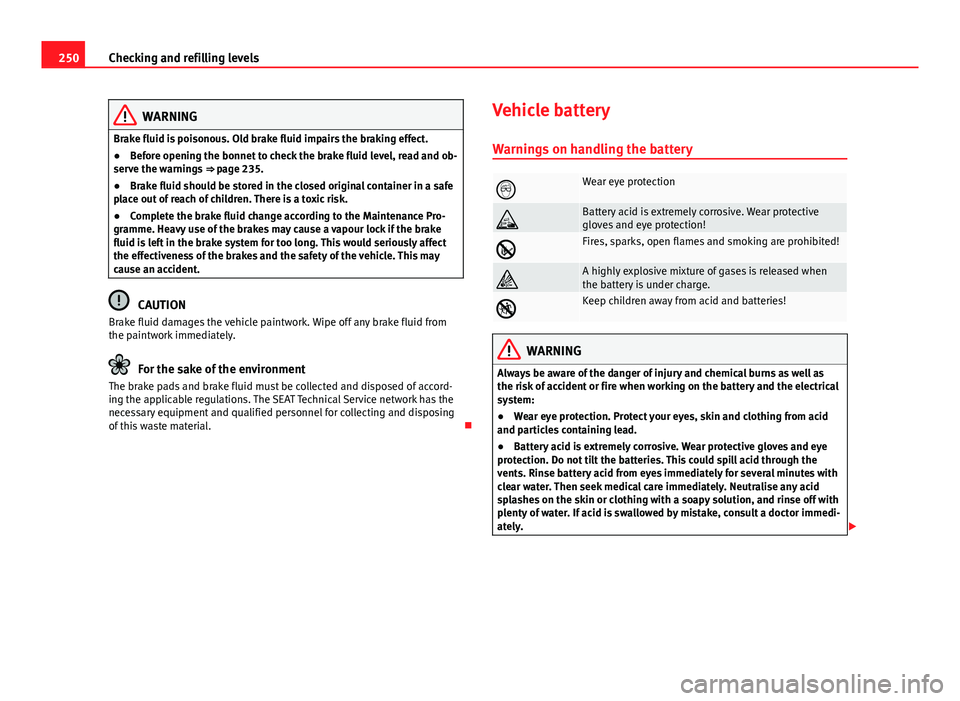
Wear eye protection
Battery acid is extremely corrosive. Wear protective
gloves and eye protection!
Fires, sparks, open flames and smoking are prohibited!
A highly explosive mixture of gases is released when
the battery is under charge.
Keep children away from acid and batteries!
WARNING
Always be aware of the danger of injury and chemical burns as well as
the risk of accident or fire when working on the battery and the electrical
system:
● Wear eye protection. Protect your eyes, skin and clothing from acid
and particles containing lead.
● Battery acid is extremely corrosive. Wear protective gloves and eye
protection. Do not tilt the batteries. This could spill acid through the
vents. Rinse battery acid from eyes immediately for several minutes with
clear water. Then seek medical care immediately. Neutralise any acid
splashes on the skin or clothing with a soapy solution, and rinse off with
plenty of water. If acid is swallowed by mistake, consult a doctor immedi-
ately.
Page 253 of 321
251
Checking and refilling levels
WARNING (Continued)
● Fires, sparks, open flames and smoking are prohibited. When han-
dling cables and electrical equipment, avoid causing sparks and electro-
static charge. Never short the battery terminals. High-energy sparks can
cause injury.
● A highly explosive mixture of gases is released when the battery is
under charge. The batteries should be charged in a well-ventilated room
only.
● Keep children away from acid and batteries.
● Before working on the electrical system, you must switch off the en-
gine, the ignition and all consumers. The negative cable on the battery
must be disconnected. When a light bulb is changed, you need only
switch off the light.
● Deactivate the anti-theft alarm by unlocking the vehicle before you
disconnect the battery! The alarm will otherwise be triggered.
● When disconnecting the battery from the vehicle on-board network,
disconnect first the negative cable and then the positive cable.
● Switch off all electrical consumers before reconnecting the battery.
Reconnect first the positive cable and then the negative cable. Never re-
verse the polarity of the connections. This could cause an electrical fire.
● Never charge a frozen battery, or one which has thawed. This could
result in explosions and chemical burns. Always replace a battery which
has frozen. A flat battery can also freeze at temperatures close to 0 °C
(+32 °F).
● Ensure that the vent hose is always connected to the battery.
● Never use a defective battery. This could cause an explosion. Replace
a damaged battery immediately.CAUTION
● Never disconnect the battery if the ignition is switched on or if the en-
gine is running. This could damage the electrical system or electronic com-
ponents.
● Do not expose the battery to direct sunlight over a long period of time,
as the intense ultraviolet radiation can damage the battery housing.
● If the vehicle is left standing in cold conditions for a long period, protect
the battery from freezing. If it freezes it will be damaged.
Checking the electrolyte level
The electrolyte level should be checked regularly in high-
mileage vehicles, in hot countries and in older batteries. – Open the engine bonnet and the battery cover ⇒
in Safety in-
structions on working in the engine compartment on page 236
⇒
in Warnings on handling the battery on page 250.
– Check the colour display in the "magic eye" on the top of the
battery.
– If there are air bubbles in the window, tap the window gently
until they disperse.
The position of the battery is shown in the corresponding engine compart-
ment diagram ⇒ page 297.
The “magic eye” indicator, located on the top of the battery changes colour,
depending on the charge state and electrolyte level of the battery.
There are two different colours:
Safety FirstOperating instructionsPractical TipsTechnical Specifications
Page 275 of 321
273
If and when
Vehicle fuses
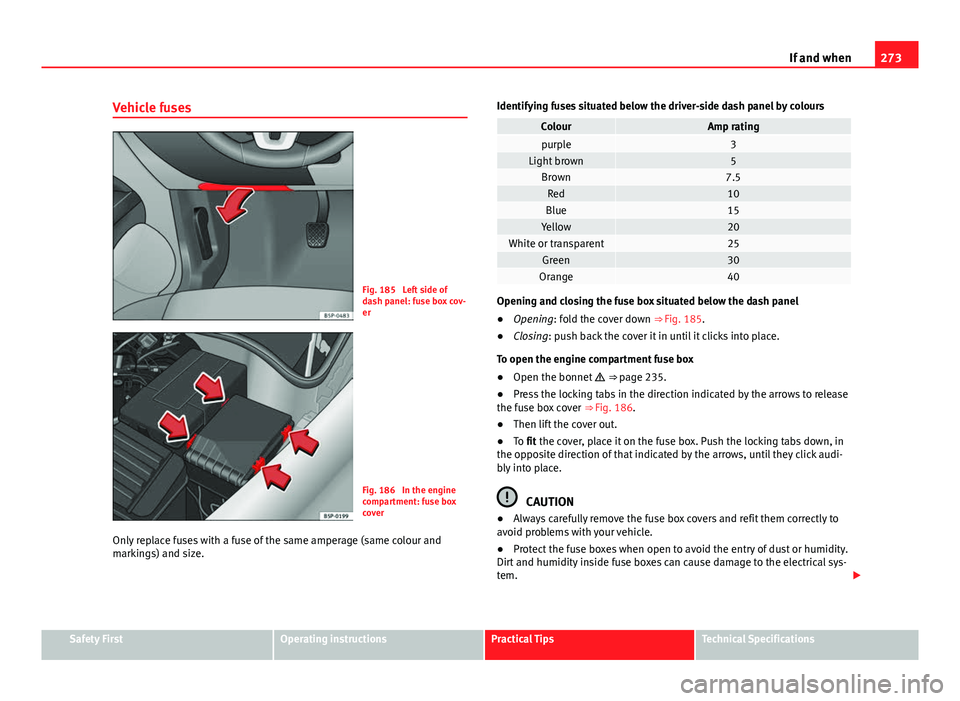
Fig. 185 Left side of
dash panel: fuse box cov-
er
Fig. 186 In the engine
compartment: fuse box
cover
Only replace fuses with a fuse of the same amperage (same colour and
markings) and size. Identifying fuses situated below the driver-side dash panel by colours
ColourAmp ratingpurple3Light brown5Brown7.5Red10Blue15Yellow20White or transparent25Green30Orange40
Opening and closing the fuse box situated below the dash panel
●
Opening: fold the cover down ⇒ Fig. 185.
● Closing: push back the cover it in until it clicks into place.
To open the engine compartment fuse box
● Open the bonnet ⇒ page 235.
● Press the locking tabs in the direction indicated by the arrows to release
the fuse box cover ⇒ Fig. 186.
● Then lift the cover out.
● To fit the cover, place it on the fuse box. Push the locking tabs down, in
the opposite direction of that indicated by the arrows, until they click audi-
bly into place.
CAUTION
● Always carefully remove the fuse box covers and refit them correctly to
avoid problems with your vehicle.
● Protect the fuse boxes when open to avoid the entry of dust or humidity.
Dirt and humidity inside fuse boxes can cause damage to the electrical sys-
tem.
Safety FirstOperating instructionsPractical TipsTechnical Specifications
Page 278 of 321
276If and when
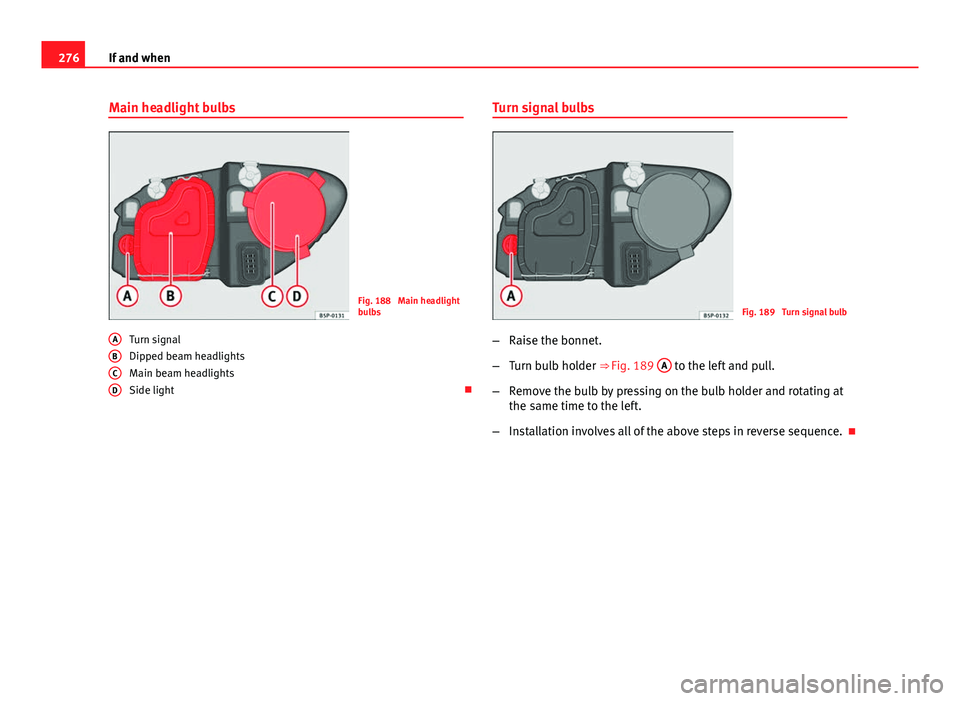
Main headlight bulbs
Fig. 188 Main headlight
bulbs
Turn signal
Dipped beam headlights
Main beam headlights
Side light
A
BCD
Turn signal bulbs
Fig. 189 Turn signal bulb
– Raise the bonnet.
– Turn bulb holder ⇒ Fig. 189 A
to the left and pull.
– Remove the bulb by pressing on the bulb holder and rotating at
the same time to the left.
– Installation involves all of the above steps in reverse sequence.
Page 279 of 321
277
If and when
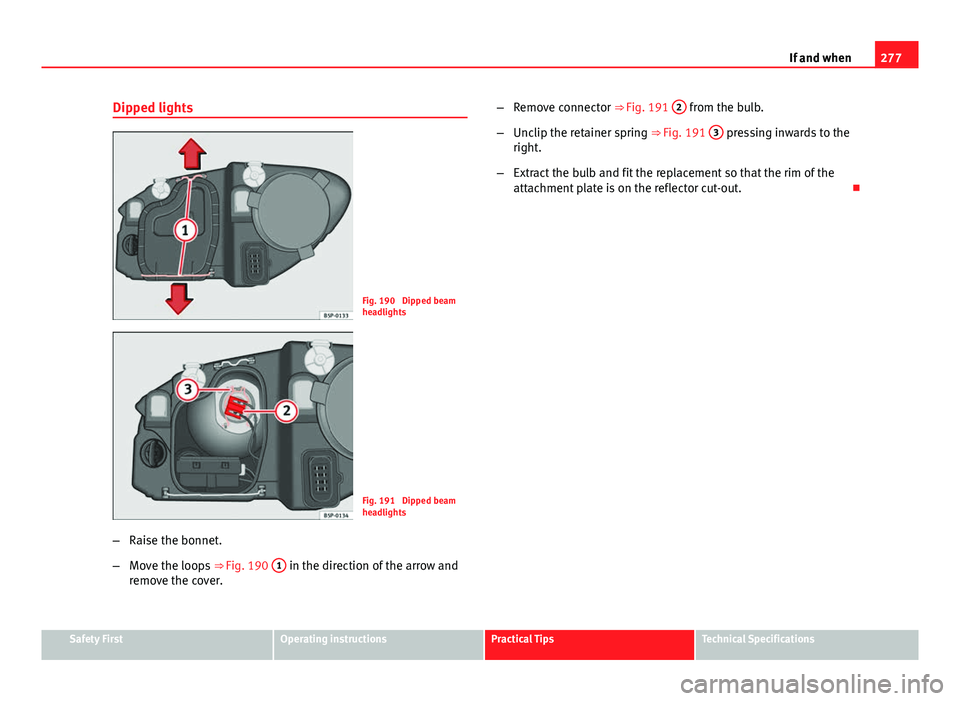
Dipped lights
Fig. 190 Dipped beam
headlights
Fig. 191 Dipped beam
headlights
– Raise the bonnet.
– Move the loops ⇒ Fig. 190 1
in the direction of the arrow and
remove the cover. –
Remove connector ⇒ Fig. 191 2
from the bulb.
– Unclip the retainer spring ⇒ Fig. 191 3
pressing inwards to the
right.
– Extract the bulb and fit the replacement so that the rim of the
attachment plate is on the reflector cut-out.
Safety FirstOperating instructionsPractical TipsTechnical Specifications
Page 280 of 321
278If and when
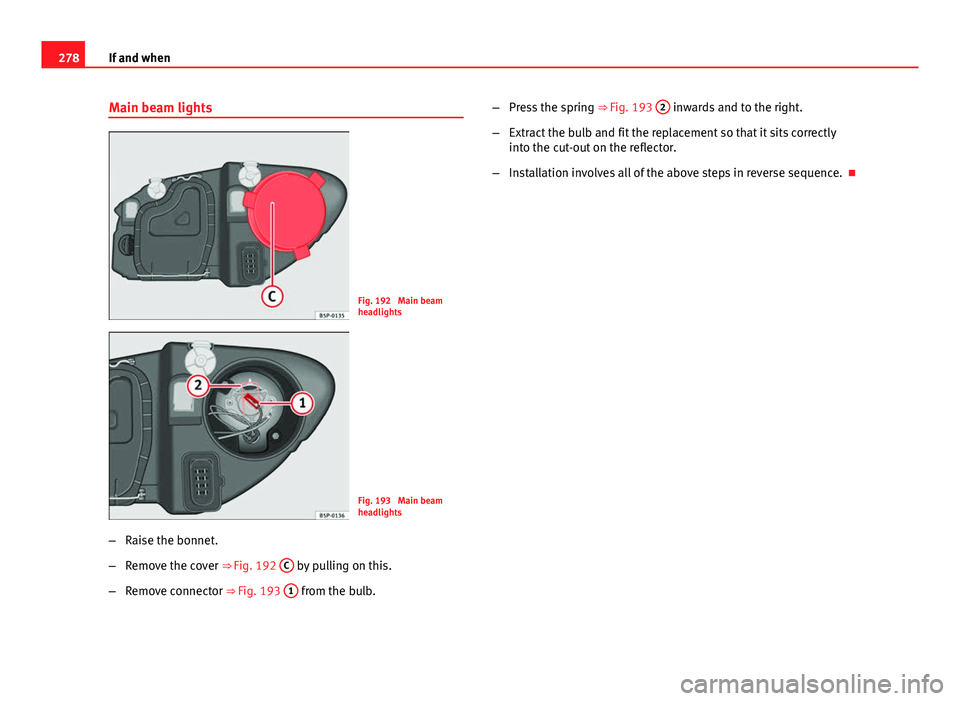
Main beam lights
Fig. 192 Main beam
headlights
Fig. 193 Main beam
headlights
– Raise the bonnet.
– Remove the cover ⇒ Fig. 192 C
by pulling on this.
– Remove connector ⇒ Fig. 193 1
from the bulb. –
Press the spring ⇒ Fig. 193 2
inwards and to the right.
– Extract the bulb and fit the replacement so that it sits correctly
into the cut-out on the reflector.
– Installation involves all of the above steps in reverse sequence.
Page 281 of 321
279
If and when
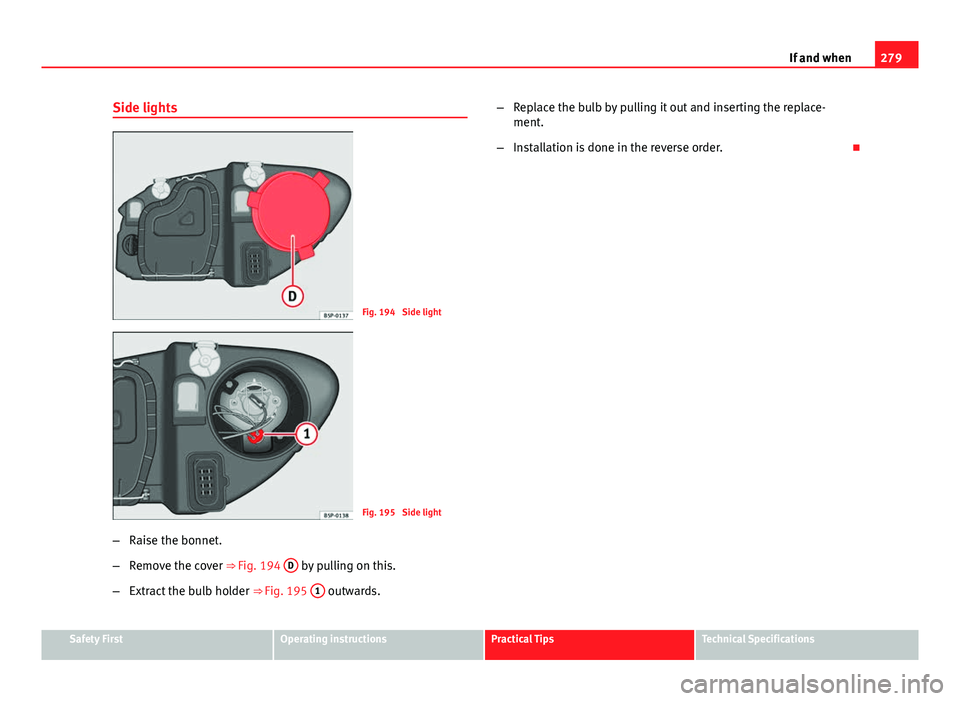
Side lights
Fig. 194 Side light
Fig. 195 Side light
– Raise the bonnet.
– Remove the cover ⇒ Fig. 194 D
by pulling on this.
– Extract the bulb holder ⇒ Fig. 195 1
outwards. –
Replace the bulb by pulling it out and inserting the replace-
ment.
– Installation is done in the reverse order.
Safety FirstOperating instructionsPractical TipsTechnical Specifications
Page 311 of 321
Index
A
ABS . . . . . . . . . . . . . . . . . . . . . . . . . . . . . . . . . . 197control lamp . . . . . . . . . . . . . . . . . . . . . . . . . 83
Accessories . . . . . . . . . . . . . . . . . . . . . . . . . . . . 226
Acoustic warning . . . . . . . . . . . . . . . . . . . . . . . 173
Adaptive headlights . . . . . . . . . . . . . . . . . . . . . 119
Adjusting the seat belt height . . . . . . . . . . . . . . 28
AFS (cornering lights) . . . . . . . . . . . . . . . . . . . 120
Airbag covers . . . . . . . . . . . . . . . . . . . . . . . . . . . 36
Airbag system . . . . . . . . . . . . . . . . . . . . . . . . . . . 30 control lamp . . . . . . . . . . . . . . . . . . . . . . . . . 32
Curtain airbags . . . . . . . . . . . . . . . . . . . . . . . 41
Front airbags . . . . . . . . . . . . . . . . . . . . . . . . 34
side airbags . . . . . . . . . . . . . . . . . . . . . . . . . 37
Air conditioner 2C-Climatronic . . . . . . . . . . . . . . . . . . . . . . 164
General notes . . . . . . . . . . . . . . . . . . . . . . . 169
Air conditioner automatic mode 2C-Climatronic . . . . . . . . . . . . . . . . . . . . . . 166
Air conditioning . . . . . . . . . . . . . . . . . . . . . . . . 161
Air recirculation mode 2C-Climatronic . . . . . . . . . . . . . . . . . . . . . . 168
Manual air conditioner . . . . . . . . . . . . . . . . 163
Alarm system Switching off . . . . . . . . . . . . . . . . . . . . . . . . 106
Alcantara . . . . . . . . . . . . . . . . . . . . . . . . . . . . . . 222
All-wheel drive . . . . . . . . . . . . . . . . . . . . . . . . . 200 Alternator
Warning lamp . . . . . . . . . . . . . . . . . . . . . . . . 84
Anti-lock brake system . . . . . . . . . . . . . . . . . . . 197 control lamp . . . . . . . . . . . . . . . . . . . . . . . . . 83
Anti-theft alarm system . . . . . . . . . . . . . . . . . . 106 Switching off . . . . . . . . . . . . . . . . . . . . . . . . 106
Anti-theft wheel bolts . . . . . . . . . . . . . . . . . . . 266
Antifreeze . . . . . . . . . . . . . . . . . . . . . . . . . . . . . 242
Aquaplaning . . . . . . . . . . . . . . . . . . . . . . . . . . . 256
Ashtray . . . . . . . . . . . . . . . . . . . . . . . . . . . . . . . 150
Aspects to note before setting off . . . . . . . . . . . . 8
ASR . . . . . . . . . . . . . . . . . . . . . . . . . . . . . . . . . . 197 Control lamp . . . . . . . . . . . . . . . . . . . . . . . . . 88
Audible warning . . . . . . . . . . . . . . . . . . . . . . . . . 20
Automatic anti-dazzle interior rear vision mirror Activating the anti-dazzle function . . . . . . 131
Deactivating the anti-dazzle function . . . . 131
Automatic car wash tunnel . . . . . . . . . . . . . . . 215
Automatic gearbox Kick-down feature . . . . . . . . . . . . . . . . . . . . 187
Automatic gearbox/DSG automatic gearbox . 183
Automatic lighting . . . . . . . . . . . . . . . . . . . . . . 116
Automatic windscreen wiper/washer . . . . . . . 127
Auxiliary audio input: AUX-IN . . . . . . . . . . . . . 152
B
Ball coupling . . . . . . . . . . . . . . . . . . . . . . . . . . . 211 Battery
Changing . . . . . . . . . . . . . . . . . . . . . . . . . . 252
Charging . . . . . . . . . . . . . . . . . . . . . . . . . . . 252
Winter conditions . . . . . . . . . . . . . . . . . . . . 250
Before setting off . . . . . . . . . . . . . . . . . . . . . . . . . 8
Biodiesel . . . . . . . . . . . . . . . . . . . . . . . . . . . . . . 234
Biodiesel fuel . . . . . . . . . . . . . . . . . . . . . . . . . . 234
Bonnet . . . . . . . . . . . . . . . . . . . . . . . . . . . . . . . 237
Brake fluid . . . . . . . . . . . . . . . . . . . . . . . . . . . . 249 Changing . . . . . . . . . . . . . . . . . . . . . . . . . . 249
control lamp . . . . . . . . . . . . . . . . . . . . . . . . . 66
Brake pads . . . . . . . . . . . . . . . . . . . . . . . . . . . . 204
Brake pedal control lamp . . . . . . . . . . . . . . . . . . . . . . . . . 89
Brakes . . . . . . . . . . . . . . . . . . . . . . . . . . . . . . . . 204 Worn brake pads . . . . . . . . . . . . . . . . . . . . . 84
Brake servo . . . . . . . . . . . . . . . . . . . . . . . . 196, 204
Brake system . . . . . . . . . . . . . . . . . . . . . . . . . . 249 Brakes . . . . . . . . . . . . . . . . . . . . . . . . . . . . . 201
Brake servo . . . . . . . . . . . . . . . . . . . . . . . . . 201
warning lamp . . . . . . . . . . . . . . . . . . . . . . . . 85
Braking distance . . . . . . . . . . . . . . . . . . . . . . . 204
Bulb changes General notes . . . . . . . . . . . . . . . . . . . . . . . 274
Bulb defect Control lamp . . . . . . . . . . . . . . . . . . . . . . . . . 86
Buzzer . . . . . . . . . . . . . . . . . . . . . . . . . . . . 122, 173
309
Index