child restraint Seat Arona 2017 User Guide
[x] Cancel search | Manufacturer: SEAT, Model Year: 2017, Model line: Arona, Model: Seat Arona 2017Pages: 308, PDF Size: 6.66 MB
Page 90 of 308
Safety
Transporting children safely Saf ety
f
or children
Introduction For safety reasons, as we have learned from
acc
ident
statistics, we recommend that chil-
dren under 12 years of age travel in the rear
seats. Depending on their age, height and
weight, children travelling in rear seats must
use a child seat or a seat belt. For safety rea-
sons, the child seat should be installed in the
rear seat, behind the front passenger seat or
in the centre back seat.
The physical laws involved and the forces
acting in a collision apply also to children
››› page 79. But unlike adults, children do not
have fully developed muscle and bone struc-
tures. This means that children are subject to
a greater risk of injury.
To reduce the risk of injuries, children must
always use special child restraint systems
when travelling in the vehicle.
We recommend the use of child safety prod-
ucts from the SEAT Original Accessories Pro-
gramme, which includes systems for all ages
made by “Peke” (not for all countries) (see
www.seat.com). These systems have been especially de-
signed and ap
pr
oved, complying with the
ECE-R44. regulation.
SEAT recommends securing the child seats
shown on the website as described below:
● Child seats in the opposite direction of
travel
(group 0+): ISOFIX and support bracket
(Peke G0 Plus + ISOFIX Base (RWF)).
● Child seats in the direction of travel (group
1): ISOFIX and T
op Tether (Peke G1 ISOFIX
DUO Plus).
● Child seats in the direction of travel (group
2): seat belt
and ISOFIX (RÖMER KIDFIX XP ©
).
● Child seats in the direction of travel (group
3): with seat
belt (TAKATA MAXI PLUS ©
).
Follow the manufacturer's instructions and
observe any statutory requirements when in-
stalling and using child seats. Always read
and note ››› page 88.
We recommend you always carry the manu-
facturer's Child Seat Instruction Manual to-
gether with the on-board documentation.
Important information regarding the
front p
assenger's airbag Read the additional information carefully
› ›
›
page 23. Read and always observe the safety informa-
tion included in the fo
llowing chapters:
● Safety distance with respect to the passen-
ger airbag ›
›› page 82.
● Objects between the passenger and the
pas
senger side airbag ››› in Front airbags
on p ag
e 84
.
The passenger side front airbag, when ena-
bled, is a serious risk for a child that is facing
backward since the airbag can strike the seat
with such force that it can cause serious or
fatal injuries. Children up to 12 years old
should always travel on the rear seat.
Therefore we strongly recommend you to
transport children on the rear seats. This is
the safest location in the vehicle. Alternative-
ly, the front passenger airbag can be disa-
bled with a key-operated switch ››› page 86.
When transporting children, use a child seat
suitable for the age and size of each child
››› page 90. WARNING
● If a c hi
ld seat is secured to the front pas-
senger seat, the risk to the child of sustain-
ing critical or fatal injuries in the event of an
accident increases.
● An inflating front passenger airbag can
strike the r
ear-facing child seat and project it
with great force against the door, the roof or
the backrest. 88
Page 91 of 308
Transporting children safely
●
Never in s
tall a child seat facing backwards
on the front passenger seat unless the front
passenger front airbag has been disabled.
Risk of potentially fatal injuries to the child!
However, if it is necessary, in exceptional ca-
ses, to transport a child in the front passen-
ger seat, the front passenger front airbag
must always be disabled ››› page 86, Deacti-
vation of front passenger front airbag*. If the
passenger seat has a height adjustment op-
tion, move it to the rearmost and highest po-
sition. If it is a fixed seat, it should be moved
to the rearmost position possible.
● For those vehicles that do not include a key
lock sw
itch to deactivate the airbag, the vehi-
cle must be taken to a technical service. Do
not forget to reconnect the airbag when an
adult wants to sit in the front passenger seat.
● All vehicle occupants, especially children,
must
assume the proper sitting position and
be properly belted in while travelling.
● Never hold children or babies on your lap,
this c
an result in potentially fatal injuries to
the child!
● Never allow a child to be transported in a
vehicl
e without being properly secured, or to
stand up or kneel on a seat while travelling.
In an accident, the child could be flung
through the vehicle, causing possibly fatal in-
juries to themselves and to the other vehicle
occupants.
● If children assume an improper sitting posi-
tion when the vehic
le is moving, they expose
themselves to greater risk of injury in the
event of a sudden braking manoeuvre or in an accident. This is particularly important if the
chi
l
d is travelling on the front passenger seat
and the airbag system is triggered in an acci-
dent; as this could cause serious injury or
even death.
● A suitable child seat can protect your child!
● Never leave a child alone in the child seat
or inside the
vehicle because depending on
the season, very high temperatures may be
reached inside a parked vehicle, which could
be fatal.
● Children who are less than 1.5 metres tall
must
not wear a normal seat belt without a
child seat, as this could cause injuries to the
abdominal and neck areas during a sudden
braking manoeuvre or in an accident.
● Do not allow the seat belt to become twis-
ted and the seat
belt should be properly in
place ››› page 77.
● Only one child may occupy a child seat
›››
page 89, Child seats.
● When a child seat is mounted in the rear
seats, the door c
hild-proof lock should be ac-
tivated ››› page 132. Child seats
Saf ety
in
structions Read the additional information carefully
› ›
›
page 23. WARNING
When travelling, children must be secured in
the v ehic
le with a restraint system suitable
for age, weight and size.
● Read and always observe information and
warning
s concerning the use of child seats
››› page 88. WARNING
The retaining rings are designed only for use
with “ISOFIX” and T op
Tether* system child
seats.
● Never secure other child seats that do not
have the “ISOFIX” or T
op Tether* system, or
retaining belts or objects to the fastening
rings - this can result in potentially fatal inju-
ries to the child.
● Ensure that the child seat is secured cor-
rectly u
sing the “ISOFIX” and Top Tether* se-
curing rings. WARNING
An undue installation of the safety seat will
incr e
ase the risk of injury in the event of a
crash.
● Never tie the retainer strap to a hook in the
luggag
e compartment.
● Never secure or tie luggage or other items
to the low
er anchorages (ISOFIX) or the upper
ones (Top Tether). 89
Technical data
Advice
Operation
Emergencies
Safety
Page 93 of 308
Transporting children safely
● Aut om
atic
three-point seat belt . Whenever
possible, it is preferable to attach the child
seats with the ISOFIX system rather than at-
taching them with an automatic three-point
seat belt ›››
page 24.
Additional attachment:
● Top Tether : The Top Tether belt is guided
ov
er the back of the rear seat and attached to
an anchor point with a hook. Anchor points
are located at the back of the rear seat back-
rest on the boot side ›››
page 29
. The
rings for retaining the Top Tether belt are
marked with an anchor symbol.
● Support bracket : Some chi
ld seats rest on
the floor of the vehicle with a support brack-
et. The support bracket prevents the child
seat from tipping forward in the event of im-
pact. Child seats fitted with a support bracket
should only be used in the passenger seat
and side rear seats ››› . For the assembly of
thi s
type of
seat you should also consult the
list of approved vehicles for this assembly,
available in the instructions for child restraint
systems.
Recommended systems for attaching child
seats
SEAT recommends attaching child seats as
follows: ●
Baby
carriers or child seats in the opposite
direction of travel: ISOFIX and support brack-
et or iSize.
● Child seats in the direction of travel: ISO-
FIX and T
op Tether. WARNING
Incorrect use of the support bracket can
cau se seriou
s or fatal injury.
● Make sure the support bracket is correctly
and safely
installed. 91
Technical data
Advice
Operation
Emergencies
Safety
Page 149 of 308
Seats and head restraints
Note
● When fitting the he a
d restraints again, in-
sert the tubes as far as possible into the
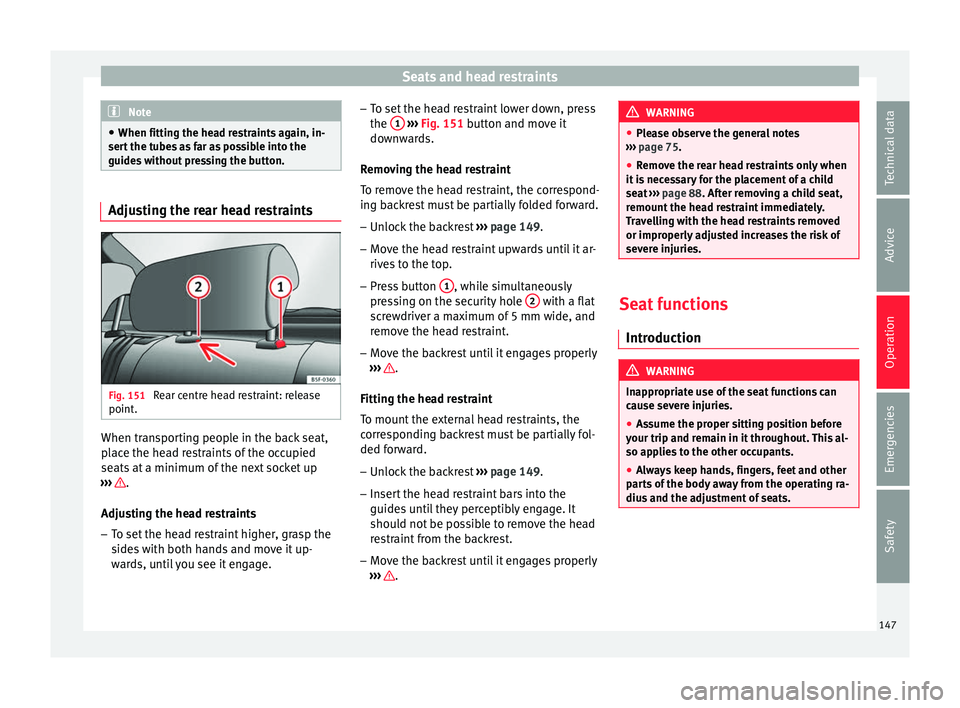
guides without pressing the button. Adjusting the rear head restraints
Fig. 151
Rear centre head restraint: release
point . When transporting people in the back seat,
p
l
ac
e the head restraints of the occupied
seats at a minimum of the next socket up
››› .
Adju s
tin
g the head restraints
– To set the head restraint higher, grasp the
sides
with both hands and move it up-
wards, until you see it engage. –
To set the he
ad restraint lower down, press
the 1
› ››
Fig. 151
b utton and move it
downwards.
Removing the head restraint
To remove the head restraint, the correspond-
ing backrest must be partially folded forward. – Unlock the backrest ›››
page 149.
– Move the head restraint upwards until it ar-
rives
to the top.
– Press button 1 , while simultaneously
pr e
s
sing on the security hole 2 with a flat
s c
r
ewdriver a maximum of 5 mm wide, and
remove the head restraint.
– Move the backrest until it engages properly
›››
.
Fittin g the he
a
d restraint
To mount the external head restraints, the
corresponding backrest must be partially fol-
ded forward.
– Unlock the backrest ›››
page 149.
– Insert the head restraint bars into the
guides u
ntil they perceptibly engage. It
should not be possible to remove the head
restraint from the backrest.
– Move the backrest until it engages properly
›››
. WARNING
● Ple a
se observe the general notes
››› page 75.
● Remove the rear head restraints only when
it is
necessary for the placement of a child
seat ››› page 88. After removing a child seat,
remount the head restraint immediately.
Travelling with the head restraints removed
or improperly adjusted increases the risk of
severe injuries. Seat functions
Intr oduction WARNING
Inappropriate use of the seat functions can
cau se sev
ere injuries.
● Assume the proper sitting position before
your trip and rem
ain in it throughout. This al-
so applies to the other occupants.
● Always keep hands, fingers, feet and other
part
s of the body away from the operating ra-
dius and the adjustment of seats. 147
Technical data
Advice
Operation
Emergencies
Safety
Page 303 of 308
Index
Rear window wiper blade ch
an
ging . . . . . . . . . . . . . . . . . . . . . . . . . . . . . . . 70
cleaning . . . . . . . . . . . . . . . . . . . . . . . . . . . . . . . 70
Refuelling . . . . . . . . . . . . . . . . . . . . . . . . . . . . . . . 265 opening fuel tank flap . . . . . . . . . . . . . . . . . . . 265
Remote control . . . . . . . . . . . . . . . . . . . . . . . . . . . 124
Removing and attaching head restraints . . . . . . 147
Repair work . . . . . . . . . . . . . . . . . . . . . . . . . . . . . . 255
Replacement parts . . . . . . . . . . . . . . . . . . . . . . . . . . . . . . . . . 255
Replacement keys . . . . . . . . . . . . . . . . . . . . . . . . 124
Replacement parts . . . . . . . . . . . . . . . . . . . . . . . . 255
Replacing the battery of the vehicle key . . . . . . . . . . . . . . . . . . . . . . . 125
Reset the trip recorder . . . . . . . . . . . . . . . . . . . . . 116
Rev counter . . . . . . . . . . . . . . . . . . . . . . . . . 113, 115
Reverse gear (automatic gearbox) . . . . . . . . . . . 183
Rims changing a wheel . . . . . . . . . . . . . . . . . . . . . . . . 61
Roll-back function windows . . . . . . . . . . . . . . . . . . . . . . . . . . . . . . 136
Roof carrier . . . . . . . . . . . . . . . . . . . . . . . . . . . . . . 156
Roof carrier system . . . . . . . . . . . . . . . . . . . . . . . . 156
Roof load . . . . . . . . . . . . . . . . . . . . . . . . . . . . . . . . 157 technical data . . . . . . . . . . . . . . . . . . . . . . . . . . 157
Roof luggage rack attach the cross bars . . . . . . . . . . . . . . . . . . . . 156
Roof rack . . . . . . . . . . . . . . . . . . . . . . . . . . . . . . . . 156
Rubber seals care . . . . . . . . . . . . . . . . . . . . . . . . . . . . . . . . . . 260
Run-in brake pads . . . . . . . . . . . . . . . . . . . . . . . . . . . . 191
engine . . . . . . . . . . . . . . . . . . . . . . . . . . . . . . . . 191
tyres . . . . . . . . . . . . . . . . . . . . . . . . . . . . . . . . . . 191
S Safe . . . . . . . . . . . . . . . . . . . . . . . . . . . . . . . . . . . . 127 Safe driving . . . . . . . . . . . . . . . . . . . . . . . . . . . . . . 71
Safe Sec
urity system . . . . . . . . . . . . . . . . . . . . . . 127
Safety . . . . . . . . . . . . . . . . . . . . . . . . . . . . . . . . . . . 71 child safety . . . . . . . . . . . . . . . . . . . . . . . . . . . . . 88
child seats . . . . . . . . . . . . . . . . . . . . . . . . . . . . . . 88
deactivating the front passenger airbag . . . . . . 21
safe driving . . . . . . . . . . . . . . . . . . . . . . . . . . . . . 71
Safety equipment . . . . . . . . . . . . . . . . . . . . . . . . . . 71
Safety instructions coolant temperature . . . . . . . . . . . . . . . . . . . . . 274
front airbags . . . . . . . . . . . . . . . . . . . . . . . . . . . . 84
head-protection airbags . . . . . . . . . . . . . . . . . . 22
seat belt tensioners . . . . . . . . . . . . . . . . . . . . . . 81
side airbags . . . . . . . . . . . . . . . . . . . . . . . . . . . . 85
using child seats . . . . . . . . . . . . . . . . . . . . . 23, 88
using seat belts . . . . . . . . . . . . . . . . . . . . . . . . . 78
Saving fuel inertia mode . . . . . . . . . . . . . . . . . . . . . . . . . . . 189
Saving tips (efficiency programme) . . . . . . . . . . . 40
Seat heating . . . . . . . . . . . . . . . . . . . . . . . . . . . . . . . 148
Seat belt position . . . . . . . . . . . . . . . . . . . . . . . . . . 19 for pregnant women . . . . . . . . . . . . . . . . . . . . . . 19
Seat belts . . . . . . . . . . . . . . . . . . . . . . . . . . . . . . . . 77 adjustment . . . . . . . . . . . . . . . . . . . . . . . . . . 19, 80
control lamp . . . . . . . . . . . . . . . . . . . . . . . . . . . . 77
protective function . . . . . . . . . . . . . . . . . . . . . . . 78
purpose . . . . . . . . . . . . . . . . . . . . . . . . . . . . . 77, 82
safety notes . . . . . . . . . . . . . . . . . . . . . . . . . . . . 78
unfastened . . . . . . . . . . . . . . . . . . . . . . . . . . . . . 79
Seat belt tensioners . . . . . . . . . . . . . . . . . . . . . . . . 20 control lamp . . . . . . . . . . . . . . . . . . . . . . . . . . . . 84
SEAT Drive Profile . . . . . . . . . . . . . . . . . . . . . . . . . 225
Seat heating . . . . . . . . . . . . . . . . . . . . . . . . . . . . . 148
Selective opening . . . . . . . . . . . . . . . . . . . . . . . . 127
Selector lever lock . . . . . . . . . . . . . . . . . . . . . . . . 184 Selector lever (automatic gearbox)
malfu nction . . . . . . . . . . . . . . . . . . . . . . . . . . . . 184
manual release . . . . . . . . . . . . . . . . . . . . . . . . . . 48
positions . . . . . . . . . . . . . . . . . . . . . . . . . . . . . . 183
Service intervals . . . . . . . . . . . . . . . . . . . . . . . . . . . 41
Service notification: read . . . . . . . . . . . . . . . . . . . . 42
Side airbags description . . . . . . . . . . . . . . . . . . . . . . . . . . . . . 22
safety instructions . . . . . . . . . . . . . . . . . . . . . . . 85
Signal lever . . . . . . . . . . . . . . . . . . . . . . . . . . . . . . . 31
Sitting position driver . . . . . . . . . . . . . . . . . . . . . . . . . . . . . . . . . . 72
Snow chains . . . . . . . . . . . . . . . . . . . . . . . . . . . . . . 66
Spanner symbol . . . . . . . . . . . . . . . . . . . . . . . . . . . 41
Spare wheel . . . . . . . . . . . . . . . . . . . . . . . . . . . . . 283
Special characteristics tow-starting . . . . . . . . . . . . . . . . . . . . . . . . . . . . . 97
Speed limiter . . . . . . . . . . . . . . . . . . . . . . . 198, 200 control lamp . . . . . . . . . . . . . . . . . . . . . . . . . . . 200
display message . . . . . . . . . . . . . . . . . . . . . . . . 200
operate . . . . . . . . . . . . . . . . . . . . . . . . . . . . . . . 201
warning lamp . . . . . . . . . . . . . . . . . . . . . . . . . . 200
Speed warning . . . . . . . . . . . . . . . . . . . . . . . . . . . . 40
Speed warning device . . . . . . . . . . . . . . . . . . . . . . 40
Sport Mode . . . . . . . . . . . . . . . . . . . . . . . . . . . . . . 179
Start-Stop . . . . . . . . . . . . . . . . . . . . . . . . . . . . . . . 196
Start-Stop system driver messages . . . . . . . . . . . . . . . . . . . . . . . . 198
lamps . . . . . . . . . . . . . . . . . . . . . . . . . . . . . . . . 196
operation . . . . . . . . . . . . . . . . . . . . . . . . . . . . . . 196
stopping and starting the engine . . . . . . . . . . 196
switching off and on . . . . . . . . . . . . . . . . . . . . . 198
the engine does not switch off . . . . . . . . . . . . 197
the engine starts by itself . . . . . . . . . . . . . . . . 197
Starter button . . . . . . . . . . . . . . . . . . . . . . . . . . . . 171
301