eco mode Seat Arona 2017 Owner's Guide
[x] Cancel search | Manufacturer: SEAT, Model Year: 2017, Model line: Arona, Model: Seat Arona 2017Pages: 308, PDF Size: 6.66 MB
Page 228 of 308
Operation
profiles, suitable for daily use. Contrasting
w ith thi
s
it features a sporty suspension in
the Sport profile, suitable for a sporty driv-
ing style. In the Individual profile the sus-
pension can be switched between Normal or
Sport , depending on personal preference.
In the event of a fault in the “Dual Ride” sus-
pension, the following message is displayed
on the instrument panel screen Fault:
damping setting .
Address
Power steering becomes more robust in Sport mode to enable a sportier driving
style.
Air conditioning
In vehicles with Climatronic, this can operate
in eco mode, especially restricting fuel con-
sumption.
Adaptive Cruise Control (ACC)
According to the active driving profile, the ac-
celeration gradient of the adaptive cruise
control varies. Setting driving mode
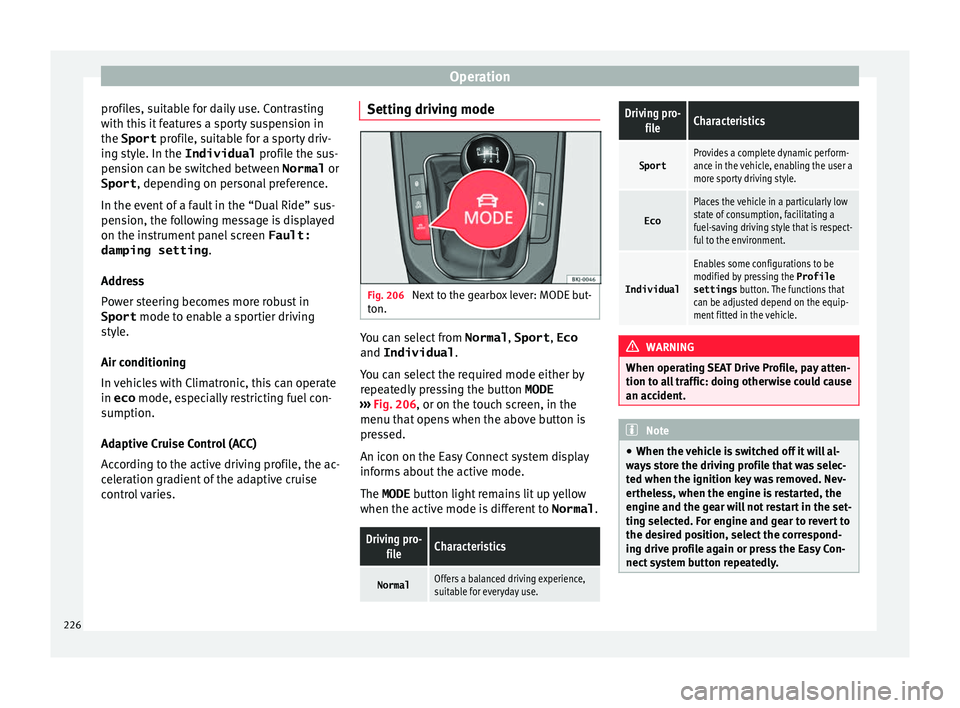
Fig. 206
Next to the gearbox lever: MODE but-
t on. You can select from
Normal, Sport, Eco
and Individual .
Y ou c
an sel
ect the required mode either by
repeatedly pressing the button MODE
››› Fig. 206, or on the touch screen, in the
menu that opens when the above button is
pressed.
An icon on the Easy Connect system display
informs about the active mode.
The MODE button light remains lit up yellow
when the active mode is different to Normal.
Driving pro-
fileCharacteristics
NormalOffers a balanced driving experience,
suitable for everyday use.
Driving pro-fileCharacteristics
SportProvides a complete dynamic perform-
ance in the vehicle, enabling the user a
more sporty driving style.
Eco
Places the vehicle in a particularly low
state of consumption, facilitating a
fuel-saving driving style that is respect-
ful to the environment.
Individual
Enables some configurations to be
modified by pressing the Profile
settings button. The functions that
can be adjusted depend on the equip-
ment fitted in the vehicle. WARNING
When operating SEAT Drive Profile, pay atten-
tion to a l
l traffic: doing otherwise could cause
an accident. Note
● When the v ehic
le is switched off it will al-
ways store the driving profile that was selec-
ted when the ignition key was removed. Nev-
ertheless, when the engine is restarted, the
engine and the gear will not restart in the set-
ting selected. For engine and gear to revert to
the desired position, select the correspond-
ing drive profile again or press the Easy Con-
nect system button repeatedly. 226
Page 229 of 308
Driver assistance systems
●
Your s peed and driv
ing style must always
be adjusted to visibility, weather, and traffic
conditions.
● The eco mode is not
available when towing
a trailer. Kick-down
The kick-down feature allows maximum ac-
cel
er
ation to be reached.
If the eco* ››› page 226 mode has been se-
lected in SEAT Drive Profile*, and the acceler-
ator is pressed beyond a hard point, the en-
gine power is automatically controlled to give
your vehicle maximum acceleration. WARNING
Please note that if the road surface is slip-
pery or w
et, the kick-down feature could
cause the driving wheels to spin, which could
result in skidding. Fatigue detection (break rec-
ommend
ation)*
R el
ated video Fig. 207
Safety Introduction
The Fatigue detection informs the driver
when their driv
in
g beh
aviour shows signs of
fatigue. WARNING
Do not let the comfort afforded by the Fatigue
detection sy s
tem tempt you into taking any
risks when driving. Take regular breaks, suffi-
cient in length when making long journeys.
● The driver always assumes the responsibil-
ity of driv
ing to their full capacity.
● Never drive if you are tired.
● The system does not detect the tiredness of
the driver in al
l circumstances. Consult the in-
formation in the section ››› page 228, System
limitations. ●
In some sit uation
s, the system may incor-
rectly interpret an intended driving manoeu-
vre as driver tiredness.
● No warning is given in the event of the ef-
fect c
alled microsleep!
● Please observe the indications on the in-
strument p
anel and act as is necessary. Note
● Fatigue det ection h
as been developed for
driving on motorways and well paved roads
only.
● If there is a fault in the system, have it
check
ed by a specialised workshop. Function and operation
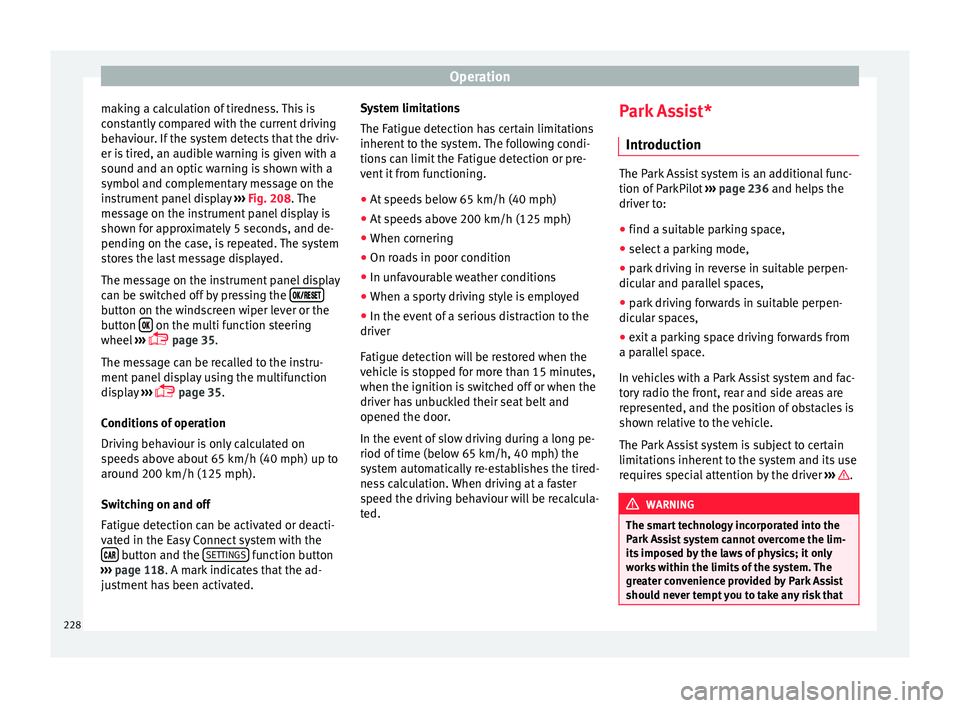
Fig. 208
On the instrument panel display: fa-
tigue det ection symbo
l
. Fatigue detection determines the driving be-
h
av
iour of
the driver when starting a journey, »
227
Technical data
Advice
Operation
Emergencies
Safety
Page 230 of 308
Operation
making a calculation of tiredness. This is
c on
s
tantly compared with the current driving
behaviour. If the system detects that the driv-
er is tired, an audible warning is given with a
sound and an optic warning is shown with a
symbol and complementary message on the
instrument panel display ››› Fig. 208. The
message on the instrument panel display is
shown for approximately 5 seconds, and de-
pending on the case, is repeated. The system
stores the last message displayed.
The message on the instrument panel display
can be switched off by pressing the button on the windscreen wiper lever or the
b
utt
on on the multi function steering
wheel
›
›
› page 35.
The message can be recalled to the instru-
ment panel display using the multifunction
display ›››
page 35.
Conditions of operation
Driving behaviour is only calculated on
speeds above about 65 km/h (40 mph) up to
around 200 km/h (125 mph).
Switching on and off
Fatigue detection can be activated or deacti-
vated in the Easy Connect system with the button and the
S
ET
TINGS function button
› ›
›
page 118. A mark indicates that the ad-
justment has been activated. System limitations
The Fatigue detection h
as certain limitations
inherent to the system. The following condi-
tions can limit the Fatigue detection or pre-
vent it from functioning.
● At speeds below 65 km/h (40 mph)
● At speeds above 200 km/h (125 mph)
● When cornering
● On roads in poor condition
● In unfavourable weather conditions
● When a sporty driving style is employed
● In the event of a serious distraction to the
driver
Fatigue det
ection will be restored when the
vehicle is stopped for more than 15 minutes,
when the ignition is switched off or when the
driver has unbuckled their seat belt and
opened the door.
In the event of slow driving during a long pe-
riod of time (below 65 km/h, 40 mph) the
system automatically re-establishes the tired-
ness calculation. When driving at a faster
speed the driving behaviour will be recalcula-
ted. Park Assist*
Introduction The Park Assist system is an additional func-
tion of P
arkPi
lot ››› page 236 and helps the
driver to:
● find a suitable parking space,
● select a parking mode,
● park driving in reverse in suitable perpen-
dicul
ar and parallel spaces,
● park driving forwards in suitable perpen-
dicu l
ar spaces,
● exit a parking space driving forwards from
a paral
lel space.
In vehicles with a Park Assist system and fac-
tory radio the front, rear and side areas are
represented, and the position of obstacles is
shown relative to the vehicle.
The Park Assist system is subject to certain
limitations inherent to the system and its use
requires special attention by the driver ››› .
WARNING
The smart technology incorporated into the
Park As
sist system cannot overcome the lim-
its imposed by the laws of physics; it only
works within the limits of the system. The
greater convenience provided by Park Assist
should never tempt you to take any risk that 228
Page 246 of 308
Operation
Parking and manoeuvring with the
r e
ar a
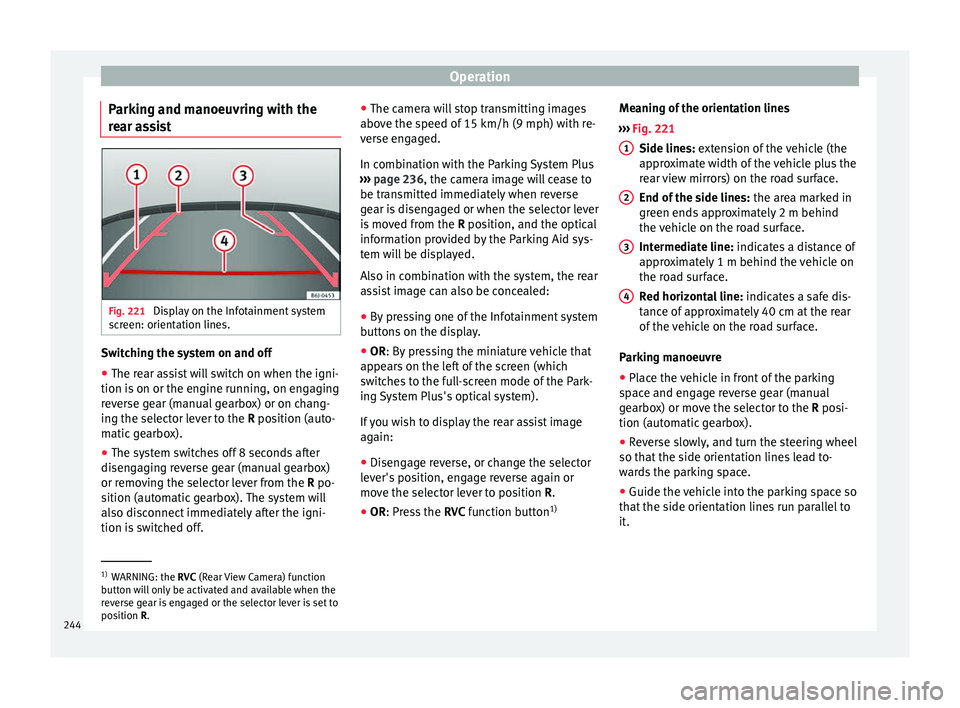
ssist Fig. 221
Display on the Infotainment system
s c
r
een: orientation lines. Switching the system on and off
●
The rear assist will switch on when the igni-
tion i s
on or the en
gine running, on engaging
reverse gear (manual gearbox) or on chang-
ing the selector lever to the R position (auto-
matic gearbox).
● The system switches off 8 seconds after
diseng
aging reverse gear (manual gearbox)
or removing the selector lever from the R po-
sition (automatic gearbox). The system will
also disconnect immediately after the igni-
tion is switched off. ●
The camera w
ill stop transmitting images
above the speed of 15 km/h (9 mph) with re-
verse engaged.
In combination with the Parking System Plus
››› page 236, the camera image will cease to
be transmitted immediately when reverse
gear is disengaged or when the selector lever
is moved from the R position, and the optical
information provided by the Parking Aid sys-
tem will be displayed.
Also in combination with the system, the rear
assist image can also be concealed:
● By pressing one of the Infotainment system
button
s on the display.
● OR: By pressing the miniature vehicle that
appe
ars on the left of the screen (which
switches to the full-screen mode of the Park-
ing System Plus's optical system).
If you wish to display the rear assist image
again:
● Disengage reverse, or change the selector
lever's
position, engage reverse again or
move the selector lever to position R.
● OR: Press the RVC fu
nction button1)Meaning of the orientation lines
›››
Fig. 221
Side lines: extension of the vehicle (the
approximate width of the vehicle plus the
rear view mirrors) on the road surface.
End of the side lines: the area marked in
green ends approximately 2 m behind
the vehicle on the road surface.
Intermediate line: indicates a distance of
approximately 1 m behind the vehicle on
the road surface.
Red horizontal line: indicates a safe dis-
tance of approximately 40 cm at the rear
of the vehicle on the road surface.
Parking manoeuvre
● Place the vehicle in front of the parking
spac
e and engage reverse gear (manual
gearbox) or move the selector to the R posi-
tion (automatic gearbox).
● Reverse slowly, and turn the steering wheel
so that the s
ide orientation lines lead to-
wards the parking space.
● Guide the vehicle into the parking space so
that the s
ide orientation lines run parallel to
it. 1
2
3
4
1)
WARNING: the RVC (Rear
View Camera) function
button will only be activated and available when the
reverse gear is engaged or the selector lever is set to
position R.
244
Page 252 of 308

Operation
Trailer towing Wh at
do
you need to bear in mind
when towing a trailer? Your vehicle may be used to tow a trailer
when fitted w
ith the c
orrect equipment.
If you wish to retrofit a towing bracket, con-
sult ››› page 253.
Connectors
Your vehicle is fitted with a 13-pin connector
for the electrical connection between the
trailer and the vehicle.
If the trailer has a 7-pin plug you will need to
use an adapter cable. It is available at any
Technical Service.
Trailer weight/drawbar load
Never exceed the authorised trailer weight. If
you do not load the trailer up to the maxi-
mum permitted trailer weight, you can then
climb correspondingly steeper slopes.
The maximum trailer weights listed are only
applicable for altitudes up to 1000 m above
sea level. With increasing altitude the engine
power and therefore the vehicle climbing
ability are impaired because of the reduced
air density. The maximum trailer weight has
to be reduced accordingly. The weight of the
vehicle and trailer combination must be re- duced by 10% for every further 1000 m (or
par
t
thereof). The gross combination weight
is the actual weight of the laden vehicle plus
the actual weight of the laden trailer. When
possible, operate the trailer with the maxi-
mum permitted drawbar load on the ball joint
of the towing bracket, but do not exceed the
specified limit.
The figures for trailer weights and drawbar
loads that are given on the data plate of the
towing bracket are for certification purposes
only. The correct figures for your specific
model, which may be lower than these fig-
ures for the towing bracket, are given in the
vehicle documentation or in ››› chapter Tech-
nical Data .
Distributing the load
Distribute loads in the trailer so that heavy
objects are as near to the axle as possible.
Loads carried in the trailer must be secured
to prevent them moving.
Tyre pressure
The maximum permissible tyre pressure val-
ues are shown on the sticker on the back of
the right front door frame. Set the tyre pres-
sure of the trailer tyres in accordance with the
trailer manufacturer's recommendations. Exterior mirrors
Check whether
you can see enough of the
road behind the trailer with the standard rear
vision mirrors. If this is not the case, you
should have additional exterior mirrors fitted.
Both exterior mirrors should be mounted on
hinged extension brackets. Adjust the mirrors
to give sufficient vision to the rear.
Tow rope
Always use a cable between the vehicle and
the trailer ››› page 251.
Trailer rear lights
The trailer's rear lights should comply with
the statutory safety regulations ››› page 251. WARNING
Never transport people in a trailer. This could
re s
ult in fatal accidents. Note
● To w
ing a trailer places additional demands
on the vehicle. We recommend additional
services between the normal inspection inter-
vals if the vehicle is used frequently for tow-
ing a trailer.
● Find out whether special regulations apply
to to
wing a trailer in your country. 250
Page 268 of 308
Advice
The following titles appear on the corre-
s pondin
g a
dhesive on the fuel tank flap:
Super unleaded 95 octane or normal 91 oc-
tane unleaded petrol
We recommend you use super 95 octane pet-
rol. If this is not available: normal 91 octane
petrol, with a slight decrease in power.
Super unleaded petrol with a minimum of 95
octanes
You should use super petrol with a minimum
of 95 octanes.
If super is not available, in an emergency you
may refuel with normal 91 octane petrol. In
this case only use moderate engine speeds
and a light throttle. Refuel with super as soon
as possible.
Super unleaded 98 octane or super 95 oc-
tane unleaded petrol
We recommend you use super plus 98 octane
petrol. If this is not available: super 95 oc-
tane petrol, with a slight decrease in power.
If super is not available, in an emergency you
may refuel with normal 91 octane petrol. In
this case only use moderate engine speeds
and a light throttle. Refuel with super as soon
as possible. Petrol additives
The quality of the f
uel influences the behav-
iour, power and service life of the engine.
This is why the petrol you use should carry
suitable additives already included by the
petrol industry, free of metals. These addi-
tives will help to prevent corrosion, keep the
fuel system clean and prevent deposits from
building up in the engine.
If good-quality petrol with metal-free addi-
tives is not available or engine problems
arise, the necessary additives must be added
when refuelling ››› .
Not al
l
petrol additives have been shown to
be effective. The use of unsuitable petrol ad-
ditives may cause significant damage to the
engine and the catalytic converter. Metal ad-
ditives should never be used. Metal additives
may also be contained in petrol additives for
improving anti-detonation ratings or octane
ratings ››› .
S EA
T r
ecommends “genuine Volkswagen
Group Fuel Additives for petrol engines”.
These additives can be bought at SEAT deal-
ers, where information on how to use them
can also be obtained. CAUTION
● Do not r ef
uel if the filler indicates that the
fuel contains metal. LRP ( lead replacement
petrol) fuels contain high concentrations of metal additives. Using them may damage the
engine!
● Nev er r
efuel with fuels containing a large
proportion of
ethanol (for example, E50, E85).
This could damage the fuel system.
● Just filling one full tank of leaded fuel or
fuel c
ontaining other metal additives would
seriously impair the efficiency of the catalytic
converter.
● Only use fuel additives that have been ap-
prov
ed by SEAT. Octane boosting or anti-
knock additives may contain metal additives
that could seriously damage the engine or
the catalytic converter. These additives must
not be used.
● High engine speed and full throttle can
damag
e the engine when using petrol with an
octane rating lower than the correct grade for
the engine. Note
● You m a
y use petrol with a high octane num-
ber than the one recommended for your en-
gine.
● In those countries where unleaded petrol is
not avai
lable, you may refuel with a fuel with
a low lead content. Diesel fuel
Please note the information on the inside of
the f
uel
t
ank flap.
266
Page 283 of 308
Wheels
For the sake of the environment
Under-inflated tyres will increase fuel con-
sumption. New tyres and wheels
New tyres and wheels have to be run in.
The tyr
e
s and wheel rims are an essential
part of the vehicle's design. Those approved
by SEAT are specially matched to the charac-
teristics of the vehicle and make a major con-
tribution to good road-holding and safe han-
dling ››› .
T y
r
es should be replaced at least in pairs and
not individually (i.e. both front tyres or both
rear tyres together). A knowledge of tyre des-
ignations makes it easier to choose the cor-
rect tyres. Radial tyres have the tyre designa-
tions marked on the sidewall, for example:
195/55 R16 91V
This contains the following information:
Tyre width in mm
Height/width ratio in %
Tyre construction: Radial
Rim diameter in inches
Load rating code
Speed rating
195
55
R
16
91
V The tyres could also have the following infor-
mation:
● A direction of
rotation symbol
● “Reinforced” denotes heavy-duty tyres.
The manufact
uring date is also indicated on
the tyre sidewall (possibly only on the inner
side of the wheel).
“DOT ... 1116 ...” means, for example, that
the tyre was produced in the 11th week of
2016.
We recommend that work on tyres and
wheels be carried out by a Technical Service.
They are familiar with the procedure and
have the necessary special tools and spare
parts as well as the proper facilities for dis-
posing of the old tyres.
Any technical service has full information on
the technical requirements when installing or
changing tyres, wheels or wheel trims. WARNING
● We r ec
ommend that you use only wheels
and tyres which have been approved by SEAT
for your model. Failure to do so could impair
vehicle handling. Risk of accident.
● Avoid running the vehicle on tyres that are
more than 6
years old. If you have no alterna-
tive, you should drive slowly and with extra
care at all times. ●
Never u se o
ld tyres or those with an un-
known “history of use”.
● If wheel trims are retrofitted, you must en-
sure th
at the flow of air to the brakes is not
restricted. This could cause the brake system
to overheat.
● All four wheels must be fitted with radial
tyre
s of the same type, size (rolling circumfer-
ence) and the same tread pattern. For the sake of the environment
Old tyres must be disposed of according to
the l aw
s in the country concerned. Note
● A S EA
T Service Centre should be consulted
to find out whether wheels or tyres of differ-
ent sizes to those originally fitted by SEAT
can be fitted, and to find out about the com-
binations allowed between the front axle
(axle 1) and the rear axle (axle 2).
● For technical reasons, it is not generally
poss
ible to use the wheels from other vehi-
cles. This can also apply to wheels of the
same model. The use of wheels or tyres
which have not been approved by SEAT for
use with your model may invalidate the vehi-
cle's type approval for use on public roads.
● If the spare tyre is not the same as the
tyre
s that are mounted on the vehicle (e.g.
winter tyres) you should only use the spare
tyre for a short period of time and drive with » 281
Technical data
Advice
Operation
Emergencies
Safety
Page 284 of 308
Advice
extra care. Refit the normal road wheel as
soon as
po
ssible. Wheel bolts
The design of wheel bolts is matched to the
rims. If diff
er
ent wheel rims are fitted, the
correct wheel bolts with the right length and
correctly shaped bolt heads must be used.
This ensures that wheels are fitted securely
and that the brake system functions correctly.
In certain circumstances, you should not use
wheel bolts from a different vehicle, even if it
is the same model ››› page 255. WARNING
If the wheel bolts are not tightened correctly,
the wheel c ou
ld become loose while driving.
Risk of accident.
● The wheel bolts must be clean and turn
eas
ily. Never apply grease or oil to them.
● Use only wheel bolts which belong to the
wheel.
● If the pr
escribed torque of the wheel bolts
is t
oo low, they could loosen whilst the vehi-
cle is in motion. Risk of accident! If the tight-
ening torque is too high, the wheel bolts and
threads can be damaged. CAUTION
The prescribed tightening torque for wheel
bolt s
for steel and alloy wheels is 120 Nm. Tyre monitoring indicator*
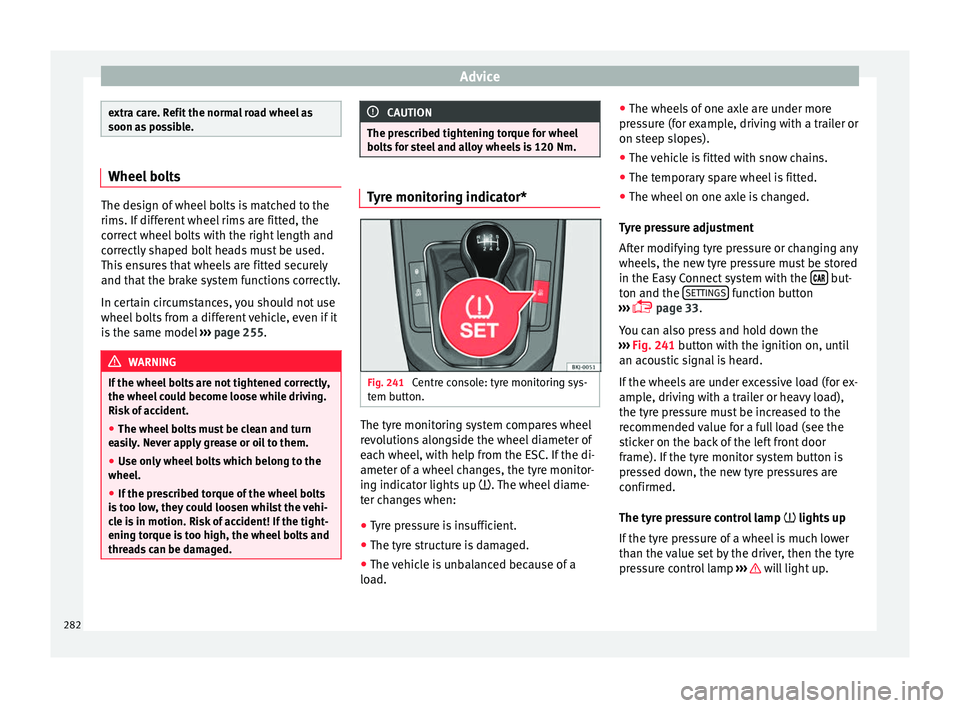
Fig. 241
Centre console: tyre monitoring sys-
t em b
utt
on. The tyre monitoring system compares wheel
r
ev
o
lutions alongside the wheel diameter of
each wheel, with help from the ESC. If the di-
ameter of a wheel changes, the tyre monitor-
ing indicator lights up . The wheel diame-
ter changes when:
● Tyre pressure is insufficient.
● The tyre structure is damaged.
● The vehicle is unbalanced because of a
load. ●
The wheel
s of
one axle are under more
pressure (for example, driving with a trailer or
on steep slopes).
● The vehicle is fitted with snow chains.
● The temporary spare wheel is fitted.
● The wheel on one axle is changed.
Tyr
e pressure adjustment
After modifying tyre pressure or changing any
wheels, the new tyre pressure must be stored
in the Easy Connect system with the but-
t on and the S
ET
TINGS function button
› ›
›
page 33.
You can also press and hold down the
››› Fig. 241 button with the ignition on, until
an acoustic signal is heard.
If the wheels are under excessive load (for ex-
ample, driving with a trailer or heavy load),
the tyre pressure must be increased to the
recommended value for a full load (see the
sticker on the back of the left front door
frame). If the tyre monitor system button is
pressed down, the new tyre pressures are
confirmed.
The tyre pressure control lamp lights up
If the tyre pressure of a wheel is much lower
than the value set by the driver, then the tyre
pressure control lamp ››› will light up.
282
Page 288 of 308
Technical data
Vehicle data sticker
The d at
a s
ticker is placed on the inside of the
spare wheel well, in the boot and on the rear
cover of the Maintenance Programme.
The following information is provided on the
vehicle data sticker: ››› Fig. 242
Vehicle identification number (chassis
number)
Vehicle type, model, capacity, engine
type, finish, engine power and gearbox
type
Engine code, gearbox code, external
paint code and internal equipment code
Optional extras and PR numbers
Identifying letters
The identifying letters of the engine can be
viewed on the instrument panel when the en-
gine is switched off and the ignition is on.
● Hold down the 0.0/SET
4
› ›
› Fig. 124
but-
ton for more than 15 seconds.
Information on fuel consump-
tion
Fuel c
onsumption Approved consumption values are derived
fr
om me
a
surements performed or supervised
1 2
3
4 by certified EU laboratories, according to the
l
e
gi
slation in force at the time (for more infor-
mation, see the Publications Office of the Eu-
ropean Union on the EUR-Lex website: © Eu-
ropean Union, http://eur-lex.europa.eu/) and
apply to the specified vehicle characteristics.
The values relating to fuel consumption and
CO 2 emissions can be found in the documen-
tation provided to the purchaser of the vehi-
cle at the time of purchase.
Fuel consumption and CO 2 emissions depend
on the equipment/features of each individual
vehicle, as well as on the driving style, road
conditions, traffic conditions, environmental
conditions, load or number of passengers. Note
In practice, and considering all the factors
mentioned here, c on
sumption values can dif-
fer from those calculated in the current Euro-
pean regulations. Weights
Kerb weight refers to the basic model with a
f
uel
t
ank filled to 90% capacity and without
optional extras. The figure quoted includes
75 kg to allow for the weight of the driver.
Special versions, optional equipment fittings
or retro-fitting accessories will increase the
weight of the vehicle ››› . WARNING
● Ple a
se note that the centre of gravity may
shift when transporting heavy objects; this
may affect vehicle handling and lead to an ac-
cident. Always adjust your speed and driving
style to suit road conditions and require-
ments.
● Never exceed the gross axle weight rating
or the gros
s vehicle weight rating. If the per-
missible axle load or the permissible total
weight is exceeded, the driving characteris-
tics of the vehicle may change, leading to ac-
cidents, injuries and damage to the vehicle. Trailer mode
Tr
ai
ler weights The trailer weights and drawbar loads ap-
pr
o
v
ed are selected in intensive trials accord-
ing to precisely defined criteria. The ap-
proved trailer weights are valid for vehicles in
the EU for maximum speeds of 80 km/h (50
mph) (in certain circumstances up to 100
km/h (62 mph)). The figures may be different
in other countries. All data in the official vehi-
cle documentation takes precedence over
these data at all times ››› .
286
Page 298 of 308
Index
Driver information system ad
dition
al electrical appliances . . . . . . . . . . . . 40
assist systems . . . . . . . . . . . . . . . . . . . . . . . . . . 38
bonnet, rear lid and doors open . . . . . . . . . . . . 38
engine oil temperature . . . . . . . . . . . . . . . . . . . . 40
gear-change indicator . . . . . . . . . . . . . . . . . . . . 39
journey data . . . . . . . . . . . . . . . . . . . . . . . . . . . . 36
menu . . . . . . . . . . . . . . . . . . . . . . . . . . . . . . . . . . 36
operation . . . . . . . . . . . . . . . . . . . . . . . . . . . . . . . 35
outside temperature . . . . . . . . . . . . . . . . . . . . . . 39
saving tips . . . . . . . . . . . . . . . . . . . . . . . . . . . . . . 40
service intervals . . . . . . . . . . . . . . . . . . . . . . . . . 41
speed warning . . . . . . . . . . . . . . . . . . . . . . . . . . 40
warning and information messages . . . . . . . . . 39
Driving driving abroad . . . . . . . . . . . . . . . . . . . . . . . . . 195
driving through water . . . . . . . . . . . . . . . . . . . . 195
economical driving . . . . . . . . . . . . . . . . . . . . . . 192
with a trailer . . . . . . . . . . . . . . 245, 250, 252, 253
Driving abroad headlights . . . . . . . . . . . . . . . . . . . . . . . . . . . . . 195
petrol . . . . . . . . . . . . . . . . . . . . . . . . . . . . . . . . . 195
Driving data data summary . . . . . . . . . . . . . . . . . . . . . . . . . . . 37
Driving mode . . . . . . . . . . . . . . . . . . . . . . . . . . . . 226
Driving on flooded roads . . . . . . . . . . . . . . . . . . . 195
Driving profile . . . . . . . . . . . . . . . . . . . . . . . . . . . . 226
Driving safety . . . . . . . . . . . . . . . . . . . . . . . . . . . . . 71
DSG . . . . . . . . . . . . . . . . . . . . . . . . . . . . . . . . . . . . 183
Duplicate keys . . . . . . . . . . . . . . . . . . . . . . . . . . . 124
Dust and pollen filter . . . . . . . . . . . . . . . . . . . . . . 158
Dynamic lights range control . . . . . . . . . . . . . . . . 141
E E10 see Ethanol (fuel) . . . . . . . . . . . . . . . . . . . . . . . 265
Easy Connect . . . . . . . . . . . . . . . . . . . . . . . . 33, 118 EDL
see Electronic differential lock . . . . . . . . . . . . . 179
EDS . . . . . . . . . . . . . . . . . . . . . . . . . . . . . . . . . . . . 179
Efficiency programme additional electrical appliances . . . . . . . . . . . . 40
saving tips . . . . . . . . . . . . . . . . . . . . . . . . . . . . . . 40
Electrical power socket . . . . . . . . . . . . . . . . . . . . 151
Electrical socket trailer . . . . . . . . . . . . . . . . . . . . . . . . . . . . . . . . . 251
Electric windows . . . . . . . . . . . . . . . . . . . . . . 18, 135 convenience opening and closing . . . . . . . . . 136
Electrolyte . . . . . . . . . . . . . . . . . . . . . . . . . . . . . . . 277
Electronic differential lock . . . . . . . . . . . . . 177, 179 control lamp . . . . . . . . . . . . . . . . . . . . . . 180, 181
Electronic differential lock (XDS) . . . . . . . . . . . . . 181
Electronic immobiliser . . . . . . . . . . . . . . . . . 15, 169
Electronic Stability Control (ESC) . . . . . . . 177, 179
Emergencies . . . . . . . . . . . . . . . . . . . . . . . . . . . . . . 93 automatic gearbox backup programme . . . . . 189
bulbs . . . . . . . . . . . . . . . . . . . . . . . . . . . . . . . . . . 59
changing a wheel . . . . . . . . . . . . . . . . . . . . . . . . 61
changing the battery . . . . . . . . . . . . . . . . . . . . 278
emergency towing of the vehicle . . . . . . . . . . . . 66
emergency warning triangle . . . . . . . . . . . . . . . 93
fire extinguisher . . . . . . . . . . . . . . . . . . . . . . . . . 93
first-aid kit . . . . . . . . . . . . . . . . . . . . . . . . . . . . . . 93
fuses . . . . . . . . . . . . . . . . . . . . . . . . . . . . . . . . . . 58
hazard warning lights . . . . . . . . . . . . . . . . . . . 141
jump leads . . . . . . . . . . . . . . . . . . . . . . . . . . . . . 67
puncture . . . . . . . . . . . . . . . . . . . . . . . . . . . . . . . 60
replacing a blown fuse . . . . . . . . . . . . . . . . . . . . 58
Spare wheel . . . . . . . . . . . . . . . . . . . . . . . . . . . 283
vehicle tools . . . . . . . . . . . . . . . . . . . . . . . . . . . . 93
Emergency operation front passenger door . . . . . . . . . . . . . . . . . . . . . 16
selector lever . . . . . . . . . . . . . . . . . . . . . . . . . . . 48
Emergency warning triangle . . . . . . . . . . . . . . . . . 93 Emission control system
contro l lamp . . . . . . . . . . . . . . . . . . . . . . . . . . . 194
Emissions data . . . . . . . . . . . . . . . . . . . . . . . . . . . 285
Engine assisted starting . . . . . . . . . . . . . . . . . . . . . . . . . 67
noises . . . . . . . . . . . . . . . . . . . . . . . . . . . . . . . . 173
running in . . . . . . . . . . . . . . . . . . . . . . . . . . . . . 191
Start-Stop system . . . . . . . . . . . . . . . . . . . . . . . 196
Engine and ignition automatic ignition switch-off . . . . . . . . . . . . . . 172My Beat . . . . . . . . . . . . . . . . . . . . . . . . . . . . . . . 174
preheating the engine . . . . . . . . . . . . . . . . . . . 173
starting the engine . . . . . . . . . . . . . . . . . . . . . . 173
starting the engine with Press & Drive . . . . . . 173 stopping the engine . . . . . . . . . . . . . . . . . . . . . 174
Engine compartment . . . . . . . . . . . . . . 17, 267, 270 battery . . . . . . . . . . . . . . . . . . . . . . . . . . . . . . . . 276
brake fluid . . . . . . . . . . . . . . . . . . . . . . . . . . . . . 275
closing . . . . . . . . . . . . . . . . . . . . . . . . . . . . . . . . 269
coolant . . . . . . . . . . . . . . . . . . . . . . . . . . 273, 274
engine oil . . . . . . . . . . . . . . . . . . . . . . . . . . . . . 272
opening . . . . . . . . . . . . . . . . . . . . . . . . . . . . . . . 268
safety notes . . . . . . . . . . . . . . . . . . . . . . . . . . . 267
windscreen washer liquid . . . . . . . . . . . . . . . . 276
Engine coolant . . . . . . . . . . . . . . . . . . . . . . . . . . . . 56 checking level . . . . . . . . . . . . . . . . . . . . . . . . . . 273
G12 plus-plus . . . . . . . . . . . . . . . . . . . . . . . . . . . 56
G13 . . . . . . . . . . . . . . . . . . . . . . . . . . . . . . . . . . . 56
specifications . . . . . . . . . . . . . . . . . . . . . . . . . . . 56
Engine data . . . . . . . . . . . . . . . . . . . . . . . . . . . . . . 288
Engine fault control lamp . . . . . . . . . . . . . . . . . . . . . . . . . . . 195
Engine management . . . . . . . . . . . . . . . . . . . . . . 193 control lamp . . . . . . . . . . . . . . . . . . . . . . . . . . . 194
Engine oil . . . . . . . . . . . . . . . . . . . . . . . . . . . 55, 270 changing . . . . . . . . . . . . . . . . . . . . . . . . . 270, 273
check oil level . . . . . . . . . . . . . . . . . . . . . . . . . . 272
296