cooling Seat Ateca 2016 User Guide
[x] Cancel search | Manufacturer: SEAT, Model Year: 2016, Model line: Ateca, Model: Seat Ateca 2016Pages: 328, PDF Size: 6.32 MB
Page 171 of 328
Driving
●
Electric
al components with a high power
consumption are switched off temporarily
when the engine starts.
● When starting with a cold engine, noise
lev
els may briefly increase. This is quite nor-
mal, and no cause for concern.
● When the outside temperature is below
+5°C (+41°F), if
the engine is diesel, some
smoke may appear under the vehicle when the fuel-operated auxiliary heater is on. Stopping the engine
3
V
alid for vehicles: with Keyless Access
StepSwitch off the engine with the starter
button ››› page 167.
1.Stop the vehicle completely ››› .
2.Press and hold the brake pedal until the step
4 is performed.
3.If you are driving an automatic vehicle, place
the selector lever in position P.
4.Connect the electronic parking brake
››› page 170.
5.
Briefly press the start-up button ››› Fig. 164.
The START ENGINE STOP button blinks again. If
the engine fails to switch off, perform an emer-
gency disconnect ››› page 167.
6.If the vehicle is equipped with a manual gear-
box, put it into 1st or reverse. WARNING
Never switch off the engine while the vehicle
i s
moving. This could cause loss of control of
the vehicle, accidents and serious injury.
● The airbags and belt tensioners do not
work
when the ignition is switched off.
● The brake servo does not work with the en-
gine off.
Therefore, you need to press the
break pedal harder to brake the vehicle.
● Power steering does not work when the en-
gine is
not running. You need more strength
to steer when the engine is switched off.
● If the ignition is switched off, the steering
co
lumn could be locked, making it impossible
to control the vehicle. CAUTION
If the engine is made to work hard for a long
time, it m
ay overheat after being switched
off. To prevent damage to the engine before
switching it off, leave it idle for approx. 2 mi-
nutes in neutral. Note
After switching off the engine, the cooling fan
m a
y continue to operate in the engine com-
partment for a few more minutes, even with
the ignition off. The radiator fan is automati-
cally switched off. “My Beat” Function
For vehicles with a convenience key there is
the “M
y
Beat” function. This feature provides
an additional indication of the vehicle igni-
tion system.
When accessing the vehicle, e.g. by opening
the doors with the remote control, the START ENGINE STOP button flashes, calling at-
t ention t
o the relevant starter system button.
Upon switching the ignition on/off, the light
of the START ENGINE STOP button flashes. With
the en gine sw
itched off, after a few seconds,
the STOP ENGINE START button stops flashing
and g oe
s out.
With the engine running, the START ENGINE STOP button light stays on, indi-
c atin
g that the engine is running. Upon
switching the ignition off with the START ENGINE STOP button, it starts flashing
ag ain.
In
vehicles with the Start-Stop system , the
“My Beat” function also offers additional in-
formation:
● When the engine stops during the Stop
pha
se, the light of the START ENGINE STOP but-
t on s
tays on, since, even though the engine
is off, the Start-Stop system is active.
● When the engine cannot be stated again
with the
Start-Stop system, ›››
page 188, and
needs to be started manually, the »
169
Technical data
Advice
Operation
Emergencies
Safety
Page 184 of 328
Operation
●
Mak
e sure that the ESC remains switched
on. Please note that when the ASR and ESC
are deactivated, the wheels may start to spin,
causing the vehicle to lose grip. Risk of acci-
dent!
● After putting the vehicle into gear, the
“spor
t” mode of the ESC should be deactiva-
ted again by briefly pressing the OFF but-
t on. Note
● Af t
er using the Launch control programme,
the temperature in the gearbox may have in-
creased considerably. In this case, the pro-
gramme could be disabled for several mi-
nutes. The programme can be used again af-
ter the cooling phase.
● Accelerating with the Launch control pro-
gramme p
laces a heavy load on all parts of
the vehicle. This can result in increased wear
and tear. Downhill speed control*
The downhill speed control function helps
the driv
er when driv
ing down steep gradi-
ents.
Downhill speed control is activated when the
selector lever is in D/S and the driver applies
the foot brake. The automatic gearbox auto-
matically engages a lower gear that is suita-
ble for the slope. The downhill speed control function attempts to maintain the speed at
which the
vehicle was travelling when the
foot brake was applied (subject to the laws of
physics and technical drive limitations). It
may be necessary to adjust the speed again
using the foot brake in certain situations. Giv-
en that the downhill speed control can only
change down to 3rd gear, on very steep de-
scents the tiptronic mode may be required. In
this case, manually reduce the tiptronic to
2nd or 1st gear to use the engine brake and
reduce the charge on the brakes.
Downhill speed control is deactivated as
soon as the road levels out again or you
press the accelerator pedal.
On vehicles with cruise control system*
››› page 193, downhill speed control is acti-
vated when you set a cruising speed. WARNING
The downhill speed control cannot defy the
l a
ws of physics. Therefore, speed cannot be
maintained constant in all situations. Always
be prepared to use the brakes! Inertia mode
The inertia mode enables the kinetic energy
of
the
vehicle to be harnessed enabling cer-
tain stretches to be driven without using the
accelerator. This enables fuel to be saved. Use the inertia mode to “let the vehicle roll”
befor
e, for example, arriving in a town.
Switching on inertia mode
Important: selector lever must be in position
D, gradients below 12 %.
– Select, in SEAT Drive Profile*, Eco mode
››
› page 225.
– Take your foot off the accelerator.
The driver me
ssage Inertia will be dis-
played. At speeds higher than 20 km/h (12
mph), the gearbox will automatically disen-
gage and the vehicle will roll freely, without
the effect of the engine brake. While the vehi-
cle rolls, the engine runs at idling speed.
Stopping inertia mode
– Press the brake or the accelerator pedal.
To m
ake use of the braking force and switch
off the engine again, simply press the brake
pedal briefly.
Applying both the inertia mode (= prolonged
section with less energy) and the switching
off using inertia (= shorter section without
the need for fuel) facilitates improved fuel
consumption and emission balance.
182
Page 186 of 328
Operation
Gearbox: press the brake and
engage a gear again.
If the f
ault was caused by a gearbox with a
high temperature, this driver message will be
displayed when the gearbox has cooled
again.
Run-in and economical driving Ru
nning-in the engine A new vehicle should be run in over a dis-
t
anc
e of 1500 km (1000 miles). For the first
1,000 km the engine speed should not ex-
ceed 2/3 of the maximum permissible engine
speed. In doing so, do not accelerate at full
throttle and do not drive with a trailer! From
1000 to 1500 km (600 to 1000 miles) you
can gradually increase the engine rpm and
road speed.
During its first few hours of running, the in-
ternal friction in the engine is greater than
later on when all the moving parts have bed-
ded down.
How the vehicle is driven for the first 1,500
km influences the future engine perform-
ance. Subsequently, also drive at a moderate
rate, especially when the engine is still cold:
this will lead to less engine wear and tear
and will prolong its useful life. You should also avoid driving with the engine
speed t
oo low. Change down to a lower gear
when the engine no longer runs “smoothly”.
If the engine revs too much, cut fuel injection
to protect the engine.
Environmental compatibility Environmental protection is a top priority in
the de
s
ign, choice of materials and manufac-
ture of your new SEAT.
Constructive measures to encourage recy-
cling
● Joints and connections designed for easy
di sm
antling
● Modular construction to facilitate disman-
tling
● Inc
reased use of single-grade materials.
● Plastic parts and elastomers are marked in
acc
ordance with ISO 1043, ISO 11469 and
ISO 1629.
Choice of materials
● Use of recycled materials.
● Use of compatible plastics in the same part
if its
components are not easily separated.
● Use of recycled materials and/or materials
originatin
g from renewable sources. ●
Reduction of
volatile components, includ-
ing odour, in plastic materials.
● Use of CFC-free coolants.
Ban on he
avy metals, with the exceptions
dictated by law (Annex II of ELV Directive
2000/53/EC): cadmium, lead, mercury, hexa-
valent chromium.
Manufacturing methods
● Reduction of the quantity of thinner in the
prot
ective wax for cavities.
● Use of plastic film as protection during ve-
hicl
e transport.
● Use of solvent-free adhesives.
● Use of CFC-free coolants in cooling sys-
tems.
● R
ecycling and energy recovery from resi-
dues
(RDF).
● Improvement in the quality of waste water.
● Use of systems for the recovery of residual
heat
(thermal recovery, enthalpy wheels,
etc.).
● The use of water-soluble paints.
184
Page 258 of 328
Operation
into account the speed limit for vehicles with
tr
ai
lers in the corresponding country, as it
could be less than the speed limit for vehi-
cles without a trailer.
● Never attempt to “straighten” the towing
vehic
le and trailer while accelerating. WARNING
If the towing bracket has been retrofitted by a
non- S
EAT workshop, the Start-Stop system
must be disconnected manually whenever
driving with a trailer. Otherwise the brake
system could be damaged and could conse-
quently cause a serious accident or injury.
● Always disconnect the Start-Stop system
manua
lly when using a towing bracket that
has not been fitted by a SEAT workshop. Note
● Bef
ore hitching or unhitching a trailer, al-
ways deactivate the anti-theft alarm
››› page 112. Otherwise, the tilt sensor could
cause the alarm to go off.
● Do not drive with a trailer for the engine's
firs
t 1000 km ››› page 184.
● SEAT recommends that, if possible, the tow
hitc
h be disassembled or covered when it is
not going to be used. In the event of a rear-
end collision, the damage to the vehicle
could be greater if the bracket is fitted.
● Some retrofitted towing brackets cover the
re
ar towing eye. In these cases, the towing eye should not be used for tow-starting or for
t
o
wing other vehicles. For this reason, if the
vehicle has been retrofitted with a towing
bracket, always keep the tow hitch in the ve-
hicle when you disassemble it. Control lamp
The tow hitch is not securely locked in
position.
Check that the towing bracket is locked
››› page 257. Some warning and control lamps will light up
briefly
when the ignition i
s switched on to
check certain functions. They will switch off
after a few seconds. WARNING
If the warning lamps and the corresponding
me s
sages are ignored when they light up, the
vehicle may stall in traffic and cause acci-
dents and severe injuries.
● Never ignore the warning lamps or messag-
es.
● St
op the vehicle at the next opportunity
and in a saf
e place. CAUTION
Failure to heed the control lamps and corre-
s pondin
g text messages when they light up
may result in damage to the vehicle. Technical requirements
Vehicles that are
fact
ory-equipped with a
towing bracket fulfil all the technical and le-
gal requirements for driving with a trailer.
If the vehicle is retrofitted with a towing
bracket, only a bracket that is authorised for
the maximum authorised load of the trailer
that is to be towed may be fitted. The towing
bracket must be suitable for the vehicle and
the trailer and must be properly secured to
the vehicle's chassis. Only use a towing
bracket that has been authorised by SEAT for
this vehicle. Always check and take into ac-
count the towing bracket manufacturer's in-
structions. Never fit a towing bracket “with
weight distribution” or “load compensation”.
Towing bracket fitted on the bumper
Never fit a towing bracket to the bumper or to
the area where the bumper is mounted. The
towing bracket should not impair the bum-
per's function. Do not make modifications or
repairs to the exhaust system or the brake
system. Make regular checks to ensure that
the towing bracket is secure.
Engine cooling system
Driving with a trailer increases the load on
the engine and cooling system. The cooling
system should have sufficient coolant and be
prepared for the additional effort involved in
driving with a trailer.
256
Page 266 of 328
Operation
SEAT recommends that towing brackets be
r etr
ofitted at a specialised workshop. For ex-
ample, it may very well be necessary to ad-
just the cooling system or mount thermal pro-
tection plates. SEAT recommends visiting a
SEAT dealership for this.
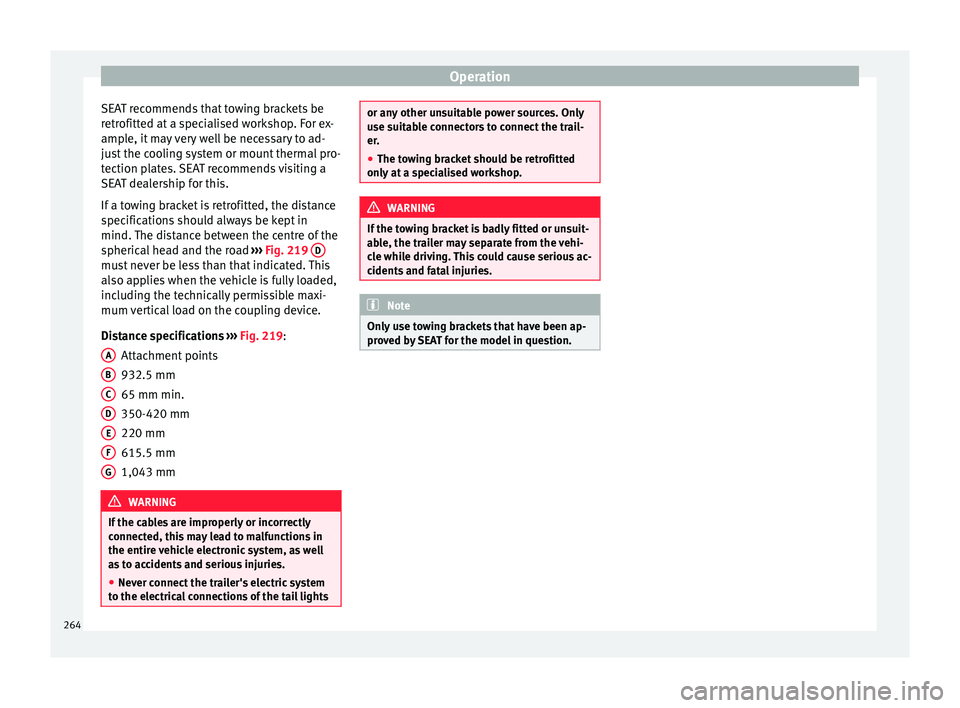
If a towing bracket is retrofitted, the distance
specifications should always be kept in
mind. The distance between the centre of the
spherical head and the road ››› Fig. 219 D must never be less than that indicated. This
al
so ap
plies when the vehicle is fully loaded,
including the technically permissible maxi-
mum vertical load on the coupling device.
Distance specifications ››› Fig. 219:
Attachment points
932.5 mm
65 mm min.
350-420 mm
220 mm
615.5 mm
1,043 mm WARNING
If the cables are improperly or incorrectly
c onnect
ed, this may lead to malfunctions in
the entire vehicle electronic system, as well
as to accidents and serious injuries.
● Never connect the trailer's electric system
to the el
ectrical connections of the tail lights A
B
C
D
E
F
G or any other unsuitable power sources. Only
u
se s
uitable connectors to connect the trail-
er.
● The towing bracket should be retrofitted
only
at a specialised workshop. WARNING
If the towing bracket is badly fitted or unsuit-
ab l
e, the trailer may separate from the vehi-
cle while driving. This could cause serious ac-
cidents and fatal injuries. Note
Only use towing brackets that have been ap-
pr o
ved by SEAT for the model in question.264
Page 285 of 328
Checking and refilling levels
WARNING
● Sw it
ch the engine off, remove the key from
the ignition and apply the hand brake. If the
vehicle has a manual gearbox, place the lever
in neutral; if it has an automatic gearbox,
place the selector lever in position P. Wait for
the engine to cool down.
● Keep children away from the engine com-
par
tment.
● Never spill liquids used for vehicle opera-
tion on the engine c
ompartment, as these
may catch fire (e.g. the antifreeze in coolant).
● Take care not to cause short circuits in the
electric
al system, especially when working
on the battery.
● If working inside the engine compartment,
remember th
at, even when the ignition is
switched off, the radiator fan may start up au-
tomatically, and therefore there is a risk of in-
jury.
● Never cover the engine with additional in-
su
lating materials such as a blanket. Risk of
fire!
● Do not unscrew the cap on the coolant ex-
pan
sion tank when the engine is hot. The
cooling system is under pressure.
● Protect face, hands and arms by covering
the cap w
ith a large, thick rag to protect
against escaping coolant and steam.
● If it is necessary to work in the engine com-
par
tment while the engine is running, the ro-
tating components (for example, poly-V belt, alternator, radiator fan) and the high voltage
ignition sy
s
tem are an additional hazard.
● Observe the following additional warnings
if w
ork on the fuel system or the electrical
system is necessary:
– Always disconnect the battery from the
on-board network.
– Do not smoke.
– Never work near naked flames.
– Always keep an approved fire extinguish-
er immediately available. CAUTION
When topping up fluids make sure the correct
fluid i s
put into the correct filler opening, oth-
erwise this can cause serious malfunctions or
engine damage. For the sake of the environment
Inspect the ground underneath your vehicle
r e
gularly so that any leaks are detected at an
early stage. If you find spots of oil or other
fluids in the area where it was parked, have
your vehicle inspected at the workshop. Note
In right-hand drive vehicles* some brake flu-
id r e
servoirs are on the other side of the en-
gine compartment ››› Fig. 221. Opening the bonnet
Read the additional information carefully
› ›
› page 11
The bonnet is released from inside the vehi-
cle.
Check that the windscreen wiper arms are
not unfolded. Otherwise the paint may be
damaged.
The bonnet can only be unlocked when the
driver door is open. WARNING
Never open the bonnet if you see steam or
drip s
of coolant being released from the en-
gine compartment. Failure to comply could
result in burns. Wait until no steam or coolant
can be seen before opening the bonnet. Closing the bonnet
–
Slightly lift the bonnet.
– Release the bonnet stay before pressing it
bac
k into its support.
– Carefully close the bonnet.
– Press the bonnet down until it locks into
pl
ace.
– Make sure that the bonnet catches onto its
cl
asp. Do not press down too hard ››› .
»
283
Technical data
Advice
Operation
Emergencies
Safety
Page 288 of 328
Advice
WARNING
Oil is highly inflammable! Ensure that no oil
c ome
s into contact with hot engine compo-
nents when topping up. CAUTION
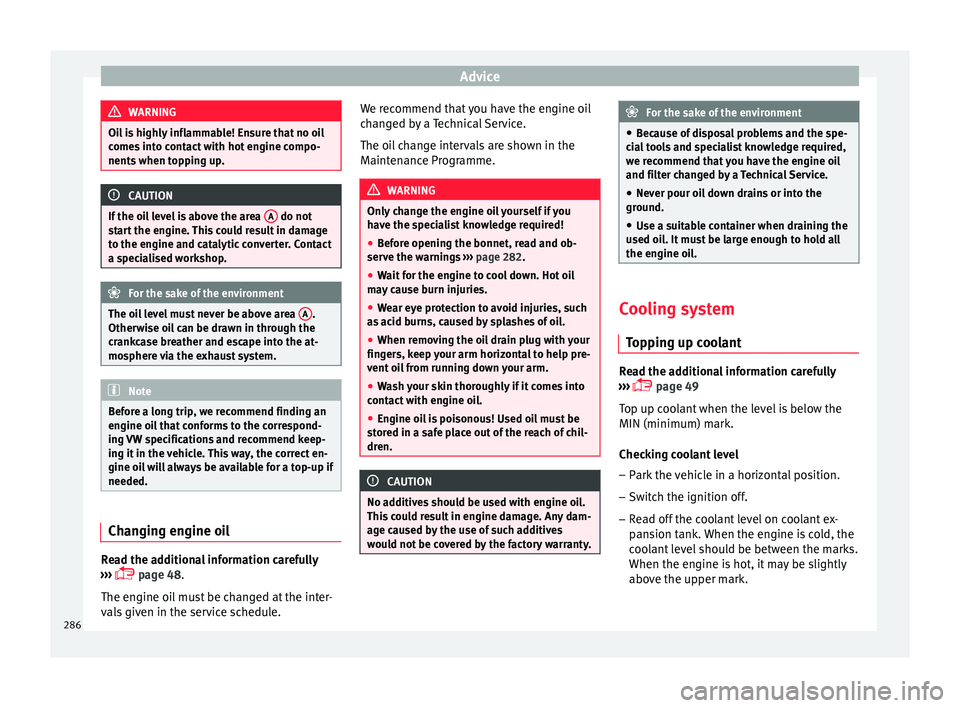
If the oil level is above the area A do not
s t
art the engine. This could result in damage
to the engine and catalytic converter. Contact
a specialised workshop. For the sake of the environment
The oil level must never be above area A .
Other w
ise oil can be drawn in through the
crankcase breather and escape into the at-
mosphere via the exhaust system. Note
Before a long trip, we recommend finding an
en gine oi
l that conforms to the correspond-
ing VW specifications and recommend keep-
ing it in the vehicle. This way, the correct en-
gine oil will always be available for a top-up if
needed. Changing engine oil
Read the additional information carefully
› ›
› page 48.
The engine oil must be changed at the inter-
vals given in the service schedule. We recommend that you have the engine oil
ch
anged by a Technical Service.
The oil change intervals are shown in the
Maintenance Programme. WARNING
Only change the engine oil yourself if you
h av
e the specialist knowledge required!
● Before opening the bonnet, read and ob-
serv
e the warnings ››› page 282.
● Wait for the engine to cool down. Hot oil
ma
y cause burn injuries.
● Wear eye protection to avoid injuries, such
as
acid burns, caused by splashes of oil.
● When removing the oil drain plug with your
fing
ers, keep your arm horizontal to help pre-
vent oil from running down your arm.
● Wash your skin thoroughly if it comes into
cont
act with engine oil.
● Engine oil is poisonous! Used oil must be
st
ored in a safe place out of the reach of chil-
dren. CAUTION
No additives should be used with engine oil.
Thi s
could result in engine damage. Any dam-
age caused by the use of such additives
would not be covered by the factory warranty. For the sake of the environment
● Bec
ause of disposal problems and the spe-
cial tools and specialist knowledge required,
we recommend that you have the engine oil
and filter changed by a Technical Service.
● Never pour oil down drains or into the
grou
nd.
● Use a suitable container when draining the
used oi
l. It must be large enough to hold all
the engine oil. Cooling system
Top
ping up coolant Read the additional information carefully
› ›
› page 49
Top up coolant when the level is below the
MIN (minimum) mark.
Checking coolant level
– Park the vehicle in a horizontal position.
– Switch the ignition off.
– Read off the coolant level on coolant ex-
pan
sion tank. When the engine is cold, the
coolant level should be between the marks.
When the engine is hot, it may be slightly
above the upper mark.
286
Page 289 of 328
Checking and refilling levels
Topping up coolant
– Wait for the engine to cool down.
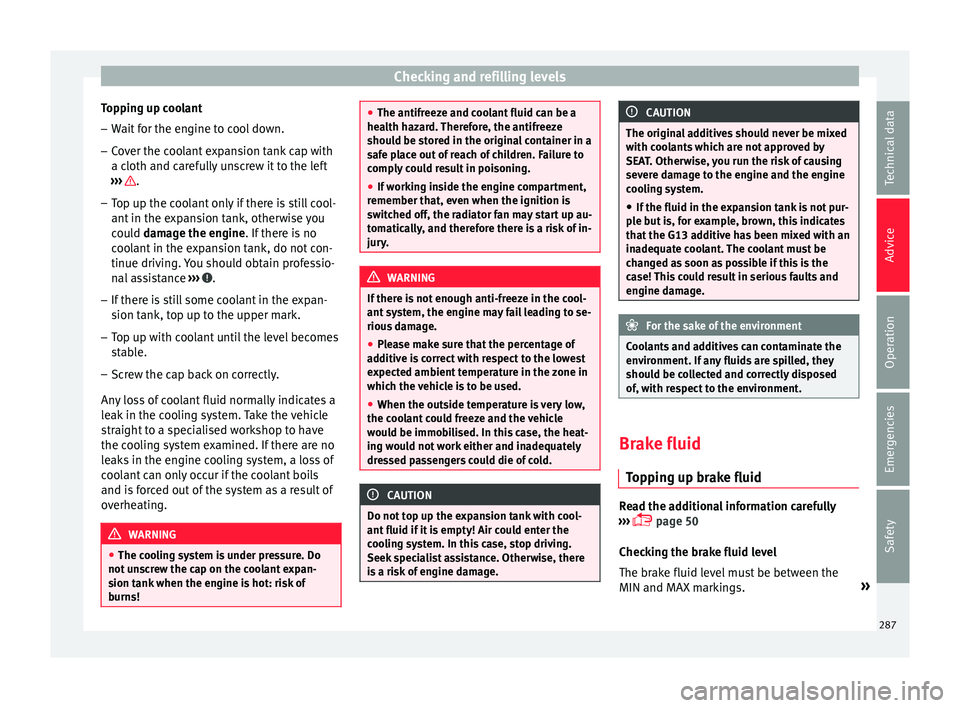
– Cover the coolant expansion tank cap with
a c loth and c
arefully unscrew it to the left
››› .
– Top up the coolant only if there is still cool-
ant in the e
xpansion tank, otherwise you
could damage the engine. If there is no
coolant in the expansion tank, do not con-
tinue driving. You should obtain professio- nal assistance ››› .
– If there is still some coolant in the expan-
sion t
ank, top up to the upper mark.
– Top up with coolant until the level becomes
st
able.
– Screw the cap back on correctly.
Any
loss of coolant fluid normally indicates a
leak in the cooling system. Take the vehicle
straight to a specialised workshop to have
the cooling system examined. If there are no
leaks in the engine cooling system, a loss of
coolant can only occur if the coolant boils
and is forced out of the system as a result of
overheating. WARNING
● The c oo
ling system is under pressure. Do
not unscrew the cap on the coolant expan-
sion tank when the engine is hot: risk of
burns! ●
The antifr eez
e and coolant fluid can be a
health hazard. Therefore, the antifreeze
should be stored in the original container in a
safe place out of reach of children. Failure to
comply could result in poisoning.
● If working inside the engine compartment,
remember th
at, even when the ignition is
switched off, the radiator fan may start up au-
tomatically, and therefore there is a risk of in-
jury. WARNING
If there is not enough anti-freeze in the cool-
ant sy
stem, the engine may fail leading to se-
rious damage.
● Please make sure that the percentage of
ad
ditive is correct with respect to the lowest
expected ambient temperature in the zone in
which the vehicle is to be used.
● When the outside temperature is very low,
the coo
lant could freeze and the vehicle
would be immobilised. In this case, the heat-
ing would not work either and inadequately
dressed passengers could die of cold. CAUTION
Do not top up the expansion tank with cool-
ant fluid if
it is empty! Air could enter the
cooling system. In this case, stop driving.
Seek specialist assistance. Otherwise, there
is a risk of engine damage. CAUTION
The original additives should never be mixed
w ith c
oolants which are not approved by
SEAT. Otherwise, you run the risk of causing
severe damage to the engine and the engine
cooling system.
● If the fluid in the expansion tank is not pur-
pl
e but is, for example, brown, this indicates
that the G13 additive has been mixed with an
inadequate coolant. The coolant must be
changed as soon as possible if this is the
case! This could result in serious faults and
engine damage. For the sake of the environment
Coolants and additives can contaminate the
en v
ironment. If any fluids are spilled, they
should be collected and correctly disposed
of, with respect to the environment. Brake fluid
Top
ping up brake fluid Read the additional information carefully
› ›
› page 50
Checking the brake fluid level
The brake fluid level must be between the
MIN and MAX markings. »
287
Technical data
Advice
Operation
Emergencies
Safety
Page 297 of 328
Wheels
●
Av
oid running the vehicle on tyres that are
more than 6 years old. If you have no alterna-
tive, you should drive slowly and with extra
care at all times.
● If wheel trims are fitted after the car is pur-
ch
ased, ensure that there is an adequate flow
of air for cooling the brake system. For the sake of the environment
Old tyres must be disposed of according to
the l a
ws in the country concerned. Note
● A S
EAT Service Centre should be consulted
to find out whether wheels or tyres of differ-
ent sizes to those originally fitted by SEAT
can be fitted, and to find out about the com-
binations allowed between the front axle
(axle 1) and the rear axle (axle 2).
● Never mount used tyres if you are not sure
of their
“previous history”.
● For technical reasons, it is not generally
pos
sible to use the wheels from other vehi-
cles. In some cases, this may also be true for
the same model of wheel. Wheel bolts
The wheel
bolts
ar
e matched to the rims.
When installing different wheels (for instance
alloy wheels or wheels with winter tyres) it is
important to use the correct wheel bolts with the right length and correctly shaped bolt
hea
ds. This ensures that wheels are fitted se-
curely and that the brake system functions
correctly.
The wheel bolts must be clean and turn easi-
ly.
A special adapter is required to turn the anti-
theft wheel bolts* ›››
page 54.
Tyre monitoring systems Introduction WARNING
Unsuitable handling of the wheels and tyres
m a
y lead to sudden tyre pressure losses, to
tread separation or even to a blow-out.
● Check tyre pressures regularly and ensure
they ar
e maintained at the pressures indica-
ted. Tyre pressure that is too low could cause
overheating, resulting in tread detachment or
even burst tyres.
● Tyre pressure should be that indicated on
the label
when the tyres are cold at all times
››› page 303.
● Regularly check the cold inflation pressure
of the ty
res. If necessary, change the tyre
pressure of the vehicle tyres while they are
cold. ●
Re
gularly check your tyres for damage and
wear.
● Never exceed the maximum permitted
speed or lo
ads specified for the type of tyre
fitted on your vehicle. For the sake of the environment
Under-inflated tyres lead to increased fuel
c on
sumption and tyre wear. Note
● Driv in
g for the first time with new tyres at a
high speed can cause them to slightly ex-
pand, which could then produce an air pres-
sure warning.
● Only replace used tyres with those author-
ised b
y SEAT for the corresponding type vehi-
cle.
● Do not only rely on the tyre monitoring sys-
tem. R
egularly check your tyres to ensure
that the tyre pressure is correct and that the
tyres are not damaged due to puncture, cuts,
tears and impacts/dents. Remove objects
from the tyres only when they have not
pierced the tyres. 295
Technical data
Advice
Operation
Emergencies
Safety
Page 313 of 328
Index
Changing a wheel . . . . . . . . . . . . . . . . . . . . . . . . . 54 sub
sequent work . . . . . . . . . . . . . . . . . . . . . . . . 56
Changing bulbs number plate light . . . . . . . . . . . . . . . . . . . . . . . 98
Changing gear engaging gears (manual gearbox) . . . . . . . . . 176
Changing settings CAR menu . . . . . . . . . . . . . . . . . . . . . . . . . . . . . . 26
Changing the blades . . . . . . . . . . . . . . . . . . . . . . . 85
Changing the wiper blades . . . . . . . . . . . . . . . . . . 60
Charging the battery . . . . . . . . . . . . . . . . . . . . . . 290
Checking levels engine compartment . . . . . . . . . . . . . . . . . . . . 282
Child-proof locking electric windows . . . . . . . . . . . . . . . . . . . . . . . . 126
Child seat Categorisation in groups . . . . . . . . . . . . . . . . . . 81
Child seats . . . . . . . . . . . . . . . . . . . . . . . . . . . . 17, 80 ISOFIX system . . . . . . . . . . . . . . . . . . . . . . . . . . . 19
safety instructions . . . . . . . . . . . . . . . . . . . . 17, 79
securing with seat belt . . . . . . . . . . . . . . . . . . . . 18
Top Tether system . . . . . . . . . . . . . . . . . . . . . 19, 22
City Emergency braking function . . . . . . . . . . . . . 211
Cleaning . . . . . . . . . . . . . . . . . . . . . . . . . . . . . . . . 266 alcantara . . . . . . . . . . . . . . . . . . . . . . . . . . . . . . 272
carbon parts . . . . . . . . . . . . . . . . . . . . . . . . . . . 269
Easy Connect control panel . . . . . . . . . . . . . . . 270
Exhaust pipe . . . . . . . . . . . . . . . . . . . . . . . . . . . 269
fabrics . . . . . . . . . . . . . . . . . . . . . . . . . . . . . . . . 270
leather . . . . . . . . . . . . . . . . . . . . . . . . . . . . . . . . 271
natural leather . . . . . . . . . . . . . . . . . . . . . . . . . 271
plastic parts . . . . . . . . . . . . . . . . . . . . . . . . . . . 270
Plastic parts . . . . . . . . . . . . . . . . . . . . . . . . . . . 268
Radio display . . . . . . . . . . . . . . . . . . . . . . . . . . 270
seat belts . . . . . . . . . . . . . . . . . . . . . . . . . . . . . 272
trims . . . . . . . . . . . . . . . . . . . . . . . . . . . . . . . . . 268
washing the vehicle . . . . . . . . . . . . . . . . . . . . . 266 wheels . . . . . . . . . . . . . . . . . . . . . . . . . . . . . . . . 269
windo
ws . . . . . . . . . . . . . . . . . . . . . . . . . . . . . . 269
Climatronic . . . . . . . . . . . . . . . . . . . . . . . . . . . . . . . 42
Close . . . . . . . . . . . . . . . . . . . . . . . . . . . . . . . . . . . 112 rear lid . . . . . . . . . . . . . . . . . . . . . . . . . . . . . . . . 123
sunroof . . . . . . . . . . . . . . . . . . . . . . . . . . . . . . . 129
windows . . . . . . . . . . . . . . . . . . . . . . . . . . . . . . 126
Closing . . . . . . . . . . . . . . . . . . . . . . . . . . . . . . . . . 112 bonnet . . . . . . . . . . . . . . . . . . . . . . . . . . . . . . . . 283
rear lid . . . . . . . . . . . . . . . . . . . . . . . . . . . . . . . . 123
sun blind (sunroof) . . . . . . . . . . . . . . . . . . . . . . 129
sunroof . . . . . . . . . . . . . . . . . . . . . . . . . . . . . . . 129
windows . . . . . . . . . . . . . . . . . . . . . . . . . . . . . . 126
Clutch (warning lamp) . . . . . . . . . . . . . . . . . . . . . 183
Coming Home . . . . . . . . . . . . . . . . . . . . . . . . . . . . 134
Connectivity Box . . . . . . . . . . . . . . . . . . . . . . . . . . 111
Contact . . . . . . . . . . . . . . . . . . . . . . . . . . . . . . . . . 165
Control and warning lamps diesel particulate filter . . . . . . . . . . . . . . . . . . . 186
emission control . . . . . . . . . . . . . . . . . . . . . . . . 187
remote control (auxiliary heater) . . . . . . . . . . . 162
Control lamps AdBlue . . . . . . . . . . . . . . . . . . . . . . . . . . . . . . . . 279
blind spot detector (BSD) . . . . . . . . . . . . . . . . 220
Hill Descent Control . . . . . . . . . . . . . . . . . . . . . 190
parking assistant (RTA) . . . . . . . . . . . . . . . . . . 220
speed limiter . . . . . . . . . . . . . . . . . . . . . . . . . . . 194
tow hitch . . . . . . . . . . . . . . . . . . . . . . . . . . . . . . 258
towing bracket . . . . . . . . . . . . . . . . . . . . . . . . . 256
Controls and displays general instrument panel . . . . . . . . . . . . . . . . . 101
Controls on the steering wheel operating the audio system and telephone . . 109
Coolant checking level . . . . . . . . . . . . . . . . . . . . . . . . . . 286
cooling system checking coolant . . . . . . . . . . . . . . . . . . . . . . . 286 Cooling system
Coo lant temperature gauge . . . . . . . . . . . . . . . 105
topping up coolant . . . . . . . . . . . . . . . . . . . . . . 286
Cornering lights . . . . . . . . . . . . . . . . . . . . . . . . . . . . . . . . . 134
Correct position . . . . . . . . . . . . . . . . . . . . . . . . . . . 63
Correct sitting position front passenger . . . . . . . . . . . . . . . . . . . . . . . . . 64
rear seat passengers . . . . . . . . . . . . . . . . . . . . . 65
Cruise control . . . . . . . . . . . . . . . . . . . . . . . . 36, 193 operation . . . . . . . . . . . . . . . . . . . . . . . . . . . . . . 193
Cruise control system . . . . . . . . . . . . . . . . . . . . . . 193 Warning and indication lamp . . . . . . . . . . . . . 193
D Dangers in not using the seat belt . . . . . . . . . . . . 70
Dash panel . . . . . . . . . . . . . . . . . . . . . . . . . . . . . . . 38
Data sticker . . . . . . . . . . . . . . . . . . . . . . . . . . . . . . 301
Deactivating the front passenger front airbag . . . 15
Deactivation of front airbag . . . . . . . . . . . . . . . . . . 77
Defective bulbs changing a bulb . . . . . . . . . . . . . . . . . . . . . . . . . 93
Diesel diesel particulate filter . . . . . . . . . . . . . . . . . . . 186
engine oil . . . . . . . . . . . . . . . . . . . . . . . . . . . . . 284
preheating . . . . . . . . . . . . . . . . . . . . . . . . . . . . 165
refuelling . . . . . . . . . . . . . . . . . . . . . . . . . . . . . . 278
Diesel particulate filter malfunction . . . . . . . . . . . . . . . . . . . . . . . . . . . . 186
Digital clock . . . . . . . . . . . . . . . . . . . . . . . . . . . . . 102
Dimensions . . . . . . . . . . . . . . . . . . . . . . . . . . . . . . 307
Direction of rotation tyres . . . . . . . . . . . . . . . . . . . . . . . . . . . . . . . . . . . 56
Display . . . . . . . . . . . . . . . . . . . . . . . . . . . . 102, 103
Display messages speed limiter . . . . . . . . . . . . . . . . . . . . . . . . . . . 194
311