warning light Seat Ateca 2017 Owner's Manual
[x] Cancel search | Manufacturer: SEAT, Model Year: 2017, Model line: Ateca, Model: Seat Ateca 2017Pages: 328, PDF Size: 6.36 MB
Page 265 of 328
Towing bracket device*
If the system detects that the trailer is sway-
in g, it
intervenes automatically with the driv-
er steering recommendation to reduce the
swaying of the trailer.
Requirements for the stabilisation of the
towing vehicle and trailer
● The vehicle is factory-equipped with a tow-
ing br
acket or has been retro-fitted with a
compatible towing bracket.
● The ESC and ASR are active. The control
lamp
or is not lit up on the instrument
panel.
● The trailer is electrically connected to the
to
wing vehicle through the trailer power
socket.
● The vehicle is travelling at over 60 km/h
(appr
ox. 37 mph).
● The maximum vertical load technically per-
mis
sible is being utilised on the coupling de-
vice.
● The trailer has a rigid draw bar.
● If the trailer has brakes, it must be equip-
ped with a mec
hanical overrun brake. WARNING
The enhanced security provided by the elec-
tric s
tability control of the towing vehicle and
trailer should not lead you to take any risks
that could compromise your safety. ●
Ad apt
your speed and driving style at all
times to suit visibility, weather, road and traf-
fic conditions.
● Accelerate with caution when the road is
slip
pery.
● When adjusting any settings, stop acceler-
ating. WARNING
The electric stability control for the towing
v ehic
le and trailer may not correctly detect all
driving conditions.
● When the ESC is switched off, the stabilisa-
tion of the t
owing vehicle and trailer is also
switched off.
● The stability system does not always detect
light and u
nstable trailers, so it may not sta-
bilise these correctly.
● When driving on slippery surfaces with
poor grip, the tr
ailer can even interfere with
the stability system.
● Trailers with a high centre of gravity can tip
even w
ithout having previously swayed.
● If a trailer is not attached, but the trailer
pow
er socket is connected (e.g. installation
of a bicycle rack with lights), repeated auto-
matic braking may occur in extreme driving
conditions. Retrofitting a towing bracket
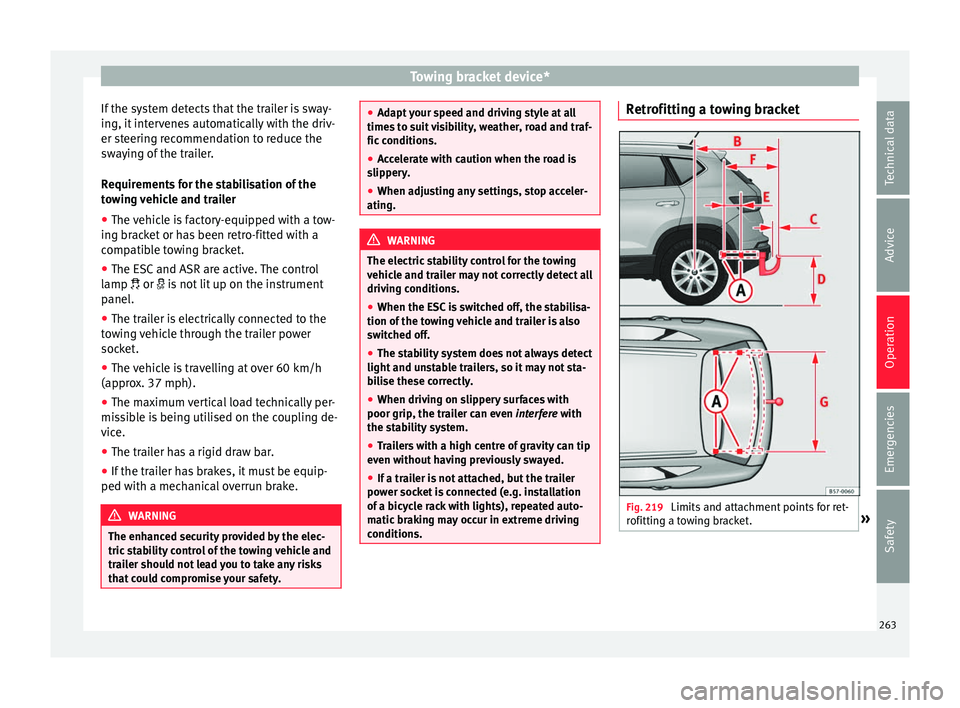
Fig. 219
Limits and attachment points for ret-
r ofittin
g a towing bracket. » 263
Technical data
Advice
Operation
Emergencies
Safety
Page 266 of 328
Operation
SEAT recommends that towing brackets be
r etr
ofitted at a specialised workshop. For ex-
ample, it may very well be necessary to ad-
just the cooling system or mount thermal pro-
tection plates. SEAT recommends visiting a
SEAT dealership for this.
If a towing bracket is retrofitted, the distance
specifications should always be kept in
mind. The distance between the centre of the
spherical head and the road ››› Fig. 219 D must never be less than that indicated. This
al
so ap
plies when the vehicle is fully loaded,
including the technically permissible maxi-
mum vertical load on the coupling device.
Distance specifications ››› Fig. 219:
Attachment points
932.5 mm
65 mm min.
350-420 mm
220 mm
615.5 mm
1,043 mm WARNING
If the cables are improperly or incorrectly
c onnect
ed, this may lead to malfunctions in
the entire vehicle electronic system, as well
as to accidents and serious injuries.
● Never connect the trailer's electric system
to the el
ectrical connections of the tail lights A
B
C
D
E
F
G or any other unsuitable power sources. Only
u
se s
uitable connectors to connect the trail-
er.
● The towing bracket should be retrofitted
only
at a specialised workshop. WARNING
If the towing bracket is badly fitted or unsuit-
ab l
e, the trailer may separate from the vehi-
cle while driving. This could cause serious ac-
cidents and fatal injuries. Note
Only use towing brackets that have been ap-
pr o
ved by SEAT for the model in question.264
Page 268 of 328
Advice
A SEAT Official Service and specialised work-
shop w i
ll be able to inform you about options
for installing and operating radio transmitters
with a higher transmitting power.
Mobile radio transmitters
Commercial mobile telephones or radio
equipment might interfere with the electron-
ics of your vehicle and cause malfunctions.
This may be due to:
● No external aerial.
● External aerial incorrectly installed.
● Transmitting power more than 10 W.
You mu
st, therefore, do not operate portable
mobile telephones or radio equipment inside
the vehicle without a properly installed exter-
nal aerial ››› .
Pl e
ase note also that the maximum range of
the equipment can only be achieved with an
external aerial.
Business equipment
Retrofit installation of business or private
equipment in the vehicle is permitted, provi-
ded the equipment cannot interfere with the
driver's immediate control of the vehicle and
that any such equipment carries the mark.
Any retrofit equipment that could influence
the driver's control of the vehicle must have a
type approval for your vehicle and must carry
the e mark. WARNING
Mobile telephones or radio equipment which
i s
operated inside the vehicle without a prop-
erly installed external aerial can create exces-
sive magnetic fields that could cause a health
hazard. Note
● The po s
terior fitting of electric and elec-
tronic equipment in this vehicle affects its li-
cence and could lead to the withdrawal of the
vehicle registration document under certain
circumstances.
● Please use the mobile telephone/radio op-
eratin
g instructions. Care and cleaning
Gener a
l information Regular and careful care helps to
maint
ain
the value of the vehicle. This may also be one
of the requirements for upholding any war-
ranty claims in the event of corrosion or paint
defects.
SEAT Official Services and specialist retailers
carry stocks of suitable car care materials.
Please follow the instructions for use on the
packaging. WARNING
● Cl
eaning products and other materials used
for car care can be damaging to your health if
misused.
● Always keep care products in a safe place,
out of
the reach of children. Failure to comply
could result in poisoning. For the sake of the environment
● If po
ssible, use environmentally friendly
products.
● The remains of car care products should not
be dis
posed of with ordinary household
waste. Vehicle exterior care
W a
shing the vehicle The longer substances such as insects, bird
dr
op
pings, resinous tree sap, road dirt, in-
dustrial deposits, tar, soot or road salt and
other aggressive materials remain on the ve-
hicle, the more damage they do to the paint-
work. High temperatures (for instance due to
strong sunlight) further intensify the corro-
sive effect.
After the period when salt is put on the roads
it is important to have the underside of the
vehicle washed thoroughly.
266
Page 269 of 328
Care and maintenance
Automatic car washes
B ef
ore going through a car wash, be sure to
take the usual precautions such as closing
the windows and roof. If the vehicle has spe-
cial accessories such as spoilers or a roof
rack or two-way radio aerial, etc., it is advisa-
ble to consult the car wash tunnel operator.
It is best to use a car wash without revolving
bristles if possible.
Washing the vehicle with a high pressure
cleaner
When washing the vehicle with a high-pres-
sure cleaner, always follow the operating in-
structions for the equipment. This applies
particularly to the operating pressure and the
spraying distance. Do not hold the nozzle too
close to soft materials such as rubber hoses
or seals. The same applies to the parking aid
sensors*, which are located in the rear bump-
er.
Do not use a nozzle that sprays the water out
in a direct stream or one that has a rotating
jet for forcing off dirt.
Washing the car by hand
When washing the car by hand, use plenty of
water to soften the dirt first, and rinse off as
well as possible.
Then clean the vehicle with a soft sponge,
glove or brush using only slight pressure.
You should start on the roof and work down. Special car
soap should only be used for very
persistent dirt.
Rinse the sponge or glove thoroughly and of-
ten.
Wheels, sills and similar should be cleaned
last. Use a second sponge for this. WARNING
● The v
ehicle should only be washed with the
ignition switched off. Failure to follow this in-
struction could result in an accident.
● Do not clean the underside of chassis, the
ins
ide of wheel arches or wheel trims without
protecting your hands and arms. You may cut
yourself on sharp-edged metal parts. Other-
wise, there is a risk of sustaining cuts.
● When washing the car during the winter
sea
son: water and ice in the brake system
can reduce braking effectiveness: risk of acci-
dent! CAUTION
● Do not w
ash the vehicle in direct sunlight –
otherwise the paint can be damaged.
● Do not use sponges, abrasive household
spon
ges or similar to clean insect remains.
This could damage the surface.
● Clean off stubborn dirt (insects, etc.) from
the hea
dlights at regular intervals, for in-
stance when filling the fuel tank. The head-
lights should only be washed with water, do not wipe them with a dry cloth or sponge. It
i
s
best to use soapy water.
● Never wash tyres with a jet that sprays the
wat
er out in a direct stream. This could dam-
age the tyres even if the spray is kept at a
distance and only used for a very short time.
● Before washing the vehicle in an automatic
car w
ash, please make sure to retract the ex-
terior mirrors to prevent them from being
damaged. Electrically retractable exterior
mirrors must not be folded in or out by hand,
always use the electrical power control. CAUTION
● Bef
ore washing the vehicle in an automatic
car wash, please proceed as follows to lock
the wiper arms so that they are not moved to-
wards the top of the windscreen:
–the bonnet must be closed.
– switch the ignition on and off.
– press the windscreen wiper lever forward
briefly (windscreen washer function).
This will lock the wiper arms. For the sake of the environment
The car should only be washed in special
w a
sh bays. These areas are prepared to pre-
vent oily water from getting into the public
drains. In some places, washing vehicles out-
side the areas intended for this purpose is
prohibited. 267
Technical data
Advice
Operation
Emergencies
Safety
Page 275 of 328
Intelligent technology
The retract function may not operate properly
in v
ery dirty belts. Make sure that the inertia
reel seat belts are completely dry before al-
lowing them to retract. CAUTION
● Do not r
emove the seat belts from the vehi-
cle to clean them.
● Do not use chemical cleaning agents on the
seat
belts, as this can damage the webbing.
Ensure that the seat belts do not come into
contact with corrosive fluids.
● If you find any damage to the belt webbing,
belt fittin
gs, the belt retractor or the buckle,
the belt in question must be replaced by a
specialised workshop. Intelligent technology
El ectr
omechanical steering Electro-mechanical power steering assists
the driv
er when s
teering.
Electro-mechanical power steering adapts
electronically to the speed of the car, torque
and turning angle.
If the power steering should fail at any time
or the engine is switched off (for instance
when being towed), the car can still be
steered. However, more effort than normal
will be required to turn the steering wheel.
Driver warning lamps and messages (in red) Faulty steering! To
park the vehicle
If the warning lamp remains on and the driver
indication appears, the power steering could
be faulty.
Do not continue driving. Seek specialist as-
sistance. (in yellow) Steering: System
fault! You may continue driving.
If the warning lamp comes on, the steering
could react with more difficultly or more sen-
sitivity than normal. In addition, when driving
in a straight line the steering wheel may be
off-centre. Drive slowly to a specialised workshop and
h
av
e the fault repaired.
(in yellow) Steering lock:
fault! Go to an Official Service
The electronic steering lock is malfunction-
ing.
Go to a specialised workshop as soon as
possible and have the fault repaired. WARNING
Take it immediately to a specialised work-
shop and h av
e the fault repaired: risk of acci-
dent! Note
If the lamp (in red) or el
se (in yellow)
lights up briefly, you may continue driving. Four-wheel drive
3
V
alid for vehicles: with four-wheel drive
On four-wheel drive models, the engine pow-
er is distributed to all four wheels
General notes
On four-wheel drive vehicles, the engine
power is distributed to all four wheels. The
distribution of power is controlled automati-
cally according to your driving style and the
road conditions. Also see ›››
page 173. »
273
Technical data
Advice
Operation
Emergencies
Safety
Page 278 of 328
Advice
You may also notice that the engine runs at a
s lightly
faster idling speed when necessary.
This is quite normal, and no cause for con-
cern. The increased idling speed allows the
alternator to meet the greater power require-
ment and charge the battery at the same
time. Checking and refilling levels
Fi l
ling the tank
Filling up Read the additional information carefully
› ›
› page 48
If the automatic filler nozzle is operated cor-
rectly, it will switch itself off as soon as the
fuel tank is “full”. Do not try to put in more
fuel after the nozzle cuts out, as this will fill
the expansion chamber in the fuel tank.
The correct fuel grade for your vehicle is giv-
en on a sticker on the inside of the fuel tank
flap. Further notes on fuel can be found at
››› page 277.
The capacity of your vehicle's fuel tank is giv-
en in ›››
page 48. WARNING
Fuel is highly flammable and can cause seri-
ou s
burns and other injuries.
● When refuelling, turn off the engine, the
auxi
liary heater ››› page 161 and turn off the
ignition for safety reasons.
● Do not smoke when filling the fuel tank or a
cani
ster. Naked flames are forbidden in the
vicinity due to the risk of explosion. ●
Ob
serve legislation governing the use,
storage and carrying of a spare fuel canister
in the vehicle.
● For safety reasons we do not recommend
carr
ying a spare fuel canister in the vehicle.
In an accident the canister could be damaged
and could leak.
● If, in exceptional circumstances, you have
to c
arry a spare fuel canister, please observe
the following points:
– Never fill fuel into the spare fuel canister
if it is inside or on top of the vehicle. An
electrostatic charge could build up during
filling, causing the fuel vapour to ignite.
Danger of explosion. Always place the
canister on the ground to fill it.
– Insert the filling nozzle as far as possible
into the spare fuel canister.
– If the spare fuel canister is made of met-
al, the filling nozzle must be in contact
with the canister during filling. This
helps prevent an electrostatic charge
building up.
– Never spill fuel in the vehicle or in the
luggage compartment. Fuel vapour is ex-
plosive. Risk of fatal accident! CAUTION
● If an
y fuel is spilt onto the vehicle, it
should be removed immediately. It could oth-
erwise damage the paintwork.
● Never run the tank completely dry. An irreg-
ul
ar fuel supply could cause misfiring. As a 276
Page 281 of 328
Checking and refilling levels
CAUTION
● The v
ehicle is not designed for the use of
FAME fuel (biodiesel). The fuel system would
be damaged if you used biodiesel.
● Do not mix fuel additives, the so-called
“thinners”, petr
ol or similar additives with
diesel fuel.
● If poor-quality diesel fuel is used, it may be
nece
ssary to drain the fuel filter more fre-
quently than is specified in the Maintenance
Programme. We recommend having this done
by a specialised workshop. If water is allowed
to collect in the filter, this can cause engine
performance problems. Exhaust purification system for
v
ehic
les with diesel engines
(AdBlue ®
)
Introduction To reduce emissions, SCR (Selective Catalytic
R
eduction) c
an be used in vehicles with die-
sel engines. Through the special urea solu-
tion AdBlue ®
, SCR transforms nitrogen ox-
ides into nitrogen and water.
AdBlue ®
is stored in a separate tank in the
vehicle ›››
page 280. WARNING
If the level of AdBlue ®
is
too low and the igni-
tion is switched off, it will no longer be possi-
ble to re-start the engine. Not even by jump-
starting the car!
● Insert enough AdBlue ®
when the dis
tance
to empty is approx. 1000 km, at the latest.
● Never run the AdBlue ®
tank
completely dry. WARNING
AdBlue ®
is an irritant, corrosive liquid that
c
an cause injuries if it comes into contact
with the skin, eyes or respiratory organs.
● Before opening an AdBlue ®
rec
ipient, al-
ways take the manufacturer's instructions for
use into account. If the instructions are fol-
lowed correctly, it is not likely that the user
will come into contact with AdBlue ®
.
● If AdBlue ®
come
s into contact with your
eyes, rinse it immediately with plenty of wa-
ter for at least 15 minutes before seeking
medical attention.
● If AdBlue ®
come
s into contact with your
skin, rinse with water for at least 15 minutes
and, in case of skin irritation, seek medical
attention immediately.
● If you accidentally swallow AdBlue ®
, rinse
y
our mouth with plenty of water for at least
15 minutes. Do not induce vomiting unless
advised to by a doctor. Seek immediate medi-
cal attention. CAUTION
AdBlue ®
m ay damage the vehicle's painted
s
urfaces, plastic, upholstery and carpet,
among other things. In case of a spill, clean it
as soon as possible with a damp cloth and
plenty of cold water.
● Remove the AdBlue ®
that
has crystallised
with hot water and a sponge. Warning and control lamps
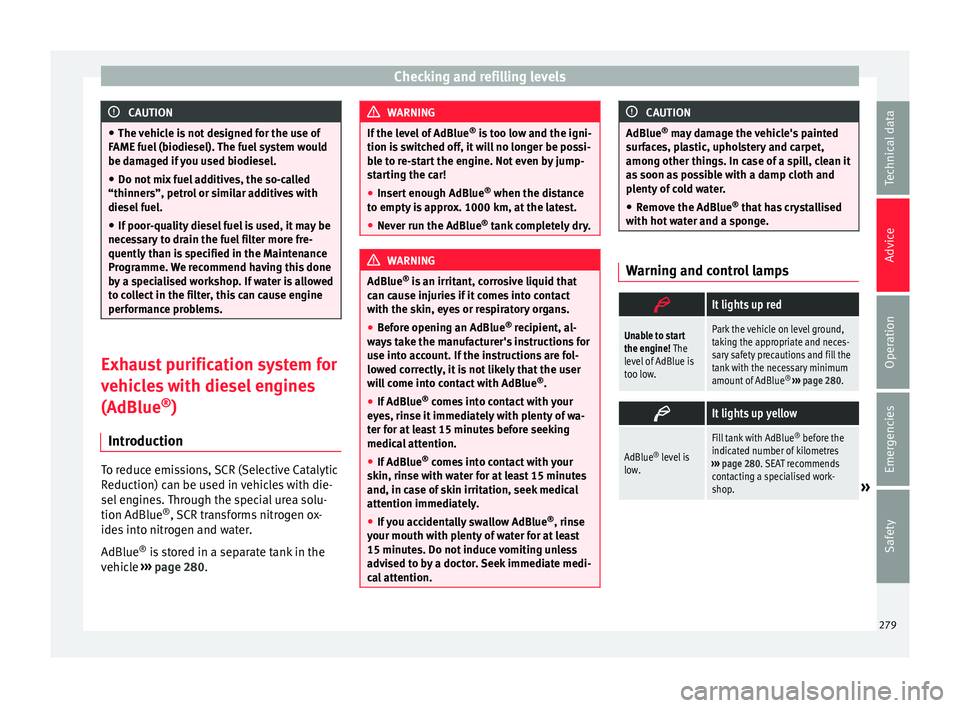
It lights up red
Unable to start
the engine! The
level of AdBlue is
too low.Park the vehicle on level ground,
taking the appropriate and neces-
sary safety precautions and fill the
tank with the necessary minimum
amount of AdBlue ®
››› page 280.
It lights up yellow
AdBlue
®
level is
low.
Fill tank with AdBlue ®
before the
indicated number of kilometres
››› page 280. SEAT recommends
contacting a specialised work-
shop.
» 279
Technical data
Advice
Operation
Emergencies
Safety
Page 282 of 328
Advice
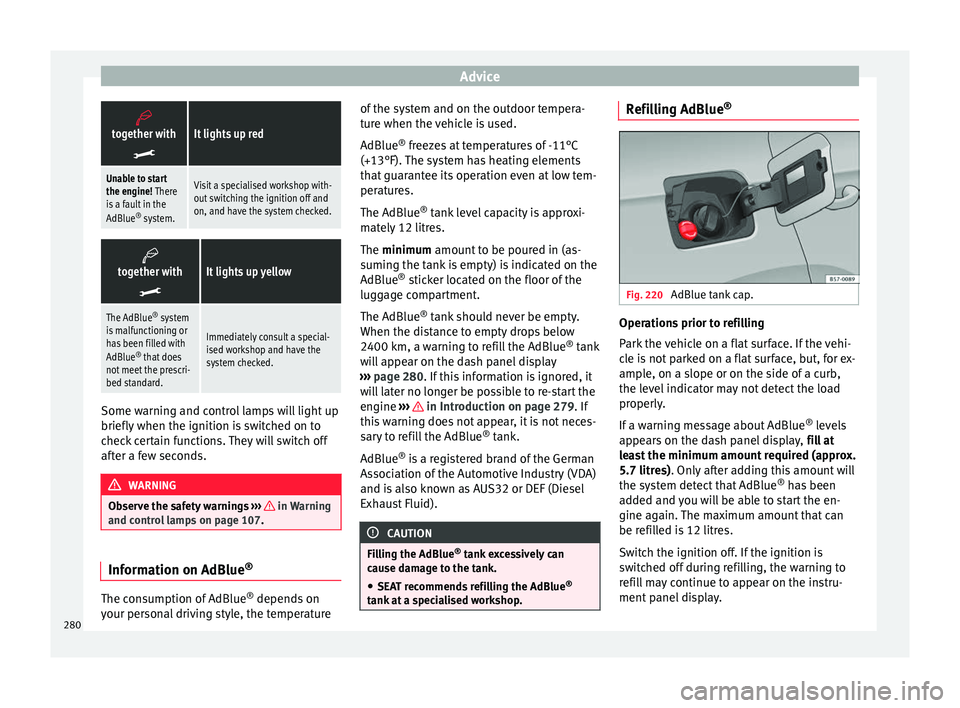
together with
It lights up red
Unable to start
the engine! There
is a fault in the
AdBlue ®
system.Visit a specialised workshop with-
out switching the ignition off and
on, and have the system checked.
together with
It lights up yellow
The AdBlue
®
system
is malfunctioning or
has been filled with
AdBlue ®
that does
not meet the prescri-
bed standard.
Immediately consult a special-
ised workshop and have the
system checked. Some warning and control lamps will light up
briefly
when the ignition i
s switched on to
check certain functions. They will switch off
after a few seconds. WARNING
Observe the safety warnings ››
› in Warning
and c ontr
ol lamps on page 107. Information on AdBlue
®The consumption of AdBlue
®
depend s
on
your personal driving style, the temperature of the system and on the outdoor tempera-
tur
e when the vehicle is used.
AdBlue ®
freezes at temperatures of -11°C
(+13°F). The system has heating elements
that guarantee its operation even at low tem-
peratures.
The AdBlue ®
tank level capacity is approxi-
mately 12 litres.
The minimum amount to be poured in (as-
suming the tank is empty) is indicated on the
AdBlue ®
sticker located on the floor of the
luggage compartment.
The AdBlue ®
tank should never be empty.
When the distance to empty drops below
2400 km, a warning to refill the AdBlue ®
tank
will appear on the dash panel display
››› page 280. If this information is ignored, it
will later no longer be possible to re-start the
engine ››› in Introduction on page 279. If
thi s
warning does not appear, it is not neces-
sary to refill the AdBlue ®
tank.
AdBlue ®
is a registered brand of the German
Association of the Automotive Industry (VDA)
and is also known as AUS32 or DEF (Diesel
Exhaust Fluid). CAUTION
Filling the AdBlue ®
tank
excessively can
cause damage to the tank.
● SEAT recommends refilling the AdBlue ®
tank
at a specialised workshop. Refilling AdBlue
® Fig. 220
AdBlue tank cap. Operations prior to refilling
P
ark
the vehicle on a flat surface. If the vehi-
cle is not parked on a flat surface, but, for ex-
ample, on a slope or on the side of a curb,
the level indicator may not detect the load
properly.
If a warning message about AdBlue ®
levels
appears on the dash panel display, fill at
least the minimum amount required (approx.
5.7 litres). Only after adding this amount will
the system detect that AdBlue ®
has been
added and you will be able to start the en-
gine again. The maximum amount that can
be refilled is 12 litres.
Switch the ignition off. If the ignition is
switched off during refilling, the warning to
refill may continue to appear on the instru-
ment panel display.
280
Page 285 of 328
Checking and refilling levels
WARNING
● Sw it
ch the engine off, remove the key from
the ignition and apply the hand brake. If the
vehicle has a manual gearbox, place the lever
in neutral; if it has an automatic gearbox,
place the selector lever in position P. Wait for
the engine to cool down.
● Keep children away from the engine com-
par
tment.
● Never spill liquids used for vehicle opera-
tion on the engine c
ompartment, as these
may catch fire (e.g. the antifreeze in coolant).
● Take care not to cause short circuits in the
electric
al system, especially when working
on the battery.
● If working inside the engine compartment,
remember th
at, even when the ignition is
switched off, the radiator fan may start up au-
tomatically, and therefore there is a risk of in-
jury.
● Never cover the engine with additional in-
su
lating materials such as a blanket. Risk of
fire!
● Do not unscrew the cap on the coolant ex-
pan
sion tank when the engine is hot. The
cooling system is under pressure.
● Protect face, hands and arms by covering
the cap w
ith a large, thick rag to protect
against escaping coolant and steam.
● If it is necessary to work in the engine com-
par
tment while the engine is running, the ro-
tating components (for example, poly-V belt, alternator, radiator fan) and the high voltage
ignition sy
s
tem are an additional hazard.
● Observe the following additional warnings
if w
ork on the fuel system or the electrical
system is necessary:
– Always disconnect the battery from the
on-board network.
– Do not smoke.
– Never work near naked flames.
– Always keep an approved fire extinguish-
er immediately available. CAUTION
When topping up fluids make sure the correct
fluid i s
put into the correct filler opening, oth-
erwise this can cause serious malfunctions or
engine damage. For the sake of the environment
Inspect the ground underneath your vehicle
r e
gularly so that any leaks are detected at an
early stage. If you find spots of oil or other
fluids in the area where it was parked, have
your vehicle inspected at the workshop. Note
In right-hand drive vehicles* some brake flu-
id r e
servoirs are on the other side of the en-
gine compartment ››› Fig. 221. Opening the bonnet
Read the additional information carefully
› ›
› page 11
The bonnet is released from inside the vehi-
cle.
Check that the windscreen wiper arms are
not unfolded. Otherwise the paint may be
damaged.
The bonnet can only be unlocked when the
driver door is open. WARNING
Never open the bonnet if you see steam or
drip s
of coolant being released from the en-
gine compartment. Failure to comply could
result in burns. Wait until no steam or coolant
can be seen before opening the bonnet. Closing the bonnet
–
Slightly lift the bonnet.
– Release the bonnet stay before pressing it
bac
k into its support.
– Carefully close the bonnet.
– Press the bonnet down until it locks into
pl
ace.
– Make sure that the bonnet catches onto its
cl
asp. Do not press down too hard ››› .
»
283
Technical data
Advice
Operation
Emergencies
Safety
Page 288 of 328
Advice
WARNING
Oil is highly inflammable! Ensure that no oil
c ome
s into contact with hot engine compo-
nents when topping up. CAUTION
If the oil level is above the area A do not
s t
art the engine. This could result in damage
to the engine and catalytic converter. Contact
a specialised workshop. For the sake of the environment
The oil level must never be above area A .
Other w
ise oil can be drawn in through the
crankcase breather and escape into the at-
mosphere via the exhaust system. Note
Before a long trip, we recommend finding an
en gine oi
l that conforms to the correspond-
ing VW specifications and recommend keep-
ing it in the vehicle. This way, the correct en-
gine oil will always be available for a top-up if
needed. Changing engine oil
Read the additional information carefully
› ›
› page 48.
The engine oil must be changed at the inter-
vals given in the service schedule. We recommend that you have the engine oil
ch
anged by a Technical Service.
The oil change intervals are shown in the
Maintenance Programme. WARNING
Only change the engine oil yourself if you
h av
e the specialist knowledge required!
● Before opening the bonnet, read and ob-
serv
e the warnings ››› page 282.
● Wait for the engine to cool down. Hot oil
ma
y cause burn injuries.
● Wear eye protection to avoid injuries, such
as
acid burns, caused by splashes of oil.
● When removing the oil drain plug with your
fing
ers, keep your arm horizontal to help pre-
vent oil from running down your arm.
● Wash your skin thoroughly if it comes into
cont
act with engine oil.
● Engine oil is poisonous! Used oil must be
st
ored in a safe place out of the reach of chil-
dren. CAUTION
No additives should be used with engine oil.
Thi s
could result in engine damage. Any dam-
age caused by the use of such additives
would not be covered by the factory warranty. For the sake of the environment
● Bec
ause of disposal problems and the spe-
cial tools and specialist knowledge required,
we recommend that you have the engine oil
and filter changed by a Technical Service.
● Never pour oil down drains or into the
grou
nd.
● Use a suitable container when draining the
used oi
l. It must be large enough to hold all
the engine oil. Cooling system
Top
ping up coolant Read the additional information carefully
› ›
› page 49
Top up coolant when the level is below the
MIN (minimum) mark.
Checking coolant level
– Park the vehicle in a horizontal position.
– Switch the ignition off.
– Read off the coolant level on coolant ex-
pan
sion tank. When the engine is cold, the
coolant level should be between the marks.
When the engine is hot, it may be slightly
above the upper mark.
286