brake Seat Ateca 2017 User Guide
[x] Cancel search | Manufacturer: SEAT, Model Year: 2017, Model line: Ateca, Model: Seat Ateca 2017Pages: 328, PDF Size: 6.36 MB
Page 62 of 328
The essentials
on battery). Failure to comply could result in
an e
xp
losion.
● Never use jump leads when one of the bat-
terie
s is frozen. Danger of explosion! Even af-
ter the battery has thawed, battery acid could
leak and cause chemical burns. If a battery
freezes, it should be replaced.
● Keep sparks, flames and lighted cigarettes
aw
ay from batteries, danger of explosion.
Failure to comply could result in an explo-
sion.
● Observe the instructions provided by the
manuf
acturer of the jump leads.
● Do not connect the negative cable from the
other v
ehicle directly to the negative terminal
of the flat battery. The gas emitted from the
battery could be ignited by sparks. Danger of
explosion.
● Do not attach the negative cable from the
other v
ehicle to parts of the fuel system or to
the brake line.
● The non-insulated parts of the battery
cl
amps must not be allowed to touch. The
jump lead attached to the positive battery
terminal must not touch metal parts of the ve-
hicle, this can cause a short circuit.
● Position the leads in such a way that they
cannot
come into contact with any moving
parts in the engine compartment.
● Do not lean on the batteries. This could re-
su
lt in chemical burns. Note
The vehicles must not touch each other, oth-
er w
ise electricity could flow as soon as the
positive terminals are connected. Changing the wiper blades
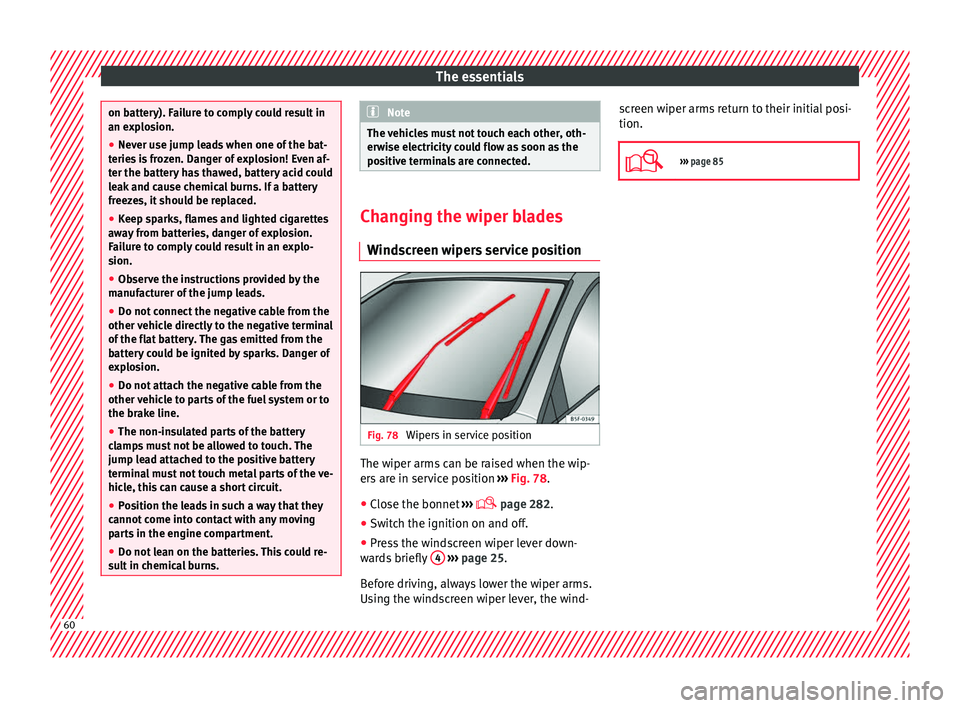
W ind
screen wipers service position Fig. 78
Wipers in service position The wiper arms can be raised when the wip-
er
s
are in service position ››› Fig. 78.
● Close the bonnet ››
›
page 282.
● Switch the ignition on and off.
● Press the windscreen wiper lever down-
war
ds briefly 4
› ››
page 25.
Before driving, always lower the wiper arms.
Using the windscreen wiper lever, the wind- screen wiper arms return to their initial posi-
tion.
››› page 85 60
Page 65 of 328
Safe driving
● Belt
tensioners for the front seats
● Front airbags
● knee airbags,
● Side airbags in the front seat backrests
● Head-protection airbags
● “ISOFIX” anchor points for child seats in
the re
ar side seats with the “ISOFIX” system,
● Height-adjustable front head restraints
● Rear head restraints with in-use position
and non-use po
sition
● Adjustable steering column
The saf
ety equipment mentioned above
works together to provide you and your pas-
sengers with the best possible protection in
the event of an accident. However, these
safety systems can only be effective if you
and your passengers are sitting in a correct
position and use this equipment properly.
Safety is everyone's business! Correct position for passengers
Corr
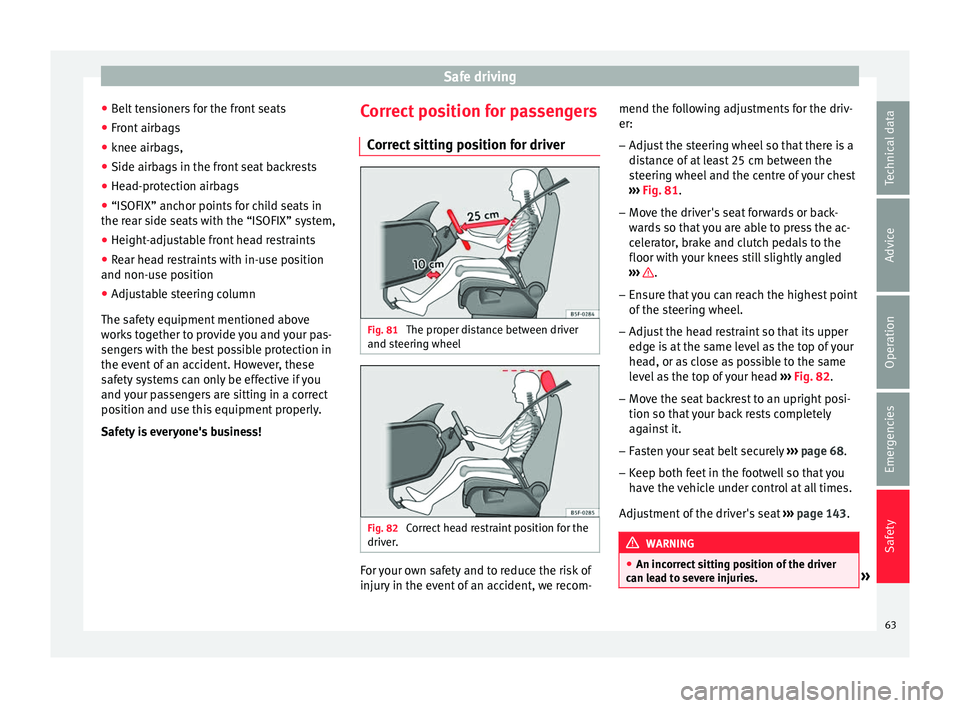
ect sitting position for driver Fig. 81
The proper distance between driver
and s t
eering wheel Fig. 82
Correct head restraint position for the
driv er
. For your own safety and to reduce the risk of
injur
y
in the event of an accident, we recom- mend the following adjustments for the driv-
er:
– Adjust the steering wheel so that there is a
dis
tance of at least 25 cm between the
steering wheel and the centre of your chest
››› Fig. 81.
– Move the driver's seat forwards or back-
war
ds so that you are able to press the ac-
celerator, brake and clutch pedals to the
floor with your knees still slightly angled
››› .
– Ensure that you can reach the highest point
of the s
teering wheel.
– Adjust the head restraint so that its upper
edge i
s at the same level as the top of your
head, or as close as possible to the same
level as the top of your head ››› Fig. 82.
– Move the seat backrest to an upright posi-
tion so that
your back rests completely
against it.
– Fasten your seat belt securely ››
› page 68.
– Keep both feet in the footwell so that you
hav
e the vehicle under control at all times.
Adjustment of the driver's seat ››› page 143. WARNING
● An inc orr
ect sitting position of the driver
can lead to severe injuries. » 63
Technical data
Advice
Operation
Emergencies
Safety
Page 69 of 328

Safe driving
Rear head restraints – The rear head restraints have 2 positions:
use
and non-use.
– One position for use
(head restraint raised)
››› Fig. 84. In this position, the head re-
straints are used normally, protecting pas-
sengers along with the rear seat belts.
– And one position for non-use
(head re-
straint lowered).
– To fit the head restraints in position for use,
pu
ll on the edges with both hands in the
direction of the arrow. WARNING
● Under no c ir
cumstances should the rear
passengers travel while the head restraints
are in the non-use position. See the warning
label located on the rear side fixed window
››› Fig. 85.
● Do not swap the centre rear head restraint
with either of
the outer seat rear head re-
straints. Risk of injury in case of an accident! CAUTION
Note the instructions on the adjustment of
the he a
d restraints ››› page 143. Pedal area
P ed
als –
Ensure that you can always press the accel-
er at
or, brake and clutch pedals unimpaired
to the floor.
– Ensure that the pedals can return unim-
pair
ed to their initial positions.
– Ensure that the floor mats are securely fas-
tened durin
g the trip and do not obstruct
the pedals ››› .
On ly
use floor mats which leave the pedals
clear and which are secured to prevent them
from slipping. You can obtain suitable floor
mats from a specialised dealership. Fasten-
ers* for floor mats are fitted in the footwells.
If a brake circuit fails, the brake pedal must
be pressed down thoroughly in order to stop
the vehicle.
Wear suitable footwear
Always wear shoes which support your feet
properly and give you a good feeling for the
pedals. WARNING
● Re
stricting pedal operation can lead to crit-
ical situations while driving. ●
Nev er l
ay or fit floor mats or other floor cov-
erings over the original floor mats. This
would reduce the pedal area and could ob-
struct the pedals. Risk of accident.
● Never place objects in the driver footwell.
An ob
ject could move into the pedal area and
impair pedal operation. In the event of a sud-
den driving or braking manoeuvre, you will
not be able to operate the brake, clutch or ac-
celerator pedal. Risk of accident! 67Technical data
Advice
Operation
Emergencies
Safety
Page 88 of 328
Emergencies
they should be changed if they are damaged,
or c l
eaned if they are dirty ››› .
Dam ag
ed wiper blades should be replaced
immediately. These are available from quali-
fied workshops. WARNING
Worn or dirty wiper blades reduce visibility
and inc r
ease the risk of accident and serious
injury.
● Always replace damaged or worn blades or
bl
ades which do not clean the windscreen
correctly. CAUTION
● Dam ag
ed or dirty windscreen wipers could
scratch the glass.
● If products containing solvents, rough
spon
ges or sharp objects are used to clean
the blades, the graphite layer will be dam-
aged.
● Never use fuel, nail varnish remover, paint
thinner or simi
lar products to clean the win-
dows.
● In icy conditions, always check that the
wiper b
lades are not frozen to the glass be-
fore using the wipers. In cold weather, it may
help to leave the vehicle parked with the wip-
ers in service position ›››
page 60. CAUTION
● To pr
event damage to the bonnet and the
wiper arms, only leave them in the service
position.
● Before driving, always lower the wiper
arms. Tow-starting and towing
Intr oduction Tow-starting me
an
s starting the engine of
the vehicle while another pulls it.
Towing means one vehicle pulling another
that is not roadworthy.
Always consider the legal provisions relating
to tow-starting and towing.
For technical reasons, towing a vehicle with a
discharged battery is not allowed. The jump
start should be used instead ›››
page 58.
If the vehicle comes with the Keyless Access
system, towing is only allowed with the igni-
tion on!
The vehicle battery drains if the vehicle is
towed with the engine switched off and the
ignition connected. Depending on the battery
charge status, the drop in voltage may be so
large, even after just a few minutes, that no
electrical device in the vehicle may work e.g. the hazard warning lights. In vehicles with
the Keyl
ess Access system, the steering
wheel could lock ››› .
WARNING
A vehicle with no power should never be tow-
ed.
● During towing, never switch off the ignition
w ith the s
tarter button. Otherwise, the elec-
tronic lock of the steering column could sud-
denly get blocked and it would be impossible
to steer the vehicle. This could cause an acci-
dent, serious injury and loss of control of the
vehicle.
● If during towing the vehicle runs out of
pow
er, stop towing immediately and request
the assistance of specialist personnel. WARNING
Vehicle handling and braking capacity
c h
ange considerably during towing. Please
observe the following instructions to mini-
mise the risk of serious accidents and injury:
● As the driver of the vehicle being towed:
– You shou
ld depress the brake much hard-
er as the brake servo does not operate.
Pay the utmost attention to avoid crash-
ing into the towing vehicle.
– More strength is required at the steering
wheel as the power steering does not op-
erate when the engine is switched off.
● As the driver of the towing vehicle: 86
Page 89 of 328
Self-help
–
Ac
celerate with particular care and cau-
tion.
– Avoid sudden braking and manoeuvres.
– Brake earlier than usual and more
smoothly. CAUTION
● To av
oid damaging the vehicle, for example
the paint, remove and replace the lid and
towing eye carefully.
● Unburnt fuel could enter the catalytic con-
ver
ter and damage it during towing. Indications for tow-starting
Vehicle's should not generally be tow-star-
t
ed.
The jump start should be used instead
››› page 58.
For technical reasons, towing the following
vehicles is not allowed:
● Vehicles with an automatic gearbox.
● If the vehicle battery is discharged, be-
cau
se in vehicles with the Keyless Access
locking and ignition system the steering re-
mains locked and the electronic parking
brake cannot be deactivated nor can the elec-
tronic lock of the steering column be re-
leased if they are activated. ●
If the b
attery is flat, it is possible that the
engine control units may not operate correct-
ly.
However, if the vehicle must absolutely be
tow-started (in the case of manual gearbox-
es):
● Engage the 2nd or 3rd gear.
● Keep the clutch pressed down.
● Switch on the ignition and the hazard warn-
ing lights.
● Onc
e both vehicles are moving, release the
clut
ch.
● Once the engine starts, press the clutch
and disen
gage the gear to avoid colliding
with the towing vehicle. CAUTION
When tow-starting, unburnt fuel could enter
the c at
alytic converter and damage it. Note
The vehicle can only be tow-started if the
el ectr
onic parking brake and, if appropriate,
the electronic lock of the steering column are
deactivated. If the vehicle has no power sup-
ply or there is an electric system fault, the
engine must be tow-started to deactivate the
electronic parking brake and the electronic
lock of the steering column. Indications for towing
Tow rope or tow bar
It
i
s safer for the vehicle to be towed using a
tow bar, avoiding damage to the vehicle. A
tow rope should only be used if a tow bar is
not available.
A tow rope should be slightly elastic to avoid
damage to both vehicles. It is advisable to
use a tow rope made of synthetic fibre or sim-
ilarly elastic material.
Only attach the tow rope or the tow bar to the
towing eyes provided or a towing bracket.
If the vehicle is factory-equipped with a tow-
ing bracket, it is only allowed to tow with a
tow bar if this has been specially designed to
be installed with a tow hitch ›››
page 257.
When the vehicle needs to be towed:
Check whether the vehicle may be towed
››› page 88, Cases where towing a vehicle
is not allowed .
● Switch the ignition on.
● Put the gearbox lever in neutral or the se-
l ect
or lever in the N position ›››
page 176.
● Do not allow the vehicle to be towed at
speed
s of over 50 km/h (30 mph).
● Do not allow the vehicle to be towed at
s peed
s of over 50 km. »
87
Technical data
Advice
Operation
Emergencies
Safety
Page 90 of 328
Emergencies
● If a br
eakdown lorry is used, vehicles with
automatic transmission are only allowed to
be towed with the front wheels suspended.
Towing vehicles with four-wheel drive
(4Drive)
Four-wheel drive vehicles (4Drive) can be
towed using a tow bar or tow rope. If the ve-
hicle is towed with the front or rear axle sus-
pended, the engine must be switched off,
otherwise the transmission may be damaged.
Cases where towing a vehicle is not allowed
● If, due to a fault, the gearbox is out of lubri-
cant
.
● If the vehicle battery is discharged, be-
cau
se the steering remains locked and, if ap-
propriate, the electronic parking brake can-
not be deactivated or the electronic lock of
the steering column released.
● If a distance above 50 km needs to be trav-
ell
ed.
● When, for example, after an accident, the
smooth rot
ation of the wheels or the steering
operation cannot be guaranteed.
When the vehicle is to tow another vehicle:
● Observe legal requirements.
● Keep in mind the instructions in the man-
ual on t
owing vehicles. Note
The vehicle can only be towed if the electron-
ic p
arking brake and the electronic lock of the
steering column are deactivated. If the vehi-
cle has no power supply or there is an electric
system fault, the engine must be tow-started
››› page 58 to deactivate the electronic
parking brake and the electronic lock of the
steering column. Fitting the front towing eye
Fig. 96
Front bumper on right: remove the lid. Fig. 97
Front bumper on right: towline an-
c hor
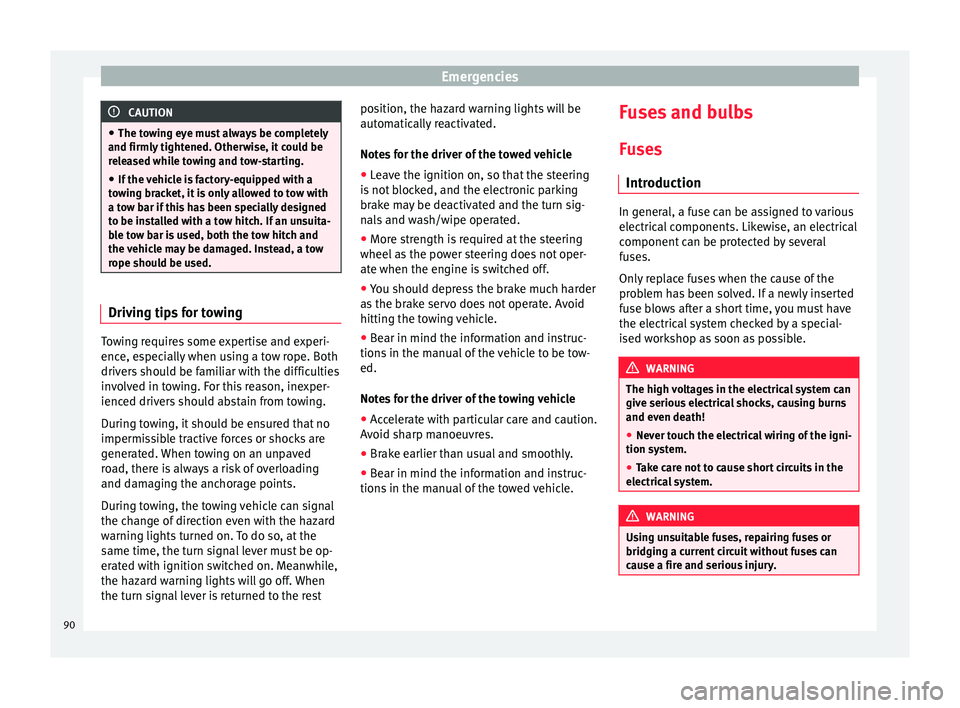
age screwed in. The housing of the screw towing eye is on the
right
s
ide of the front bumper behind a lid
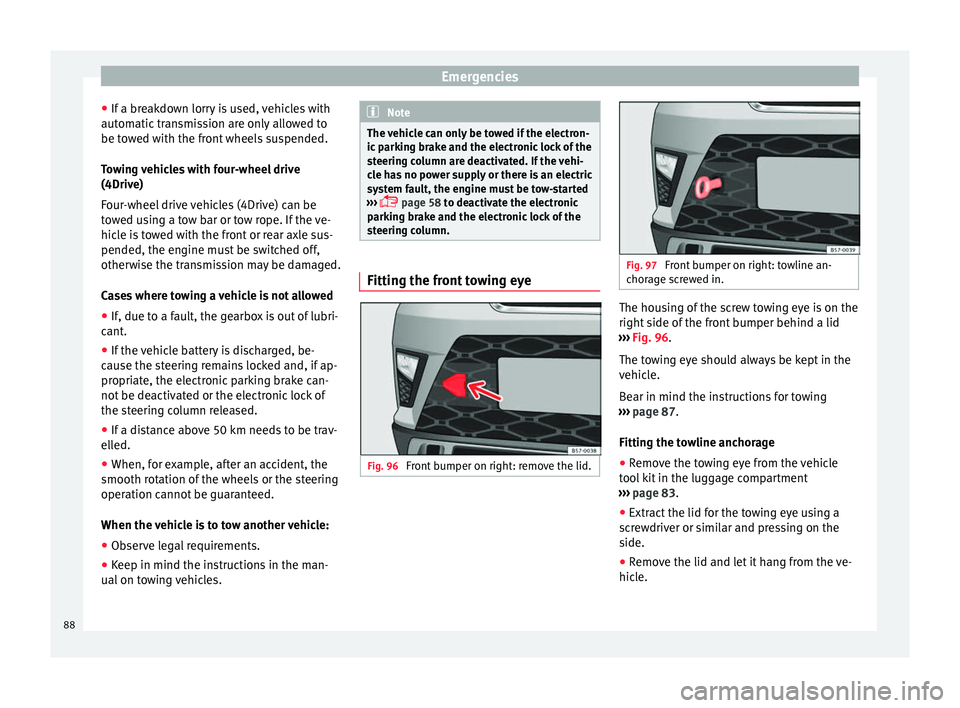
››› Fig. 96.
The towing eye should always be kept in the
vehicle.
Bear in mind the instructions for towing
››› page 87.
Fitting the towline anchorage
● Remove the towing eye from the vehicle
too
l kit in the luggage compartment
››› page 83.
● Extract the lid for the towing eye using a
sc
rewdriver or similar and pressing on the
side.
● Remove the lid and let it hang from the ve-
hicl
e.
88
Page 92 of 328
Emergencies
CAUTION
● The t o
wing eye must always be completely
and firmly tightened. Otherwise, it could be
released while towing and tow-starting.
● If the vehicle is factory-equipped with a
to
wing bracket, it is only allowed to tow with
a tow bar if this has been specially designed
to be installed with a tow hitch. If an unsuita-
ble tow bar is used, both the tow hitch and
the vehicle may be damaged. Instead, a tow
rope should be used. Driving tips for towing
Towing requires some expertise and experi-
enc
e, e
specially when using a tow rope. Both
drivers should be familiar with the difficulties
involved in towing. For this reason, inexper-
ienced drivers should abstain from towing.
During towing, it should be ensured that no
impermissible tractive forces or shocks are
generated. When towing on an unpaved
road, there is always a risk of overloading
and damaging the anchorage points.
During towing, the towing vehicle can signal
the change of direction even with the hazard
warning lights turned on. To do so, at the
same time, the turn signal lever must be op-
erated with ignition switched on. Meanwhile,
the hazard warning lights will go off. When
the turn signal lever is returned to the rest position, the hazard warning lights will be
autom
atically reactivated.
Notes for the driver of the towed vehicle ● Leave the ignition on, so that the steering
is
not blocked, and the electronic parking
brake may be deactivated and the turn sig-
nals and wash/wipe operated.
● More strength is required at the steering
wheel a
s the power steering does not oper-
ate when the engine is switched off.
● You should depress the brake much harder
as
the brake servo does not operate. Avoid
hitting the towing vehicle.
● Bear in mind the information and instruc-
tions
in the manual of the vehicle to be tow-
ed.
Notes for the driver of the towing vehicle
● Accelerate with particular care and caution.
Av
oid sharp manoeuvres.
● Brake earlier than usual and smoothly.
● Bear in mind the information and instruc-
tions
in the manual of the towed vehicle. Fuses and bulbs
F u
ses
Introduction In general, a fuse can be assigned to various
el
ectric
al components. Likewise, an electrical
component can be protected by several
fuses.
Only replace fuses when the cause of the
problem has been solved. If a newly inserted
fuse blows after a short time, you must have
the electrical system checked by a special-
ised workshop as soon as possible. WARNING
The high voltages in the electrical system can
giv e seriou
s electrical shocks, causing burns
and even death!
● Never touch the electrical wiring of the igni-
tion sys
tem.
● Take care not to cause short circuits in the
electric
al system. WARNING
Using unsuitable fuses, repairing fuses or
bridgin g a c
urrent circuit without fuses can
cause a fire and serious injury. 90
Page 93 of 328
Fuses and bulbs
●
Nev er u
se a fuse with a higher value. Only
replace fuses with a fuse of the same amper-
age (same colour and markings) and size.
● Never repair a fuse.
● Never replace a fuse by a metal strip, staple
or simi
lar. CAUTION
● To pr
event damage to the vehicle's electric
system, before replacing a fuse always turn
off the ignition, the lights and all electrical
elements and remove the key from the igni-
tion.
● If you replace a fuse with higher-rating
fu
se, you could cause damage to another part
of the electrical system.
● Protect the fuse boxes when open to pre-
vent
the entry of dust or humidity as they can
damage the electrical system. Note
● One c omponent
may have more than one
fuse.
● Several components may run on a single
fu
se. Vehicle fuses
Fig. 100
On the driver-side dash panel: fuse
bo x
cover Fig. 101
In the engine compartment: fuse box
c o
ver Read the additional information carefully
› ›
› page 51
Only replace fuses with a fuse of the same
amperage (same colour and markings) and
size. Opening and closing the fuse box situated
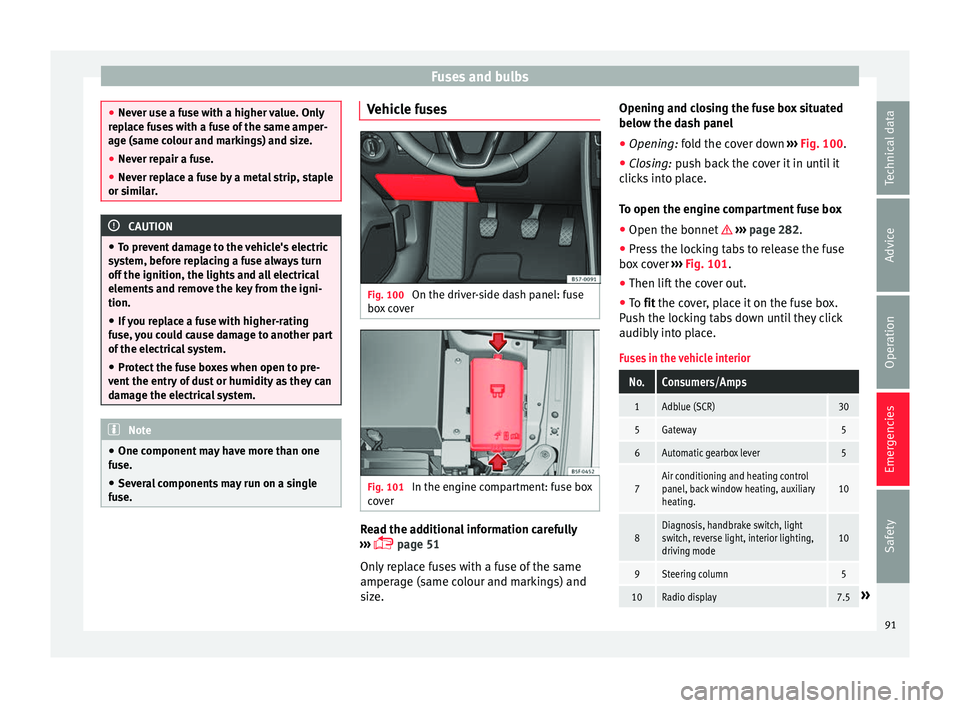
below the d
ash panel
● Opening: fold the cover down ›
›› Fig. 100.
● Closing: push back the cover it in until it
c
licks into place.
To open the engine compartment fuse box
● Open the bonnet ››
› page 282.
● Press the locking tabs to release the fuse
box
cover ››› Fig. 101.
● Then lift the cover out.
● To fit the cover, place it on the fuse box.
P
ush the locking tabs down until they click
audibly into place.
Fuses in the vehicle interior
No.Consumers/Amps
1Adblue (SCR)30
5Gateway5
6Automatic gearbox lever5
7Air conditioning and heating control
panel, back window heating, auxiliary
heating.10
8Diagnosis, handbrake switch, light
switch, reverse light, interior lighting,
driving mode10
9Steering column5
10Radio display7.5» 91
Technical data
Advice
Operation
Emergencies
Safety
Page 94 of 328
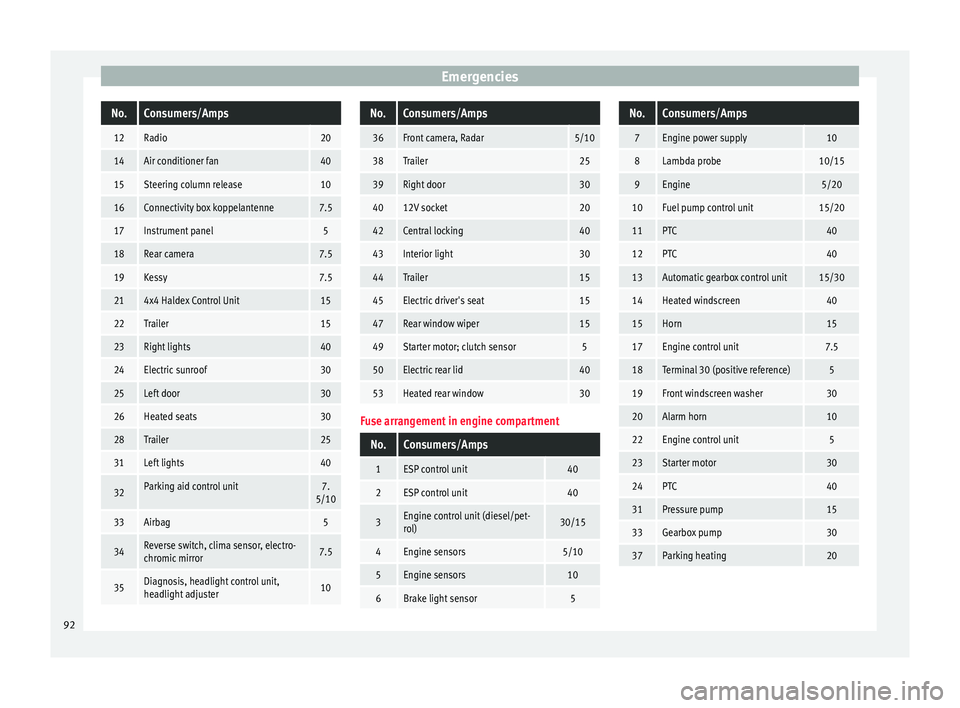
EmergenciesNo.Consumers/Amps
12Radio20
14Air conditioner fan40
15Steering column release10
16Connectivity box koppelantenne7.5
17Instrument panel5
18Rear camera7.5
19Kessy7.5
214x4 Haldex Control Unit15
22Trailer15
23Right lights40
24Electric sunroof30
25Left door30
26Heated seats30
28Trailer25
31Left lights40
32Parking aid control unit7.
5/10
33Airbag5
34Reverse switch, clima sensor, electro-
chromic mirror7.5
35Diagnosis, headlight control unit,
headlight adjuster10
No.Consumers/Amps
36Front camera, Radar5/10
38Trailer25
39Right door30
4012V socket20
42Central locking40
43Interior light30
44Trailer15
45Electric driver's seat15
47Rear window wiper15
49Starter motor; clutch sensor5
50Electric rear lid40
53Heated rear window30
Fuse arrangement in engine compartment
No.Consumers/Amps
1ESP control unit40
2ESP control unit40
3Engine control unit (diesel/pet-
rol)30/15
4Engine sensors5/10
5Engine sensors10
6Brake light sensor5
No.Consumers/Amps
7Engine power supply10
8Lambda probe10/15
9Engine5/20
10Fuel pump control unit15/20
11PTC40
12PTC40
13Automatic gearbox control unit15/30
14Heated windscreen40
15Horn15
17Engine control unit7.5
18Terminal 30 (positive reference)5
19Front windscreen washer30
20Alarm horn10
22Engine control unit5
23Starter motor30
24PTC40
31Pressure pump15
33Gearbox pump30
37Parking heating20 92
Page 98 of 328
Emergencies
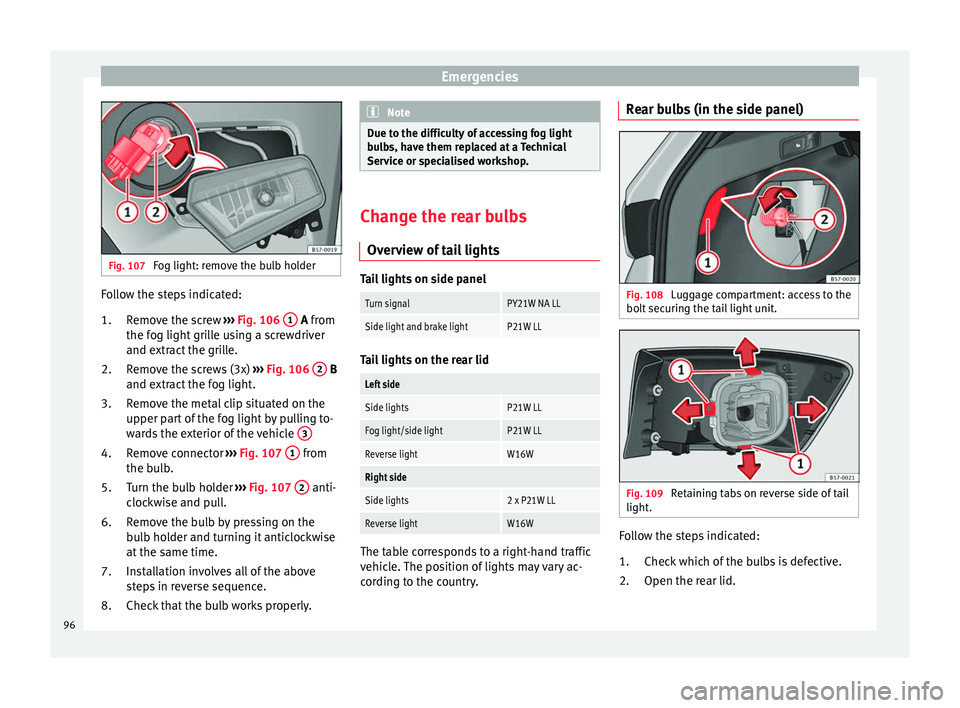
Fig. 107
Fog light: remove the bulb holder Follow the steps indicated:
Remo
ve the screw ››› Fig. 106 1 A fr
om
the f
og light grille using a screwdriver
and extract the grille.
Remove the screws (3x) ››› Fig. 106 2 B
and e xtr
act the fog light.
Remove the metal clip situated on the
upper part of the fog light by pulling to-
wards the exterior of the vehicle 3Remove connector
››
›
Fig. 107 1 from
the b u
lb.
Turn the bulb holder ›››
Fig. 107 2 anti-
c loc
kwise and pull.
Remove the bulb by pressing on the
bulb holder and turning it anticlockwise
at the same time.
Installation involves all of the above
steps in reverse sequence.
Check that the bulb works properly.
1.
2.
3.
4.
5.
6.
7.
8. Note
Due to the difficulty of accessing fog light
b u
lbs, have them replaced at a Technical
Service or specialised workshop. Change the rear bulbs
Ov er
view of tail lights Tail lights on side panel
Turn signalPY21W NA LL
Side light and brake lightP21W LL
Tail lights on the rear lid
Left side
Side lightsP21W LL
Fog light/side lightP21W LL
Reverse lightW16W
Right side
Side lights2 x P21W LL
Reverse lightW16W
The table corresponds to a right-hand traffic
v
ehic
le. The position of lights may vary ac-
cording to the country. Rear bulbs (in the side panel)
Fig. 108
Luggage compartment: access to the
bo lt
securing the tail light unit. Fig. 109
Retaining tabs on reverse side of tail
light . Follow the steps indicated:
Chec k
which of the bulbs is defective.
Open the rear lid.
1.
2.
96