tyre pressure Seat Ateca 2017 Owner's Manual
[x] Cancel search | Manufacturer: SEAT, Model Year: 2017, Model line: Ateca, Model: Seat Ateca 2017Pages: 328, PDF Size: 6.36 MB
Page 29 of 328
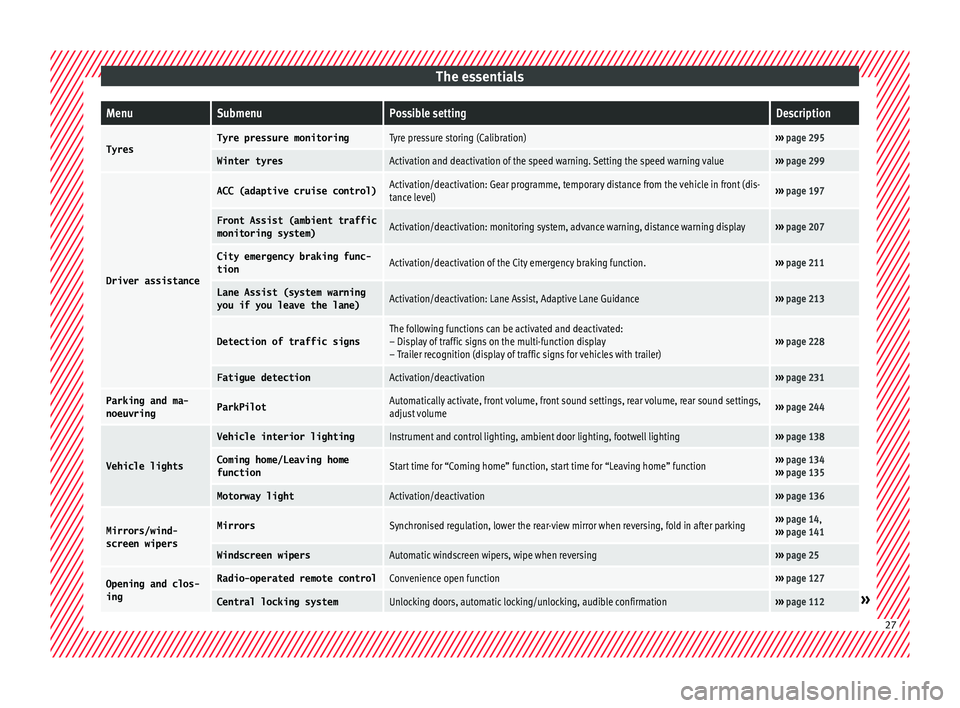
The essentialsMenuSubmenuPossible settingDescription
TyresTyre pressure monitoringTyre pressure storing (Calibration)›››
page 295
Winter tyresActivation and deactivation of the speed warning. Setting the speed warning value››› page 299
Driver assistance
ACC (adaptive cruise control)Activation/deactivation: Gear programme, temporary distance from the vehicle in front (dis-
tance level)››› page 197
Front Assist (ambient traffic
monitoring system)Activation/deactivation: monitoring system, advance warning, distance warning display››› page 207
City emergency braking func-
tionActivation/deactivation of the City emergency braking function.››› page 211
Lane Assist (system warning
you if you leave the lane)Activation/deactivation: Lane Assist, Adaptive Lane Guidance››› page 213
Detection of traffic signsThe following functions can be activated and deactivated:
– Display of traffic signs on the multi-function display
– Trailer recognition (display of traffic signs for vehicles with trailer)››› page 228
Fatigue detectionActivation/deactivation››› page 231
Parking and ma-
noeuvringParkPilotAutomatically activate, front volume, front sound settings, rear volume, rear sound settings,
adjust volume››› page 244
Vehicle lights
Vehicle interior lightingInstrument and control lighting, ambient door lighting, footwell lighting››› page 138
Coming home/Leaving home
functionStart time for “Coming home” function, start time for “Leaving home” function››› page 134
››› page 135
Motorway lightActivation/deactivation››› page 136
Mirrors/wind‐
screen wipersMirrorsSynchronised regulation, lower the rear-view mirror when reversing, fold in after parking››› page 14,
››› page 141
Windscreen wipersAutomatic windscreen wipers, wipe when reversing››› page 25
Opening and clos-
ingRadio-operated remote controlConvenience open function››› page 127
Central locking systemUnlocking doors, automatic locking/unlocking, audible confirmation››› page 112» 27
Page 41 of 328
The essentials
Front brake pads worn.
›››
page
173 it lights up:
Fault in the ESC, or dis-
connection caused by the system.
flashes: ESC or ASR activated.
ASR manually deactivated.›››
page
173ESC in Sport mode.
ABS faulty or does not work.
Rear fog light switched on.›››
page
131
lights up or flashes:
fault in the
emission control system.››› page
186
it lights up:
pre-heating of diesel
engine.
››› page
187
flashes: fault in the diesel engine
management.
fault in the petrol engine manage-
ment.›››
page
187
lights up or flashes:
fault in the
steering system.››› page
273
Tyre pressure too low, or fault in
the tyre pressure monitoring sys-
tem.›››
page
295
Fuel tank almost empty.›››
page
102
Fault in airbag system and seat
belt tensioners.›››
page
73
Lane Assist is switched on, but not
active.›››
page
213 Other warning lamps
Left or right turn signal.›››
page
131
Hazard warning lights on.››› page
135
Trailer turn signals.›››
page
255
it lights up green:
Auto Hold activa-
ted.››› page
191
it lights up green:
Press the brake
pedal!
It blinks in green: the selector lever
locking button has not engaged.››› page
177
it lights up green:
cruise control ac-
tivated or speed limiter switched
on and active.
››› page
193
it blinks in green: the speed set by
the speed limiter has been excee-
ded.
it lights up green:
Lane Assist is
switched on and active.››› page
213
Main beam on or flasher on.›››
page
131 On the instrument panel display
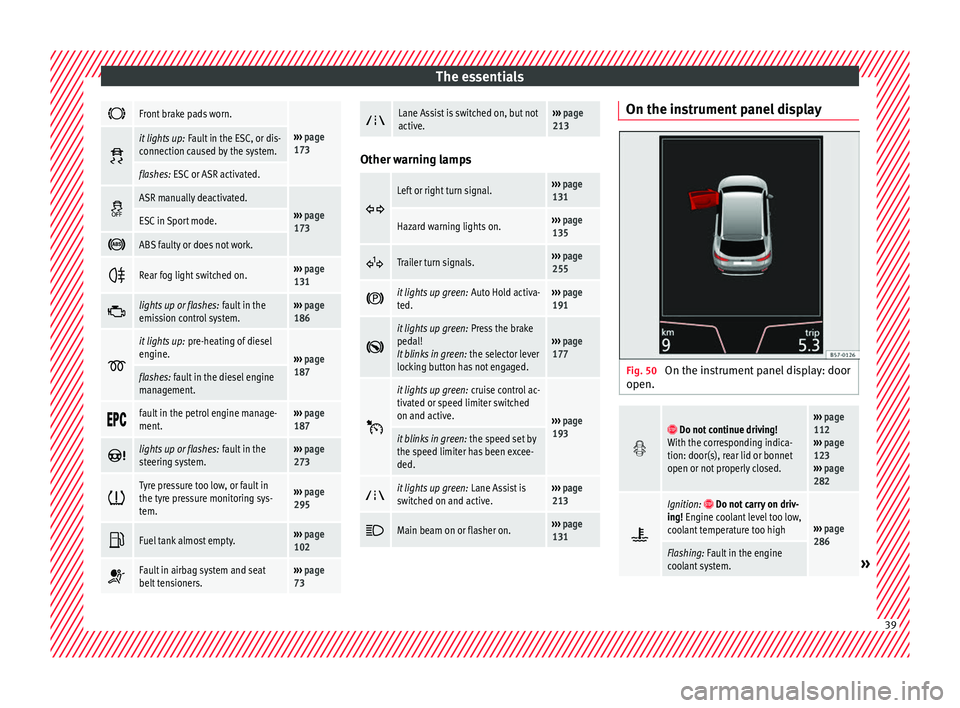
Fig. 50
On the instrument panel display: door
open.
Do not continue driving!
With the corresponding indica-
tion: door(s), rear lid or bonnet
open or not properly closed.››› page
112
››› page
123
››› page
282
Ignition: Do not carry on driv-
ing! Engine coolant level too low,
coolant temperature too high
››› page
286
Flashing: Fault in the engine
coolant system.» 39
Page 55 of 328

The essentials
Repairing a tyre with the anti-punc-
t ur
e kit Fig. 67
Standard representation: contents of
the anti-p u
ncture kit. The anti-puncture kit is located under the
floor p
anel
in the luggage compartment.
Sealing the tyre
● Unscrew the tyre valve cap and insert. Use
the ››
› Fig. 67 1 tool to remove the insert.
Pl ac
e it on a clean surface.
● Shake the tyre sealant bottle vigorously
››
› Fig. 67 10 .
● Screw the inflator tube ››
› Fig. 67 3 into
the se al
ant bottle. The bottle's seal will break
automatically. ●
Remo
ve the lid from the filling tube
››› Fig. 67 3 and screw the open end of the
t ube int
o the tyre valve.
● With the tyre sealant bottle upside down,
fil
l the tyre with the contents of the sealant
bottle.
● Remove the bottle from the valve.
● Place the insert back into the tyre valve us-
ing the t
ool ››› Fig. 67 1 .
Infl atin
g the tyre
● Screw the compressor tyre inflator tube
››
› Fig. 67 5 into the tyre valve.
● Check that the air bleed screw is closed
› ›
› Fig. 67 7 .
● Start the engine and leave it running.
● Insert the connector ››
› Fig. 67 9 into the
v ehic
le's 12-volt socket ›››
page 148.
● Turn the air compressor on with the ON/OFF
swit
ch ››› Fig. 67 8 .
● Keep the air compressor running until it
r e
aches 2.0 to 2.5 bar
(29-36 psi/200-250 kPa). a maximum of 8
minutes.
● Disconnect the air compressor.
● If it does not reach the pressure indicated,
un
screw the tyre inflator tube from the valve.
● Move the vehicle 10m so that the sealant is
di s
tributed throughout the tyre. ●
Sc r
ew the compressor tyre inflator into the
valve.
● Repeat the inflation process.
● If the indicated pressure still cannot be
re
ached, the tyre is too badly damaged. Stop
and request assistance from an authorised
technician.
● Disconnect the air compressor. Unscrew
the tyr
e inflator tube from the tyre valve.
● When the tyre pressure is between 2.5 and
2.0 bar
s, continue driving without exceeding
80 km/h (50 mph).
● Check the pressure again after 10 minutes
››
› page 85.
››› in TMS (Tyre Mobility System)* on
page 83
››› page 83 53
Page 58 of 328

The essentials
the jack* could slip as it does not have an
a
dequat
e grip on the vehicle: risk of injury!
● The height of the parked vehicle can
ch
ange as a result of variations in tempera-
ture and loading. CAUTION
The vehicle must not be raised on the cross-
b ar
. Only place the jack* on the points de-
signed for this purpose on the strut. Other-
wise, the vehicle may be damaged. Removing and fitting a wheel
Change the wheel after loosening the wheel
bo
lts
and raising the vehicle with the jack.
Taking off the wheel ● Unscrew the wheel bolts using the box
sp
anner and place them on a clean surface.
● Take off the wheel.
Puttin
g on the spare wheel
When fitting tyres with a compulsory rotation
direction, observe the instructions in
››› page 56.
● Mount the wheel.
● Screw on the wheel bolts in position and
tight en them loo
sely with a box spanner.
● Carefully lower the vehicle using the jack*. ●
Tight en the wheel
bolts in diagonal pairs
using the wheel brace.
The wheel bolts should be clean and turn
easily. Before fitting the spare wheel, inspect
the wheel condition and hub mounting surfa-
ces. These surfaces must be clean before fit-
ting the wheel.
Tyres with compulsory direction of ro-
tation A directional tread pattern can be identified
b
y
the arrows on the sidewall that point in
the direction of rotation. Always observe the
direction of rotation indicated when fitting
the wheel to guarantee optimum properties
of this type of tyres with regard to grip,
noises, wear and aquaplaning.
If it is absolutely necessary to fit the spare
tyre* against the direction of rotation, drive
with care as this means the tyre does not of-
fer optimum driving properties. This is of par-
ticular importance when the road surface is
wet.
To return to directional tread tires, replace
the punctured tyre as soon as possible and
restore the obligatory direction of rotation of
all tyres. Subsequent work ●
Alloy wheels: rep
lace the wheel bolt caps.
● Plate wheels: fit the c
entral wheel rim again
››› page 54.
● Return all tools to their proper storing loca-
tion.
● If the replaced wheel does not fit in the
sp
are wheel housing, store it safely in the
luggage compartment ›››
page 149.
● Check the tyre pressure of the newly moun-
ted ty
re as soon as possible.
● In vehicles fitted with a tyre pressure indi-
c at
or, adjust the pressure and store the read-
ing in the radio/Easy Connect system*
››› page 295.
● Have the tightening torque of the wheel
bolts
checked as soon as possible with a tor-
que wrench (it should be 140 Nm). Mean-
while, drive carefully.
● Have the flat tyre replaced as quickly as
pos
sible.
Snow chains Use Snow chains should only be used on the
fr
on
t wheels.56
Page 64 of 328
Safety
Safety
Saf e driv
ing
Safety first! WARNING
● Thi s
manual contains important informa-
tion about the operation of the vehicle, both
for the driver and the passengers. The other
sections of the on-board documentation also
contain further information that you should
be aware of for your own safety and for the
safety of your passengers.
● Ensure that the on-board documentation is
kept
in the vehicle at all times. This is espe-
cially important when lending or selling the
vehicle to another person. Advice about driving
B ef
ore starting every trip For your own safety and the safety of your
p
a
ssengers, always note the following points
before every trip:
– Make sure that the vehicle's lights and turn
sign
als are working properly.
– Check tyre pressure. –
Ens
ure that all windows provide a clear and
good view of the surroundings.
– Make sure all luggage is secured
››
› page 149.
– Make sure that no objects can interfere
with the ped
als.
– Adjust front seat, head restraint and mir-
ror
s properly according to your size.
– Ensure that the passengers in the rear
seats
always have the head restraints in
the in-use position ››› page 66.
– Instruct passengers to adjust the head re-
str
aints according to their height.
– Protect children with appropriate child
seats
and properly applied seat belts
››› page 79.
– Assume the correct sitting position. Instruct
your p
assengers also to assume a proper
sitting position. ››› page 63.
– Fasten your seat belt securely. Instruct your
pa
ssengers also to fasten their seat belts
properly. ››› page 68.
What affects driving safety? As a driver, you are responsible for yourself
and
y
our passengers. When your concentra-
tion or driving safety is affected by any cir- cumstance, you endanger yourself as well as
others
on the road ››› , for this reason:
– Always pay attention to traffic and do not
g et
distracted by passengers or telephone
calls.
– Never drive when your driving ability is im-
pair
ed (e.g. by medication, alcohol, drugs).
– Observe traffic laws and speed limits.
– Always reduce your speed as appropriate
for r
oad, traffic and weather conditions.
– When travelling long distances, take
bre
aks regularly - at least every two hours.
– If possible, avoid driving when you are tired
or str
essed. WARNING
When driving safety is impaired during a trip,
the ri sk
of injury and accidents increases. Safety equipment
Never put your safety or the safety of your
p
a
ssengers in danger. In the event of an acci-
dent, the safety equipment may reduce the
risk of injury. The following list includes most
of the safety equipment in your SEAT:
● Three-point seat belts
● belt tension limiters for the front and rear
side se
ats,
62
Page 85 of 328
Self-help
Emergencies
Self -help
V
ehicle tool kit, anti-puncture kit* The tools and anti-puncture kit* are stored
u
nder the floor p
anel in the luggage compart-
ment.
To access the vehicle tools:
– Lift up the floor surface by the plastic han-
dl e u
ntil it is fastened to the tabs on both
sides.
Depending on the vehicle equipment, the an-
ti-puncture kit* is located under the floor
panel in the luggage compartment.
The tool kit includes:
● Jack*
● Wire hook for pulling off the wheel cov-
er*/wheel bo
lt cap clip.
● Box spanner for wheel bolts*
● Towline anchorage
● Adapter for the anti-theft wheel bolts*
● Towing bracket device
Some of the it
ems listed are only provided in
certain model versions, or are optional ex-
tras. Note
The jack does not generally require any main-
t en
ance. If required, it should be greased us-
ing universal type grease. Tyre repair
TM S
(Tyre Mobility System)* Read the additional information carefully
› ›
› page 53
The Anti-puncture kit* (Tyre Mobility System)
will reliably seal punctures caused by the
penetration of a foreign body of up to about
4 mm in diameter. Do not remove foreign ob-
jects, e.g. screws or nails, from the tyre.
After inserting the sealant residue in the tyre,
you must again check the tyre pressure about
10 minutes after starting the engine.
You should only use the tyre mobility set if
the vehicle is parked in a safe place, you are
familiar with the procedure and you have the
necessary tyre mobility set! Otherwise, you
should seek professional assistance.
Do not use the tyre sealant in the following
cases:
● If the wheel rim has been damaged.
● In outside temperatures below -20°C (-4°F). ●
In the ev ent
of cuts or perforations in the
tyre greater than 4 mm.
● If you have been driving with very low pres-
sur
e or a completely flat tyre.
● If the sealant bottle has passed its use by
dat
e. WARNING
Using the tyre mobility system can be dan-
g er
ous, especially when filling the tyre at the
roadside. Please observe the following rules
to minimise the risk of injury:
● Stop the vehicle safely as soon as possible.
Park
it at a safe distance from surrounding
traffic to fill the tyre.
● Ensure the ground on which you park is flat
and solid.
● A
ll passengers and particularly children
mus
t keep a safe distance from the work area.
● Turn on the hazard warning lights to warn
other ro
ad users.
● Use the tyre mobility system only if you are
fami
liar with the necessary procedures. Oth-
erwise, you should seek professional assis-
tance.
● The tyre mobility set is intended for tempo-
rar
y emergency use only until you can reach
the nearest specialised workshop.
● Replace the repaired tyre with the tyre mo-
bi
lity set as soon as possible. » 83
Technical data
Advice
Operation
Emergencies
Safety
Page 86 of 328
Emergencies
●
The se a
lant is a health hazard and must be
cleaned immediately if it comes into contact
with the skin.
● Always keep the tyre mobility set out of the
re
ach of small children.
● Never use an equivalent jack, even if it has
been appr
oved for your vehicle.
● Always stop the engine, apply the hand-
brak
e lever firmly and engage gear if using a
manual gearbox, in order to reduce the risk of
vehicle involuntary movement. WARNING
A tyre filled with sealant does not have the
s ame per
formance properties as a conven-
tional tyre.
● Never drive faster than 80 km/h (50 mph).
● Avoid heavy acceleration, hard braking and
fa
st cornering.
● Drive for only 10 minutes at a maximum
speed of
80 km/h (50 mph) and then check
the tyre. For the sake of the environment
Dispose of used or expired sealant observing
an y
legal requirements. Note
A new bottle of sealant can be purchased at
S EA
T dealerships. Note
Take into account the separate instruction
m anua
l of the tyre mobility set* manufactur-
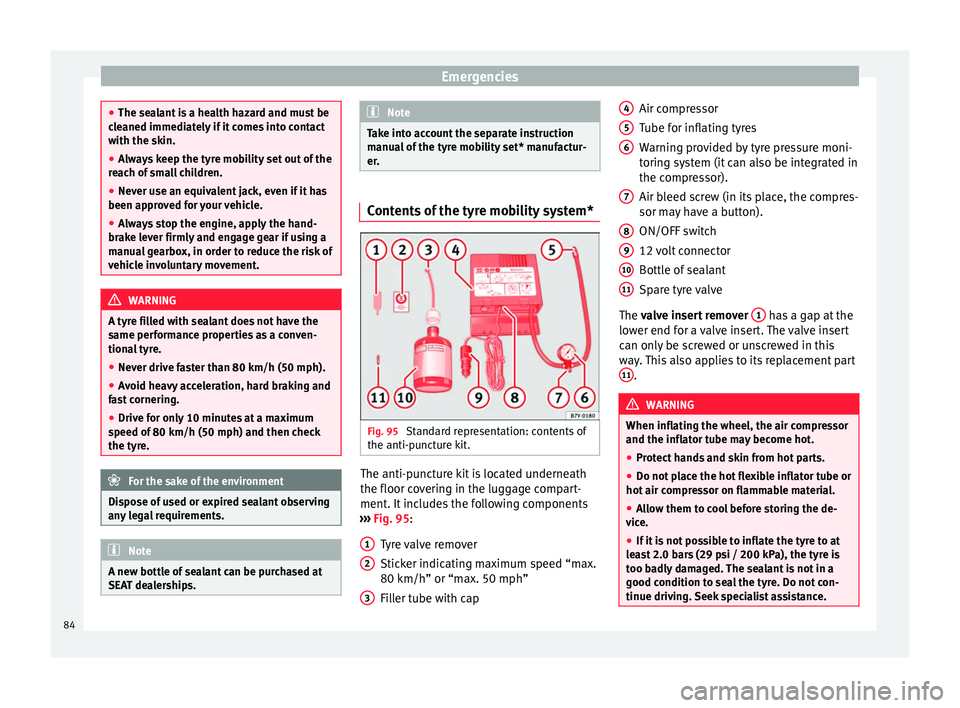
er. Contents of the tyre mobility system*
Fig. 95
Standard representation: contents of
the anti-p u
ncture kit. The anti-puncture kit is located underneath
the floor c
o
vering in the luggage compart-
ment. It includes the following components
››› Fig. 95:
Tyre valve remover
Sticker indicating maximum speed “max.
80 km/h” or “max. 50 mph”
Filler tube with cap
1 2
3 Air compressor
T
ube f
or inflating tyres
Warning provided by tyre pressure moni-
toring system (it can also be integrated in
the compressor).
Air bleed screw (in its place, the compres-
sor may have a button).
ON/OFF switch
12 volt connector
Bottle of sealant
Spare tyre valve
The valve insert remover 1 has a gap at the
lo w
er end for a valve insert. The valve insert
can only be screwed or unscrewed in this
way. This also applies to its replacement part 11 .
WARNING
When inflating the wheel, the air compressor
and the infl at
or tube may become hot.
● Protect hands and skin from hot parts.
● Do not place the hot flexible inflator tube or
hot air c
ompressor on flammable material.
● Allow them to cool before storing the de-
vic
e.
● If it is not possible to inflate the tyre to at
le
ast 2.0 bars (29 psi / 200 kPa), the tyre is
too badly damaged. The sealant is not in a
good condition to seal the tyre. Do not con-
tinue driving. Seek specialist assistance. 4
5
6
7
8
9
10
11
84
Page 87 of 328
Self-help
CAUTION
Switch off the air compressor after a maxi-
mum of 8 oper
ational minutes to avoid over-
heating! Before switching on the air compres-
sor again, let it cool for several minutes. Check after 10 minutes of driving
Screw the inflator tube
››
› Fig. 95 5 again
and c hec
k the pressure on the gauge 6 .
1.3 b ar (19 p
si / 130 kPa) and lower:
● Stop the vehicle! The tyr
e cannot be sealed
sufficiently with the tyre mobility set.
● You should obtain professional assistance
››
› .
1.4 b ar (20 p
si / 140 kPa) and higher:
● Set the tyre pressure to the correct value
again.
● C
arefully resume your journey until you
re
ach the nearest specialised workshop with-
out exceeding 80 km/h (50 mph).
● Have the damaged tyre replaced. WARNING
Driving with an unsealed tyre is dangerous
and c an c
ause accidents and serious injury.
● Do not continue driving if the tyre pressure
is
1.3 bar (19 psi / 130 kPa) and lower. ●
Seek s
pecialist assistance. Manual unlocking/locking
Intr oduction Read the additional information carefully
› ›
› page 10,
›››
page 11.
The doors, rear lid and panoramic tilting sun-
roof can be locked manually and partially
opened, for example if the key or the central
locking is damaged. WARNING
Opening and closing doors carelessly can
c au
se serious injury.
● If the vehicle is locked from outside, the
doors
and windows cannot be opened from
the inside.
● Never leave children or disabled people
alone in the c
ar. They could be trapped in the
car in an emergency and will not be able to
get themselves to safety.
● Depending on the time of the year, temper-
atur
es inside a locked and closed vehicle can
be extremely high or extremely low resulting
in serious injuries and illness or even death,
particularly for young children. WARNING
Getting in the way of the doors and the rear
lid i s
dangerous and can lead to serious in-
jury.
● Open and close the doors and the rear lid
only
when there is nobody in the way. CAUTION
When opening and closing in an emergency,
c ar
efully disassemble components and then
reassemble them carefully to avoid damage
to the vehicle. Changing the windscreen wiper
b
l
ades
Changing the windscreen and rear
window wiper blades Read the additional information carefully
› ›
› page 61.
The windscreen wiper blades are supplied as
standard with a layer of graphite. This layer is
responsible for ensuring that the wipe is si-
lent. If the graphite layer is damaged, the
noise of the water as it is wiped across the
windscreen will be louder.
Check the condition of the wiper blades regu-
larly. If the wipers scrape across the glass ,»
85
Technical data
Advice
Operation
Emergencies
Safety
Page 176 of 328
Operation
situations the torque delivered to the inner
wheel i
s too high, causing the wheels to
spin. On the other hand, the outer wheel is
receiving a lower drive torque than it could
transmit. This causes an overall loss of lateral
grip on the front axle, resulting in understeer
or “lengthening” of the trajectory.
The XDS system can detect and correct this
effect via the sensors and signals of the ESC.
Via the ESC, the XDS will brake the inside
wheel and counter the excess driving torque
of that wheel. This means that the driver's
desired trajectory is much more precise.
The XDS system works in combination with
the ESC and is always active, even when ASR
traction control is disconnected, or the ESC in
Sport mode or disconnected.
Multi-collision brake
In an accident, the multi-collision brake can
help the driver by braking to avoid the risk of
skidding during the accident, which could
lead to further collisions.
The multi-collision brake works for front, side
or rear accidents, when the airbag control
unit records its activation level and the acci-
dent takes place at a speed of over 10 km/h
(6 mph). The ESC automatically brakes the
vehicle, as long as the accident has not dam-
aged the ESC, the brake hydraulics or the on-
board network The following actions control automatic brak-
ing durin
g the accident:
● When the driver presses the accelerator,
the autom
atic braking does not take place.
● When the braking pressure through press-
ing the br
ake pedal is greater than the sys-
tem’s braking pressure the vehicle will brake
automatically.
● Multi-collision braking will not be available
if E
SC is malfunctioning. WARNING
● The E SC, ABS, ASR, ED
S and the electronic
torque control system cannot exceed the lim-
its imposed by the laws of physics. Always
bear this in mind, especially on wet or slip-
pery roads. If you notice the systems cutting
in, you should reduce your speed immediate-
ly to suit the road and traffic conditions. Do
not be encouraged to take risks by the pres-
ence of more safety systems. If you do, an ac-
cident may occur.
● Please remember that the accident risk al-
wa
ys increases if you drive fast, especially in
corners or on a slippery road, or if you follow
too close behind the vehicle in front of you.
The ESC, ABS, brake assist, EDS and the elec-
tronic torque control system cannot prevent
accidents: risk of accidents!
● Accelerate with caution on slippery surfa-
ce
s (for example, icy or snow-covered). De-
spite the control systems, the driven wheels could spin, affecting the stability of the vehi-
c
l
e: risk of accident! Note
● The ABS and ASR w
ill only operate correctly
if the four wheels have identical tyres. Any
differences in the rolling radius of the tyres
can cause the system to reduce engine power
when this is not desired.
● The regulating processes of the systems
can m
ake noises when they intervene.
● If the warning lamp lights
up, or alter-
natively, there could be a fault ››› page 106. Switching on/off the ESC and ASR
The ESC is switched on automatically when
the en
gine i
s started, and only works when
the engine is running and includes the ABS,
EDS and ASR systems.
The ASR function should only be switched off
in situations in which traction is insufficient,
including:
● When driving in deep snow or on surfaces
that
are not very firm.
● To “free” the vehicle if it gets stuck.
Then swit
ch the ASR function back on.
174
Page 188 of 328
Operation
(2.5 miles), when fuel consumption will re-
t urn t
o a normal level.
Check tyre pressure
Always make sure the tyres are inflated to the
correct pressures ››› page 292 to save fuel. If
the pressure is below half bar, fuel consump-
tion may increase by 5%. Due to the greater
rolling resistance, under-inflation also increa-
ses tyre wear and impairs handling.
Do not use winter tyres all year round as they
increase fuel consumption by up to 10%.
Avoid carrying unnecessary loads
Given that every kilo of extra weight will in-
crease the fuel consumption, it is advisable
to always check the luggage compartment to
make sure that no unnecessary loads are be-
ing transported.
Since the luggage rack increases the aerody-
namic drag of the vehicle, you should remove
it when not needed. At speeds of 100-120
km/h (62-75 mph), this will save 12% of fuel.
Save electrical energy
The engine drives the alternator, thereby gen-
erating electricity. This implies that any in-
crease in power consumption also increases
fuel consumption! For this reason, switch off
any unneeded electrical devices. Devices that
use a lot of electricity includes the blower at a high setting, the rear window heating or
the seat
heating*.
Engine management and ex-
hau
st gas purification system
Introduction WARNING
● Bec
ause of the high temperatures which
can occur in the exhaust purification system
(catalytic converter or diesel particulate fil-
ter), do not park the vehicle where the ex-
haust can come into contact with flammable
materials under the car (e.g. on grass or at
the forest edge). Fire hazard!
● Do not apply wax underneath the vehicle
arou
nd the area of the exhaust system: Fire
hazard! Note
While the control lamps , , or re-
m
ain lit, there may be engine problems, fuel
consumption may increase and the engine
may lose power. Catalytic converter
3 Ap
plies to vehicles with petrol engine
The
vehicle must only be used with unleaded
petrol, otherwise the catalytic converter will
be irreparably damaged.
Never drive until the tank is empty; an irregu-
lar supply of fuel can cause faulty combus-
tion. In these cases, unburned fuel reaches
the exhaust system, which can overheat and
damage the catalytic converter.
Diesel particulate filter 3 Ap
p
lies to vehicles with diesel engine
The diesel engine particulate filter eliminates
most of the soot from the exhaust gas sys-
tem. Under normal driving conditions, the fil-
ter cleans itself. The diesel particulate filter is
cleaned automatically without need for indi-
cation by the warning lamp . This may be
noticed because the engine idle speed in-
creases and an odour may be detected.
If automatic filter purification cannot be car-
ried out (because only short trips are taken,
for example), soot will accumulate on the fil-
ter and the Diesel particulate filter warning
lamp will switch on.
Facilitate the automatic filter cleaning proc-
ess by driving in the following manner: drive
for approximately 15 minutes at a minimum
speed of 60 km/h (37 mph) in 4th or 5th gear
186