key battery Seat Ateca 2018 User Guide
[x] Cancel search | Manufacturer: SEAT, Model Year: 2018, Model line: Ateca, Model: Seat Ateca 2018Pages: 348, PDF Size: 7.32 MB
Page 184 of 348
Operation
WARNING
● Never ru n the en
gine in confined spaces, as
the exhaust gases are poisonous. CAUTION
Avoid high engine speeds, full throttle and
extr eme lo
ad conditions until the engine has
reached its normal operating temperature,
otherwise this can damage the engine. For the sake of the environment
Do not warm up the engine by idling it. You
shoul d driv
e off as soon as you start the en-
gine. This will help avoid unnecessary ex-
haust emissions. Note
● If it i
s difficult to turn the ignition key to
the position 2 , turn the steering wheel to
both side s
to release the steering lock.
● When starting from cold, the engine may be
a little noisy
for the first few seconds until oil
pressure has built up in the hydraulic valve
lifters. This is quite normal, and no cause for
concern.
● If the vehicle battery is disconnected and
reconnect
ed, the key must remain in the posi-
tion 1 for around 5 seconds before starting
up.
● Vehic
les with automatic gearbox: depend-
ing on the cou
ntry, after switching off the ig-
nition, you can only remove the ignition key if the selector lever is in position “P” (parking
lock). Ne
xt, the sel
ector lever is locked. Switching off the engine with the key
Switching off the engine
– Stop the vehicle.
– Turn the ignition key to position 1 ›››
Fig. 177.
Eng agin
g the steering wheel lock
In vehicles with automatic gearbox, the igni-
tion key can only be removed when the selec-
tor lever is in position P.
– Remove the key from the ignition in posi-
tion 1
› ›
› Fig. 177
››› .
– Turn the steering wheel until you hear it en-
gag
e.
P
ossible vehicle theft is prevented with the
steering lock engaged. WARNING
● Never sw it
ch the engine off until the vehi-
cle is stationary. The brake servo and power
steering functions will not be completely cov-
ered under warranty. More force may also be
needed to turn the steering wheel or to brake.
As you cannot steer and brake in the normal
manner, there is a greater risk of accidents
and serious injury. ●
Never r emo
ve the key from the ignition if
the vehicle is in motion. Otherwise, the steer-
ing could suddenly lock, making it impossible
to steer the vehicle: risk of accident!
● Always take the key with you when you
leav
e the vehicle. This is particularly impor-
tant if there are children in the vehicle, as
they might otherwise be able to start the en-
gine or use power-operated equipment (e.g.
the electric windows), which could cause in-
juries. CAUTION
If the engine has been running under high
loa d f
or a long time, there is a risk of heat
building up in the engine compartment after
it has been switched off; this could cause en-
gine damage. For this reason, you should idle
the engine for approximately 2 minutes be-
fore you switch it off. Note
After the engine is switched off the radiator
fan m a
y run on for up to 10 minutes, even if
the ignition is switched off. It is also possible
that the fan turns itself on once more if the
coolant temperature increases due to the
heat accumulated in the engine compartment
or due to its prolonged exposure to solar ra-
diation. 182
Page 185 of 348
Driving
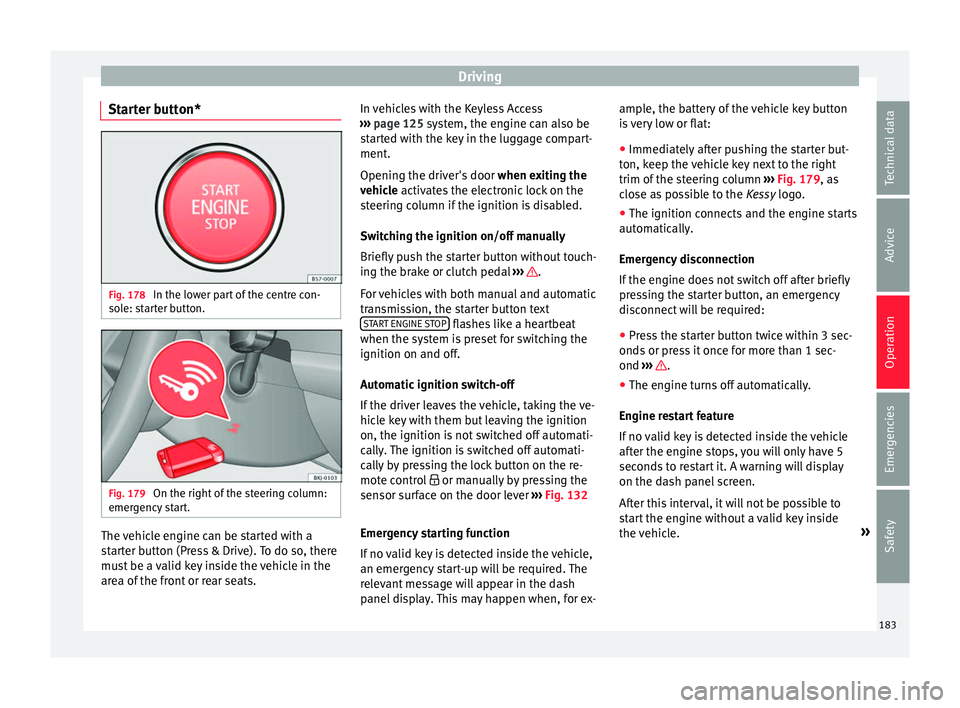
Starter button* Fig. 178
In the lower part of the centre con-
so l
e: s
tarter button. Fig. 179
On the right of the steering column:
emer gency
start. The vehicle engine can be started with a
s
t
ar
ter button (Press & Drive). To do so, there
must be a valid key inside the vehicle in the
area of the front or rear seats. In vehicles with the Keyless Access
›››
page 125 system, the engine can also be
started with the key in the luggage compart-
ment.
Opening the driver's door when exiting the
vehicle activates the electronic lock on the
steering column if the ignition is disabled.
Switching the ignition on/off manually
Briefly push the starter button without touch-
ing the brake or clutch pedal ››› .
F or
v
ehicles with both manual and automatic
transmission, the starter button text START ENGINE STOP flashes like a heartbeat
when the sy s
t
em is preset for switching the
ignition on and off.
Automatic ignition switch-off
If the driver leaves the vehicle, taking the ve-
hicle key with them but leaving the ignition
on, the ignition is not switched off automati-
cally. The ignition is switched off automati-
cally by pressing the lock button on the re-
mote control or manually by pressing the
sensor surface on the door lever ››› Fig. 132
Emergency starting function
If no valid key is detected inside the vehicle,
an emergency start-up will be required. The
relevant message will appear in the dash
panel display. This may happen when, for ex- ample, the battery of the vehicle key button
is
very low or flat:
● Immediately after pushing the starter but-
ton, keep the
vehicle key next to the right
trim of the steering column ››› Fig. 179, as
close as possible to the Kessy logo.
● The ignition connects and the engine starts
automatic
ally.
Emergency disconnection
If the engine does not switch off after briefly
pressing the starter button, an emergency
disconnect will be required:
● Press the starter button twice within 3 sec-
onds or pr
ess it once for more than 1 sec-
ond ››› .
● The engine turns off automatically.
En gine r
e
start feature
If no valid key is detected inside the vehicle
after the engine stops, you will only have 5
seconds to restart it. A warning will display
on the dash panel screen.
After this interval, it will not be possible to
start the engine without a valid key inside
the vehicle. »
183
Technical data
Advice
Operation
Emergencies
Safety
Page 186 of 348
Operation
Automatic deactivation of the ignition on ve-
hic l
e
s with the Start-Stop system
The ignition is switched off automatically
when the vehicle is stopped and the auto-
matic engine shutdown is active, if:
● The driver's seat belt is not fastened,
● the driver does not step on any pedal,
● the driver door is opened.
After aut
omatically turning off the ignition, if
the dipped beam is on, the side light re-
mains on for approx. 30 minutes (if the bat-
tery is sufficiently charged). If the driver locks
the vehicle or manually turns off the light, the
side light goes out. WARNING
Any accidental movement of the vehicle could
re s
ult in serious injury.
● When switching on the ignition, do not
pre
ss the brake or clutch pedal, otherwise
the engine could start immediately. WARNING
If vehicle keys are used negligently or with-
out due c ar
e, this may cause accidents and
serious injury.
● Never leave any key inside the vehicle
when exitin
g. Otherwise, a child or unauthor-
ised person could lock the vehicle, start the
engine or connect the ignition and, in this way, operate electronic equipment (e.g. the
windo
w
s). Note
● Bef or
e leaving the vehicle, always discon-
nect the ignition manually and, if appropri-
ate, take into account the instructions on the
screen of the dash panel.
● If the vehicle is stationary for a long time
with the ignition on, the v
ehicle battery
might be discharged and it might not be pos-
sible to start the engine.
● In diesel vehicles, there may be a delay in
the engine st
arting if it requires preheating.
● If during the STOP phase you press the
STAR
T ENGINE STOP button, the ignition is
swit c
hed off and the button flashes.
● If the indication “Start-Stop system deacti-
vated:
Start the engine manually” is dis-
played on the dash panel display, the START ENGINE STOP button will blink.
Starting the engine
3 V
alid for vehicles: with Keyless Access
StepStarting the engine with the starter
button ››› page 183 (Press & Drive).
1.Press and hold the brake pedal until step 5
is performed.
StepStarting the engine with the starter
button ››› page 183 (Press & Drive).
1a.In vehicles with a manual gearbox: press
and hold the clutch down until the engine
starts.
2.Put the gearbox lever in neutral or the selec-
tor lever in position P or N.
3.
Briefly press the starter button ››› Fig. 178
without pressing the accelerator. For the en-
gine to start there must be a valid key in the
vehicle.
After starting the engine, the light of the START ENGINE STOP
button changes to a fixed
light indicating that the engine has started.
4.
If the engine does not start, stop and wait
for approx. 1 minute before trying again. If
necessary, perform an emergency start
››› page 183.
5.Disconnect the electronic parking brake
when you are about to start driving
››› page 186. WARNING
Never leave the vehicle with the engine run-
ning, e s
pecially if a gear or gear range is en-
gaged. The vehicle could then suddenly move
or something strange could happen that
would cause damage, fire or serious injury. WARNING
Cold start sprays could explode or cause a
sud den inc
rease in the engine speed.184
Page 189 of 348
Driving
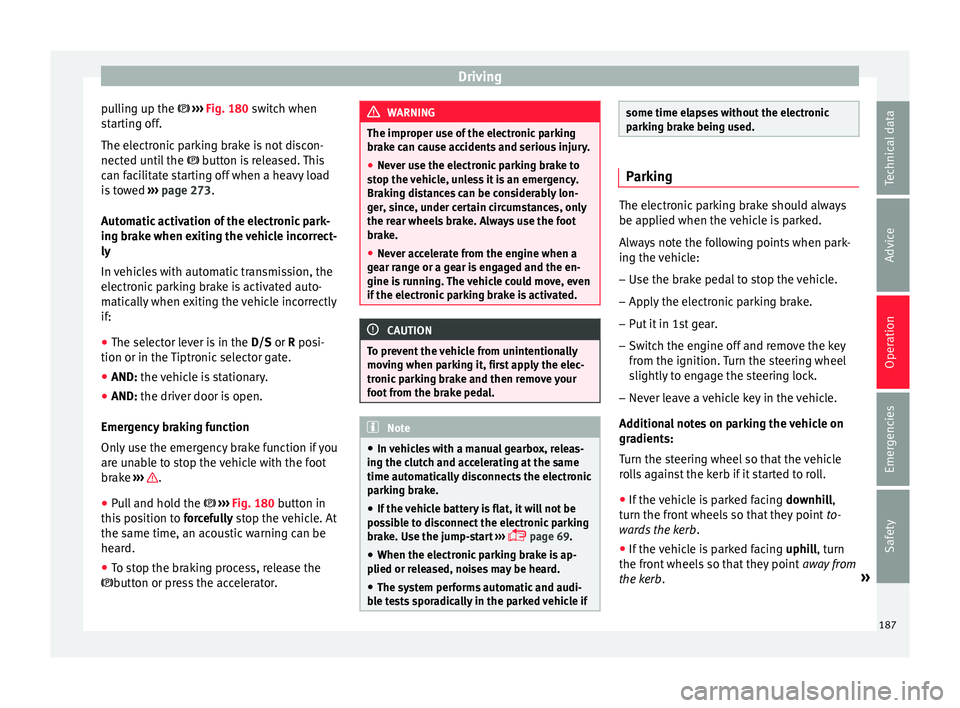
pulling up the ››
› Fig. 180 switch when
starting off.
The electronic parking brake is not discon-
nected until the button is released. This
can facilitate starting off when a heavy load
is towed ››› page 273.
Automatic activation of the electronic park-
ing brake when exiting the vehicle incorrect-
ly
In vehicles with automatic transmission, the
electronic parking brake is activated auto-
matically when exiting the vehicle incorrectly
if: ● The selector lever is in the D/S or R posi-
tion or in the
Tiptronic selector gate.
● AND: the vehicle is stationary.
● AND: the driv
er door is
open.
Emergency braking function
Only use the emergency brake function if you
are unable to stop the vehicle with the foot
brake ››› .
● Pull and hold the › ›
›
Fig. 180 button in
this position to forcefully stop the vehicle. At
the same time, an acoustic warning can be
heard.
● To stop the braking process, release the
button or pr
ess the accelerator. WARNING
The improper use of the electronic parking
brak e c
an cause accidents and serious injury.
● Never use the electronic parking brake to
stop the
vehicle, unless it is an emergency.
Braking distances can be considerably lon-
ger, since, under certain circumstances, only
the rear wheels brake. Always use the foot
brake.
● Never accelerate from the engine when a
gear r
ange or a gear is engaged and the en-
gine is running. The vehicle could move, even
if the electronic parking brake is activated. CAUTION
To prevent the vehicle from unintentionally
mov in
g when parking it, first apply the elec-
tronic parking brake and then remove your
foot from the brake pedal. Note
● In v ehic
les with a manual gearbox, releas-
ing the clutch and accelerating at the same
time automatically disconnects the electronic
parking brake.
● If the vehicle battery is flat, it will not be
poss
ible to disconnect the electronic parking
brake. Use the jump-start ›››
page 69.
● When the electronic parking brake is ap-
plied or rel
eased, noises may be heard.
● The system performs automatic and audi-
ble t
ests sporadically in the parked vehicle if some time elapses without the electronic
park
in
g brake being used. Parking
The electronic parking brake should always
be app
lied when the
vehicle is parked.
Always note the following points when park-
ing the vehicle: – Use the brake pedal to stop the vehicle.
– Apply the electronic parking brake.
– Put it in 1st gear.
– Switch the engine off and remove the key
from the ignition. T
urn the steering wheel
slightly to engage the steering lock.
– Never leave a vehicle key in the vehicle.
Additiona
l notes on parking the vehicle on
gradients:
Turn the steering wheel so that the vehicle
rolls against the kerb if it started to roll.
● If the vehicle is parked facing downhil
l,
turn the front wheels so that they point to-
wards the kerb .
● If the vehicle is parked facing uphill
, turn
the front wheels so that they point away from
the kerb. »
187
Technical data
Advice
Operation
Emergencies
Safety
Page 301 of 348
Checking and refilling levels
WARNING
● Swit c
h the engine off, remove the key from
the ignition and apply the hand brake. If the
vehicle has a manual gearbox, place the lever
in neutral; if it has an automatic gearbox,
place the selector lever in position P. Wait for
the engine to cool down.
● Keep children away from the engine com-
partment
.
● Never spill liquids used for vehicle opera-
tion on the engine comp
artment, as these
may catch fire (e.g. the antifreeze in coolant).
● Take care not to cause short circuits in the
electrica
l system, especially when working
on the battery.
● If working inside the engine compartment,
remember that, ev
en when the ignition is
switched off, the radiator fan may start up au-
tomatically, and therefore there is a risk of in-
jury.
● Never cover the engine with additional in-
sul
ating materials such as a blanket. Risk of
fire!
● Do not unscrew the cap on the coolant ex-
pans
ion tank when the engine is hot. The
cooling system is under pressure.
● Protect face, hands and arms by covering
the cap with a l
arge, thick rag to protect
against escaping coolant and steam.
● If it is necessary to work in the engine com-
partment
while the engine is running, the ro-
tating components (for example, poly-V belt, alternator, radiator fan) and the high voltage
ignition sys
t
em are an additional hazard.
● Observe the following additional warnings
if work
on the fuel system or the electrical
system is necessary:
– Always disconnect the battery from the
on-board network.
– Do not smoke.
– Never work near naked flames.
– Always keep an approved fire extinguish-
er immediately available. CAUTION
When topping up fluids make sure the correct
fluid is p
ut into the correct filler opening, oth-
erwise this can cause serious malfunctions or
engine damage. For the sake of the environment
Inspect the ground underneath your vehicle
re gu
larly so that any leaks are detected at an
early stage. If you find spots of oil or other
fluids in the area where it was parked, have
your vehicle inspected at the workshop. Note
In right-hand drive vehicles* some brake flu-
id re ser
voirs are on the other side of the en-
gine compartment ››› Fig. 239. Opening the bonnet
Read the additional information carefully
›› ›
page 17
The bonnet is released from inside the vehi-
cle.
Check that the windscreen wiper arms are
not unfolded. Otherwise the paint may be
damaged.
The bonnet can only be unlocked when the
driver door is open. WARNING
Never open the bonnet if you see steam or
drips of
coolant being released from the en-
gine compartment. Failure to comply could
result in burns. Wait until no steam or coolant
can be seen before opening the bonnet. Closing the bonnet
–
Slightly lift the bonnet.
– Release the bonnet stay before pressing it
bac
k
into its support.
– Carefully close the bonnet.
– Press the bonnet down until it locks into
plac
e.
– Make sure that the bonnet catches onto its
cla
sp. Do not press down too hard ››› .
»
299
Technical data
Advice
Operation
Emergencies
Safety
Page 307 of 348
Checking and refilling levels
CAUTION
● Do not mi x
cleaning products recommen-
ded by SEAT with other products. This could
lead to flocculation and may block the wind-
screen washer jets.
● When topping up service fluids, make abso-
lutely c
ertain that you fill the fluids into the
correct reservoirs. Using the wrong fluids
could cause serious malfunctions and engine
damage!
● Not having windscreen wiper fluid reduces
vis
ibility through the windscreen, and leads
to loss of visibility in headlights in models
with headlight washer. Battery
Gener a
l
informationRead the additional information carefully
› ›
›
page 59.
The battery is located in the engine compart-
ment and is almost maintenance-free. It is
checked as part of the Inspection Service.
Nevertheless, check the terminals are clean
and have the correct tightening torque, espe-
cially in summer and winter.
Disconnecting the battery
The battery should only be disconnected in
exceptional cases. When the battery is dis- connected, some of the vehicle's functions
are “los
t” (››› table on page 305). These
functions will require resetting after the bat-
tery is reconnected.
Deactivate the anti-theft alarm* before you
disconnect the battery Otherwise the alarm
will be triggered.
FunctionReprogramming
One-touch function of
the electric windows››› page 141, One-touch
opening and closing.
Remote control key
If the vehicle does not re-
spond to the key, they
should be synchronised
››› page 134.
Digital clock››› page 116.
ESC warning lampAfter driving for a few me-
tres, the warning lamp goes
out again. If the vehicle is not used for long periods
The
v
ehic
le has a system for monitoring the
current consumption when the engine is left
unused for long periods of time ››› page 203.
Some functions, such as the interior lights, or
the remote door opening, may be temporarily
disabled to prevent the battery from running
flat. These functions will come back on as
soon as the ignition is switched on and the
engine started. Winter conditions
During the w
inter, the starting power may be
reduced, and if necessary, the battery should
be charged ››› in Important safety warn-
in g
s
for handling a vehicle battery on
page 306
Important safety warnings for han-
dling a v
ehicle battery All work on batteries requires specialist
kno
wl
edg
e. Please refer to a SEAT Official
Service or a workshop specialising in batter-
ies: risk of burns or exploding battery!
The battery must not be opened. Never try to
change the fluid level of the battery. Other-
wise explosive gas is released from the bat-
tery that could cause an explosion.
Wear eye protection.
Battery acid is very corrosive and caustic. Wear
protective gloves and eye protection. In the event
of electrolyte splashes, rinse off with plenty of
water.
Fires, sparks, open flames and smoking are pro-
hibited.
The battery should only be charged in a well-ven-
tilated zone. Risk of explosion!
Keep children away from acid and batteries!»
305
Technical data
Advice
Operation
Emergencies
Safety
Page 308 of 348
Advice
WARNING
● When rep airin
g or working on the electrical
system, proceed as follows:
–1. Remove the key from the ignition. The
negative cable on the battery must be
disconnected.
– 2. When the repair is finished, reconnect
the negative pole of the battery.
● Switch off all electrical devices before re-
connecting the b
attery. Reconnect first the
positive cable and then the negative cable.
Never reverse the polarity of the connections.
This could cause an electrical fire.
● Ensure that the vent hose is always connec-
ted to the b
attery.
● Never use damaged batteries. This could
cause an e
xplosion! Replace a damaged bat-
tery immediately. CAUTION
● Never di s
connect the battery if the ignition
is switched on or if the engine is running.
This could damage the electrical system or
electronic components. Charging the battery
Terminals for charging the battery are fitted
in the en
gine comp
artment. –
Note the warnin
gs ››› in Important safety
w arnin
g
s for handling a vehicle battery on
page 306 and ››› .
– Switch off all electrical devices. Remove the
ignition k ey
.
– R
aise the bonnet ›››
page 299.
– Open the battery cover.
– Connect the charger clamps as described
to the po
sitive pole of the battery (+) and
exclusively to an earth on the bodywork
(–).
– Only use a charger which is compatible for
use with 12
V nominal voltage batteries.
The charge must not exceed a voltage of 15
V.
– Now connect the battery charger to the
power soc
ket and switch on.
– After charging the battery: switch off the
batter
y charger and disconnect the power
socket cable.
– Finally disconnect the charger cables from
the batter
y.
– Replace the battery cover correctly.
– Close the bonnet ›››
page 299.
Important: Before you charge the battery
make sure you read the manufacturer's in-
structions for using the battery charger. WARNING
Never charge a battery that has frozen: re-
pl ac
e battery! Failure to do so may lead to an
explosion. Note
Use only the terminals in the engine compart-
ment t o c
harge the battery. Replacing the battery
The new battery should have the same speci-
fic
ation
s
(amperage, load and voltage) as the
used battery.
Your vehicle is equipped with an intelligent
power management system to control the
distribution of electrical energy ›››
page 203.
The power management function ensures
that the battery is charged much more effi-
ciently than on vehicles without a power
management system. To maintain this func-
tion after replacing the battery, we recom-
mend that the replacement battery used is of
the same make and type as the original fitted
battery. To make proper use of the power
management function after the battery has
been changed, have the battery coded to the
power management mode at a specialised
workshop.
306
Page 334 of 348
Index
Diesel die sel
p
articulate filter . . . . . . . . . . . . . . . . . . . 204
engine oil . . . . . . . . . . . . . . . . . . . . . . . . . . . . . 300
preheating . . . . . . . . . . . . . . . . . . . . . . . . . . . . 181
refuelling . . . . . . . . . . . . . . . . . . . . . . . . . . . . . . 294
Diesel particulate filter malfunction . . . . . . . . . . . . . . . . . . . . . . . . . . . . 204
Digital clock . . . . . . . . . . . . . . . . . . . . . . . . . . . . . 114
Dimensions . . . . . . . . . . . . . . . . . . . . . . . . . . . . . . 327
Direction of rotation tyres . . . . . . . . . . . . . . . . . . . . . . . . . . . . . . . . . . . 67
Display . . . . . . . . . . . . . . . . . . . . . . . . . . . . 114, 115
Display messages speed limiter . . . . . . . . . . . . . . . . . . . . . . . . . . . 214
Display of traffic signs on the instrument panel activate . . . . . . . . . . . . . . . . . . . . . . . . . . . . . . . 246
deactivate . . . . . . . . . . . . . . . . . . . . . . . . . . . . . 246
Disposal belt tensioners . . . . . . . . . . . . . . . . . . . . . . . . . . 83
Distance control see Adaptive cruise control . . . . . . . . . . . . . . . 221
Door cylinder . . . . . . . . . . . . . . . . . . . . . . . . . . . . . 15
Door handle . . . . . . . . . . . . . . . . . . . . . . . . . . . . . . 15
Door lock . . . . . . . . . . . . . . . . . . . . . . . . . . . . . . . . . 15
Door release lever . . . . . . . . . . . . . . . . . . . . . . . . 113
Doors childproof locks . . . . . . . . . . . . . . . . . . . . . . . . 134
opening and closing . . . . . . . . . . . . . . . . . . . . . 15
Downhill speed control . . . . . . . . . . . . . . . . . . . . 198
Downhill speed control function . . . . . . . . . . . . . 198
Drawer . . . . . . . . . . . . . . . . . . . . . . . . . . . . . . . . . . 160
Drink holders . . . . . . . . . . . . . . . . . . . . . . . . . . . . 161
Driver see Correct sitting position . . . . . . . . . 74, 75, 76
Driver-side general instrument panel left-hand drive . . . . . . . . . . . . . . . . . . . . . . . . . . . 9
right-hand drive . . . . . . . . . . . . . . . . . . . . . . . . . 10 Driver information system
engine oil temperature display . . . . . . . . . . . . . 42
operation through the windscreen wiper lever . 36
Driving driving abroad . . . . . . . . . . . . . . . . . . . . . . . . . 150
driving through water . . . . . . . . . . . . . . . . . . . . 206
economical . . . . . . . . . . . . . . . . . . . . . . . . . . . . 201
safe . . . . . . . . . . . . . . . . . . . . . . . . . . . . . . . . . . . 73
towing . . . . . . . . . . . . . . . . . . . . . . . . . . . . . . . . 102
Driving abroad headlights . . . . . . . . . . . . . . . . . . . . . . . . . . . . . 150
Driving data data summary . . . . . . . . . . . . . . . . . . . . . . . . . . . 39
memory . . . . . . . . . . . . . . . . . . . . . . . . . . . . . . . . 38
Driving in winter trailer . . . . . . . . . . . . . . . . . . . . . . . . . . . . . . . . . 273
Driving mode . . . . . . . . . . . . . . . . . . . . . . . . . . . . 243
Driving on flooded roads . . . . . . . . . . . . . . . . . . . 206
Driving profile . . . . . . . . . . . . . . . . . . . . . . . . . . . . 243
DSG . . . . . . . . . . . . . . . . . . . . . . . . . . . . . . . . . . . . 193
Duplicate keys . . . . . . . . . . . . . . . . . . . . . . . . . . . 126
Dust and pollen filter . . . . . . . . . . . . . . . . . . . . . . 170
Dynamic lights range control . . . . . . . . . . . . . . . . 151
E E10 see Ethanol (fuel) . . . . . . . . . . . . . . . . . . . . . . . 293
Easy Connect . . . . . . . . . . . . . . . . . . . . . . . . 33, 120
Easy Open . . . . . . . . . . . . . . . . . . . . . . . . . . . . . . . 129 things to note . . . . . . . . . . . . . . . . . . . . . . . . . . 132
EDL see Electronic differential lock . . . . . . . . . . . . . 189
Efficiency program additional consumers . . . . . . . . . . . . . . . . . . . . 42
saving tips . . . . . . . . . . . . . . . . . . . . . . . . . . . . . . 42
Electrical accessories see Power socket . . . . . . . . . . . . . . . . . . . . . . . 162 Electric windows . . . . . . . . . . . . . . . . . . . . . . 18, 139
conv enience opening and closing . . . . . . . . . 140
Electromechanical steering . . . . . . . . . . . . . . . . . 200 lamp . . . . . . . . . . . . . . . . . . . . . . . . . . . . . . . . . 200
Electronic differential lock . . . . . . . . . . . . . . . . . . 189
Electronic immobiliser . . . . . . . . . . . . . . . . . . . . . . 15
Electronic self-locking . . . . . . . . . . . . . . . . . . . . . 189
Electronic stability control (ESC) . . . . . . . . . . . . . 189
Electronic torque management (XDS) . . . . . . . . . 190
Emergencies . . . . . . . . . . . . . . . . . . . . . . . . . . . . . . 95 anti-puncture kit . . . . . . . . . . . . . . . . . . . . . . . . . 95
automatic gearbox emergency program . . . . . 199
bulbs . . . . . . . . . . . . . . . . . . . . . . . . . . . . . . . . . . 62
changing a wheel . . . . . . . . . . . . . . . . . . . . . . . . 64
emergency towing of the vehicle . . . . . . . . . . . . 68
fuses . . . . . . . . . . . . . . . . . . . . . . . . . . . . . . . . . . 61
hazard warning lights . . . . . . . . . . . . . . . . . . . 149
jump leads . . . . . . . . . . . . . . . . . . . . . . . . . . . . . 69
manual unlocking and locking . . . . . . . . . . . . . 97
puncture . . . . . . . . . . . . . . . . . . . . . . . . . . . . . . . 62
replacing a blown fuse . . . . . . . . . . . . . . . . . . . . 62
replacing the battery . . . . . . . . . . . . . . . . . . . . 306
vehicle tool kit . . . . . . . . . . . . . . . . . . . . . . . . . . 95
Emergency Assist . . . . . . . . . . . . . . . . . . . . . . . . . 234 see Emergency Assist . . . . . . . . . . . . . . . . . . . . 234
switching off . . . . . . . . . . . . . . . . . . . . . . . . . . . 235
switching on . . . . . . . . . . . . . . . . . . . . . . . . . . . 235
Emergency braking assistance system indications on the display . . . . . . . . . . . . . . . . 217
malfunction . . . . . . . . . . . . . . . . . . . . . . . . . . . . 218
operating . . . . . . . . . . . . . . . . . . . . . . . . . . . . . . 219
radar sensor . . . . . . . . . . . . . . . . . . . . . . . . . . . 219
switching off temporarily . . . . . . . . . . . . . . . . . 220
system limitations . . . . . . . . . . . . . . . . . . . . . . 220
Emergency braking function . . . . . . . . . . . . . . . . 187
Emergency braking warning . . . . . . . . . . . . . . . . 150
332
Page 335 of 348

Index
Emergency operation front
p
assenger door . . . . . . . . . . . . . . . . . . . . . 16
selector lever . . . . . . . . . . . . . . . . . . . . . . . . . . . 49
Emission control system control lamp . . . . . . . . . . . . . . . . . . . . . . . . . . . 205
Emissions data . . . . . . . . . . . . . . . . . . . . . . . . . . . 317
Engine assisted starting . . . . . . . . . . . . . . . . . . . . . . . . . 69
noises . . . . . . . . . . . . . . . . . . . . . . . . . . . . . . . . 185
preheating . . . . . . . . . . . . . . . . . . . . . . . . . . . . 181
running in . . . . . . . . . . . . . . . . . . . . . . . . . . . . . 201
Start-Stop system . . . . . . . . . . . . . . . . . . . . . . . 208
starting . . . . . . . . . . . . . . . . . . . . . . . . . . . . . . . 181
starting up (driver messages with the mechan-ical contact) . . . . . . . . . . . . . . . . . . . . . . . . . . 181
switching off (key) . . . . . . . . . . . . . . . . . . . . . . 182
Engine and ignition automatic ignition switch-off . . . . . . . . . . . . . . 183
My Beat . . . . . . . . . . . . . . . . . . . . . . . . . . . . . . . 185
preheating the engine . . . . . . . . . . . . . . . . . . . 184
starting the engine . . . . . . . . . . . . . . . . . . . . . . 184
starting the engine with Press & Drive . . . . . . 184
stopping the engine . . . . . . . . . . . . . . . . . . . . . 185
Engine compartment . . . . . . . . . . . . . . . . . . 17, 298 battery . . . . . . . . . . . . . . . . . . . . . . . . . . . . 59, 305
brake fluid . . . . . . . . . . . . . . . . . . . . . . . . . 59, 303
closing the bonnet . . . . . . . . . . . . . . . . . . . . . . 299
coolant . . . . . . . . . . . . . . . . . . . . . . . . . . . 58, 302
engine oil . . . . . . . . . . . . . . . . . . . . . . . . . 57, 301
opening the bonnet . . . . . . . . . . . . . . . . . . . . . 299
safety notes . . . . . . . . . . . . . . . . . . . . . . . . . . . 298
windscreen washer reservoir . . . . . . . . . . 59, 304
Engine coolant . . . . . . . . . . . . . . . . . . . . . . . . . . . . 58 G 12 plus-plus . . . . . . . . . . . . . . . . . . . . . . . . . . 58
G 13 . . . . . . . . . . . . . . . . . . . . . . . . . . . . . . . . . . . 58
specifications . . . . . . . . . . . . . . . . . . . . . . . . . . . 58
Engine data . . . . . . . . . . . . . . . . . . . . . . . . . . . . . . 320 Engine fault
contro l lamp . . . . . . . . . . . . . . . . . . . . . . . . . . . 205
Engine management . . . . . . . . . . . . . . . . . . . . . . 204 control lamp . . . . . . . . . . . . . . . . . . . . . . . . . . . 205
Engine oil . . . . . . . . . . . . . . . . . . . . . . . . . . . 57, 300 changing . . . . . . . . . . . . . . . . . . . . . . . . . 300, 302
checking oil level . . . . . . . . . . . . . . . . . . . . . . . 301
consumption . . . . . . . . . . . . . . . . . . . . . . . . . . . 301
dipstick . . . . . . . . . . . . . . . . . . . . . . . . . . . . . . . 301
inspection service . . . . . . . . . . . . . . . . . . . . . . 300
maintenance intervals . . . . . . . . . . . . . . . . . . . 300
oil properties . . . . . . . . . . . . . . . . . . . . . . . . . . . 58
specifications . . . . . . . . . . . . . . . . . . . . . . . . . . 300
temperature display . . . . . . . . . . . . . . . . . . . . . . 42
topping up . . . . . . . . . . . . . . . . . . . . . . . . . . . . 301
Environment ecological driving . . . . . . . . . . . . . . . . . . . . . . . 201
environmental compatibility . . . . . . . . . . . . . . 201
Environmental tips filling the tank . . . . . . . . . . . . . . . . . . . . . . . . . 293
refuelling . . . . . . . . . . . . . . . . . . . . . . . . . . . . . . 292
Equipment . . . . . . . . . . . . . . . . . . . . . . . . . 162, 284
ESC electronic stability control (ESC) . . . . . . . . . . . 189
Multi-collision brake . . . . . . . . . . . . . . . . . . . . . 190
Sport Mode . . . . . . . . . . . . . . . . . . . . . . . . . . . . 191
Ethanol (fuel) . . . . . . . . . . . . . . . . . . . . . . . . . . . . 293
Event Data Recorder . . . . . . . . . . . . . . . . . . . . . . . . 94
Exhaust gas purification system catalytic converter . . . . . . . . . . . . . . . . . . . . . . 204
diesel particulate filter . . . . . . . . . . . . . . . . . . . 204
Exhaust pipe: cleaning . . . . . . . . . . . . . . . . . . . . 289
Exhaust purification system for vehicles with diesel engines . . . . . . . . . . . . . . . . . . . . . . . . . 295
Exiting a parking space with Park Assist . . . . . . 256
Exterior lighting changing a bulb . . . . . . . . . . . . . . . . . . . . . . . . 106 Exterior mirrors
adjus ting . . . . . . . . . . . . . . . . . . . . . . . . . . . . . . . 20
driving with a trailer . . . . . . . . . . . . . . . . . . . . . 275
Exterior rear-view mirrors adjusting the exterior rear-view mirrors . . . . . 155
exterior . . . . . . . . . . . . . . . . . . . . . . . . . . . . . . . 155
heated . . . . . . . . . . . . . . . . . . . . . . . . . . . . . . . . 155
Exterior view . . . . . . . . . . . . . . . . . . . . . . . . . . . . . 7, 8
External aerial . . . . . . . . . . . . . . . . . . . . . . . . . . . . 284
F Fastening rings . . . . . . . . . . . . . . . . . . . . . . . . . . . 165
Fatigue detection . . . . . . . . . . . . . . . . . . . . . . . . . 248
Filling the tank . . . . . . . . . . . . . . . . . . . . . . . . . . . 292
Floor mats . . . . . . . . . . . . . . . . . . . . . . . . . . . . . . . . 78
Fluid Level control . . . . . . . . . . . . . . . . . . . . . . . . . 56
Fog light bulb . . . . . . . . . . . . . . . . . . . . . . . . . . . . 108
Four-wheel drive snow chains . . . . . . . . . . . . . . . . . . . . . . . . . . . 206
towing . . . . . . . . . . . . . . . . . . . . . . . . . . . . . . . . . 99
winter tyres . . . . . . . . . . . . . . . . . . . . . . . . . . . . 206
Four wheel drive . . . . . . . . . . . . . . . . . . . . . . . . . . 206
Front airbags . . . . . . . . . . . . . . . . . . . . . . . . . . 21, 86
Front armrest . . . . . . . . . . . . . . . . . . . . . . . . . . . . 159
Front Assist . . . . . . . . . . . . . . . . . . . . . . . . . . . . . . 189 indications on the display . . . . . . . . . . . . . . . . 217
Front passenger front airbag control lamp . . . . . . . . . . . . . . . . . . . . . . . . . . . . 89
deactivation . . . . . . . . . . . . . . . . . . . . . . . . . . . . 22
Front seat manual adjustment . . . . . . . . . . . . . . . . . . . . . . 18
Fuel . . . . . . . . . . . . . . . . . . . . . . . . . . . . . . . . 56, 293 consumption . . . . . . . . . . . . . . . . . . . . . . . . . . . 318
diesel . . . . . . . . . . . . . . . . . . . . . . . . . . . . . . . . . 294
ethanol . . . . . . . . . . . . . . . . . . . . . . . . . . . . . . . 293
fuel gauge . . . . . . . . . . . . . . . . . . . . . . . . . . . . . 118
333
Page 337 of 348
Index
Instruments . . . . . . . . . . . . . . . . . . . . . . . . . . . . . 114
Int erior lights
. . . . . . . . . . . . . . . . . . . . . . . . . . . . .
31
Interior view . . . . . . . . . . . . . . . . . . . . . . . . . . . . . . 14
ISOFIX . . . . . . . . . . . . . . . . . . . . . . . . . . . . . . . . 26, 28
ISOFIX system . . . . . . . . . . . . . . . . . . . . . . . . . . . . . 26
J Jack . . . . . . . . . . . . . . . . . . . . . . . . . . . . . . . . . . 64, 95 mounting points . . . . . . . . . . . . . . . . . . . . . . . . . 66
Journey data . . . . . . . . . . . . . . . . . . . . . . . . . . . . . . 36
Jump leads . . . . . . . . . . . . . . . . . . . . . . . . . . . . . . . 69
K
Key-operated switch . . . . . . . . . . . . . . . . . . . . . . . . 88
Keyless-Entry see Keyless Access . . . . . . . . . . . . . . . . . . . . . . 129
Keyless-Exit see Keyless Access . . . . . . . . . . . . . . . . . . . . . . 129
Keyless Access Easy Open . . . . . . . . . . . . . . . . . . . . . . . . . . . . . 129
Keyless-Entry . . . . . . . . . . . . . . . . . . . . . . . . . . 129
Keyless-Exit . . . . . . . . . . . . . . . . . . . . . . . . . . . . 129
Press & Drive . . . . . . . . . . . . . . . . . . . . . . . . . . . 183
special characteristics . . . . . . . . . . . . . . . . . . . 132
starting the engine . . . . . . . . . . . . . . . . . . . . . . 184
unlocking and locking the vehicle . . . . . . . . . . 129
Keyless Access locking and ignition system see Keyless Access . . . . . . . . . . . . . . . . . . . . . . 129
Keys assign key . . . . . . . . . . . . . . . . . . . . . . . . . . . . . 126
car key . . . . . . . . . . . . . . . . . . . . . . . . . . . . . . . . 126
driver messages (mechanical contact) . . . . . . 181
remote control . . . . . . . . . . . . . . . . . . . . . . . . . 126
replacing the battery . . . . . . . . . . . . . . . . . . . . 133
spare key . . . . . . . . . . . . . . . . . . . . . . . . . . . . . . 126
synchronising . . . . . . . . . . . . . . . . . . . . . . . . . . 134
unlocking and locking . . . . . . . . . . . . . . . 15, 127 Kick-down
automatic gearbox . . . . . . . . . . . . . . . . . . . . . . 197
manual gearbox . . . . . . . . . . . . . . . . . . . . . . . . 244
Knee airbags safety information . . . . . . . . . . . . . . . . . . . . . . . 23
L
Lane Assist . . . . . . . . . . . . . . . . . . . . . . . . . . . . . . 230 cleaning the camera area . . . . . . . . . . . . . . . . . 287
Lane Assist system see Lane Assist . . . . . . . . . . . . . . . . . . . . . . . . . 230
Launch control (automatic gearbox) . . . . . . . . . . 197
Leather: care . . . . . . . . . . . . . . . . . . . . . . . . . . . . . 290
Leaving Home . . . . . . . . . . . . . . . . . . . . . . . . . . . . 149
Lifting the vehicle . . . . . . . . . . . . . . . . . . . . . . . . . . 66
Light Assist . . . . . . . . . . . . . . . . . . . . . . . . . . . . . . 146
Lighting of the instrument panel . . . . . . . . . . . . . 151
Lights . . . . . . . . . . . . . . . . . . . . . . . . . . . . . . 30, 144 audible signals . . . . . . . . . . . . . . . . . . . . . . . . . 144
AUTO . . . . . . . . . . . . . . . . . . . . . . . . . . . . . . . . . 146
changing a bulb . . . . . . . . . . . . . . . . . . . . . . . . 106
coming home . . . . . . . . . . . . . . . . . . . . . . . . . . 148
cornering lights . . . . . . . . . . . . . . . . . . . . . . . . 148
daytime running lights . . . . . . . . . . . . . . . . . . . 145
dipped beam headlight . . . . . . . . . . . . . . . . . . 144
fog light . . . . . . . . . . . . . . . . . . . . . . . . . . . . . . . 147
hazard warning lights . . . . . . . . . . . . . . . . . . . . 31
interior lights . . . . . . . . . . . . . . . . . . . . . . . . . . 152
leaving home . . . . . . . . . . . . . . . . . . . . . . . . . . 149
light control . . . . . . . . . . . . . . . . . . . . . . . . . . . 144
lighting of instruments . . . . . . . . . . . . . . . . . . 151
lighting of the controls . . . . . . . . . . . . . . . . . . . 151
lights range control . . . . . . . . . . . . . . . . . . . . . 151
main beam lever . . . . . . . . . . . . . . . . . . . . . . . . 145
main beam lights . . . . . . . . . . . . . . . . . . . . . . . 144
main beams . . . . . . . . . . . . . . . . . . . . . . . . . . . . 31
motorway light . . . . . . . . . . . . . . . . . . . . . . . . . 150 parking lights . . . . . . . . . . . . . . . . . . . . . . . . . . 150
rea
ding lights . . . . . . . . . . . . . . . . . . . . . . . . . . 152
side lights . . . . . . . . . . . . . . . . . . . . . . . . . . . . . 144
switch . . . . . . . . . . . . . . . . . . . . . . . . . . . . . . . . . 30
turn signal lever . . . . . . . . . . . . . . . . . . . . . . . . 145
welcome light . . . . . . . . . . . . . . . . . . . . . . . . . . 149
Lights range control . . . . . . . . . . . . . . . . . . . . . . . 151
Load compartment in the luggage compartment see Loading the luggage compartment . . . . . 162
Loading the luggage compartment . . . . . . . . . . . 162
Loading the vehicle fastening rings . . . . . . . . . . . . . . . . . . . . . . . . . 165
luggage compartment . . . . . . . . . . . . . . . . . . . . 16
roof carrier system . . . . . . . . . . . . . . . . . . . . . . 170
tailboard for transporting long items . . . . . . . 164
trailer . . . . . . . . . . . . . . . . . . . . . . . . . . . . . . . . . 279
Locking and unlocking in the door cylinder . . . . . . . . . . . . . . . . . . . . . . 15
Locking the front passenger door manually . . . . . 16
Luggage . . . . . . . . . . . . . . . . . . . . . . . . . . . . . . . . 162
Luggage compartment . . . . . . . . . . . . . . . . . . . . . . 16 automatic locking . . . . . . . . . . . . . . . . . . . . . . . 139
electric opening and closing . . . . . . . . . . . . . . 137
luggage compartment lighting . . . . . . . . . . . . 152
luggage compartment variable floor . . . . . . . . 167
manual release mechanism . . . . . . . . . . . . . . . . 17
net bag . . . . . . . . . . . . . . . . . . . . . . . . . . . . . . . 166
shelf . . . . . . . . . . . . . . . . . . . . . . . . . . . . . . . . . 163
special characteristics of the electric rear lid . 138
storing the rear shelf . . . . . . . . . . . . . . . . . . . . 164
see also Loading the luggage compartment . 162
Luggage compartment floor . . . . . . . . . . . . . . . . 167
Luggage compartment variable floor . . . . . . . . . 167
Luggage net luggage compartment . . . . . . . . . . . . . . . . . . . 166
Lumbar support . . . . . . . . . . . . . . . . . . . . . . . . . . 156
335