start stop button Seat Ateca 2018 Owner's Guide
[x] Cancel search | Manufacturer: SEAT, Model Year: 2018, Model line: Ateca, Model: Seat Ateca 2018Pages: 348, PDF Size: 7.32 MB
Page 276 of 348
Operation
Vehicles with the Start-Stop system
If the
v
ehicle has a factory-fitted towing
bracket or one that is retrofitted by SEAT, the
Start-Stop system operates as normal. No
special characteristics need to be taken into
account.
If the system does not recognise the trailer or
the trailer bracket has not been retrofitted by
SEAT, the Start-Stop system must be discon-
nected by pressing the corresponding button
in the lower part of the centre console before
driving with the trailer, and it should remain
off for the rest of the journey ››› .
V ehic
l
es with driving profile selection
If you are going to be towing a trailer, the use
of the Eco driving profile is not recommen-
ded. You are advised to select another of the
available driving profiles before beginning to
drive with a trailer. WARNING
Never use the trailer to transport people,
sinc e it
would put their life in danger and is
also prohibited. WARNING
Undue use of the towing bracket may cause
injury and ac
cidents.
● Only use the towing bracket if it is in a per-
fect s
tate of repair and is properly secured. ●
Never modif y
or repair the towing bracket
in any way.
● In order to reduce the danger of injury in
the event of
rear-end collisions and to avoid
injury to pedestrians and cyclists when park-
ing the vehicle, cover or remove the tow hitch
when you are not using a trailer.
● Never fit a towing bracket “with weight dis-
tribution” or “loa
d compensation”. The vehi-
cle has not been designed for this type of
towing bracket. The towing bracket could fail
and the trailer could be released from the ve-
hicle. WARNING
Driving with a trailer and transporting heavy
or lar g
e objects can affect driving properties
and even cause an accident.
● Always secure the load properly using belts
or strap
s that are suitable and in good condi-
tion.
● Adapt your speed and driving style at all
times t
o suit visibility, weather, road and traf-
fic conditions.
● Trailers with a high centre of gravity are
more likely
to overturn than those with a low
one.
● Avoid sudden braking and manoeuvres.
● Take great care when overtaking.
● Reduce speed immediately if you notice
that the tr
ailer is swaying, however slightly. ●
Never driv e at
more than 80 km/h (50 mph)
when towing a trailer (or at more than
100 km/h (60 mph) in exceptional circum-
stances). This also applies in countries where
driving at higher speeds is permitted. Take
into account the speed limit for vehicles with
trailers in the corresponding country, as it
could be less than the speed limit for vehi-
cles without a trailer.
● Never attempt to “straighten” the towing
vehicl
e and trailer while accelerating. WARNING
If the towing bracket has been retrofitted by a
non-S EA
T workshop, the Start-Stop system
must be disconnected manually whenever
driving with a trailer. Otherwise the brake
system could be damaged and could conse-
quently cause a serious accident or injury.
● Always disconnect the Start-Stop system
manual
ly when using a towing bracket that
has not been fitted by a SEAT workshop. Note
● Bef or
e hitching or unhitching a trailer, al-
ways deactivate the anti-theft alarm
››› page 125. Otherwise, the tilt sensor could
cause the alarm to go off.
● Do not drive with a trailer for the engine's
first
1000 km ››› page 201.
● SEAT recommends that, if possible, the tow
hitch be di
sassembled or covered when it is274
Page 277 of 348

Towing bracket device*
not going to be used. In the event of a rear-
end co
l
lision, the damage to the vehicle
could be greater if the bracket is fitted.
● Some retrofitted towing brackets cover the
rear t
owing eye. In these cases, the towing
eye should not be used for tow-starting or for
towing other vehicles. For this reason, if the
vehicle has been retrofitted with a towing
bracket, always keep the tow hitch in the ve-
hicle when you disassemble it. Control lamp
Lamp on button lights up
The tow hitch is not securely locked in position.
Check that the towing bracket is locked
››› page 276. Some warning and control lamps will light up
briefly
when the ignition i
s
switched on to
check certain functions. They will switch off
after a few seconds. WARNING
If the warning lamps and the corresponding
mes s
ages are ignored when they light up, the
vehicle may stall in traffic and cause acci-
dents and severe injuries.
● Never ignore the warning lamps or messag-
es.
● Stop the
vehicle at the next opportunity
and in a safe p
lace. CAUTION
Failure to heed the control lamps and corre-
spondin g t
ext messages when they light up
may result in damage to the vehicle. Technical requirements
Vehicles that are
factor
y-equipped with a
towing bracket fulfil all the technical and le-
gal requirements for driving with a trailer.
If the vehicle is retrofitted with a towing
bracket, only a bracket that is authorised for
the maximum authorised load of the trailer
that is to be towed may be fitted. The towing
bracket must be suitable for the vehicle and
the trailer and must be properly secured to
the vehicle's chassis. Only use a towing
bracket that has been authorised by SEAT for
this vehicle. Always check and take into ac-
count the towing bracket manufacturer's in-
structions. Never fit a towing bracket “with
weight distribution” or “load compensation”.
Towing bracket fitted on the bumper
Never fit a towing bracket to the bumper or to
the area where the bumper is mounted. The
towing bracket should not impair the bum-
per's function. Do not make modifications or
repairs to the exhaust system or the brake
system. Make regular checks to ensure that
the towing bracket is secure. Engine cooling system
Drivin
g w
ith a trailer increases the load on
the engine and cooling system. The cooling
system should have sufficient coolant and be
prepared for the additional effort involved in
driving with a trailer.
Trailer brakes
If the trailer has its own brake system, please
take the relevant legal requirements into ac-
count. Never connect the trailer's brake sys-
tem to the vehicle's brake system.
Tow rope
Always use a cable between the vehicle and
the trailer ››› page 278.
Trailer rear lights
The trailer's rear lights should comply with
the statutory safety regulations ››› page 278.
Never connect the trailer's rear lights directly
to the vehicle's electric system. If you are not
sure that the trailer's electrical connection is
correct, have it checked by a specialised
workshop. SEAT recommends visiting a SEAT
dealership for this.
Exterior mirrors
If you cannot see the area behind the trailer
with the exterior mirrors of the towing vehi-
cle, additional mirrors will have to be instal-
led in accordance with the regulations of the »
275
Technical data
Advice
Operation
Emergencies
Safety
Page 278 of 348
Operation
country in question. The exterior mirrors
shou l
d be a
djusted before you start driving
and must provide a sufficient field of vision
at the rear.
Trailer maximum electricity consumption
ConsumersEurope, Asia, Africa, South America and
Central AmericaAustralia
Brake lights (total)84 Watts108 Watts
Turn signal (on each
side)42 Watts54 Watts
Side lights (on each
side)50 Watts100 Watts
Reverse lights (in
total)42 Watts54 Watts
Rear fog light42 Watts54 Watts
Never exceed the values indicated! WARNING
If the towing bracket is wrongly fitted or is
not the right one, the tr
ailer could become
detached from the vehicle and cause serious
injury. CAUTION
● If the r e
ar lights of the trailer are not cor-
rectly connected, the vehicle's electronic sys-
tem may be damaged.
● If the trailer absorbs excessive electric cur-
rent, the v
ehicle's electronic system may be
damaged.
● Never connect the trailer's electric system
directly t
o the electrical connections of the
tail lights or any other power sources. Only
use the connections intended for providing
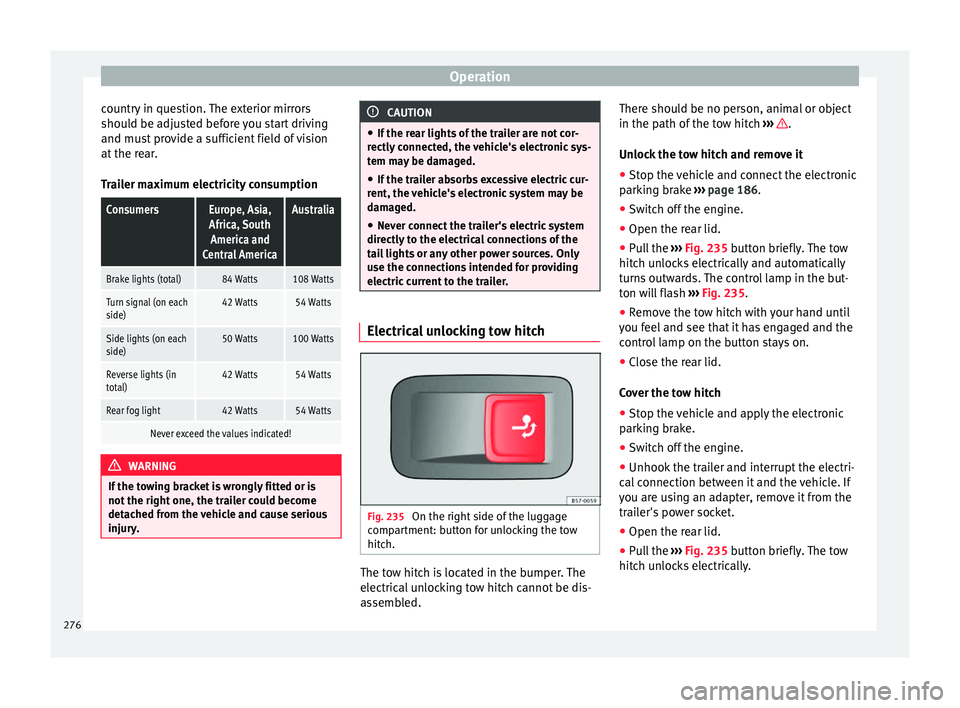
electric current to the trailer. Electrical unlocking tow hitch
Fig. 235
On the right side of the luggage
c omp
ar
tment: button for unlocking the tow
hitch. The tow hitch is located in the bumper. The
el
ectric al
unlocking tow hitch cannot be dis-
assembled. There should be no person, animal or object
in the path of the t
ow hitch ››› .
Un loc
k
the tow hitch and remove it
● Stop the vehicle and connect the electronic
parkin
g brake ››› page 186.
● Switch off the engine.
● Open the rear lid.
● Pull the ››› Fig. 235 b
utton briefly. The tow
hitch unlocks electrically and automatically
turns outwards. The control lamp in the but-
ton will flash ››› Fig. 235.
● Remove the tow hitch with your hand until
you feel
and see that it has engaged and the
control lamp on the button stays on.
● Close the rear lid.
Cov
er the tow hitch
● Stop the vehicle and apply the electronic
parkin
g brake.
● Switch off the engine.
● Unhook the trailer and interrupt the electri-
cal c
onnection between it and the vehicle. If
you are using an adapter, remove it from the
trailer's power socket.
● Open the rear lid.
● Pull the ››› Fig. 235
button briefly. The tow
hitch unlocks electrically.
276
Page 283 of 348
Towing bracket device*
● The tr ai
l
er weight, as well as the gross com-
bination weight of the towing vehicle and
trailer, change the centre of gravity and the
properties of the vehicle.
● If the towing vehicle is empty and the trail-
er is lo
aded, then the load distribution is in-
correct. Under these conditions, drive slowly
and with extra caution.
Hill starts with a trailer
Depending on the slope of the hill and the
combination weight of the towing vehicle
and trailer, the vehicle might start rolling
backwards slightly when you first start up.
For hill-starting with a trailer, do the follow-
ing:
● Press and hold the brake pedal.
● Press the button t
o disconnect the elec-
tronic parking brake ››› page 186.
● If the vehicle is equipped with a manual
gearbo
x, push the clutch pedal all the way
down.
● Put the vehicle into first gear or turn the se-
lector l
ever to position D/S ››› page 192.
● Pull out the button and ho
ld it in that
position to stop the towing vehicle and trailer
with the electronic parking brake.
● Release the brake pedal.
● Start driving slowly. To do this, in the case
of a manual
gearbox, slowly release the
clutch pedal. ●
Do not rel
ease the button until the en-
gine has sufficient force to start driving. WARNING
If a trailer is pulled incorrectly, this may lead
to lo s
s of control of the vehicle and serious
injury.
● Driving with a trailer and transporting
heavy or l
arge objects will change the vehicle
handling and braking distances.
● Always drive cautiously and carefully.
Brake e
arlier than usual.
● Adapt your speed and driving style at all
times t
o suit visibility, weather, road and traf-
fic conditions. Slow down, especially when
driving down hills or slopes.
● Accelerate with particular care and caution.
Avoid s
udden braking and manoeuvres.
● Take great care when overtaking. Reduce
speed immediat
ely if you notice that the trail-
er is swaying, however slightly.
● Never attempt to “straighten” the towing
vehicl
e and trailer while accelerating.
● Take into account the speed limit for vehi-
cle
s with a trailer, as it could be lower than
for vehicles without a trailer. Stabilisation of the towing vehicle
and tr
ai
l
er The stabilisation of the towing vehicle and
trai
l
er together is an additional function of
the electronic stability control (ESC).
If the system detects that the trailer is sway-
ing, it intervenes automatically with the driv-
er steering recommendation to reduce the
swaying of the trailer.
Requirements for the stabilisation of the
towing vehicle and trailer
● The vehicle is factory-equipped with a tow-
ing br ac
ket or has been retro-fitted with a
compatible towing bracket.
● The ESC and ASR are active. The control
lamp or is
not lit up on the instrument
panel.
● The trailer is electrically connected to the
tow
ing vehicle through the trailer power
socket.
● The vehicle is travelling at over 60 km/h
(appro
x. 37 mph).
● The maximum vertical load technically per-
miss
ible is being utilised on the coupling de-
vice.
● The trailer has a rigid draw bar.
● If the trailer has brakes, it must be equip-
ped with a mech
anical overrun brake. »
281
Technical data
Advice
Operation
Emergencies
Safety
Page 336 of 348
Index
refuelling . . . . . . . . . . . . . . . . . . . . . . . . . . . . . . 293
s av
in
g . . . . . . . . . . . . . . . . . . . . . . . . . . . . . . . . 201
Fuel consumption engine cut-off due to inertia . . . . . . . . . . . . . . 201
why does fuel consumption increase? . . . . . . 204
Fuel tank cap opening and closing . . . . . . . . . . . . . . . . . . . . . 56
Fuel tank flap opening and closing . . . . . . . . . . . . . . . . . . . . . 56
Full-LED Headlights . . . . . . . . . . . . . . . . . . . . . . . 106
Function Leaving Home . . . . . . . . . . . . . . . . . . . . 149
Fuses . . . . . . . . . . . . . . . . . . . . . . . . . . . . . . . 61, 102 fuse box . . . . . . . . . . . . . . . . . . . . . . . . . . 103, 104
identifying blown fuses . . . . . . . . . . . . . . . . . . . 62
identifying by colours . . . . . . . . . . . . . . . . . . . . . 61
preparation before replacing . . . . . . . . . . . . . . . 62
replacing . . . . . . . . . . . . . . . . . . . . . . . . . . . . . . . 62
G Gear-change indicator . . . . . . . . . . . . . . . . . . . . . . 41
Gearbox DSG see Automatic gearbox . . . . . . . . . . . . . . . . . . . 193
Gearbox lever . . . . . . . . . . . . . . . . . . . . . . . . . . . . . 49
Gear change . . . . . . . . . . . . . . . . . . . . . . . . . . . . . . 49 automatic . . . . . . . . . . . . . . . . . . . . . . . . . . . . . . 49
kick-down . . . . . . . . . . . . . . . . . . . . . . . . . . . . . 244
manual gearbox . . . . . . . . . . . . . . . . . . . . . . . . 192
manual gear change . . . . . . . . . . . . . . . . . . . . . . 49
Gear engaged . . . . . . . . . . . . . . . . . . . . . . . . . . . . . 49
Gear recommendation . . . . . . . . . . . . . . . . . . . . . . 41
Gear shift paddles (automatic gearbox) . . . . . . . 195
General instrument panel control lamps . . . . . . . . . . . . . . . . . . . . . . . . . . . 46
controls and displays . . . . . . . . . . . . . . . . . . . . 113
engine compartment . . . . . . . . . . . . . . . . . . . . 298
warning lamps . . . . . . . . . . . . . . . . . . . . . . . . . . 46
Glove compartment . . . . . . . . . . . . . . . . . . . . . . . 161 H
Hand brake
see P
arking brake . . . . . . . . . . . . . . . . . . . . . . . 186
Hazard warning lights . . . . . . . . . . . . . . . . . 31, 149
HDC see Hill Descent Control . . . . . . . . . . . . . . . . . . 210
Head-on collisions and their laws of physics . . . . 81
Head-protection airbags description . . . . . . . . . . . . . . . . . . . . . . . . . . . . . 24
safety instructions . . . . . . . . . . . . . . . . . . . . . . . 87
Headlights changing a bulb . . . . . . . . . . . . . . . . . . . . . . . . 106
driving abroad . . . . . . . . . . . . . . . . . . . . . . . . . 150
headlight washers . . . . . . . . . . . . . . . . . . . . . . 153
Head restraints . . . . . . . . . . . . . . . . . . . . . . . . . . . . 19 adjustment . . . . . . . . . . . . . . . . . . . . . . . . . . . . 157
front head restraints . . . . . . . . . . . . . . . . . . . . . . 77
rear head restraints . . . . . . . . . . . . . . . . . . . . . . 77
Headrests . . . . . . . . . . . . . . . . . . . . . . . . . . . . . . . . 19 adjustment . . . . . . . . . . . . . . . . . . . . . . . . . . . . 157
front . . . . . . . . . . . . . . . . . . . . . . . . . . . . . . . . . . . 77
Heated rear window . . . . . . . . . . . . . . . . . . . . . 52, 54
Heated windscreen . . . . . . . . . . . . . . . . . . . . . . . 175
Heating and fresh air . . . . . . . . . . . . . . . . . . . . . . . 54
Hill Descent Control control lamp . . . . . . . . . . . . . . . . . . . . . . . . . . . 210
Horn . . . . . . . . . . . . . . . . . . . . . . . . . . . . . . . . . . . 113
How to jump start . . . . . . . . . . . . . . . . . . . . . . . . . . 69 description . . . . . . . . . . . . . . . . . . . . . . . . . . . . . 69
I Identifying letters on engine . . . . . . . . . . . . . . . . 317
Ignition . . . . . . . . . . . . . . . . . . . . . . . . . . . . . 30, 181
Ignition lock . . . . . . . . . . . . . . . . . . . . . . . . . 30, 181 see Starter button . . . . . . . . . . . . . . . . . . . . . . . 183
Incorrect position . . . . . . . . . . . . . . . . . . . . . . . . . . 76 Indications on the display . . . . . . . . . . . . . . . . . . 115
ACT . . . . . . . . . . . . . . . . . . . . . . . . . . . . . . . . . . 202
a
daptive cruise control . . . . . . . . . . . . . . . . . . . 222
assist systems submenu . . . . . . . . . . . . . . . . . . 39
compass . . . . . . . . . . . . . . . . . . . . . . . . . . . . . . 116
distance travelled . . . . . . . . . . . . . . . . . . . . . . . 116
doors, bonnet and rear lid open . . . . . . . . . . . . 40
driver information system . . . . . . . . . . . . . . . . . 36
driving data . . . . . . . . . . . . . . . . . . . . . . . . . . . . . 38
ECO . . . . . . . . . . . . . . . . . . . . . . . . . . . . . . . . . . 116
Emergency brake assist system (Front Assist) 217
engine oil . . . . . . . . . . . . . . . . . . . . . . . . . . . . . . 42
MKB . . . . . . . . . . . . . . . . . . . . . . . . . . . . . . . . . . 117
outside temperature . . . . . . . . . . . . . . . . . . . . . . 41
recommended gear . . . . . . . . . . . . . . . . . . . . . 116
SEAT Drive Profile . . . . . . . . . . . . . . . . . . . . . . . 242
second speed display . . . . . . . . . . . . . . . . . . . 116
selector lever positions . . . . . . . . . . . . . 116, 193
service intervals . . . . . . . . . . . . . . . . . . . . . . . . . 43
speed warning . . . . . . . . . . . . . . . . . . . . . . . . . 116
Start-Stop . . . . . . . . . . . . . . . . . . . . . . . . . . . . . 116
time . . . . . . . . . . . . . . . . . . . . . . . . . . . . . . . . . . 116
traffic signs . . . . . . . . . . . . . . . . . . . . . . . . . . . . 246
tyre monitoring . . . . . . . . . . . . . . . . . . . . . . . . . 313
warning and control lamps . . . . . . . . . . . . . . . 223
warning and information messages . . . . . . . . . 40
Inertia mode . . . . . . . . . . . . . . . . . . . . . . . . . . . . . 199
Infotainment system . . . . . . . . . . . . . . . . . . . . . . . 33
Inspection . . . . . . . . . . . . . . . . . . . . . . . . . . . . . . . 300
Inspection service . . . . . . . . . . . . . . . . . . . . . . . . 300
Instrument panel . . . . . . . . . . . . . . . . . . . . . . . . . 114 display . . . . . . . . . . . . . . . . . . . . . . . . . . . 114, 115
instruments . . . . . . . . . . . . . . . . . . . . . . . . . . . . 114
menus . . . . . . . . . . . . . . . . . . . . . . . . . . . . . . . . . 36
odometer . . . . . . . . . . . . . . . . . . . . . . . . . . . . . . 117
service interval indication . . . . . . . . . . . . . . . . . 43
warning and control lamps . . . . . . . . . . . . . . . 119
334