service Seat Ateca XL 2006 Workshop Manual
[x] Cancel search | Manufacturer: SEAT, Model Year: 2006, Model line: Ateca XL, Model: Seat Ateca XL 2006Pages: 288, PDF Size: 9.08 MB
Page 228 of 288

Checking and refilling levels
226
Driving with puncture-proof tyres (driving in emergency conditions)
– Leave the ESP/TCS on (electronic stabilisation programme), or, if necessary, switch on ⇒page 179.
– Drive carefully and at moderate speed (80km/h maximum).
– Avoid sharp turns and rapid manoeuvres.
– Avoid driving over obstacles (for example, kerbs) or potholes.
– Pay special attention to whether the ESP/TCS comes on frequently, whether there is smoke coming from the tyres or there
is smell of rubber, or whether the vehicle vibrates or rattles. In
the event of any of the above, stop the vehicle.Puncture-proof tyres are marked on th e tyre sidewall: “DSST”, “Eufonia”,
“RFT”, “ROF”, “RSC”, “SSR” or “ZP”.
This type of tyre sidewall is reinforced. When the tyres lose air, they are held
up by the sidewalls (driving in emergency conditions).
The loss in tyre pressure is displayed on the instrument panel. It is still
possible to drive for a minimum of 50 km or even more in favourable circum-
stances (for example, with low loads).
The damaged tyre should be replaced as soon as possible. The rim should be
checked for damage at a specialised workshop and replaced if necessary. We
recommend you contact your Service Centre. Where more than one tyre is
used in emergency conditions, the distance it is possible to travel decreases.
Starting to drive in emergency conditions
When the loss in tyre pressure is displayed on the instrument panel, this
implies that at least one tyre is being used in emergency conditions. ⇒
Stopping driving in emergency conditions
Do not drive on if:
•
smoke is coming from one of the tyres,
•
there is a smell of rubber,
•
the vehicle vibrates,
•
there is a rattling noise.
WARNING
When driving in emergency conditions, the driving quality of the vehicle is
considerably impaired.•
Drive carefully and at moderate speed (80km/h maximum).
•
Avoid sharp turns and rapid manoeuvres, and brake earlier than usual.
•
Avoid driving over obstacles (for example, kerbs) or potholes.
•
If one or more tyres are used in emergency conditions, the driving
quality of the vehicle is impaired and there is a risk of accident.Note
•
Puncture-proof tyres do not “deflate” on losing air pressure because they
are supported by the reinforced sidewalls. Therefore it is not possible to
detect damage to the tyre visually.
•
Snow chains should not be used on front wheels when driving in emer-
gency conditions.
New tyres and wheels
New tyres and wheels have to be run-in.The tyres and wheel rims are an essenti al part of the vehicle’s design. The
tyres and rims approved by SEAT are specially matched to the characteristics
of the vehicle and make a major contribution to good road holding and safe
handling ⇒.
AlteaXL_ingles_02_06 Seite 226 Dienstag, 1. August 2006 11:11 11
Page 229 of 288

Checking and refilling levels227
Safety First
Operating instructions
Tips and Maintenance
Te c h n i c a l D a t a
Tyres should be replaced at least in pairs and not individually (i.e. both front
tyres or both rear tyres together). A knowledge of tyre designations makes it
easier to choose the correct tyres. Radial tyres have the tyre designations
marked on the sidewall, for example:
195/65 R15 91T
This contains the following information:
195 Tyre width in mm
65 Height/width ratio in %
R Tyre construction: Radial
15 Rim diameter in inches
91 Load rating code
T Speed rating
The tyres could also have the following information:
•
A direction of rotation symbol
•
“Reinforced” denotes heavy-duty tyres.
The manufacturing date is also indicated on the tyre sidewall (possibly only
on the inner side of the wheel).
“DOT ... 1103 ...” means, for example, th at the tyre was produced in the 11th
week of 2003.
We recommend that work on tyres and wheels is carried out by an Authorised
Service Centre. They are familiar with the procedure and have the necessary
special tools and spare parts as well as the proper facilities for disposing of
the old tyres.
Any Authorised Service Centre has full information on the technical require-
ments when installing or changing tyres, wheels or wheel trims.
WARNING
•
We recommend that you use only wheels and tyres that have been
approved by SEAT for your model. Failure to do so could impair vehicle
handling. Risk of accident.
•
Avoid running the vehicle on tyres th at are more than six years old. If
you have no alternative, you should drive slowly and with extra care at all
times.
•
Never use old tyres or those with an unknown “history of use”.
•
If wheel trims are retrofitted, you must ensure that the flow of air to the
brakes is not restricted. This could cause them to overheat.
•
All four wheels must be fitted with radial tyres of the same type, size
(rolling circumference) and the same tread pattern.For the sake of the environment
Old tyres must be disposed of accordi ng to the laws in the country concerned.
Note
•
For technical reasons, it is not generally possible to use the wheels from
other vehicles. This can also apply to wheels of the same model. The use of
wheels or tyres which have not been approved by SEAT for use with your
model may invalidate the vehicle’s type approval for use on public roads.
•
If the spare tyre is not the same as the tyres that are mounted on the
vehicle - for example with winter tyres - you should only use the spare tyre for
a short period of time and drive with extra care. Refit the normal road wheel
as soon as possible.
AlteaXL_ingles_02_06 Seite 227 Dienstag, 1. August 2006 11:11 11
Page 230 of 288

Checking and refilling levels
228Wheel bolts
Wheel bolts must be tightened to the correct torque.The design of wheel bolts is matched to the rims. If different wheel rims are
fitted, the correct wheel bolts with the right length and correctly shaped bolt
heads must be used. This ensures that wheels are fitted securely and that the
brake system functions correctly.
In certain circumstances, you may not use wheel bolts from a different car -
even if it is the same model ⇒page 199.
WARNING
If the wheel bolts are not tightened correctly, the wheel could become
loose while driving. Risk of accident.•
The wheel bolts must be clean and turn easily. Never apply grease or oil
to them.
•
Use only wheel bolts which belong to the wheel.
•
If the prescribed torque of the wheel bolts is too low, they could loosen
whilst the vehicle is in motion. Risk of accident! If the tightening torque is
too high, the wheel bolts and threads could be damaged.Caution
The prescribed torque for wheel bolts for steel and alloy wheels is 120 Nm.
Winter tyres
Winter tyres will improve the vehicles handling on snow and
ice.In winter conditions winter tyres will considerably improve the vehicles
handling. The design of summer tyres (width, rubber compound, tread
pattern) gives less grip on ice and snow.
Winter tyres must be inflated to a pressure 0.2 bar higher than the pressures
specified for summer tyres (see sticker on tank flap).
Winter tyres must be fitted on all four wheels.
Information on permitted winter tyre sizes can be found in the vehicle’s regis-
tration documents. Use only radial winter tyres. All tyre sizes listed in the
vehicle documentation also apply to winter tyres.
Winter tyres lose their effectiveness when the tread is worn down to a depth
of 4 mm.
The speed rating code ⇒page 226, “New tyres and wheels” determines the
following speed limits : ⇒
Q max. 160 km/h
S max. 180 km/h
T max. 190 km/h
H max. 210 km/h
In some countries, vehicles which can exceed the speed rating of the fitted
tyre must have an appropriate sticker in the driver’s field of view. These
stickers are available from your Authorised Service Centre. The legal require-
ments of each country must be followed.
Do not have winter tyres fitted for unnecessarily long periods. Vehicles with
summer tyres handle better when the roads are free of snow and ice.
If you have a flat tyre, please refer to the notes on the spare wheel
⇒ page 226, “New tyres and wheels”.
AlteaXL_ingles_02_06 Seite 228 Dienstag, 1. August 2006 11:11 11
Page 231 of 288

Checking and refilling levels229
Safety First
Operating instructions
Tips and Maintenance
Te c h n i c a l D a t a
WARNING
The maximum speed for the winter tyre s must not be exceeded. Otherwise,
this could lead to tyre damage and thus, an accident risk.
For the sake of the environment
Fit your summer tyres in good time. They are quieter, do not wear so quickly
and reduce fuel consumption.Snow chainsSnow chains may be fitted only to the front wheels, and only to certain tyre
sizes ⇒page 266.
Snow chains must have fine-pitch link s which do not protrude more that 9
mm, including tension device.
Remove wheel hub covers and trim rings before fitting snow chains. For safety
reasons cover caps, available in any Authorised Service Centre, must then be
fitted over the wheel bolts.
WARNING
Observe the fitting instructions provided by the snow chain manufacturer.
Caution
You must remove the snow chains to drive on roads which are free of snow.
Otherwise they will impair handling, damage the tyres and wear out very
quickly.
Note
In some countries, the speed limit for using snow chains is 50 km/h. The legal
requirements of the country should be followed.
AlteaXL_ingles_02_06 Seite 229 Dienstag, 1. August 2006 11:11 11
Page 240 of 288

If and when
238
– Insert the adapter onto the wheel bolt and push it on as far as it will go ⇒page 237, fig. 175 .
– Fit the box spanner as far as it will go over the adapter.
– Loosen or tighten the wheel bolt as appropriate.Code number
The code number of the anti-theft wheel bolt is stamped on the front of the
adaptor.
The code number should be noted and kept in a safe place, as it is only by
using the code number that a duplicate adaptor can be obtained from an
Authorised Service Centre.Tyres with directional tread pattern
Tyres with directional tread pattern must be fitted so that they
rotate in the correct direction.A directional tread pattern can be identified by arrows on the sidewall that
point in the direction of rotation. Always note the direction of rotation indi-
cated when fitting the wheel. This is important so that these tyres can give
maximum grip and avoid excessive noise, tread wear and aquaplaning.
If, in an emergency, you have to fit the spare wheel so it rotates in the wrong
direction, you must drive extremely ca refully. The tyre will not give optimum
performance. This is particularly important when driving on wet roads.
To benefit from the advantages of tyres with this type of tread pattern, the
defective tyre should be replaced as soon as possible so that all tyres again
rotate in the correct direction.
Tyre repair kit (Tyre-Mobility-System)*General Observations and safety adviceYour vehicle is equipped with the tyre repair kit called the Tyre mobility
system.
Beneath the floor of the stowage compartment there is a sealant and a
compressor which should be used in case of puncture.
The Tyre Mobility System will allow you to safely repair damage to a tyre by
penetration of a foreign object to 4mm diameter.
The foreign object can be left inside the tyre.
The sealant comes with instructions for use.
There is also a guide to using the compressor.
WARNING
•
The sealant should not be used if th e tyre has been damaged as a result
of going flat.
•
Follow the instructions for your safety and use on the compressor and
the sealant packaging.
•
Do not drive at more than 80 km/h, avo id accelerating or braking hard
or taking curves at high speed.
•
A tyre that has been repaired with sealant should only be used provi-
sionally, and for a short time Therefore, your car should be taken carefully
to the nearest spec ialised workshop.For the sake of the environment
If you want to dispose of the sealant bottle, go to a company that treats waste
products.
AlteaXL_ingles_02_06 Seite 238 Dienstag, 1. August 2006 11:11 11
Page 267 of 288
General notes on the technical data 265
Safety First
Operating instructions
Tips and Maintenance
Te c h n i c a l D a t a
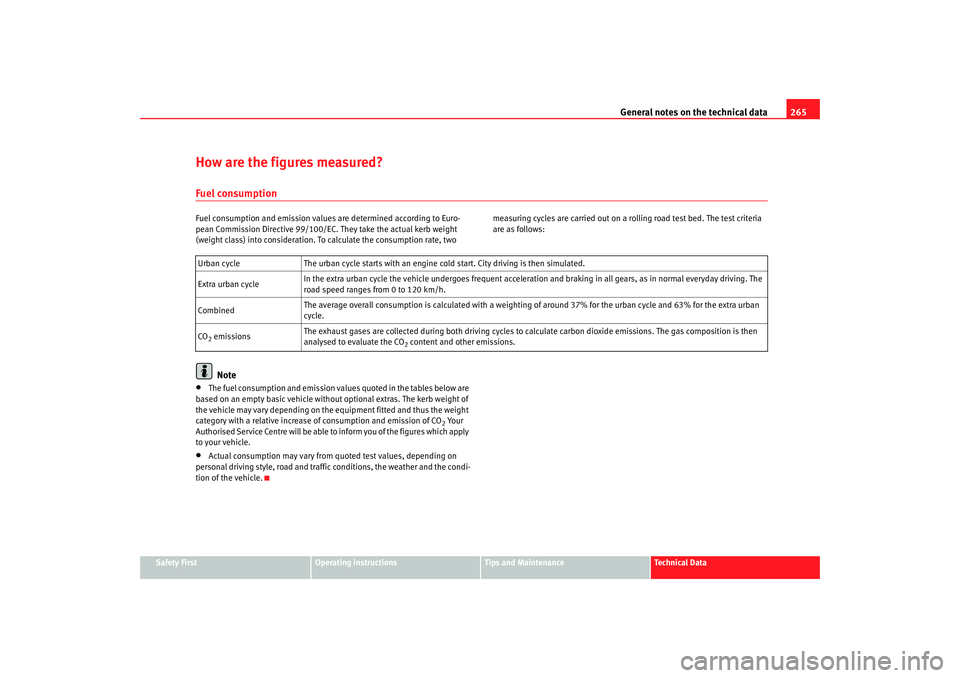
How are the figures measured?Fuel consumptionFuel consumption and emission values are determined according to Euro-
pean Commission Directive 99/100/EC. They take the actual kerb weight
(weight class) into consideration. To calculate the consumption rate, two measuring cycles are carried out on a rolling road test bed. The test criteria
are as follows:
Note
•
The fuel consumption and emission values quoted in the tables below are
based on an empty basic vehicle without optional extras. The kerb weight of
the vehicle may vary depending on the equipment fitted and thus the weight
category with a relative increase of consumption and emission of CO
2 Your
Authorised Service Centre will be able to inform you of the figures which apply
to your vehicle.
•
Actual consumption may vary from quoted test values, depending on
personal driving style, road and traffic conditions, the weather and the condi-
tion of the vehicle. Urban cycle
The urban cycle starts with an engine cold start. City driving is then simulated.
Extra urban cycle In the extra urban cycle the vehicle undergoes frequent acceleration
and braking in all gears, as in normal everyday driving. The
road speed ranges from 0 to 120 km/h.
Combined The average overall consumption is calculat
ed with a weighting of around 37% for the urban cycle and 63% for the extra urban
cycle.
CO2 emissions The exhaust gases are collected during both driving cycles to calculate carbon dioxide emissions. The gas composition is then
analysed to evaluate the CO
2 content and other emissions.
AlteaXL_ingles_02_06 Seite 265 Dienstag, 1. August 2006 11:11 11
Page 269 of 288

General notes on the technical data 267
Safety First
Operating instructions
Tips and Maintenance
Te c h n i c a l D a t a
Snow chains
Snow chains may be fitted only to the
front wheels.
Consult the chapter “wheels” of this manual.
Wheel bolts
After the wheels have been changed, the tightening torque of the wheel bolts
should be checked as soon as possible with a torque wrench ⇒. The tight-
ening torque for steel and alloy wheels is 120 Nm.
WARNING
•
Check the tyre pressure at least once per month. Correct tyre pressure
is very important. If the tyre pressure is too high or too low, there is an
increased danger of accidents, particularly at high speeds.
•
If the torque of the wheel bolts is too low, they could loosen whilst the
vehicle is in motion. Risk of accident! If the tightening torque is too high,
the wheel bolts and threads could be damaged.Note
We recommend that you ask your Authorised Service Centre for information
about appropriate wheel, tyre and snow chain size.
AlteaXL_ingles_02_06 Seite 267 Dienstag, 1. August 2006 11:11 11
Page 270 of 288
Technical Data
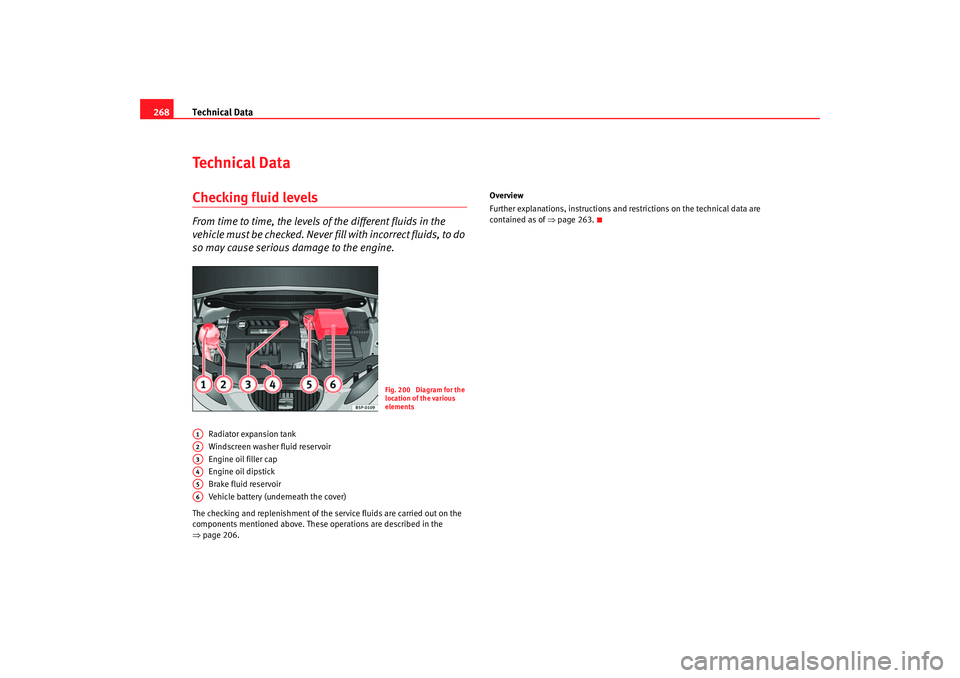
268Te c h n i c a l D a t aChecking fluid levelsFrom time to time, the levels of the different fluids in the
vehicle must be checked. Never fi ll with incorrect fluids, to do
so may cause serious damage to the engine.
Radiator expansion tank
Windscreen washer fluid reservoir
Engine oil filler cap
Engine oil dipstick
Brake fluid reservoir
Vehicle battery (underneath the cover)
The checking and replenishment of the service fluids are carried out on the
components mentioned above. These operations are described in the
⇒ page 206. Overview
Further explanations, instructions and restrictions on the technical data are
contained as
of ⇒ page 263.
Fig. 200 Diagram for the
location of the various
elements
A1A2A3A4A5A6
AlteaXL_ingles_02_06 Seite 268 Dienstag, 1. August 2006 11:11 11
Page 285 of 288
Index283
Seat belt position
Pregnant women . . . . . . . . . . . . . . . . . . . . . . 26
Seat belts . . . . . . . . . . . . . . . . . . . . . . . . . . . . 25
Seat belt release . . . . . . . . . . . . . . . . . . . . . . . . . 27
Seat belt warning lamp . . . . . . . . . . . . . . . . . . . . 19
Seat belts . . . . . . . . . . . . . . . . . . . . . . . . . . . . . . . 19 adjustment . . . . . . . . . . . . . . . . . . . . . . . . . . . 24
Incorrectly fastened . . . . . . . . . . . . . . . . . . . . 28
Not worn . . . . . . . . . . . . . . . . . . . . . . . . . . . . . 22
Safety notes . . . . . . . . . . . . . . . . . . . . . . . . . . 23
Warning lamp . . . . . . . . . . . . . . . . . . . . . . . . . 19
Seat belts protect . . . . . . . . . . . . . . . . . . . . . . . . 23
Seat heating . . . . . . . . . . . . . . . . . . . . . . . . . . . . 131
Seats . . . . . . . . . . . . . . . . . . . . . . . . . . . . . . . . . . . 19
Selective opening* . . . . . . . . . . . . . . . . . . . . . . . 94
Selector lever locking . . . . . . . . . . . . . . . . . . . . 167
Selector lever positions . . . . . . . . . . . . . . . . . . . 166
Service interval display . . . . . . . . . . . . . . . . . . . . 60
Shoes . . . . . . . . . . . . . . . . . . . . . . . . . . . . . . . . . . 16
Side airbags . . . . . . . . . . . . . . . . . . . . . . . . . . . . . 37 Description . . . . . . . . . . . . . . . . . . . . . . . . . . . 37
Function . . . . . . . . . . . . . . . . . . . . . . . . . . . . . 39
Safety notes . . . . . . . . . . . . . . . . . . . . . . . . . . 40
Side lights . . . . . . . . . . . . . . . . . . . . . . . . . . . . . 111
Sitting position Driver . . . . . . . . . . . . . . . . . . . . . . . . . . . . . . . 10
Front passenger . . . . . . . . . . . . . . . . . . . . . . . 11
Incorrect sitting position . . . . . . . . . . . . . . . . 15
Passengers . . . . . . . . . . . . . . . . . . . . . . . . . . . 12
Sitting position, occupants . . . . . . . . . . . . . . . . . 10
Sliding/tilting roof . . . . . . . . . . . . . . . . . . . . . . . 108 Snow chains . . . . . . . . . . . . . . . . . . . . . . . 229, 267
Soot accumulation in the
diesel engine particulate
filter *
Indicator . . . . . . . . . . . . . . . . . . . . . . . . . . . . . 79
Spare wheel* . . . . . . . . . . . . . . . . . . . . . . . . . . . 231
Starting Petrol engines . . . . . . . . . . . . . . . . . . . 163
Starting the engine . . . . . . . . . . . . . . . . . 162, 163 After the fuel tank has been run dry . . . . . . 164
Steam cleaners . . . . . . . . . . . . . . . . . . . . . . . . . 192
Steering . . . . . . . . . . . . . . . . . . . . . . . . . . . . . . . 159 Steering lock . . . . . . . . . . . . . . . . . . . . . . . . 161
Steering wheel audio controls audio + telephone version . . . . . . . . . . . . . . 84
audio version . . . . . . . . . . . . . . . . . . . . . . . . . 84
Steering wheel controls Lighting . . . . . . . . . . . . . . . . . . . . . . . . . . . . . 92
Steering wheel height adjustment . . . . . . . . . . 159
Stowage area Centre arm rest . . . . . . . . . . . . . . . . . . . . . . 134
Front seats . . . . . . . . . . . . . . . . . . . . . . . . . . 134
Other stowage areas . . . . . . . . . . . . . . . . . . 137
Stowage compartment Front passenger side . . . . . . . . . . . . . . . . . . 133
Stowage in the luggage compartment . . . . . . . 136
Sun visors . . . . . . . . . . . . . . . . . . . . . . . . . . . . . 119
Sunroof . . . . . . . . . . . . . . . . . . . . . . . . . . . . . . . . 108
Sunroof blind Sliding/tilting roof . . . . . . . . . . . . . . . . . . . . 109
Switch Hazard warning lights . . . . . . . . . . . . . . . . . 114 Switches
Electric windows . . . . . . . . . . . . . . . . . . . . . 106
Electrical exterior mirrors . . . . . . . . . . . . . . 125
Sliding/tilting roof . . . . . . . . . . . . . . . . . . . . 108
Switching off the engine . . . . . . . . . . . . . . . . . . 164
Switching on hazard warning lights . . . . . . . . . 115
TTailgate . . . . . . . . . . . . . . . . . . . . . . . . . . . . . . . 104 Emergency opening . . . . . . . . . . . . . . . . . . . 105
Warning lamp . . . . . . . . . . . . . . . . . . . . . . . . 82
Tank fuel level . . . . . . . . . . . . . . . . . . . . . . . . . . . . . 57
reserve indicator . . . . . . . . . . . . . . . . . . . . . . 57
tank capacity . . . . . . . . . . . . . . . . . . . . . . . . . 57
TCS . . . . . . . . . . . . . . . . . . . . . . . . . . . . . . . . . . . 178
TCS (Traction control system) Warning lamp . . . . . . . . . . . . . . . . . . . . . . . . 79
The danger of not using the seat belt . . . . . . . . 22
Tightening torque of wheel bo lts . . . . . . . . . . . 267
Tools . . . . . . . . . . . . . . . . . . . . . . . . . . . . . . . . . . 230
Towing . . . . . . . . . . . . . . . . . . . . . . . . . . . . . . . . 259
Towing a trailer . . . . . . . . . . . . . . . . . . . . 186, 266
Towing bracket . . . . . . . . . . . . . . . . . . . . . . . . . 187
Towing bracket, fitting . . . . . . . . . . . . . . . . . . . 201
Towing eye . . . . . . . . . . . . . . . . . . . . . . . . . . . . . 259
Tow-starting . . . . . . . . . . . . . . . . . . . . . . . . . . . . 259
Traction control system warning lamp . . . . . . . . . . . . . . . . . . . . . . . . . 79
AlteaXL_ingles_02_06 Seite 283 Dienstag, 1. August 2006 11:11 11
Page 286 of 288

Index
284Trailer turn signals
Indicator lamps . . . . . . . . . . . . . . . . . . . . . . . 76
Warning lamp . . . . . . . . . . . . . . . . . . . . . . . 116
Trailer weights . . . . . . . . . . . . . . . . . . . . . . . . . . 266
Trips, checklist . . . . . . . . . . . . . . . . . . . . . . . . . . . 8
Turn signals . . . . . . . . . . . . . . . . . . . . . . . . . . . . 115 Warning lamp . . . . . . . . . . . . . . . . . . . . 76, 116
Two-way radio . . . . . . . . . . . . . . . . . . . . . . . . . . 200
Type plate . . . . . . . . . . . . . . . . . . . . . . . . . . . . . 264
Tyre Mobility-System (Tyre repair kit) . . . . . . . 231
Tyre monitor indicator . . . . . . . . . . . . . . . . . . . . . 80
Tyre pressure . . . . . . . . . . . . . . . . . . . . . . . . . . . 224
Tyre pressures . . . . . . . . . . . . . . . . . . . . . . . . . . 266
Tyre repair kit . . . . . . . . . . . . . . . . . . . . . . . 231, 238
Tyre-Mobility-System (Tyre repair kit) . . . . . . . 238
Tyres and wheels Dimensions . . . . . . . . . . . . . . . . . . . . . . . . . 226
Tyres service life . . . . . . . . . . . . . . . . . . . . . . . . 224
Tyres tread depth . . . . . . . . . . . . . . . . . . . . . . . 225
Tyres with directional tread pattern . . . . . . . . . 223UUnderbody sealant . . . . . . . . . . . . . . . . . . . . . . 195
USB* connection . . . . . . . . . . . . . . . . . . . . . . . . 145
Using the Tiptronic gear system . . . . . . . . . . . . 170VVehicle battery . . . . . . . . . . . . . . . . . . . . . . . . . 221
Vehicle data . . . . . . . . . . . . . . . . . . . . . . . . . . . . 264 Vehicle identification data . . . . . . . . . . . . . . . . 264
Vehicle identification number . . . . . . . . . . . . . 264
Vehicle paint
Car care products . . . . . . . . . . . . . . . . . . . . 190
Vehicle tools Storage . . . . . . . . . . . . . . . . . . . . . . . . . . . . 230
Vehicle wallet storage . . . . . . . . . . . . . . . . . . . 133
Ventilation slits . . . . . . . . . . . . . . . . . . . . . . . . . . 17
Volumetric sensor* Activation . . . . . . . . . . . . . . . . . . . . . . . . . . . 103
Deactivation . . . . . . . . . . . . . . . . . . . . . . . . 103
WWarning lamp . . . . . . . . . . . . . . . . . . . . . . . . . . . 31
Warning lamps . . . . . . . . . . . . . . . . . . . . . . . . . . 72
Warning reportsRed . . . . . . . . . . . . . . . . . . . . . . . . . . . . . . . . . 64
Yellow . . . . . . . . . . . . . . . . . . . . . . . . . . . . . . . 64
Warning texts in the display . . . . . . . . . . . . . . . . 63
Warning triangle and first aid kit . . . . . . . . . . . 145
Washer fluid . . . . . . . . . . . . . . . . . . . . . . . . . . . 216
Washing by hand . . . . . . . . . . . . . . . . . . . . . . . 191
Washing the vehicle . . . . . . . . . . . . . . . . . . . . . 191
Washing with high pressure cleaners . . . . . . . 192
Water warning . . . . . . . . . . . . . . . . . . . . . . . . . . . . . 64
Water in the windscreen washer tank . . . . . . . 216
Wear indicators . . . . . . . . . . . . . . . . . . . . . . . . . 225 Wheel bolts . . . . . . . . . . . . . . . . . . . . . . . . 234, 267
Torque . . . . . . . . . . . . . . . . . . . . . . . . . . . . . 228
Wheel change . . . . . . . . . . . . . . . . . . . . . . . . . . 232
Wheel trims . . . . . . . . . . . . . . . . . . . . . . . . . . . . 233
Wheels . . . . . . . . . . . . . . . . . . . . . . . . . . . . 223, 266
Why assume the correct sitting position? . . . . . 30
Why should head restraints be correctly adjusted? 13
Why wear seat belts? . . . . . . . . . . . . . . . . . . 19, 21
Why wear seatbelts? . . . . . . . . . . . . . . . . . . . . . . 30
Windows . . . . . . . . . . . . . . . . . . . . . . . . . . . . . . 106
Windscreen washer fluid Warning lamp . . . . . . . . . . . . . . . . . . . . . . . . 77
Windscreen wiper blades Cleaning . . . . . . . . . . . . . . . . . . . . . . . . . . . . 194
Windscreen wipers . . . . . . . . . . . . . . . . . . . . . . 120 Changing blades . . . . . . . . . . . . . . . . . . . . . 217
Changing the rear blade . . . . . . . . . . . . . . . 218
Winter driving Diesel engine . . . . . . . . . . . . . . . . . . . . . . . 206
Winter tyres . . . . . . . . . . . . . . . . . . . . . . . . . . . . 228
Wiper/wash automatic function . . . . . . . . . . . 120
Working in the engine compartment . . . . . . . . 206
AlteaXL_ingles_02_06 Seite 284 Dienstag, 1. August 2006 11:11 11