warning Seat Cordoba 2006 Manual PDF
[x] Cancel search | Manufacturer: SEAT, Model Year: 2006, Model line: Cordoba, Model: Seat Cordoba 2006Pages: 255, PDF Size: 7.57 MB
Page 102 of 255
Seats and stowage
100Head restraintsCorrect adjustment of head restraints
Properly adjusted head restraints are an important part of
occupant protection and can redu ce the risk of injuries in
most accident situations.
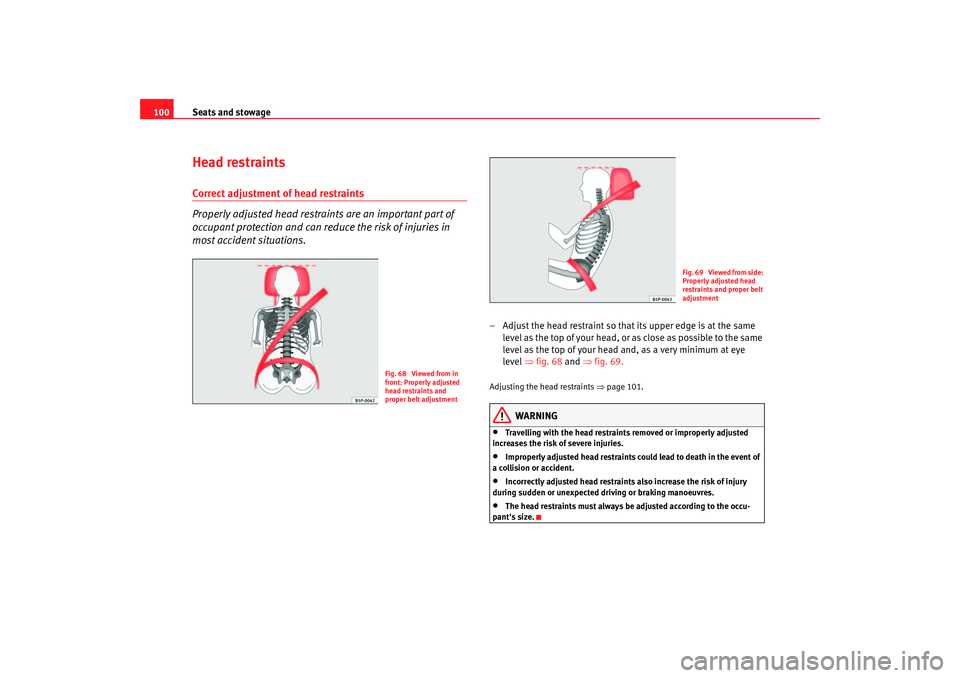
– Adjust the head restraint so that its upper edge is at the same
level as the top of your head, or as close as possible to the same
level as the top of your head and, as a very minimum at eye
level ⇒ fig. 68 and ⇒ fig. 69.Adjusting the head restraints ⇒ page 101.
WARNING
•
Travelling with the head restraints removed or improperly adjusted
increases the risk of severe injuries.
•
Improperly adjusted head restraints could lead to death in the event of
a collision or accident.
•
Incorrectly adjusted head restraints also increase the risk of injury
during sudden or unexpected driving or braking manoeuvres.
•
The head restraints must always be adjusted according to the occu-
pant's size.
Fig. 68 Viewed from in
front: Properly adjusted
head restraints and
proper belt adjustment
Fig. 69 Viewed from side:
Properly adjusted head
restraints and proper belt
adjustment
cordoba_ingles Seite 100 Freitag, 7. Oktober 2005 6:00 18
Page 103 of 255
Seats and stowage101
Safety First
Operating instructions
Tips and Maintenance
Te c h n i c a l D a t a
Removing or adjusting head restraints
The head restraints can be adju sted by moving them up and
down.Adjusting height (front seats)
– Press the button on the side and pull upwards to the desired
position.
– To lower the head restraint, press the button and push head restraint downwards.
– Make sure that it engages securely into position.
Adjust height (rear outer seats)
– Press the button on the side an d pull upwards or downwards to
the desired position. – Make sure that the head restraint engages securely in one of its
positions.
Adjusting height (rear central seat)
– Press the button on the side and pull upwards to the desired position.
– To lower the head restraint, press the button and push head restraint downwards.
– Make sure that the head restraint engages securely in one of its positions ⇒ page 12.
Angle adjustment (front seats)
– Press the head restraint forward or back to the required position.
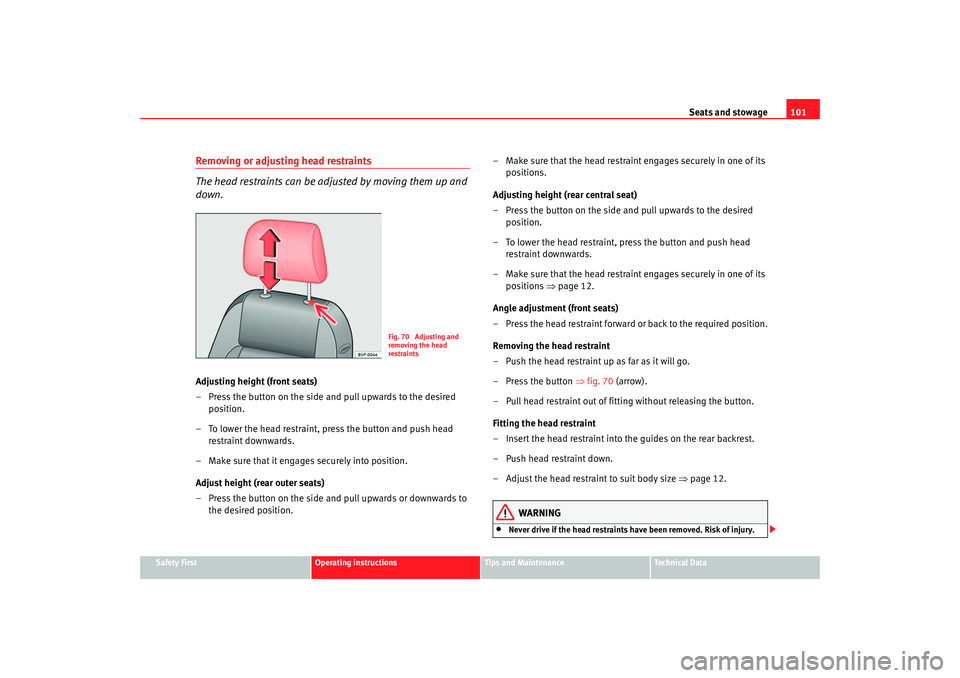
Removing the head restraint
– Push the head restraint up as far as it will go.
– Press the button ⇒fig. 70 (arrow).
– Pull head restraint out of fitting without releasing the button.
Fitting the head restraint
– Insert the head restraint into the guides on the rear backrest.
– Push head restraint down.
– Adjust the head restraint to suit body size ⇒page 12.
WARNING
•
Never drive if the head restraints have been removed. Risk of injury.
Fig. 70 Adjusting and
removing the head
restraints
cordoba_ingles Seite 101 Freitag, 7. Oktober 2005 6:00 18
Page 104 of 255
Seats and stowage
102•
Never drive if the head restraints ar e in an unsuitable position, there is
a risk of serious injury.
•
After refitting the head restraint, you must always adjust it properly for
height to achieve optimal protection.
•
Please observe the safety warnings ⇒page 100, “Correct adjustment
of head restraints”.Note
•
To fit and remove the rear head restraints, gently tilt the seat back
forwards.
•
When fitting the head restraints again, insert the tubes as far as possible
into the guides without pressing the button.
Front seatsAdjustment of the front seats
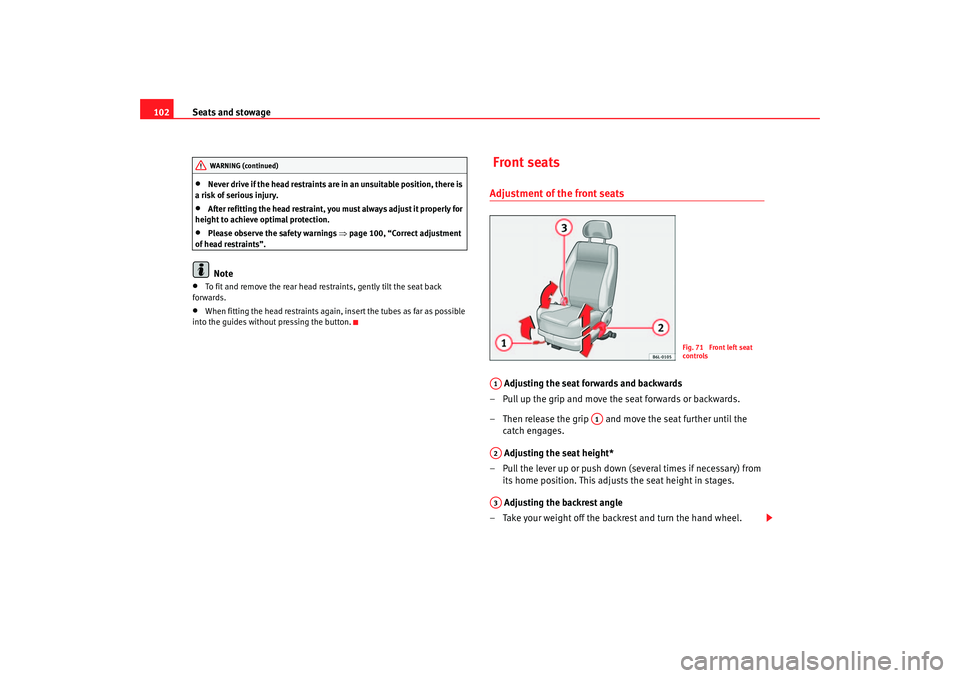
Adjusting the seat forwards and backwards
– Pull up the grip and move the seat forwards or backwards.
– Then release the grip and move the seat further until the catch engages.
Adjusting the seat height*
– Pull the lever up or push down (several times if necessary) from its home position. This adjusts the seat height in stages.
Adjusting the backrest angle
– Take your weight off the backrest and turn the hand wheel.
WARNING (continued)
Fig. 71 Front left seat
controls
A1
A1
A2A3
cordoba_ingles Seite 102 Freitag, 7. Oktober 2005 6:00 18
Page 105 of 255
Seats and stowage103
Safety First
Operating instructions
Tips and Maintenance
Te c h n i c a l D a t a
WARNING
•
Never adjust the driver or front pass enger seat while the vehicle is in
motion. While adjusting your seat, you will assume an incorrect sitting
position. Risk of fatal accidents. Adjust the driver or front passenger seat
only when the vehicle is stationary.
•
To reduce the risk of injury to the driver and front passenger during
sudden braking manoeuvres or an accident, never drive with the backrest
tilted far to the rear. The maximum pr otection of the seat belt can be
achieved only when the backrests are in an upright position and the driver
and front passenger have properly adjusted their seat belts. The further
the backrests are tilted to the rear, the greater the risk of injury due to
improper positioning of the belt web!
•
Exercise caution when adjusting the seat height or forwards/back-
wards position. Injuries can be caused if the backrest is tilted without due
care and attention.
Heated seats*
The front seat cushions and backrests can be heated electri-
cally.
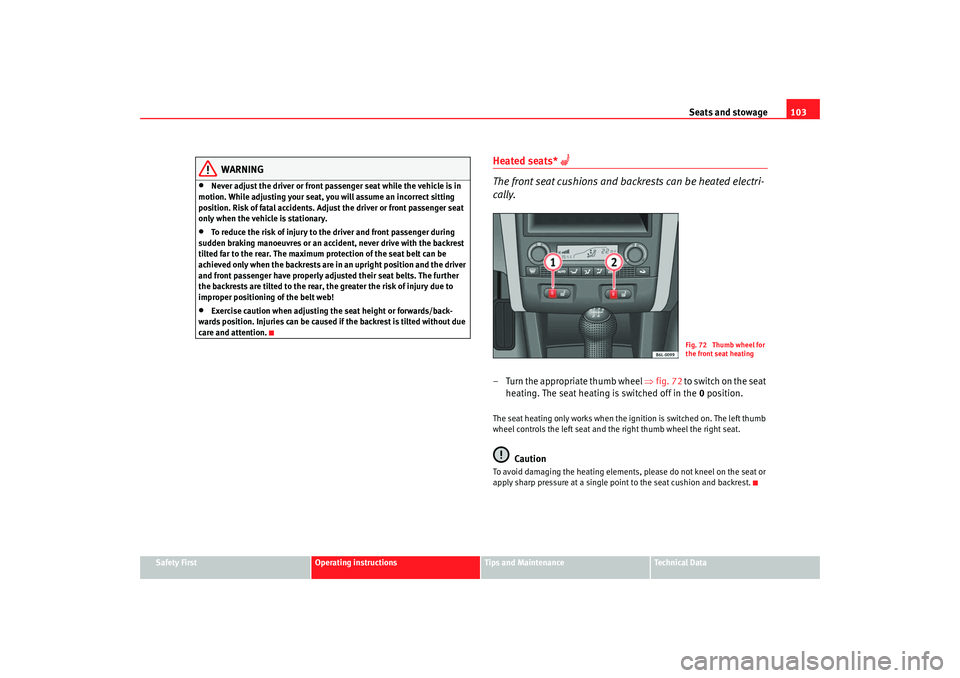
– Turn the appropriate thumb wheel ⇒ fig. 72 to switch on the seat
heating. The seat heating is switched off in the 0 position.The seat heating only works when the ignition is switched on. The left thumb
wheel controls the left seat and the right thumb wheel the right seat.
Caution
To avoid damaging the heating elements, please do not kneel on the seat or
apply sharp pressure at a single point to the seat cushion and backrest.
Fig. 72 Thumb wheel for
the front seat heating
cordoba_ingles Seite 103 Freitag, 7. Oktober 2005 6:00 18
Page 107 of 255
Seats and stowage105
Safety First
Operating instructions
Tips and Maintenance
Te c h n i c a l D a t a
WARNING
•
Please be careful when folding back the backrest! Injuries can be
caused if the backrest is tilted without due care and attention.
•
Do no trap or damage seatbelts when raising the backrest.
•
After raising the backrest, check it has engaged properly in position .
•
The three point automatic seat belt only works correctly when the back-
rest of the central seat is correctly engaged.
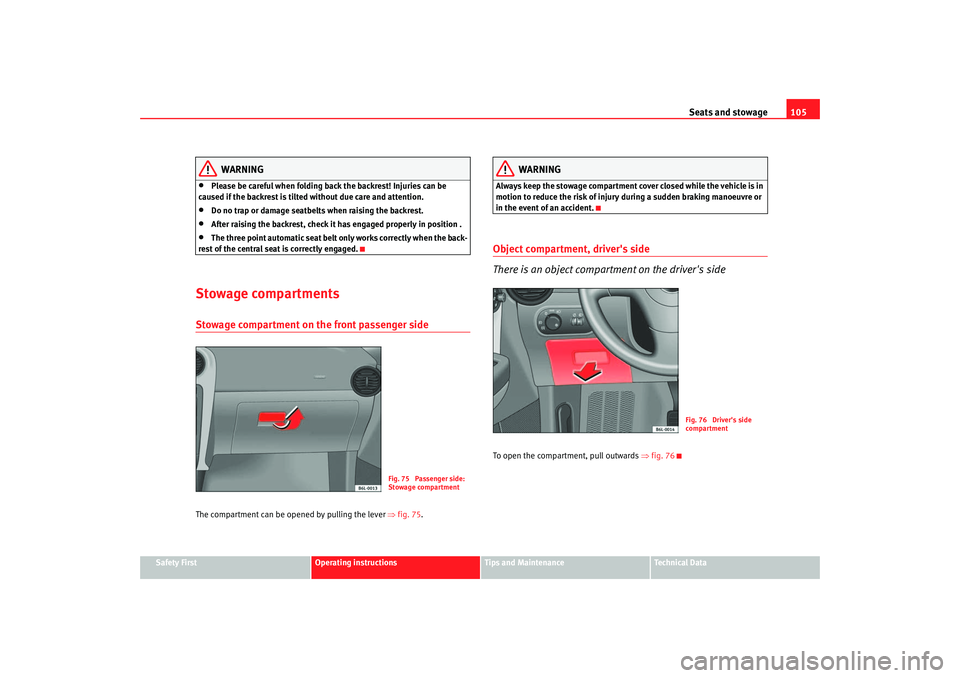
Stowage compartmentsStowage compartment on the front passenger sideThe compartment can be opened by pulling the lever ⇒fig. 75 .
WARNING
Always keep the stowage compartment cover closed while the vehicle is in
motion to reduce the risk of injury during a sudden braking manoeuvre or
in the event of an accident.Object compartment, driver's side
There is an object compartment on the driver's sideTo open the compartment, pull outwards ⇒ fig. 76
Fig. 75 Passenger side:
Stowage compartment
Fig. 76 Driver's side
compartment
cordoba_ingles Seite 105 Freitag, 7. Oktober 2005 6:00 18
Page 108 of 255
Seats and stowage
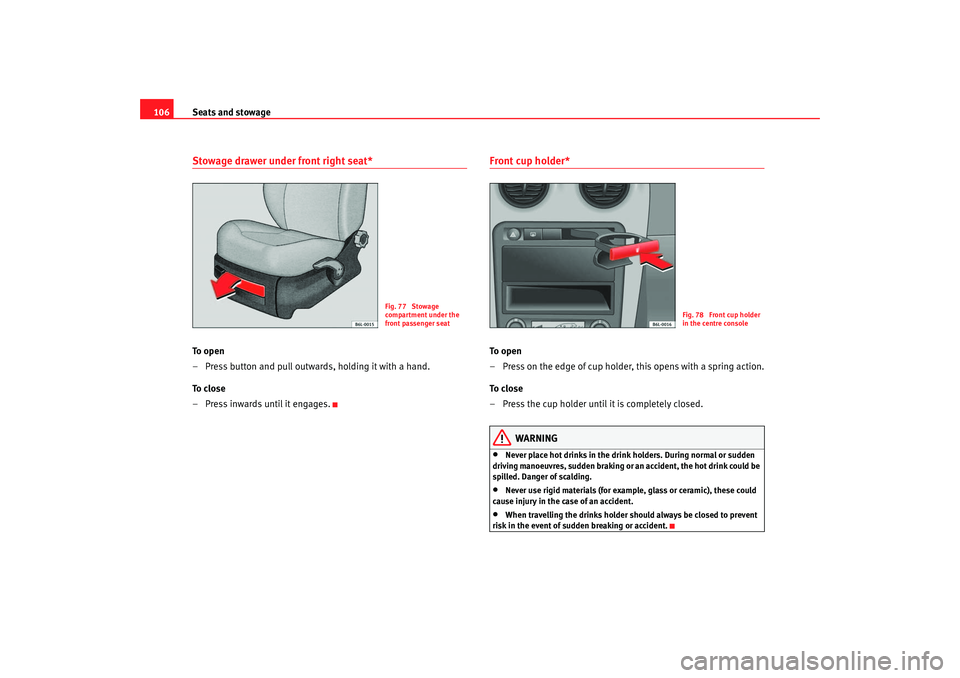
106Stowage drawer under front right seat*To o p e n
– Press button and pull outwards, holding it with a hand.
To close
– Press inwards until it engages.
Front cup holder* To o p e n
– Press on the edge of cup holder, this opens with a spring action.
To close
– Press the cup holder until it is completely closed.
WARNING
•
Never place hot drinks in the drink holders. During normal or sudden
driving manoeuvres, sudden braking or an accident, the hot drink could be
spilled. Danger of scalding.
•
Never use rigid materials (for example, glass or ceramic), these could
cause injury in the case of an accident.
•
When travelling the drinks holder should always be closed to prevent
risk in the event of sudden breaking or accident.
Fig. 77 Stowage
compartment under the
front passenger seat
Fig. 78 Front cup holder
in the centre console
cordoba_ingles Seite 106 Freitag, 7. Oktober 2005 6:00 18
Page 110 of 255
Seats and stowage
108
Closing
– Move the ashtray cover towards the gearstick until it engages.
WARNING
Never put paper in the ashtray. Hot ash could ignite the paper in the
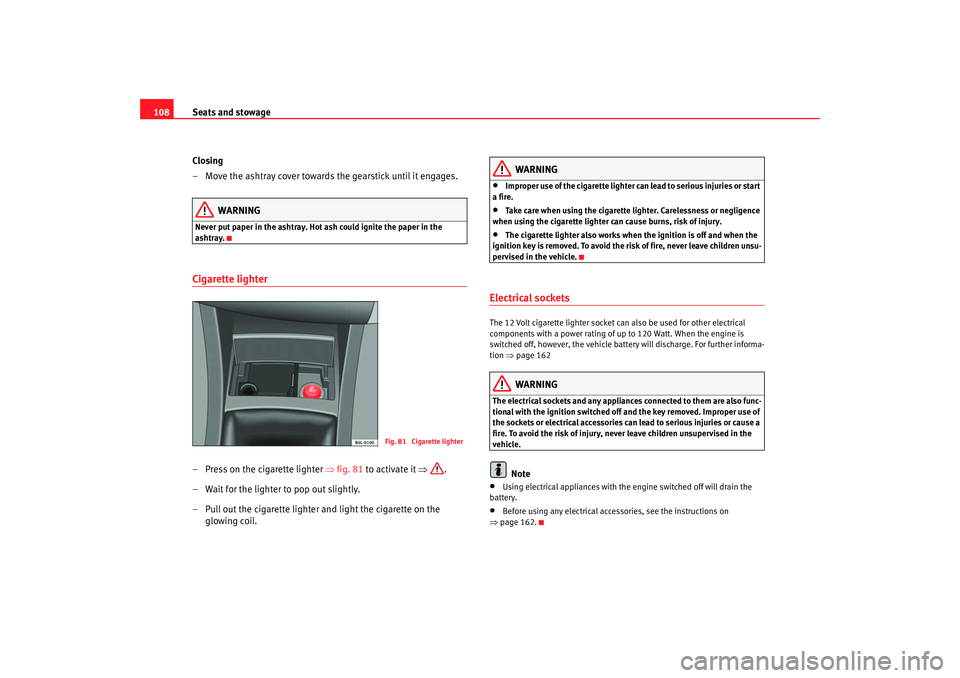
ashtray.Cigarette lighter– Press on the cigarette lighter ⇒fig. 81 to activate it ⇒.
– Wait for the lighter to pop out slightly.
– Pull out the cigarette lighter and light the cigarette on the glowing coil.
WARNING
•
Improper use of the cigarette lighter can lead to serious injuries or start
a fire.
•
Take care when using the cigarette lighter. Carelessness or negligence
when using the cigarette lighter can cause burns, risk of injury.
•
The cigarette lighter also works when the ignition is off and when the
ignition key is removed. To avoid the risk of fire, never leave children unsu-
pervised in the vehicle.
Electrical sockets The 12 Volt cigarette lighter socket can also be used for other electrical
components with a power rating of up to 120 Watt. When the engine is
switched off, however, the vehicle battery will discharge. For further informa-
tion ⇒page 162
WARNING
The electrical sockets and any appliances connected to them are also func-
tional with the ignition switched off and the key removed. Improper use of
the sockets or electrical accessories can lead to serious injuries or cause a
fire. To avoid the risk of injury, never leave children unsupervised in the
vehicle.
Note
•
Using electrical appliances with the engine switched off will drain the
battery.
•
Before using any electrical accessories, see the instructions on
⇒ page 162.
Fig. 81 Cigarette lighter
cordoba_ingles Seite 108 Freitag, 7. Oktober 2005 6:00 18
Page 111 of 255
Seats and stowage109
Safety First
Operating instructions
Tips and Maintenance
Te c h n i c a l D a t a
First-aid kit, warning triangle, fire
extinguisherFirst aid kit, warning triangles and fire extinguisherThe use of reflective warning triangles is obligatory in emergencies in some
countries. As are the first aid kit and a set of spare lightbulbs.
The first aid kit can be fitted in one of the stowage compartments, located
below the boot floor mat. The warning tria ngle can be attached to the back of
the boot using rubber straps. The fire ex tinguisher can be fixed on the left-
hand side of the boot floor, fastened with velcro.
Note
•
The first aid kit, the warning triangles and the fire extinguisher are not
supplied with the vehicle as standard.
•
The first aid kit, the warning triangles and the fire extinguisher should
meet legal requirements.
•
The expiry date of the content of the first aid kit should be checked.
•
Ensure that the fire extinguisher is fu lly functional. The fire extinguisher
should, therefore, be checked regularly. The sticker on the fire extinguisher
will inform you of the next date for checking.
•
Before acquiring accessories and emergency equipment see the instruc-
tions on ⇒page 162, “Accessories, parts repl acement and modifications”.
Luggage compartmentStowing luggage
All luggage must be securely stowed.Please observe the following points to ensure the vehicle handles
well at all times:
– Distribute the load as evenly as possible.
– Place heavy objects as far forward in the luggage compartment
as possible.
– Secure luggage in the luggage compartment with suitable straps on the fastening rings.
WARNING
•
Loose luggage and other loose items in the vehicle can cause serious
injuries.
•
Loose objects in the luggage compartment can suddenly move and
change the way the vehicle handles.
•
During sudden manoeuvres or ac cidents, loose objects in the
passenger compartment can be flung forward, injuring vehicle occupants.
•
Always store objects in the luggage compartment and secure with suit-
able straps. This is especially important for heavy objects.
•
When you transport heavy objects, always keep in mind that a change
in the centre of gravity can also cause changes in vehicle handling.
•
Please observe information on safe driving ⇒page 7, “Safe driving”.
cordoba_ingles Seite 109 Freitag, 7. Oktober 2005 6:00 18
Page 112 of 255
Seats and stowage
110
CautionHard objects on the shelf could chafe against the wires of the heating
element in the rear window and cause damage.
Note
The ventilation slots in front of the rear side windows must not be covered as
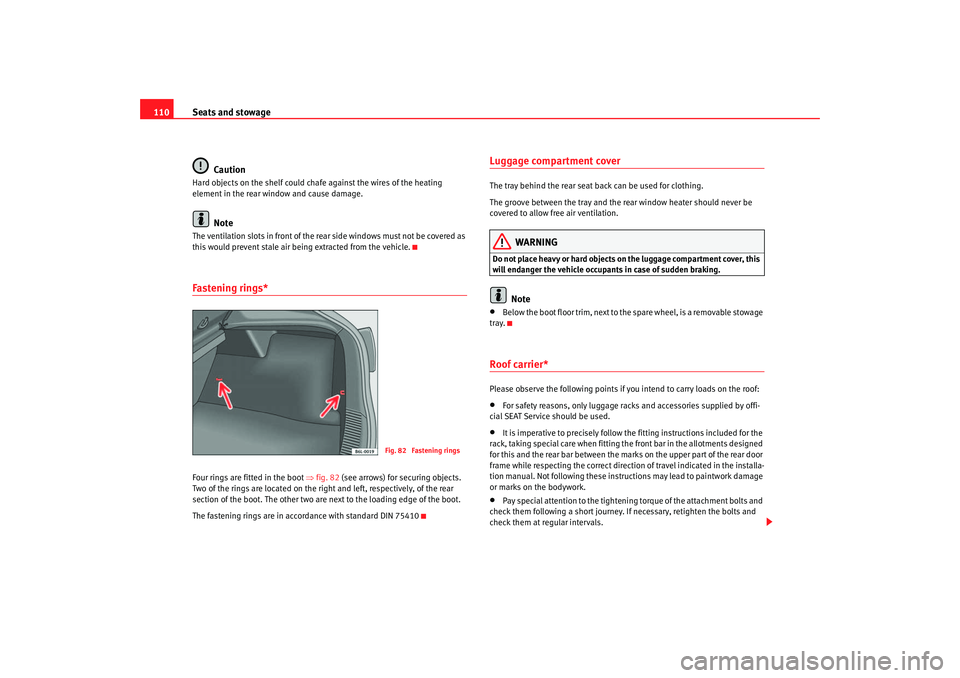
this would prevent stale air being extracted from the vehicle.Fastening rings*Four rings are fitted in the boot ⇒fig. 82 (see arrows) for securing objects.
Two of the rings are located on the right and left, respectively, of the rear
section of the boot. The other two are next to the loading edge of the boot.
The fastening rings are in accordance with standard DIN 75410
Luggage compartment coverThe tray behind the rear seat back can be used for clothing.
The groove between the tray and the re ar window heater should never be
covered to allow free air ventilation.
WARNING
Do not place heavy or hard objects on the luggage compartment cover, this
will endanger the vehicle occupants in case of sudden braking.
Note
•
Below the boot floor trim, next to the spare wheel, is a removable stowage
tray.
Roof carrier*Please observe the following points if you intend to carry loads on the roof:•
For safety reasons, only luggage racks and accessories supplied by offi-
cial SEAT Service should be used.
•
It is imperative to precisely follow the fitting instructions included for the
rack, taking special care when fitting th e front bar in the allotments designed
for this and the rear bar between the marks on the upper part of the rear door
frame while respecting the correct direction of travel indicated in the installa-
tion manual. Not following these instr uctions may lead to paintwork damage
or marks on the bodywork.
•
Pay special attention to the tightening torque of the attachment bolts and
check them following a short journey. If necessary, retighten the bolts and
check them at regular intervals.
Fig. 82 Fastening rings
cordoba_ingles Seite 110 Freitag, 7. Oktober 2005 6:00 18
Page 114 of 255
Air conditioning
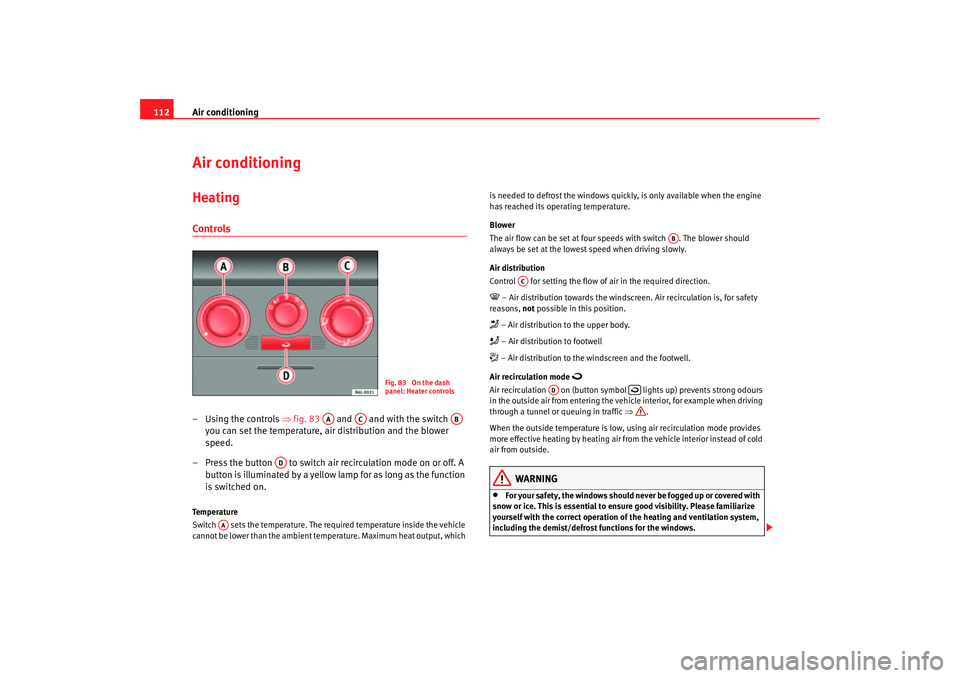
112Air conditioningHeatingControls– Using the controls ⇒fig. 83 and and with the switch
you can set the temperature, air distribution and the blower
speed.
– Press the button to switch air recirculation mode on or off. A button is illuminated by a yellow lamp for as long as the function
is switched on.Temperature
Switch sets the temperature. The required temperature inside the vehicle
cannot be lower than the ambient temp erature. Maximum heat output, which is needed to defrost the windows quickly, is only available when the engine
has reached its operating temperature.
Blower
The air flow can be set at four speeds with switch . The blower should
always be set at the lowest speed when driving slowly.
Air distribution
Control for setting the flow of
air in the required direction.
– Air distribution towards the windsc reen. Air recirculation is, for safety
reasons, not possible in this position. – Air distribution to the upper body. – Air distribution to footwell – Air distribution to the windscreen and the footwell.
Air recirculation mode
Air recirculation on (button symbol lights up) prevents strong odours
in the outside air from entering the vehicle interior, for example when driving
through a tunnel or queuing in traffic ⇒.
When the outside temperature is low, us ing air recirculation mode provides
more effective heating by heating air from the vehicle interior instead of cold
air from outside.
WARNING
•
For your safety, the windows should never be fogged up or covered with
snow or ice. This is essential to ensure good visibility. Please familiarize
yourself with the correct operation of the heating and ventilation system,
including the demist/defrost functions for the windows.
Fig. 83 On the dash
panel: Heater controls
AA
AC
AB
AD
AA
AB
AC
AD
cordoba_ingles Seite 112 Freitag, 7. Oktober 2005 6:00 18