display Seat Cordoba 2008 User Guide
[x] Cancel search | Manufacturer: SEAT, Model Year: 2008, Model line: Cordoba, Model: Seat Cordoba 2008Pages: 258, PDF Size: 7.87 MB
Page 64 of 258
Cockpit
62
WARNING
•
Failure to observe warning lamps and warning messages can result in
serious personal injury or damage to your vehicle.
•
The risk of an accident increases if your vehicle breaks down. Use a
warning triangle to draw the attention of other road users to your
stationary vehicle so that it does not represent a danger.
•
The engine compartment of any motor vehicle is a dangerous area!
Before you open the bonnet to work on the engine or in the engine compart-
ment, you must switch off the engine and allow it to cool to reduce the risk
of scalding or other injuries. Read and observe the relevant warnings
⇒ page 175.Note
•
The appropriate warning lamp for a fa ult will light up in vehicles without
warning or information texts in the display.
•
In vehicles with warning or information texts in the display, the appro-
priate warning lamp for a fault will ligh t up and a warning or information text
will also appear in the display.
Alternator
This warning lamp signals a fault in the alternator.
The warning lamp
lights up when the ignition is switched on. It should go
out when the engine has started running.
If the warning lamp lights up while driving, the alternator is no longer
charging the battery. You should immediately drive to the nearest qualified
workshop.
You should avoid using electrical equipment that is not absolutely necessary
because this will drain the battery.
If the indicator flashes the voltage is insufficient for normal vehicle
operation.
Electro-hydraulic steering*
The level of steering assistance depends on the vehicle speed and on the
steering angle.
The warning lamp should li ght up for a few seconds when the ignition is
switched on. It should go out when the engine has started running.
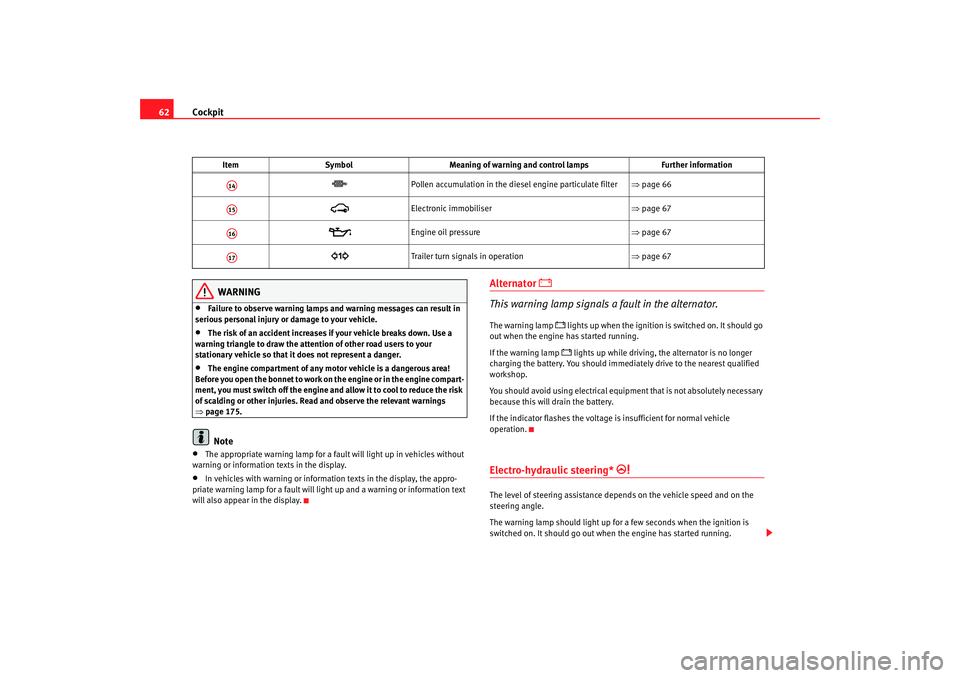
Pollen accumulation in the diesel engine particulate filter ⇒page 66
Electronic immobiliser ⇒page 67
Engine oil pressure ⇒page 67
Trailer turn signals in operation ⇒page 67
Item
Symbol Meaning of warning and control lamps Further information
A14A15A16A17
COR_ING_0707 Seite 62 Mittwoch, 1. August 2007 6:25 18
Page 125 of 258
Heating, Ventilation and Air conditioning 123
Safety First
Operating instructions
Tips and Maintenance
Te c h n i c a l D a t a
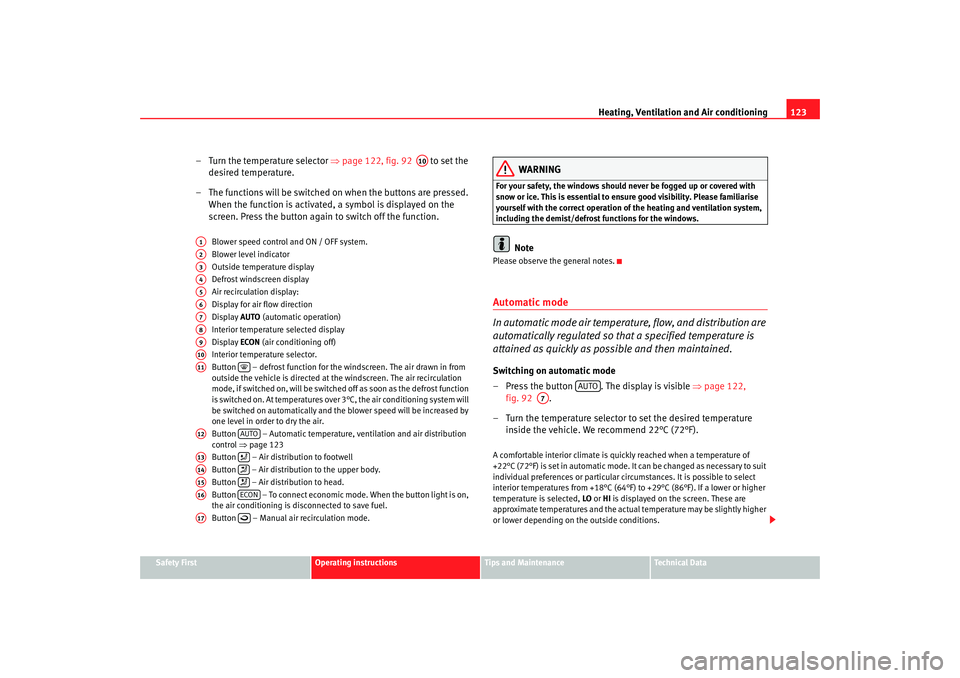
– Turn the temperature selector ⇒page 122, fig. 92 to set the
desired temperature.
– The functions will be switched on when the buttons are pressed. When the function is activated, a symbol is displayed on the
screen. Press the button again to switch off the function.
Blower speed control and ON / OFF system.
Blower level indicator
Outside temperature display
Defrost windscreen display
Air recirculation display:
Display for air flow direction
Displa y AU
TO (automatic operation)
Interior temperature selected display
Di spla y
EC
ON (air conditioning off)
Interior temperature selector.
Button – defrost function for the windscreen. The air drawn in from
outside the vehicle is directed at the windscreen. The air recirculation
mode, if switched on, will be switched off as soon as the defrost function
is switched on. At temperatures over 3°C, the air conditioning system will
be switched on automatically and the blower speed will be increased by
one level in order to dry the air.
Button – Automatic temperature, ventilation and air distribution
control ⇒page 123
Button – Air distribution to footwell
Button – Air distribution to the upper body.
Button – Air distribution to head.
Button – To connect economic mode. When the button light is on,
the air conditioning is disconnected to save fuel.
Button – Manual air recirculation mode.
WARNING
For your safety, the windows should never be fogged up or covered with
snow or ice. This is essential to ensure good visibility. Please familiarise
yourself with the correct operation of the heating and ventilation system,
including the demist/defrost functions for the windows.
Note
Please observe the general notes.Automatic mode
In automatic mode air temperatur e, flow, and distribution are
automatically regulated so that a specified temperature is
attained as quickly as possible and then maintained.Switching on automatic mode
– Press the button . The display is visible ⇒ page 122,
fig. 92 .
– Turn the temperature selector to set the desired temperature inside the vehicle. We recommend 22°C (72°F).A comfortable interior climate is quickly reached when a temperature of
+22°C (72°F) is set in automatic mode. It can be changed as necessary to suit
individual preferences or particular ci rcumstances. It is possible to select
interior temperatures from +18°C (64°F) to +29°C (86°F). If a lower or higher
temperature is selected, LO or HI is displayed on the screen. These are
approximate temperatures and the actual temperature may be slightly higher
or lower depending on the outside conditions.
A10
A1A2A3A4A5A6A7A8A9A10A11
A12
AUTO
A13
A14
A15
A16
ECON
A17
AUTO
A7
COR_ING_0707 Seite 123 Mittwoch, 1. August 2007 6:25 18
Page 126 of 258
Heating, Ventilation and Air conditioning
124Climatronic maintains a constant temperature level fully automatically. The
temperature of the air supplied to the interior, the blower speed and the air
distribution are regulated automatically. The system also allows for the effect
of strong sunlight, so there is no need for manual adjustment. Therefore,
automatic mode provides the best comfort for the vehicle occupants in virtu-
ally all conditions throughout the year.
Automatic mode is switched off whenever an adjustment is made using the
buttons for the air distribution, blower or . The temperature continues
to be regulated.Manual mode
In manual mode you can adjust the air temperature, flow, and
distribution yourself.Switching on manual mode
– Press one of the buttons ⇒page 122, fig. 92 to , or turn
the blower control . The display is switched off .Temperature
It is possible to select interior te mperatures from +18°C (64°F) to +29°C
(86°F). These are approximate temperat ures and the actual temperature may
be slightly higher or lower depen ding on the outside conditions.
If a temperature below 18°C (64°F) is selected, the display switches to LO. In
this setting the system runs at maximum cooling output and the temperature
is not regulated.
If a temperature above 29°C (86°F) is selected the display indicates HI . In this
setting the system runs at maximum heating output and the temperature is
not controlled. Blower
The blower can be infinitely adjusted
with the blower control . Always have
the blower running at a low setting to ensure a constant flow of fresh air into
the vehicle. If the blower is switched off (no level displayed ) and the
control is turned further to the left, th e Climatronic is switched off. Then OFF
is displayed on the screen.
Air distribution
The air distribution is adjusted using the buttons , and . It is also
possible to open and close some of the air outlets separately.
Switching the air conditioning system on and off
Pressing the button switches off the air cooling system to save fuel.
The temperature continues to be regulated. The set temperature can then
only be reached if it is higher than the outside temperature.
Air recirculation mode
Air recirculation mode prevents fumes or unpleasant smells
from entering the vehicle.– Press the button to switch air recirculation mode on or off. This is ON if the symbol
⇒ page 122, fig. 92 is displayed
on the screen.
Air recirculation mode pr events strong odours in the ambient air from
entering the vehicle interior, for example when passing through a tunnel or in
queuing traffic.
When the outside temperature is low, us ing air recirculation mode provides
more effective heating by heating air from the vehicle interior instead of cold
air from outside.
ECON
A13
A15
A1
A7
A1A2
ECON
A5
COR_ING_0707 Seite 124 Mittwoch, 1. August 2007 6:25 18
Page 127 of 258
Heating, Ventilation and Air conditioning 125
Safety First
Operating instructions
Tips and Maintenance
Te c h n i c a l D a t a
When the outside temperature is high, using air recirculation mode provides
more effective cooling by cooling air fr
om the vehicle interior instead of warm
air from outside.
For reasons of safety, air recirculation is not possible when the control for air
distribution is set to the windscreen setting
.
WARNING
In air recirculation mode, no ambient air enters the vehicle interior. If the
air conditioning system is switched of f, the windows can quickly mist over.
Therefore, you should never leave the air recirculation mode switched on
for longer periods, as this increases the risk of an accident.
Note
When reverse gear is engaged the air recirculation connects automatically to
prevent the entrance of exhaust fumes in the vehicle on travelling backwards.
In this case the symbol for air recirculation is not displayed.General notesThe pollen filter
The pollution filter (a combined particulate filter and active carbon filter)
serves as a barrier against impurities in the ambient air, including dust and
pollen.
For the air conditioning system to work with maximum efficiency, the pollen
filter must be replaced at the interv als specified in the Maintenance Program.
If the filter loses efficiency prematurely due to use in areas with very high
levels of air pollution, the pollen filter must be changed more frequently than
stated in the Service Schedule.
Caution
•
If you suspect that the air conditioning is damaged, switch off the air
conditioning with button to prevent further damage and have it
checked by a qualified workshop.
•
Repairs to the air conditioning system require specialist knowledge and
special tools. Therefore, we recommend that you take the vehicle to a quali-
fied workshop should problems occur.Note
•
If the humidity and temperature outside the vehicle are high, condensa-
tion can drip off the evaporator in the cooling system and form a pool under-
neath the vehicle, this is completely normal and there is no need to suspect
a leak.
•
Keep the air intake slots in front of the windscreen free of snow, ice and
leaves to ensure heating and cooling is not impaired, and to prevent the
windows misting over.
•
The air from the vents flows through the passenger compartment and is
extracted by slots designed for this purpose. Do not cover these slots with
articles of clothing or other objects.
•
The air conditioning system operates most effectively with the windows
and the sliding/tilting roof* closed. However, if the sun has heated up the
vehicle, the air inside can be cooled more quickly by opening the windows for
a short period.
•
Do not smoke while air recirculation mode is on, as smoke drawn into the
air conditioning system leaves a residue on the evaporator, producing a
permanent unpleasant odour.
•
At low outside temperatures the comp ressor switches off automatically.
The button cannot be switched on either.
•
It is advisable to connect the air conditioning at least once a month, to
lubricate the system gasket s and prevent leaks. If a decrease in the cooling
capacity is detected, an Authorised Service Centre should be consulted to
check the system.
ECON
AUTO
COR_ING_0707 Seite 125 Mittwoch, 1. August 2007 6:25 18
Page 137 of 258
Driving135
Safety First
Operating instructions
Tips and Maintenance
Te c h n i c a l D a t a
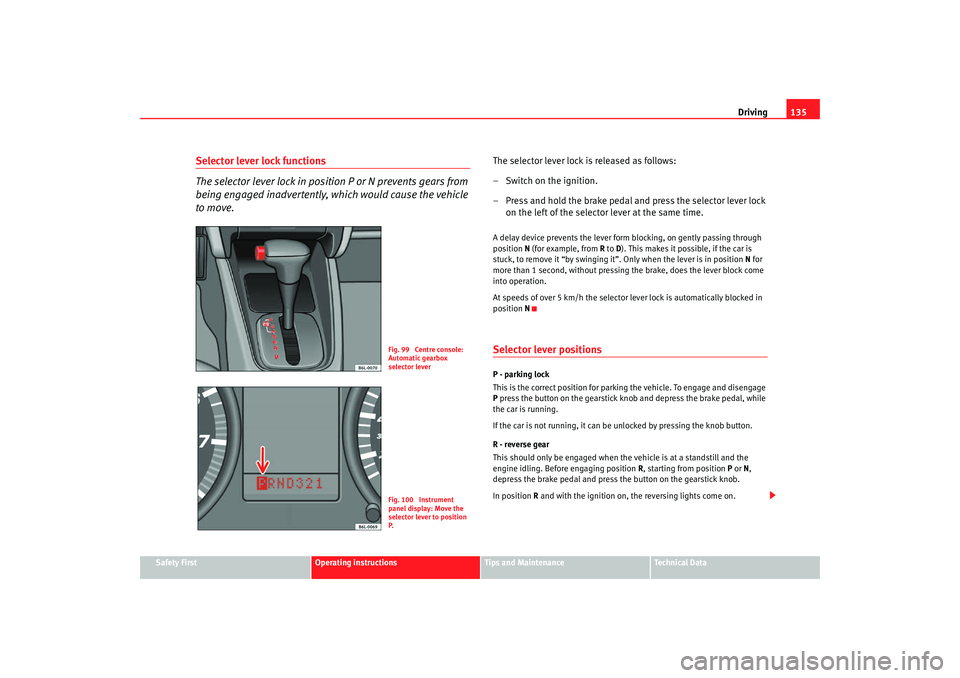
Selector lever lock functions
The selector lever lock in positi on P or N prevents gears from
being engaged inadvertently, which would cause the vehicle
to move.
The selector lever lock is released as follows:
– Switch on the ignition.
– Press and hold the brake pedal and press the selector lever lock
on the left of the selector lever at the same time.A delay device prevents the lever form blocking, on gently passing through
position N (for example, fr o
m R to D). This makes it po ssible, if the car is
stuck, to remove it “by swinging it”. Only when the lever is in position N for
more than 1 second, without pressing th e brake, does the lever block come
into operation.
At speeds of over 5 km/h the selector lever lock is automatically blocked in
position N
Selector lever positionsP - parking lock
This is the correct position for parking the vehicle. To engage and disengage
P press the button on the gearstick knob and depress the brake pedal, while
the car is running.
If the car is not running, it can be unlocked by pressing the knob button.
R - reverse gear
This should only be engaged when the vehicle is at a standstill and the
engine idling. Before engaging position R, starting from position P or N,
depress the brake pedal and press the button on the gearstick knob.
In position R and with the ignition on, th e reversing lights come on.
Fig. 99 Centre console:
Automatic gearbox
selector leverFig. 100 Instrument
panel display: Move the
selector lever to position
P.
COR_ING_0707 Seite 135 Mittwoch, 1. August 2007 6:25 18
Page 180 of 258

Checking and refilling levels
178If the bonnet does not close, do not press downwards. Open it once more and
let it fall as before.
WARNING
If the bonnet is not closed properly, it could open while you are driving and
completely obscure your view of the road. Risk of accident.•
After closing the bonnet, always check that it is properly secured. The
bonnet must be flush with the surrounding body panels.
•
If you notice that the bonnet latch is not secured when the vehicle is
moving, stop the vehicle immediately and close the bonnet properly. Risk
of accident.
Engine oilEngine oil specifications
The engine oil used must conform with exact specifications.Specifications
The engine comes with a special, high quality, multi grade oil that can be
used in all seasons of the year except for those regions affected by extreme
cold.
As the use of good qualit y oil is necessary for the correct operation and long
service life of the engine, when it be comes necessary to replenish or change
the oil, always use an oil that complies to the VW standards.
If it is not possible to find oil conforming to the VW standards then oil
conforming to the ACEA or API standards with an appropriate viscosity at
atmospheric temperature should be used instead. The use of this type of oil may have some repercussions on the performance of the engine for example,
long starting time, increased consumption and a higher emission level.
If a top up is required then different oils may be mixed as long as they all
conform to the VW standards.
The specifications (VW standards) set out in the following page should
appear on the container of the service oil; the container will display together
the different standards for petrol and diesel engines, the oil can be used for
both types of engines.
COR_ING_0707 Seite 178 Mittwoch, 1. August 2007 6:25 18
Page 189 of 258
Checking and refilling levels187
Safety First
Operating instructions
Tips and Maintenance
Te c h n i c a l D a t a
Brake fluidChecking the brake fluid level
The brake fluid is checked at the intervals given in the service
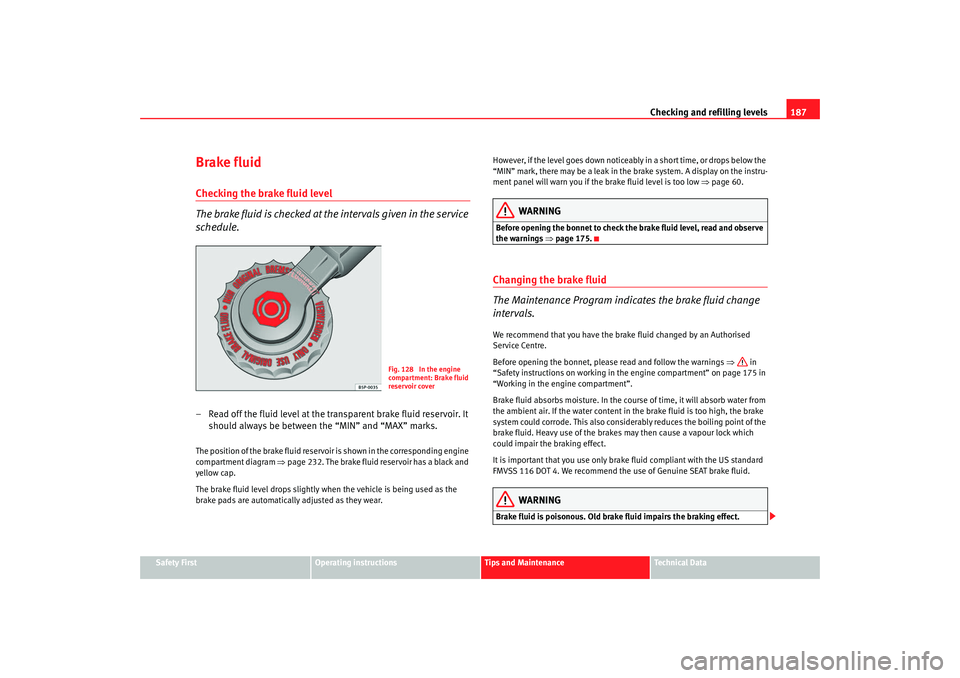
schedule.– Read off the fluid level at the transparent brake fluid reservoir. It
should always be between the “MIN” and “MAX” marks.The position of the brake fluid reservoir is shown in the corresponding engine
compartment diagram ⇒page 232. The brake fluid reservoir has a black and
yellow cap.
The brake fluid level drops slightly when the vehicle is being used as the
brake pads are automatically adjusted as they wear. However, if the level goes down noticeably in a short time, or drops below the
“MIN” mark, there may be a leak in the brake system. A display on the instru-
ment panel will warn you if the brake fluid level is too low
⇒page 60.
WARNING
Before opening the bonnet to check the brake fluid level, read and observe
the warnings ⇒ page 175.Changing the brake fluid
The Maintenance Program indicates the brake fluid change
intervals.We recommend that you have the brake fluid changed by an Authorised
Service Centre.
Before opening the bonnet, please read and follow the warnings ⇒ in
“Safety instructions on working in the engine compartment” on page 175 in
“Working in the engine compartment”.
Brake fluid absorbs moisture. In the course of time, it will absorb water from
the ambient air. If the water content in the brake fluid is too high, the brake
system could corrode. This also considerably reduces the boiling point of the
brake fluid. Heavy use of the brakes may then cause a vapour lock which
could impair the braking effect.
It is important that you use only brake fluid compliant with the US standard
FMVSS 116 DOT 4. We recommend the use of Genuine SEAT brake fluid.
WARNING
Brake fluid is poisonous. Old brake fluid impairs the braking effect.
Fig. 128 In the engine
compartment: Brake fluid
reservoir cover
COR_ING_0707 Seite 187 Mittwoch, 1. August 2007 6:25 18
Page 191 of 258
Checking and refilling levels189
Safety First
Operating instructions
Tips and Maintenance
Te c h n i c a l D a t a
charge. Never short the battery terminals. High-energy sparks can cause
injury.
•
A highly explosive mixture of gases is released when the battery is
under charge. The batteries should be charged in a well-ventilated room
only.
•
Keep children away from acid and batteries.
•
Before working on the electrical system, you must switch off the
engine, the ignition and all consumers. The negative cable on the battery
must be disconnected. When a light bulb is changed, you need only switch
off the light.
•
Deactivate the anti-theft alarm by unlocking the vehicle before you
disconnect the battery! The alar m will otherwise be triggered.
•
When disconnecting the battery from the vehicle electrical system,
disconnect first the negative cable and then the positive cable.
•
Switch off all electrical consumers before reconnecting the battery.
Reconnect first the positive cable and then the negative cable. Never
reverse the polarity of the connections. This could cause an electrical fire.
•
Never charge a frozen battery, or one which has thawed. This could
result in explosions and chemical burns. Always replace a battery which
has frozen. A flat battery can freeze at temperatures around 0
°C.
•
Ensure that the vent hose is always connected to the battery.
•
Never use a defective battery. This may be fatally explosive. Replace a
damaged battery immediately.Caution
•
Never disconnect the battery if the ignition is switched on or if the engine
is running. This could damage the electrical system or electronic compo-
nents.
•
Do not expose the battery to direct sunlight over a long period of time, as
the intense ultraviolet radiation can damage the battery housing.
•
If the vehicle is left standing in cold conditions for a long period, protect
the battery from frost. If it “freezes” it will be damaged.
Checking the electrolyte level
The electrolyte level should be checked regularly in high-
mileage vehicles, in hot countries and in older batteries.– Open the bonnet and open the battery cover at the front ⇒ in
“Safety instructions on working in the engine compartment” on
page 175 ⇒ in “Warnings on handling the battery” on
page 188.
– Check the colour display in the "magic eye" on the top of the battery.
– If there are air bubbles in the window, tap the window gently until they disperse.The position of the battery is show n in the corresponding engine compart-
ment diagram ⇒page 232.
The round window (“magic eye”) on the top of the battery changes colour,
depending on the charge level and electrolyte level of the battery.
If the colour in the window is colourless or bright yellow, the electrolyte level
of the battery is too low. Have the battery checked by a qualified workshop.
The colours green and black are used by the workshops for diagnostic
purposes.
WARNING (continued)
COR_ING_0707 Seite 189 Mittwoch, 1. August 2007 6:25 18
Page 249 of 258
Index247
Index
AABS . . . . . . . . . . . . . . . . . . . . . . . . . . . . . . . . . . . 144
Warning lamp . . . . . . . . . . . . . . . . . . . . . . . . . 64
Accessories . . . . . . . . . . . . . . . . . . . . . . . . . . . . 167
Acoustic signal . . . . . . . . . . . . . . . . . . . . . . . . . . 17
Acoustic warning . . . . . . . . . . . . . . . . . . . . . . . . 129
Adjustable service interval display . . . . . . . . . . 58
Adjusting simp le headlights
driving on the left . . . . . . . . . . . . . . . . . . . . 150
driving on the right . . . . . . . . . . . . . . . . . . . 150
Adjusting the seat belt height . . . . . . . . . . . . . . 24
Air conditioning system Climatronic . . . . . . . . . . . . . . . . . . . . . . . . . . 122
General notes . . . . . . . . . . . . . . . . . . . . . . . . 125
Air conditioning* . . . . . . . . . . . . . . . . . . . . . . . . 119
Air outlets . . . . . . . . . . . . . . . . . . . . . . . . . . . . . . 118
Air recirculation Semi-automatic air conditi oning . . . . . . . . 121
Air recirculation mode Climatronic . . . . . . . . . . . . . . . . . . . . . . . . . . 124
Airbag covers . . . . . . . . . . . . . . . . . . . . . . . . . . . . 32
Airbag system . . . . . . . . . . . . . . . . . . . . . . . . . . . 27 Curtain airbags . . . . . . . . . . . . . . . . . . . . . . . 37
Front airbags . . . . . . . . . . . . . . . . . . . . . . . . . 30
Side airbags . . . . . . . . . . . . . . . . . . . . . . . . . . 33
Warning lamp . . . . . . . . . . . . . . . . . . . . . . . . . 28 Airbags
Care . . . . . . . . . . . . . . . . . . . . . . . . . . . . . . . . 29
Disposal . . . . . . . . . . . . . . . . . . . . . . . . . . . . . 29
Safety notes . . . . . . . . . . . . . . . . . . . . . . . . . . 29
Alarm system Switching off . . . . . . . . . . . . . . . . . . . . . . . . . 81
Alterations to the vehicle . . . . . . . . . . . . . . . . . 167
Alternator Warning lamp . . . . . . . . . . . . . . . . . . . . . . . . . 62
Ambient temperature display . . . . . . . . . . . . 55, 57
Anti-freeze . . . . . . . . . . . . . . . . . . . . . . . . . . . . . 182
Anti-lock brake system . . . . . . . . . . . . . . . . . . . 144 Warning lamp . . . . . . . . . . . . . . . . . . . . . . . . . 64
Anti-theft alarm system . . . . . . . . . . . . . . . . . . . . 80 Switching off . . . . . . . . . . . . . . . . . . . . . . . . . 81
Anti-theft wheel bolts . . . . . . . . . . . . . . . . . . . . 200
Aquaplaning . . . . . . . . . . . . . . . . . . . . . . . . . . . 193
Athermic windscreen* . . . . . . . . . . . . . . . . . . . . . 98
Automatic anti-dazzle interior mirror* Activating the anti-dazzle function . . . . . . . 99
Deactivating anti-dazzle function . . . . . . . . . 99
Automatic car washes . . . . . . . . . . . . . . . . . . . . 159
Automatic gearbox . . . . . . . . . . . . . . . . . . . . . . 134 Instructions for driving . . . . . . . . . . . . . . . . 136
Kick-down feature . . . . . . . . . . . . . . . . . . . . 136
Selector lever positions . . . . . . . . . . . . . . . . 135
Auxiliary audio connection: AUX-IN . . . . . . . . . 112
BBall coupling . . . . . . . . . . . . . . . . . . . . . . . . . . . 155
BAS . . . . . . . . . . . . . . . . . . . . . . . . . . . . . . . . . . . 143
Battery Changing . . . . . . . . . . . . . . . . . . . . . . . . . . . 190
Charging . . . . . . . . . . . . . . . . . . . . . . . . . . . . 190
Winter conditions . . . . . . . . . . . . . . . . . . . . 188
Belt tension device Disposal . . . . . . . . . . . . . . . . . . . . . . . . . . . . . 25
Warning lamp . . . . . . . . . . . . . . . . . . . . . . . . 28
Belt tension devices . . . . . . . . . . . . . . . . . . . . . . 25
Biodiesel . . . . . . . . . . . . . . . . . . . . . . . . . . . . . . 174
Bonnet . . . . . . . . . . . . . . . . . . . . . . . . . . . . . . . . 177
Brake assist system . . . . . . . . . . . . . . . . . . . . . 143
Brake fluid . . . . . . . . . . . . . . . . . . . . . . . . . . . . . 187 Changing . . . . . . . . . . . . . . . . . . . . . . . . . . . 187
Brake pads . . . . . . . . . . . . . . . . . . . . . . . . . . . . . 147
Brake servo . . . . . . . . . . . . . . . . . . . . . . . 143, 147
Brake system . . . . . . . . . . . . . . . . . . . . . . . . . . . 187 Warning lamp . . . . . . . . . . . . . . . . . . . . . . . . 65
Brakes . . . . . . . . . . . . . . . . . . . . . . . . . . . . . . . . 147
Braking distance . . . . . . . . . . . . . . . . . . . . . . . . 147
Bulb changes general notes . . . . . . . . . . . . . . . . . . . . . . . . 211
Buzzer . . . . . . . . . . . . . . . . . . . . . . . . . . . . . . 93, 129
COR_ING_0707 Seite 247 Mittwoch, 1. August 2007 6:25 18
Page 251 of 258
Index249
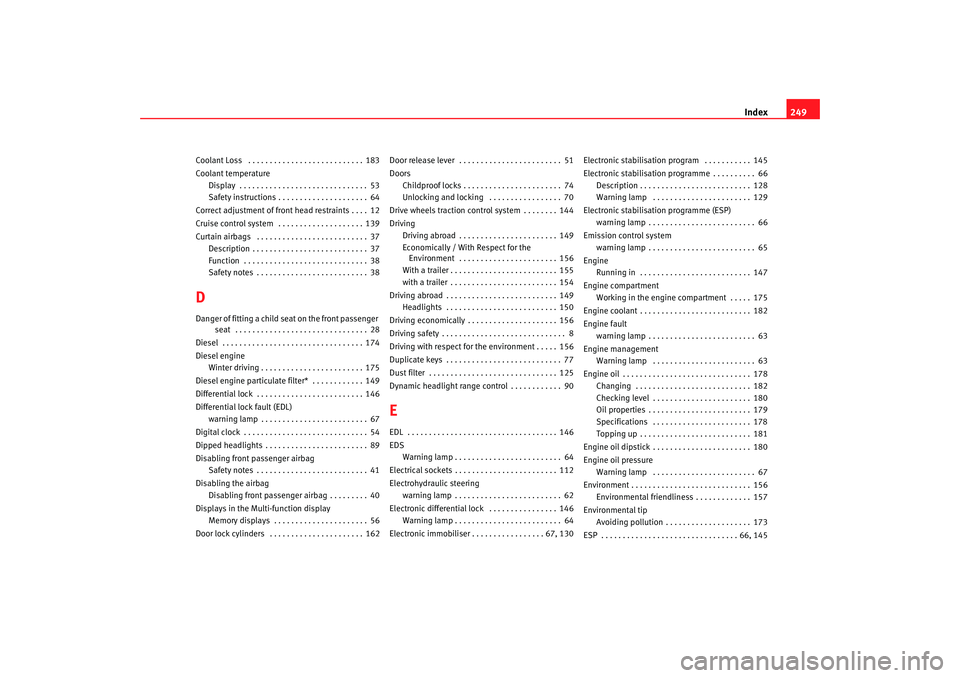
Coolant Loss . . . . . . . . . . . . . . . . . . . . . . . . . . . 183
Coolant temperature
Display . . . . . . . . . . . . . . . . . . . . . . . . . . . . . . 53
Safety instructions . . . . . . . . . . . . . . . . . . . . . 64
Correct adjustment of front head restraints . . . . 12
Cruise control system . . . . . . . . . . . . . . . . . . . . 139
Curtain airbags . . . . . . . . . . . . . . . . . . . . . . . . . . 37 Description . . . . . . . . . . . . . . . . . . . . . . . . . . . 37
Function . . . . . . . . . . . . . . . . . . . . . . . . . . . . . 38
Safety notes . . . . . . . . . . . . . . . . . . . . . . . . . . 38DDanger of fitting a child seat on the front passenger seat . . . . . . . . . . . . . . . . . . . . . . . . . . . . . . . 28
Diesel . . . . . . . . . . . . . . . . . . . . . . . . . . . . . . . . . 174
Diesel engine Winter driving . . . . . . . . . . . . . . . . . . . . . . . . 175
Diesel engine particulate filter* . . . . . . . . . . . . 149
Differential lock . . . . . . . . . . . . . . . . . . . . . . . . . 146
Differential lock fault (EDL) warning lamp . . . . . . . . . . . . . . . . . . . . . . . . . 67
Digital clock . . . . . . . . . . . . . . . . . . . . . . . . . . . . . 54
Dipped headlights . . . . . . . . . . . . . . . . . . . . . . . . 89
Disabling front passenger airbag Safety notes . . . . . . . . . . . . . . . . . . . . . . . . . . 41
Disabling the airbag Disabling front passenger airbag . . . . . . . . . 40
Displays in the Multi-function display Memory displays . . . . . . . . . . . . . . . . . . . . . . 56
Door lock cylinders . . . . . . . . . . . . . . . . . . . . . . 162 Door release lever . . . . . . . . . . . . . . . . . . . . . . . . 51
Doors
Childproof locks . . . . . . . . . . . . . . . . . . . . . . . 74
Unlocking and locking . . . . . . . . . . . . . . . . . 70
Drive wheels traction control system . . . . . . . . 144
Driving Driving abroad . . . . . . . . . . . . . . . . . . . . . . . 149
Economically / With Respect for the Environment . . . . . . . . . . . . . . . . . . . . . . . 156
With a trailer . . . . . . . . . . . . . . . . . . . . . . . . . 155
with a trailer . . . . . . . . . . . . . . . . . . . . . . . . . 154
Driving abroad . . . . . . . . . . . . . . . . . . . . . . . . . . 149 Headlights . . . . . . . . . . . . . . . . . . . . . . . . . . 150
Driving economically . . . . . . . . . . . . . . . . . . . . . 156
Driving safety . . . . . . . . . . . . . . . . . . . . . . . . . . . . . 8
Driving with respect for the environment . . . . . 156
Duplicate keys . . . . . . . . . . . . . . . . . . . . . . . . . . . 77
Dust filter . . . . . . . . . . . . . . . . . . . . . . . . . . . . . . 125
Dynamic headlight range control . . . . . . . . . . . . 90
EEDL . . . . . . . . . . . . . . . . . . . . . . . . . . . . . . . . . . . 146
EDS Warning lamp . . . . . . . . . . . . . . . . . . . . . . . . . 64
Electrical sockets . . . . . . . . . . . . . . . . . . . . . . . . 112
Electrohydraulic steering warning lamp . . . . . . . . . . . . . . . . . . . . . . . . . 62
Electronic differential lock . . . . . . . . . . . . . . . . 146 Warning lamp . . . . . . . . . . . . . . . . . . . . . . . . . 64
Electronic immobiliser . . . . . . . . . . . . . . . . . 67, 130 Electronic stabilisation program . . . . . . . . . . . 145
Electronic stabilisation programme . . . . . . . . . . 66
Description . . . . . . . . . . . . . . . . . . . . . . . . . . 128
Warning lamp . . . . . . . . . . . . . . . . . . . . . . . 129
Electronic stabilisation programme (ESP) warning lamp . . . . . . . . . . . . . . . . . . . . . . . . . 66
Emission control system warning lamp . . . . . . . . . . . . . . . . . . . . . . . . . 65
Engine Running in . . . . . . . . . . . . . . . . . . . . . . . . . . 147
Engine compartment Working in the engine compartment . . . . . 175
Engine coolant . . . . . . . . . . . . . . . . . . . . . . . . . . 182
Engine fault warning lamp . . . . . . . . . . . . . . . . . . . . . . . . . 63
Engine management Warning lamp . . . . . . . . . . . . . . . . . . . . . . . . 63
Engine oil . . . . . . . . . . . . . . . . . . . . . . . . . . . . . . 178 Changing . . . . . . . . . . . . . . . . . . . . . . . . . . . 182
Checking level . . . . . . . . . . . . . . . . . . . . . . . 180
Oil properties . . . . . . . . . . . . . . . . . . . . . . . . 179
Specifications . . . . . . . . . . . . . . . . . . . . . . . 178
Topping up . . . . . . . . . . . . . . . . . . . . . . . . . . 181
Engine oil dipstick . . . . . . . . . . . . . . . . . . . . . . . 180
Engine oil pressure Warning lamp . . . . . . . . . . . . . . . . . . . . . . . . 67
Environment . . . . . . . . . . . . . . . . . . . . . . . . . . . . 156 Environmental friendliness . . . . . . . . . . . . . 157
Environmental tip Avoiding pollution . . . . . . . . . . . . . . . . . . . . 173
ESP . . . . . . . . . . . . . . . . . . . . . . . . . . . . . . . . 66, 145
COR_ING_0707 Seite 249 Mittwoch, 1. August 2007 6:25 18