warning Seat Cordoba 2008 Manual PDF
[x] Cancel search | Manufacturer: SEAT, Model Year: 2008, Model line: Cordoba, Model: Seat Cordoba 2008Pages: 258, PDF Size: 7.87 MB
Page 103 of 258
Lights and visibility101
Safety First
Operating instructions
Tips and Maintenance
Te c h n i c a l D a t a
– Place the control in position L or R once the mirrors have
demisted to prevent unnecessary use of the battery.
Folding in exterior mirrors*
– Turn the control ⇒page 100, fig. 68 to position
to fold in the
exterior mirrors. You should always fold in the exterior mirrors if
you are driving through an automatic car wash. This will help
prevent damage.
Folding exterior mirrors back out to the extended position*
– Turn the knob to position L or R to fold the exterior mirrors back out ⇒ .
Synchronised wing mirror adjustment*
1. Turn the control to the position L ( left exterior mirror ).
2. Turn the rotary knob to position the mirror so that you have a good view to the rear of the vehicle. The right exterior mirror will
be adjusted at the same time (synchronised).
WARNING
•
The rear view convex or aspheric mirror increase the field of vision
however the objects appear smaller and further away in the mirrors. If you
use these mirrors to estimate the distance to vehicles behind you when
changing lane, you could make a mistake. Risk of accident.
•
If possible, use the interior mirror to estimate distances to vehicles
behind you.
•
Make sure that you do not get your finger trapped between the mirror
and the mirror base when folding back the mirrors. Risk of injury!
For the sake of the environment
The exterior mirror heating should be switched off when it is no longer
needed. Fuel is wasted otherwise.
Note
•
If the electrical adjustment ever fails to operate, the mirrors can be
adjusted by hand by lightly pressing the edge of the mirror glass.
•
In vehicles with electric wing mirrors, the following points should be
observed: if, due to an external force (e.g. a knock while manoeuvring), the
adjustment of the mirror housing is altered, the mirror will have to be
completely folded electrically. Do not readjust the mirror housing by hand, as
this will interfere with the mirror adjuster function.
•
The rear view mirrors can be adjusted separately or simultaneously, as
described before.
COR_ING_0707 Seite 101 Mittwoch, 1. August 2007 6:25 18
Page 104 of 258
Seats and stowage
102Seats and stowageThe importance of correct seat adjustmentProper seat adjustment optimi ses the level of protection
offered by seat belts and airbags.Your vehicle has five passenger places, two individual front seats and three
places on the rear seat. Each seat is equipped with a three-point seat belt.
The driver seat and front passenger seat can be adjusted in many ways to suit
the physical requirements of the vehicl e occupants. The correct seat position
is very important for:•
fast and easy operation of all controls on the instrument panel,
•
relaxed posture that does not cause drowsiness,
•
safe driving ⇒page 7,
•
and to ensure that the seat belts and airbag system provide maximum
protection ⇒page 16.
WARNING
•
If the driver and passengers assume improper sitting positions, they
may sustain critical injuries.
•
Never transport more people than there are seats available in the
vehicle.
•
Every occupant in the vehicle must properly fasten and wear the seat
belt belonging to his or her seat. Children must be protected with an appro-
priate child restraint system ⇒page 42, “Child safety”.
•
The front seats and all head restraints must always be adjusted to body
size and the seat belt must always be properly adjusted to provide you and
your passengers with optimum protection.
•
Always keep your feet in the foot well when the vehicle is moving; never
rest them on the dash panel, out of the window or on the seat. This also
applies to passengers. An incorrect sitting position exposes you to an
increased risk of injury in the event of a braking manoeuvre or an accident.
If the airbag is triggered, you could sustain severe injuries due to an incor-
rect sitting position.
•
It is important for the driver and front passenger to maintain a distance
of at least 25 cm from the steering wh eel or dash panel. Failure to respect
the minimum distance means that the airbag will not protect you. Risk of
fatal injury. The distance between the driver and the steering wheel or
between the front passenger and the dash panel should always be as great
as possible.
•
Adjust the driver or front passenger seat only when the vehicle is
stationary. Otherwise your seat could move unexpectedly while the vehicle
is moving. This could increase the risk of an accident and therefore injury.
In addition, while adjusting your seat, you will assume an incorrect sitting
position. Risk of fatal accidents.
•
Special guidelines apply to installing a child seat on the front
passenger seat. When installing a chil d seat, observe the warning note in
the ⇒page 42, “Child safety”.WARNING (continued)
COR_ING_0707 Seite 102 Mittwoch, 1. August 2007 6:25 18
Page 105 of 258
Seats and stowage103
Safety First
Operating instructions
Tips and Maintenance
Te c h n i c a l D a t a
Head restraintsCorrect adjustment of head restraints
Properly adjusted head restraints are an important part of
occupant protection and can redu ce the risk of injuries in
most accident situations.
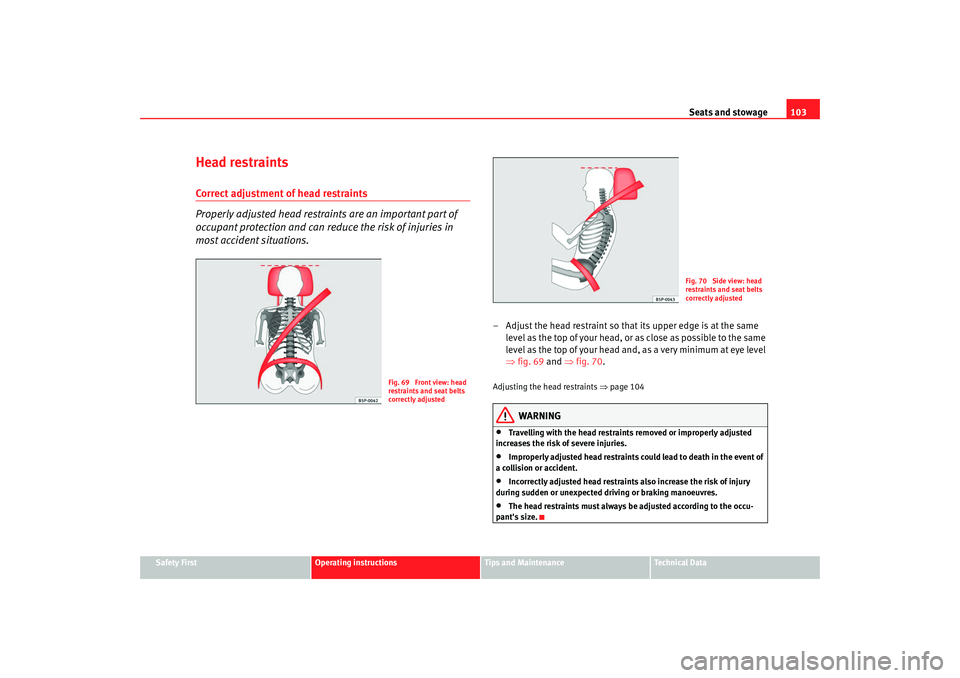
– Adjust the head restraint so that its upper edge is at the same
level as the top of your head, or as close as possible to the same
level as the top of your head and, as a very minimum at eye level
⇒fig. 69 and ⇒ fig. 70.Adjusting the head restraints ⇒page 104
WARNING
•
Travelling with the head restrain ts removed or improperly adjusted
increases the risk of severe injuries.
•
Improperly adjusted head restraints could lead to death in the event of
a collision or accident.
•
Incorrectly adjusted head restraints also increase the risk of injury
during sudden or unexpected driving or braking manoeuvres.
•
The head restraints must always be adjusted according to the occu-
pant's size.
Fig. 69 Front view: head
restraints and seat belts
correctly adjusted
Fig. 70 Side view: head
restraints and seat belts
correctly adjusted
COR_ING_0707 Seite 103 Mittwoch, 1. August 2007 6:25 18
Page 107 of 258
Seats and stowage105
Safety First
Operating instructions
Tips and Maintenance
Te c h n i c a l D a t a
WARNING
•
Never drive if the head restraints have been removed. Risk of injury.
•
Never drive if the head restraints are in an unsuitable position, there is
a risk of serious injury.
•
After refitting the head restraint, you must always adjust it properly for
height to achieve optimal protection.
•
Please observe the safety warnings ⇒page 103, “Correct adjustment
of head restraints”.Note
•
To fit and remove the rear head restraints, gently tilt the seat back
forwards.
•
When fitting the head restraints again, insert the tubes as far as possible
into the guides without pressing the button.
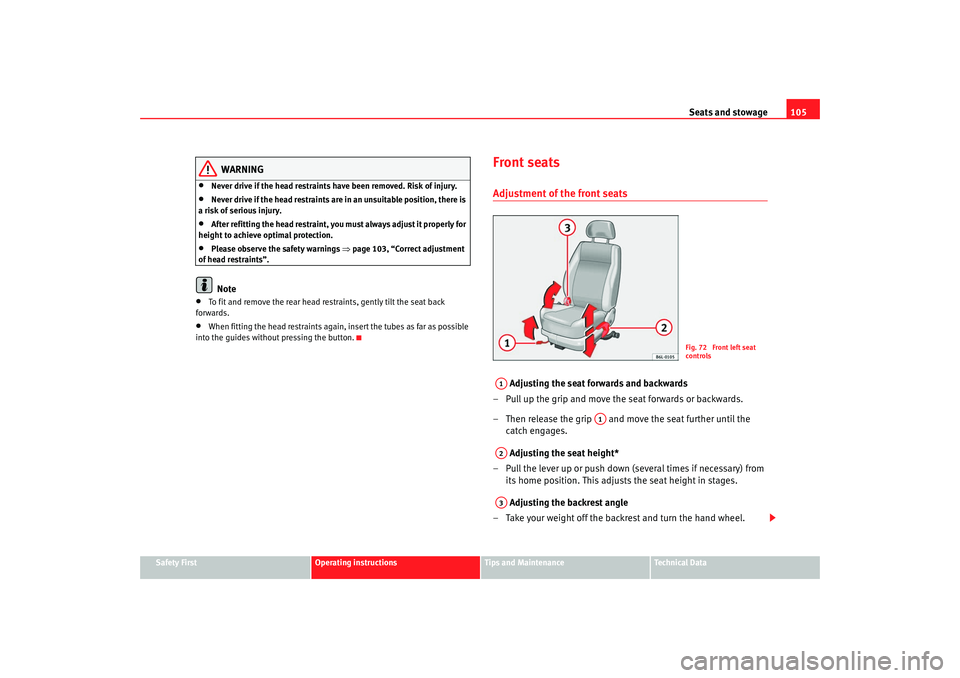
Front seatsAdjustment of the front seats Adjusting the seat forwards and backwards
– Pull up the grip and move the seat forwards or backwards.
– Then release the grip and mo ve the seat further until the
catch engages.
Adjusting the seat height*
– Pull the lever up or push down (several times if necessary) from its home position. This adjust s the seat height in stages.
Adjusting the backrest angle
– Take your weight off the backrest and turn the hand wheel.
Fig. 72 Front left seat
controls
A1
A1
A2A3
COR_ING_0707 Seite 105 Mittwoch, 1. August 2007 6:25 18
Page 108 of 258
Seats and stowage
106
WARNING
•
Never adjust the driver or front passenger seat while the vehicle is in
motion. While adjusting your seat, you will assume an incorrect sitting
position. Risk of fatal accidents. Adju st the driver or front passenger seat
only when the vehicle is stationary.
•
To reduce the risk of injury to the driver and front passenger during
sudden braking manoeuvres or an accident, never drive with the backrest
tilted far to the rear. The maximum protection of the seat belt can be
achieved only when the backrests are in an upright position and the driver
and front passenger have properly adjusted their seat belts. The further
the backrests are tilted to the rear, the greater the risk of injury due to
improper positioning of the belt web!
•
Exercise caution when adjusting the seat height or forwards/back-
wards position. Injuries can be caused if the backrest is tilted without due
care and attention.
Heated seats*
The front seat cushions and backrests can be heated electri-
cally.
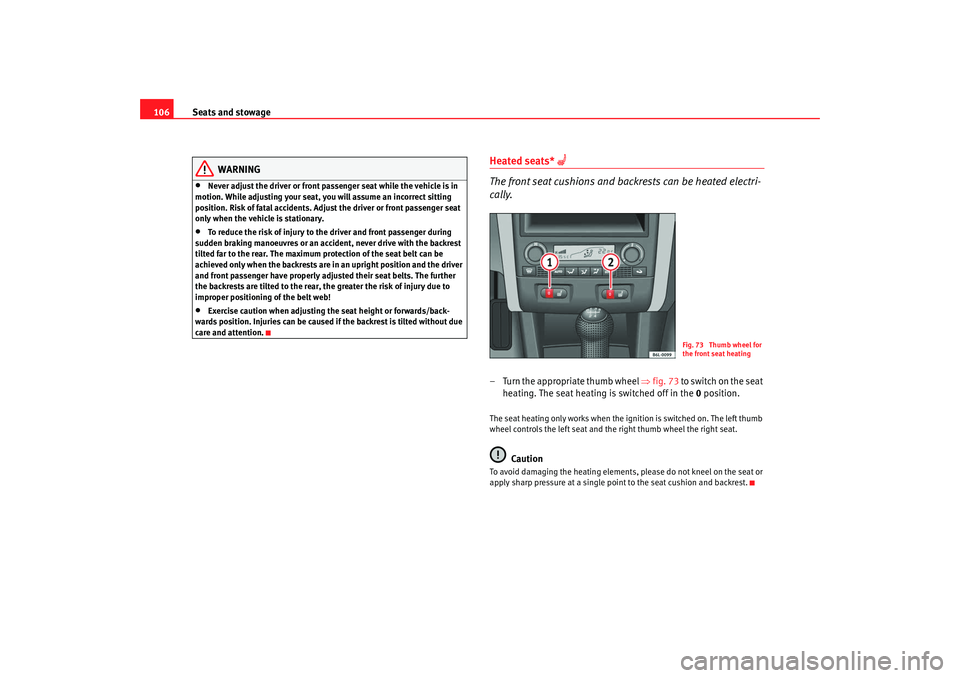
– Turn the appropriate thumb wheel ⇒fig. 73 t o s wi t ch o n t h e s e a t
heating. The seat heating is switched off in the 0 position.The seat heating only works when the ignition is switched on. The left thumb
wheel controls the left seat and the right thumb wheel the right seat.
Caution
To avoid damaging the heating elements, please do not kneel on the seat or
apply sharp pressure at a single point to the seat cushion and backrest.
Fig. 73 Thumb wheel for
the front seat heating
COR_ING_0707 Seite 106 Mittwoch, 1. August 2007 6:25 18
Page 110 of 258
Seats and stowage
108
WARNING
•
Please be careful when folding back the backrest! Injuries can be
caused if the backrest is tilted without due care and attention.
•
Do no trap or damage seatbelts when raising the backrest.
•
After raising the backrest, check it has engaged properly in position.
•
The three point automatic seat belt only works correctly when the back-
rest of the central seat is correctly engaged.
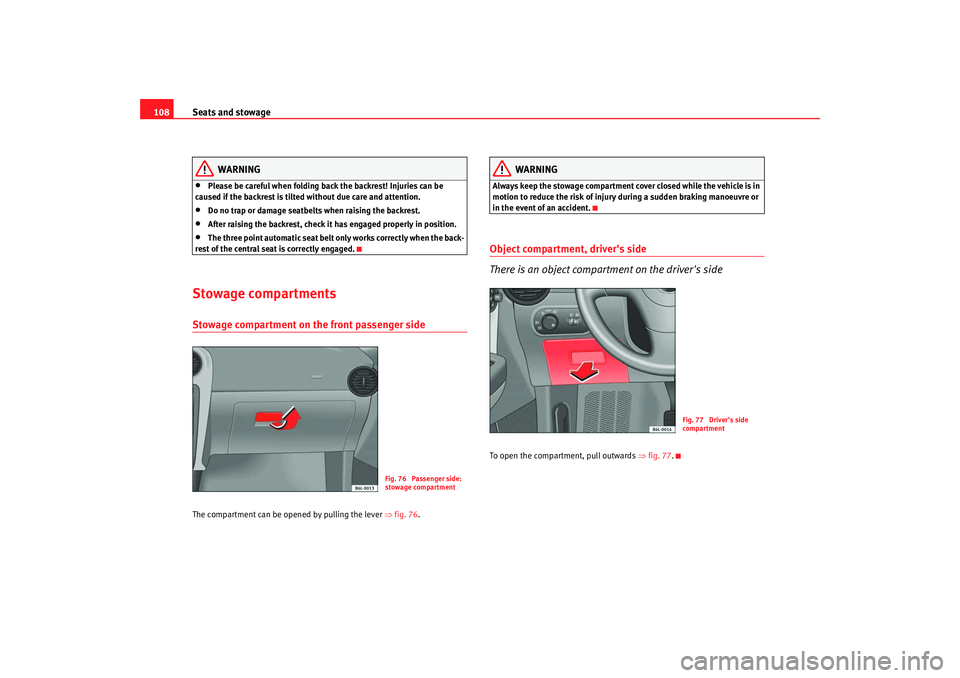
Stowage compartmentsStowage compartment on the front passenger sideThe compartment can be opened by pulling the lever ⇒fig. 76 .
WARNING
Always keep the stowage compartment co ver closed while the vehicle is in
motion to reduce the risk of injury during a sudden braking manoeuvre or
in the event of an accident.Object compartment, driver's side
There is an object compartment on the driver's sideTo open the compartment, pull outwards ⇒ fig. 77.
Fig. 76 Passenger side:
stowage compartment
Fig. 77 Driver's side
compartment
COR_ING_0707 Seite 108 Mittwoch, 1. August 2007 6:25 18
Page 112 of 258
Seats and stowage
110Front cup holder* To o p e n
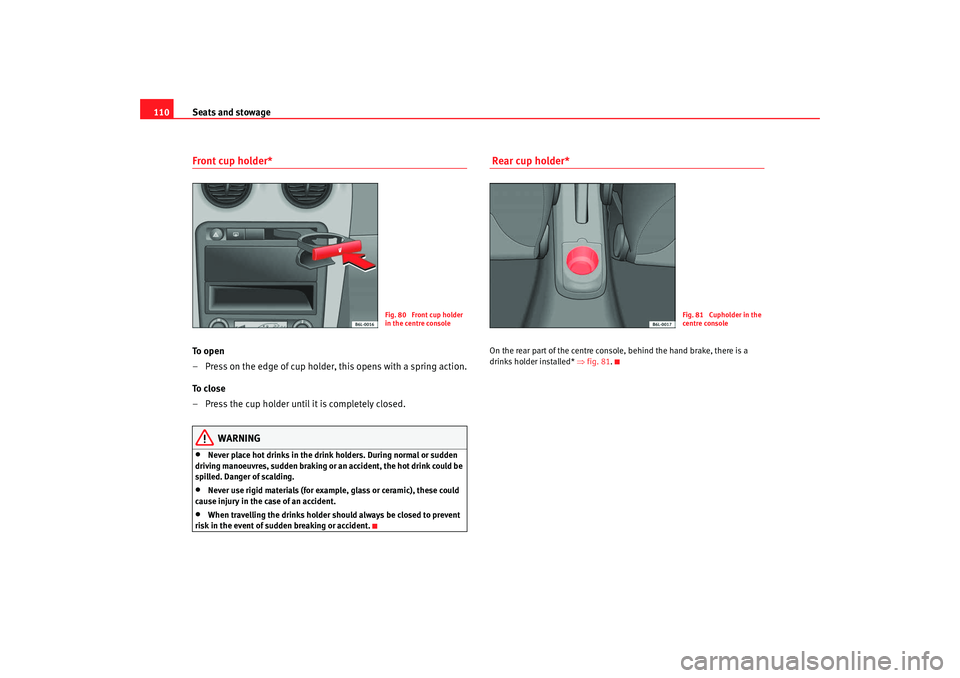
– Press on the edge of cup holder, this opens with a spring action.
To close
– Press the cup holder until it is completely closed.
WARNING
•
Never place hot drinks in the drink holders. During normal or sudden
driving manoeuvres, sudden braking or an accident, the hot drink could be
spilled. Danger of scalding.
•
Never use rigid materials (for example, glass or ceramic), these could
cause injury in the case of an accident.
•
When travelling the drinks holder should always be closed to prevent
risk in the event of sudden breaking or accident.
Rear cup holder* On the rear part of the centre console, behind the hand brake, there is a
drinks holder installed* ⇒fig. 81 .
Fig. 80 Front cup holder
in the centre console
Fig. 81 Cupholder in the
centre console
COR_ING_0707 Seite 110 Mittwoch, 1. August 2007 6:25 18
Page 113 of 258
Seats and stowage111
Safety First
Operating instructions
Tips and Maintenance
Te c h n i c a l D a t a
Ashtrays, cigarette lighter and electrical
socketsFront ashtrayOpening
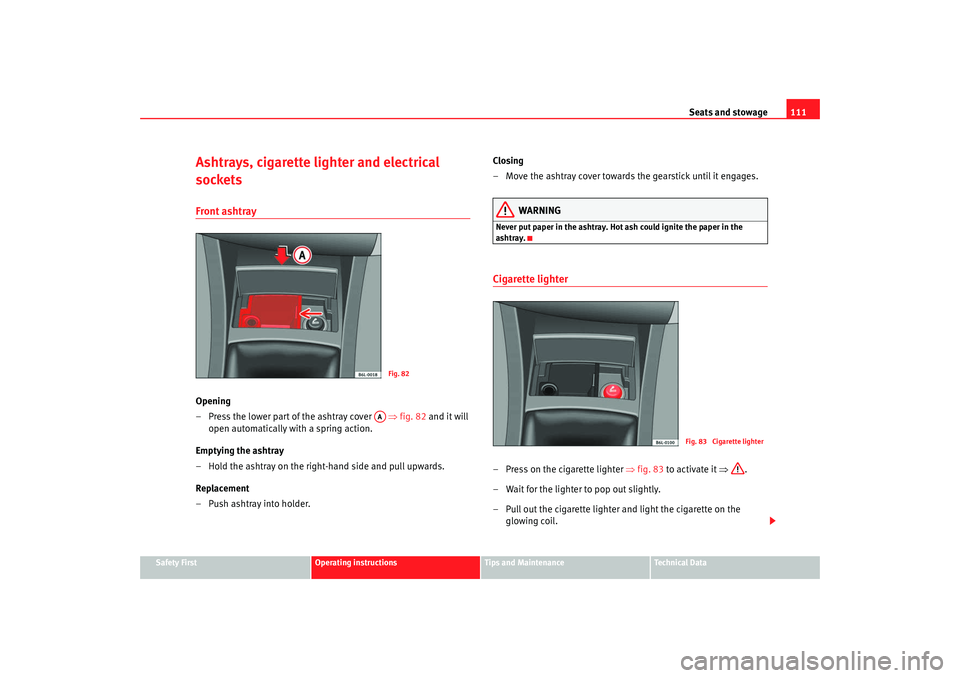
– Press the lower part of the ashtray cover ⇒fig. 82 and it will
open automatically with a spring action.
Emptying the ashtray
– Hold the ashtray on the right-hand side and pull upwards.
Replacement
– Push ashtray into holder. Closing
– Move the ashtray cover towards the gearstick until it engages.
WARNING
Never put paper in the ashtray. Hot ash could ignite the paper in the
ashtray.Cigarette lighter– Press on the cigarette lighter
⇒fig. 83 to activate it ⇒.
– Wait for the lighter to pop out slightly.
– Pull out the cigarette lighter and light the cigarette on the glowing coil.
Fig. 82
AA
Fig. 83 Cigarette lighter
COR_ING_0707 Seite 111 Mittwoch, 1. August 2007 6:25 18
Page 114 of 258
Seats and stowage
112
WARNING
•
Improper use of the cigarette lighter can lead to serious injuries or start
a fire.
•
Take care when using the cigarette lighter. Carelessness or negligence
when using the cigarette lighter can cause burns, risk of injury.
•
The lighter only works when the ignition is turned on or the engine is
running. To avoid the risk of fire, never leave children unsupervised in the
vehicle.
Electrical sockets The 12 Volt cigarette lighter socket can also be used for other electrical
components with a power rating of up to 120 Watt. When the engine is
switched off, however, the vehicle battery will discharge. Further information
⇒ page 167.
WARNING
The current sockets and the connected accessories will only operate when
the ignition is on or when the engine is running. Improper use of the
sockets or electrical accessories can lead to serious injuries or cause a fire.
To avoid the risk of injury, never leave children unsupervised in the vehicle.
Note
•
Using electrical appliances with the engine switched off will drain the
battery.
•
Before using any electrical accessories, see the instructions on
⇒ page 167.
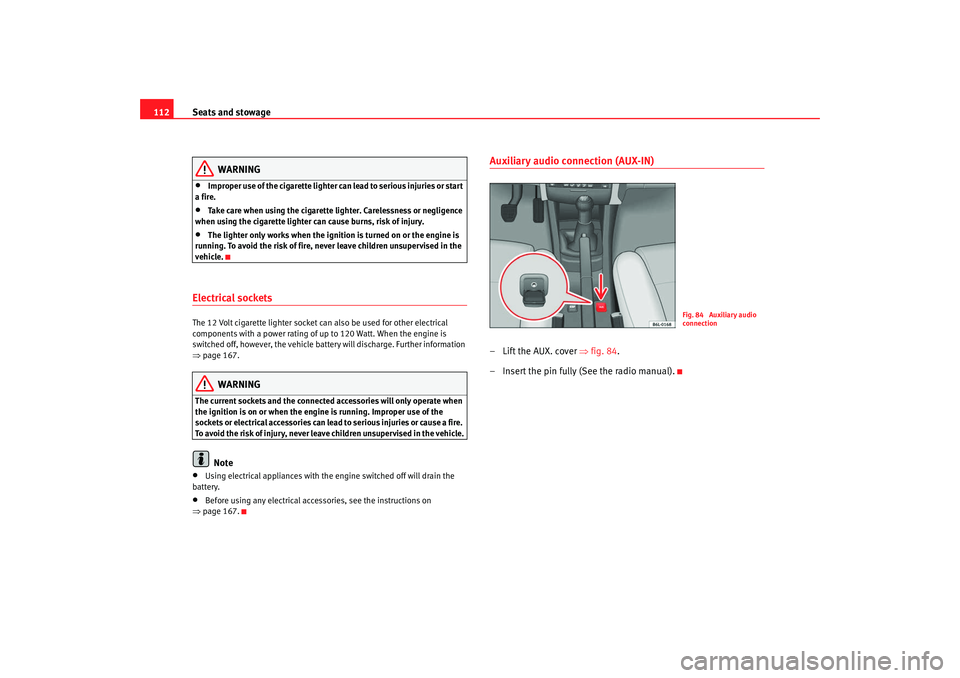
Auxiliary audio connection (AUX-IN)– Lift the AUX. cover ⇒fig. 84 .
– Insert the pin fully (See the radio manual).
Fig. 84 Auxiliary audio
connection
COR_ING_0707 Seite 112 Mittwoch, 1. August 2007 6:25 18
Page 115 of 258
Seats and stowage113
Safety First
Operating instructions
Tips and Maintenance
Te c h n i c a l D a t a
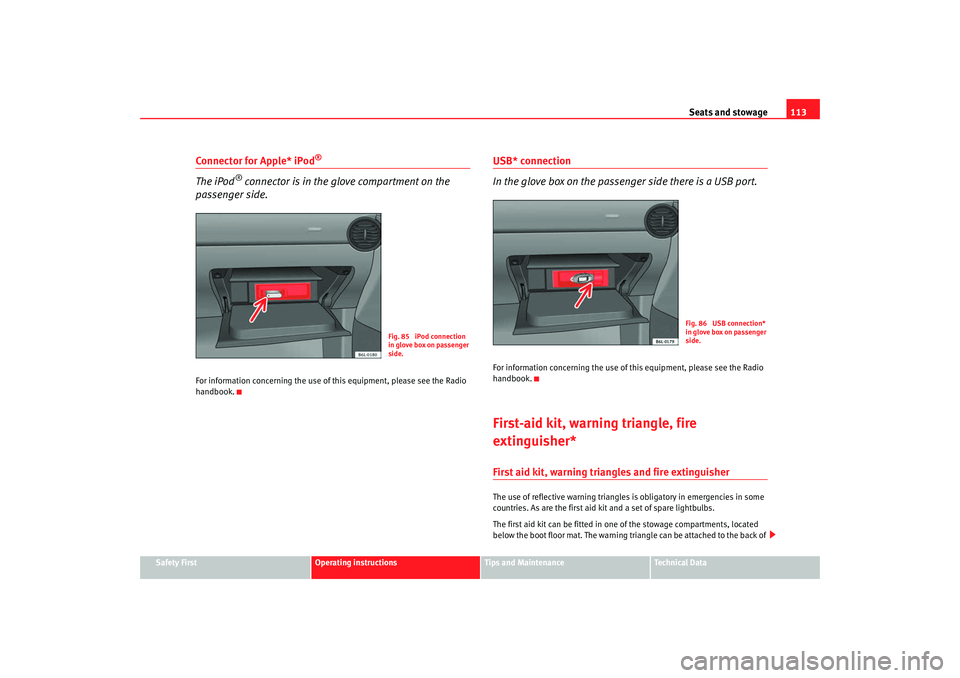
Connector for Apple* iPod
®
The iPod
® connector is in the glove compartment on the
passenger side.
For information concerning the use of this equipment, please see the Radio
handbook.
USB* connection
In the glove box on the passenger side there is a USB port.For information concerning the use of this equipment, please see the Radio
handbook.First-aid kit, warning triangle, fire
extinguisher*First aid kit, warning triangles and fire extinguisherThe use of reflective warning triangles is obligatory in emergencies in some
countries. As are the first aid kit and a set of spare lightbulbs.
The first aid kit can be fitted in one of the stowage compartments, located
below the boot floor mat. The warning tr iangle can be attached to the back of
Fig. 85 iPod connection
in glove box on passenger
side.
Fig. 86 USB connection*
in glove box on passenger
side.
COR_ING_0707 Seite 113 Mittwoch, 1. August 2007 6:25 18