warning Seat Cordoba 2008 Manual Online
[x] Cancel search | Manufacturer: SEAT, Model Year: 2008, Model line: Cordoba, Model: Seat Cordoba 2008Pages: 258, PDF Size: 7.87 MB
Page 116 of 258
Seats and stowage
114the boot using rubber straps. The fire ex tinguisher can be fixed on the left-
hand side of the boot floor, fastened with velcro.
Note
•
The first aid kit, the warning triangles and the fire extinguisher are not
supplied with the vehicle as standard.
•
The first aid kit, the warning triangles and the fire extinguisher should
meet legal requirements.
•
The expiry date of the content of the first aid kit should be checked.
•
Ensure that the fire extinguisher is fully functional. The fire extinguisher
should, therefore, be checked regularly. The sticker on the fire extinguisher
will inform you of the next date for checking.
•
Before acquiring accessories and emergency equipment see the instruc-
tions on ⇒ page 167, “Accessories, parts replacement and modifications”.
Luggage compartmentStowing luggage
All luggage must be securely stowed.Please observe the following points to ensure the vehicle handles
well at all times:
– Distribute the load as evenly as possible.
– Place heavy objects as far forward in the luggage compartment
as possible.
WARNING
•
Loose luggage and other loose items in the vehicle can cause serious
injuries.
•
Loose objects in the luggage compartment can suddenly move and
change the way the vehicle handles.
•
During sudden manoeuvres or accidents, loose objects in the
passenger compartment can be flung forward, injuring vehicle occupants.
•
Always put objects in the luggage compartment.
•
When you transport heavy objects, always keep in mind that a change
in the centre of gravity can also cause changes in vehicle handling.
•
Please observe information on safe driving ⇒page 7, “Safe driving”.Caution
Hard objects on the shelf could chafe against the wires of the heating
element in the rear window and cause damage.
Note
The ventilation slots in front of the rear side windows must not be covered as
this would prevent stale air being extracted from the vehicle.Luggage compartment coverThe tray behind the rear seat back can be used for clothing.
The groove between the tray and the re ar window heater should never be
covered to allow free air ventilation.
COR_ING_0707 Seite 114 Mittwoch, 1. August 2007 6:25 18
Page 117 of 258
Seats and stowage115
Safety First
Operating instructions
Tips and Maintenance
Te c h n i c a l D a t a
WARNING
Do not place heavy or hard objects on the luggage compartment cover, this
will endanger the vehicle occupants in case of sudden braking.
Caution
•
Before closing the tailgate, ensure that the stowage compartment tray is
correctly fitted.
•
An overloaded boot could mean that the rear stowage tray is not correctly
seated and it may be bent or damaged.Note
•
Below the boot floor trim, next to the spare wheel, is a removable stowage
tray.
Roof carrier*Please observe the following points if you intend to carry loads on the roof:•
For safety reasons, only luggage racks and accessories approved by SEAT
should be used.
•
It is imperative to precisely follow the fitting instructions included for the
rack, taking special care when fitting the front bar in the holes designed for
this and the rear bar between the marks on the upper part of the rear door
frame while respecting the correct direction of travel indicated in the installa-
tion manual. Not following these instructions may lead to paintwork damage
or marks on the bodywork.
•
Pay special attention to the tightening torque of the attachment bolts and
check them following a short journey. If necessary, retighten the bolts and
check them at regular intervals.
•
Distribute the load evenly. A maximum load of 40 kg only is permitted for
each roof carrier system support bar, the load must be distributed evenly over
the entire length. However, the maximum load permitted for the entire roof
(including the support system) of 75 kg must not be exceeded nor should the
total weight of the vehicle be exceeded. See the chapter on “Technical Data”.
•
When transporting heavy or large objects on the roof, any change in the
normal vehicle behaviour due to a change in the centre of gravity or an
increased wind resistance must be taken into account. For this reason, a suit-
able speed and driving style must be used.
•
For those vehicles fitted with a sunroof*, ensure that it does not interfere
with the load on the roof carrier system when opened.
COR_ING_0707 Seite 115 Mittwoch, 1. August 2007 6:25 18
Page 118 of 258
Heating, Ventilation and Air conditioning
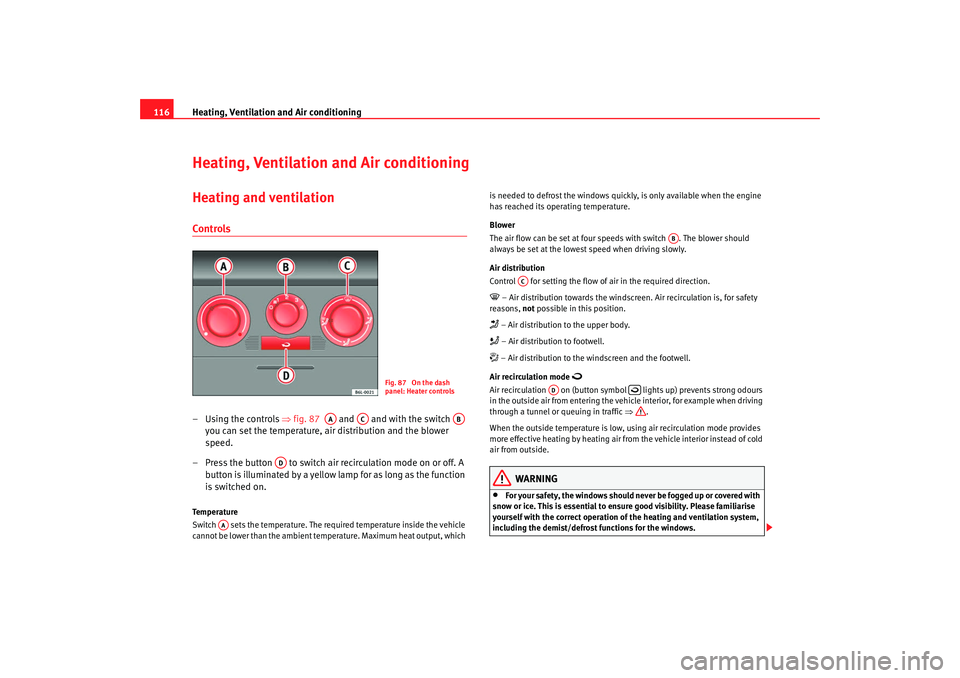
116Heating, Ventilation and Air conditioningHeating and ventilationControls– Using the controls ⇒fig. 87 and and with the switch
you can set the temperature, air distribution and the blower
speed.
– Press the button to switch air recirculation mode on or off. A button is illuminated by a yellow lamp for as long as the function
is switched on.Temperature
Switch sets the temperature. The required temperature inside the vehicle
cannot be lower than the ambient temp erature. Maximum heat output, which is needed to defrost the windows quickly, is only available when the engine
has reached its operating temperature.
Blower
The air flow can be set at four speeds with switch . The blower should
always be set at the lowest speed when driving slowly.
Air distribution
Control for setting the flow of
air in the required direction.
– Air distribution towards the windsc reen. Air recirculation is, for safety
reasons, not possible in this position. – Air distribution to the upper body. – Air distribution to footwell. – Air distribution to the windscreen and the footwell.
Air recirculation mode
Air recirculation on (button symbol lights up) prevents strong odours
in the outside air from entering the vehicle interior, for example when driving
through a tunnel or queuing in traffic ⇒.
When the outside temperature is low, us ing air recirculation mode provides
more effective heating by heating air from the vehicle interior instead of cold
air from outside.
WARNING
•
For your safety, the windows should never be fogged up or covered with
snow or ice. This is essential to ensure good visibility. Please familiarise
yourself with the correct operation of the heating and ventilation system,
including the demist/defrost functions for the windows.
Fig. 87 On the dash
panel: Heater controls
AA
AC
AB
AD
AA
AB
AC
AD
COR_ING_0707 Seite 116 Mittwoch, 1. August 2007 6:25 18
Page 119 of 258
Heating, Ventilation and Air conditioning 117
Safety First
Operating instructions
Tips and Maintenance
Te c h n i c a l D a t a
•
In air recirculation mode, no ambient air enters the vehicle interior. The
windows can quickly fog over if the heating is switched off. Therefore, you
should never leave the air recirculat ion mode switched on for longer
periods, as this increases the risk of an accident.Note
•
Please observe the general notes ⇒page 125.
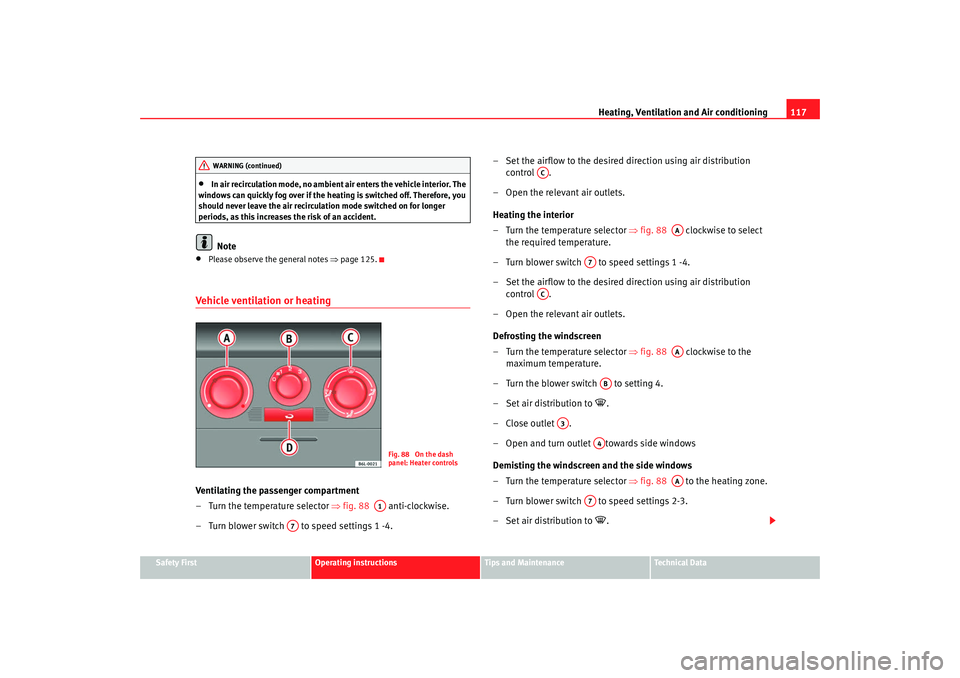
Vehicle ventilation or heatingVentilating the passenger compartment
– Turn the temperature selector ⇒ fig. 88 anti-clockwise.
– Turn blower switch to speed settings 1 -4. – Set the airflow to the desired direction using air distribution
control .
– Open the relevant air outlets.
Heating the interior
– Turn the temperature selector ⇒ fig. 88 clockwise to select
the required temperature.
– Turn blower switch to speed settings 1 -4.
– Set the airflow to the desired direction using air distribution control .
– Open the relevant air outlets.
Defrosting the windscreen
– Turn the temperature selector ⇒ fig. 88 clockwise to the
maximum temperature.
– Turn the blower switch to setting 4.
– Set air distribution to
.
–Close outlet .
– Open and turn outlet towards side windows
Demisting the windscreen and the side windows
– Turn the temperature selector ⇒ fig. 88 to the heating zone.
– Turn blower switch to speed settings 2-3.
– Set air distribution to
.
WARNING (continued)
Fig. 88 On the dash
panel: Heater controls
A1
A7
AC
AA
A7
AC
AA
AB
A3
A4
AA
A7
COR_ING_0707 Seite 117 Mittwoch, 1. August 2007 6:25 18
Page 121 of 258
Heating, Ventilation and Air conditioning 119
Safety First
Operating instructions
Tips and Maintenance
Te c h n i c a l D a t a
Air distribution
The outlets and can be closed or opened separately and the air flow
directed according to need.
Air vent closed:
operating lever vertical.
Air vent open: operating lever horizontal.
Swivelling the outlet with the operating lever, it is possible to direct the air
output as desired.
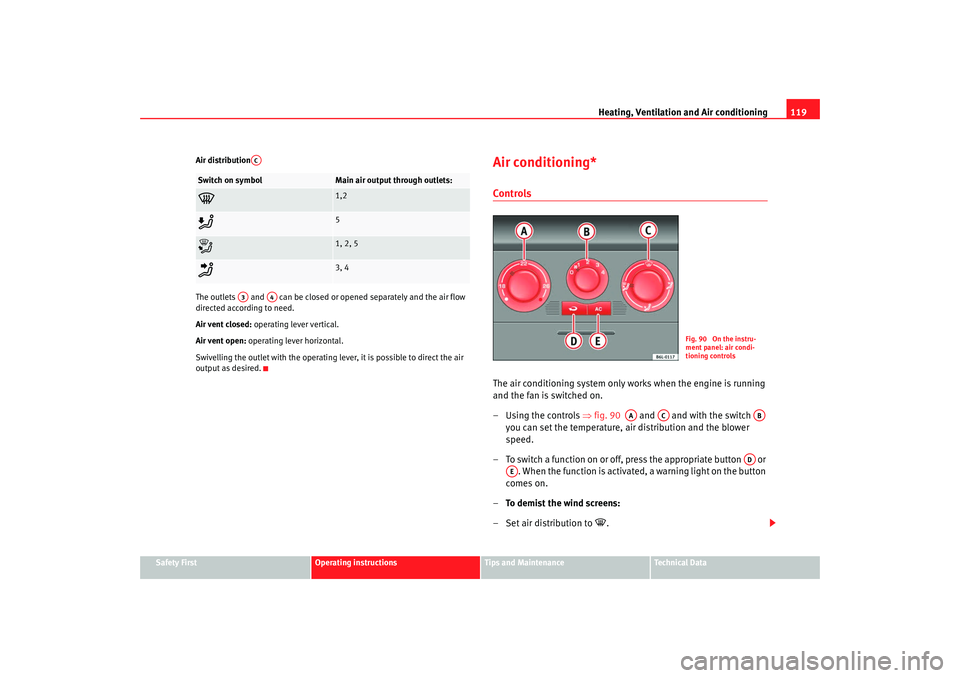
Air conditioning* ControlsThe air conditioning system only works when the engine is running
and the fan is switched on.
– Using the controls ⇒fig. 90 and and with the switch
you can set the temperature, air distribution and the blower
speed.
– To switch a function on or off, press the appropriate button or . When the function is activated, a warning light on the button
comes on.
– To demist the wind screens:
– Set air distribution to
.
Switch on symbol
Main air output through outlets:
1,2
5
1, 2, 5
3, 4
AC
A3
A4
Fig. 90 On the instru-
ment panel: air condi-
tioning controls
AA
AC
AB
AD
AE
COR_ING_0707 Seite 119 Mittwoch, 1. August 2007 6:25 18
Page 122 of 258
Heating, Ventilation and Air conditioning
120
– Turn the fan control to one of the two levels depending on the
speed required.
– Rotate the temperature control to the desired level.
– Close outlets 3 .
– Open and turn outlets towards side windows.
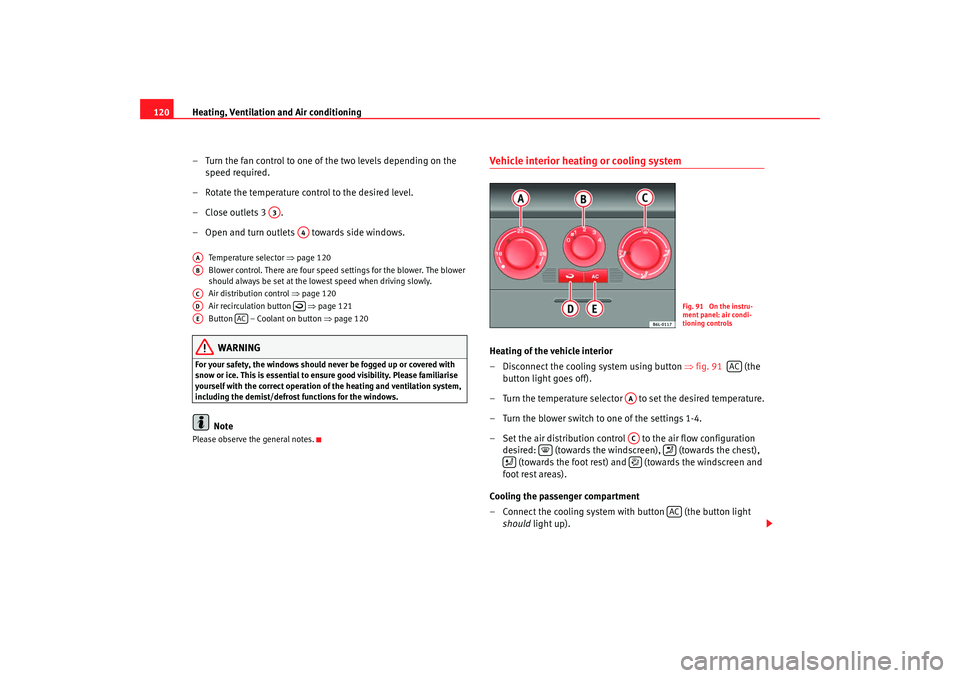
Temperature selector ⇒page 120
Blower control. There are four speed settings for the blower. The blower
should always be set at the lowest speed when driving slowly.
Air distribution control ⇒page 120
Air recirculation button ⇒page 121
Button – Coolant on button ⇒page 120WARNING
For your safety, the windows should never be fogged up or covered with
snow or ice. This is essential to ensure good visibility. Please familiarise
yourself with the correct operation of the heating and ventilation system,
including the demist/defrost functions for the windows.
Note
Please observe the general notes.
Vehicle interior heating or cooling system Heating of the vehicle interior
– Disconnect the cooling system using button ⇒fig. 91 (the
button light goes off).
– Turn the temperature selector to set the desired temperature.
– Turn the blower switch to one of the settings 1-4.
– Set the air distribution control to the air flow configuration desired: (towards the windscreen), (towards the chest), (towards the foot rest) and (towards the windscreen and
foot rest areas).
Cooling the passenger compartment
– Connect the cooling system with button (the button light
should light up).
A3
A4
AAABACAD
AE
AC
Fig. 91 On the instru-
ment panel: air condi-
tioning controls
AC
AAAC
AC
COR_ING_0707 Seite 120 Mittwoch, 1. August 2007 6:25 18
Page 123 of 258
Heating, Ventilation and Air conditioning 121
Safety First
Operating instructions
Tips and Maintenance
Te c h n i c a l D a t a
– Turn the temperature control switch until the desired interior
temperature is obtained.
– Turn the blower switch to one of the settings 1-4.
– Set the air distribution control to the air flow configuration desired: (towards the windsc reen), (towards the chest),
(towards the foot rest) and (towards the windscreen and
foot rest areas).Heating
Maximum heat output, which is needed to defrost the windows quickly, is
only available when the engine has reached its operating temperature.
Coolant system
When the cooling system is switched on , not only the temperature, but also
the air humidity in the vehicle interior is reduced. This improves comfort for
the vehicle occupants and prevents misting of the windows when the outside
air humidity is high.
If the cooling system cannot be switched on this may be due to the following
reasons:•
the engine is not running.
•
The blower is switched off.
•
The outside temperature is lower than +5°C.
•
the cooling system compressor has been temporarily switched off
because the engine coolant temperature is too high.
•
The air conditioning fuse is faulty.
•
Another fault in the vehicle. Have the air conditioning checked by a qual-
ified workshop.
Air recirculation
Air recirculation mode prevents fumes or unpleasant smells
from entering the vehicle.When air recirculation mode is switched on (button ⇒page 120, fig. 91
with warning lamp) strong odours in th e outside air do not enter the vehicle
interior, for example when passing th rough a tunnel or in queuing traffic.
When the outside temperature is low, using air recirculation mode provides
more effective heating by heating air from the vehicle interior instead of cold
air from outside.
When the outside temperature is high, using air recirculation mode provides
more effective cooling by cooling air from the vehicle interior instead of warm
air from outside.
For reasons of safety, air recirculation is not possible when the control for air
distribution is set to the windscreen setting
.
WARNING
In air recirculation mode, no ambient air enters the vehicle interior. If the
air conditioning system is switched off, the windows can quickly mist over.
Therefore, you should never leave the air recirculation mode switched on
for longer periods, as this increases the risk of an accident.
Note
•
When reverse gear is engaged the air recirculation connects automatically
to prevent the entrance of exhaust fumes in the vehicle on travelling back-
wards. The control light on the button does not light up.
•
If the temperature control is turned to the coldest setting (blue point) and
the switch is activated, the “Air recirculation” function is automatically
activated in order to cool the passenger compartment rapidly using a
minimum of energy and the fu nction indicator will light.
AC
COR_ING_0707 Seite 121 Mittwoch, 1. August 2007 6:25 18
Page 125 of 258
Heating, Ventilation and Air conditioning 123
Safety First
Operating instructions
Tips and Maintenance
Te c h n i c a l D a t a
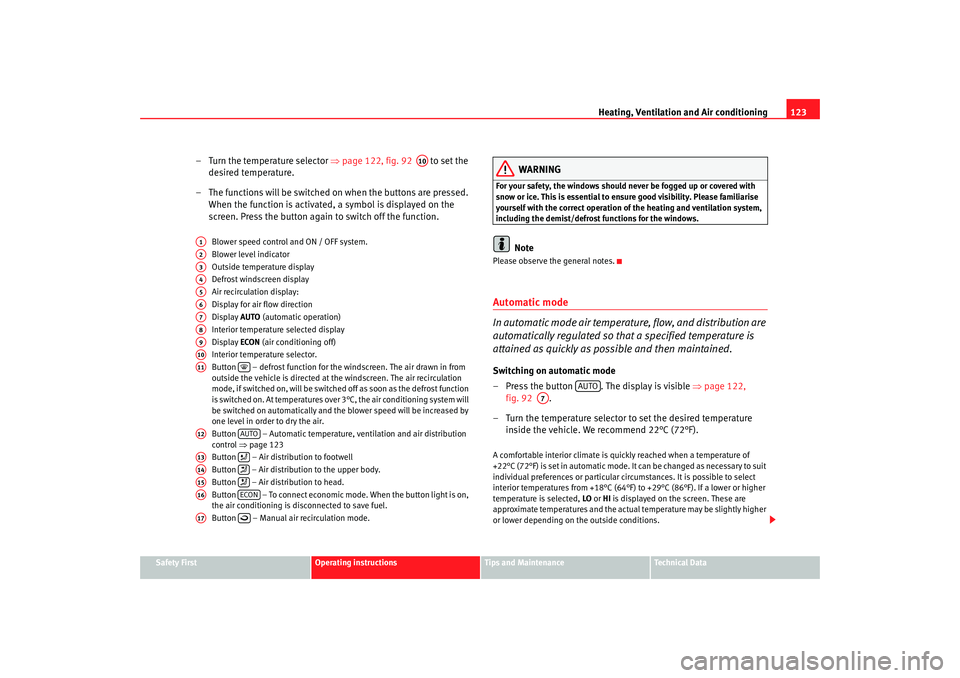
– Turn the temperature selector ⇒page 122, fig. 92 to set the
desired temperature.
– The functions will be switched on when the buttons are pressed. When the function is activated, a symbol is displayed on the
screen. Press the button again to switch off the function.
Blower speed control and ON / OFF system.
Blower level indicator
Outside temperature display
Defrost windscreen display
Air recirculation display:
Display for air flow direction
Displa y AU
TO (automatic operation)
Interior temperature selected display
Di spla y
EC
ON (air conditioning off)
Interior temperature selector.
Button – defrost function for the windscreen. The air drawn in from
outside the vehicle is directed at the windscreen. The air recirculation
mode, if switched on, will be switched off as soon as the defrost function
is switched on. At temperatures over 3°C, the air conditioning system will
be switched on automatically and the blower speed will be increased by
one level in order to dry the air.
Button – Automatic temperature, ventilation and air distribution
control ⇒page 123
Button – Air distribution to footwell
Button – Air distribution to the upper body.
Button – Air distribution to head.
Button – To connect economic mode. When the button light is on,
the air conditioning is disconnected to save fuel.
Button – Manual air recirculation mode.
WARNING
For your safety, the windows should never be fogged up or covered with
snow or ice. This is essential to ensure good visibility. Please familiarise
yourself with the correct operation of the heating and ventilation system,
including the demist/defrost functions for the windows.
Note
Please observe the general notes.Automatic mode
In automatic mode air temperatur e, flow, and distribution are
automatically regulated so that a specified temperature is
attained as quickly as possible and then maintained.Switching on automatic mode
– Press the button . The display is visible ⇒ page 122,
fig. 92 .
– Turn the temperature selector to set the desired temperature inside the vehicle. We recommend 22°C (72°F).A comfortable interior climate is quickly reached when a temperature of
+22°C (72°F) is set in automatic mode. It can be changed as necessary to suit
individual preferences or particular ci rcumstances. It is possible to select
interior temperatures from +18°C (64°F) to +29°C (86°F). If a lower or higher
temperature is selected, LO or HI is displayed on the screen. These are
approximate temperatures and the actual temperature may be slightly higher
or lower depending on the outside conditions.
A10
A1A2A3A4A5A6A7A8A9A10A11
A12
AUTO
A13
A14
A15
A16
ECON
A17
AUTO
A7
COR_ING_0707 Seite 123 Mittwoch, 1. August 2007 6:25 18
Page 127 of 258
Heating, Ventilation and Air conditioning 125
Safety First
Operating instructions
Tips and Maintenance
Te c h n i c a l D a t a
When the outside temperature is high, using air recirculation mode provides
more effective cooling by cooling air fr
om the vehicle interior instead of warm
air from outside.
For reasons of safety, air recirculation is not possible when the control for air
distribution is set to the windscreen setting
.
WARNING
In air recirculation mode, no ambient air enters the vehicle interior. If the
air conditioning system is switched of f, the windows can quickly mist over.
Therefore, you should never leave the air recirculation mode switched on
for longer periods, as this increases the risk of an accident.
Note
When reverse gear is engaged the air recirculation connects automatically to
prevent the entrance of exhaust fumes in the vehicle on travelling backwards.
In this case the symbol for air recirculation is not displayed.General notesThe pollen filter
The pollution filter (a combined particulate filter and active carbon filter)
serves as a barrier against impurities in the ambient air, including dust and
pollen.
For the air conditioning system to work with maximum efficiency, the pollen
filter must be replaced at the interv als specified in the Maintenance Program.
If the filter loses efficiency prematurely due to use in areas with very high
levels of air pollution, the pollen filter must be changed more frequently than
stated in the Service Schedule.
Caution
•
If you suspect that the air conditioning is damaged, switch off the air
conditioning with button to prevent further damage and have it
checked by a qualified workshop.
•
Repairs to the air conditioning system require specialist knowledge and
special tools. Therefore, we recommend that you take the vehicle to a quali-
fied workshop should problems occur.Note
•
If the humidity and temperature outside the vehicle are high, condensa-
tion can drip off the evaporator in the cooling system and form a pool under-
neath the vehicle, this is completely normal and there is no need to suspect
a leak.
•
Keep the air intake slots in front of the windscreen free of snow, ice and
leaves to ensure heating and cooling is not impaired, and to prevent the
windows misting over.
•
The air from the vents flows through the passenger compartment and is
extracted by slots designed for this purpose. Do not cover these slots with
articles of clothing or other objects.
•
The air conditioning system operates most effectively with the windows
and the sliding/tilting roof* closed. However, if the sun has heated up the
vehicle, the air inside can be cooled more quickly by opening the windows for
a short period.
•
Do not smoke while air recirculation mode is on, as smoke drawn into the
air conditioning system leaves a residue on the evaporator, producing a
permanent unpleasant odour.
•
At low outside temperatures the comp ressor switches off automatically.
The button cannot be switched on either.
•
It is advisable to connect the air conditioning at least once a month, to
lubricate the system gasket s and prevent leaks. If a decrease in the cooling
capacity is detected, an Authorised Service Centre should be consulted to
check the system.
ECON
AUTO
COR_ING_0707 Seite 125 Mittwoch, 1. August 2007 6:25 18
Page 129 of 258
Driving127
Safety First
Operating instructions
Tips and Maintenance
Te c h n i c a l D a t a
DrivingAddressAdjusting the steering wheel position
The height and reach of the steering wheel can be freely
adjusted to suit the driver.
– Adjust the driver seat to the correct position.
– Push the lever under the steering column ⇒fig. 93 down ⇒ .
– Adjust the steering wheel in this way until the correct position is set ⇒fig. 94 .
– Then push the lever up again firmly ⇒.
WARNING
•
Incorrect use of the steering column adjustment function and an incor-
rect seating position can result in serious injury.
•
To avoid accidents, the steering column should be adjusted only when
the vehicle is stationary. Risk of accident.
Fig. 93 Adjusting the
steering wheel position
Fig. 94 Proper sitting
position for driver
COR_ING_0707 Seite 127 Mittwoch, 1. August 2007 6:25 18