warning Seat Exeo 2008 Owner's manual
[x] Cancel search | Manufacturer: SEAT, Model Year: 2008, Model line: Exeo, Model: Seat Exeo 2008Pages: 303, PDF Size: 10.02 MB
Page 189 of 303
Trailer towing187
Safety First
Operating instructions
Practical tips
Te c h n i c a l D a t a
Where possible, operate the trailer with the maximum permitted
draw bar
weight on the ball joint of the towing bracket, but do not exceed the specified
limit.
Tyre pressure
Check the tyre pressures on your car, and adjust for “full load” conditions
(refer to the sticker listing the tyre pressures on the door pillar). It may also be
necessary to adjust the tyre pressures on the trailer according to the recom-
mendations of the trailer manufacturer.
Exterior mirrors
Check whether you can see enough of the road behind the trailer with the
standard mirrors. If this is not the case you should have additional mirrors
fitted. The two exterior mi rrors should be fitted on folding arms. Adjust the
mirrors to give sufficient rear vision.
Headlights
Before starting a journey, check the headlight beam settings with the trailer
hitched up. If necessary, alter the height of the headlight beams by means of
the headlight range control. See ⇒page 116.
Power supply
When you remove the ignition key, the power supply to the trailer is inter-
rupted.
Removable ball joint coupling
Vehicles with a factory-fitted towing bracket are equipped with a removable
ball joint coupling. This is stored in the spare wheel well in the luggage
compartment together with the necessary fitting instructions.
Note
If you frequently tow, we recommend you also have vehicle serviced between
services.
Notes on towing
Towing a trailer involves additi onal attention by the driver.Weight distribution
The weight distribution of a loaded trailer with an unladen vehicle is very
unfavourable. However, if this cannot be avoided, drive extra slowly to allow
for the unbalanced we ight distribution.
Speed
The stability of the car and trailer is reduced with increasing speed. Therefore,
it is advisable not to drive at the maximum permissible speed in an unfavour-
able road, weather or wind conditions. This especially applies when driving
downhill.
You should always reduce speed immediately if the trailer shows the slightest
sign of swaying. Never try to stop the “snaking” by increasing speed.
Anticipate hazards and brake in good time. If towing a trailer with an inertia
brake , first brake gently and then more severely. This will prevent brake
tapping by the trailer wheels when they lock. Select a low gear in due course
before going down a steep downhill. This enables you to use the engine
braking to slow down the vehicle.
Swaying and pitching can be reduced by stabiliser aids. We recommend
having stabiliser aids installed when towing trailers with a high trailer load.
They can be purchased and installed at a Dealer.
Reheating
When climbing long hills in hot weather wi th the engine running fast in low
gear, you should keep an eye on the coolant temperature gauge ⇒page 60.
Reduce speed immediately if the needle moves to the right end of the scale.
If the temperature warning light
in the instrument cluster should start
flashing, stop the car and let the engine cool down by running it at idling
speed for a few minutes.
Exeo_EN.book Seite 187 Freitag, 17. Oktober 2008 11:24 11
Page 190 of 303
Trailer towing
188Equipment and accessories
Before mounting equipment and accessories (e.g. bicycle
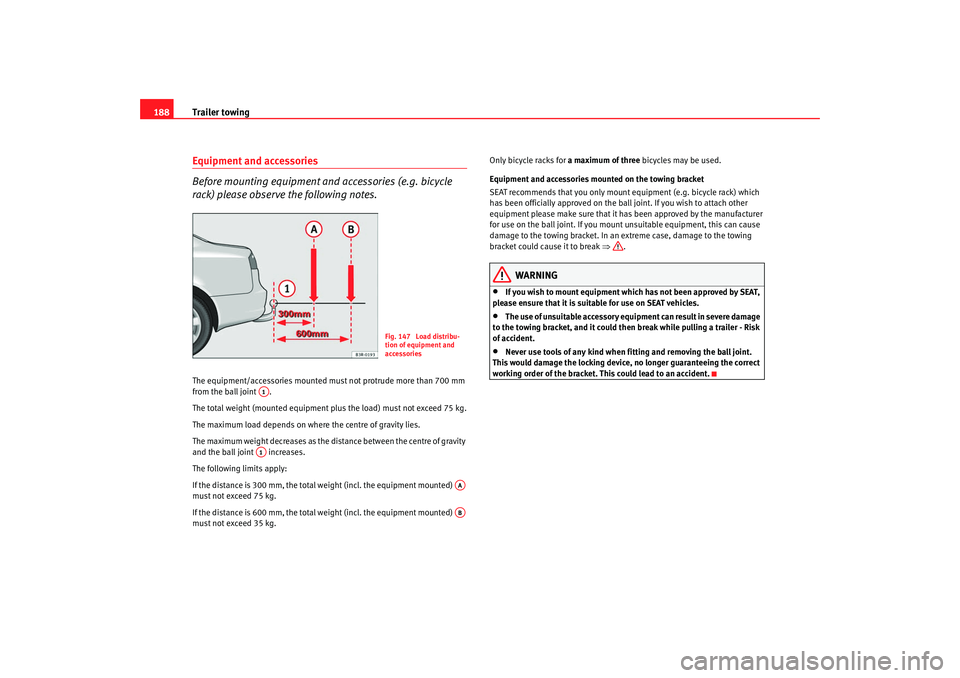
rack) please observe the following notes.The equipment/accessories mounted must not protrude more than 700 mm
from the ball joint .
The total weight (mounted equipment plus the load) must not exceed 75 kg.
The maximum load depends on where the centre of gravity lies.
The maximum weight decreases as the distance between the centre of gravity
and the ball joint increases.
The following limits apply:
If the distance is 300 mm, the total we ight (incl. the equipment mounted)
must not exceed 75 kg.
If the distance is 600 mm, the total we ight (incl. the equipment mounted)
must not exceed 35 kg. Only bicycle racks for
a maximum of three bicycles may be used.
Equipment and accessories mounted on the towing bracket
SEAT recommends that you only mount equipment (e.g. bicycle rack) which
has been officially approved on the ball joint. If you wish to attach other
equipment please make sure that it has been approved by the manufacturer
for use on the ball joint. If you mount unsuitable equipment, this can cause
damage to the towing bracket. In an extreme case, damage to the towing
bracket could cause it to break ⇒.
WARNING
•
If you wish to mount equipment which has not been approved by SEAT,
please ensure that it is suitable for use on SEAT vehicles.
•
The use of unsuitable accessory equipment can result in severe damage
to the towing bracket, and it could then break while pulling a trailer - Risk
of accident.
•
Never use tools of any kind when fitting and removing the ball joint.
This would damage the locking device , no longer guaranteeing the correct
working order of the bracket. This could lead to an accident.
Fig. 147 Load distribu-
tion of equipment and
accessories
A1A1
AAAB
Exeo_EN.book Seite 188 Freitag, 17. Oktober 2008 11:24 11
Page 191 of 303
Trailer towing189
Safety First
Operating instructions
Practical tips
Te c h n i c a l D a t a
Removable towing bracketIntroduction
Special care is required when fitting and removing the towing
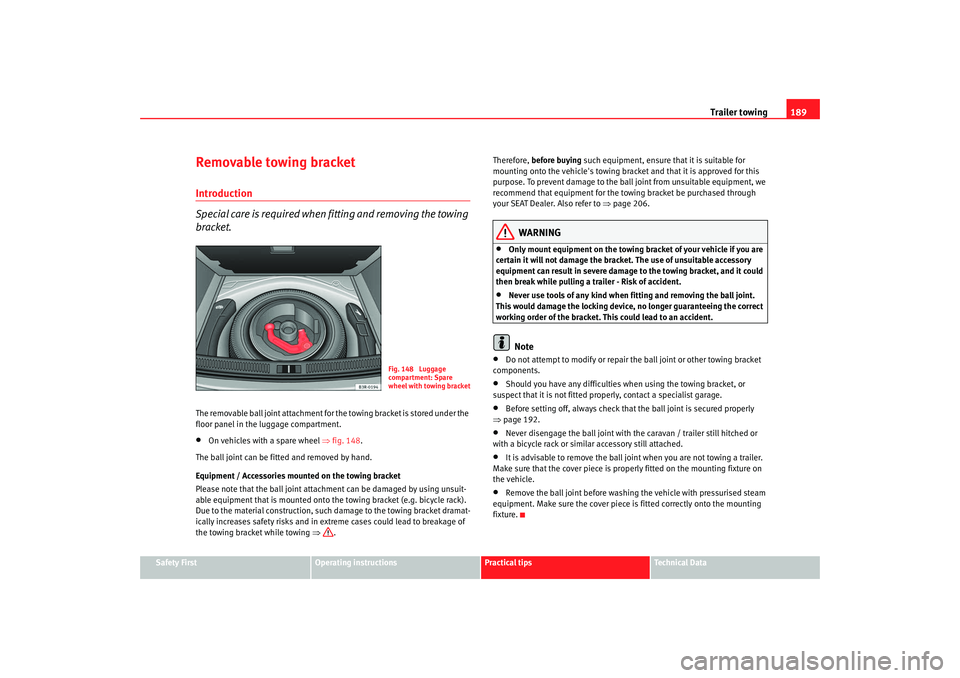
bracket.The removable ball joint attachment for the towing bracket is stored under the
floor panel in the luggage compartment.•
On vehicles with a spare wheel ⇒fig. 148 .
The ball joint can be fitted and removed by hand.
Equipment / Accessories mounted on the towing bracket
Please note that the ball joint attach ment can be damaged by using unsuit-
able equipment that is mounted onto the towing bracket (e.g. bicycle rack).
Due to the material construction, such damage to the towing bracket dramat-
ically increases safety risks and in extreme cases could lead to breakage of
the towing bracket while towing ⇒ . Therefore, before buying
such equipment, ensure that it is suitable for
mounting onto the vehicle's towing bracket and that it is approved for this
purpose. To prevent damage to the ball joint from unsuitable equipment, we
recommend that equipment for the to wing bracket be purchased through
your SEAT Dealer. Also refer to ⇒page 206.
WARNING
•
Only mount equipment on the towing bracket of your vehicle if you are
certain it will not damage the bracket. The use of unsuitable accessory
equipment can result in severe damage to the towing bracket, and it could
then break while pulling a trailer - Risk of accident.
•
Never use tools of any kind when fitting and removing the ball joint.
This would damage the locking device, no longer guaranteeing the correct
working order of the bracket. This could lead to an accident.Note
•
Do not attempt to modify or repair the ball joint or other towing bracket
components.
•
Should you have any difficulties when using the towing bracket, or
suspect that it is not fitted properly, contact a specialist garage.
•
Before setting off, always check that the ball joint is secured properly
⇒ page 192.
•
Never disengage the ball joint with the caravan / trailer still hitched or
with a bicycle rack or similar accessory still attached.
•
It is advisable to remove the ball joint when you are not towing a trailer.
Make sure that the cover piece is proper ly fitted on the mounting fixture on
the vehicle.
•
Remove the ball joint before washing the vehicle with pressurised steam
equipment. Make sure the cover piece is fitted correctly onto the mounting
fixture.
Fig. 148 Luggage
compartment: Spare
wheel with towing bracket
Exeo_EN.book Seite 189 Freitag, 17. Oktober 2008 11:24 11
Page 192 of 303
Trailer towing
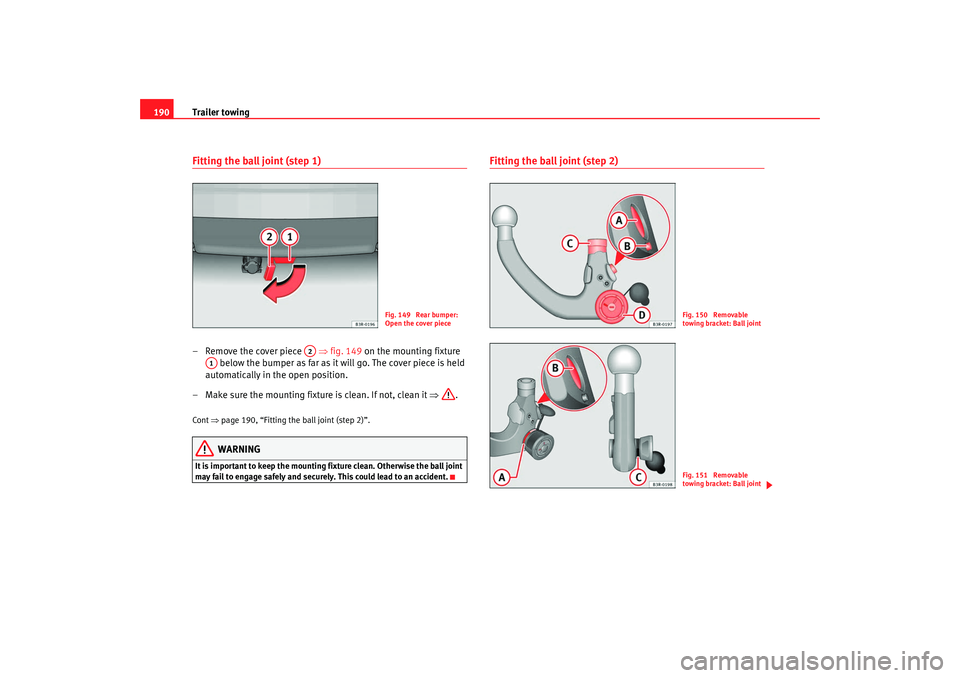
190Fitting the ball joint (step 1)– Remove the cover piece ⇒fig. 149 on the mounting fixture
below the bumper as far as it will go. The cover piece is held
automatically in the open position.
– Make sure the mounting fixture is clean. If not, clean it ⇒.Cont ⇒page 190, “Fitting the ball joint (step 2)”.
WARNING
It is important to keep the mounting fixture clean. Otherwise the ball joint
may fail to engage safely and securely. This could lead to an accident.
Fitting the ball joint (step 2)
Fig. 149 Rear bumper:
Open the cover piece
A2
A1
Fig. 150 Removable
towing bracket: Ball jointFig. 151 Removable
towing bracket: Ball joint
Exeo_EN.book Seite 190 Freitag, 17. Oktober 2008 11:24 11
Page 194 of 303
Trailer towing
192
Setting the spring mechanism to the ready position (if required)
– Insert the key ⇒page 191, fig. 152 in the lock on the knob
and turn it towards the red marking.
– Pull out the knob in direction , hold and turn in direction until the locking pin engages and the release pin moves
out visibly ⇒.
inserting the ball joint
– With the spring mechanism in the ready position, insert the ball joint into the mounting fixture and push it upwards ⇒ page 191,
fig. 153 in the direction indicated (arrow) ⇒. It should lock
into position automatically. You should now clearly hear it click
into place.
– Lock the ball joint by turning the key to the green marking.
– Remove the key.Cont ⇒page 192, “Fitting the ball joint (step 4)”.
WARNING
•
If it is not possible to set the spri ng mechanism to the ready position as
described above, do not use the ball joint. Please contact a specialist
garage.
•
To avoid injury, keep your hands away from the knob or cover piece
when inserting the ball joint in the mounting fixture. Otherwise, you could
be injured.
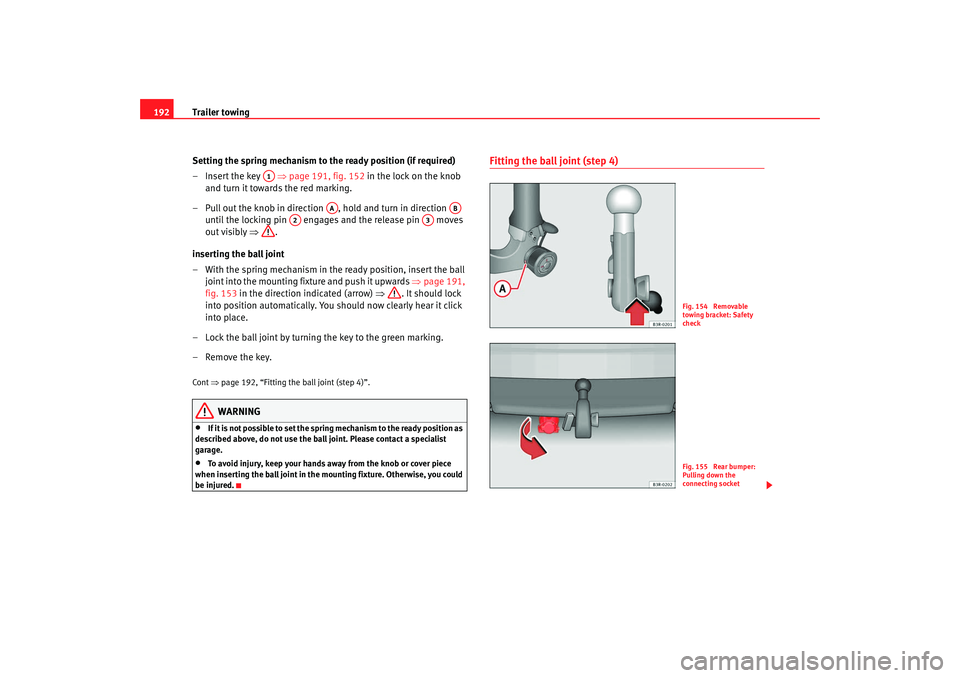
Fitting the ball joint (step 4)
A1
AA
AB
A2
A3
Fig. 154 Removable
towing bracket: Safety
checkFig. 155 Rear bumper:
Pulling down the
connecting socket
Exeo_EN.book Seite 192 Freitag, 17. Oktober 2008 11:24 11
Page 195 of 303
Trailer towing193
Safety First
Operating instructions
Practical tips
Te c h n i c a l D a t a
Safety check
– Check that the green marking ⇒page 192, fig. 154 on the
knob is inside the black zone marked on the ball joint.
– Check that the knob is directly against the ball joint, so that there is no gap between the knob and the ball joint -arrow-.
– Check that the ball joint is locked and the key is removed so that the knob cannot be pulled out ⇒.
– Check that the ball joint fits tightly in the mounting fixture (try moving it about to check).
To w i n g s o ck e t
– To plug in the electrical connection for the trailer, pull down the socket below the bumper ⇒page 192, fig. 155 .If the safety check is not satisfactory, the ball joint must be fitted again prop-
erly.
WARNING
To avoid accidents, the ball joint must meet all the safety requirements
listed in the safety check. The towing bracket must not be used if any one
of these requirements is not met. If this is the case, you should contact a
specialist garage.
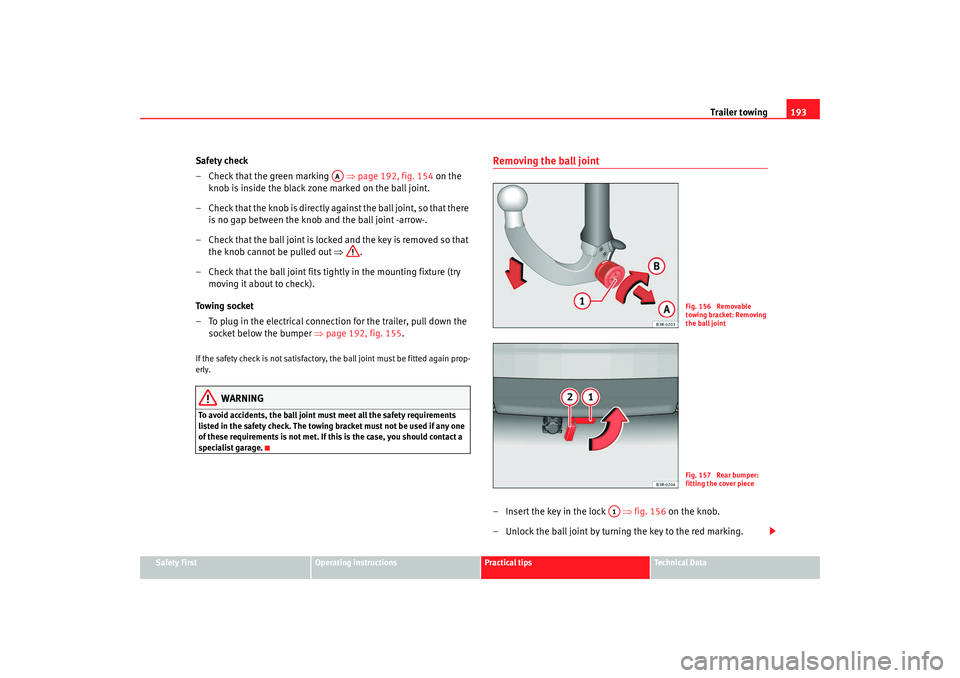
Removing the ball joint– Insert the key in the lock ⇒fig. 156 on the knob.
– Unlock the ball joint by turning the key to the red marking.
AA
Fig. 156 Removable
towing bracket: Removing
the ball jointFig. 157 Rear bumper:
fitting the cover piece
A1
Exeo_EN.book Seite 193 Freitag, 17. Oktober 2008 11:24 11
Page 196 of 303

Trailer towing
194
– Take hold of the ball joint and pull out the knob in direction .
– Keep hold of the knob and turn it as far as it will go in direction .
– Release the knob. The spring mechanism will remain in the ready position ⇒.
– Pull the ball joint down out of the mounting fixture ⇒page 193, fig. 157 . The cover piece will cover the mounting
fixture automatically .
– Put away the ball joint attachme nt under the floor panel in the
luggage compartment.
– Move the socket back up to its original position.
WARNING
•
To avoid injury, keep your hands away from the locking pin and the
release pin when releasing the locking mechanism.
•
Make sure that the cover piece is properly engaged on the mounting
fixture on the vehicle. Otherwise the ball joint may fail to engage securely
if dirt accumulates in the mounting fixture.
AA
AB
A1
A2
Exeo_EN.book Seite 194 Freitag, 17. Oktober 2008 11:24 11
Page 198 of 303
Trailer towing
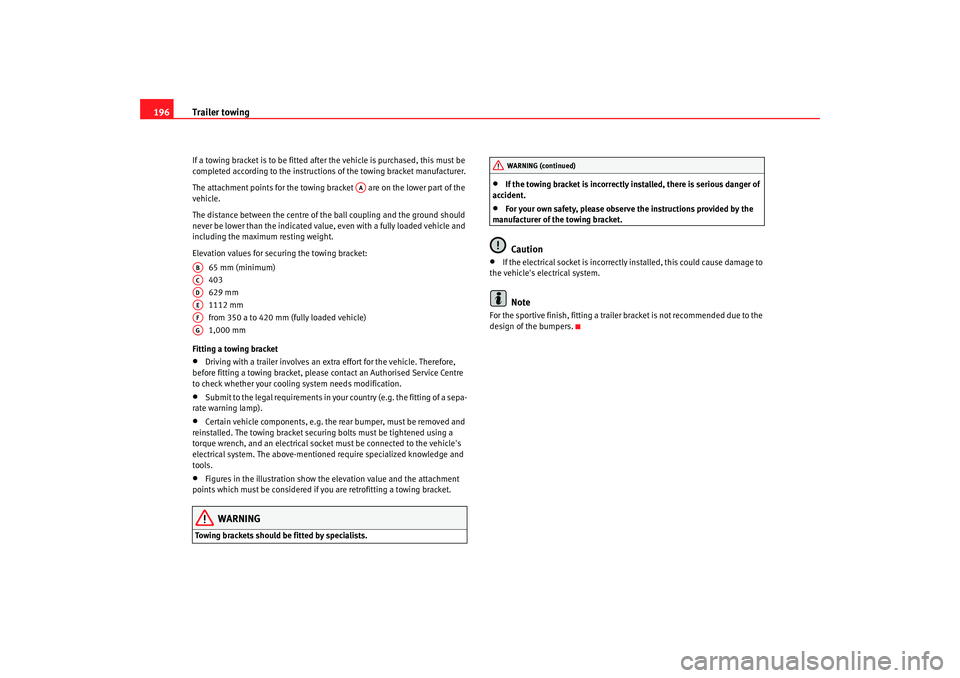
196If a towing bracket is to be fitted after the vehicle is purchased, this must be
completed according to the instructions of the towing bracket manufacturer.
The attachment points for the towing bracket are on the lower part of the
vehicle.
The distance between the centre of the ball coupling and the ground should
never be lower than the indicated value, even with a fully loaded vehicle and
including the maximum resting weight.
Elevation values for securing the towing bracket:
65 mm (minimum)
403
629 mm
1112 mm
from 350 a to 420 mm (fully loaded vehicle)
1,000 mm
Fitting a towing bracket•
Driving with a trailer involves an extra effort for the vehicle. Therefore,
before fitting a towing bracket, please contact an Authorised Service Centre
to check whether your cooling system needs modification.
•
Submit to the legal requirements in your country (e.g. the fitting of a sepa-
rate warning lamp).
•
Certain vehicle components, e.g. the rear bumper, must be removed and
reinstalled. The towing bracket securin g bolts must be tightened using a
torque wrench, and an electrical socket must be connected to the vehicle's
electrical system. The above-mentione d require specialized knowledge and
tools.
•
Figures in the illustration show the elevation value and the attachment
points which must be considered if you are retrofitting a towing bracket.
WARNING
Towing brackets should be fitted by specialists.
•
If the towing bracket is incorrectly installed, there is serious danger of
accident.
•
For your own safety, please observe the instructions provided by the
manufacturer of the towing bracket.Caution
•
If the electrical socket is incorrectly installed, this could cause damage to
the vehicle's electrical system.Note
For the sportive finish, fitting a trailer bracket is not recommended due to the
design of the bumpers.
AA
ABACADAEAFAG
WARNING (continued)
Exeo_EN.book Seite 196 Freitag, 17. Oktober 2008 11:24 11
Page 199 of 303
Your vehicle maintenance and cleaning197
Safety First
Operating instructions
Practical tips
Te c h n i c a l D a t a
Your vehicle maintenance and cleaningGeneral notesRegular washing and care help maintain the value of your
vehicle.Your vehicle maintenance
Regular care and washing help to maintain the value of the vehicle. This may
also be one of the requirements for acknowledging warranty claims in the
event of bodywork corr osion or paint defects.
The best way to protect your car against the harmful effects of the environ-
ment is through correct maintenance and frequent washing. The longer
substances such as insects remains, bird droppings, resinous tree sap, road
dirt, industrial deposits, tar, soot or road salt and other aggressive materials
remain on the vehicle, the more damage they do to the paintwork. High
temperatures (for instance in strong sunlight) further intensify the corrosive
effect.
After winter, a period when salt is put on the roads, it is important to have the
underside of the vehicle washed thoroughly.
Products for vehicle maintenance
Car care products are available in your Authorised Service Centre. Keep the
product instructions until you have used them up.
WARNING
•
Car care products can be toxic. For this, they must always be kept
closed in their original container. Keep them out of the reach of children.
Failure to comply could result in poisoning.
•
Always read and observe the instructions and warnings on the package
before using car care products. Improper use could damage your health or your vehicle. The use of certain products may produce noxious vapours;
they should be used in well ventilated areas.
•
Never use fuel, turpentine, engine oil, nail varnish remover or other
volatile fluids. These are toxic and highly flammable. Risk of fire and explo-
sion.
•
Before washing your vehicle, or carrying out any maintenance, switch
the engine off, apply your handbrake firmly and remove the key from the
ignition.Caution
Never attempt to remove dirt, mud or dust if the surface of the vehicle is dry.
Never use a dry cloth or sponge for clea ning purposes. This could damage the
paintwork or the windows of your vehicle. Soak dirt, mud or dust with plenty
of water.
For the sake of the environment
•
When purchasing products for your vehicle maintenance, select the ones
which are not harmful to the environment.
•
The leftovers of the car care products should not be disposed of with ordi-
nary household waste. Observe the disposal information on the package.WARNING (continued)
Exeo_EN.book Seite 197 Freitag, 17. Oktober 2008 11:24 11
Page 200 of 303
Your vehicle maintenance and cleaning
198Vehicle exterior maintenanceAutomatic car wash tunnel
The car can normally be washed without problem in an auto-
matic car wash.The vehicle paintwork is so durable that the car can normally be washed
without problems in an automatic car washing tunnel. However, the paint-
work wear depends to a large extent, on the kind of the car washing tunnel,
the brushes used, its water filtering and the type of cleaning and preservative
products.
Before going through a car wash, be sure to take the usual precautions such
as closing the windows and sunroof. There is nothing to note apart from that.
If the vehicle has special accessories such as spoilers or a roof carrier or two-
way radio aerial, etc., it is advisable to consult the car washing tunnel oper-
ator.
After washing, the brakes could hesitate to respond as the brake discs and
pads could be wet, or even frozen in winter. “Dry” the brakes by braking
several times.
WARNING
Water, ice and salt on the brakes can reduce braking efficiency. Risk of
accident.Washing by handVe hicle washing
– First soften the dirt with plenty of water and rinse it off. – Clea n you r vehicle from top to bo ttom with a soft sponge, a g love
or a brush. Use very light pressure.
– Rinse the sponge or glove often with clean water.
– Special car shampoo should only be used for very stubborn dirt.
– Clean the wheels, sill panels etc. until last with a different sponge or glove.
– Rinse the vehicle thoroughly with water.
– Dry your vehicle surface gently with a chamois leather.
–When temperature is cold , dry the rubber seals and its surfaces
to prevent them from freezing. Ap ply silicone spray to the rubber
seals.
After washing
– Directly after washing, avoid sudden and sharp braking. “Dry” ⇒page 181, “Braking effect and braking distance”the brakes by
braking several times.
WARNING
•
Wash your car with the ignition switched off.
•
Protect your hands and arms from cuts on sharp metal edges when
cleaning the underbody, the inside of the wheel housings etc. Risk of
injury.
•
Water, ice and salt on the brakes can reduce braking efficiency. Risk of
accident.
Exeo_EN.book Seite 198 Freitag, 17. Oktober 2008 11:24 11