airbag off Seat Exeo 2008 User Guide
[x] Cancel search | Manufacturer: SEAT, Model Year: 2008, Model line: Exeo, Model: Seat Exeo 2008Pages: 303, PDF Size: 10.02 MB
Page 46 of 303
Airbag system
44Deactivating airbags*Disabling front passenger airbag
If you fit a rear-facing child seat to the front passenger seat,
the front passenger airbag must be de-activated.
When the passenger airbag is deactivated, this means that only the
frontal airbag is deactivated. All the other airbags in the vehicle
remain functional.
Disabling front passenger airbag
– Switch the ignition on.
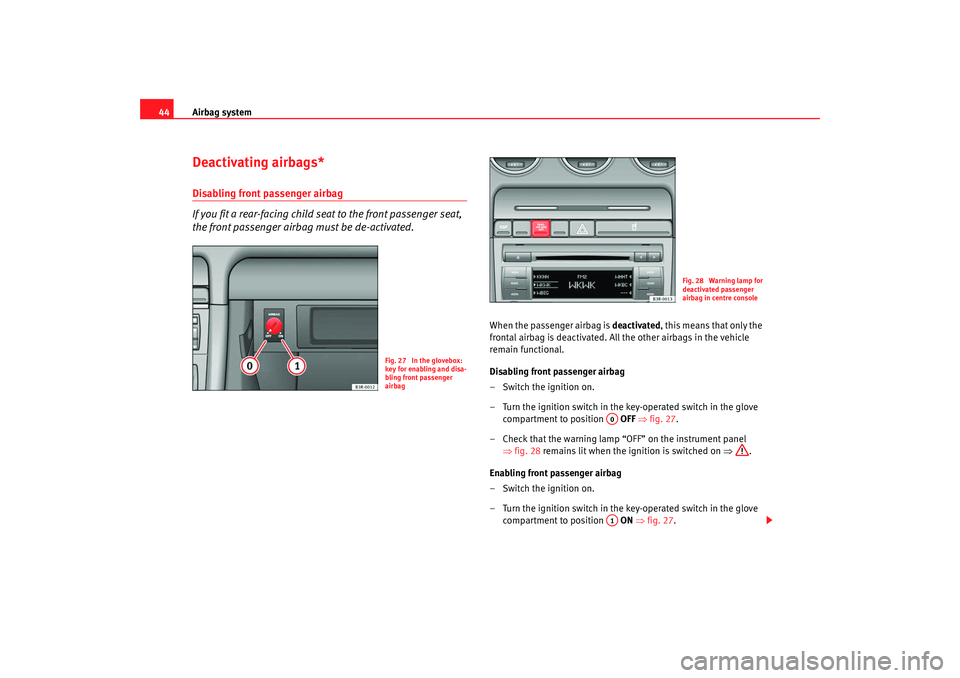
– Turn the ignition switch in the key-operated switch in the glove compartment to position OFF ⇒ fig. 27.
– Check that the warning lamp “OFF” on the instrument panel ⇒fig. 28 remains lit when the ignition is switched on ⇒.
Enabling front passenger airbag
– Switch the ignition on.
– Turn the ignition switch in the key-operated switch in the glove compartment to position ON ⇒ fig. 27 .
Fig. 27 In the glovebox:
key for enabling and disa-
bling front passenger
airbag
Fig. 28 Warning lamp for
deactivated passenger
airbag in centre console
A0A1
Exeo_EN.book Seite 44 Freitag, 17. Oktober 2008 11:24 11
Page 47 of 303
Airbag system45
Safety First
Operating instructions
Practical tips
Te c h n i c a l D a t a
– Check that the warning lamp on the instrument panel does
⇒page 44, fig. 28 not light up when the ignition is switched on
⇒ .
WARNING
•
The driver is responsible for the proper position of the key-operated
switch.
•
You should deactivate the front passenger airbag only if you have to use
a rear-facing child seat in exceptional cases ⇒page 46, “Child safety”.
•
Never install a child seat facing backwards (or rear-facing) on the front
passenger seat unless the front passenger airbag has been disabled. This
represents a risk of fatal injuries to th e child! However, if it is necessary in
exceptional circumstances to transport a child in a rear-facing child seat on
the front passenger seat, you must always disable the front passenger
airbag.
•
As soon as the child seat is no longer needed on the front passenger
seat, enable the front passenger airbag again.
•
Only deactivate the passenger airbag when the ignition is off, other-
wise a fault may occur in the airbag system, this will create a danger that
in case of an accident, the airbag do es not deploy properly or does not
deploy at all.
•
When the passenger airbag is deactivated, if the warning lamp AIRBAG
OFF is not continuously lit up when the front passenger airbag is disabled,
there may be a fault in the airbag system:
−Have the airbag system inspected immediately by a qualified work-
shop.
− Do not use a child seat on the front passenger seat! The front
passenger airbag could be triggered despite the fact that there is a fault
in the system and, as a result, a child could sustain serious or fatal inju-
ries. −
It is predictable whether the front passenger airbag will deploy
during an accident! Warn all your passengers of this.
•
When using the ignition key to activate / deactivate the passenger front
airbag, only the passenger front airbag will be activated / deactivated. The
side airbag and head airbag on the passenger side will remain active.WARNING (continued)
Exeo_EN.book Seite 45 Freitag, 17. Oktober 2008 11:24 11
Page 49 of 303
Child safety47
Safety First
Operating instructions
Practical tips
Te c h n i c a l D a t a
“Deactivating airbags*”. If the passe
nger seat has a height adjustment
option, move it to the highest position.
•
For those vehicles that do not include a key lock switch to turn the
airbag off, an Authorised Service Centre must be consulted.
•
All passengers, especially children, must assume the proper sitting
position and be properly belted in while travelling.
•
Never hold children or babies on your lap, this can result in potentially
fatal injuries to the child!
•
Never allow a child to be transported in a vehicle without being properly
secured, or to stand up or kneel on a seat while travelling. In an accident,
the child could be flung through the vehicle, causing possibly fatal injuries
to themselves and to the other passengers.
•
If children assume an improper sitting position when the car is moving,
they expose themselves to greater ri sk of injury in the event of sudden
braking manoeuvre or in an accident. This is particularly important if the
child is travelling on the front passenger seat and the airbag system is trig-
gered in an accident; as this could cause serious injury or even death.
•
A suitable child seat can protect your child!
•
Never leave an unsupervised child alone on a child seat or in the
vehicle.
•
Depending on weather conditions, it may become extremely hot or cold
inside the vehicle. This can be fatal.
•
Children who are less than 1.5 metres tall must not wear a normal seat
belt without a child restraint system, as this could cause injuries to the
abdominal and neck areas during a sudden braking manoeuvre or in an
accident.
•
Do not allow the belt webbing to become twisted or jammed, or to rub
on any sharp edges.
•
Incorrectly worn seat belts can cause injuries even in a minor collision
or in sudden braking manoeuvres.
•
The seat belt provides maximum protection only when the belt web is
properly positioned ⇒page 22, “Seat belts”.
•
Only one child may occupy a child seat ⇒page 48, “Child seats”.
WARNING (continued)
WARNING (continued)
Exeo_EN.book Seite 47 Freitag, 17. Oktober 2008 11:24 11
Page 59 of 303
Cockpit57
Safety First
Operating instructions
Practical tips
Te c h n i c a l D a t a
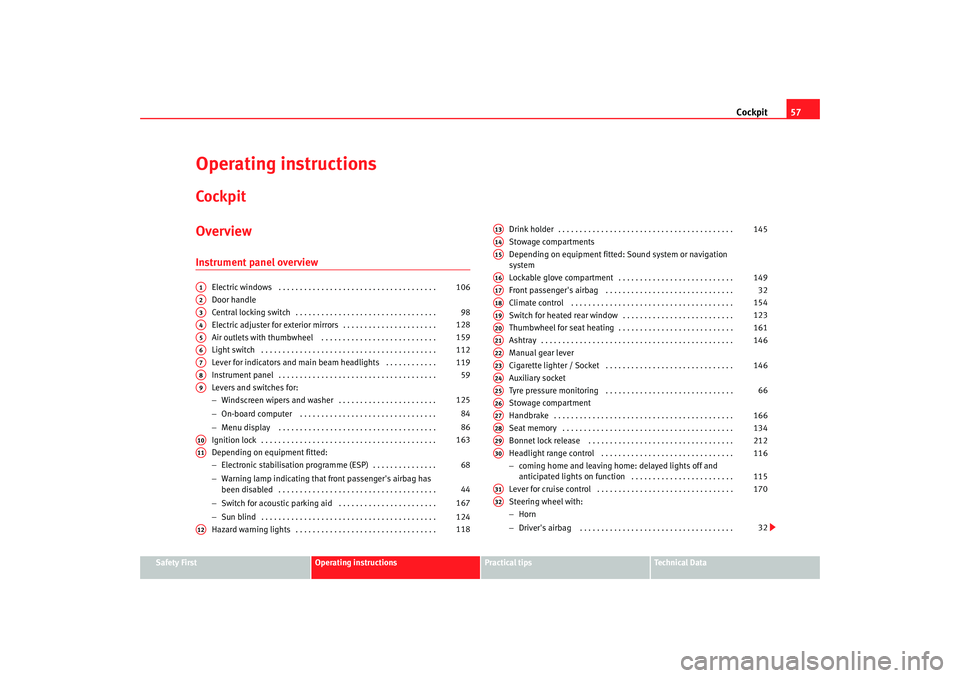
Operating instructionsCockpitOverviewInstrument panel overview
Electric windows . . . . . . . . . . . . . . . . . . . . . . . . . . . . . . . . . . . . .
Door handle
Central locking switch . . . . . . . . . . . . . . . . . . . . . . . . . . . . . . . . .
Electric adjuster for exterior mirrors . . . . . . . . . . . . . . . . . . . . . .
Air outlets with thumbwheel . . . . . . . . . . . . . . . . . . . . . . . . . . .
Light switch . . . . . . . . . . . . . . . . . . . . . . . . . . . . . . . . . . . . . . . . .
Lever for indicators and main beam headlights . . . . . . . . . . . .
Instrument panel . . . . . . . . . . . . . . . . . . . . . . . . . . . . . . . . . . . . .
Levers and switches for:
−Windscreen wipers and washer . . . . . . . . . . . . . . . . . . . . . . .
− On-board computer . . . . . . . . . . . . . . . . . . . . . . . . . . . . . . . .
− Menu display . . . . . . . . . . . . . . . . . . . . . . . . . . . . . . . . . . . . .
Ignition lock . . . . . . . . . . . . . . . . . . . . . . . . . . . . . . . . . . . . . . . . .
Depending on equipment fitted:
− Electronic stabilisation programme (ESP) . . . . . . . . . . . . . . .
− Warning lamp indicating that front passenger's airbag has
been disabled . . . . . . . . . . . . . . . . . . . . . . . . . . . . . . . . . . . . .
− Switch for acoustic parking aid . . . . . . . . . . . . . . . . . . . . . . .
− Sun blind . . . . . . . . . . . . . . . . . . . . . . . . . . . . . . . . . . . . . . . . .
Hazard warning lights . . . . . . . . . . . . . . . . . . . . . . . . . . . . . . . . . Drink holder . . . . . . . . . . . . . . . . . . . . . . . . . . . . . . . . . . . . . . . . .
Stowage compartments
Depending on equipment fitted: Sound system or navigation
system
Lockable glove compartment . . . . . . . . . . . . . . . . . . . . . . . . . . .
Front passenger's airbag . . . . . . . . . . . . . . . . . . . . . . . . . . . . . .
Climate control . . . . . . . . . . . . . . . . . . . . . . . . . . . . . . . . . . . . . .
Switch for heated rear window . . . . . . . . . . . . . . . . . . . . . . . . . .
Thumbwheel for seat heating . . . . . . . . . . . . . . . . . . . . . . . . . . .
Ashtray . . . . . . . . . . . . . . . . . . . . . . . . . . . . . . . . . . . . . . . . . . . . .
Manual gear lever
Cigarette lighter / Socket . . . . . . . . . . . . . . . . . . . . . . . . . . . . . .
Auxiliary socket
Tyre pressure monitoring . . . . . . . . . . . . . . . . . . . . . . . . . . . . . .
Stowage compartment
Handbrake . . . . . . . . . . . . . . . . . . . . . . . . . . . . . . . . . . . . . . . . . .
Seat memory . . . . . . . . . . . . . . . . . . . . . . . . . . . . . . . . . . . . . . . .
Bonnet lock release . . . . . . . . . . . . . . . . . . . . . . . . . . . . . . . . . .
Headlight range control . . . . . . . . . . . . . . . . . . . . . . . . . . . . . . .
−
coming home and leaving home : delayed lights off and
anticipated lights on function . . . . . . . . . . . . . . . . . . . . . . . .
Lever for cruise control . . . . . . . . . . . . . . . . . . . . . . . . . . . . . . . .
Steering wheel with:
− Horn
− Driver's airbag . . . . . . . . . . . . . . . . . . . . . . . . . . . . . . . . . . . .
A1
106
A2A3
98
A4
128
A5
159
A6
112
A7
119
A8
59
A9
125
84
86
A10
163
A11
68
44
167
124
A12
118
A13
145
A14A15A16
149
A17
32
A18
154
A19
123
A20
161
A21
146
A22A23
146
A24A25
66
A26A27
166
A28
134
A29
212
A30
116
115
A31
170
A32
32
Exeo_EN.book Seite 57 Freitag, 17. Oktober 2008 11:24 11
Page 100 of 303
Unlocking and locking
98•
The driver's door cannot be locked using the central locking system when
it is still open. The door must be lo cked separately after it has been closed.
This helps to prevent you from being locked out of the vehicle.
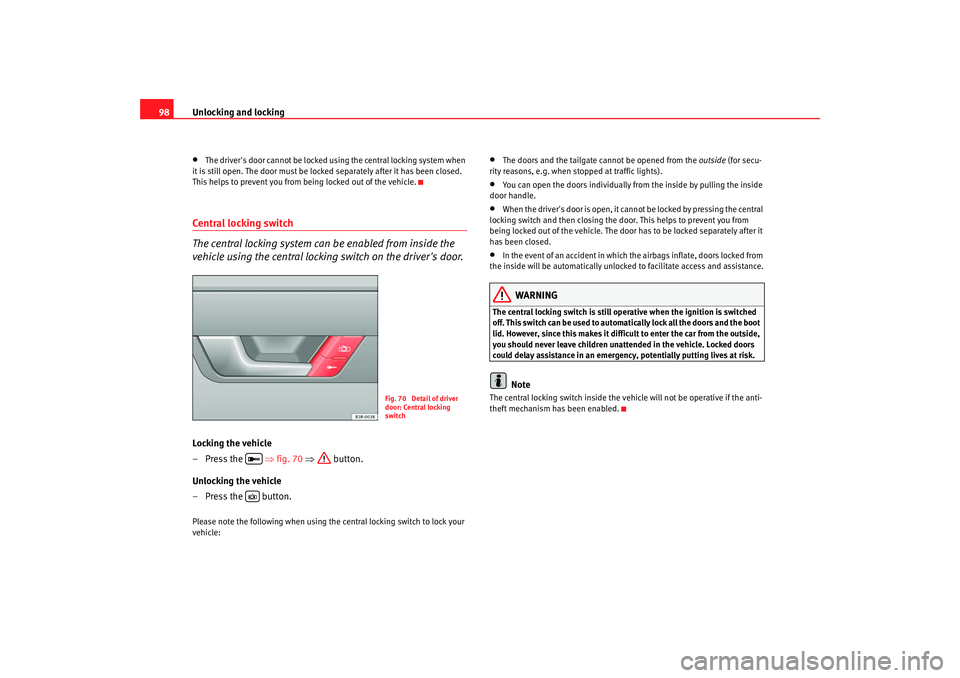
Central locking switch
The central locking system can be enabled from inside the
vehicle using the central locking switch on the driver's door.Locking the vehicle
– Press the ⇒fig. 70 ⇒ button.
Unlocking the vehicle
– Press the button.Please note the following when using the central lock ing switch to lock your
vehicle:
•
The doors and the tailgate ca nnot be opened from the outside (for secu-
rity reasons, e.g. when stopped at traffic lights).
•
You can open the doors individually from the inside by pulling the inside
door handle.
•
When the driver's door is open, it cannot be locked by pressing the central
locking switch and then closing the door. This helps to prevent you from
being locked out of the vehicle. The door has to be locked separately after it
has been closed.
•
In the event of an accident in which the airbags inflate, doors locked from
the inside will be automatically unlocked to facilitate access and assistance.
WARNING
The central locking switch is still op erative when the ignition is switched
off. This switch can be used to autom atically lock all the doors and the boot
lid. However, since this makes it difficu lt to enter the car from the outside,
you should never leave children unattended in the vehicle. Locked doors
could delay assistance in an emergency, potentially putting lives at risk.
Note
The central locking switch inside the vehicle will not be operative if the anti-
theft mechanism has been enabled.
Fig. 70 Detail of driver
door: Central locking
switch
Exeo_EN.book Seite 98 Freitag, 17. Oktober 2008 11:24 11
Page 121 of 303
Lights and visibility119
Safety First
Operating instructions
Practical tips
Te c h n i c a l D a t a
–Press the switch
⇒ page 118, fig. 90 to switch the hazard
warning lights on or off.
All four indicators flash simultaneously when the hazard warning lights are
switched on. The hazard warning light indication lamps
and the turn
signal indication lamp itself
flash at the same time. The hazard warning
lights also work when the ignition is switched off.
In an accident in which the airbags ar e triggered, the hazard warning lights
are switched on automatically.
Note
You should switch on the hazard warning lights to warn other road users, e.g.•
When reaching the tail end of a traffic jam
•
If your vehicle breaks down or there is an emergency
•
If your vehicle is being towed away or if you are towing another vehicle
Indicator
and main beam headlight lever
The turn signal and main beam headlight lever also operates
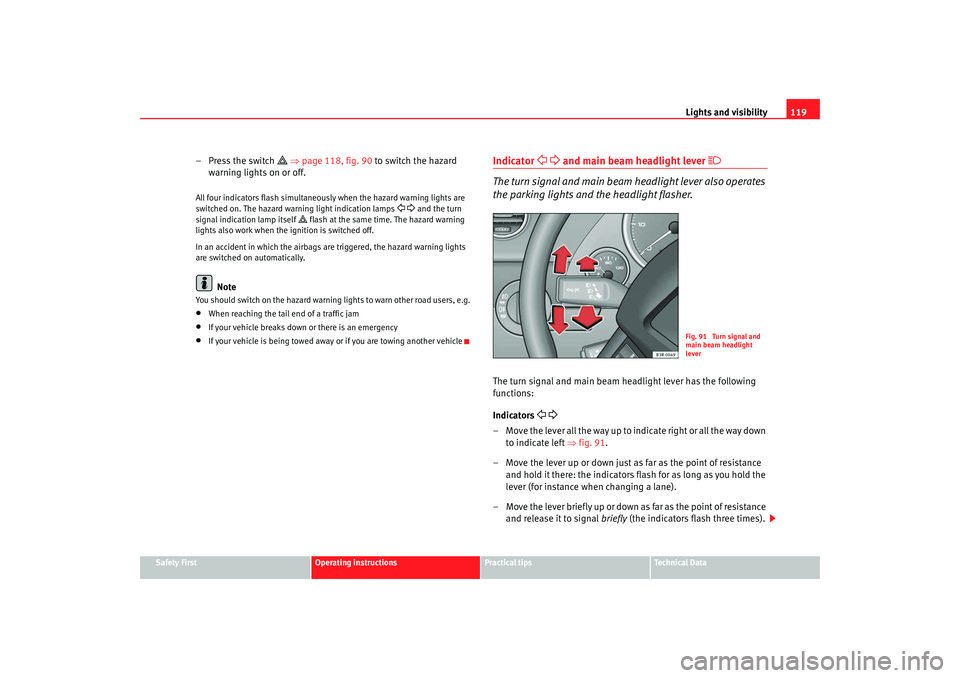
the parking lights and the headlight flasher.The turn signal and main beam headlight lever has the following
functions:
Indicators
– Move the lever all the way up to indicate right or all the way down to indicate left ⇒fig. 91 .
–Move the lever up or down just as far as the point of resistance
and hold it there: the indicators flash for as long as you hold the
lever (for instance when changing a lane).
– Move the lever briefly up or down as far as the point of resistance and release it to signal briefly (the indicators flash three times).
Fig. 91 Turn signal and
main beam headlight
lever
Exeo_EN.book Seite 119 Freitag, 17. Oktober 2008 11:24 11
Page 133 of 303
Seats and stowage131
Safety First
Operating instructions
Practical tips
Te c h n i c a l D a t a
•
Be careful when adjusting the seat he ight. Injuries can be caused if the
height is adjusted without due care and attention.
Adjusting the backrest angle– Lean forwards to take your weight off the backrest.
– Turn the adjuster wheel ⇒page 130, fig. 104 to set the angle
of the backrest as required.
WARNING
The front backrests must not be reclined for driving. Otherwise, safety
belts and the airbag system might no t protect as they should, with the
subsequent danger of injury.
WARNING (continued)
A4
Exeo_EN.book Seite 131 Freitag, 17. Oktober 2008 11:24 11
Page 135 of 303
Seats and stowage133
Safety First
Operating instructions
Practical tips
Te c h n i c a l D a t a
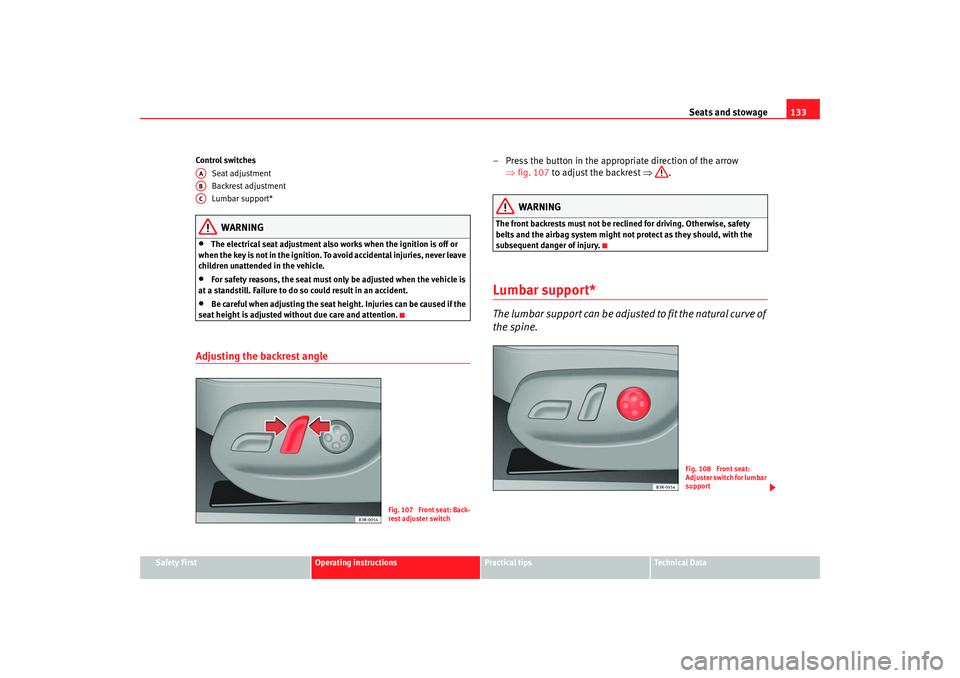
Control switches
Seat adjustment
Backrest adjustment
Lumbar support*
WARNING
•
The electrical seat adjustment also works when the ignition is off or
when the key is not in th e ignition. To avoid accidental injuries, never leave
children unattended in the vehicle.
•
For safety reasons, the seat must on ly be adjusted when the vehicle is
at a standstill. Failure to do so could result in an accident.
•
Be careful when adjusting the seat h eight. Injuries can be caused if the
seat height is adjusted with out due care and attention.
Adjusting the backrest angle
– Press the button in the appropriate direction of the arrow
⇒fig. 107 to adjust the backrest ⇒.
WARNING
The front backrests must not be reclin ed for driving. Otherwise, safety
belts and the airbag system might no t protect as they should, with the
subsequent danger of injury.Lumbar support*The lumbar support can be adjust ed to fit the natural curve of
the spine.
AAABAC
Fig. 107 Front seat: Back-
rest adjuster switch
Fig. 108 Front seat:
Adjuster switch for lumbar
support
Exeo_EN.book Seite 133 Freitag, 17. Oktober 2008 11:24 11
Page 152 of 303
Seats and stowage
150
WARNING
For safety reasons, the glove compartment must always be closed when
the vehicle is moving. Failure to do so could result in an accident.Cool box in glove compartment
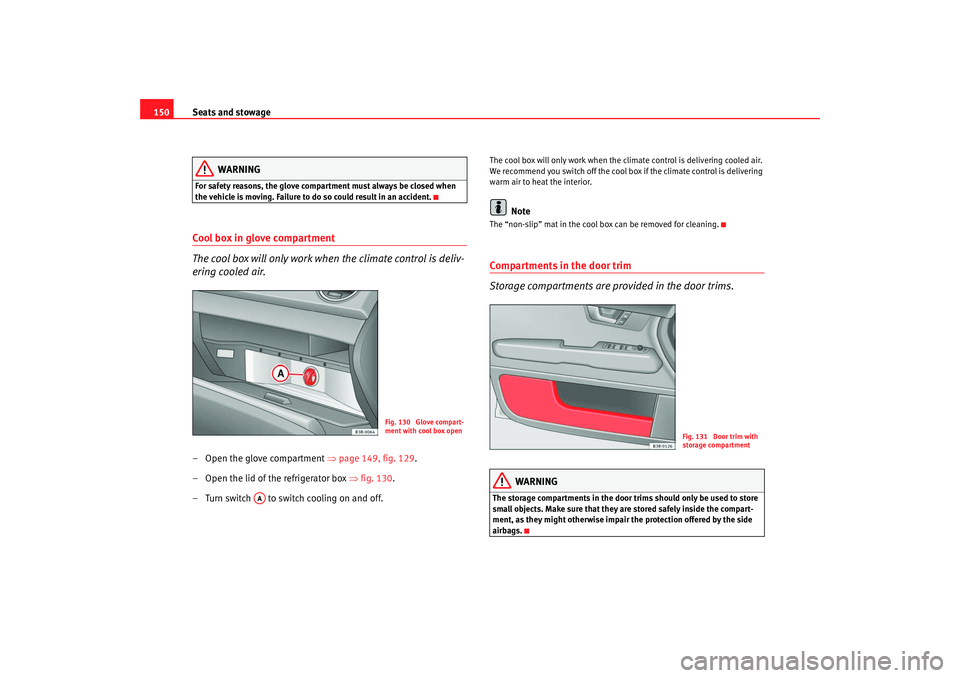
The cool box will only work when the climate control is deliv-
ering cooled air.– Open the glove compartment ⇒page 149, fig. 129 .
– Open the lid of the refrigerator box ⇒fig. 130 .
– Turn switch to switch cooling on and off.
The cool box will only work when the climate control is delivering cooled air.
We recommend you switch off the cool box if the climate control is delivering
warm air to heat the interior.
Note
The “non-slip” mat in the cool box can be removed for cleaning.Compartments in the door trim
Storage compartments are provided in the door trims.
WARNING
The storage compartments in the door trims should only be used to store
small objects. Make sure that they are stored safely inside the compart-
ment, as they might otherwise impair the protection offered by the side
airbags.
Fig. 130 Glove compart-
ment with cool box open
AA
Fig. 131 Door trim with
storage compartment
Exeo_EN.book Seite 150 Freitag, 17. Oktober 2008 11:24 11
Page 205 of 303
Your vehicle maintenance and cleaning203
Safety First
Operating instructions
Practical tips
Te c h n i c a l D a t a
Cleaning the engine compartment
Take special care when cleaning the engine compartment.Anti-corrosion treatment
The engine compartment and the surface of the power unit are given anti-
corrosion treatment at the factory.
Good corrosion protection is particularly important in winter when the car is
frequently driven on salted roads. To prevent the salt corroding the vehicle,
the entire engine compartment should be thoroughly cleaned before and
after winter.
Your Authorised Service Centre has got the necessary equipment to provide
the correct cleaning and preserving products. For this reason, we recommend
having this work performed by them.
The anti-corrosion protection is usua lly removed if the engine compartment
is cleaned with grease removing solution s, or if you have the engine cleaned.
On commissioning theis work, ensure that all surfaces, seams, joints and
components in the engine compartmen t are given anti-corrosion treatment.
WARNING
•
When working in the engine compartment, always observe the safety
warnings ⇒ page 213
•
Before opening the bonnet, switch the engine off, apply the parking
brake firmly and always remove the key from the ignition.
•
Allow the engine to cool before you clean the engine compartment.
•
Do not clean the vehicle underbody, wheel arches without protecting
your hands and arms. You may cut your self on sharp-edged metal parts.
Failure to comply could result in injury.
•
Moisture, ice and salt on the brakes may affect braking efficiency. Risk
of accident. Directly after washing, avoid sudden and sharp braking.
•
Never touch the radiator fan. It is temperature-controlled and could
start automatically, even when the key is removed from the ignition!For the sake of the environment
Fuel, grease and oil deposits could be removed when the engine is washed.
The polluted water must be cleaned in an oil separator. For this reason,
engine washing should be carried out on ly by a qualified workshop or a petrol
station.Vehicle interior maintenancePlastic parts and dash panel cleaning– Use a clean, damp cloth to clean plastic parts and the dash panel.
– If this does not provide satisfactory results, use a special solvent-free plastic cleaning product.
WARNING
Never clean the dash panel and the airbag module surface with cleansers
containing solvents. Solvents cause the surface to become porous. If the
airbag triggered, disintegrating plastic parts could cause substantial inju-
ries.
WARNING (continued)
Exeo_EN.book Seite 203 Freitag, 17. Oktober 2008 11:24 11