warning Seat Exeo 2008 Owner's manual
[x] Cancel search | Manufacturer: SEAT, Model Year: 2008, Model line: Exeo, Model: Seat Exeo 2008Pages: 303, PDF Size: 10.02 MB
Page 5 of 303
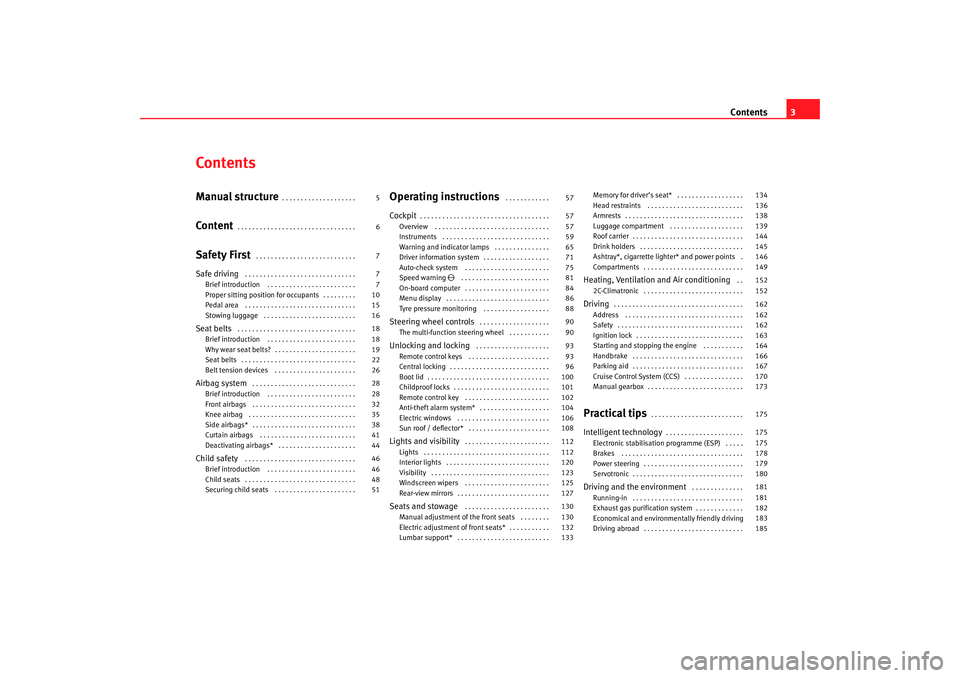
Contents3
ContentsManual structure
. . . . . . . . . . . . . . . . . . . .
Content
. . . . . . . . . . . . . . . . . . . . . . . . . . . . . . . .
Safety First
. . . . . . . . . . . . . . . . . . . . . . . . . . .
Safe driving
. . . . . . . . . . . . . . . . . . . . . . . . . . . . . .
Brief introduction . . . . . . . . . . . . . . . . . . . . . . . .
Proper sitting position for occupants . . . . . . . . .
Pedal area . . . . . . . . . . . . . . . . . . . . . . . . . . . . . .
Stowing luggage . . . . . . . . . . . . . . . . . . . . . . . . .
Seat belts
. . . . . . . . . . . . . . . . . . . . . . . . . . . . . . . .
Brief introduction . . . . . . . . . . . . . . . . . . . . . . . .
Why wear seat belts? . . . . . . . . . . . . . . . . . . . . . .
Seat belts . . . . . . . . . . . . . . . . . . . . . . . . . . . . . . .
Belt tension devices . . . . . . . . . . . . . . . . . . . . . .
Airbag system
. . . . . . . . . . . . . . . . . . . . . . . . . . . .
Brief introduction . . . . . . . . . . . . . . . . . . . . . . . .
Front airbags . . . . . . . . . . . . . . . . . . . . . . . . . . . .
Knee airbag . . . . . . . . . . . . . . . . . . . . . . . . . . . . .
Side airbags* . . . . . . . . . . . . . . . . . . . . . . . . . . . .
Curtain airbags . . . . . . . . . . . . . . . . . . . . . . . . . .
Deactivating airbags* . . . . . . . . . . . . . . . . . . . . .
Child safety
. . . . . . . . . . . . . . . . . . . . . . . . . . . . . .
Brief introduction . . . . . . . . . . . . . . . . . . . . . . . .
Child seats . . . . . . . . . . . . . . . . . . . . . . . . . . . . . .
Securing child seats . . . . . . . . . . . . . . . . . . . . . .
Operating instructions
. . . . . . . . . . . .
Cockpit
. . . . . . . . . . . . . . . . . . . . . . . . . . . . . . . . . . .
Overview . . . . . . . . . . . . . . . . . . . . . . . . . . . . . . .
Instruments . . . . . . . . . . . . . . . . . . . . . . . . . . . . .
Warning and indicator lamps . . . . . . . . . . . . . . .
Driver information system . . . . . . . . . . . . . . . . . .
Auto-check system . . . . . . . . . . . . . . . . . . . . . . .
Speed warning . . . . . . . . . . . . . . . . . . . . . . . .
On-board computer . . . . . . . . . . . . . . . . . . . . . . .
Menu display . . . . . . . . . . . . . . . . . . . . . . . . . . . .
Tyre pressure monitoring . . . . . . . . . . . . . . . . . .
Steering wheel controls
. . . . . . . . . . . . . . . . . . .
The multi-function steering wheel . . . . . . . . . . .
Unlocking and locking
. . . . . . . . . . . . . . . . . . . .
Remote control keys . . . . . . . . . . . . . . . . . . . . . .
Central locking . . . . . . . . . . . . . . . . . . . . . . . . . . .
Boot lid . . . . . . . . . . . . . . . . . . . . . . . . . . . . . . . . .
Childproof locks . . . . . . . . . . . . . . . . . . . . . . . . . .
Remote control key . . . . . . . . . . . . . . . . . . . . . . .
Anti-theft alarm system* . . . . . . . . . . . . . . . . . . .
Electric windows . . . . . . . . . . . . . . . . . . . . . . . . .
Sun roof / deflector* . . . . . . . . . . . . . . . . . . . . . .
Lights and visibility
. . . . . . . . . . . . . . . . . . . . . . .
Lights . . . . . . . . . . . . . . . . . . . . . . . . . . . . . . . . . .
Interior lights . . . . . . . . . . . . . . . . . . . . . . . . . . . .
Visibility . . . . . . . . . . . . . . . . . . . . . . . . . . . . . . . .
Windscreen wipers . . . . . . . . . . . . . . . . . . . . . . .
Rear-view mirrors . . . . . . . . . . . . . . . . . . . . . . . . .
Seats and stowage
. . . . . . . . . . . . . . . . . . . . . . .
Manual adjustment of the front seats . . . . . . . .
Electric adjustment of front seats* . . . . . . . . . . .
Lumbar support* . . . . . . . . . . . . . . . . . . . . . . . . . Memory for driver’s seat* . . . . . . . . . . . . . . . . . .
Head restraints . . . . . . . . . . . . . . . . . . . . . . . . . .
Armrests . . . . . . . . . . . . . . . . . . . . . . . . . . . . . . . .
Luggage compartment . . . . . . . . . . . . . . . . . . . .
Roof carrier . . . . . . . . . . . . . . . . . . . . . . . . . . . . . .
Drink holders . . . . . . . . . . . . . . . . . . . . . . . . . . . .
Ashtray*, cigarrette lighter* and power points .
Compartments . . . . . . . . . . . . . . . . . . . . . . . . . . .
Heating, Ventilation and Air conditioning
. .
2C-Climatronic . . . . . . . . . . . . . . . . . . . . . . . . . . .
Driving
. . . . . . . . . . . . . . . . . . . . . . . . . . . . . . . . . . .
Address . . . . . . . . . . . . . . . . . . . . . . . . . . . . . . . .
Safety . . . . . . . . . . . . . . . . . . . . . . . . . . . . . . . . . .
Ignition lock . . . . . . . . . . . . . . . . . . . . . . . . . . . . .
Starting and stopping the engine . . . . . . . . . . .
Handbrake . . . . . . . . . . . . . . . . . . . . . . . . . . . . . .
Parking aid . . . . . . . . . . . . . . . . . . . . . . . . . . . . . .
Cruise Control System (CCS) . . . . . . . . . . . . . . . .
Manual gearbox . . . . . . . . . . . . . . . . . . . . . . . . . .
Practical tips
. . . . . . . . . . . . . . . . . . . . . . . . .
Intelligent technology
. . . . . . . . . . . . . . . . . . . . .
Electronic stabilisation programme (ESP) . . . . .
Brakes . . . . . . . . . . . . . . . . . . . . . . . . . . . . . . . . .
Power steering . . . . . . . . . . . . . . . . . . . . . . . . . . .
Servotronic . . . . . . . . . . . . . . . . . . . . . . . . . . . . . .
Driving and the environment
. . . . . . . . . . . . . .
Running-in . . . . . . . . . . . . . . . . . . . . . . . . . . . . . .
Exhaust gas purification system . . . . . . . . . . . . .
Economical and environmentally friendly driving
Driving abroad . . . . . . . . . . . . . . . . . . . . . . . . . . .
5
6
7
7
7
10
15
16
18
18
19
22
26
28
28
32
35
38
41
44
46
46
48
51 57
57
57
59
65
71
75
81
84
86
88
90
90
93
93
96
100
101
102
104
106
108
112
112
120
123
125
127
130
130
132
133 134
136
138
139
144
145
146
149
152
152
162
162
162
163
164
166
167
170
173
175
175
175
178
179
180
181
181
182
183
185
Exeo_EN.book Seite 3 Freitag, 17. Oktober 2008 11:24 11
Page 7 of 303
Manual structure5
Manual structureWhat you should know before reading the on-board manualThis manual contains a description of the equipment supplied with the
vehicle at the time of press. Some of the equipment hereunder described will
not be available until a later date, or is only available in certain markets.
As this is a general manual for the EXEO, some of the equipment and func-
tions that are described in this manual are not included in all types or
versions of the model. These may vary or be modified depending on tech-
nical and market requirements, which is in no way deceptive advertising.
The illustrations are intended as a general guide, and may vary from the
equipment fitted in your vehicle in some details.
The direction indications (left, right, front, rear) appearing in this manual
refer to the normal forward working di rection of the vehicle except when
otherwise indicated.
The equipment marked with an asterisk * is supplied as standard on certain
versions of the model only, it can be supplied as an option on some models,
or else it is only on sale in certain countries.
® All registered marks are indicated with ®. Although the copyright symbol
does not appear, it is a copyrighted mark.
The section is continued on the following page.
This shows the end of the section .WARNING
Texts preceded by this symbol contain safety information. They warn you
of serious dangers, possibly involving accident or injury.
Caution
Texts preceded by this symbol draw your attention to a possible risk of
damage to your vehicle.
For the sake of the environment
Texts preceded by this symbol refer to relevant points concerning environ-
mental protection.
Note
Texts preceded by this symbol contain additional information.
Exeo_EN.book Seite 5 Freitag, 17. Oktober 2008 11:24 11
Page 9 of 303
Safe driving7
Safety First
Operating instructions
Practical tips
Te c h n i c a l D a t a
Safety FirstSafe drivingBrief introductionDear SEAT Driver
Safety first!This chapter contains important information, tips, suggestions and
warnings that you should read and consider for both your own safety
and for your passengers safety.
WARNING
•
This manual contains important info rmation concerning the driver's
and passengers' handling of the vehicle. The other booklets in the on
board manual also contain further information that you should be aware of
for your own safety and for the safety of your passengers.
•
Ensure that the onboard documentatio n is kept in the vehicle at all
times. This is especially important when lending or selling the vehicle to
another person.
Safety equipment
The safety equipment listed here are part of the vehicle's
passenger restraint system. They work together to help
reduce the risk of injury in a wide variety of accident situa-
tions.Your safety and the safety of your passengers should not be left to chance. In
the event of an accident, the safety features incorporated in your vehicle are
capable of reducing the risk of injury. These are just a few of the safety
features in your SEAT:•
Three-point seat belts optimised for all seats,
•
Belt force limite rs for the seats,
•
Belt pre-tensioners for the outer seats,
•
front airbags,
•
side airbags on front backrests,
•
head-protection airbags*,
•
knee airbag for left guide only.
•
“ISOFIX” mountings* for “ISOFIX” child safety seats on the outer rear
seats,
•
height-adjustable head restraints,
•
adjustable steering column,
These individual safety features are harmonised to provide you and your
passengers with the best possible protection in accident situations.
Exeo_EN.book Seite 7 Freitag, 17. Oktober 2008 11:24 11
Page 10 of 303
Safe driving
8However, they can only be effective if you and your passengers sit in the
correct position and adjust and u se the safety equipment properly.
Therefore, this chapter explains why th ese safety features are so important,
how they can protect you, what you n eed to remember when using them and
how you and your passengers can gain the most benefit from them. There are
also a number of important safety warnings that you and your passengers
should always observe in order to minimise the risk of injury.
Safety is everyone's responsibility!Before setting off
The driver is responsible for th e safety of the passengers and
the safe operation of the vehicle at all times.For your own safety and the safety of your passengers, always note
the following points before setting off:
– Make sure that all lights and indicators are working properly.
– Check tyre pressure.
– Make sure that all windows are clean and give good visibility to
the outside.
– Secure all luggage and other items carefully ⇒page 16.
– Make sure that no objects can interfere with the pedals.
– Adjust the front seat, head restraint and mirrors correctly.
– Make sure that the head restraints for all passengers are adjusted to the correct position. – Make sure that children are protected with suitable safety seats
and properly worn seat belts ⇒page 46.
– Sit in a correct position. Make sure that your passengers are seated correctly ⇒page 10.
– Fasten your seat belt correctly. Make sure that your passengers do the same ⇒page 18.
What affects safe driving?
Safety on the road is directly related to how you drive, and can
also be affected by the passengers in the vehicle.The driver is responsible for the safety of the vehicle and all its occu-
pants. If your ability to drive is impaired in any way, you endanger
yourself and other road users ⇒. Therefore:
– Do not let yourself be distracted by passengers or by using a mobile phone, etc.
– Never drive when your driving ab ility is impaired (by medication,
alcohol, drugs, etc.).
– Obey all traffic regulations and speed limits and always maintain a safe distance to the vehicle in front.
– Always adjust your speed to suit the road, traffic and weather conditions.
– Take frequent breaks on long trips. Do not drive for more than two hours without a stop.
Exeo_EN.book Seite 8 Freitag, 17. Oktober 2008 11:24 11
Page 11 of 303
Safe driving9
Safety First
Operating instructions
Practical tips
Te c h n i c a l D a t a
– If possible, avoid driving when you are tired or stressed.
WARNING
When driving safety is impaired during a trip, the risk of injury and acci-
dents increases.What affects driving safety?
Driving safety is largely determined by your driving style and
the personal behaviour of all occupants.As a driver, you are responsible for yourself and your passengers.
When your concentration or driving safety is affected by any circum-
stance, you endanger yourself as well as others on the road ⇒,
for this reason:
– Do not allow yourself to be distracted from the traffic around you, e.g. by passengers or telephone conversations.
– Never drive when your driving ability is impaired (e.g. by medica- tion, alcohol, drugs).
– Observe traffic laws and speed limits.
– Always reduce your speed as appropriate for road, traffic and weather conditions.
– When travelling long distances, take breaks regularly - at least every two hours.
– If possible, avoid driving when you are tired or are in tension.
WARNING
When driving safety is impaired during a trip, the risk of injury and acci-
dents increases.
Exeo_EN.book Seite 9 Freitag, 17. Oktober 2008 11:24 11
Page 13 of 303
Safe driving11
Safety First
Operating instructions
Practical tips
Te c h n i c a l D a t a
– Fasten your safety belt securely ⇒page 18.
– Keep both feet in the foot well so that you have the vehicle under control at all times.Adjustment of the driver's seat ⇒page 130.
WARNING
•
An incorrect sitting position of the driver can lead to severe injuries.
•
Adjust the driver's seat so that ther e is at least 25 cm distance between
the centre of the chest and the centre of the steering wheel ⇒page 10,
fig. 1 . If you are sitting nearer than 25 cm, the airbag system cannot protect
you properly.
•
If your physical constitution prevents you from maintaining the
minimum distance of 25 cm, contact a qualified workshop. The workshop
will help you decide if special specific modifications are necessary.
•
When driving, always hold the steering wheel with both hands on the
outside of the ring at the 9 o'clock and 3 o'clock positions. This reduces the
risk of injury when the driver airbag is triggered.
•
Never hold the steering wheel at the 12 o'clock position, or in any other
manner (e.g. in the centre of the stee ring wheel). In such cases, if the
airbag is triggered, you may sustain injuries to the arms, hands and head.
•
To reduce the risk of injury to the driver during sudden braking manoeu-
vres or an accident, never drive with the backrest tilted far back! The airbag
system and seat belts can only provide optimal protection when the back-
rest is in an upright position and the driver is wearing his or her seat belt
properly. The further the backrests are ti lted to the rear, the greater the risk
of injury due to incorrect positioning of the belt web or to the incorrect
sitting position!
•
Adjust the head restraint properly to achieve optimal protection.
Proper sitting position for front passenger
The front passenger must sit at least 25 cm away from the
dash panel so that the airbag can provide the greatest
possible protection in the event that it is triggered.For your own safety and to reduce the risk of injury in the event of an
accident, we recommend the following adjustments for the front
passenger:
– Move the front passenger's seat back as far as possible ⇒.
– Move the backrest to an upright position so that your back rests completely against it.
– Adjust the head restraint so that its upper edge is at the same level as the top of your head, or as close as possible to the same
level as the top of your head ⇒page 13.
– Keep both feet in the footwell in front of the front passenger seat.
– Fasten your safety belt securely ⇒page 18.It is possible to deactivate the passenger airbag in exceptional circum-
stances ⇒ page 23.
Adjusting the front passenger's seat ⇒page 130.
WARNING
•
An incorrect sitting position of the front passenger can lead to severe
injuries.
•
Adjust the front passenger seat so that there is at least 25 cm between
your breastbone and the dash panel. If you are sitting nearer than 25 cm,
the airbag system cannot protect you properly.
Exeo_EN.book Seite 11 Freitag, 17. Oktober 2008 11:24 11
Page 14 of 303

Safe driving
12•
If your physical constitution prevents you from maintaining the
minimum distance of 25 cm, contact a qualified workshop. The workshop
will help you decide if special specific modifications are necessary.
•
Always keep your feet in the footwell when the vehicle is moving; never
rest them on the instrument panel, out the window or on the seat. An incor-
rect sitting position exposes you to an increased risk of injury in case of a
sudden braking or an accident. If the airbag is triggered, you could sustain
severe injuries due to an incorrect sitting position.
•
To reduce the risk of injury to the front passenger in events such sudden
braking manoeuvres or an accident, never travel with the backrest tilted far
back! The airbag system and seat belts can only provide optimal protection
when the backrest is in an upright position and the front passenger is
wearing his or her seat belt properly. The further the backrests are tilted to
the rear, the greater the risk of injury due to incorrect positioning of the
belt web or to the incorrect sitting position!
•
Adjust the head restraint properly in order to achieve maximum
protection.
Correct sitting position for passengers in the rear seats
Passengers in the rear seats must sit up straight, keep their
feet in the foot well s and wear their seat belts properly.To reduce the risk of injury in the event of a sudden braking
manoeuvre or an accident, passengers on the rear bench seat must
consider the following:
– Adjust the headrest to the correct position ⇒page 14.
– Keep both feet in the foot well in front of the rear seat. – Fasten your safety belt securely
⇒page 18.
– Use an appropriate child restraint system when you take children in the vehicle ⇒page 46.
WARNING
•
If the passengers on the rear seat are not sitting properly, they could
sustain severe injuries.
•
Adjust the head restraint properly in order to achieve maximum protec-
tion.
•
Seat belts can only provide optimal protection when backrests are in an
upright position and the passengers ar e wearing their seat belts properly.
If passengers on the rear seat are not sitting in an upright position, the risk
of injury due to incorrect positioning of the belt web increases.
WARNING (continued)
Exeo_EN.book Seite 12 Freitag, 17. Oktober 2008 11:24 11
Page 15 of 303
Safe driving13
Safety First
Operating instructions
Practical tips
Te c h n i c a l D a t a
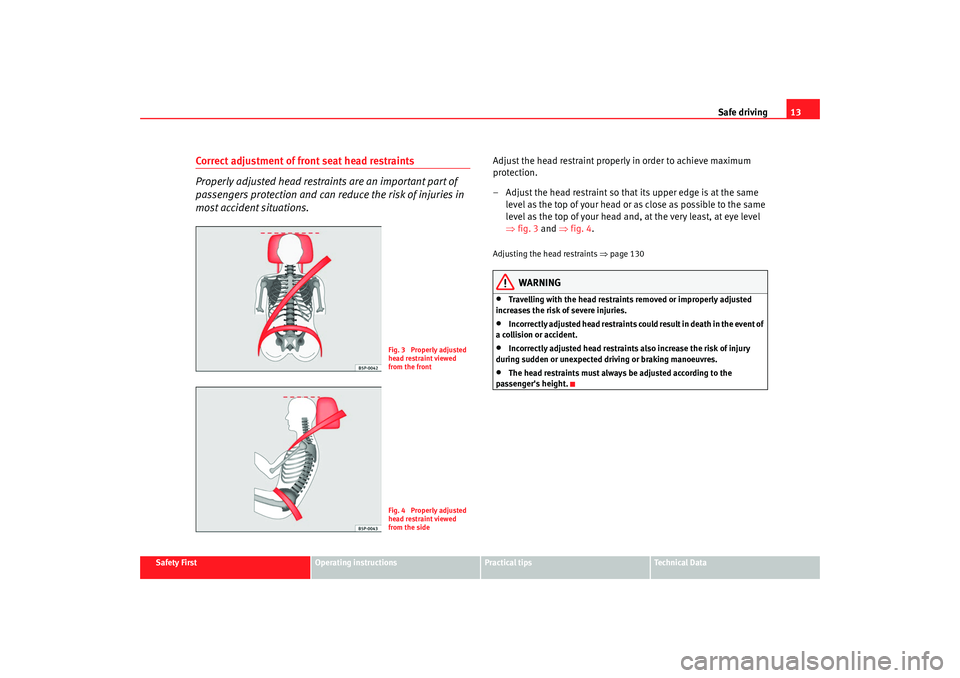
Correct adjustment of front seat head restraints
Properly adjusted head restraints are an important part of
passengers protection and can reduce the risk of injuries in
most accident situations.
Adjust the head restraint properly in order to achieve maximum
protection.
– Adjust the head restraint so that its upper edge is at the same
level as the top of your head or as close as possible to the same
level as the top of your head and, at the very least, at eye level
⇒fig. 3 and ⇒ fig. 4.Adjusting the head restraints ⇒page 130
WARNING
•
Travelling with the head restrain ts removed or improperly adjusted
increases the risk of severe injuries.
•
Incorrectly adjusted head restraints could result in death in the event of
a collision or accident.
•
Incorrectly adjusted head restraints also increase the risk of injury
during sudden or unexpected driving or braking manoeuvres.
•
The head restraints must always be adjusted according to the
passenger's height.
Fig. 3 Properly adjusted
head restraint viewed
from the frontFig. 4 Properly adjusted
head restraint viewed
from the side
Exeo_EN.book Seite 13 Freitag, 17. Oktober 2008 11:24 11
Page 16 of 303
Safe driving
14Correct adjustment of rear seat head restraints
Properly adjusted head restraints are an important part of the
occupant protection and can redu ce the risk of injuries in
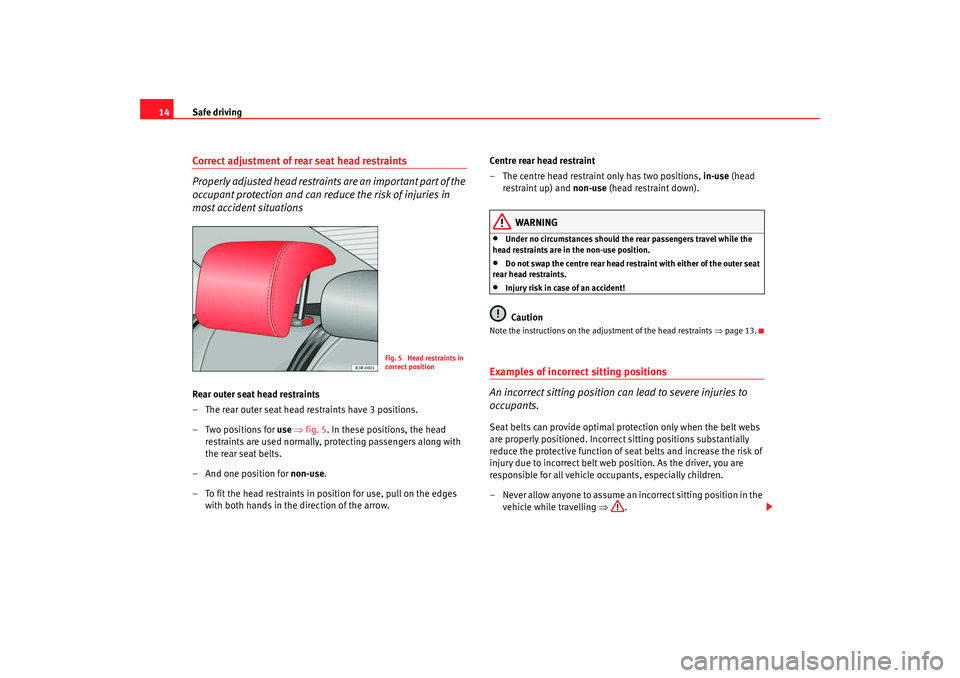
most accident situationsRear outer seat head restraints
– The rear outer seat head restraints have 3 positions.
–Two positions for use ⇒ fig. 5. In these positions, the head
restraints are used normally, protecting passengers along with
the rear seat belts.
–And one position for non-use .
– To fit the head restraints in position for use, pull on the edges with both hands in the direction of the arrow. Centre rear head restraint
– The centre head restraint only has two positions,
in-use (head
restraint up) and non-use (head restraint down).
WARNING
•
Under no circumstances should the rear passengers travel while the
head restraints are in the non-use position.
•
Do not swap the centre rear head rest raint with either of the outer seat
rear head restraints.
•
Injury risk in case of an accident!Caution
Note the instructions on the adjustment of the head restraints ⇒page 13.Examples of incorrect sitting positions
An incorrect sitting position can lead to severe injuries to
occupants.Seat belts can provide optimal prot ection only when the belt webs
are properly positioned. Incorrect sitting positions substantially
reduce the protective function of se at belts and increase the risk of
injury due to incorrect belt web position. As the driver, you are
responsible for all vehicle occupants, especially children.
– Never allow anyone to assume an incorrect sitting position in the vehicle while travelling ⇒.
Fig. 5 Head restraints in
correct position
Exeo_EN.book Seite 14 Freitag, 17. Oktober 2008 11:24 11
Page 17 of 303
Safe driving15
Safety First
Operating instructions
Practical tips
Te c h n i c a l D a t a
The following list contains examples of sitting positions that could be
dangerous for all occupants. The list is not complete, but we would like to
make you aware of this issue.
Therefore, whenever the vehicle is in motion:
•
Never stand in the vehicle,
•
never stand on the seats,
•
never kneel on the seats,
•
never tilt your backrest far to the rear,
•
never lean against the dash panel,
•
never lie on the rear bench,
•
never sit on the front edge of a seat,
•
never sit sideways,
•
never lean out of a window,
•
never put your feet out of a window,
•
never put your feet on the dash panel,
•
never put your feet on the surface of a seat,
•
never travel in a foot well ,
•
never travel on a seat without wearing the seat belt,
•
never carry any person in the luggage compartment.
WARNING
•
Every incorrect sitting position increases the risk of severe injuries.
•
Sitting in an incorrect position exposes the occupants to severe injuries
if airbags trigger, by striking a passenger who has assumed an incorrect
sitting position.
•
Before the vehicle moves, assume th e proper sitting position and main-
tain it throughout the trip. Before ever y trip, instruct your passengers to sit
properly and to stay in this position during the trip ⇒page 10, “Proper
sitting position for occupants”.
Pedal areaPedals
The operation of all pedals must nev er b e i m p a i red by o b j ec t s
or floor mats.– Ensure that you can always press the accelerator, brake and
clutch pedals unimpaired to the floor.
– Ensure that the pedals can return unimpaired to their initial posi- tions.Use only floor mats which leave the pedal area free and can be securely
fastened on the foot well.
If a brake circuit fails, the brake pedal must be pressed down thoroughly in
order to stop the vehicle.
Wear suitable shoes
Always wear shoes which support your feet properly and give you a good
feeling for the pedals.
WARNING
•
Restricting pedal operation can lead to critical situations while driving.
•
Never place objects on the driver fo otwell. An object could move into
the pedal area and impair pedal operation. In the event of a sudden driving
or braking manoeuvre, you will not be able to operate the brake, clutch or
accelerator pedal. Risk of accident!
Exeo_EN.book Seite 15 Freitag, 17. Oktober 2008 11:24 11