bonnet Seat Exeo 2008 User Guide
[x] Cancel search | Manufacturer: SEAT, Model Year: 2008, Model line: Exeo, Model: Seat Exeo 2008Pages: 303, PDF Size: 10.02 MB
Page 205 of 303
Your vehicle maintenance and cleaning203
Safety First
Operating instructions
Practical tips
Te c h n i c a l D a t a
Cleaning the engine compartment
Take special care when cleaning the engine compartment.Anti-corrosion treatment
The engine compartment and the surface of the power unit are given anti-
corrosion treatment at the factory.
Good corrosion protection is particularly important in winter when the car is
frequently driven on salted roads. To prevent the salt corroding the vehicle,
the entire engine compartment should be thoroughly cleaned before and
after winter.
Your Authorised Service Centre has got the necessary equipment to provide
the correct cleaning and preserving products. For this reason, we recommend
having this work performed by them.
The anti-corrosion protection is usua lly removed if the engine compartment
is cleaned with grease removing solution s, or if you have the engine cleaned.
On commissioning theis work, ensure that all surfaces, seams, joints and
components in the engine compartmen t are given anti-corrosion treatment.
WARNING
•
When working in the engine compartment, always observe the safety
warnings ⇒ page 213
•
Before opening the bonnet, switch the engine off, apply the parking
brake firmly and always remove the key from the ignition.
•
Allow the engine to cool before you clean the engine compartment.
•
Do not clean the vehicle underbody, wheel arches without protecting
your hands and arms. You may cut your self on sharp-edged metal parts.
Failure to comply could result in injury.
•
Moisture, ice and salt on the brakes may affect braking efficiency. Risk
of accident. Directly after washing, avoid sudden and sharp braking.
•
Never touch the radiator fan. It is temperature-controlled and could
start automatically, even when the key is removed from the ignition!For the sake of the environment
Fuel, grease and oil deposits could be removed when the engine is washed.
The polluted water must be cleaned in an oil separator. For this reason,
engine washing should be carried out on ly by a qualified workshop or a petrol
station.Vehicle interior maintenancePlastic parts and dash panel cleaning– Use a clean, damp cloth to clean plastic parts and the dash panel.
– If this does not provide satisfactory results, use a special solvent-free plastic cleaning product.
WARNING
Never clean the dash panel and the airbag module surface with cleansers
containing solvents. Solvents cause the surface to become porous. If the
airbag triggered, disintegrating plastic parts could cause substantial inju-
ries.
WARNING (continued)
Exeo_EN.book Seite 203 Freitag, 17. Oktober 2008 11:24 11
Page 214 of 303
Checking and refilling levels
212The bonnetReleasing the bonnet
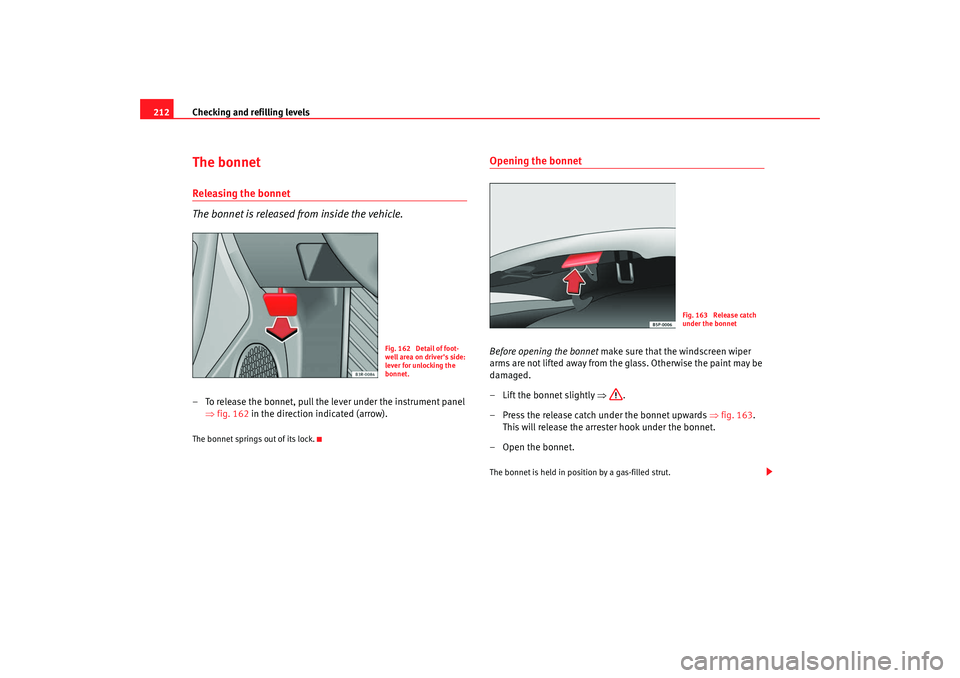
The bonnet is released from inside the vehicle.– To release the bonnet, pull the lever under the instrument panel
⇒fig. 162 in the direction indicated (arrow).The bonnet springs out of its lock.
Opening the bonnetBefore opening the bonnet make sure that the windscreen wiper
arms are not lifted away from the glass. Otherwise the paint may be
damaged.
– Lift the bonnet slightly ⇒.
– Press the release catch under the bonnet upwards ⇒fig. 163.
This will release the arrester hook under the bonnet.
– Open the bonnet.The bonnet is held in positi on by a gas-filled strut.
Fig. 162 Detail of foot-
well area on driver's side:
lever for unlocking the
bonnet.
Fig. 163 Release catch
under the bonnet
Exeo_EN.book Seite 212 Freitag, 17. Oktober 2008 11:24 11
Page 215 of 303
Checking and refilling levels213
Safety First
Operating instructions
Practical tips
Te c h n i c a l D a t a
WARNING
Never open the bonnet if you see steam or drips of coolant being released
from the engine compartment. Failure to comply could result in burns. Wait
until no steam or coolant can be seen before opening the bonnet.Work in the engine compartment
Extra caution is necessary when working on components in
the engine compartment.Always be aware of the danger of injury and scalding as well as the risk of
accident or even fire when working in the engine compartment (e.g. when
checking and refilling fluids). Therefor e, always observe the warnings listed
below and follow all general safety precautions. The engine compartment of
any motor vehicle is a potentially hazardous area ⇒
WARNING
•
Switch the engine off.
•
Remove the ignition key.
•
Apply handbrake firmly.
•
Place the gear lever into neutral.
•
Wait for the engine to cool down.
•
Children should not be allowed to approach the engine compartment
•
Never spill liquids involved in vehicle operations on the engine
compartment, as these may catch fire (e.g. anti-freeze containing liquid
coolant).
•
Take care not to cause short circuits in the electrical system, especially
when working on the battery.
•
Never touch the radiator fan while the engine is hot, as the fan could
start up suddenly.
•
Never open the expansion tank when the engine is hot. The cooling
system is under pressure.
•
Protect face, hands and arms from any hot steam or hot liquid coolant
released by covering the cap with a large, thick rag when opening the
expansion tank.
•
If any tests have to be performed with the engine running, there is an
extra safety risk from the rotating parts, such as the drive belts, alternator
and radiator fan, etc., and from the high-voltage ignition system.
•
Observe the following additional warnings if work on the fuel system or
the electrical system is necessary:
−Always disconnect the battery.
− Do not smoke.
− Never work near open flames
− Always keep an approved fire extinguisher immediately available.Caution
When topping up fluids, make sure the correct fluid is put into the correct
filler opening. This can otherwise cau se serious malfunctions or engine
damage.
For the sake of the environment
Inspect the ground underneath your vehicle regularly so that any leaks are
detected at an early stage. If you find spots of oil or other fluids, have your
vehicle inspected in the garage.
WARNING (continued)
Exeo_EN.book Seite 213 Freitag, 17. Oktober 2008 11:24 11
Page 216 of 303

Checking and refilling levels
214
NoteOn right-hand drive vehicles some of the containers/ reservoirs mentioned
below are located on the other side of the engine compartment.Closing the bonnet– To close the bonnet, pull it down to overcome the spring pres- sure.
– Leave the bonnet secured in the locking part. Do not tighten
⇒ .
WARNING
•
For safety reasons the bonnet must always be completely closed when
the vehicle is moving. After closing it always check that it is properly
secured. The bonnet must be flus h with the adjacent body panels.
•
Should you notice that the bonnet is not safely secured when the
vehicle is moving, stop the vehicle immediately and close the bonnet.
Failure to do so could result in an accident.
Engine oilGeneral notesWe recommend you to entrust the oil change with your Technical Service or a
qualified workshop, according to the Maintenance Program. The correct oil specifications for your engine are listed in the
Technical data
section ⇒page 282.
Check that the specifications quoted (VW standards) appear on the container
either singly or in combination with other specifications.
Fixed service intervals*
You can use oils for service intervals - ⇒ page 282. In this case, your car must
be serviced after a fixed interval of 1 year / 15,000 km (10,000 miles) see
Service Schedule.
•
In exceptional circumstances, if the engine oil level is too low
⇒ page 215 and you cannot obtain the oi l specified for your vehicle, you can
put in a small quantity of oil conforming to the specification ACEA A2 or
ACEA A3 (petrol engines) or ACEA B3 or ACEA B4 (diesel engines) (up to 0.5l).
Vehicles with diesel particulate filter*
The Service Schedule states whether your vehicle is fitted with a diesel partic-
ulate filter.
•
Vehicles with a diesel particulate filter must only b e f ill e d wi th VW 507 00
engine oil.
•
Avoid mixing this oil with other engine oils.
•
Only in exceptional circumstances, if the engine oil level is too low
⇒ page 215 and you cannot obtain the oi l specified for your vehicle, can you
put in a small quantity of oil (once) conforming to the VW 506 00, VW 506 01,
VW 505 00, VW 505 01 or ACEA B3 / ACEA B4 specification. (up to 0.5l).
Exeo_EN.book Seite 214 Freitag, 17. Oktober 2008 11:24 11
Page 223 of 303
Checking and refilling levels221
Safety First
Operating instructions
Practical tips
Te c h n i c a l D a t a
Changing windscreen wiper blades
If the windscreen wiper blades are in perfect condition, you
will benefit from an improved visibility. Damaged wiper
blades should be replaced immediately.
Removing the wiper blade
– Lift the wiper arm away from the windscreen.
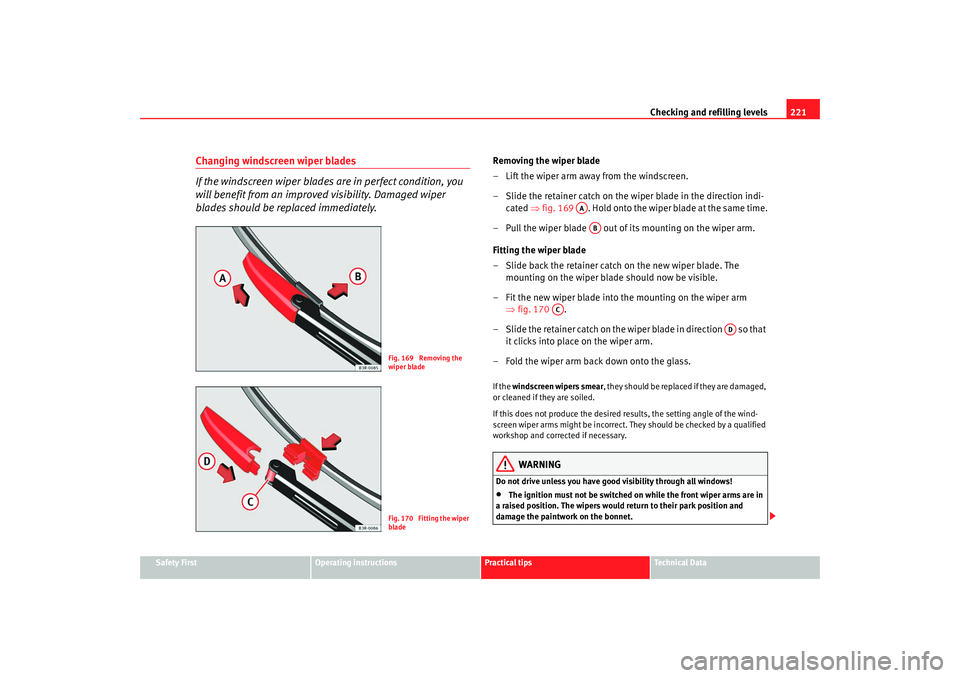
– Slide the retainer catch on the wiper blade in the direction indi-
cated ⇒fig. 169 . Hold onto the wiper blade at the same time.
– Pull the wiper blade out of its mounting on the wiper arm.
Fitting the wiper blade
– Slide back the retainer catch on the new wiper blade. The mounting on the wiper blade should now be visible.
– Fit the new wiper blade into the mounting on the wiper arm
⇒ fig. 170 .
– Slide the retainer catch on the wiper blade in direction so that it clicks into place on the wiper arm.
– Fold the wiper arm back down onto the glass.If the windscreen wipers smear , they should be replaced if they are damaged,
or cleaned if they are soiled.
If this does not produce the desired results, the setting angle of the wind-
screen wiper arms might be incorrect. Th ey should be checked by a qualified
workshop and corrected if necessary.
WARNING
Do not drive unless you have good visibility through all windows!•
The ignition must not be switched on while the front wiper arms are in
a raised position. The wipers would return to their park position and
damage the paintwork on the bonnet.
Fig. 169 Removing the
wiper bladeFig. 170 Fitting the wiper
blade
AAAB
AC
AD
Exeo_EN.book Seite 221 Freitag, 17. Oktober 2008 11:24 11
Page 224 of 303
Checking and refilling levels
222•
To prevent smearing on the windscreen, the wiper blades should be
cleaned regularly using a window cleaner solution. If the wiper blades are
very dirty (e.g. insects etc.), they should be cleaned using a sponge or
cloth. Failure to do so co uld result in an accident.
•
For safety reasons, the wiper blades should be changed once or twice a
year.Caution
•
Damaged or dirty windscreen wipers could scratch the windscreen.
•
Never use fuel, nail varnish remover, paint thinner or similar products to
clean the windows. This could damage the windscreen wiper blades.
•
Never move the windscreen wiper or windscreen wiper arm manually. This
could cause damage.
•
Do not pull the windscreen wipers forward unless they are in the service
position. Otherwise the bonnet could be damaged.Note
•
The wiper arms can be moved to the service position only when the
bonnet is properly closed.
Brake fluidChecking the brake fluid level
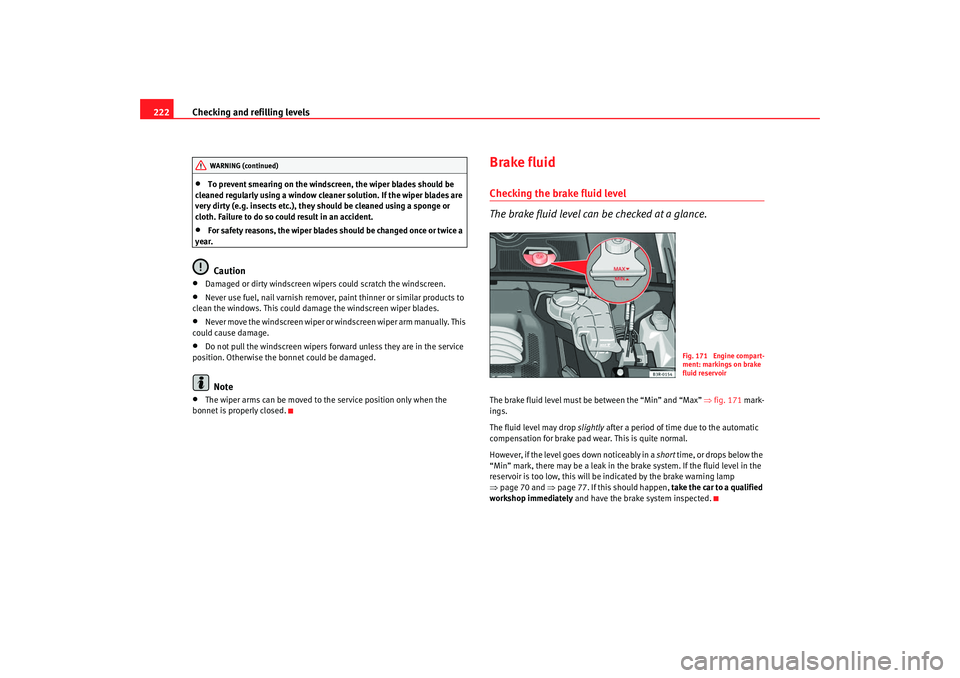
The brake fluid level can be checked at a glance.The brake fluid level must be between the “Min” and “Max” ⇒fig. 171 mark-
ings.
The fluid level may drop slightly after a period of time due to the automatic
compensation for brake pad wear. This is quite normal.
However, if the level goes down noticeably in a short time, or drops below the
“Min” mark, there may be a leak in the brake system. If the fluid level in the
reservoir is too low, this will be indicated by the brake warning lamp
⇒ page 70 and ⇒ page 77. If this should happen, take the car to a qualified
workshop immediately and have the brake system inspected.
WARNING (continued)
Fig. 171 Engine compart-
ment: markings on brake
fluid reservoir
Exeo_EN.book Seite 222 Freitag, 17. Oktober 2008 11:24 11
Page 254 of 303
If and when
252Changing the turn signal bulb
The procedure for changing the bulbs on the front
passenger's side is the same as on the driver's side.– Switch off the ignition and the lights.
– Raise the bonnet.
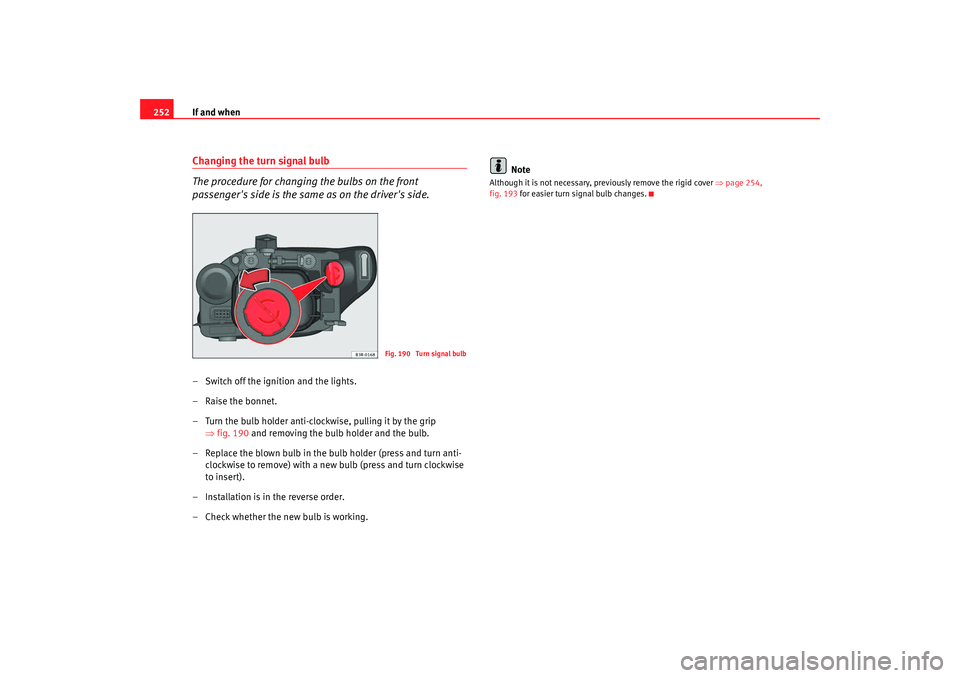
– Turn the bulb holder anti-clockwise, pulling it by the grip
⇒fig. 190 and removing the bulb holder and the bulb.
– Replace the blown bulb in the bulb holder (press and turn anti- clockwise to remove) with a new bulb (press and turn clockwise
to insert).
– Installation is in the reverse order.
– Check whether the new bulb is working. Note
Although it is not necessary, previously remove the rigid cover
⇒page 254,
fig. 193 for easier turn signal bulb changes.
Fig. 190 Turn signal bulb
Exeo_EN.book Seite 252 Freitag, 17. Oktober 2008 11:24 11
Page 255 of 303
If and when253
Safety First
Operating instructions
Practical tips
Te c h n i c a l D a t a
Changing the main headlight bulb
The procedure for changing the bulbs on the front
passenger's side is the same as on the driver's side.
– Switch off the ignition and the lights.
– Raise the bonnet.
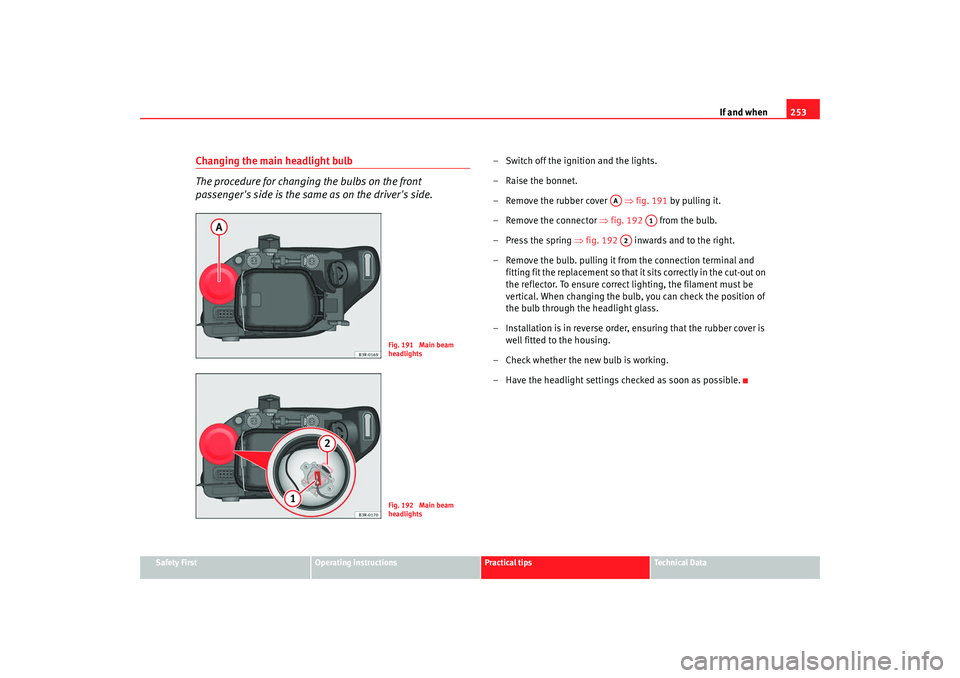
– Remove the rubber cover ⇒ fig. 191 by pulling it.
– Remove the connector ⇒fig. 192 from the bulb.
– Press the spring ⇒fig. 192 inwards and to the right.
– Remove the bulb. pulling it from the connection terminal and fitting fit the replacement so that it sits correctly in the cut-out on
the reflector. To ensure correct lighting, the filament must be
vertical. When changing the bulb, you can check the position of
the bulb through the headlight glass.
– Installation is in reverse order, ensuring that the rubber cover is well fitted to the housing.
– Check whether the new bulb is working.
– Have the headlight settings checked as soon as possible.
Fig. 191 Main beam
headlightsFig. 192 Main beam
headlights
AA
A1
A2
Exeo_EN.book Seite 253 Freitag, 17. Oktober 2008 11:24 11
Page 256 of 303

If and when
254Changing the dipped beam headlight bulb
The procedure for changing the bulbs on the front
passenger's side is the same as on the driver's side.
– Switch off the ignition and the lights.
–Raise the bonnet.
– Move the brace ⇒fig. 193 in the direction of the arrow and
remove the rigid cover, separating the brace side and then
removing the two tabs from the other end of the cover.
– Pull the connector ⇒fig. 194 from the bulb.
– Unclip the retainer spring ⇒fig. 194 pressing inwards to the
right.
– Remove the bulb and fit the new one in the headlight casing with the tab upwards, starting to position it from below.
– Clip on the spring, raising it and pressing it slightly while turning it anti-clockwise. To ensure correct lighting, the filament must be
vertical. When changing the bulb, you can check the position of
the bulb through the headlight glass.
– Connect the connector to the bulb.
– Fit the cover, first inserting the side tabs and then closing the cover and the brace. Make sure that the gasket sits well on the
casing cover during the operation.
– Check whether the new bulb is working.
– Have the headlight settings checked as soon as possible.
Fig. 193 Dipped head-
lightsFig. 194 Dipped head-
lights
A1A2
A3
Exeo_EN.book Seite 254 Freitag, 17. Oktober 2008 11:24 11
Page 257 of 303
If and when255
Safety First
Operating instructions
Practical tips
Te c h n i c a l D a t a
Changing side light bulb (outside of vehicle)
The procedure for changing the bulbs on the front
passenger's side is the same as on the driver's side.
– Switch off the ignition and the lights.
– Raise the bonnet.
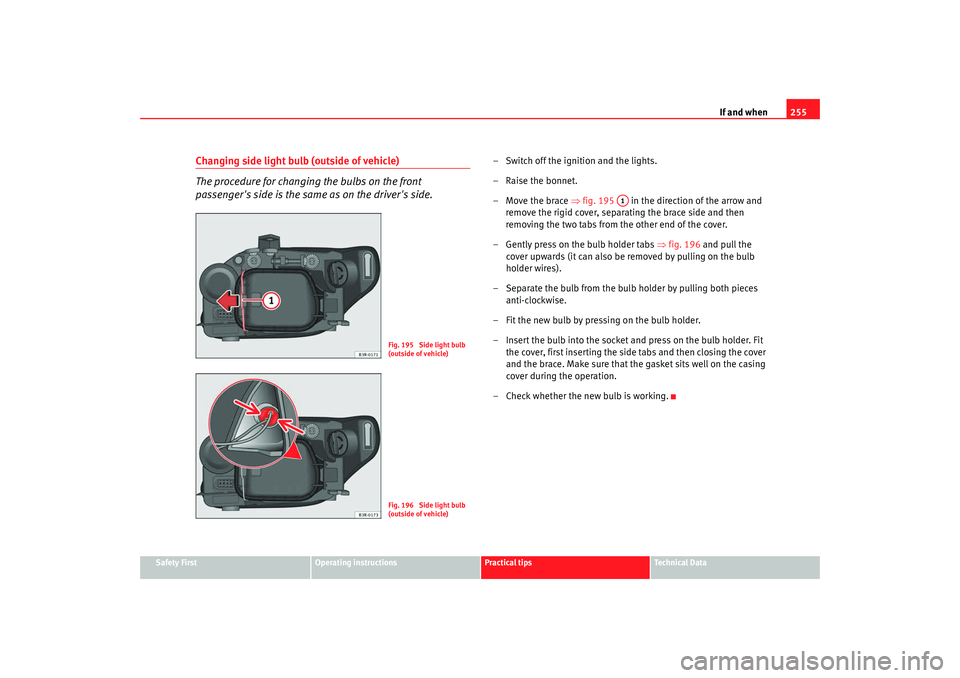
– Move the brace ⇒fig. 195 in the direction of the arrow and
remove the rigid cover, separating the brace side and then
removing the two tabs from the other end of the cover.
– Gently press on the bulb holder tabs ⇒fig. 196 and pull the
cover upwards (it can also be removed by pulling on the bulb
holder wires).
– Separate the bulb from the bulb holder by pulling both pieces anti-clockwise.
– Fit the new bulb by pressing on the bulb holder.
– Insert the bulb into the socket and press on the bulb holder. Fit the cover, first inserting the side tabs and then closing the cover
and the brace. Make sure that the gasket sits well on the casing
cover during the operation.
– Check whether the new bulb is working.
Fig. 195 Side light bulb
(outside of vehicle)Fig. 196 Side light bulb
(outside of vehicle)
A1
Exeo_EN.book Seite 255 Freitag, 17. Oktober 2008 11:24 11