spare wheel Seat Exeo 2008 Owner's manual
[x] Cancel search | Manufacturer: SEAT, Model Year: 2008, Model line: Exeo, Model: Seat Exeo 2008Pages: 303, PDF Size: 10.02 MB
Page 6 of 303
Contents
4Trailer towing
. . . . . . . . . . . . . . . . . . . . . . . . . . . . .
Trailer towing . . . . . . . . . . . . . . . . . . . . . . . . . . . .
Removable towing bracket . . . . . . . . . . . . . . . . .
Your vehicle maintenance and cleaning
. . . .
General notes . . . . . . . . . . . . . . . . . . . . . . . . . . .
Vehicle exterior maintenance . . . . . . . . . . . . . . .
Vehicle interior maintenance . . . . . . . . . . . . . . .
Accessories, parts replacement and
modifications
. . . . . . . . . . . . . . . . . . . . . . . . . . . .
Accessories and spare parts . . . . . . . . . . . . . . . .
Technical modifications . . . . . . . . . . . . . . . . . . .
Mobile telephones and radiotelephones . . . . .
Athermic windscreen* . . . . . . . . . . . . . . . . . . . . .
Checking and refilling levels
. . . . . . . . . . . . . .
Refuelling . . . . . . . . . . . . . . . . . . . . . . . . . . . . . . .
Releasing the tank flap manually . . . . . . . . . . . .
Petrol . . . . . . . . . . . . . . . . . . . . . . . . . . . . . . . . . .
Diesel . . . . . . . . . . . . . . . . . . . . . . . . . . . . . . . . . .
The bonnet . . . . . . . . . . . . . . . . . . . . . . . . . . . . . .
Engine oil . . . . . . . . . . . . . . . . . . . . . . . . . . . . . . .
Cooling system . . . . . . . . . . . . . . . . . . . . . . . . . .
Washer fluid and windscreen wiper blades . . . .
Brake fluid . . . . . . . . . . . . . . . . . . . . . . . . . . . . . .
Battery . . . . . . . . . . . . . . . . . . . . . . . . . . . . . . . . .
Wheels and tyres
. . . . . . . . . . . . . . . . . . . . . . . . .
Wheels . . . . . . . . . . . . . . . . . . . . . . . . . . . . . . . . .
If and when
. . . . . . . . . . . . . . . . . . . . . . . . . . . . . .
Tools, tyre repair kit and spare wheel . . . . . . . .
Changing a wheel . . . . . . . . . . . . . . . . . . . . . . . .
Tyre repair* (Tyre-Mobility-System) . . . . . . . . . .
Fuses . . . . . . . . . . . . . . . . . . . . . . . . . . . . . . . . . .
Bulbs . . . . . . . . . . . . . . . . . . . . . . . . . . . . . . . . . .
Changing bulbs Halogen headlights . . . . . . . . .
Changing bulbs. Bi-Xenon AFS headlights . . . .
Changing rear bulbs (in side panel) . . . . . . . . . .
Changing rear light bulbs (i n boot lid) . . . . . . . . Side indicators . . . . . . . . . . . . . . . . . . . . . . . . . .
Luggage compartment lights . . . . . . . . . . . . . . .
Registration light . . . . . . . . . . . . . . . . . . . . . . . . .
Sunroof light . . . . . . . . . . . . . . . . . . . . . . . . . . . .
Jump-starting . . . . . . . . . . . . . . . . . . . . . . . . . . . .
Towing and tow-starting . . . . . . . . . . . . . . . . . . .
Te c h n i c a l D a t a
. . . . . . . . . . . . . . . . . . . . . . .
General notes on the technical data
. . . . . . .
Outstanding information . . . . . . . . . . . . . . . . . .
Data on fuel consumption . . . . . . . . . . . . . . . . .
Towing a trailer . . . . . . . . . . . . . . . . . . . . . . . . . .
Wheels . . . . . . . . . . . . . . . . . . . . . . . . . . . . . . . . .
Techn ical Data
. . . . . . . . . . . . . . . . . . . . . . . . . . . .
Checking fluid levels . . . . . . . . . . . . . . . . . . . . . .
Petrol engine 1.6l 75 kW (102 HP) . . . . . . . . . . .
Petrol engine 1.8l 110 kW (150 HP) . . . . . . . . .
Petrol engine 2.0l 147 kW (200 HP) . . . . . . . . .
Diesel engine 2.0l 105 kW (143 hp) . . . . . . . . .
Diesel engine 2.0l 125 kW (170 hp) . . . . . . . . .
Dimensions and capacities . . . . . . . . . . . . . . . .
Index
. . . . . . . . . . . . . . . . . . . . . . . . . . . . . . . . . .
186
186
189
197
197
198
203
206
206
206
207
207
208
208
209
210
210
212
214
217
220
222
223
227
227
236
236
238
243
247
249
249
256
262
266 268
269
270
271
271
274
277
277
277
279
280
280
282
282
283
284
285
287
288
290
291
Exeo_EN.book Seite 4 Freitag, 17. Oktober 2008 11:24 11
Page 189 of 303
Trailer towing187
Safety First
Operating instructions
Practical tips
Te c h n i c a l D a t a
Where possible, operate the trailer with the maximum permitted
draw bar
weight on the ball joint of the towing bracket, but do not exceed the specified
limit.
Tyre pressure
Check the tyre pressures on your car, and adjust for “full load” conditions
(refer to the sticker listing the tyre pressures on the door pillar). It may also be
necessary to adjust the tyre pressures on the trailer according to the recom-
mendations of the trailer manufacturer.
Exterior mirrors
Check whether you can see enough of the road behind the trailer with the
standard mirrors. If this is not the case you should have additional mirrors
fitted. The two exterior mi rrors should be fitted on folding arms. Adjust the
mirrors to give sufficient rear vision.
Headlights
Before starting a journey, check the headlight beam settings with the trailer
hitched up. If necessary, alter the height of the headlight beams by means of
the headlight range control. See ⇒page 116.
Power supply
When you remove the ignition key, the power supply to the trailer is inter-
rupted.
Removable ball joint coupling
Vehicles with a factory-fitted towing bracket are equipped with a removable
ball joint coupling. This is stored in the spare wheel well in the luggage
compartment together with the necessary fitting instructions.
Note
If you frequently tow, we recommend you also have vehicle serviced between
services.
Notes on towing
Towing a trailer involves additi onal attention by the driver.Weight distribution
The weight distribution of a loaded trailer with an unladen vehicle is very
unfavourable. However, if this cannot be avoided, drive extra slowly to allow
for the unbalanced we ight distribution.
Speed
The stability of the car and trailer is reduced with increasing speed. Therefore,
it is advisable not to drive at the maximum permissible speed in an unfavour-
able road, weather or wind conditions. This especially applies when driving
downhill.
You should always reduce speed immediately if the trailer shows the slightest
sign of swaying. Never try to stop the “snaking” by increasing speed.
Anticipate hazards and brake in good time. If towing a trailer with an inertia
brake , first brake gently and then more severely. This will prevent brake
tapping by the trailer wheels when they lock. Select a low gear in due course
before going down a steep downhill. This enables you to use the engine
braking to slow down the vehicle.
Swaying and pitching can be reduced by stabiliser aids. We recommend
having stabiliser aids installed when towing trailers with a high trailer load.
They can be purchased and installed at a Dealer.
Reheating
When climbing long hills in hot weather wi th the engine running fast in low
gear, you should keep an eye on the coolant temperature gauge ⇒page 60.
Reduce speed immediately if the needle moves to the right end of the scale.
If the temperature warning light
in the instrument cluster should start
flashing, stop the car and let the engine cool down by running it at idling
speed for a few minutes.
Exeo_EN.book Seite 187 Freitag, 17. Oktober 2008 11:24 11
Page 191 of 303
Trailer towing189
Safety First
Operating instructions
Practical tips
Te c h n i c a l D a t a
Removable towing bracketIntroduction
Special care is required when fitting and removing the towing
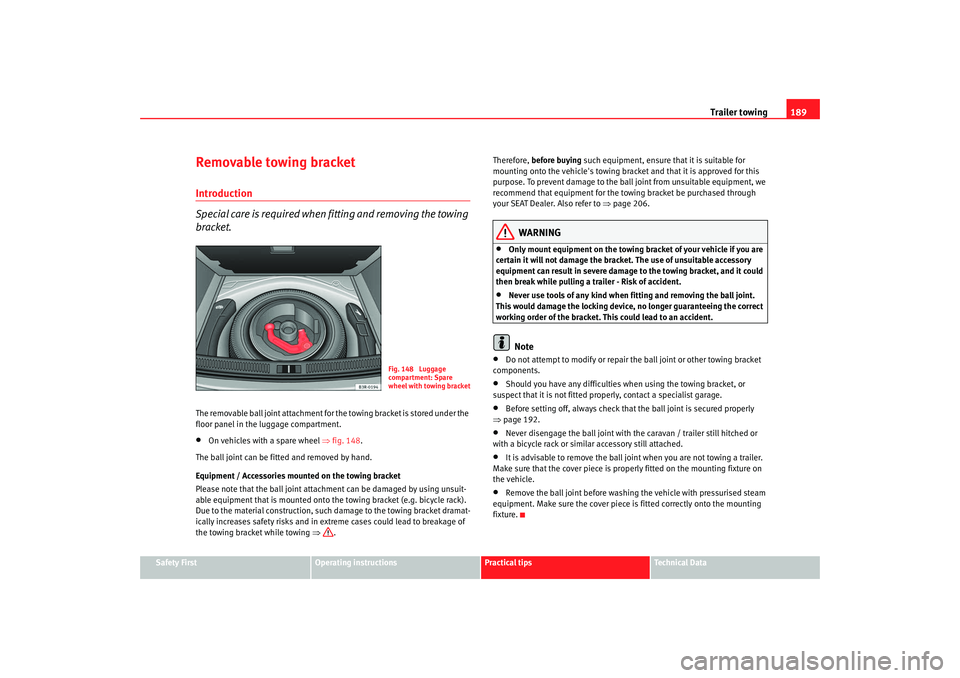
bracket.The removable ball joint attachment for the towing bracket is stored under the
floor panel in the luggage compartment.•
On vehicles with a spare wheel ⇒fig. 148 .
The ball joint can be fitted and removed by hand.
Equipment / Accessories mounted on the towing bracket
Please note that the ball joint attach ment can be damaged by using unsuit-
able equipment that is mounted onto the towing bracket (e.g. bicycle rack).
Due to the material construction, such damage to the towing bracket dramat-
ically increases safety risks and in extreme cases could lead to breakage of
the towing bracket while towing ⇒ . Therefore, before buying
such equipment, ensure that it is suitable for
mounting onto the vehicle's towing bracket and that it is approved for this
purpose. To prevent damage to the ball joint from unsuitable equipment, we
recommend that equipment for the to wing bracket be purchased through
your SEAT Dealer. Also refer to ⇒page 206.
WARNING
•
Only mount equipment on the towing bracket of your vehicle if you are
certain it will not damage the bracket. The use of unsuitable accessory
equipment can result in severe damage to the towing bracket, and it could
then break while pulling a trailer - Risk of accident.
•
Never use tools of any kind when fitting and removing the ball joint.
This would damage the locking device, no longer guaranteeing the correct
working order of the bracket. This could lead to an accident.Note
•
Do not attempt to modify or repair the ball joint or other towing bracket
components.
•
Should you have any difficulties when using the towing bracket, or
suspect that it is not fitted properly, contact a specialist garage.
•
Before setting off, always check that the ball joint is secured properly
⇒ page 192.
•
Never disengage the ball joint with the caravan / trailer still hitched or
with a bicycle rack or similar accessory still attached.
•
It is advisable to remove the ball joint when you are not towing a trailer.
Make sure that the cover piece is proper ly fitted on the mounting fixture on
the vehicle.
•
Remove the ball joint before washing the vehicle with pressurised steam
equipment. Make sure the cover piece is fitted correctly onto the mounting
fixture.
Fig. 148 Luggage
compartment: Spare
wheel with towing bracket
Exeo_EN.book Seite 189 Freitag, 17. Oktober 2008 11:24 11
Page 235 of 303

Wheels and tyres233
Safety First
Operating instructions
Practical tips
Te c h n i c a l D a t a
•
Avoid driving over obstacles (for example kerbs) or potholes.
•
If one or more tyres is being driven in emergency conditions, the driving
quality of the vehicle is impaired and there is a risk of accident.Note
•
The anti-puncture tyres do not “deflate” on losing pressure because they
are supported on the reinforced sides. Therefore defects in the tyre can not be
detected with a visual inspection.
•
Snow chains must not be used on front tyres used in emergency
conditions.
New tyres and wheels
New tyres and wheels have to be run-in.The tyres and wheel rims are an essential part of the vehicle's design. The
tyres and rims approved by SEAT are specially matched to the characteristics
of the vehicle and make a major contribution to good road holding and safe
handling ⇒.
Tyres should be replaced at least in pairs and not individually (i.e. both front
tyres or both rear tyres together). A knowledge of tyre designations makes it
easier to choose the correct tyres. Radial tyres have the tyre designations
marked on the sidewall, for example: 195/65 R15 91T
This contains the following information:
195 Tyre width in mm
65 Height/width ratio in %
R Tyre construction: Radial 15 Rim diameter in inches
91 Load rating code
T Speed rating
The tyres could also have the following information:
•
A direction of rotation symbol
•
“Reinforced” denotes heavy-duty tyres.
The manufacturing date is also indicate d on the tyre sidewall (possibly only
on the inner side of the wheel).
“DOT ... 1103...” means, for example, that the tyre was produced in the 11th
week of 2003.
We recommend that work on tyres and wh eels is carried out by an Authorised
Service Centre. They are familiar with the procedure and have the necessary
special tools and spare parts as well as the proper facilities for disposing of
the old tyres.
Any Authorised Service Centre has full information on the technical require-
ments when installing or changing tyres, wheels or wheel trims.
WARNING
•
We recommend that you use only wh eels and tyres which have been
approved by SEAT for your model. Failure to do so could impair vehicle
handling. Risk of accident.
•
Avoid running the vehicle on tyres th at are more than six years old. If
you have no alternative, you should drive slowly and with extra care at all
times.
•
Never use old tyres or those with an unknown “history of use”.
•
If wheel trims are retrofitted, you must ensure that the flow of air to the
brakes is not restricted. This could cause them to overheat.
•
All four wheels must be fitted with radial tyres of the same type, size
(rolling circumference) and the same tread pattern.
WARNING (continued)
Exeo_EN.book Seite 233 Freitag, 17. Oktober 2008 11:24 11
Page 236 of 303

Wheels and tyres
234
For the sake of the environmentOld tyres must be disposed of according to the laws in the country concerned.
Note
•
For technical reasons, it is not generally possible to use the wheels from
other vehicles. This can also apply to wheels of the same model. The use of
wheels or tyres which have not been approved by SEAT for use with your
model may invalidate the vehicle's type approval for use on public roads.
•
If the spare tyre is not the same as the tyres that are mounted on the
vehicle - for example with winter tyres - you should only use the spare tyre for
a short period of time and drive with extra care. Refit the normal road wheel
as soon as possible.
Wheel bolts
Wheel bolts must be tightened to the correct torque.The design of wheel bolts is matched to the rims. If different wheel rims are
fitted, the correct wheel bolts with the right length and correctly shaped bolt
heads must be used. This ensures that wheels are fitted securely and that the
brake system functions correctly.
In certain circumstances, you may not use wheel bolts from a different car -
even if it is the same model ⇒page 206.
After the wheels have been changed, the tightening torque of the wheel bolts
should be checked as soon as possible with a torque wrench ⇒. The tight-
ening torque for steel and alloy wheels is 120 Nm.
WARNING
If the wheel bolts are not tightened correctly, the wheel could become
loose while driving. Risk of accident.•
The wheel bolts must be clean and turn easily. Never apply grease or oil
to them.
•
Use only wheel bolts which belong to the wheel.
•
If the torque of the wheel bolts is too low, they could loosen whilst the
vehicle is in motion. Risk of accident! If the tightening torque is too high,
the wheel bolts and threads can be damaged.Caution
The prescribed torque for wheel bolts for steel and alloy wheels is 120 Nm.Winter tyres
Winter tyres will improve the vehicles handling on snow and
ice.In winter conditions winter tyres will considerably improve the vehicles
handling. The design of summer ty res (width, rubber compound, tread
pattern) gives less grip on ice and snow.
Winter tyres must be inflated to a pressure 0.2 bar higher than the pressures
specified for summer tyres (see sticker on tank flap).
Winter tyres must be fitted on all four wheels.
Information on permitted winter tyre sizes can be found in the vehicle's regis-
tration documents. Use only radial winter tyres. All tyre sizes listed in the
vehicle documentation also apply to winter tyres.
Exeo_EN.book Seite 234 Freitag, 17. Oktober 2008 11:24 11
Page 237 of 303
Wheels and tyres235
Safety First
Operating instructions
Practical tips
Te c h n i c a l D a t a
Winter tyres lose their effectiveness when the tread is worn down to a depth
of 4 mm.
The speed rating code
⇒page 233, “New tyres and wheels” determines the
following speed limits for winter tyres: ⇒
Q max. 160 km/h
S max. 180 km/h
T max. 190 km/h
H max. 210 km/h
In some countries, vehicles which can exceed the speed rating of the fitted
tyre must have an appropriate sticker in the driver's field of view. These
stickers are available from your Authorised Service Centre. The legal require-
ments of each country must be followed.
Do not have winter tyres fitted for u nnecessarily long periods. Vehicles with
summer tyres handle better when the roads are free of snow and ice.
If you have a flat tyre, please refer to the notes on the spare wheel
⇒ page 233, “New tyres and wheels”.
WARNING
The maximum speed for the winter tyre s must not be exceeded. Otherwise,
this could lead to tyre damage and thus, an accident risk.
For the sake of the environment
Fit your summer tyres in good time. They are quieter, do not wear so quickly
and reduce fuel consumption.
Snow chainsSnow chains may be fitted only to the front wheels, and only to certain tyre
sizes ⇒page 280.
Remove wheel hub covers and trim rings before fitting snow chains. For safety
reasons cover caps, available in any Authorised Service Centre, must then be
fitted over the wheel bolts.
WARNING
Observe the fitting instructions provided by the snow chain manufacturer.
Caution
You must remove the snow chains to drive on roads which are free of snow.
Otherwise they will impair handling, damage the tyres and wear out very
quickly.
Note
•
In some countries, the speed limit for using snow chains is 50 km/h. The
legal requirements of the country should be followed.
•
We recommend that you ask your Appr oved Service Centre for information
about appropriate wheel, tyre and snow chain size.205/55 R16
15 mm chains
225/45 R17
9 mm chains
225/40 R18
7 mm chains
Exeo_EN.book Seite 235 Freitag, 17. Oktober 2008 11:24 11
Page 238 of 303
If and when
236If and whenTools, tyre repair kit and spare wheelTools
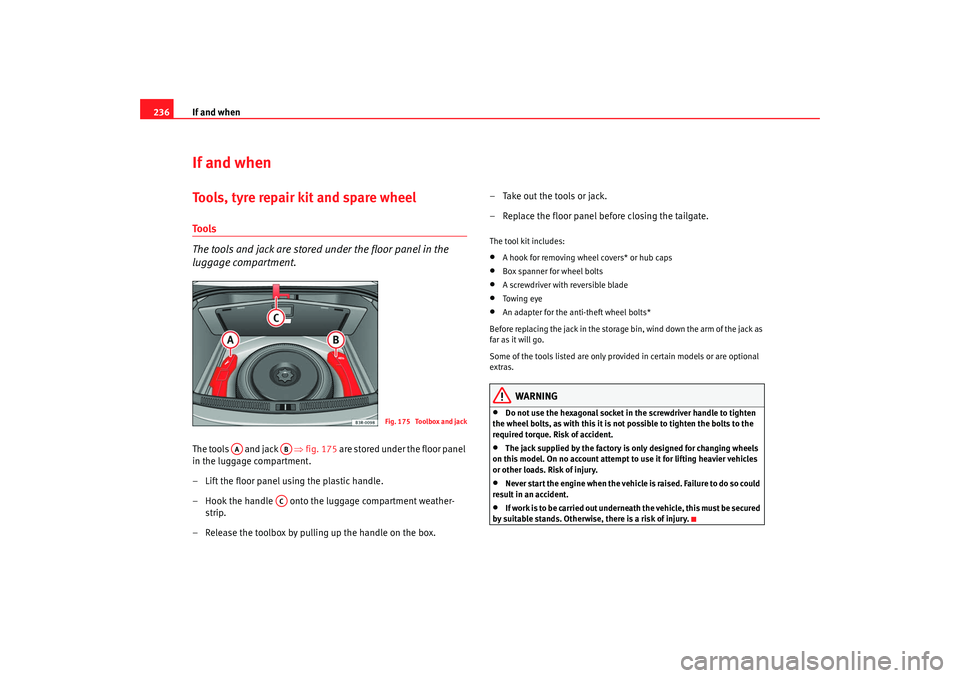
The tools and jack are stored under the floor panel in the
luggage compartment.The tools and jack ⇒fig. 175 are stored under the floor panel
in the luggage compartment.
– Lift the floor panel using the plastic handle.
– Hook the handle onto the luggage compartment weather- strip.
– Release the toolbox by pulling up the handle on the box. – Take out the tools or jack.
– Replace the floor panel before closing the tailgate.
The tool kit includes:•
A hook for removing wheel covers* or hub caps
•
Box spanner for wheel bolts
•
A screwdriver with reversible blade
•
Towing eye
•
An adapter for the anti-theft wheel bolts*
Before replacing the jack in the storage bin, wind down the arm of the jack as
far as it will go.
Some of the tools listed are only provid ed in certain models or are optional
extras.
WARNING
•
Do not use the hexagonal socket in the screwdriver handle to tighten
the wheel bolts, as with this it is not possible to tighten the bolts to the
required torque. Risk of accident.
•
The jack supplied by the factory is only designed for changing wheels
on this model. On no account attempt to use it for lifting heavier vehicles
or other loads. Risk of injury.
•
Never start the engine when the vehicle is raised. Failure to do so could
result in an accident.
•
I f wo r k is t o b e ca r r i e d o u t un d e r n ea th the vehicle, this must be secured
by suitable stands. Otherwise, there is a risk of injury.
Fig. 175 Toolbox and jac
k
AA
ABAC
Exeo_EN.book Seite 236 Freitag, 17. Oktober 2008 11:24 11
Page 239 of 303
If and when237
Safety First
Operating instructions
Practical tips
Te c h n i c a l D a t a
Tyre mobili ty system
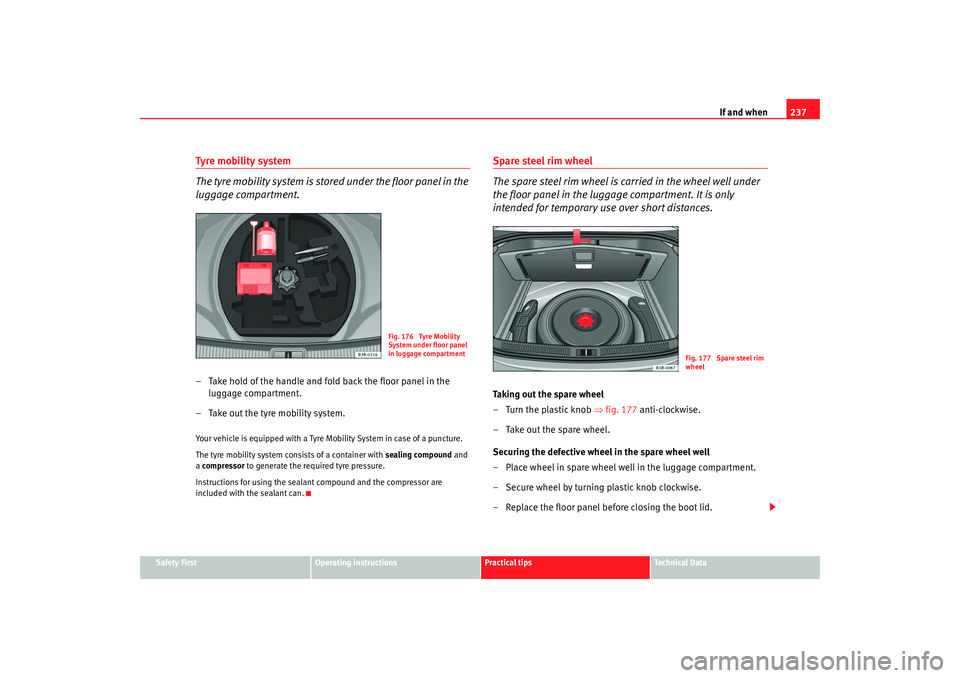
The tyre mobility system is stored under the floor panel in the
luggage compartment.– Take hold of the handle and fold back the floor panel in the
luggage compartment.
– Take out the tyre mobility system.Your vehicle is equipped with a Tyre Mobility System in case of a puncture.
The tyre mobility system consists of a container with sealing compound and
a compressor to generate the required tyre pressure.
Instructions for using the sealant compound and the compressor are
included with the sealant can.
Spare steel rim wheel
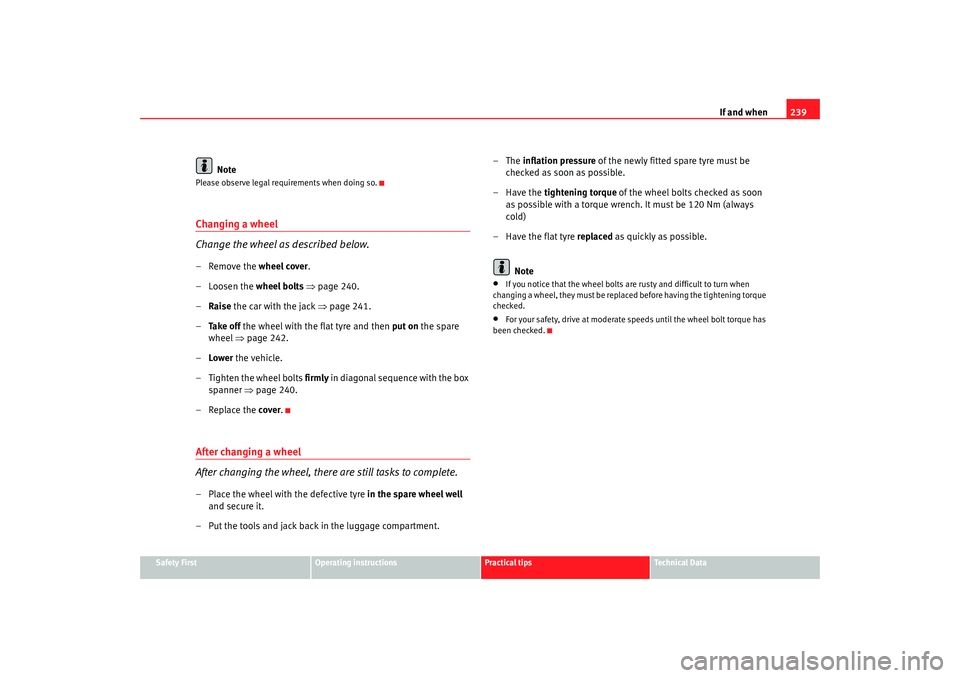
The spare steel rim wheel is carried in the wheel well under
the floor panel in the luggage compartment. It is only
intended for temporary use over short distances.Taking out the spare wheel
– Turn the plastic knob ⇒fig. 177 anti-clockwise.
– Take out the spare wheel.
Securing the defective wheel in the spare wheel well
– Place wheel in spare wheel well in the luggage compartment.
– Secure wheel by turning plastic knob clockwise.
– Replace the floor panel before closing the boot lid.
Fig. 176 Tyre Mobility
System under floor panel
in luggage compartment
Fig. 177 Spare steel rim
wheel
Exeo_EN.book Seite 237 Freitag, 17. Oktober 2008 11:24 11
Page 240 of 303

If and when
238Your vehicle can be equipped with a steel spare wheel at the factory. The
spare wheel does not usually meet the same performance standards as the
wheels fitted on the vehicle because of the wheel/tyre dimensions, rubber
composition, tread pattern, etc. Theref ore, note the following restrictions:•
The spare steel rim wheel is designed on ly for your vehicle model. Do not
attempt to mount the wheel on any vehicle but your own.
•
Your vehicle will have different driving characteristics when the spare
steel rim wheel is mounted ⇒.
•
The spare wheel is only intended for temporary use after having a flat tyre.
Replace the spare wheel with a normal wheel that has the proper tyre dimen-
sions as soon as possible.
•
If the size of the spare steel rim wheel is different to that of the other
wheels, it is unlikely that snow chains suitable for the other wheels will fit it.
WARNING
•
After mounting the spare steel rim wheel, the tyre pressure must be
checked and corrected as soon as possible. The inflating pressure must
adapt to the vehicle load (consult th e table containing the inflation pres-
sures). Otherwise there is danger of causing an accident. Use the highest
tyre pressure as indicated in the table.
•
Do not drive faster than 80 km/h, as higher speeds can cause an acci-
dent.
•
Avoid heavy acceleration, hard braking and fast cornering, as this could
cause an accident.
Changing a wheelPreparation work
What you must do before changing a wheel.– If you have a flat tyre or puncture, park the car as far away from the flow of traffic as possible. Choose a location that is as level
as possible.
– All passengers should leave the vehicle. They should wait in a
safe place (e.g. behind the roadside crash barrier).
–Apply the handbrake firmly.
– Engage 1st gear.
– When towing a trailer: Unhitch the trailer from your vehicle.
–Take the tools and the spare wheel ⇒ page 236 out of the
luggage compartment.
WARNING
If you have a puncture in heavy traffic, switch on the hazard warning lights
and place the warning triangle in a visible location. This is for your own
safety and also warns other road users.
Caution
If you have to change the tyre on a gradient, block the wheel opposite the
wheel being changed by placing a stone or similar object under it to prevent
the vehicle from rolling away.
Exeo_EN.book Seite 238 Freitag, 17. Oktober 2008 11:24 11
Page 241 of 303
If and when239
Safety First
Operating instructions
Practical tips
Te c h n i c a l D a t a
Note
Please observe legal requirements when doing so.Changing a wheel
Change the wheel as described below.– Remove the wheel cover.
– Loosen the wheel bolts ⇒ page 240.
– Raise the car with the jack ⇒ page 241.
– Ta k e o f f the wheel with the flat tyre and then put on the spare
wheel ⇒page 242.
– Lower the vehicle.
– Tighten the wheel bolts firmly in diagonal sequence with the box
spanner ⇒page 240.
–Replace the cover.After changing a wheel
After changing the wheel, there are still tasks to complete.– Place the wheel with the defective tyre in the spare wheel well
and secure it.
– Put the tools and jack back in the luggage compartment. –The
inflation pressure of the newly fitted spare tyre must be
checked as soon as possible.
– Have the tightening torque of the wheel bolts checked as soon
as possible with a torque wrench. It must be 120 Nm (always
cold)
– Have the flat tyre replaced as quickly as possible.
Note
•
If you notice that the wheel bolts are rusty and difficult to turn when
changing a wheel, they must be replaced before having the tightening torque
checked.
•
For your safety, drive at moderate speeds until the wheel bolt torque has
been checked.
Exeo_EN.book Seite 239 Freitag, 17. Oktober 2008 11:24 11