ESP Seat Exeo 2008 Owner's Guide
[x] Cancel search | Manufacturer: SEAT, Model Year: 2008, Model line: Exeo, Model: Seat Exeo 2008Pages: 303, PDF Size: 10.02 MB
Page 90 of 303

Cockpit
88Use the rocker switch to select the menus and adjust various values. The
selected values are highlighted on a red background.
By pressing the button, you can conf irm the option you have selected
or the value you have set. Selected functions are marked with a tick.
The following symbols are used:Tyre pressure monitoringIntroduction
The tyre pressure monitoring system constantly checks the
pressure of the tyres.The system warns the driver in the event of a loss of pressure by means of
symbols and messages in the instrument panel display. The system works
with the help of the ABS sensors in the wheels.
Please bear in mind that the tyre inflation pressure is also influenced by the
temperature of the tyre. Tyre pressure increases about 0.1 bar for each 10°C
in tyre temperature increase. The tyre heats up while the vehicle is being driven and the tyre pressure will rise accordingly. Therefore, you should only
adjust the tyre pressures when they are
cold (i.e. approximately at ambient
temperature).
To ensure that the tyre pressure monitoring system works reliably, you should
check and, if necessary, adjust the tyre pressures at regular intervals and
store the correct pressures (reference values) in the system.
A tyre pressure information label is attached to the inside of the fuel tank flap.
WARNING
•
Never adjust tyre pressure when the tyres are hot. This may damage or
even burst the tyres. Risk of accident!
•
An insufficiently inflated tyre flexes a lot more at high speeds and
causes significant heating of the ty re. Under these conditions, the tyre
bead may be released or the tyre may burst. Risk of accident!For the sake of the environment
Under-inflated tyres lead to increased fuel consumption and tyre wear.
Note
•
Responsibility for ensuring that the tyres are correctly inflated remains
with the driver; the system can only provide assistance.
•
Pressure can only be adjusted when the tyres are at ambient
temperature.
Cursor
Function selected
Red background (active
function)
Tick
Selected
Box
Not selected
Triangle pointing upwards
Previous page
Triangle pointing down-
wards
Next page
Reset
Exeo_EN.book Seite 88 Freitag, 17. Oktober 2008 11:24 11
Page 98 of 303
Unlocking and locking
96Central lockingDescription
The central locking system enables you to lock and unlock all
the doors, the boot lid and the tank flap together.The central locking system on your vehicle locks and unlocks all the doors
and the tank flap simultaneously. The tailgate is unlocked when the vehicle
is opened. However, the handle must be used to open it. The vehicle can be
locked and unlocked using the remote control ⇒page 102 or by turning the
key in the lock in the driver's door.
The windows can also be centrally opened or closed using the central locking
system ⇒page 107. The sun roof* can be closed but not opened using the
central locking system.
The central locking system is combined with an anti-theft security system. If
the vehicle is locked with the key from the outside, the interior opening levers
stop working, which make it difficult fo r unauthorised people to get into the
vehicle.
Should the central locking system fail to work, you can still normally enable
all the locks individually. The fuel tank flap can be released manually if neces-
sary. For manual release of the tank flap ⇒page 209.
Automatic locking function (Auto Lock)*
The Auto Lock* function locks the doors and the boot lid when the vehicle
exceeds a speed of about 15 km/h.
The vehicle is unlocked again automatically when the ignition key is
removed. Alternatively, the driver can also unlock the vehicle using the
central locking switch
or by opening one of the doors.
WARNING
Do not leave anyone (especially children) inside the car if it is locked from
the outside and the anti-theft security system is enabled, as the doors and
windows cannot then be opened from the inside. Locked doors could delay
assistance in an emergency, potentially putting lives at risk.
Note
•
Should the central locking system fail to work, you can still lock and
unlock the driver's door and the tailgate using the key. For manual release of
the tank flap ⇒page 209. Locking the doors manually if central locking fails
to work ⇒page 99.
•
The anti-theft mechanism and the anti-theft alarm* cannot be enabled if
the central locking is not working.
•
Never leave any valuable items in the vehicle unattended. Even a locked
vehicle is not a safe.
Exeo_EN.book Seite 96 Freitag, 17. Oktober 2008 11:24 11
Page 99 of 303
Unlocking and locking97
Safety First
Operating instructions
Practical tips
Te c h n i c a l D a t a
Unlocking the vehicle with the key– To unlock the vehicle, turn the key in the driver's door to position
⇒ fig. 69 .
– Pull the handle to open the door.•
This will unlock all the doors, the tailgate and the tank flap simultane-
ously.
•
The anti-theft security system will be disabled.
Locking the vehicle with the key– To lock the vehicle, turn the key in the driver's door to position
⇒ fig. 69 ⇒ .•
This will lock all the doors and the tailgate.
•
The interior lights are switched off, provided the light switch is in the cour-
tesy light position.
•
The windows and the sun roof* will close as the key is held in the locking
position.
•
The anti-theft security system will be enabled immediately.
Locking the vehicle without enabling the anti-theft security system
With the anti-theft security system enabled, it is more difficult to break into
the vehicle. If the anti-theft security system has been enabled, the inside
door handles and the central locking switch will not work ⇒.
If you are leaving passengers in the vehicle while it is parked, it is possible to
lock the vehicle without enabling the anti-theft security system.
To do so, turn the key in the driver's door twice in quick succession to position
⇒ fig. 69 .
WARNING
Do not leave anyone (especially children) in the car if it is locked from the
outside and the anti-theft security system is enabled, as the doors and
windows cannot then be opened from the inside. Locked doors could delay
assistance in an emergency, potentially putting lives at risk.
Caution
If the driver's door is locked using the key while open, the car will be automat-
ically immobilised and the alarm triggered.
Note
•
Please note that when the vehicle is locked without enabling the anti-
theft mechanism, the anti-theft alarm* remains operative. You should there-
fore switch off the interior monitor be fore locking the vehicle, as otherwise
the alarm could be triggered unintentionally.
Fig. 69 Turning the key to
enable the open and close
functions
AA
AB
AB
Exeo_EN.book Seite 97 Freitag, 17. Oktober 2008 11:24 11
Page 105 of 303
Unlocking and locking103
Safety First
Operating instructions
Practical tips
Te c h n i c a l D a t a
Locking the vehicle
– Press button for about 1 second.
Opening the tailgate
– Press button and hold for at least one second.The indicators will flash twice as confirmation when you unlock the car. The
vehicle will be locked again automatically if you do not open one of the doors
or the tailgate within 60 seconds after unlocking the car with button . This
function prevents the vehicle from remaining unlocked if the unlocking
button is pressed by mistake.
On vehicles with the security central locking* feature, you can unlock just the
driver's door and the tank flap by pressing button once, or the whole
vehicle by pressing the button twice.
The indicators flash once when the vehicle is locked to confirm that the doors
and tailgate are properly locked.
Moreover, apart from unlocking the vehicle, the seat* and mirror* memory
programmed in the key is activated. The dr iver's seat and exterior mirrors will
be automatically adjusted to the positions stored in the memory.
The interior lights will automatically light up when the vehicle is unlocked and
go out when the vehicle is locked, provided that the switch is in the courtesy
light position.
WARNING
Do not leave anyone (especially children) in the car if it is locked from the
outside and the anti- theft security system is enabled, as the doors and
windows cannot then be opened from the inside. Locked doors could delay
assistance in an emergency, potentially putting lives at risk.
Note
•
The remote control should only be us ed when the doors and the tailgate
are closed.
•
The remote control should not be used when the vehicle is out of sight.
•
The anti-theft alarm* can be accidentally triggered and the vehicle locked
if you press the locking button on th e remote control inside the vehicle
before inserting the key in the ignition. If this should happen by mistake,
press the unlock button .
Re-synchronising
Should the remote control fail to lock or unlock the vehicle,
the system must be re-synchronised.– If the vehicle is locked, use the key to unlock the driver's door.
– Press the unlock button on the remote control.
– Insert the key into the ignition and switch on the ignition.
– Switch off the ignition and remove the key.
– Press the unlock or the lock button .
AB
AC
AA
AA
Exeo_EN.book Seite 103 Freitag, 17. Oktober 2008 11:24 11
Page 107 of 303
Unlocking and locking105
Safety First
Operating instructions
Practical tips
Te c h n i c a l D a t a
•
The alarm is triggered immediately if one of the battery cables is discon-
nected while the alarm system is enabled.
Interior monitoring*
The interior monitor triggers an alarm if it detects movement
inside the vehicle.You should disable the interior monitor if there is a possibility that
the alarm could be triggered, e.g. by a pet or by an object moving
about inside the car ⇒. The tow-away protection feature, which
is integrated into the alarm system, should be disabled if the car is
being towed or transported (e.g. by rail or ship).
Disabling the interior monitor
– Open the door and pull out th e switch (with the symbol
) on
the storage compartment side, in the driver's door ⇒fig. 77 . – Then lock the vehicle.
Disabling the tow-away protection
– Open the door and pull out th
e switch (with the symbol
)
on the storage compartment side, in the driver's door ⇒fig. 77 .
– Then lock the vehicle.
The LED on switch will light up when the interior monitor is disabled. The
LED on the top of the driver's door trim will also light up for about 3 seconds.
When the vehicle is locked, the LED on the top of the driver's door trim will
flash rapidly for about 3 seconds. The interior monitor is automatically
enabled again the next time the vehicle is locked.
The LED on switch will light up when the tow-away protection function is
disabled. The LED on the top of the driver 's door trim will also light up for
about 3 seconds. When the vehicle is locked, the LED on the top of the
driver's door trim will flash rapidly for about 3 seconds. The tow-away protec-
tion is automatically enabled again the next time the vehicle is locked.
WARNING
Do not leave anyone (especially children) in the car if it is locked from the
outside and the anti-theft security system is enabled, as the doors and
windows cannot then be opened from the inside. Locked doors could delay
assistance in an emergency, potentially putting lives at risk.
Fig. 77 Interior monitor
switch
AA
AB
Exeo_EN.book Seite 105 Freitag, 17. Oktober 2008 11:24 11
Page 111 of 303

Unlocking and locking109
Safety First
Operating instructions
Practical tips
Te c h n i c a l D a t a
Sliding/Tilting
The sun roof will create less wind noise if it is opened in the
comfort setting.Comfort setting
– Turn the control until it engages at position ⇒fig. 80 . The sun
roof will now only open as far as the comfort setting which means
there is less wind noise.
Opening completely
– Turn the switch to position and hold it until the sun roof reaches the desired position. This position can cause more wind
noise.
Tilting open
– Turn the control to position . – With the control in position 0, press the control
briefly to make
the roof tilt open all the way.
– To open the roof as far as an intermediate setting, press and hold
the control until the roof has moved to the desired position.
When you release the switch it will auto matically spring back from position
to position .
The sliding sun blind in the headliner automatically opens when the sunroof
is slid open. If required, it can be closed by hand when the sunroof is closed.
It is advisable to close the sun blind when the vehicle is left standing in the
sun. It is important to remember to close the sunroof when parking the
vehicle or if it suddenly starts raining – especially when the sun blind is
extended.
For further information on the automatic close function, see ⇒page 110.ClosingClosing
–Turn the control to position ⇒ fig. 80 to close the sunroof
⇒ .
Closing the sunroof from the tilt position
– Pull the specially formed rear end of the control and hold it until
the sunroof has moved down to the desired position.
–Pull the switch briefly to lower the sunroof automatically to the
fully closed position. If required, the sunroof can be stopped in
any position by briefly pulling the control again ⇒.
Fig. 80 Details of head-
liner: Rotary sun roof
controlA1
A2A0
A2
A1
A0
Exeo_EN.book Seite 109 Freitag, 17. Oktober 2008 11:24 11
Page 117 of 303

Lights and visibility115
Safety First
Operating instructions
Practical tips
Te c h n i c a l D a t a
Coming home and leaving home functions*
The coming home and leaving home functions are used to
light up the surroundings in th e dark. The front fog lights, the
rear side lights and the number plate light switch on.Enabling the functions
– Briefly press the knob ⇒fig. 85 to release it from its set position.
– Turn the knob to position 1.
– Press the knob in again to prevent the setting from being changed unintentionally.
Disabling the functions
– Briefly press the knob ⇒fig. 85 to release it from its set position.
– Turn the knob to position 0. – Press the knob in again to prevent the setting from being
changed unintentionally.
The coming home and leaving home functions are controlled by light sensors
in the rear view mirror housing. The sy stem will function when the following
requirements are met:•
The knob is set to position 1.
•
The headlights and the ignition are switched off.
•
Dark conditions; the sensors register little or no light.
Coming home
When the system is enabled and it is dark, the corresponding exterior lights
switch on as soon as the driver's door is opened.
The exterior lights will stay on for up to a maximum of 2 minutes as long as
one of the doors or the tailgate is open.
The exterior lights stay on for about 30 seconds to light up the area in front of
the car after all the doors and the tailgate have been closed.
This time interval is factory-set, but you can have it changed by a specialist
garage to suit your own requirements (max. setting is 60 seconds).
Leaving home
The exterior lights are switched on wh en the vehicle is unlocked with the
button on the remote control key.
The exterior lights go out when the dr iver's door is opened or after 60
seconds when the vehicle locks itself again automatically ⇒page 102.
WARNING
Before leaving the vehicle, remove the key from the ignition, as the lights
will not go out if the coming home is enabled. This will lead to battery
discharge and vehicle breakdown.
Fig. 85 Detailed view of
the instrument panel:
Coming home and leaving
home functions
Exeo_EN.book Seite 115 Freitag, 17. Oktober 2008 11:24 11
Page 119 of 303
Lights and visibility117
Safety First
Operating instructions
Practical tips
Te c h n i c a l D a t a
– Briefly press the knob
⇒ page 116, fig. 87 to release it from
its set position.
– Turn the knob to the required setting.
– Press the knob in again to prevent the setting from being changed unintentionally.
Settings
The settings roughly correspond to the following load conditions:
Two front occupants, luggage compartment empty
Full load of occupants, lug gage compartment empty
Full load of occupants, luggage compartment loaded
Driver only, luggage compartment loaded
Caution
Always adjust the headlights to avoid dazzling oncoming traffic. Make sure
you lower the headlights when the vehicle is more heavily laden.Dynamic headlight range controlOn vehicles with xenon gas-discharge bulbs, the headlights automatically
adapt to suit the load being carried when the ignition is switched on. The
headlights are also automatically adjusted when the vehicle is in motion (e.g.
when accelerating and braking).
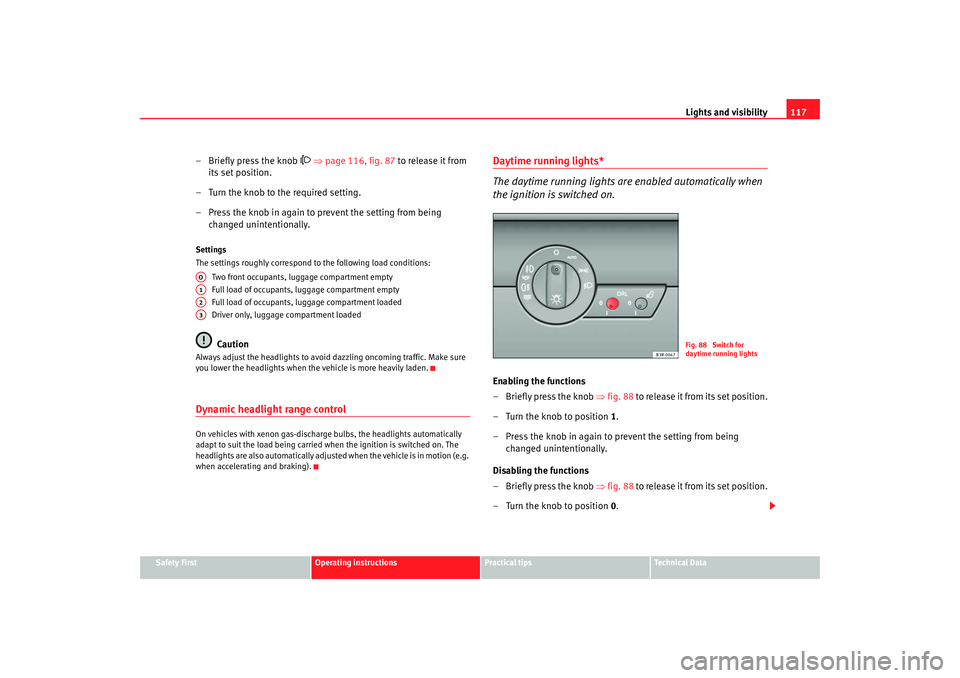
Daytime running lights*
The daytime running lights are enabled automatically when
the ignition is switched on.Enabling the functions
– Briefly press the knob ⇒fig. 88 to release it from its set position.
– Turn the knob to position 1.
– Press the knob in again to prevent the setting from being changed unintentionally.
Disabling the functions
– Briefly press the knob ⇒fig. 88 to release it from its set position.
– Turn the knob to position 0.
AOA1A2A3
Fig. 88 Switch for
daytime running lights
Exeo_EN.book Seite 117 Freitag, 17. Oktober 2008 11:24 11
Page 122 of 303
Lights and visibility
120
Main beam headlights
– Press the lever forward to switch on the main beams.
– Pull the lever back towards you to switch the main beam head-lights off again.
Headlight flasher
– Pull the lever towards the steering wheel to operate the flasher.
Parking light
– Switch the ignition off.
– Move the lever up or down to turn on the right or left-hand parking lights respectively.Notes on these functions•
The indicators only work when the ignition is switched on. The indicator
lamp or flashes in the instrument panel when the turns signals
⇒ page 65 are working.
•
The indicators are cancelled automatically when the steering wheel is
returned to the straight-ahead position.
•
The main beam headlights can only be switched on if the dipped beam
headlights are already on. The main beam headlight indicator lamp
then
comes on in the instrument panel.
•
The headlight flasher comes on for as long as you pull the lever, even if no
other lights are switched on. The main beam headlight indicator lamp
then comes on in the instrument panel.
•
When the parking lights are switched on, the headlight and the rear light
on one side of the car light up with re duced intensity. The parking lights will
only work with the ignition off.
Caution
Never use the main beam headlights or the headlight flasher if this would
dazzle oncoming traffic.Interior lightsFront interior lights and glove compartment light
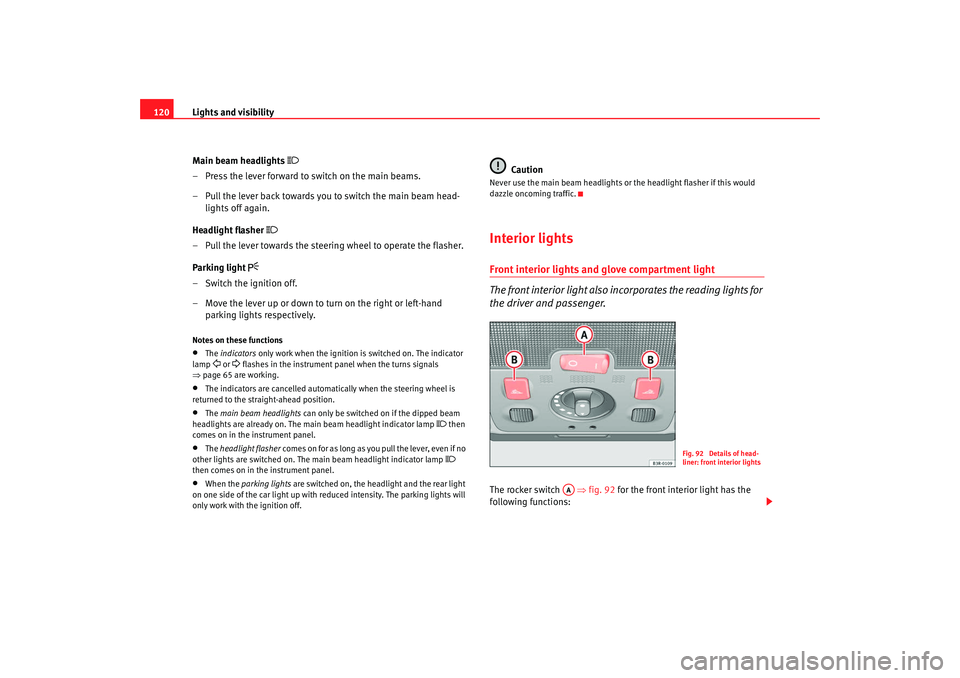
The front interior light also incorporates the reading lights for
the driver and passenger.The rocker switch ⇒fig. 92 for the front interior light has the
following functions:
Fig. 92 Details of head-
liner: front interior lights
AA
Exeo_EN.book Seite 120 Freitag, 17. Oktober 2008 11:24 11
Page 130 of 303

Lights and visibility
128•
the interior lighting is switched on
•
reverse gear is engaged
Sensors for automatic headlights*
When the light switch is set to the AUTO position, the dipped beam head-
lights are switched on and off automatically according to the ambient light
level with the aid of the sensors located in the interior rear view mirror
⇒ page 113.
WARNING
Electrolyte fluid can leak from a broken mirror. This fluid can cause irrita-
tion to the skin, eyes and respiratory organs. Wash thoroughly with clean
water should you come into contact with this fluid. Seek medical assist-
ance if needed!
Caution
Electrolyte fluid leaking from a broken mirror can cause damage to plastic
surfaces. Use a sponge or similar to remove the fluid as soon as possible.
Note
•
The rear-view mirrors automatic anti-dazzle function* will only work prop-
erly if the sun blind* for the rear window is rolled down and if there are no
other objects preventing light fr om reaching the interior mirror.
•
If you have to stick any type of sticker on the windscreen, do not do so in
front of the sensors. Doing so could pr event the automatic headlight or anti-
dazzle function from working correctly or even from working at all.
Exterior mirrors
The exterior mirrors are adjusted electrically.Adjusting the exterior mirrors
– Turn the adjuster knob to position ⇒fig. 103 (left exterior
mirror) or position (right exterior mirror).
– Move the knob as required to adjust the exterior mirror for a good view behind you.
Retracting both exterior mirrors
– Turn the knob to position .It is advisable to fold the exterior mirrors, for example when parking or when
driving along narrow spaces.
Fig. 103 Detailed view of
the armrest: Adjuster
knobAL
AR
AA
Exeo_EN.book Seite 128 Freitag, 17. Oktober 2008 11:24 11