lock Seat Exeo 2008 Workshop Manual
[x] Cancel search | Manufacturer: SEAT, Model Year: 2008, Model line: Exeo, Model: Seat Exeo 2008Pages: 303, PDF Size: 10.02 MB
Page 166 of 303

Driving
164Switching on the ignition/pre-heating glow plugs
If the key is difficult to turn in the lock, move the steering wheel (to take the
load off the steering lock mechanism) until the key turns freely. In the case of
vehicles with a diesel engine, the key is turned to this position to preheat the
glow plugs.
Starting the engine
The engine is started in this position . Electrical components with a high
power consumption are switched off temporarily.
After the engine has started, the ignition key returns to position by itself.
The ignition key has to be turned back to position before re-starting the
engine. The starter inhibitor in the ignition lock prevents the starter motor
from engaging when the engine is running, as this could cause damage.
Switching off the ignition
Turn the ignition key to this position.
WARNING
•
Never remove the ignition key until the vehicle is stationary! Otherwise
the steering lock could engage suddenly, which could cause an accident.
•
Always take the key with you when leaving the vehicle, even if you only
intend to be gone for a short time. This is particularly important if there are
children in the car, as they might otherwise be able to start the engine or
use power-operated equipment (e.g. the electric windows), which could
lead to injuries.Note
•
If the battery has been disconnected and then reconnected, it will be
necessary to leave the key in position for about 5 seconds before starting
the engine.
Starting and stopping the engineStarting the engine
The engine can only be started with an original SEAT key.Vehicles with a petrol engine:
– Use the foot brake.
– Manual gearbox: Push the clutch pedal all the way down.
– Move the gear lever into the neutral position ⇒.
– Turn the ignition key to position without pressing the acceler- ator.
– Release the ignition key as soon as the engine starts (the starter motor must not be allowed to run on with the engine).
A1
A2
A1
A0
A0
A1
Fig. 140 Ignition key
positions
A2
Exeo_EN.book Seite 164 Freitag, 17. Oktober 2008 11:24 11
Page 169 of 303

Driving167
Safety First
Operating instructions
Practical tips
Te c h n i c a l D a t a
If you drive by mistake with the handbrake still applied, you will hear a
warning buzzer and the display will show the message:
Handbrake applied
The handbrake warning is enabled after driving for 3 seconds at a speed
above 5 km/h.
The handbrake warning lamp
lights up when the handbrake is applied
with the ignition on.
WARNING
Please note that the handbrake should be released all the way. If it is only
partially released, this will cause rear brakes overheating, which can
impair the function of the brake system and could lead to an accident.
Caution
After the vehicle has been stopped, always apply the hand brake and engage
a gear.Parking
The following points will ensure there is no risk of the car
rolling away accidentally after it is parked.– Use the foot brake to stop the vehicle.
– Apply handbrake firmly.
– Switch the engine off.
– Engage the first gear ⇒.
When parking on slopes:
Turn the steering wheel so that the, if the vehicle moves, it will do so towards
the curb.
WARNING
•
Do not leave anyone (especially chil dren) in the vehicle when it is
locked. Locked doors could delay assistance in an emergency, potentially
putting lives at risk.
•
Never leave children unsupervised in the vehicle. They could release
e.g. the handbrake or gear lever, moving the vehicle and causing an
accident.
Parking aidGeneral notesVarious systems are available to help you when parking or manoeuvring in
tight spaces, dependi ng on the equipment fitted on your vehicle.
The SEAT parking system gives an acoustic warning if there are any obstacles
behind your car ⇒ page 168.
When you are parking, SEAT parking system plus warns you acoustically and
optically about obstacles in front of and behind the vehicle ⇒ page 168.
Note
To ensure the acoustic parking aid works properly, the sensors must be kept
clean and free of snow and ice.
Exeo_EN.book Seite 167 Freitag, 17. Oktober 2008 11:24 11
Page 177 of 303
Intelligent technology175
Safety First
Operating instructions
Practical tips
Te c h n i c a l D a t a
Practical tipsIntelligent technologyElectronic stabilisation programme (ESP)General notes
The electronic stabilisation programme increases the
vehicle?s stability on the road.The ESP is designed to increase the degree of control in situations where the
car approaches the limits of adhesion, especially when accelerating and
cornering. It reduces the risk of skidding and improves stability in all road
conditions. The system is active across the entire speed range. The anti-lock brake system (ABS), the electronic differential lock (EDL) and
the traction control system (TCS) are all
integrated into the electronic stabili-
sation programme.
How it works
The ESP control unit processes data from the three integrated systems. It also
processes additional inputs provided by other high-precision sensors. These
register the vehicle's rotation about the vertical axis (yaw rate), lateral accel-
eration, brake pressure and steering wheel angle.
The system uses the steering wheel angle and road speed to calculate the
changes of direction desired by the driver, and constantly compares them
with the actual behaviour of the vehi cle. If the desired course is not being
maintained (for instance, if the car is starting to skid), then the ESP compen-
sates automatically by braking the appropriate wheel.
The forces acting on the braked wheel bring the car back to a stable condi-
tion. If the vehicle over swerves (tendency of the rear to leave the road), the
brakes will act on the front wheel facing the outside of the bend. If the vehicle
under swerves (tendency to leave the bend), the braking force is applied to
the rear wheel facing th e inside of the bend.
The ESP works in conjunction with the ABS ⇒page 176. If a malfunction
should occur in the ABS, the ESP will also be out of action.
Disabling
The ESP is enabled automatically when the engine is started and performs a
self-test routine.
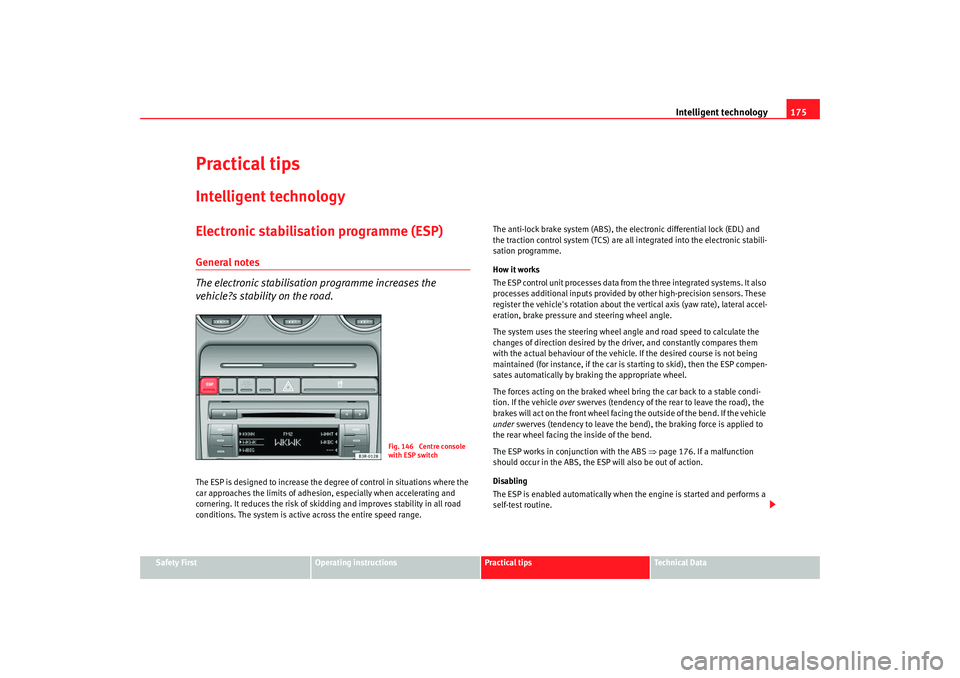
Fig. 146 Centre console
with ESP switch
Exeo_EN.book Seite 175 Freitag, 17. Oktober 2008 11:24 11
Page 178 of 303
Intelligent technology
176If required, the ESP can also be enab led and disabled manually by briefly
pressing the switch ⇒ page 175, fig. 146. The ESP warning lamp lights
up when the system is switched off, see ⇒page 68.
In general, the ESP should be left switched on at all times. In particular
circumstances where a certain amount of wheel slip is desirable, it may be
advisable to switch off the ESP. Examples:•
when driving with snow chains
•
when driving in deep snow or on loose surfaces
•
when rocking the car backwards and forwards to free it.
The ESP should be switched on again afterwards as soon as possible.
WARNING
The ESP is not able to overcome the physical limits of adhesion. Even with
ESP, you should always adjust your speed to suit the co nditions. Please
bear this in mind, especially on wet or slippery road surfaces. Do not let the
extra safety features tempt you into ta king any risks when driving. Failure
to do so could result in an accident.Anti-lock brake system (ABS)
ABS prevents the wheels from locking up under braking.The anti-lock brake system (ABS) is an im portant part of the car's active safety
system. However, the ABS will not necessarily guarantee shorter stopping
distances in all conditions. For instance, on loose gravel or fresh snow on top
of an icy surface (conditions which anyway require extreme care and reduced
speed), the stopping distance with ABS may even be slightly longer. How the ABS works
The system runs an automatic self-check when the car reaches a road speed
of about 6 km/h. This may be accompanied by a noise from the ABS pump.
When one of the wheels is turning very slowly in relation to the road speed
and is close to locking up, the system will reduce the pressure in the brake
line to this wheel. The driver is made aware of this adjustment process by a
vibration of the brake pedal
and an audible noise. This is a deliberate
warning to the driver that one or more of the wheels is tending to lock up and
the ABS control function has intervened. In this situation it is important to
keep the brake pedal fully depressed so the ABS can regulate the brake appli-
cation, but do not “pump” the brake pedal.
WARNING
The grip provided by ABS is still subj ect to the physical limits of adhesion.
Always bear this in mind, especially on wet or slippery roads. If you notice
that the ABS is working (to countera ct locked wheels under braking), you
should reduce speed immediately to su it the road and traffic conditions. Do
not let the extra safety features tempt you into taking any risks when
driving. Failure to do so could result in an accident.
Note
If a malfunction should occur in the ABS, this is indicated by a warning lamp
⇒ page 67.Brake assist system
The brake assist system helps the driver to achieve optimum
braking effect.The brake assist system helps to increase braking power and thus to achieve
a shorter stopping distance. If the driver presses the brake pedal very quickly,
ESP
Exeo_EN.book Seite 176 Freitag, 17. Oktober 2008 11:24 11
Page 179 of 303
Intelligent technology177
Safety First
Operating instructions
Practical tips
Te c h n i c a l D a t a
the brake assist system automatically boosts the braking force to the
maximum level, up to the point where the anti-lock brake function (ABS) inter-
venes to stop the wheels from locking. You should then keep the brake pedal
pressed until the vehicle has braked to the required speed. The brake assist
system switches itself off as soon as you release the brake pedal.
The brake assist system will not be operative if there is a malfunction in the
ABS.or in the ESP.
WARNING
Please remember that the accident risk always increases if you drive too
fast, especially in corners or on a slippery road, or if you follow too close
behind the vehicle in front of you. An increased accident risk cannot be
compensated even by the brake assist system. Risk of accident.Electronic differential lock (EDL)
The electronic differential lock prevents the loss of traction
caused if one wheel starts spinning.General notes
The electronic differential lock (EDL) helps the car to start moving, accelerate
and climb a gradient in slippery conditions where this may otherwise be diffi-
cult or even impossible.
How it works
The EDL works automatically, i.e. without the driver's involvement. With the
aid of the ABS sensors, the system monitors the rotational speed of the
driven wheels
⇒page 176. If a considerable difference in revs is detected
(approx. 100 rpm) in the speed of the driven wheels, e.g. when only one part
of the surface supporting the wheels is slippery, the system applies the brake
to slow down the skidding wheel so that more of the power is directed to the other wheels. The systems works up to a speed of approx. 80 km/h. The
system will make noises while it is working.
Moving away from a standstill
If one wheel has less grip and starts spinning (for instance, if one of the
driven wheels is on ice), keep pressing the accelerator gradually until the car
starts moving.
Overheating of the brakes
To prevent the brake disk of the braked wheel from overheating, the EDL cuts
out automatically if subjected to excessive loads. In this case, the vehicle will
continue to run and will have the same
running properties as those of another
without EDL.
The EDL will switch on again automatically when the brake has cooled down.
WARNING
•
When accelerating on a uniformly slippery surface (for instance all four
wheels on ice or snow), press the accelerator gradually and carefully.
Despite EDL, the driven wheels may otherwise start to spin. This could
impair the car's stability. Risk of accident.
•
Even with EDL, you should always ad just your speed to suit the condi-
tions. Do not let the extra safety features tempt you into taking any risks
when driving. Failure to do so could result in an accident.Note
If the ABS warning lamp lights up, this can also mean there is a fault in the
EDL. Please take the vehicle to a specialist garage as soon as possible.
Exeo_EN.book Seite 177 Freitag, 17. Oktober 2008 11:24 11
Page 184 of 303
Driving and the environment
182your vehicle has automatic transmission). This makes use of engine
braking and relieves the brakes.•
Never let the brakes “slip” by applying light pressure. Continuous
braking will cause the brakes to overheat and the braking distance will
increase. Apply and then release the brakes alternately.
•
Never let the vehicle run with the engine switched off. The braking
distance is increased considerably when the brake servo is not active.
•
Very heavy use of the brakes may cause a vapour lock if the brake fluid
is left in the system for too long. This impairs the braking effect.
•
Non-standard or damaged front spoilers could restrict the airflow to the
brakes and cause them to overheat. Observe the relevant instructions
before purchasing accessories ⇒ page 206, “Technical modifications”.
•
If a brake circuit fails, the braking distance will be increased consider-
ably. Contact a qualified workshop immediately and avoid unnecessary
journeys.
Exhaust gas purification systemCatalytic converter*To conserve the useful life of the catalytic converter
– Always use unleaded petrol.
– Do not let the fuel get too low in the tank.
– For engine oil changes, do not replenish with too much engine oil ⇒page 215. – Never tow the vehicle to start it, use jump leads if necessary
⇒page 271.
If you notice misfiring, uneven running or loss of power when the vehicle is
moving, reduce speed immediately and have the vehicle inspected at the
nearest qualified workshop. In general, the exhaust warning lamp will light
up when any of the described symptoms occur ⇒page 66. If this happens,
unburnt fuel can enter the exhaust system and escape into the environment.
The catalytic converter can also be damaged by overheating.
WARNING
The catalytic converter reaches very high temperatures! Fire hazard!•
Never park where the catalytic convert er could come into contact with
dry grass or inflammable materials under the vehicle.
•
Do not apply additional underseal or anti-corrosion coatings to the
exhaust pipes, catalytic converter or the heat shields on the exhaust
system. These materials could catch fire when the vehicle is being driven.Caution
Never fully drain the fuel tank because the irregularity of the fuel supply may
cause ignition problems. This allows unburnt fuel to enter the exhaust
system, which could cause overheating and damage the catalytic converter.
For the sake of the environment
Even when the emission control system is working perfectly, there may be a
smell of sulphur from the exhaust under some conditions. This depends on
the sulphur content of the fuel used. Quite often the problem can be solved
by changing to another fuel brand.
WARNING (continued)
Exeo_EN.book Seite 182 Freitag, 17. Oktober 2008 11:24 11
Page 189 of 303
Trailer towing187
Safety First
Operating instructions
Practical tips
Te c h n i c a l D a t a
Where possible, operate the trailer with the maximum permitted
draw bar
weight on the ball joint of the towing bracket, but do not exceed the specified
limit.
Tyre pressure
Check the tyre pressures on your car, and adjust for “full load” conditions
(refer to the sticker listing the tyre pressures on the door pillar). It may also be
necessary to adjust the tyre pressures on the trailer according to the recom-
mendations of the trailer manufacturer.
Exterior mirrors
Check whether you can see enough of the road behind the trailer with the
standard mirrors. If this is not the case you should have additional mirrors
fitted. The two exterior mi rrors should be fitted on folding arms. Adjust the
mirrors to give sufficient rear vision.
Headlights
Before starting a journey, check the headlight beam settings with the trailer
hitched up. If necessary, alter the height of the headlight beams by means of
the headlight range control. See ⇒page 116.
Power supply
When you remove the ignition key, the power supply to the trailer is inter-
rupted.
Removable ball joint coupling
Vehicles with a factory-fitted towing bracket are equipped with a removable
ball joint coupling. This is stored in the spare wheel well in the luggage
compartment together with the necessary fitting instructions.
Note
If you frequently tow, we recommend you also have vehicle serviced between
services.
Notes on towing
Towing a trailer involves additi onal attention by the driver.Weight distribution
The weight distribution of a loaded trailer with an unladen vehicle is very
unfavourable. However, if this cannot be avoided, drive extra slowly to allow
for the unbalanced we ight distribution.
Speed
The stability of the car and trailer is reduced with increasing speed. Therefore,
it is advisable not to drive at the maximum permissible speed in an unfavour-
able road, weather or wind conditions. This especially applies when driving
downhill.
You should always reduce speed immediately if the trailer shows the slightest
sign of swaying. Never try to stop the “snaking” by increasing speed.
Anticipate hazards and brake in good time. If towing a trailer with an inertia
brake , first brake gently and then more severely. This will prevent brake
tapping by the trailer wheels when they lock. Select a low gear in due course
before going down a steep downhill. This enables you to use the engine
braking to slow down the vehicle.
Swaying and pitching can be reduced by stabiliser aids. We recommend
having stabiliser aids installed when towing trailers with a high trailer load.
They can be purchased and installed at a Dealer.
Reheating
When climbing long hills in hot weather wi th the engine running fast in low
gear, you should keep an eye on the coolant temperature gauge ⇒page 60.
Reduce speed immediately if the needle moves to the right end of the scale.
If the temperature warning light
in the instrument cluster should start
flashing, stop the car and let the engine cool down by running it at idling
speed for a few minutes.
Exeo_EN.book Seite 187 Freitag, 17. Oktober 2008 11:24 11
Page 190 of 303
Trailer towing
188Equipment and accessories
Before mounting equipment and accessories (e.g. bicycle
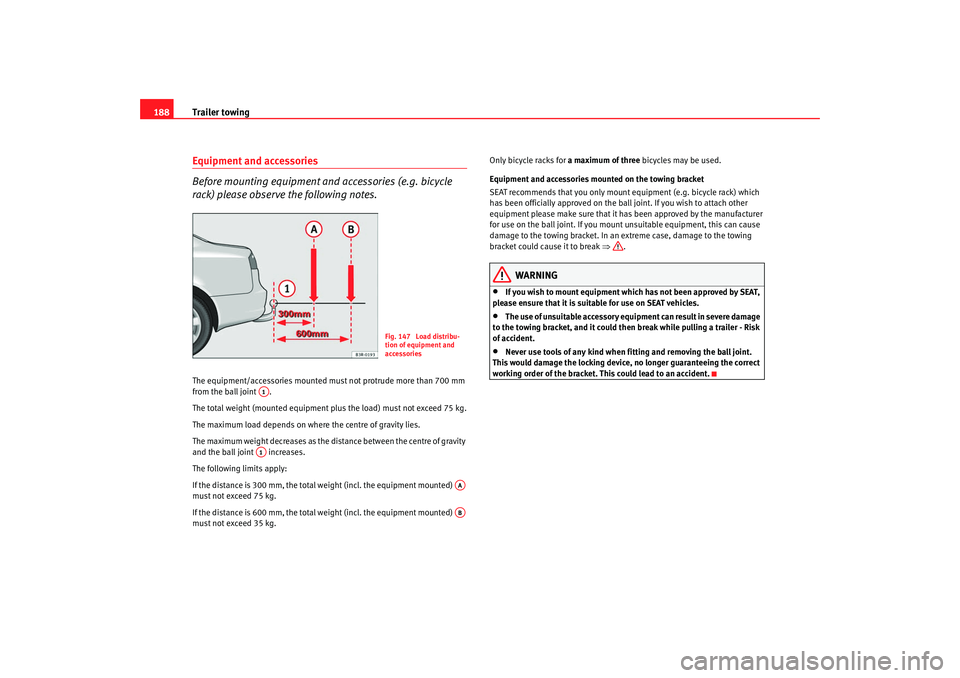
rack) please observe the following notes.The equipment/accessories mounted must not protrude more than 700 mm
from the ball joint .
The total weight (mounted equipment plus the load) must not exceed 75 kg.
The maximum load depends on where the centre of gravity lies.
The maximum weight decreases as the distance between the centre of gravity
and the ball joint increases.
The following limits apply:
If the distance is 300 mm, the total we ight (incl. the equipment mounted)
must not exceed 75 kg.
If the distance is 600 mm, the total we ight (incl. the equipment mounted)
must not exceed 35 kg. Only bicycle racks for
a maximum of three bicycles may be used.
Equipment and accessories mounted on the towing bracket
SEAT recommends that you only mount equipment (e.g. bicycle rack) which
has been officially approved on the ball joint. If you wish to attach other
equipment please make sure that it has been approved by the manufacturer
for use on the ball joint. If you mount unsuitable equipment, this can cause
damage to the towing bracket. In an extreme case, damage to the towing
bracket could cause it to break ⇒.
WARNING
•
If you wish to mount equipment which has not been approved by SEAT,
please ensure that it is suitable for use on SEAT vehicles.
•
The use of unsuitable accessory equipment can result in severe damage
to the towing bracket, and it could then break while pulling a trailer - Risk
of accident.
•
Never use tools of any kind when fitting and removing the ball joint.
This would damage the locking device , no longer guaranteeing the correct
working order of the bracket. This could lead to an accident.
Fig. 147 Load distribu-
tion of equipment and
accessories
A1A1
AAAB
Exeo_EN.book Seite 188 Freitag, 17. Oktober 2008 11:24 11
Page 191 of 303
Trailer towing189
Safety First
Operating instructions
Practical tips
Te c h n i c a l D a t a
Removable towing bracketIntroduction
Special care is required when fitting and removing the towing
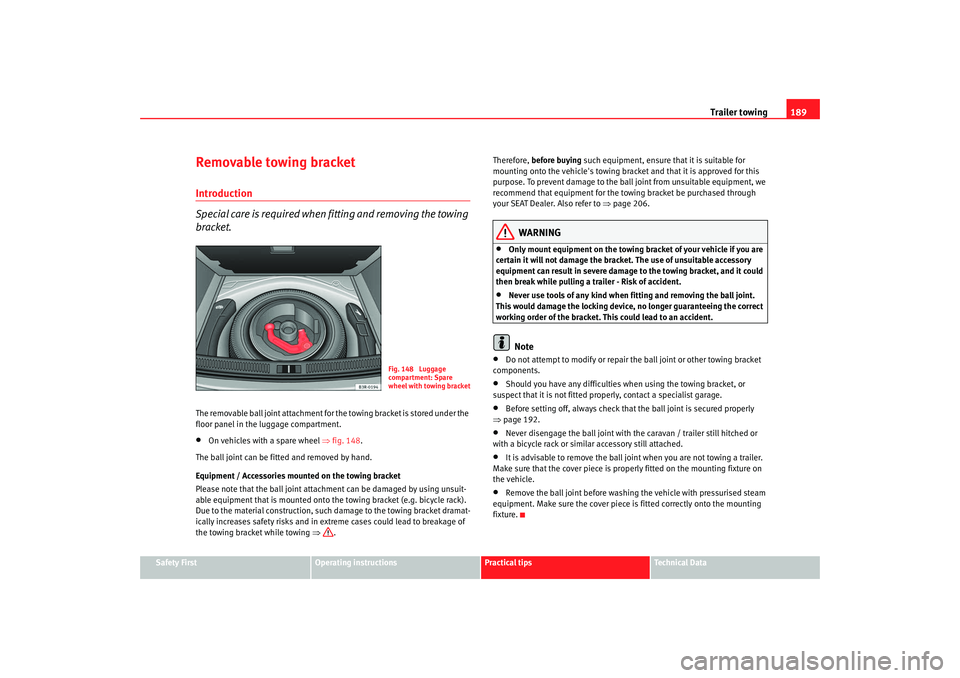
bracket.The removable ball joint attachment for the towing bracket is stored under the
floor panel in the luggage compartment.•
On vehicles with a spare wheel ⇒fig. 148 .
The ball joint can be fitted and removed by hand.
Equipment / Accessories mounted on the towing bracket
Please note that the ball joint attach ment can be damaged by using unsuit-
able equipment that is mounted onto the towing bracket (e.g. bicycle rack).
Due to the material construction, such damage to the towing bracket dramat-
ically increases safety risks and in extreme cases could lead to breakage of
the towing bracket while towing ⇒ . Therefore, before buying
such equipment, ensure that it is suitable for
mounting onto the vehicle's towing bracket and that it is approved for this
purpose. To prevent damage to the ball joint from unsuitable equipment, we
recommend that equipment for the to wing bracket be purchased through
your SEAT Dealer. Also refer to ⇒page 206.
WARNING
•
Only mount equipment on the towing bracket of your vehicle if you are
certain it will not damage the bracket. The use of unsuitable accessory
equipment can result in severe damage to the towing bracket, and it could
then break while pulling a trailer - Risk of accident.
•
Never use tools of any kind when fitting and removing the ball joint.
This would damage the locking device, no longer guaranteeing the correct
working order of the bracket. This could lead to an accident.Note
•
Do not attempt to modify or repair the ball joint or other towing bracket
components.
•
Should you have any difficulties when using the towing bracket, or
suspect that it is not fitted properly, contact a specialist garage.
•
Before setting off, always check that the ball joint is secured properly
⇒ page 192.
•
Never disengage the ball joint with the caravan / trailer still hitched or
with a bicycle rack or similar accessory still attached.
•
It is advisable to remove the ball joint when you are not towing a trailer.
Make sure that the cover piece is proper ly fitted on the mounting fixture on
the vehicle.
•
Remove the ball joint before washing the vehicle with pressurised steam
equipment. Make sure the cover piece is fitted correctly onto the mounting
fixture.
Fig. 148 Luggage
compartment: Spare
wheel with towing bracket
Exeo_EN.book Seite 189 Freitag, 17. Oktober 2008 11:24 11
Page 193 of 303
Trailer towing191
Safety First
Operating instructions
Practical tips
Te c h n i c a l D a t a
Make sure the ball joint is clean and undamaged
– Check the locking pin , release pin , shaft section and
knob ⇒page 190, fig. 150 on the ball joint to make sure they
are clean and undamaged.
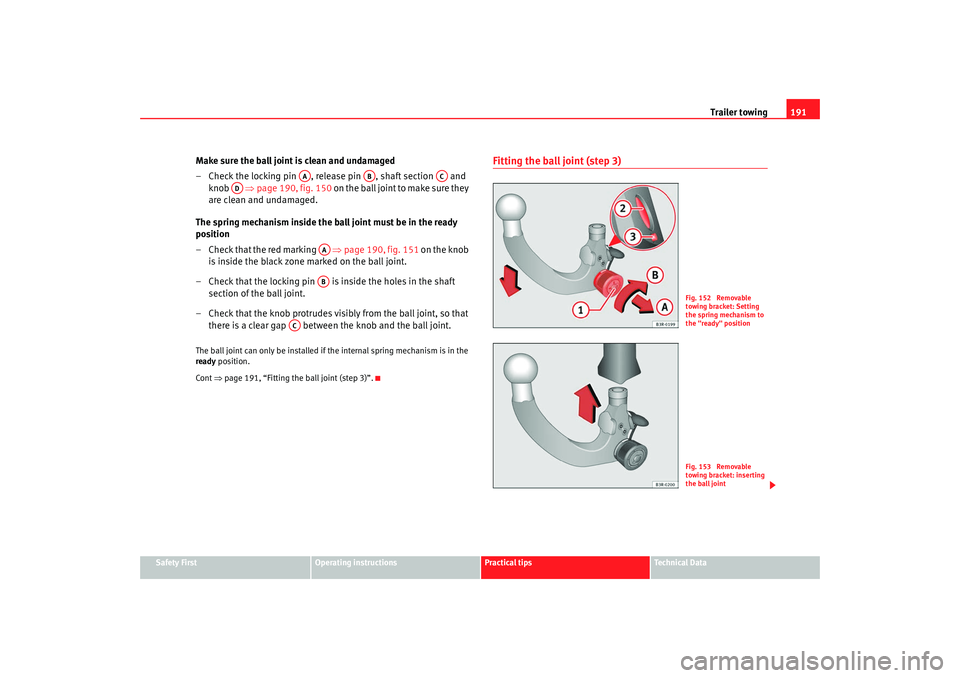
The spring mechanism inside the ball joint must be in the ready
position
– Check that the red marking ⇒ page 190, fig. 151 on the knob
is inside the black zone marked on the ball joint.
– Check that the locking pin is inside the holes in the shaft section of the ball joint.
– Check that the knob protrudes visi bly from the ball joint, so that
there is a clear gap between the knob and the ball joint.The ball joint can only be installed if the internal spring mechanism is in the
ready position.
Cont ⇒page 191, “Fitting the ball joint (step 3)”.
Fitting the ball joint (step 3)
AA
AB
AC
AD
AAAB
AC
Fig. 152 Removable
towing bracket: Setting
the spring mechanism to
the "ready" positionFig. 153 Removable
towing bracket: inserting
the ball joint
Exeo_EN.book Seite 191 Freitag, 17. Oktober 2008 11:24 11