air condition Seat Exeo 2008 Owner's manual
[x] Cancel search | Manufacturer: SEAT, Model Year: 2008, Model line: Exeo, Model: Seat Exeo 2008Pages: 303, PDF Size: 10.02 MB
Page 5 of 303
Contents3
ContentsManual structure
. . . . . . . . . . . . . . . . . . . .
Content
. . . . . . . . . . . . . . . . . . . . . . . . . . . . . . . .
Safety First
. . . . . . . . . . . . . . . . . . . . . . . . . . .
Safe driving
. . . . . . . . . . . . . . . . . . . . . . . . . . . . . .
Brief introduction . . . . . . . . . . . . . . . . . . . . . . . .
Proper sitting position for occupants . . . . . . . . .
Pedal area . . . . . . . . . . . . . . . . . . . . . . . . . . . . . .
Stowing luggage . . . . . . . . . . . . . . . . . . . . . . . . .
Seat belts
. . . . . . . . . . . . . . . . . . . . . . . . . . . . . . . .
Brief introduction . . . . . . . . . . . . . . . . . . . . . . . .
Why wear seat belts? . . . . . . . . . . . . . . . . . . . . . .
Seat belts . . . . . . . . . . . . . . . . . . . . . . . . . . . . . . .
Belt tension devices . . . . . . . . . . . . . . . . . . . . . .
Airbag system
. . . . . . . . . . . . . . . . . . . . . . . . . . . .
Brief introduction . . . . . . . . . . . . . . . . . . . . . . . .
Front airbags . . . . . . . . . . . . . . . . . . . . . . . . . . . .
Knee airbag . . . . . . . . . . . . . . . . . . . . . . . . . . . . .
Side airbags* . . . . . . . . . . . . . . . . . . . . . . . . . . . .
Curtain airbags . . . . . . . . . . . . . . . . . . . . . . . . . .
Deactivating airbags* . . . . . . . . . . . . . . . . . . . . .
Child safety
. . . . . . . . . . . . . . . . . . . . . . . . . . . . . .
Brief introduction . . . . . . . . . . . . . . . . . . . . . . . .
Child seats . . . . . . . . . . . . . . . . . . . . . . . . . . . . . .
Securing child seats . . . . . . . . . . . . . . . . . . . . . .
Operating instructions
. . . . . . . . . . . .
Cockpit
. . . . . . . . . . . . . . . . . . . . . . . . . . . . . . . . . . .
Overview . . . . . . . . . . . . . . . . . . . . . . . . . . . . . . .
Instruments . . . . . . . . . . . . . . . . . . . . . . . . . . . . .
Warning and indicator lamps . . . . . . . . . . . . . . .
Driver information system . . . . . . . . . . . . . . . . . .
Auto-check system . . . . . . . . . . . . . . . . . . . . . . .
Speed warning . . . . . . . . . . . . . . . . . . . . . . . .
On-board computer . . . . . . . . . . . . . . . . . . . . . . .
Menu display . . . . . . . . . . . . . . . . . . . . . . . . . . . .
Tyre pressure monitoring . . . . . . . . . . . . . . . . . .
Steering wheel controls
. . . . . . . . . . . . . . . . . . .
The multi-function steering wheel . . . . . . . . . . .
Unlocking and locking
. . . . . . . . . . . . . . . . . . . .
Remote control keys . . . . . . . . . . . . . . . . . . . . . .
Central locking . . . . . . . . . . . . . . . . . . . . . . . . . . .
Boot lid . . . . . . . . . . . . . . . . . . . . . . . . . . . . . . . . .
Childproof locks . . . . . . . . . . . . . . . . . . . . . . . . . .
Remote control key . . . . . . . . . . . . . . . . . . . . . . .
Anti-theft alarm system* . . . . . . . . . . . . . . . . . . .
Electric windows . . . . . . . . . . . . . . . . . . . . . . . . .
Sun roof / deflector* . . . . . . . . . . . . . . . . . . . . . .
Lights and visibility
. . . . . . . . . . . . . . . . . . . . . . .
Lights . . . . . . . . . . . . . . . . . . . . . . . . . . . . . . . . . .
Interior lights . . . . . . . . . . . . . . . . . . . . . . . . . . . .
Visibility . . . . . . . . . . . . . . . . . . . . . . . . . . . . . . . .
Windscreen wipers . . . . . . . . . . . . . . . . . . . . . . .
Rear-view mirrors . . . . . . . . . . . . . . . . . . . . . . . . .
Seats and stowage
. . . . . . . . . . . . . . . . . . . . . . .
Manual adjustment of the front seats . . . . . . . .
Electric adjustment of front seats* . . . . . . . . . . .
Lumbar support* . . . . . . . . . . . . . . . . . . . . . . . . . Memory for driver’s seat* . . . . . . . . . . . . . . . . . .
Head restraints . . . . . . . . . . . . . . . . . . . . . . . . . .
Armrests . . . . . . . . . . . . . . . . . . . . . . . . . . . . . . . .
Luggage compartment . . . . . . . . . . . . . . . . . . . .
Roof carrier . . . . . . . . . . . . . . . . . . . . . . . . . . . . . .
Drink holders . . . . . . . . . . . . . . . . . . . . . . . . . . . .
Ashtray*, cigarrette lighter* and power points .
Compartments . . . . . . . . . . . . . . . . . . . . . . . . . . .
Heating, Ventilation and Air conditioning
. .
2C-Climatronic . . . . . . . . . . . . . . . . . . . . . . . . . . .
Driving
. . . . . . . . . . . . . . . . . . . . . . . . . . . . . . . . . . .
Address . . . . . . . . . . . . . . . . . . . . . . . . . . . . . . . .
Safety . . . . . . . . . . . . . . . . . . . . . . . . . . . . . . . . . .
Ignition lock . . . . . . . . . . . . . . . . . . . . . . . . . . . . .
Starting and stopping the engine . . . . . . . . . . .
Handbrake . . . . . . . . . . . . . . . . . . . . . . . . . . . . . .
Parking aid . . . . . . . . . . . . . . . . . . . . . . . . . . . . . .
Cruise Control System (CCS) . . . . . . . . . . . . . . . .
Manual gearbox . . . . . . . . . . . . . . . . . . . . . . . . . .
Practical tips
. . . . . . . . . . . . . . . . . . . . . . . . .
Intelligent technology
. . . . . . . . . . . . . . . . . . . . .
Electronic stabilisation programme (ESP) . . . . .
Brakes . . . . . . . . . . . . . . . . . . . . . . . . . . . . . . . . .
Power steering . . . . . . . . . . . . . . . . . . . . . . . . . . .
Servotronic . . . . . . . . . . . . . . . . . . . . . . . . . . . . . .
Driving and the environment
. . . . . . . . . . . . . .
Running-in . . . . . . . . . . . . . . . . . . . . . . . . . . . . . .
Exhaust gas purification system . . . . . . . . . . . . .
Economical and environmentally friendly driving
Driving abroad . . . . . . . . . . . . . . . . . . . . . . . . . . .
5
6
7
7
7
10
15
16
18
18
19
22
26
28
28
32
35
38
41
44
46
46
48
51 57
57
57
59
65
71
75
81
84
86
88
90
90
93
93
96
100
101
102
104
106
108
112
112
120
123
125
127
130
130
132
133 134
136
138
139
144
145
146
149
152
152
162
162
162
163
164
166
167
170
173
175
175
175
178
179
180
181
181
182
183
185
Exeo_EN.book Seite 3 Freitag, 17. Oktober 2008 11:24 11
Page 8 of 303
Content
6ContentThis manual is structured to provide th e information you need in an organised
way. The content of this Manual is divided into sections which belong to
chapters (e.g. “Air conditioning”). The entire manual is divided into five large
parts which are:1. Safety FirstInformation on the vehicle equipment relating to passive safety such as seat
belts, airbags, seats, etc.2. Controls and equipmentInformation about the distribution of controls in the driver position of your
vehicle, about the seat adjustment possibilities, about how to create a suit-
able climate in the passenger compartment, etc.3. Practical tipsAdvice relating to the driving, caring and maintenance of your vehicle and
certain problems you can solve yourself.4. Technical DataFigures, values and the dimensions of your vehicle.5. Alphabetic indexAt the end of this manual there is a detailed alphabetical index, this will help
you to rapidly find the information you require.
Exeo_EN.book Seite 6 Freitag, 17. Oktober 2008 11:24 11
Page 10 of 303
Safe driving
8However, they can only be effective if you and your passengers sit in the
correct position and adjust and u se the safety equipment properly.
Therefore, this chapter explains why th ese safety features are so important,
how they can protect you, what you n eed to remember when using them and
how you and your passengers can gain the most benefit from them. There are
also a number of important safety warnings that you and your passengers
should always observe in order to minimise the risk of injury.
Safety is everyone's responsibility!Before setting off
The driver is responsible for th e safety of the passengers and
the safe operation of the vehicle at all times.For your own safety and the safety of your passengers, always note
the following points before setting off:
– Make sure that all lights and indicators are working properly.
– Check tyre pressure.
– Make sure that all windows are clean and give good visibility to
the outside.
– Secure all luggage and other items carefully ⇒page 16.
– Make sure that no objects can interfere with the pedals.
– Adjust the front seat, head restraint and mirrors correctly.
– Make sure that the head restraints for all passengers are adjusted to the correct position. – Make sure that children are protected with suitable safety seats
and properly worn seat belts ⇒page 46.
– Sit in a correct position. Make sure that your passengers are seated correctly ⇒page 10.
– Fasten your seat belt correctly. Make sure that your passengers do the same ⇒page 18.
What affects safe driving?
Safety on the road is directly related to how you drive, and can
also be affected by the passengers in the vehicle.The driver is responsible for the safety of the vehicle and all its occu-
pants. If your ability to drive is impaired in any way, you endanger
yourself and other road users ⇒. Therefore:
– Do not let yourself be distracted by passengers or by using a mobile phone, etc.
– Never drive when your driving ab ility is impaired (by medication,
alcohol, drugs, etc.).
– Obey all traffic regulations and speed limits and always maintain a safe distance to the vehicle in front.
– Always adjust your speed to suit the road, traffic and weather conditions.
– Take frequent breaks on long trips. Do not drive for more than two hours without a stop.
Exeo_EN.book Seite 8 Freitag, 17. Oktober 2008 11:24 11
Page 11 of 303
Safe driving9
Safety First
Operating instructions
Practical tips
Te c h n i c a l D a t a
– If possible, avoid driving when you are tired or stressed.
WARNING
When driving safety is impaired during a trip, the risk of injury and acci-
dents increases.What affects driving safety?
Driving safety is largely determined by your driving style and
the personal behaviour of all occupants.As a driver, you are responsible for yourself and your passengers.
When your concentration or driving safety is affected by any circum-
stance, you endanger yourself as well as others on the road ⇒,
for this reason:
– Do not allow yourself to be distracted from the traffic around you, e.g. by passengers or telephone conversations.
– Never drive when your driving ability is impaired (e.g. by medica- tion, alcohol, drugs).
– Observe traffic laws and speed limits.
– Always reduce your speed as appropriate for road, traffic and weather conditions.
– When travelling long distances, take breaks regularly - at least every two hours.
– If possible, avoid driving when you are tired or are in tension.
WARNING
When driving safety is impaired during a trip, the risk of injury and acci-
dents increases.
Exeo_EN.book Seite 9 Freitag, 17. Oktober 2008 11:24 11
Page 49 of 303
Child safety47
Safety First
Operating instructions
Practical tips
Te c h n i c a l D a t a
“Deactivating airbags*”. If the passe
nger seat has a height adjustment
option, move it to the highest position.
•
For those vehicles that do not include a key lock switch to turn the
airbag off, an Authorised Service Centre must be consulted.
•
All passengers, especially children, must assume the proper sitting
position and be properly belted in while travelling.
•
Never hold children or babies on your lap, this can result in potentially
fatal injuries to the child!
•
Never allow a child to be transported in a vehicle without being properly
secured, or to stand up or kneel on a seat while travelling. In an accident,
the child could be flung through the vehicle, causing possibly fatal injuries
to themselves and to the other passengers.
•
If children assume an improper sitting position when the car is moving,
they expose themselves to greater ri sk of injury in the event of sudden
braking manoeuvre or in an accident. This is particularly important if the
child is travelling on the front passenger seat and the airbag system is trig-
gered in an accident; as this could cause serious injury or even death.
•
A suitable child seat can protect your child!
•
Never leave an unsupervised child alone on a child seat or in the
vehicle.
•
Depending on weather conditions, it may become extremely hot or cold
inside the vehicle. This can be fatal.
•
Children who are less than 1.5 metres tall must not wear a normal seat
belt without a child restraint system, as this could cause injuries to the
abdominal and neck areas during a sudden braking manoeuvre or in an
accident.
•
Do not allow the belt webbing to become twisted or jammed, or to rub
on any sharp edges.
•
Incorrectly worn seat belts can cause injuries even in a minor collision
or in sudden braking manoeuvres.
•
The seat belt provides maximum protection only when the belt web is
properly positioned ⇒page 22, “Seat belts”.
•
Only one child may occupy a child seat ⇒page 48, “Child seats”.
WARNING (continued)
WARNING (continued)
Exeo_EN.book Seite 47 Freitag, 17. Oktober 2008 11:24 11
Page 74 of 303
Cockpit
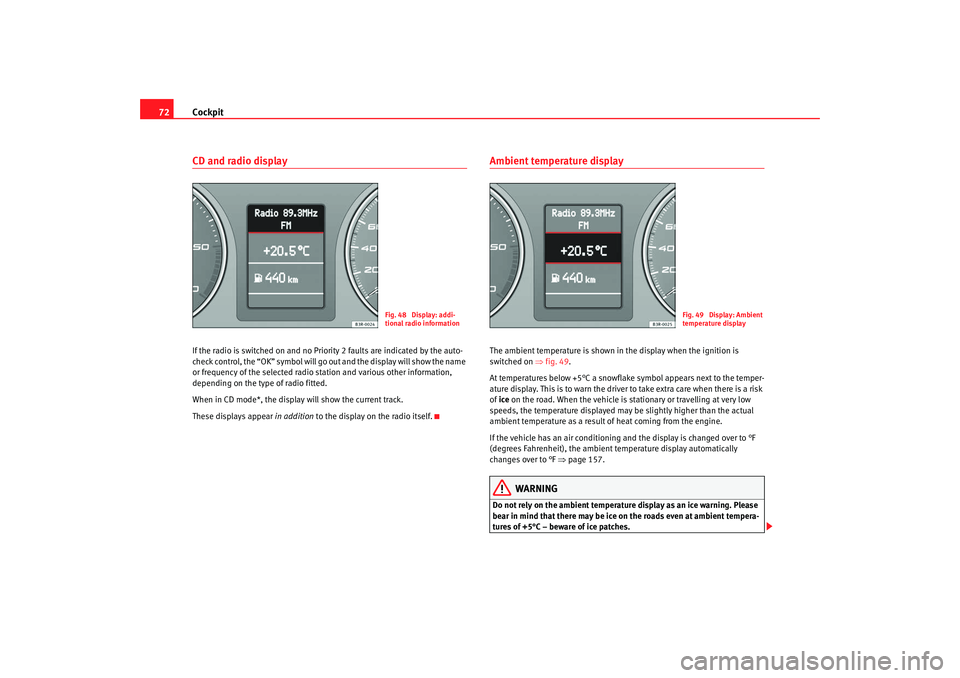
72CD and radio displayIf the radio is switched on and no Priority 2 faults are indicated by the auto-
check control, the “OK” symbol will go out and the display will show the name
or frequency of the selected radio station and various other information,
depending on the type of radio fitted.
When in CD mode*, the display will show the current track.
These displays appear in addition to the display on the radio itself.
Ambient temperature displayThe ambient temperature is shown in the display when the ignition is
switched on ⇒fig. 49.
At temperatures below +5°C a snowflake symbol appears next to the temper-
ature display. This is to warn the driver to take extra care when there is a risk
of ice on the road. When the vehicle is stationary or travelling at very low
speeds, the temperature displayed may be slightly higher than the actual
ambient temperature as a result of heat coming from the engine.
If the vehicle has an air conditioning and the display is changed over to °F
(degrees Fahrenheit), the ambient temperature display automatically
changes over to °F ⇒ page 157.
WARNING
Do not rely on the ambient temperature display as an ice warning. Please
bear in mind that there may be ice on the roads even at ambient tempera-
tures of +5°C – beware of ice patches.
Fig. 48 Display: addi-
tional radio information
Fig. 49 Display: Ambient
temperature display
Exeo_EN.book Seite 72 Freitag, 17. Oktober 2008 11:24 11
Page 81 of 303

Cockpit79
Safety First
Operating instructions
Practical tips
Te c h n i c a l D a t a
Yellow symbols are used to indicate a Priority 2 fault (warning).
Yellow symbols are accompanied by
one warning chime. The function indi-
cated should be checked as soon as possible. If several Priority 2 faults are
detected at the same time, the symbols are displayed one after the other for
about 2 seconds at a time.
Fuel level low
When this symbol
comes on for the first time, there are about 8 to 10 litres
of fuel left in the tank. You should fill up as soon as possible ⇒page 208.
Diesel particulate filter obstructed
If the symbol
lights up, you may be able to contribute towards automatic
filter cleaning by driving in the right manner. You should drive at a speed of
at least 60 km/h for about 15 minutes in 4th or 5th gear, at an engine speed
of around 2000 rpm. The increase in temperature will burn off any soot in the
filter. When cleaning is successful, the symbol switches off.
If the light on symbol
does not go off, take the vehicle to a specialist
garage to repair the fault.
For further information on the diesel particulate filter, see ⇒page 183.
WARNING
It is essential that you adjust your sp eed to suit the weather, road, terrain
and traffic conditions. The recommended driving speed must never lead to
the driver disregarding the traffic regulations.Light sensor/ rain sensor faulty
Automatic headlights / automatic wipers faulty
If the symbol appears, this means that the light sensor / rain sensor is not
working. For safety reasons, the dipp ed beam headlights will then be
switched on permanently when the light switch is set to the AUTO position.
However, you can still switch the lights on and off in the normal way with the
Brake pad worn
⇒ page 80
Speed warning 1
⇒page 80
Dynamic headlight range control*
faulty
⇒page 80
Self-directing headlights* faulty
⇒page 80
Washer fluid level low*
⇒page 80
Speed warning 2*
⇒page 80
Battery voltage too high or too low*
⇒page 80
Bulb monitor*
⇒page 81
Tyre pressure monitoring system*
Loss of pressure
⇒page 88
TPMS
Tyre pressure monitoring system*
System not available
⇒page 66
Exeo_EN.book Seite 79 Freitag, 17. Oktober 2008 11:24 11
Page 82 of 303

Cockpit
80light switch. If the rain sensor is faulty, the functions operated via the wind-
screen wiper lever will still be availa ble. You should have the light sensor /
rain sensor checked by a specialist garage as soon as possible.Worn brake pads
If the
symbol lights up, have the front brake pads (and, for safety's sake,
the rear pads as well) inspected by a specialist garage.
Speed warning 1
If the
symbol lights up, this means you are exceeding the speed that has
been pre-set with the speed warning function. You should reduce your speed
accordingly ⇒page 81.
Headlight range control faulty
This symbol
indicates a malfunction in the dynamic headlight range
control. Take the vehicle to a specialist garage to have the dynamic headlight
range control function repaired.
Self-directing headlights* faulty
Self-directing headlights faulty This symbol
indicates that the self-directing headlight system is faulty.
Take the vehicle to a specialist garage to have the headlights or the self-
directing headlight co ntrol unit repaired.
Washer fluid level low
If the
symbol lights up, top up the fluid for the windscreen washer and
headlight washer system* ⇒page 220.
Speed warning 2
If the
symbol lights up, this means you are exceeding the speed that has
been pre-set. You should reduce your speed accordingly ⇒page 81.
Battery voltage too high or too low
If the
symbol lights up, take the vehicle to a specialist garage and have
the following items checked:
•
Ribbed belt
•
Battery condition
It is also advisable to check whether the alternator warning lamp has come on
⇒ page 69.
Exeo_EN.book Seite 80 Freitag, 17. Oktober 2008 11:24 11
Page 128 of 303

Lights and visibility
126Rain sensor
The rain sensor* will only function in the intermittent wipe position. The inter-
mittent wipe function is enabled automatically when it starts to rain.
Before you reach a road speed of 6 km/h ,you will have to enable the rain
sensor manually by switching it off and back on again.
Use control to set the sensitivity of the rain sensor*.
If you have selected a high sensitivity level for the rain sensor the windscreen
wipers will react sooner to any moisture on the windscreen.
The wiper intervals in the intermittent wipe setting are also varied automati-
cally according to the road speed (in addition to the sensitivity setting).
WARNING
•
For correct visibility and safe driving, the wiper must be in perfect
condition ⇒page 201. Failure to do so could result in an accident.
•
The rain sensor* is only intended to a ssist the driver. The driver is still
obliged to manually operate the windscreen wipers as required depending
on visibility.
•
Do not use water-repellent coatings on the windscreen. In bad visibility
conditions such as light rain, low sun or when driving at night, these coat-
ings can cause increased dazzle, whic h is a serious safety hazard. Such
coatings can also cause the wiper blades to judder.Caution
•
In the event of frost, check that the wiper blade has not frozen before
enabling the windscreen wipers. Should the windscreen wiper system be
enabled when the blade is frozen, this could damage it or even the wind-
screen wiper system motor.
•
Make sure you switch off the windscreen wiper system (lever in position
0) before you use an automatic car wash. This will avoid inadvertent trig-
gering of the wipers and possible damage to the wiper system.
Note
•
Check that the washer fluid reservoir is full before starting a long journey.
Fill the reservoir ⇒page 220.
•
Worn or dirty wiper blades can cause smearing on the glass which can
also impair the effectiveness of the ra in sensor*. Check the condition of wind-
screen wiper blades at regular intervals.
Headlight washer systemWith the lights switched on, operate the automatic wash and wipe
⇒ page 125, fig. 100 , and keep the lever pulled towards you for
at least 1 second.The headlight washer jets come out of the bumper automatically (under water
pressure) ⇒fig. 101 .
AA
Fig. 101 Headlight with
extended washer jet
A5
Exeo_EN.book Seite 126 Freitag, 17. Oktober 2008 11:24 11
Page 154 of 303

Heating, Ventilation and Air conditioning
152Heating, Ventilation and Air conditioning2C-ClimatronicDescription
The climate control is designed to automatically keep the
passenger compartment at the temperature you find most
comfortable at all times of the year.Recommended settings:
– Set the temperature to 22°C (71°F).
– Press the ⇒page 154, fig. 133 button.The following setting quickly provides a comfortable temperature inside the
vehicle. We therefore recommend you do not modify the setting unless you
find this temperature uncomfortable or where circumstances require as such.
The climate control provides heating and ventilation and also cools and
dehumidifies the air inside the vehicle.
The climate control is fully automatic and will constantly maintain the temper-
ature which has been set. To achieve this, the temperature of the air supplied
to the interior, the blower speed (volume of air delivery) and the air distribu-
tion are regulated automatically. The sy stem also takes solar radiation into
account and, therefore, no subsequent manual readjustments are required.
Therefore, automatic mode ⇒ page 155 should be used for the comfort of all
the passengers in virtually all conditions throughout the year.
Please note the following points:
The humidity of the air is automatically reduced when the system cools the
interior of the vehicle. This helps to prevent condensation on the windows. If the humidity and temperature outside the vehicle are high,
condensation
can drip off the evaporator in the air cooling system and form a pool under-
neath the vehicle. This is normal and does not indicate a leak.
If the outside temperature is low, the blower normally only switches to a
higher speed once the coolant has warm ed up sufficiently (this does not
apply to the defrost setting).
In order to achieve maximum engine power, the air conditioning compressor
is temporarily switched off when pulling away from standstill with full throttle.
The compressor also switches off if the coolant temperature is excessively
high to ensure adequate engine cooling under extreme loads.
Pollution filter
The pollution filter (a combined particle filter and activated charcoal filter)
serves as a barrier against impurities in the outside air, including dust and
pollen.
For the climate control to work with maximum efficiency, the pollution filter
element must be replaced at the intervals specified in the Service Schedule.
If the vehicle is driven in areas with a high level of air pollution and the filter
is no longer fully effective, it may be necessary to change the filter element
more frequently.
Caution
•
If you suspect that the climate control system is damaged, switch over to
ECON mode to prevent further damage and have the system checked by a
specialist garage.
•
Repairs to the climate control require specialist knowledge and special
tools. For this reason, please contact a specialist garage if the system is not
working properly.
AUTO
Exeo_EN.book Seite 152 Freitag, 17. Oktober 2008 11:24 11