coolant temperature Seat Exeo 2008 Owner's manual
[x] Cancel search | Manufacturer: SEAT, Model Year: 2008, Model line: Exeo, Model: Seat Exeo 2008Pages: 303, PDF Size: 10.02 MB
Page 61 of 303

Cockpit59
Safety First
Operating instructions
Practical tips
Te c h n i c a l D a t a
InstrumentsInstrument panel overview
The instrument panel is the driver's information centre.Fig. 37 Overview of instrument panel
Coolant temperature gauge . . . . . . . . . . . . . . . . . . . . . . . . . . . .
Rev counter incorporating digital clock and date . . . . . . . . . . .
Warning and indicator lamps . . . . . . . . . . . . . . . . . . . . . . . . . . .
Speedometer (incorporating mileage recorder display) . . . . . .
Fuel gauge . . . . . . . . . . . . . . . . . . . . . . . . . . . . . . . . . . . . . . . . . . Adjuster buttons for
−
Digital clock and date . . . . . . . . . . . . . . . . . . . . . . . . . . . . . .
− Instrument lighti ng . . . . . . . . . . . . . . . . . . . . . . . . . . . . . . . . .
Digital display with
− Service indicator . . . . . . . . . . . . . . . . . . . . . . . . . . . . . . . . . . .
A1
60
A2
61, 61
A3
65
A4
63
A5
63
A6
61
62
A7
74
Exeo_EN.book Seite 59 Freitag, 17. Oktober 2008 11:24 11
Page 62 of 303
Cockpit
60
− Driver information system . . . . . . . . . . . . . . . . . . . . . . . . . . .
CHECK button . . . . . . . . . . . . . . . . . . . . . . . . . . . . . . . . . . . . . . .
Call-up button for service indicator . . . . . . . . . . . . . . . . . . . . . .
Reset button for trip recorder . . . . . . . . . . . . . . . . . . . . . . . . . . .
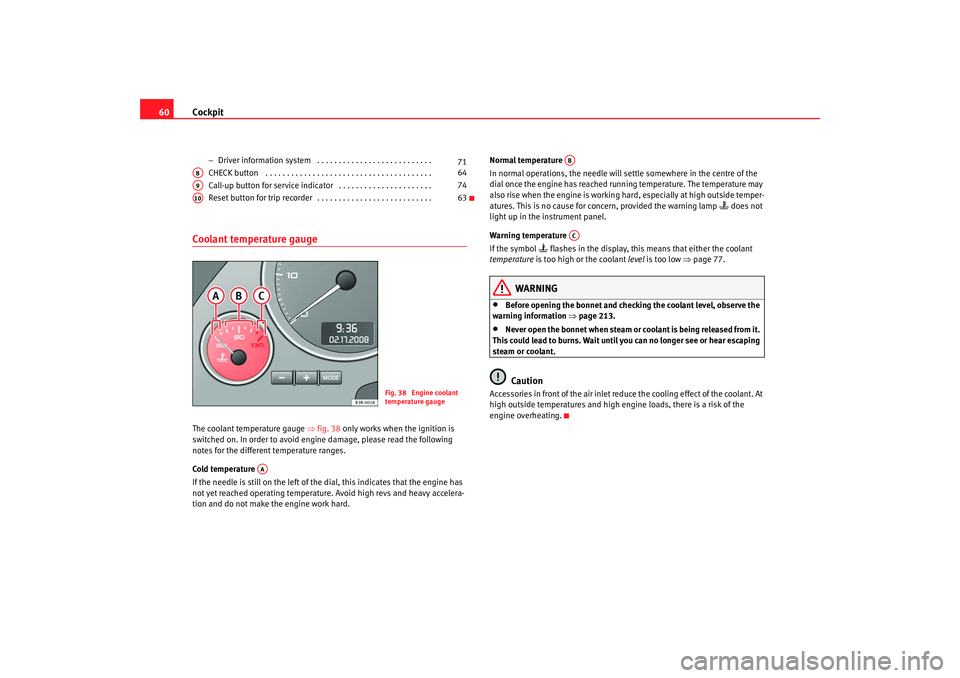
Coolant temperature gaugeThe coolant temperature gauge ⇒fig. 38 only works when the ignition is
switched on. In order to avoid engine damage, please read the following
notes for the different temperature ranges.
Cold temperature
If the needle is still on the left of the dial, this indicates that the engine has
not yet reached operating temperature. Avoid high revs and heavy accelera-
tion and do not make the engine work hard. Normal temperature
In normal operations, the needle will settle somewhere in the centre of the
dial once the engine has reached running temperature. The temperature may
also rise when the engine is working hard, especially at high outside temper-
atures. This is no cause for conc
ern, provided the warning lamp
does not
light up in the instrument panel.
Warning temperature
If the symbol
flashes in the display, this means that either the coolant
temperature is too high or the coolant level is too low ⇒page 77.
WARNING
•
Before opening the bonnet and checking the coolant level, observe the
warning information ⇒ page 213.
•
Never open the bonnet when steam or coolant is being released from it.
This could lead to burns. Wait until you can no longer see or hear escaping
steam or coolant.Caution
Accessories in front of the air inlet reduce the cooling effect of the coolant. At
high outside temperatures and high engine loads, there is a risk of the
engine overheating.
71
A8
64
A9
74
A10
63
Fig. 38 Engine coolant
temperature gauge
AA
ABAC
Exeo_EN.book Seite 60 Freitag, 17. Oktober 2008 11:24 11
Page 79 of 303
Cockpit77
Safety First
Operating instructions
Practical tips
Te c h n i c a l D a t a
The red symbols are used to indicate a Priority 1 fault (serious malfunction).
A red symbol is accompanied by
three warning chimes. The symbols will keep
flashing until the faults are corrected. If several Priority 1 faults are detected
at the same time, the symbols are displayed one after the other for about 2
seconds.
Fault in the brake system
A fault in the brake system should be rectified as soon as
possible.If the symbol
flashes in the display, there is a fault in the brake
system. One of the following messages will appear in the display
together with the symbol:
Stop vehicle, check brake fluid and hydraulic fluid levels
Warning! Fault in brake system (ABS) Please visit garage
– Stop the vehicle.
–Check the brake fluid level ⇒ page 222.
If the ABS fails, the ABS warning lamp
will light up together with the brake
system fault symbol
⇒ .
WARNING
•
Before opening the bonnet and checking the brake fluid level, observe
the warning information in ⇒page 213, “Work in the engine compart-
ment”.
•
If the brake fluid level in the reservoir is too low, this could result in an
accident. Do not drive on. Obtain technical assistance.
•
If the brake warning lamp lights up together with the ABS warning
lamp, this can mean that the control fun ction of the ABS is out of action. As
a result, the rear wheels can lock relatively easily when braking. Under
certain circumstances, the rear of the vehicle could suddenly sway from
side to side, with the subsequent danger of skidding. Drive carefully to the
nearest specialist garage and have the fault rectified.
Fault in the cooling system
Faults in the cooling system must be rectified immediately.If the
symbol flashes in the display, this means that either the
coolant temperature is too high or the coolant level is too low. The
following message will appear in the display together with the
symbol:
Switch off engine and check coolant level
–Stop the vehicle.
– Switch the engine off.
– Check the coolant level ⇒page 218.
– Add more coolant if necessary ⇒page 218.
– Wait for the symbol to go out before driving on.
– Obtain professional assistance if necessary.
If the coolant level is correct, the over heating may be caused by a malfunction
of the radiator fan.
WARNING (continued)
Exeo_EN.book Seite 77 Freitag, 17. Oktober 2008 11:24 11
Page 154 of 303

Heating, Ventilation and Air conditioning
152Heating, Ventilation and Air conditioning2C-ClimatronicDescription
The climate control is designed to automatically keep the
passenger compartment at the temperature you find most
comfortable at all times of the year.Recommended settings:
– Set the temperature to 22°C (71°F).
– Press the ⇒page 154, fig. 133 button.The following setting quickly provides a comfortable temperature inside the
vehicle. We therefore recommend you do not modify the setting unless you
find this temperature uncomfortable or where circumstances require as such.
The climate control provides heating and ventilation and also cools and
dehumidifies the air inside the vehicle.
The climate control is fully automatic and will constantly maintain the temper-
ature which has been set. To achieve this, the temperature of the air supplied
to the interior, the blower speed (volume of air delivery) and the air distribu-
tion are regulated automatically. The sy stem also takes solar radiation into
account and, therefore, no subsequent manual readjustments are required.
Therefore, automatic mode ⇒ page 155 should be used for the comfort of all
the passengers in virtually all conditions throughout the year.
Please note the following points:
The humidity of the air is automatically reduced when the system cools the
interior of the vehicle. This helps to prevent condensation on the windows. If the humidity and temperature outside the vehicle are high,
condensation
can drip off the evaporator in the air cooling system and form a pool under-
neath the vehicle. This is normal and does not indicate a leak.
If the outside temperature is low, the blower normally only switches to a
higher speed once the coolant has warm ed up sufficiently (this does not
apply to the defrost setting).
In order to achieve maximum engine power, the air conditioning compressor
is temporarily switched off when pulling away from standstill with full throttle.
The compressor also switches off if the coolant temperature is excessively
high to ensure adequate engine cooling under extreme loads.
Pollution filter
The pollution filter (a combined particle filter and activated charcoal filter)
serves as a barrier against impurities in the outside air, including dust and
pollen.
For the climate control to work with maximum efficiency, the pollution filter
element must be replaced at the intervals specified in the Service Schedule.
If the vehicle is driven in areas with a high level of air pollution and the filter
is no longer fully effective, it may be necessary to change the filter element
more frequently.
Caution
•
If you suspect that the climate control system is damaged, switch over to
ECON mode to prevent further damage and have the system checked by a
specialist garage.
•
Repairs to the climate control require specialist knowledge and special
tools. For this reason, please contact a specialist garage if the system is not
working properly.
AUTO
Exeo_EN.book Seite 152 Freitag, 17. Oktober 2008 11:24 11
Page 163 of 303

Heating, Ventilation and Air conditioning 161
Safety First
Operating instructions
Practical tips
Te c h n i c a l D a t a
Solar-powered blower/solar roof*
If the vehicle is parked in su fficiently strong sunlight, the
blower will operate in solar-powered mode when the ignition
is switched off.After the ignition is switched off, the blower is supplied with electrical power
from the solar roof. Please ensure that outlets 3 and 4 are open ⇒page 159,
fig. 135 to ensure the best possible ventilation.
The blower only works when the sun roof is closed or tilted open at the rear.
If the air recirculation mode is on when you switch off the engine, the climate
control will automatically switch to fresh air ventilation.Supplementary heating*Diesel vehicles are fitted with supplementary heating
2) to raise the tempera-
ture of the interior as quickly as possible. At outdoor temperatures below
+5°C and with the engine running, the supplementary heating will switch on
and off automatically depending on the temperature of the coolant.
In order to save fuel, the supplementary heating can be can be switched off
by briefly pressing the button on the climate control.
Seat heating*
The surface and backrest of the front seats can be electrically
heated.Turn thumbwheel or ⇒fig. 136 to switch on and adjust the
heating on the left or right front seats.The heating is switched off when the thumbwheel is set to 0. The temperature
settings range from 1 to 6.
Caution
To avoid damaging the heating elements of the seat heating, please do not
kneel on the seat or apply sharp pressure to a single point.
2)For Nordic countries only.
Fig. 136 Detailed view of
instrument panel: Thum-
bwheel controls for seat
heating
A1
A2
Exeo_EN.book Seite 161 Freitag, 17. Oktober 2008 11:24 11
Page 167 of 303

Driving165
Safety First
Operating instructions
Practical tips
Te c h n i c a l D a t a
Vehicles with a diesel engine:
–Use the foot brake.
– Manual gearbox: Push the clutch pedal all the way down.
– Move the gear lever into the neutral position ⇒.
– Turn the ignition key to position . The pre-heating indicator light
comes on while the glow plugs are preheating.
– When the indicator light
goes out, turn the ignition key to
position . Do not press the accelerator.
– Release the ignition key as soon as the engine starts (the starter motor must not be allowed to run on with the engine).
When starting a very cold engine, it may be a little noisy for the first few
seconds until oil pressure has built up in the hydraulic valve compensators.
This is quite normal, and no cause for concern.
If the engine fails to start straight-away, switch off the starter after about 10
seconds and try again after about half a minute.
Glow plug system*
To assist starting at low temperatures, diesel engines are equipped with a
glow plug preheating system. The pr eheating time depends on the coolant
temperature and the outside temperature. Start the engine as soon as the
glow plug indicator light
goes out.
When the engine is warm or at outside temperatures above +8°C, the glow
plug indicator light will only come on for about one second. This means that
the engine can be started immediately .
If the engine will not start...
•
⇒ page 271
•
⇒page 274
•
⇒page 208, “Refuelling”
WARNING
Never run the engine in confined spaces, as the exhaust gases are
poisonous.
Caution
Avoid high engine speeds, full throttle and extreme load conditions until the
engine has reached its normal operating temperature, otherwise this can
damage the engine.
For the sake of the environment
Do not warm up the engine by running the engine with the vehicle stationary.
Start immediately. This will help avoid unnecessary exhaust emissions.Stopping the engine– Turn the ignition key to position ⇒page 164, fig. 140 .
WARNING
•
Never switch the engine off until the vehicle is stationary.
•
The brake servo and the power steering system work only when the
engine is running. You need more stre ngth to steer and brake the vehicle
when the engine is switched off. Given that you will be unable to steer and
brake as usual, this could lead to a risk of accidents and injuries.
A1
A2
A0
Exeo_EN.book Seite 165 Freitag, 17. Oktober 2008 11:24 11
Page 168 of 303
Driving
166
CautionIf the engine has been running hard for a long time, there is a risk of heat
building up in the engine compartment after the engine has been switched
off; this could cause engine damage. Therefore, you should idle the engine
for approx. 2 minutes befo re you switch it off.
Note
After the engine is switched off the radiator fan may run on for up to 10
minutes, even if the ignition is switched off. It may also start running again
after some time if the coolant temperature rises due to a build-up of heat
under the bonnet, or if the engine is already wa rm and the engine compart-
ment is heated up further by direct sunlight.
HandbrakeHandbrake
The handbrake should be applied firmly to prevent the
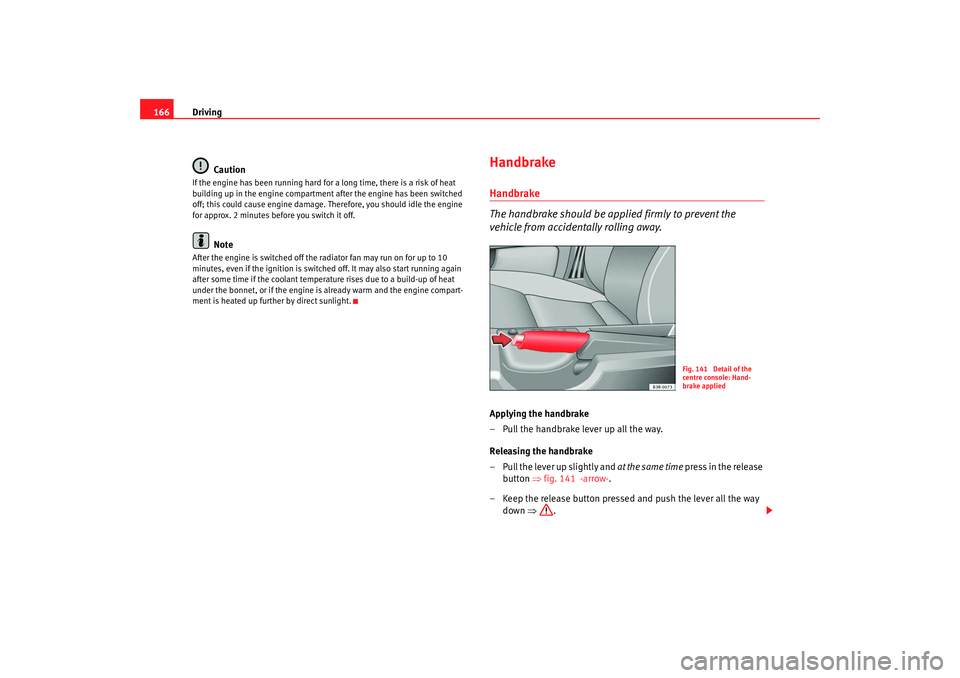
vehicle from accidentally rolling away.Applying the handbrake
– Pull the handbrake lever up all the way.
Releasing the handbrake
– Pull the lever up slightly and at the same time press in the release
button ⇒fig. 141 -arrow- .
– Keep the release button pressed and push the lever all the way down ⇒ .
Fig. 141 Detail of the
centre console: Hand-
brake applied
Exeo_EN.book Seite 166 Freitag, 17. Oktober 2008 11:24 11
Page 189 of 303
Trailer towing187
Safety First
Operating instructions
Practical tips
Te c h n i c a l D a t a
Where possible, operate the trailer with the maximum permitted
draw bar
weight on the ball joint of the towing bracket, but do not exceed the specified
limit.
Tyre pressure
Check the tyre pressures on your car, and adjust for “full load” conditions
(refer to the sticker listing the tyre pressures on the door pillar). It may also be
necessary to adjust the tyre pressures on the trailer according to the recom-
mendations of the trailer manufacturer.
Exterior mirrors
Check whether you can see enough of the road behind the trailer with the
standard mirrors. If this is not the case you should have additional mirrors
fitted. The two exterior mi rrors should be fitted on folding arms. Adjust the
mirrors to give sufficient rear vision.
Headlights
Before starting a journey, check the headlight beam settings with the trailer
hitched up. If necessary, alter the height of the headlight beams by means of
the headlight range control. See ⇒page 116.
Power supply
When you remove the ignition key, the power supply to the trailer is inter-
rupted.
Removable ball joint coupling
Vehicles with a factory-fitted towing bracket are equipped with a removable
ball joint coupling. This is stored in the spare wheel well in the luggage
compartment together with the necessary fitting instructions.
Note
If you frequently tow, we recommend you also have vehicle serviced between
services.
Notes on towing
Towing a trailer involves additi onal attention by the driver.Weight distribution
The weight distribution of a loaded trailer with an unladen vehicle is very
unfavourable. However, if this cannot be avoided, drive extra slowly to allow
for the unbalanced we ight distribution.
Speed
The stability of the car and trailer is reduced with increasing speed. Therefore,
it is advisable not to drive at the maximum permissible speed in an unfavour-
able road, weather or wind conditions. This especially applies when driving
downhill.
You should always reduce speed immediately if the trailer shows the slightest
sign of swaying. Never try to stop the “snaking” by increasing speed.
Anticipate hazards and brake in good time. If towing a trailer with an inertia
brake , first brake gently and then more severely. This will prevent brake
tapping by the trailer wheels when they lock. Select a low gear in due course
before going down a steep downhill. This enables you to use the engine
braking to slow down the vehicle.
Swaying and pitching can be reduced by stabiliser aids. We recommend
having stabiliser aids installed when towing trailers with a high trailer load.
They can be purchased and installed at a Dealer.
Reheating
When climbing long hills in hot weather wi th the engine running fast in low
gear, you should keep an eye on the coolant temperature gauge ⇒page 60.
Reduce speed immediately if the needle moves to the right end of the scale.
If the temperature warning light
in the instrument cluster should start
flashing, stop the car and let the engine cool down by running it at idling
speed for a few minutes.
Exeo_EN.book Seite 187 Freitag, 17. Oktober 2008 11:24 11
Page 219 of 303
Checking and refilling levels217
Safety First
Operating instructions
Practical tips
Te c h n i c a l D a t a
Caution
•
The oil level must never be above area . This could damage the cata-
lytic converter or the engine. Contact a specialist garage to drain the engine
oil if necessary.
•
No additives should be used with engine oil. Any damage caused by the
use of such additives would not be covered by the factory warranty.For the sake of the environment
•
Oil must not be disposed of into the drains or onto the ground.
•
Always observe legal requirements when disposing of empty oil
canisters.
Cooling systemLiquid coolant
The purpose of the liquid coolant is to carry heat away from
the engine. The correct amount of antifreeze is decisive in
preventing the cooling system from freezing in winter.The your vehicle's engine cooling system is filled for life at the factory, so no
coolant needs to be changed. The liquid coolant consists of a mixture of water
and anti-freeze G12++. This is a glycol-b ased antifreeze with anti-corrosion
additives.
Liquid coolant additive
The amount of antifreeze required depends on the temperatures to be
expected in the winter season. If the antifreeze concentration is too low the
coolant can freeze, resulting in failure of the cooling system and heater. The cooling system is filled at the fact
ory with the correct amount of anti-
freeze for the country concerned.
In most cases, the mixture consists of 60% water and 40% anti-freeze. This
mixture gives the required anti-freeze protection at temperatures down to
-25°C and particularly protects the metal parts of the cooling system against
corrosion. It also prevents scaling and significantly raises the boiling point of
the liquid coolant.
Countries with warm climate
The liquid coolant concentration must not be reduced by adding plain water,
even in the summer or in warm climates. The concentration of the anti-freeze
must always be at least 40%.
Countries with cold climate
If greater frost protection is required in very cold climates, the proportion of
the anti-freeze G12++ can be increased. A concentration of 60% offers anti-
freeze protection of temperatures down to approx. -40°C. However,the
concentration of anti-freeze must not exceed 60%, as the anti-freeze protec-
tion would then drop and the performance of the coolant system would suffer.
Vehicles for countries with cold clima tes (e.g. Sweden, Norway and Finland)
have factory-filled anti-freeze protection for temperatures down to -35°C. In
these countries, the concentration of anti-freeze should always be at least
50%.
Caution
•
It is advisable to have the cooling system checked before the winter
season to make sure that the antifreeze concentration is adequate for the
conditions to be expected. This applies particularly if you intend to take the
car into a colder climate zone. If necessary, have the antifreeze concentration
increased to 50 - 60% as required.
•
Use only anti-freeze G12++ , an additive meeting the “TL-VW 774G” spec-
ification. Other anti-freezes may give considerably inferior corrosion protec-
Aa
Exeo_EN.book Seite 217 Freitag, 17. Oktober 2008 11:24 11
Page 221 of 303
Checking and refilling levels219
Safety First
Operating instructions
Practical tips
Te c h n i c a l D a t a
Make sure that the liquid coolant meets the required specifications
⇒
page 217, “Liquid coolant”. Do not use a different type of anti-freeze if
anti-freeze G12++ is not available. In th is case, use only water and bring the
anti-freeze concentration back up to the correct level as soon as possible.
Always top up with new liquid coolant.
Do not fill above the “max” mark. Excess liquid coolant is forced out of the
system through the valve in the filler cap when the engine gets hot.
If a lot of liquid coolant has been lost, wait for the engine to cool down before
putting in cold coolant. Failure to do so could result in serious engine
damage.
WARNING
•
The cooling system is under pressu re. Do not unscrew the cap on the
expansion tank when the engine is hot. Failure to comply could result in
burns.
•
The anti-freeze and liquid coolant c an be a health hazard. Therefore,
the anti-freeze should be stored in the original container in a safe place out
of reach of children. Failure to comply could result in poisoning.For the sake of the environment
Drained off coolant should not be used again. Drain off the used coolant into
a suitable container and dispose of it in the proper manner (observe environ-
mental regulations).
Radiator fan
The radiator fan can start running spontaneously.The auxiliary fan can continue to run for as long as 10 minutes after stopping
the engine – even after the ignition is switched off. It may also start running
suddenly ⇒ after some while if•
stored heat raises the coolant temperature, or
•
the hot engine compartment is additionally heated up by the sun.
WARNING
when working in the engine compartment be aware that the radiator fan
may start running suddenly, leading to the risk of injury.
Exeo_EN.book Seite 219 Freitag, 17. Oktober 2008 11:24 11