low beam Seat Exeo 2008 Owner's manual
[x] Cancel search | Manufacturer: SEAT, Model Year: 2008, Model line: Exeo, Model: Seat Exeo 2008Pages: 303, PDF Size: 10.02 MB
Page 67 of 303

Cockpit65
Safety First
Operating instructions
Practical tips
Te c h n i c a l D a t a
Warning and indicator lampsGeneral description
The warning and indicator lamps indicate a number of
different functions and possible faults.Fig. 44 Instrument panel with warning and indicator lamps
Note
A number of functions are monito red by the auto-check control ⇒page 75. If
a malfunction should occur, this will be shown by the display in the instru-
ment cluster either with a red symbol (priority 1 - danger) or a yellow symbol
(priority 2 - warning).
Exhaust emission control system
⇒ page 66
Airbag system
⇒page 66
Tyre pressure too low
⇒page 66
Cruise control
⇒page 67
Trailer indicato rs
⇒page 67
Anti-lock brake system (ABS)
⇒page 67
Seat belt warning
⇒page 68
Left indicators
⇒page 68
Electronic stabilisation programme (ESP)
⇒page 68
Alternator
⇒page 69
Main beam headlights
⇒page 69
Engine management (alternative to
)
⇒page 69
Glow plug system (alternative to
)
⇒page 70
Fault in brake system / handbrake is
applied
⇒page 70
Right indicators
⇒page 68
Exeo_EN.book Seite 65 Freitag, 17. Oktober 2008 11:24 11
Page 81 of 303

Cockpit79
Safety First
Operating instructions
Practical tips
Te c h n i c a l D a t a
Yellow symbols are used to indicate a Priority 2 fault (warning).
Yellow symbols are accompanied by
one warning chime. The function indi-
cated should be checked as soon as possible. If several Priority 2 faults are
detected at the same time, the symbols are displayed one after the other for
about 2 seconds at a time.
Fuel level low
When this symbol
comes on for the first time, there are about 8 to 10 litres
of fuel left in the tank. You should fill up as soon as possible ⇒page 208.
Diesel particulate filter obstructed
If the symbol
lights up, you may be able to contribute towards automatic
filter cleaning by driving in the right manner. You should drive at a speed of
at least 60 km/h for about 15 minutes in 4th or 5th gear, at an engine speed
of around 2000 rpm. The increase in temperature will burn off any soot in the
filter. When cleaning is successful, the symbol switches off.
If the light on symbol
does not go off, take the vehicle to a specialist
garage to repair the fault.
For further information on the diesel particulate filter, see ⇒page 183.
WARNING
It is essential that you adjust your sp eed to suit the weather, road, terrain
and traffic conditions. The recommended driving speed must never lead to
the driver disregarding the traffic regulations.Light sensor/ rain sensor faulty
Automatic headlights / automatic wipers faulty
If the symbol appears, this means that the light sensor / rain sensor is not
working. For safety reasons, the dipp ed beam headlights will then be
switched on permanently when the light switch is set to the AUTO position.
However, you can still switch the lights on and off in the normal way with the
Brake pad worn
⇒ page 80
Speed warning 1
⇒page 80
Dynamic headlight range control*
faulty
⇒page 80
Self-directing headlights* faulty
⇒page 80
Washer fluid level low*
⇒page 80
Speed warning 2*
⇒page 80
Battery voltage too high or too low*
⇒page 80
Bulb monitor*
⇒page 81
Tyre pressure monitoring system*
Loss of pressure
⇒page 88
TPMS
Tyre pressure monitoring system*
System not available
⇒page 66
Exeo_EN.book Seite 79 Freitag, 17. Oktober 2008 11:24 11
Page 115 of 303
Lights and visibility113
Safety First
Operating instructions
Practical tips
Te c h n i c a l D a t a
Automatic (sensor-controlled) headlights*
If you set the switch to “AUTO”, the headlights will come on
and switch off automatically according to the ambient light
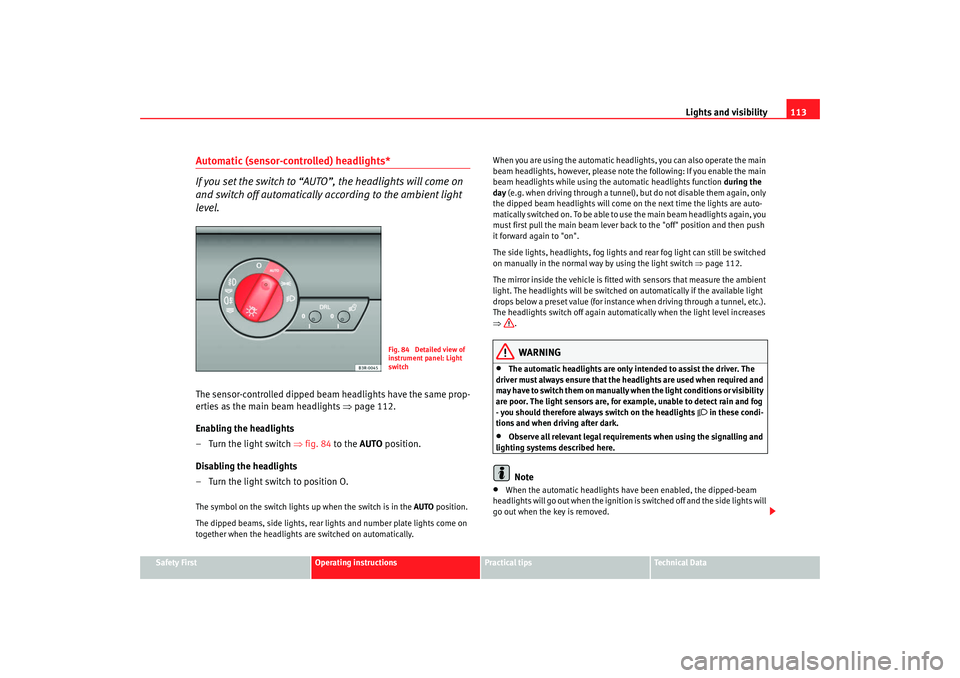
level.The sensor-controlled dipped beam headlights have the same prop-
erties as the main beam headlights ⇒page 112.
Enabling the headlights
– Turn the light switch ⇒ fig. 84 to the AUTO position.
Disabling the headlights
– Turn the light switch to position O.The symbol on the switch lights up when the switch is in the AUTO position.
The dipped beams, side lights, rear li ghts and number plate lights come on
together when the headlights are switched on automatically. When you are using the automatic headlights, you can also operate the main
beam headlights, however, please note the following: If you enable the main
beam headlights while using the automatic headlights function
during the
day (e.g. when driving through a tunnel), but do not disable them again, only
the dipped beam headlights will come on the next time the lights are auto-
matically switched on. To be able to use the main beam headlights again, you
must first pull the main beam lever back to the "off" position and then push
it forward again to "on".
The side lights, headlights, fog lights and rear fog light can still be switched
on manually in the normal way by using the light switch ⇒page 112.
The mirror inside the vehicle is fitted with sensors that measure the ambient
light. The headlights will be switched on automatically if the available light
drops below a preset value (for instance when driving through a tunnel, etc.).
The headlights switch off again automatically when the light level increases
⇒ .
WARNING
•
The automatic headlights are only intended to assist the driver. The
driver must always ensure that the headlights are used when required and
may have to switch them on manually when the light conditions or visibility
are poor. The light sensors are, for example, unable to detect rain and fog
- you should therefore always switch on the headlights
in these condi-
tions and when driving after dark.
•
Observe all relevant legal requirements when using the signalling and
lighting systems described here.Note
•
When the automatic headlights have been enabled, the dipped-beam
headlights will go out when the ignition is switched off and the side lights will
go out when the key is removed.
Fig. 84 Detailed view of
instrument panel: Light
switch
Exeo_EN.book Seite 113 Freitag, 17. Oktober 2008 11:24 11
Page 121 of 303
Lights and visibility119
Safety First
Operating instructions
Practical tips
Te c h n i c a l D a t a
–Press the switch
⇒ page 118, fig. 90 to switch the hazard
warning lights on or off.
All four indicators flash simultaneously when the hazard warning lights are
switched on. The hazard warning light indication lamps
and the turn
signal indication lamp itself
flash at the same time. The hazard warning
lights also work when the ignition is switched off.
In an accident in which the airbags ar e triggered, the hazard warning lights
are switched on automatically.
Note
You should switch on the hazard warning lights to warn other road users, e.g.•
When reaching the tail end of a traffic jam
•
If your vehicle breaks down or there is an emergency
•
If your vehicle is being towed away or if you are towing another vehicle
Indicator
and main beam headlight lever
The turn signal and main beam headlight lever also operates
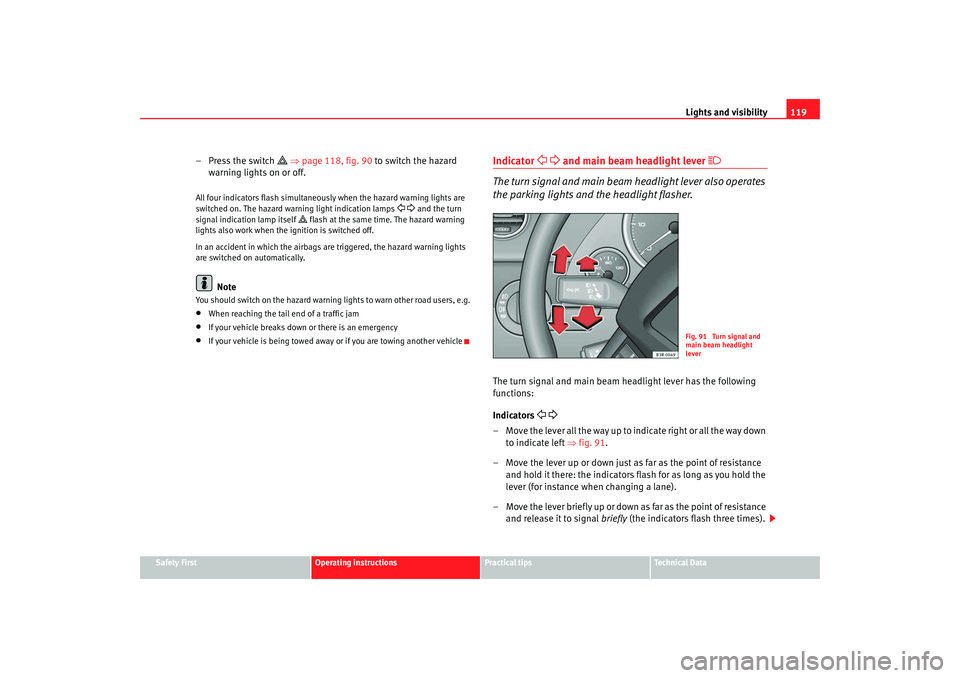
the parking lights and the headlight flasher.The turn signal and main beam headlight lever has the following
functions:
Indicators
– Move the lever all the way up to indicate right or all the way down to indicate left ⇒fig. 91 .
–Move the lever up or down just as far as the point of resistance
and hold it there: the indicators flash for as long as you hold the
lever (for instance when changing a lane).
– Move the lever briefly up or down as far as the point of resistance and release it to signal briefly (the indicators flash three times).
Fig. 91 Turn signal and
main beam headlight
lever
Exeo_EN.book Seite 119 Freitag, 17. Oktober 2008 11:24 11
Page 122 of 303
Lights and visibility
120
Main beam headlights
– Press the lever forward to switch on the main beams.
– Pull the lever back towards you to switch the main beam head-lights off again.
Headlight flasher
– Pull the lever towards the steering wheel to operate the flasher.
Parking light
– Switch the ignition off.
– Move the lever up or down to turn on the right or left-hand parking lights respectively.Notes on these functions•
The indicators only work when the ignition is switched on. The indicator
lamp or flashes in the instrument panel when the turns signals
⇒ page 65 are working.
•
The indicators are cancelled automatically when the steering wheel is
returned to the straight-ahead position.
•
The main beam headlights can only be switched on if the dipped beam
headlights are already on. The main beam headlight indicator lamp
then
comes on in the instrument panel.
•
The headlight flasher comes on for as long as you pull the lever, even if no
other lights are switched on. The main beam headlight indicator lamp
then comes on in the instrument panel.
•
When the parking lights are switched on, the headlight and the rear light
on one side of the car light up with re duced intensity. The parking lights will
only work with the ignition off.
Caution
Never use the main beam headlights or the headlight flasher if this would
dazzle oncoming traffic.Interior lightsFront interior lights and glove compartment light
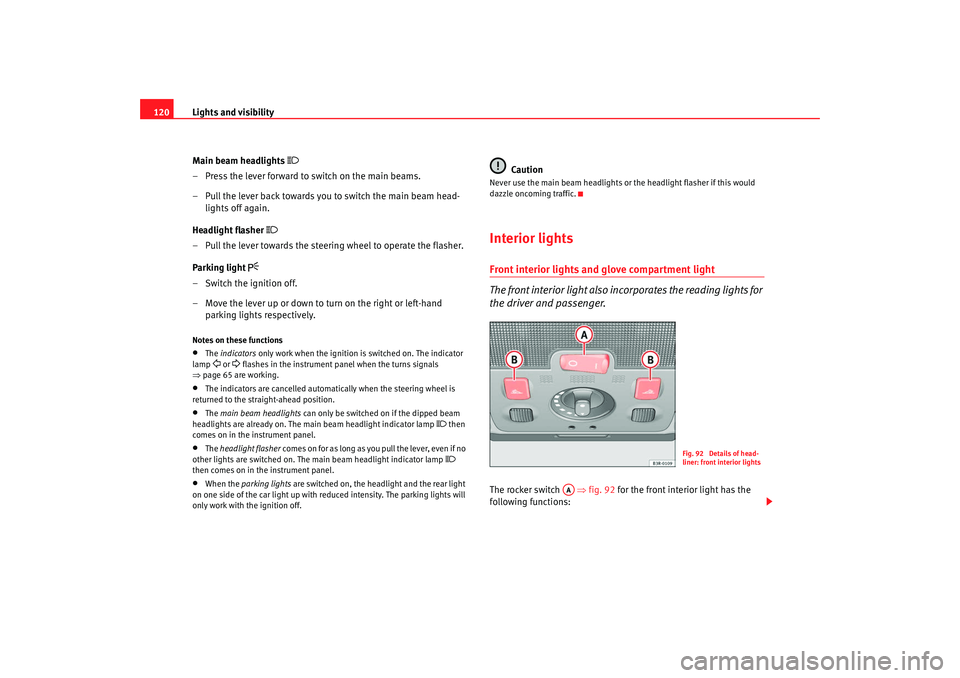
The front interior light also incorporates the reading lights for
the driver and passenger.The rocker switch ⇒fig. 92 for the front interior light has the
following functions:
Fig. 92 Details of head-
liner: front interior lights
AA
Exeo_EN.book Seite 120 Freitag, 17. Oktober 2008 11:24 11
Page 187 of 303

Driving and the environment185
Safety First
Operating instructions
Practical tips
Te c h n i c a l D a t a
•
Solvent-free wax for protecting the vehicles in transit
•
Solvent-free adhesives
•
No CFCs used in production
•
Surplus materials used extensively for energy conversion and building
materials
•
Overall water consumption reduced
•
Heat recovery systems
•
Water-soluble paint
Driving abroadObservationsTo drive abroad, the following must be taken into consideration:•
For vehicles fitted with a catalytic converter ensure that unleaded petrol is
available for the journey. See the chapter “Refuelling”. Automobile organisa-
tions will have information about service station networks selling unleaded
fuel.
•
In some countries, it is possible that a vehicle model is sold under condi-
tions where some spare parts are not available or that the Authorised Service
Centre may only carry out limited repairs.
SEAT importers and distributors will gladly provide information about the
technical preparation of your vehicle and also about necessary maintenance
and repair possibilities.
Adhesive strips for headlightsIf you have to drive a right-hand drive vehicle in a left-hand drive country, or
vice versa, the asymmetric dipped beam headlights will dazzle oncoming
traffic.
To prevent dazzling, you must apply stickers to certain parts of the headlight
lenses. Further information is available in your Authorised Service Centre.
In vehicles with self-directing headlights, the rotation system must previ-
ously be disconnected. To do this, please go to a specialist workshop.
Exeo_EN.book Seite 185 Freitag, 17. Oktober 2008 11:24 11
Page 189 of 303
Trailer towing187
Safety First
Operating instructions
Practical tips
Te c h n i c a l D a t a
Where possible, operate the trailer with the maximum permitted
draw bar
weight on the ball joint of the towing bracket, but do not exceed the specified
limit.
Tyre pressure
Check the tyre pressures on your car, and adjust for “full load” conditions
(refer to the sticker listing the tyre pressures on the door pillar). It may also be
necessary to adjust the tyre pressures on the trailer according to the recom-
mendations of the trailer manufacturer.
Exterior mirrors
Check whether you can see enough of the road behind the trailer with the
standard mirrors. If this is not the case you should have additional mirrors
fitted. The two exterior mi rrors should be fitted on folding arms. Adjust the
mirrors to give sufficient rear vision.
Headlights
Before starting a journey, check the headlight beam settings with the trailer
hitched up. If necessary, alter the height of the headlight beams by means of
the headlight range control. See ⇒page 116.
Power supply
When you remove the ignition key, the power supply to the trailer is inter-
rupted.
Removable ball joint coupling
Vehicles with a factory-fitted towing bracket are equipped with a removable
ball joint coupling. This is stored in the spare wheel well in the luggage
compartment together with the necessary fitting instructions.
Note
If you frequently tow, we recommend you also have vehicle serviced between
services.
Notes on towing
Towing a trailer involves additi onal attention by the driver.Weight distribution
The weight distribution of a loaded trailer with an unladen vehicle is very
unfavourable. However, if this cannot be avoided, drive extra slowly to allow
for the unbalanced we ight distribution.
Speed
The stability of the car and trailer is reduced with increasing speed. Therefore,
it is advisable not to drive at the maximum permissible speed in an unfavour-
able road, weather or wind conditions. This especially applies when driving
downhill.
You should always reduce speed immediately if the trailer shows the slightest
sign of swaying. Never try to stop the “snaking” by increasing speed.
Anticipate hazards and brake in good time. If towing a trailer with an inertia
brake , first brake gently and then more severely. This will prevent brake
tapping by the trailer wheels when they lock. Select a low gear in due course
before going down a steep downhill. This enables you to use the engine
braking to slow down the vehicle.
Swaying and pitching can be reduced by stabiliser aids. We recommend
having stabiliser aids installed when towing trailers with a high trailer load.
They can be purchased and installed at a Dealer.
Reheating
When climbing long hills in hot weather wi th the engine running fast in low
gear, you should keep an eye on the coolant temperature gauge ⇒page 60.
Reduce speed immediately if the needle moves to the right end of the scale.
If the temperature warning light
in the instrument cluster should start
flashing, stop the car and let the engine cool down by running it at idling
speed for a few minutes.
Exeo_EN.book Seite 187 Freitag, 17. Oktober 2008 11:24 11
Page 251 of 303
If and when249
Safety First
Operating instructions
Practical tips
Te c h n i c a l D a t a
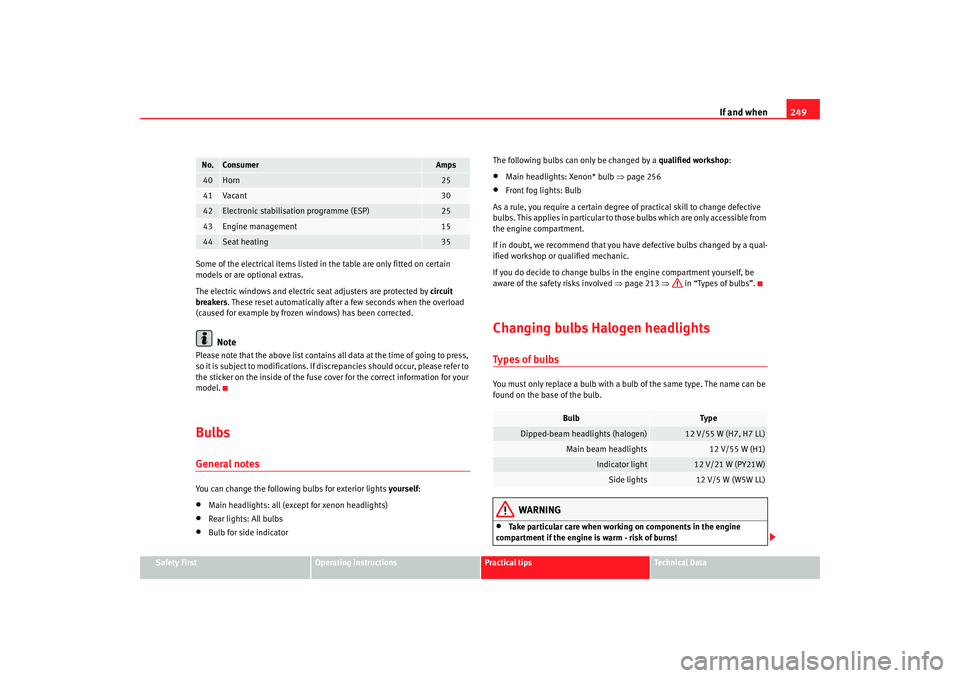
Some of the electrical items listed in
the table are only fitted on certain
models or are optional extras.
The electric windows and electric seat adjusters are protected by circuit
breakers. These reset automatically after a few seconds when the overload
(caused for example by frozen windows) has been corrected.
Note
Please note that the above list contains all data at the time of going to press,
so it is subject to modifications. If discrepancies should occur, please refer to
the sticker on the inside of the fuse cover for the correct information for your
model.BulbsGeneral notesYou can change the following bulbs for exterior lights yourself:•
Main headlights: all (exc ept for xenon headlights)
•
Rear lights: All bulbs
•
Bulb for side indicator The following bulbs can only be changed by a
qualified workshop:
•
Main headlights: Xenon* bulb ⇒page 256
•
Front fog lights: Bulb
As a rule, you require a certain degree of practical skill to change defective
bulbs. This applies in particular to those bulbs which are only accessible from
the engine compartment.
If in doubt, we recommend that you have defective bulbs changed by a qual-
ified workshop or qualified mechanic.
If you do decide to change bulbs in the engine compartment yourself, be
aware of the safety risks involved ⇒page 213 ⇒ in “Types of bulbs”.
Changing bulbs Halogen headlightsTypes of bulbsYou must only replace a bulb with a bu lb of the same type. The name can be
found on the base of the bulb.
WARNING
•
Take particular care when working on components in the engine
compartment if the engine is warm - risk of burns!
40
Horn
25
41
Va ca n t
30
42
Electronic stabilisation programme (ESP)
25
43
Engine management
15
44
Seat heating
35
No.
Consumer
Amps
Bulb
Typ e
Dipped-beam headlights (halogen)
12 V/55 W (H7, H7 LL)
Main beam headlights
12 V/55 W (H1)
Indicator light
12 V/21 W (PY21W)
Side lights
12 V/5 W (W5W LL)
Exeo_EN.book Seite 249 Freitag, 17. Oktober 2008 11:24 11
Page 256 of 303

If and when
254Changing the dipped beam headlight bulb
The procedure for changing the bulbs on the front
passenger's side is the same as on the driver's side.
– Switch off the ignition and the lights.
–Raise the bonnet.
– Move the brace ⇒fig. 193 in the direction of the arrow and
remove the rigid cover, separating the brace side and then
removing the two tabs from the other end of the cover.
– Pull the connector ⇒fig. 194 from the bulb.
– Unclip the retainer spring ⇒fig. 194 pressing inwards to the
right.
– Remove the bulb and fit the new one in the headlight casing with the tab upwards, starting to position it from below.
– Clip on the spring, raising it and pressing it slightly while turning it anti-clockwise. To ensure correct lighting, the filament must be
vertical. When changing the bulb, you can check the position of
the bulb through the headlight glass.
– Connect the connector to the bulb.
– Fit the cover, first inserting the side tabs and then closing the cover and the brace. Make sure that the gasket sits well on the
casing cover during the operation.
– Check whether the new bulb is working.
– Have the headlight settings checked as soon as possible.
Fig. 193 Dipped head-
lightsFig. 194 Dipped head-
lights
A1A2
A3
Exeo_EN.book Seite 254 Freitag, 17. Oktober 2008 11:24 11
Page 294 of 303

Index
292Catalytic converter . . . . . . . . . . . . . . . . . . . . . . 182
Central locking . . . . . . . . . . . . . . . . . . . . . . . . . . 96
Manual locking . . . . . . . . . . . . . . . . . . . . . . . 99
Sunroof: opening and closing . . . . . . . . . . 110
Central locking system Anti-theft security system . . . . . . . . . . . . . . . 97
Locking . . . . . . . . . . . . . . . . . . . . . . . . . . . . . 97
Locking and unlocking the vehicle from inside98
Opening and closing the windows . . . . . . 107
Security central locking . . . . . . . . . . . . . . . . 99
Switch on the driver's door . . . . . . . . . . . . . . 98
Tailgate . . . . . . . . . . . . . . . . . . . . . . . . . . . . 100
Unlocking . . . . . . . . . . . . . . . . . . . . . . . . . . . . 97
Cetane number . . . . . . . . . . . . . . . . . . . . . . . . . 210
Changing the main headlight bulb
Main headlight . . . . . . . . . . . . . . . . . . . . . . 253
Changing the main headlight bulbs
Dipped beam headlight . . . . . . . . . . . . . . . 254
Changing the rear lights
luggage compartment lights . . . . . . . . . . . 269
Changing windscreen wiper blades . . . . . . . . . 221
Chassis number . . . . . . . . . . . . . . . . . . . . . . . . 278
Child safety . . . . . . . . . . . . . . . . . . . . . . . . . . . . . 46
Child safety seat ISOFIX system . . . . . . . . . . . . . . . . . . . . . . . . 52
Child seat . . . . . . . . . . . . . . . . . . . . . . . . . . . . . . . 48 Categorisation in groups . . . . . . . . . . . . . . . 48
Group 1 . . . . . . . . . . . . . . . . . . . . . . . . . . . . . 49
Group 2 . . . . . . . . . . . . . . . . . . . . . . . . . . . . . 49
Group 3 . . . . . . . . . . . . . . . . . . . . . . . . . . . . . 49 Groups 0 and 0+ . . . . . . . . . . . . . . . . . . . . . . 48
Safety notes . . . . . . . . . . . . . . . . . . . . . . . . . . 46
Securing . . . . . . . . . . . . . . . . . . . . . . . . . . . . . 51
Child seats on the front passenger seat . . . . . . . . . . . . . 29
Childproof lock Rear doors . . . . . . . . . . . . . . . . . . . . . . . . . . 101
Cigarette lighter . . . . . . . . . . . . . . . . . . . . . . . . 147
Cleaning alloy wheel rims . . . . . . . . . . . . . . . . 202
Cleaning chrome . . . . . . . . . . . . . . . . . . . . . . . . 201
Cleaning engine compartment . . . . . . . . . . . . . 203
Cleaning steel wheel rims . . . . . . . . . . . . . . . . 202
Cleaning windows . . . . . . . . . . . . . . . . . . . . . . . 200
Climate control Air distribution . . . . . . . . . . . . . . . . . . . . . . 159
Air outlets . . . . . . . . . . . . . . . . . . . . . . . . . . 159
Air purity sensor . . . . . . . . . . . . . . . . . . . . . 157
Air recirculation . . . . . . . . . . . . . . . . . . . . . . 156
Air recirculation (automatic) . . . . . . . . . . . . 157
Automatic mode . . . . . . . . . . . . . . . . . . . . . 155
Blower . . . . . . . . . . . . . . . . . . . . . . . . . . . . . 158
Controls . . . . . . . . . . . . . . . . . . . . . . . . . . . . 154
ECON Mode (economy) . . . . . . . . . . . . . . . . 156
Economical use . . . . . . . . . . . . . . . . . . . . . . 160
Key settings . . . . . . . . . . . . . . . . . . . . . . . . . 160
Temperature selection . . . . . . . . . . . . . . . . 155
Clock, setting . . . . . . . . . . . . . . . . . . . . . . . . . . . . 61
Cloth seat covers cleaning . . . . . . . . . . . . . . . . 204
Coat hooks . . . . . . . . . . . . . . . . . . . . . . . . . . . . . 151
Cockpit . . . . . . . . . . . . . . . . . . . . . . . . . . . . . . . . . 57 Overview . . . . . . . . . . . . . . . . . . . . . . . . . . . . 57 Compartments . . . . . . . . . . . . . . . . . . . . . . . . . . 149
In the door trim . . . . . . . . . . . . . . . . . . . . . . 150
In the front seats . . . . . . . . . . . . . . . . . . . . . 151
Cool box in glove compartment . . . . . . . . . . . . 150
Cooling system Coolant temperature gauge . . . . . . . . . . . . . 60
Malfunction . . . . . . . . . . . . . . . . . . . . . . . . . . 77
Cruise control system . . . . . . . . . . . . . . . . . . . . 170 Adjust stored speed . . . . . . . . . . . . . . . . . . 171
Disabling . . . . . . . . . . . . . . . . . . . . . . . . . . . 172
Disabling temporarily . . . . . . . . . . . . . . . . . 172
Setting speed . . . . . . . . . . . . . . . . . . . . . . . 171
Curtain airbags . . . . . . . . . . . . . . . . . . . . . . . . . . 41 Description . . . . . . . . . . . . . . . . . . . . . . . . . . 41
Function . . . . . . . . . . . . . . . . . . . . . . . . . . . . . 42
Safety notes . . . . . . . . . . . . . . . . . . . . . . . . . . 42
DDanger of fitting a child seat on the front passenger seat . . . . . . . . . . . . . . . . . . . . . . . . . . . . . . . 29
Dash panel cleaning . . . . . . . . . . . . . . . . . . . . . 203
Data entry control . . . . . . . . . . . . . . . . . . . . . . . . 87
Date display . . . . . . . . . . . . . . . . . . . . . . . . . . . . 61
Daytime running lights . . . . . . . . . . . . . . . . . . . 117
Diesel . . . . . . . . . . . . . . . . . . . . . . . . . . . . . . . . . 210
Diesel engine Winter driving . . . . . . . . . . . . . . . . . . . . . . . 211
Diesel engine particulate filter . . . . . . . . . . . . . 183
Diesel particulate filter . . . . . . . . . . . . . . . . . . . . 79 Engine oil . . . . . . . . . . . . . . . . . . . . . . . . . . . 214
Exeo_EN.book Seite 292 Freitag, 17. Oktober 2008 11:24 11