window Seat Exeo 2008 Owner's manual
[x] Cancel search | Manufacturer: SEAT, Model Year: 2008, Model line: Exeo, Model: Seat Exeo 2008Pages: 303, PDF Size: 10.02 MB
Page 5 of 303
Contents3
ContentsManual structure
. . . . . . . . . . . . . . . . . . . .
Content
. . . . . . . . . . . . . . . . . . . . . . . . . . . . . . . .
Safety First
. . . . . . . . . . . . . . . . . . . . . . . . . . .
Safe driving
. . . . . . . . . . . . . . . . . . . . . . . . . . . . . .
Brief introduction . . . . . . . . . . . . . . . . . . . . . . . .
Proper sitting position for occupants . . . . . . . . .
Pedal area . . . . . . . . . . . . . . . . . . . . . . . . . . . . . .
Stowing luggage . . . . . . . . . . . . . . . . . . . . . . . . .
Seat belts
. . . . . . . . . . . . . . . . . . . . . . . . . . . . . . . .
Brief introduction . . . . . . . . . . . . . . . . . . . . . . . .
Why wear seat belts? . . . . . . . . . . . . . . . . . . . . . .
Seat belts . . . . . . . . . . . . . . . . . . . . . . . . . . . . . . .
Belt tension devices . . . . . . . . . . . . . . . . . . . . . .
Airbag system
. . . . . . . . . . . . . . . . . . . . . . . . . . . .
Brief introduction . . . . . . . . . . . . . . . . . . . . . . . .
Front airbags . . . . . . . . . . . . . . . . . . . . . . . . . . . .
Knee airbag . . . . . . . . . . . . . . . . . . . . . . . . . . . . .
Side airbags* . . . . . . . . . . . . . . . . . . . . . . . . . . . .
Curtain airbags . . . . . . . . . . . . . . . . . . . . . . . . . .
Deactivating airbags* . . . . . . . . . . . . . . . . . . . . .
Child safety
. . . . . . . . . . . . . . . . . . . . . . . . . . . . . .
Brief introduction . . . . . . . . . . . . . . . . . . . . . . . .
Child seats . . . . . . . . . . . . . . . . . . . . . . . . . . . . . .
Securing child seats . . . . . . . . . . . . . . . . . . . . . .
Operating instructions
. . . . . . . . . . . .
Cockpit
. . . . . . . . . . . . . . . . . . . . . . . . . . . . . . . . . . .
Overview . . . . . . . . . . . . . . . . . . . . . . . . . . . . . . .
Instruments . . . . . . . . . . . . . . . . . . . . . . . . . . . . .
Warning and indicator lamps . . . . . . . . . . . . . . .
Driver information system . . . . . . . . . . . . . . . . . .
Auto-check system . . . . . . . . . . . . . . . . . . . . . . .
Speed warning . . . . . . . . . . . . . . . . . . . . . . . .
On-board computer . . . . . . . . . . . . . . . . . . . . . . .
Menu display . . . . . . . . . . . . . . . . . . . . . . . . . . . .
Tyre pressure monitoring . . . . . . . . . . . . . . . . . .
Steering wheel controls
. . . . . . . . . . . . . . . . . . .
The multi-function steering wheel . . . . . . . . . . .
Unlocking and locking
. . . . . . . . . . . . . . . . . . . .
Remote control keys . . . . . . . . . . . . . . . . . . . . . .
Central locking . . . . . . . . . . . . . . . . . . . . . . . . . . .
Boot lid . . . . . . . . . . . . . . . . . . . . . . . . . . . . . . . . .
Childproof locks . . . . . . . . . . . . . . . . . . . . . . . . . .
Remote control key . . . . . . . . . . . . . . . . . . . . . . .
Anti-theft alarm system* . . . . . . . . . . . . . . . . . . .
Electric windows . . . . . . . . . . . . . . . . . . . . . . . . .
Sun roof / deflector* . . . . . . . . . . . . . . . . . . . . . .
Lights and visibility
. . . . . . . . . . . . . . . . . . . . . . .
Lights . . . . . . . . . . . . . . . . . . . . . . . . . . . . . . . . . .
Interior lights . . . . . . . . . . . . . . . . . . . . . . . . . . . .
Visibility . . . . . . . . . . . . . . . . . . . . . . . . . . . . . . . .
Windscreen wipers . . . . . . . . . . . . . . . . . . . . . . .
Rear-view mirrors . . . . . . . . . . . . . . . . . . . . . . . . .
Seats and stowage
. . . . . . . . . . . . . . . . . . . . . . .
Manual adjustment of the front seats . . . . . . . .
Electric adjustment of front seats* . . . . . . . . . . .
Lumbar support* . . . . . . . . . . . . . . . . . . . . . . . . . Memory for driver’s seat* . . . . . . . . . . . . . . . . . .
Head restraints . . . . . . . . . . . . . . . . . . . . . . . . . .
Armrests . . . . . . . . . . . . . . . . . . . . . . . . . . . . . . . .
Luggage compartment . . . . . . . . . . . . . . . . . . . .
Roof carrier . . . . . . . . . . . . . . . . . . . . . . . . . . . . . .
Drink holders . . . . . . . . . . . . . . . . . . . . . . . . . . . .
Ashtray*, cigarrette lighter* and power points .
Compartments . . . . . . . . . . . . . . . . . . . . . . . . . . .
Heating, Ventilation and Air conditioning
. .
2C-Climatronic . . . . . . . . . . . . . . . . . . . . . . . . . . .
Driving
. . . . . . . . . . . . . . . . . . . . . . . . . . . . . . . . . . .
Address . . . . . . . . . . . . . . . . . . . . . . . . . . . . . . . .
Safety . . . . . . . . . . . . . . . . . . . . . . . . . . . . . . . . . .
Ignition lock . . . . . . . . . . . . . . . . . . . . . . . . . . . . .
Starting and stopping the engine . . . . . . . . . . .
Handbrake . . . . . . . . . . . . . . . . . . . . . . . . . . . . . .
Parking aid . . . . . . . . . . . . . . . . . . . . . . . . . . . . . .
Cruise Control System (CCS) . . . . . . . . . . . . . . . .
Manual gearbox . . . . . . . . . . . . . . . . . . . . . . . . . .
Practical tips
. . . . . . . . . . . . . . . . . . . . . . . . .
Intelligent technology
. . . . . . . . . . . . . . . . . . . . .
Electronic stabilisation programme (ESP) . . . . .
Brakes . . . . . . . . . . . . . . . . . . . . . . . . . . . . . . . . .
Power steering . . . . . . . . . . . . . . . . . . . . . . . . . . .
Servotronic . . . . . . . . . . . . . . . . . . . . . . . . . . . . . .
Driving and the environment
. . . . . . . . . . . . . .
Running-in . . . . . . . . . . . . . . . . . . . . . . . . . . . . . .
Exhaust gas purification system . . . . . . . . . . . . .
Economical and environmentally friendly driving
Driving abroad . . . . . . . . . . . . . . . . . . . . . . . . . . .
5
6
7
7
7
10
15
16
18
18
19
22
26
28
28
32
35
38
41
44
46
46
48
51 57
57
57
59
65
71
75
81
84
86
88
90
90
93
93
96
100
101
102
104
106
108
112
112
120
123
125
127
130
130
132
133 134
136
138
139
144
145
146
149
152
152
162
162
162
163
164
166
167
170
173
175
175
175
178
179
180
181
181
182
183
185
Exeo_EN.book Seite 3 Freitag, 17. Oktober 2008 11:24 11
Page 10 of 303
Safe driving
8However, they can only be effective if you and your passengers sit in the
correct position and adjust and u se the safety equipment properly.
Therefore, this chapter explains why th ese safety features are so important,
how they can protect you, what you n eed to remember when using them and
how you and your passengers can gain the most benefit from them. There are
also a number of important safety warnings that you and your passengers
should always observe in order to minimise the risk of injury.
Safety is everyone's responsibility!Before setting off
The driver is responsible for th e safety of the passengers and
the safe operation of the vehicle at all times.For your own safety and the safety of your passengers, always note
the following points before setting off:
– Make sure that all lights and indicators are working properly.
– Check tyre pressure.
– Make sure that all windows are clean and give good visibility to
the outside.
– Secure all luggage and other items carefully ⇒page 16.
– Make sure that no objects can interfere with the pedals.
– Adjust the front seat, head restraint and mirrors correctly.
– Make sure that the head restraints for all passengers are adjusted to the correct position. – Make sure that children are protected with suitable safety seats
and properly worn seat belts ⇒page 46.
– Sit in a correct position. Make sure that your passengers are seated correctly ⇒page 10.
– Fasten your seat belt correctly. Make sure that your passengers do the same ⇒page 18.
What affects safe driving?
Safety on the road is directly related to how you drive, and can
also be affected by the passengers in the vehicle.The driver is responsible for the safety of the vehicle and all its occu-
pants. If your ability to drive is impaired in any way, you endanger
yourself and other road users ⇒. Therefore:
– Do not let yourself be distracted by passengers or by using a mobile phone, etc.
– Never drive when your driving ab ility is impaired (by medication,
alcohol, drugs, etc.).
– Obey all traffic regulations and speed limits and always maintain a safe distance to the vehicle in front.
– Always adjust your speed to suit the road, traffic and weather conditions.
– Take frequent breaks on long trips. Do not drive for more than two hours without a stop.
Exeo_EN.book Seite 8 Freitag, 17. Oktober 2008 11:24 11
Page 14 of 303

Safe driving
12•
If your physical constitution prevents you from maintaining the
minimum distance of 25 cm, contact a qualified workshop. The workshop
will help you decide if special specific modifications are necessary.
•
Always keep your feet in the footwell when the vehicle is moving; never
rest them on the instrument panel, out the window or on the seat. An incor-
rect sitting position exposes you to an increased risk of injury in case of a
sudden braking or an accident. If the airbag is triggered, you could sustain
severe injuries due to an incorrect sitting position.
•
To reduce the risk of injury to the front passenger in events such sudden
braking manoeuvres or an accident, never travel with the backrest tilted far
back! The airbag system and seat belts can only provide optimal protection
when the backrest is in an upright position and the front passenger is
wearing his or her seat belt properly. The further the backrests are tilted to
the rear, the greater the risk of injury due to incorrect positioning of the
belt web or to the incorrect sitting position!
•
Adjust the head restraint properly in order to achieve maximum
protection.
Correct sitting position for passengers in the rear seats
Passengers in the rear seats must sit up straight, keep their
feet in the foot well s and wear their seat belts properly.To reduce the risk of injury in the event of a sudden braking
manoeuvre or an accident, passengers on the rear bench seat must
consider the following:
– Adjust the headrest to the correct position ⇒page 14.
– Keep both feet in the foot well in front of the rear seat. – Fasten your safety belt securely
⇒page 18.
– Use an appropriate child restraint system when you take children in the vehicle ⇒page 46.
WARNING
•
If the passengers on the rear seat are not sitting properly, they could
sustain severe injuries.
•
Adjust the head restraint properly in order to achieve maximum protec-
tion.
•
Seat belts can only provide optimal protection when backrests are in an
upright position and the passengers ar e wearing their seat belts properly.
If passengers on the rear seat are not sitting in an upright position, the risk
of injury due to incorrect positioning of the belt web increases.
WARNING (continued)
Exeo_EN.book Seite 12 Freitag, 17. Oktober 2008 11:24 11
Page 17 of 303
Safe driving15
Safety First
Operating instructions
Practical tips
Te c h n i c a l D a t a
The following list contains examples of sitting positions that could be
dangerous for all occupants. The list is not complete, but we would like to
make you aware of this issue.
Therefore, whenever the vehicle is in motion:
•
Never stand in the vehicle,
•
never stand on the seats,
•
never kneel on the seats,
•
never tilt your backrest far to the rear,
•
never lean against the dash panel,
•
never lie on the rear bench,
•
never sit on the front edge of a seat,
•
never sit sideways,
•
never lean out of a window,
•
never put your feet out of a window,
•
never put your feet on the dash panel,
•
never put your feet on the surface of a seat,
•
never travel in a foot well ,
•
never travel on a seat without wearing the seat belt,
•
never carry any person in the luggage compartment.
WARNING
•
Every incorrect sitting position increases the risk of severe injuries.
•
Sitting in an incorrect position exposes the occupants to severe injuries
if airbags trigger, by striking a passenger who has assumed an incorrect
sitting position.
•
Before the vehicle moves, assume th e proper sitting position and main-
tain it throughout the trip. Before ever y trip, instruct your passengers to sit
properly and to stay in this position during the trip ⇒page 10, “Proper
sitting position for occupants”.
Pedal areaPedals
The operation of all pedals must nev er b e i m p a i red by o b j ec t s
or floor mats.– Ensure that you can always press the accelerator, brake and
clutch pedals unimpaired to the floor.
– Ensure that the pedals can return unimpaired to their initial posi- tions.Use only floor mats which leave the pedal area free and can be securely
fastened on the foot well.
If a brake circuit fails, the brake pedal must be pressed down thoroughly in
order to stop the vehicle.
Wear suitable shoes
Always wear shoes which support your feet properly and give you a good
feeling for the pedals.
WARNING
•
Restricting pedal operation can lead to critical situations while driving.
•
Never place objects on the driver fo otwell. An object could move into
the pedal area and impair pedal operation. In the event of a sudden driving
or braking manoeuvre, you will not be able to operate the brake, clutch or
accelerator pedal. Risk of accident!
Exeo_EN.book Seite 15 Freitag, 17. Oktober 2008 11:24 11
Page 19 of 303
Safe driving17
Safety First
Operating instructions
Practical tips
Te c h n i c a l D a t a
behind them; they will remain trapped without help and there is a mortal
risk.
•
Never allow children to play in or
around the vehicle. Close and lock
both the tailgate and all the doors wh en you leave the vehicle. Before you
lock the vehicle, make sure that there are no adults or children in the
vehicle.
•
Never transport passengers in the luggage compartment. Every
passenger must be properly belted in ⇒page 18.Note
•
Air circulation in the vehicle helps reduce fogging of the windows. Used
air escapes through ventilation slits in the side trim of the luggage compart-
ment. Ensure that the ventilation slits are never covered.
•
Straps for securing the load to the fastening rings are commercially
available.
Fastening rings*
There can be four fastening rings in the boot for fastening
luggage and other objects.– Always use suitable and undamaged straps to secure luggage and other objects to the fastening rings ⇒ in “Loading the
boot” on page 16.
– Pull up the fastening rings to attach the straps.During a collision or an accident, even small and light objects can build up so
much energy that they can cause very severe injuries. The amount of “kinetic energy” depends on the speed of the vehicle and the weight of the object.
The most significant factor, however, is the speed of the vehicle.
Example: An object weighing 4.5 kg is
lying unsecured in the vehicle. During
a frontal collision at a speed of 50 km/h, this object generates a force corre-
sponding to 20 times its weight. That means that the effective weight of the
object increases to about 90 kg. You can imagine the severity of the injuries
which might be sustained if this “projectile” strikes an occupant as it flies
through the passenger compartment. This increased risk of injury will be
further increased if a loose object is struck by an inflating airbag.
WARNING
•
If pieces of baggage or other objects are secured to the fastening rings
with inappropriate or damaged retaining cords, injuries could result in the
event of braking manoeuvres or accidents.
•
To prevent pieces of luggage or ot her objects from flying forward,
always use appropriate retaining cords which are secured to the fastening
rings.
•
Never secure a child seat on the fastening rings.
WARNING (continued)
Exeo_EN.book Seite 17 Freitag, 17. Oktober 2008 11:24 11
Page 44 of 303
Airbag system
42Function of curtain airbags
Fully inflated airbags reduce the ri sk of head or chest injury in
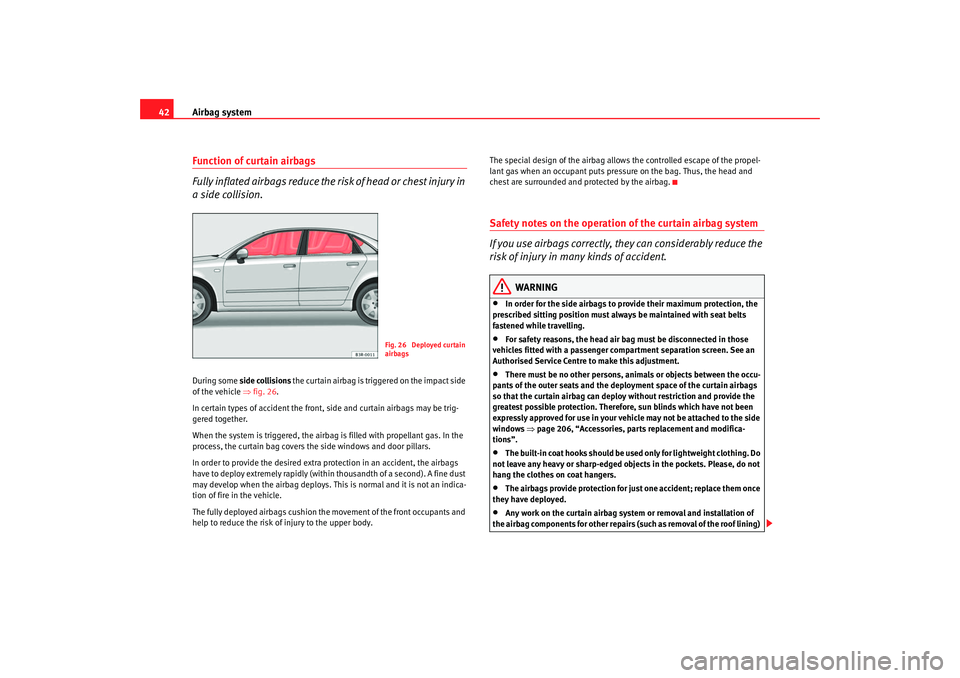
a side collision.During some side collisions the curtain airbag is tri ggered on the impact side
of the vehicle ⇒fig. 26 .
In certain types of accident the front, side and curtain airbags may be trig-
gered together.
When the system is triggered, the airbag is filled with propellant gas. In the
process, the curtain bag covers the side windows and door pillars.
In order to provide the desired extra protection in an accident, the airbags
have to deploy extremely rapidly (within thousandth of a second). A fine dust
may develop when the airbag deploys. This is normal and it is not an indica-
tion of fire in the vehicle.
The fully deployed airbags cushion the movement of the front occupants and
help to reduce the risk of injury to the upper body. The special design of the airbag allows the controlled escape of the propel-
lant gas when an occupant puts pressure on the bag. Thus, the head and
chest are surrounded and protected by the airbag.
Safety notes on the operation of the curtain airbag system
If you use airbags correctly, they can considerably reduce the
risk of injury in many kinds of accident.
WARNING
•
In order for the side airbags to provide their maximum protection, the
prescribed sitting position must alwa ys be maintained with seat belts
fastened while travelling.
•
For safety reasons, the head air bag must be disconnected in those
vehicles fitted with a passenger compartment separation screen. See an
Authorised Service Centre to make this adjustment.
•
There must be no other persons, animals or objects between the occu-
pants of the outer seats and the depl oyment space of the curtain airbags
so that the curtain airbag can deploy without restriction and provide the
greatest possible protection. Therefor e, sun blinds which have not been
expressly approved for use in your vehicle may not be attached to the side
windows ⇒page 206, “Accessories, parts replacement and modifica-
tions”.
•
The built-in coat hooks should be us ed only for lightweight clothing. Do
not leave any heavy or sharp-edged objects in the pockets. Please, do not
hang the clothes on coat hangers.
•
The airbags provide protection for just one accident; replace them once
they have deployed.
•
Any work on the curtain airbag system or removal and installation of
the airbag components for other repairs (such as removal of the roof lining)
Fig. 26 Deployed curtain
airbags
Exeo_EN.book Seite 42 Freitag, 17. Oktober 2008 11:24 11
Page 59 of 303
Cockpit57
Safety First
Operating instructions
Practical tips
Te c h n i c a l D a t a
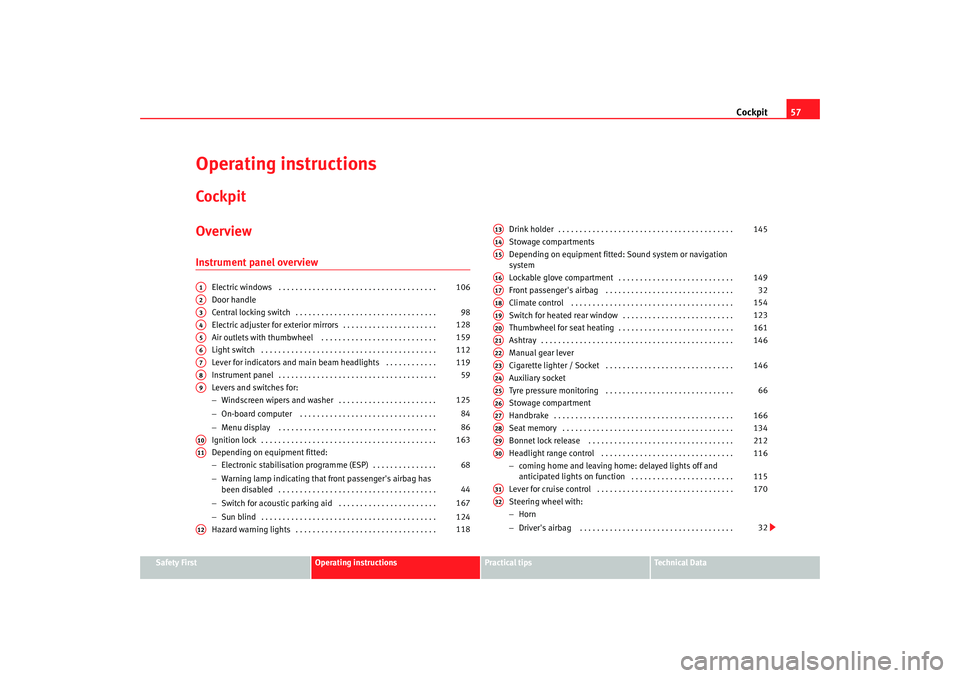
Operating instructionsCockpitOverviewInstrument panel overview
Electric windows . . . . . . . . . . . . . . . . . . . . . . . . . . . . . . . . . . . . .
Door handle
Central locking switch . . . . . . . . . . . . . . . . . . . . . . . . . . . . . . . . .
Electric adjuster for exterior mirrors . . . . . . . . . . . . . . . . . . . . . .
Air outlets with thumbwheel . . . . . . . . . . . . . . . . . . . . . . . . . . .
Light switch . . . . . . . . . . . . . . . . . . . . . . . . . . . . . . . . . . . . . . . . .
Lever for indicators and main beam headlights . . . . . . . . . . . .
Instrument panel . . . . . . . . . . . . . . . . . . . . . . . . . . . . . . . . . . . . .
Levers and switches for:
−Windscreen wipers and washer . . . . . . . . . . . . . . . . . . . . . . .
− On-board computer . . . . . . . . . . . . . . . . . . . . . . . . . . . . . . . .
− Menu display . . . . . . . . . . . . . . . . . . . . . . . . . . . . . . . . . . . . .
Ignition lock . . . . . . . . . . . . . . . . . . . . . . . . . . . . . . . . . . . . . . . . .
Depending on equipment fitted:
− Electronic stabilisation programme (ESP) . . . . . . . . . . . . . . .
− Warning lamp indicating that front passenger's airbag has
been disabled . . . . . . . . . . . . . . . . . . . . . . . . . . . . . . . . . . . . .
− Switch for acoustic parking aid . . . . . . . . . . . . . . . . . . . . . . .
− Sun blind . . . . . . . . . . . . . . . . . . . . . . . . . . . . . . . . . . . . . . . . .
Hazard warning lights . . . . . . . . . . . . . . . . . . . . . . . . . . . . . . . . . Drink holder . . . . . . . . . . . . . . . . . . . . . . . . . . . . . . . . . . . . . . . . .
Stowage compartments
Depending on equipment fitted: Sound system or navigation
system
Lockable glove compartment . . . . . . . . . . . . . . . . . . . . . . . . . . .
Front passenger's airbag . . . . . . . . . . . . . . . . . . . . . . . . . . . . . .
Climate control . . . . . . . . . . . . . . . . . . . . . . . . . . . . . . . . . . . . . .
Switch for heated rear window . . . . . . . . . . . . . . . . . . . . . . . . . .
Thumbwheel for seat heating . . . . . . . . . . . . . . . . . . . . . . . . . . .
Ashtray . . . . . . . . . . . . . . . . . . . . . . . . . . . . . . . . . . . . . . . . . . . . .
Manual gear lever
Cigarette lighter / Socket . . . . . . . . . . . . . . . . . . . . . . . . . . . . . .
Auxiliary socket
Tyre pressure monitoring . . . . . . . . . . . . . . . . . . . . . . . . . . . . . .
Stowage compartment
Handbrake . . . . . . . . . . . . . . . . . . . . . . . . . . . . . . . . . . . . . . . . . .
Seat memory . . . . . . . . . . . . . . . . . . . . . . . . . . . . . . . . . . . . . . . .
Bonnet lock release . . . . . . . . . . . . . . . . . . . . . . . . . . . . . . . . . .
Headlight range control . . . . . . . . . . . . . . . . . . . . . . . . . . . . . . .
−
coming home and leaving home : delayed lights off and
anticipated lights on function . . . . . . . . . . . . . . . . . . . . . . . .
Lever for cruise control . . . . . . . . . . . . . . . . . . . . . . . . . . . . . . . .
Steering wheel with:
− Horn
− Driver's airbag . . . . . . . . . . . . . . . . . . . . . . . . . . . . . . . . . . . .
A1
106
A2A3
98
A4
128
A5
159
A6
112
A7
119
A8
59
A9
125
84
86
A10
163
A11
68
44
167
124
A12
118
A13
145
A14A15A16
149
A17
32
A18
154
A19
123
A20
161
A21
146
A22A23
146
A24A25
66
A26A27
166
A28
134
A29
212
A30
116
115
A31
170
A32
32
Exeo_EN.book Seite 57 Freitag, 17. Oktober 2008 11:24 11
Page 96 of 303

Unlocking and locking
94Plastic key tab
Spare keys cannot be issued without the key number on the plastic key tab.
Therefore:•
Always keep the key tab in a safe place.
•
Never leave the key tab in the vehicle.
•
If you sell the vehicle, please give the plastic key tab to the new owner.
Replacing a key
If you lose a key, please contact the Technical Service. Have the remote
control coding for that key disabled. You should therefore bring the plastic
key tab and all available keys with you. It is also important to notify your
insurance company if a key or the plastic key tab has been lost.
WARNING
•
Always take the key with you when leaving the vehicle, even if you only
intend to be gone for a short time. This is particularly important if there are
children in the car, as they might otherwise be able to start the engine or
use power-operated equipment (e.g. the electric windows), which could
lead to injuries.
•
Wait for the vehicle to come to a standstill before removing the ignition
key from the lock! Otherwise, the steering lock could engage suddenly,
causing an accident.
Indicator light on the remote control key
The condition of the battery in the remote control key is moni-
tored by the indicator light.Condition of the key battery
The indicator light ⇒fig. 67 (arrow) flashes when one of the buttons is
pressed. If the indicator light does not light up or flash, this means that the
battery is exhausted and must be replaced.
Replacing the batteries ⇒ page 95.
Fig. 67 LED on the remote
control key
Exeo_EN.book Seite 94 Freitag, 17. Oktober 2008 11:24 11
Page 98 of 303
Unlocking and locking
96Central lockingDescription
The central locking system enables you to lock and unlock all
the doors, the boot lid and the tank flap together.The central locking system on your vehicle locks and unlocks all the doors
and the tank flap simultaneously. The tailgate is unlocked when the vehicle
is opened. However, the handle must be used to open it. The vehicle can be
locked and unlocked using the remote control ⇒page 102 or by turning the
key in the lock in the driver's door.
The windows can also be centrally opened or closed using the central locking
system ⇒page 107. The sun roof* can be closed but not opened using the
central locking system.
The central locking system is combined with an anti-theft security system. If
the vehicle is locked with the key from the outside, the interior opening levers
stop working, which make it difficult fo r unauthorised people to get into the
vehicle.
Should the central locking system fail to work, you can still normally enable
all the locks individually. The fuel tank flap can be released manually if neces-
sary. For manual release of the tank flap ⇒page 209.
Automatic locking function (Auto Lock)*
The Auto Lock* function locks the doors and the boot lid when the vehicle
exceeds a speed of about 15 km/h.
The vehicle is unlocked again automatically when the ignition key is
removed. Alternatively, the driver can also unlock the vehicle using the
central locking switch
or by opening one of the doors.
WARNING
Do not leave anyone (especially children) inside the car if it is locked from
the outside and the anti-theft security system is enabled, as the doors and
windows cannot then be opened from the inside. Locked doors could delay
assistance in an emergency, potentially putting lives at risk.
Note
•
Should the central locking system fail to work, you can still lock and
unlock the driver's door and the tailgate using the key. For manual release of
the tank flap ⇒page 209. Locking the doors manually if central locking fails
to work ⇒page 99.
•
The anti-theft mechanism and the anti-theft alarm* cannot be enabled if
the central locking is not working.
•
Never leave any valuable items in the vehicle unattended. Even a locked
vehicle is not a safe.
Exeo_EN.book Seite 96 Freitag, 17. Oktober 2008 11:24 11
Page 99 of 303
Unlocking and locking97
Safety First
Operating instructions
Practical tips
Te c h n i c a l D a t a
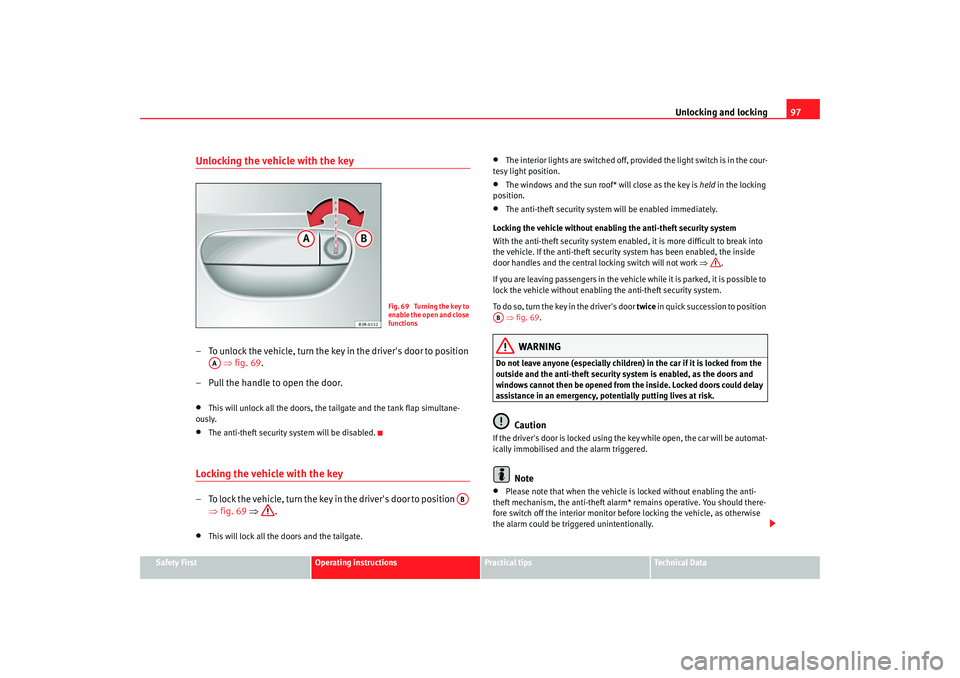
Unlocking the vehicle with the key– To unlock the vehicle, turn the key in the driver's door to position
⇒ fig. 69 .
– Pull the handle to open the door.•
This will unlock all the doors, the tailgate and the tank flap simultane-
ously.
•
The anti-theft security system will be disabled.
Locking the vehicle with the key– To lock the vehicle, turn the key in the driver's door to position
⇒ fig. 69 ⇒ .•
This will lock all the doors and the tailgate.
•
The interior lights are switched off, provided the light switch is in the cour-
tesy light position.
•
The windows and the sun roof* will close as the key is held in the locking
position.
•
The anti-theft security system will be enabled immediately.
Locking the vehicle without enabling the anti-theft security system
With the anti-theft security system enabled, it is more difficult to break into
the vehicle. If the anti-theft security system has been enabled, the inside
door handles and the central locking switch will not work ⇒.
If you are leaving passengers in the vehicle while it is parked, it is possible to
lock the vehicle without enabling the anti-theft security system.
To do so, turn the key in the driver's door twice in quick succession to position
⇒ fig. 69 .
WARNING
Do not leave anyone (especially children) in the car if it is locked from the
outside and the anti-theft security system is enabled, as the doors and
windows cannot then be opened from the inside. Locked doors could delay
assistance in an emergency, potentially putting lives at risk.
Caution
If the driver's door is locked using the key while open, the car will be automat-
ically immobilised and the alarm triggered.
Note
•
Please note that when the vehicle is locked without enabling the anti-
theft mechanism, the anti-theft alarm* remains operative. You should there-
fore switch off the interior monitor be fore locking the vehicle, as otherwise
the alarm could be triggered unintentionally.
Fig. 69 Turning the key to
enable the open and close
functions
AA
AB
AB
Exeo_EN.book Seite 97 Freitag, 17. Oktober 2008 11:24 11