ABS Seat Exeo 2009 User Guide
[x] Cancel search | Manufacturer: SEAT, Model Year: 2009, Model line: Exeo, Model: Seat Exeo 2009Pages: 310, PDF Size: 8.54 MB
Page 91 of 310
Cockpit89
Safety First
Controls and equipment
Practical tips
Technical Data
Use the rocker switch to select the menus and adjust various values. The
selected values are highlighted on a red background.
By pressing the button, you can confirm the option you have selected
or the value you have set. Selected functions are marked with a tick.
The following symbols are used:
Tyre pressure monitoring*Introduction
The tyre pressure monitoring system constantly checks the
pressure of the tyres.The system warns the driver in the event of a loss of pressure by means of
symbols and messages in the instrument panel display. The system works
with the help of the ABS sensors in the wheels.
Please bear in mind that the tyre inflation pressure is also influenced by the
temperature of the tyre. Tyre pressure increases about 0.1 bar for each 10°C
in tyre temperature increase. The tyre heats up while the vehicle is being
driven and the tyre pressure will rise accordingly. Therefore, you should only
adjust the tyre pressures when they are
cold (i.e. approximately at ambient
temperature).
To ensure that the tyre pressure monitoring system works reliably, you should
check and, if necessary, adjust the tyre pressures at regular intervals and
store the correct pressures (reference values) in the system.
A tyre pr essure i nfor ma ti on lab e l is a tta che d to t he insi de o f the fu el ta nk f lap.
WARNING
•Never adjust tyre pressure when the tyres are hot. This may damage or
even burst the tyres. Risk of accident!•An insufficiently inflated tyre flexes a lot more at high speeds and
causes significant heating of the tyre. Under these conditions, the tyre
bead may be released or the tyre may burst. Risk of accident!For the sake of the environment
Under-inflated tyres lead to increased fuel consumption and tyre wear.
Note
•Responsibility for ensuring that the tyres are correctly inflated remains
with the driver; the system can only provide assistance.•Pressure can only be adjusted when the tyres are at ambient
temperature.
Cursor
Function selected
Red background (active
function)
Tick
Selected
Box
Not selected
Triangle pointing upwards
Previous page
Triangle pointing down-
wards
Next page
Reset
Exeo_EN.book Seite 89 Freitag, 28. August 2009 10:14 10
Page 167 of 310
Driving165
Safety First
Controls and equipment
Practical tips
Technical Data
The Electronic Stabilisation Program (ESP) contains the electronic differential
lock (EDL) and the traction control system (TCS). The ESP function works
together with the ABS. If a fault in the ABS occurs, both warning lamps light
up, but if the ESP fails, only the ESP warning lamp lights up.
The ESP is started automatically when the engine is started.
The ESP switch deactivates both TCS and ESP functions. The ESP, in spite of
being deactivated, will always self-connect when necessary if brakes are
being used.
The TCS can be deactivated when in cases where wheel sliding is desirable.
For example:
•When driving with snow chains,•when driving in deep snow or on loose surfaces,•when rocking the vehicle backwards and forwards to free it from mud, for
example.
Next, the button should be pressed to reactivate the TCS.
When does the warning light switch on or flash ?•On switching the ignition on, it lights up for about two seconds to carry
out a function control.•The warning lamp will start flashing when the vehicle is moving if the ESP
or the TCS is activated.•It will light up continuously if there is a malfunction in the ESP.WARNING
•The electronic stabilisation programme (ESP) cannot defy the laws of
physics. This should be kept in mind, particularly on slippery and wet
roads and when towing a trailer.•Always adapt your driving style to suit the condition of the roads and
the traffic situation. Do not let the extra safety afforded by ESP tempt you
into taking any risks when driving, this can cause accidents.
•Please refer to the corresponding warning notes on ESP in ⇒page 183,
“Intelligent technology”.
Ignition lockIgnition key positions
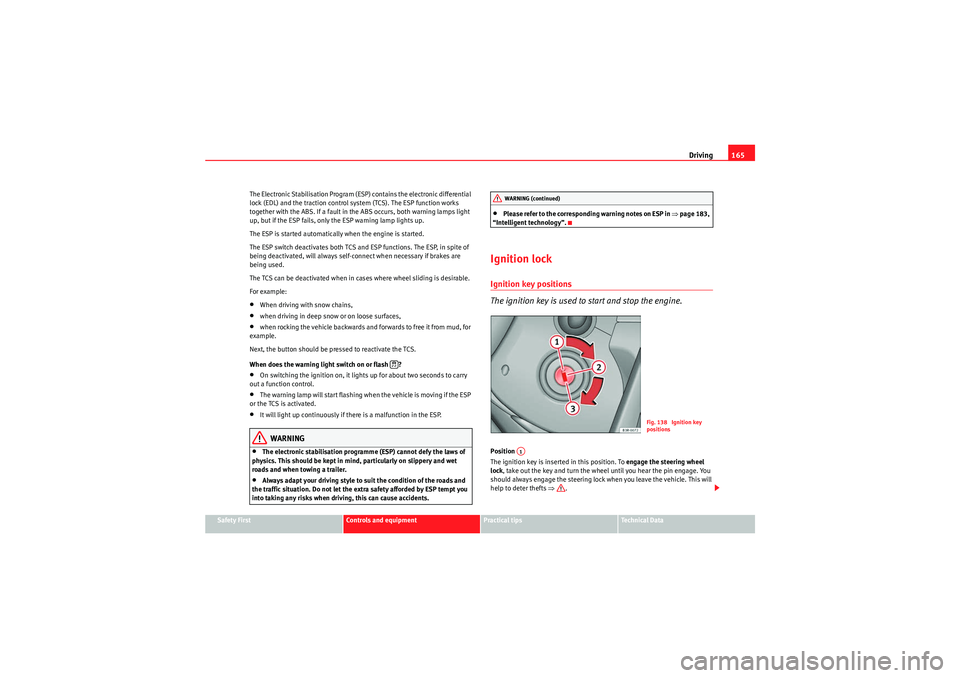
The ignition key is used to start and stop the engine.Position
The ignition key is inserted in this position. To engage the steering wheel
lock , take out the key and turn the wheel until you hear the pin engage. You
should always engage the steering lock when you leave the vehicle. This will
help to deter thefts ⇒.
WARNING (continued)
Fig. 138 Ignition key
positions
A1
Exeo_EN.book Seite 165 Freitag, 28. August 2009 10:14 10
Page 185 of 310
Intelligent technology183
Safety First
Controls and equipment
Practical tips
Technical Data
Practical tipsIntelligent technologyElectronic stabilisation programme (ESP)General notes
The electronic stabilisation programme increases the
vehicle's stability on the road.The ESP is designed to increase the degree of control in situations where the
car approaches the limits of adhesion, especially when accelerating and
cornering. It reduces the risk of skidding and improves stability in all road
conditions. The system is active across the entire speed range. The anti-lock brake system (ABS), the electronic differential lock (EDL) and
the traction control system (TCS) are all integrated into the electronic stabili-
sation programme.
How it works
The ESP control unit processes data from the three integrated systems. It also
processes additional inputs provided by other high-precision sensors. These
register the vehicle's rotation about the vertical axis (yaw rate), lateral accel-
eration, brake pressure and steering wheel angle.
The system uses the steering wheel angle and road speed to calculate the
changes of direction desired by the driver, and constantly compares them
with the actual behaviour of the vehicle. If the desired course is not being
maintained (for instance, if the car is starting to skid), then the ESP compen-
sates automatically by braking the appropriate wheel.
The forces acting on the braked wheel bring the car back to a stable condi-
tion. If the vehicle
over swerves (tendency of the rear to leave the road), the
brakes will act on the front wheel facing the outside of the bend. If the vehicle
under swerves (tendency to leave the bend), the braking force is applied to
the rear wheel facing the inside of the bend.
The ESP works in conjunction with the ABS ⇒page 184. If a malfunction
should occur in the ABS, the ESP will also be out of action.
Disabling
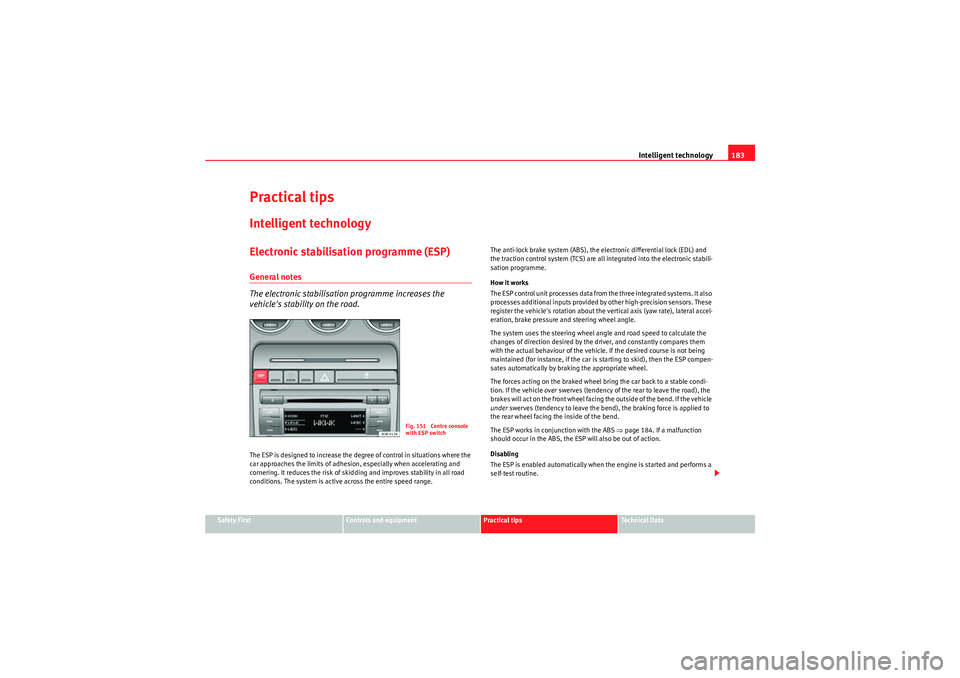
The ESP is enabled automatically when the engine is started and performs a
self-test routine.
Fig. 151 Centre console
with ESP switch
Exeo_EN.book Seite 183 Freitag, 28. August 2009 10:14 10
Page 186 of 310
Intelligent technology
184If required, the ESP can also be enabled and disabled manually by briefly
pressing the switch ⇒page 183, fig. 151. The ESP warning lamp lights
up when the system is switched off, see ⇒page 68.
In general, the ESP should be left switched on at all times. In particular
circumstances where a certain amount of wheel slip is desirable, it may be
advisable to switch off the ESP. Examples:•when driving with snow chains•when driving in deep snow or on loose surfaces•when rocking the car backwards and forwards to free it.
The ESP should be switched on again afterwards as soon as possible.WARNING
The ESP is not able to overcome the physical limits of adhesion. Even with
ESP, you should always adjust your speed to suit the conditions. Please
b ea r t h is i n m i n d , e s p e ciall y o n w e t o r s l i pp e r y roa d s u r fa ces . D o n o t l e t t h e
extra safety features tempt you into taking any risks when driving. Failure
to do so could result in an accident.Anti-lock brake system (ABS)
ABS prevents the wheels from locking up under braking.The anti-lock brake system (ABS) is an important part of the car's active safety
system. However, the ABS will not necessarily guarantee shorter stopping
distances in all conditions. For instance, on loose gravel or fresh snow on top
of an icy surface (conditions which anyway require extreme care and reduced
speed), the stopping distance with ABS may even be slightly longer. How the ABS works
The system runs an automatic self-check when the car reaches a road speed
of about 6 km/h. This may be accompanied by a noise from the ABS pump.
When one of the wheels is turning very slowly in relation to the road speed
and is close to locking up, the system will reduce the pressure in the brake
line to this wheel. The driver is made aware of this adjustment process by a
vibration of the brake pedal
and an audible noise. This is a deliberate
warning to the driver that one or more of the wheels is tending to lock up and
the ABS control function has intervened. In this situation it is important to
keep the brake pedal fully depressed so the ABS can regulate the brake appli-
cation, but do not “pump” the brake pedal.
WARNING
The grip provided by ABS is still subjec t to the physical limits of adhesion.
Always bear this in mind, especially on wet or slippery roads. If you notice
that the ABS is working (to counteract locked wheels under braking), you
should reduce speed immediately to suit the road and traffic conditions. Do
not let the extra safety features tempt you into taking any risks when
driving. Failure to do so could result in an accident.
Note
If a malfunction should occur in the ABS, this is indicated by a warning lamp
⇒ page 67.Brake assist system
The brake assist system helps the driver to achieve optimum
braking effect.The brake assist system helps to increase braking power and thus to achieve
a shorter stopping distance. If the driver presses the brake pedal very quickly,
ESP
Exeo_EN.book Seite 184 Freitag, 28. August 2009 10:14 10
Page 187 of 310
Intelligent technology185
Safety First
Controls and equipment
Practical tips
Technical Data
the brake assist system automatically boosts the braking force to the
maximum level, up to the point where the anti-lock brake function (ABS) inter-
venes to stop the wheels from locking. You should then keep the brake pedal
pressed until the vehicle has braked to the required speed. The brake assist
system switches itself off as soon as you release the brake pedal.
The brake assist system will not be operative if there is a malfunction in the
ABS or the ESP.
WARNING
Please remember that the accident risk always increases if you drive too
fast, especially in corners or on a slippery road, or if you follow too close
behind the vehicle in front of you. An increased accident risk cannot be
compensated even by the brake assist system. Risk of accident.Electronic differential lock (EDL)
The electronic differential lock prevents the loss of traction
caused if one wheel starts spinning.General notes
The electronic differential lock (EDL) helps the car to start moving, accelerate
and climb a gradient in slippery conditions where this may otherwise be diffi-
cult or even impossible.
How it works
The EDL works automatically, i.e. without the driver's involvement. With the
aid of the ABS sensors, the system monitors the rotational speed of the
driven wheels ⇒
page 184. If a considerable difference in revs is detected
(approx. 100 rpm) in the speed of the driven wheels, e.g. when only one part
of the surface supporting the wheels is slippery, the system applies the brake
to slow down the skidding wheel so that more of the power is directed to the other wheels. The systems works up to a speed of approx. 80 km/h. The
system will make noises while it is working.
Moving away from a standstill
If one wheel has less grip and starts spinning (for instance, if one of the
driven wheels is on ice), keep pressing the accelerator gradually until the car
starts moving.
Overheating of the brakes
To prevent the brake disk of the braked wheel from overheating, the EDL cuts
out automatically if subjected to excessive loads. In this case, the vehicle will
continue to run and will have the same running properties as those of another
without EDL.
The EDL will switch on again automatically when the brake has cooled down.
WARNING
•When accelerating on a uniformly slippery surface (for instance all four
wheels on ice or snow), press the accelerator gradually and carefully.
Despite EDL, the driven wheels may otherwise start to spin. This could
impair the car's stability. Risk of accident.•Even with EDL, you should always adjust your speed to suit the condi-
tions. Do not let the extra safety features tempt you into taking any risks
when driving. Failure to do so could result in an accident.Note
If the ABS warning lamp lights up, this can also mean there is a fault in the
EDL. Please take the vehicle to a specialist garage as soon as possible.
Exeo_EN.book Seite 185 Freitag, 28. August 2009 10:14 10
Page 188 of 310
Intelligent technology
186Traction control system (TCS)
The traction control system prevents the drive wheels from
spinning when the car is accelerating.General notes
The traction control system (TCS) is one of the functions incorporated in the
electronic stabilisation programme (ESP).
The traction control system (TCS) helps the car to start moving, accelerate or
climb a gradient in slippery conditions where this may otherwise be difficult
or even impossible.
How it works
The TCS acts automatically, i.e. without the driver's intervention. With the aid
of the ABS sensors ⇒page 184, the TCS monitors the speed of the driven
wheels. If the wheels start to spin, the engine power is reduced automatically
to match the amount of grip available. The system is active across the entire
speed range.
The TCS works in conjunction with the ABS. If a malfunction occurs in the ABS,
the TCS will also be inoperative.
Note
To ensure that the TCS works properly, all four wheels must be fitted with
identical tyres. The difference in size of the wheels may lead to an undesired
reduction in engine power. Also see ⇒page 241.
BrakesGeneral notesNew brake pads
New brake pads do not provide optimal performance during the first 200 km
they must be “run in”. However, the reduced braking capacity may be
compensated by pressing on the brake pedal a little harder. Avoid over-
loading the brakes during run-in.
Wear
T h e r a t e o f we a r o n t h e brake pads depends a great deal on how you drive and
the conditions in which the vehicle is operated. Negative factors are, for
instance, city traffic, frequent short trips or hard driving with abrupt starts
and stops.
Wet roads; road salt
In certain conditions, such as in heavy rain, or after washing the car or driving
through water, the full braking effect can be delayed by moisture (or in winter
by ice) on the discs and brake pads. The brakes should be “dried” by pressing
the pedal to restore full braking effect.
When the velocity is over 80 km/h windscreen wipers are on, the brake
system moves the pads towards the brake discs for a few seconds. This
occurs - without warning to the driver - at regular intervals and requires a
more rapid response from the brakes when driving on wet roads.
The effectiveness of the brakes can also be temporarily reduced if the car is
driven for some distance without using the brakes when there is a lot of salt
on the road in winter. In this case, the layer of salt on the brake discs and pads
has to wear off before braking.
Exeo_EN.book Seite 186 Freitag, 28. August 2009 10:14 10
Page 233 of 310
Checking and refilling levels231
Safety First
Controls and equipment
Practical tips
Technical Data
Topping up and changing the brake fluid
It is best to have the brake fluid changed by a professional.Brake fluid absorbs damp. Therefore, in the course of time it will absorb water
from the ambient air. If the water content in the brake fluid is too high, the
brake system could corrode. In addition, the boiling point of the brake fluid
will be considerably reduced. This could adversely affect the braking ability in
certain circumstances.
For this reason the brake fluid must be changed periodically.
Your vehicle's Service Schedule will tell you when the brake fluid has to be
renewed.
We recommend you have the brake fluid changed as part of a regular Inspec-
tion Service at your garage. They are familiar with the procedure and have the
necessary special tools and spare parts as well as the proper facilities for
disposing of the old fluid.
Use only the genuine brake fluid specified by the factory Specialist garages
know that the brake fluid -DOT 4- is factory approved. The brake fluid must be
new.
WARNING
•Therefore, it must always be kept closed in its original container. Keep
out of the reach of children. Failure to comply could result in poisoning.•Heavy use of the brakes may cause a vapour lock if the brake fluid is left
in the system for too long. This would seriously affect the efficiency of the
brakes and the safety of the car, leading to the risk of accident.Caution
Please note that brake fluid will attack the paintwork on contact.
For the sake of the environment
If the fluid has to be drained out of the brake system, use an appropriate
container to catch the used brake fluid and dispose of it in the proper
manner.BatteryGeneral notes
All work on batteries requires specialist knowledge.The battery is virtually maintenance-free and is checked in the Inspection
Services.
We recommend that you replace a battery once it is older than 5 years.
Disconnecting the battery
If the battery is disconnected, some of the vehicle's functions will become
inoperative (e.g. electric windows). These functions will require resetting
after the battery is reconnected. For this reason, the battery should only be
disconnected from the vehicle's electrical system when absolutely necessary.
Long periods of non-use
The battery will gradually lose its charge because certain electrical equip-
ment continues to draw current even when the ignition is off. If you park the
vehicle for long periods of time in winter you should take the battery out of
the vehicle and keep it in a frost-proof room. Store the battery in a place
where it cannot “freeze up” and become damaged. At warm outside temper-
atures it is sufficient to disconnect the negative terminal of the battery. Even
when the battery is not connected you should charge it from time to time.
Exeo_EN.book Seite 231 Freitag, 28. August 2009 10:14 10
Page 239 of 310
Wheels and tyres237
Safety First
Controls and equipment
Practical tips
Technical Data
Significant tyre pressure lossThe tyre symbol
is displayed and indicates that the tyre pressure for a least
one tyre is insufficient.
- Stop the vehicle.
- Switch the engine off.
- Check the tyre(s).
- Change the wheel if necessary.
Tyre pressure monitoring (RKA+)*
The type pressure monitor display on the instrument panel
indicates that the pressure is too low.The tyre pressure monitoring system makes use of the ABS sensors to
compare the rolling circumference and the frequency characteristics of the wheels. If the rolling circumference or frequency characteristic changes on
one or more wheels, the tyre pressure warning lamp
will light up. The fault
will also be indicated by a warning buzzer. The position of the affected tyre
will also be shown (if only one tyre is affected) on the centre display of the
instrument panel.
The rolling circumference and frequency characteristics can change if:
•the tyre pressure is too low.•the tyre has suffered structural damage.•the wheels or the inflation pressures have been changed without initial-
ising the system (see Adjusting the tyre pressure settings).•there is a greater load on the wheels of one axle (e.g. if you are carrying
more passengers or luggage).•the road surface under the left wheels is different to the road surface
under the right wheels for a long period.•when driving with snow chains.
Adjusting the tyre pressure settings (initialising the tyre pressure
monitoring system)
After any incident regarding the wheels of your vehicle, e.g. after modify the
tyre pressure ⇒page 238 or after changing of swapping around wheels ⇒
page 180 - with the vehicle at a standstill and the engine running - press
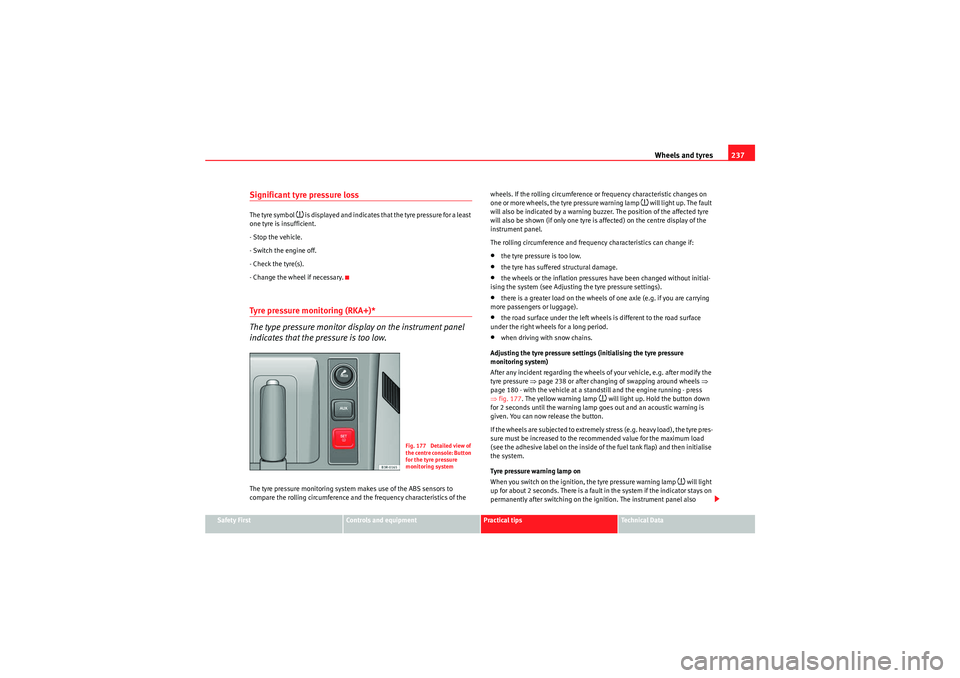
⇒ fig. 177 . The yellow warning lamp
will light up. Hold the button down
for 2 seconds until the warning lamp goes out and an acoustic warning is
given. You can now release the button.
If the wheels are subjected to extremely stress (e.g. heavy load), the tyre pres-
sure must be increased to the recommended value for the maximum load
(see the adhesive label on the inside of the fuel tank flap) and then initialise
the system.
Tyre pressure warning lamp on
When you switch on the ignition, the tyre pressure warning lamp
will light
up for about 2 seconds. There is a fault in the system if the indicator stays on
permanently after switching on the ignition. The instrument panel also
Fig. 177 Detailed view of
the centre console: Button
for the tyre pressure
monitoring system
Exeo_EN.book Seite 237 Freitag, 28. August 2009 10:14 10
Page 264 of 310
If and when
262Changing the dipped beam headlight bulb
The procedure for changing the bulbs on the front
passenger's side is the same as on the driver's side.
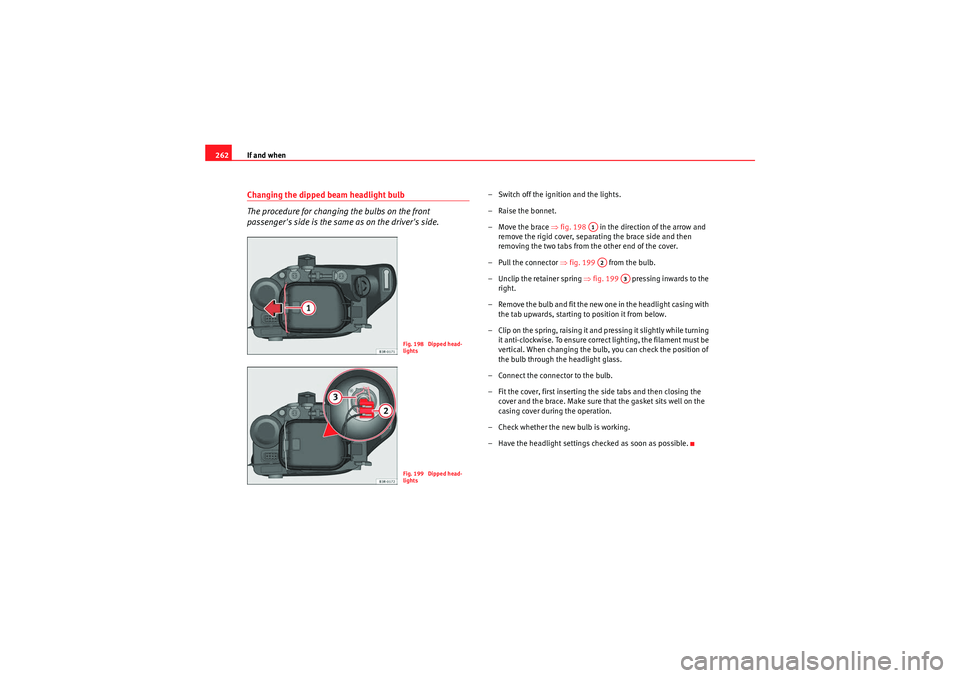
– Switch off the ignition and the lights.
– Raise the bonnet.
– Move the brace ⇒ fig. 198 in the direction of the arrow and
remove the rigid cover, separating the brace side and then
removing the two tabs from the other end of the cover.
– Pull the connector ⇒ fig. 199 from the bulb.
– Unclip the retainer spring ⇒fig. 199 pressing inwards to the
right.
– Remove the bulb and fit the new one in the headlight casing with the tab upwards, starting to position it from below.
– Clip on the spring, raising it and pressing it slightly while turning
it anti-clockwise. To ensure correct lighting, the filament must be
vertical. When changing the bulb, you can check the position of
the bulb through the headlight glass.
– Connect the connector to the bulb.
– Fit the cover, first inserting the side tabs and then closing the cover and the brace. Make sure that the gasket sits well on the
casing cover during the operation.
– Check whether the new bulb is working.
– Have the headlight settings checked as soon as possible.
Fig. 198 Dipped head-
lightsFig. 199 Dipped head-
lights
A1A2
A3
Exeo_EN.book Seite 262 Freitag, 28. August 2009 10:14 10
Page 265 of 310
If and when263
Safety First
Controls and equipment
Practical tips
Technical Data
Changing side light bulb (outside of vehicle)
The procedure for changing the bulbs on the front
passenger's side is the same as on the driver's side.
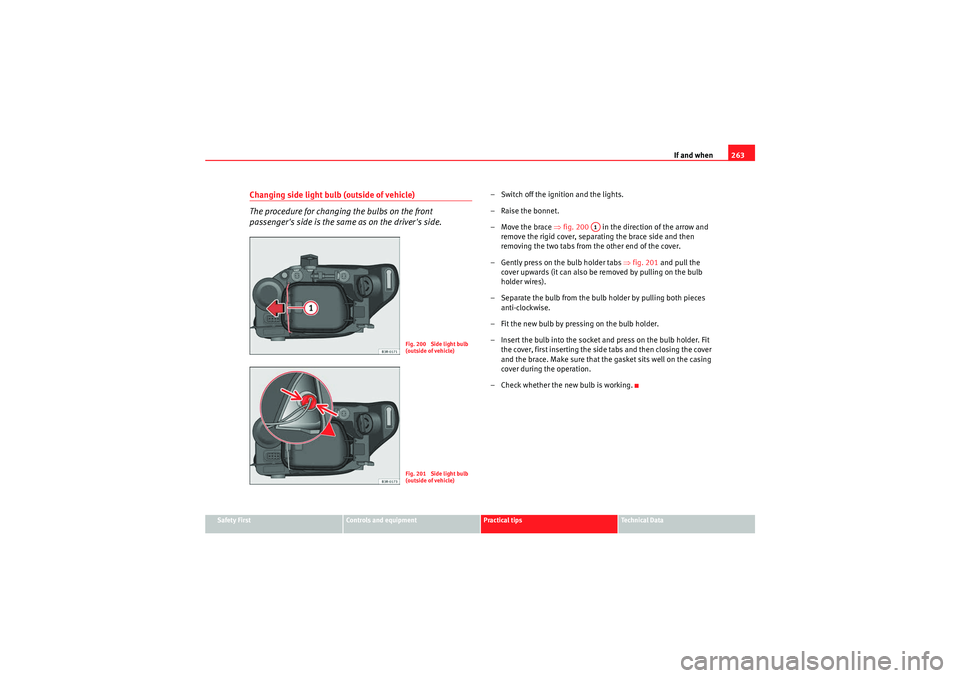
– Switch off the ignition and the lights.
– Raise the bonnet.
– Move the brace ⇒fig. 200 in the direction of the arrow and
remove the rigid cover, separating the brace side and then
removing the two tabs from the other end of the cover.
– Gently press on the bulb holder tabs ⇒fig. 201 and pull the
cover upwards (it can also be removed by pulling on the bulb
holder wires).
– Separate the bulb from the bulb holder by pulling both pieces anti-clockwise.
– Fit the new bulb by pressing on the bulb holder.
– Insert the bulb into the socket and press on the bulb holder. Fit the cover, first inserting the side tabs and then closing the cover
and the brace. Make sure that the gasket sits well on the casing
cover during the operation.
– Check whether the new bulb is working.
Fig. 200 Side light bulb
(outside of vehicle)Fig. 201 Side light bulb
(outside of vehicle)
A1
Exeo_EN.book Seite 263 Freitag, 28. August 2009 10:14 10