check oil Seat Exeo 2009 User Guide
[x] Cancel search | Manufacturer: SEAT, Model Year: 2009, Model line: Exeo, Model: Seat Exeo 2009Pages: 310, PDF Size: 8.54 MB
Page 224 of 310
Checking and refilling levels
222
NoteOn right-hand drive vehicles some of the containers/ reservoirs mentioned
below are located on the other side of the engine compartment.Closing the bonnet– To close the bonnet, pull it down to overcome the spring pres- sure.
– Leave the bonnet secured in the locking part. Do not tighten
⇒ .
WARNING
•For safety reasons the bonnet must always be completely closed when
the vehicle is moving. After closing it always check that it is properly
secured. The bonnet must be flush with the adjacent body panels.•Should you notice that the bonnet is not safely secured when the
vehicle is moving, stop the vehicle immediately and close the bonnet.
Failure to do so could result in an accident.
Engine oilGeneral notesWe recommend that the oil change should be performed by an Authorised
Service Centre or a qualified workshop, according to the Maintenance
Program. The correct oil specifications for your engine are listed in the
⇒page 223,
“Oil properties”.
Check that the specifications quoted (VW standards) appear on the container
either singly or in combination with other specifications.
Flexible maintenance intervals (Extended Service Intervals*)
Special lubricating oils ⇒page 223 have been developed in the framework
of the SEAT “Extended Service Intervals” ⇒Booklet “Maintenance Program”
This type of oil must be used if you intend to take advantage of the prolonga-
tion of the maintenance intervals in the framework of the “Extended Service
Intervals” program.
•Do not mix the LongLife oil with oil intended for fixed service intervals, as
the requirements for the extended service intervals are then no longer guar-
anteed.•Only in exceptional circumstances, if the engine oil level is too low
⇒ page 224 and LongLife oil is not available, it is permitted to top up (once)
with oil for fixed service intervals ⇒ page 223 (up to a maximum of 0.5
litres).
Fixed service intervals*
If “Extended Service Intervals” are not applied to your vehicle, you can use
oils for fixed service intervals ⇒ page 223. In this case, your vehicle must be
serviced after a fixed interval of 1 year / 15,000 km (10,000 miles) (see the
Maintenance Program).•In exceptional circumstances, if the engine oil level is too low
⇒ page 224 and you cannot obtain the oil specified for your vehicle, you can
put in a small quantity of oil conforming to the specification ACEA A2 or
ACEA A3 (petrol engines) or ACEA B3 or ACEA B4 (diesel engines) (up to 0.5l).
Vehicles with diesel particulate filter*
The Maintenance Program states whether your vehicle is fitted with a diesel
particulate filter.
Exeo_EN.book Seite 222 Freitag, 28. August 2009 10:14 10
Page 225 of 310
Checking and refilling levels223
Safety First
Controls and equipment
Practical tips
Technical Data
•Vehicles with a diesel particulate filter must only b e fille d with VW 507 00
engine oil.•Avoid mixing this oil with other engine oils.•Only in exceptional circumstances, if the engine oil level is too low
⇒ page 224 and you cannot obtain the oil specified for your vehicle, can you
put in a small quantity of oil (once) conforming to the VW 506 00, VW 506 01,
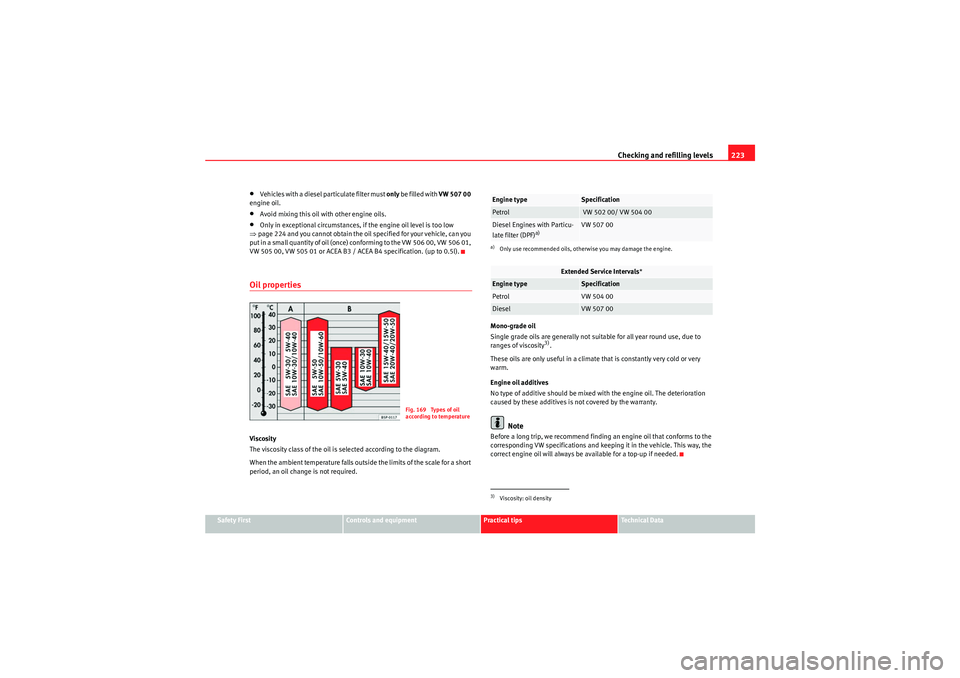
VW 505 00, VW 505 01 or ACEA B3 / ACEA B4 specification. (up to 0.5l).Oil propertiesViscosity
The viscosity class of the oil is selected according to the diagram.
When the ambient temperature falls outside the limits of the scale for a short
period, an oil change is not required. Mono-grade oil
Single grade oils are generally not suitable for all year round use, due to
ranges of viscosity
3).
These oils are only useful in a climate that is constantly very cold or very
warm.
Engine oil additives
No type of additive should be mixed with the engine oil. The deterioration
caused by these additives is not covered by the warranty.
Note
Before a long trip, we recommend finding an engine oil that conforms to the
corresponding VW specifications and keeping it in the vehicle. This way, the
correct engine oil will always be available for a top-up if needed.
Fig. 169 Types of oil
according to temperature
Engine type
Specification
Petrol
VW 502 00/ VW 504 00
Diesel Engines with Particu-
late filter (DPF)
a)
a)Only use recommended oils, otherwise you may damage the engine.
VW 507 00
Extended Service Intervals *
Engine type
Specification
Petrol
VW 504 00
Diesel
VW 507 00
3)Viscosity: oil density
Exeo_EN.book Seite 223 Freitag, 28. August 2009 10:14 10
Page 226 of 310
Checking and refilling levels
224Checking the oil levelChecking oil level
– Park the vehicle in a horizontal position.
– Briefly run the engine at idle speed until the service temperature
is reached then stop.
– Wait two minutes.
– Pull out the dipstick. Wipe the dipstick with a clean cloth and insert it again, pushing it in as far as it will go.
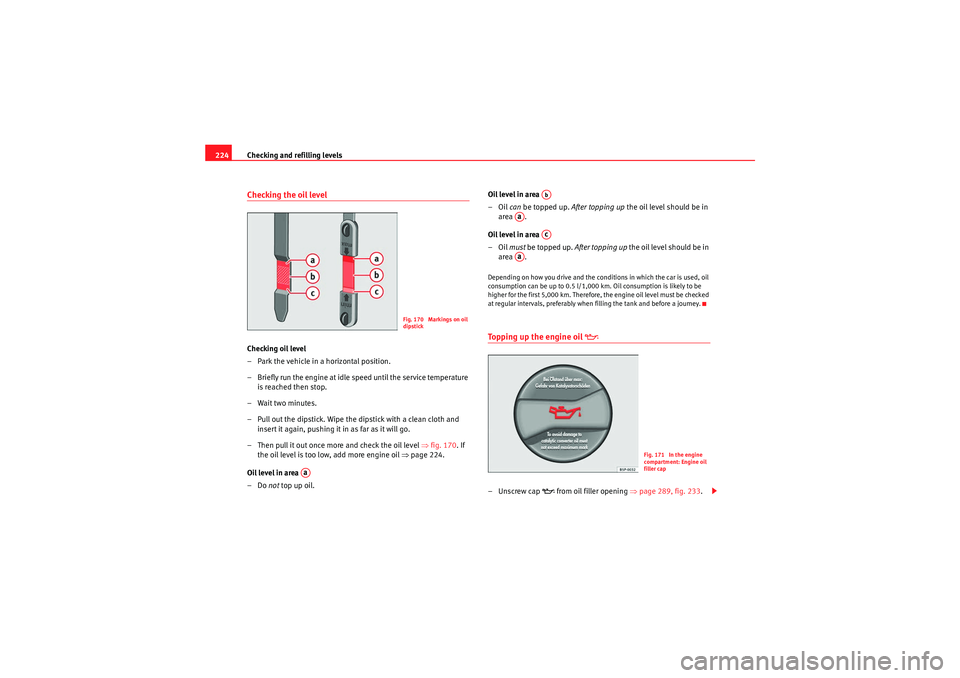
– Then pull it out once more and check the oil level ⇒fig. 170 . If
the oil level is too low, add more engine oil ⇒page 224.
Oil level in area
–Do not top up oil. Oil level in area
–Oil
can be topped up. After topping up the oil level should be in
area .
Oil level in area
–Oil must be topped up. After topping up the oil level should be in
area .
Depending on how you drive and the conditions in which the car is used, oil
consumption can be up to 0.5 l/1,000 km. Oil consumption is likely to be
higher for the first 5,000 km. Therefore, the engine oil level must be checked
at regular intervals, preferably when filling the tank and before a journey.Topping up the engine oil
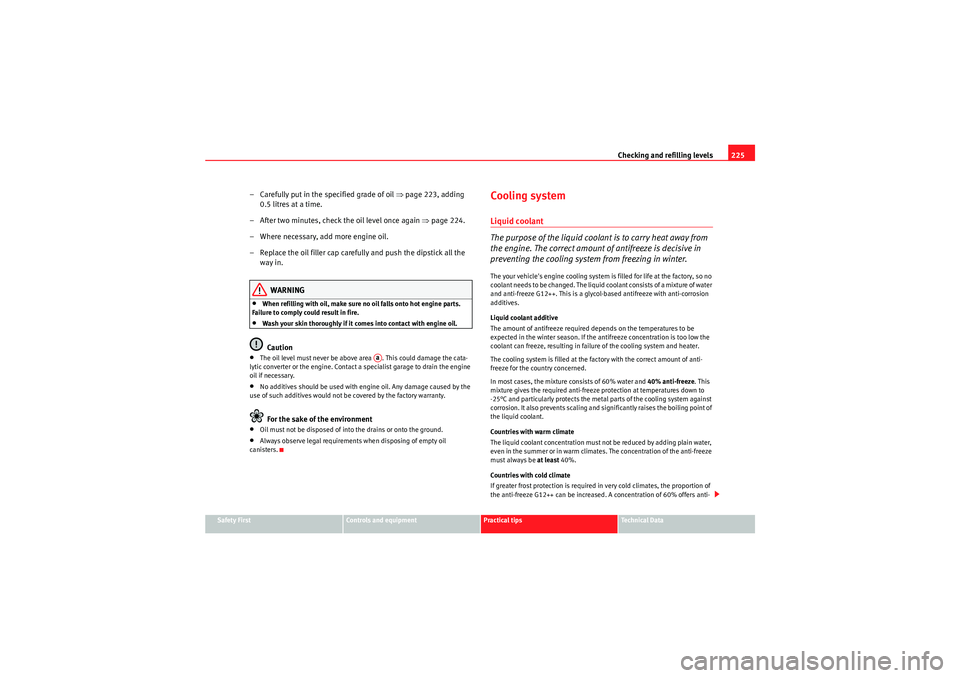
–Unscrew cap
from oil filler opening ⇒page 289, fig. 233 .
Fig. 170 Markings on oil
dipstick
Aa
Ab
Aa
Ac
Aa
Fig. 171 In the engine
compartment: Engine oil
filler cap
Exeo_EN.book Seite 224 Freitag, 28. August 2009 10:14 10
Page 227 of 310
Checking and refilling levels225
Safety First
Controls and equipment
Practical tips
Technical Data
– Carefully put in the specified grade of oil ⇒page 223, adding
0.5 litres at a time.
– After two minutes, check the oil level once again ⇒page 224.
– Where necessary, add more engine oil.
– Replace the oil filler cap carefully and push the dipstick all the way in.
WARNING
•When refilling with oil, make sure no oil falls onto hot engine parts.
Failure to comply could result in fire.•Wash your skin thoroughly if it comes into contact with engine oil.Caution
•The oil level must never be above area . This could damage the cata-
lytic converter or the engine. Contact a specialist garage to drain the engine
oil if necessary.•No additives should be used with engine oil. Any damage caused by the
use of such additives would not be covered by the factory warranty.For the sake of the environment
•Oil must not be disposed of into the drains or onto the ground.•Always observe legal requirements when disposing of empty oil
canisters.
Cooling systemLiquid coolant
The purpose of the liquid coolant is to carry heat away from
the engine. The correct amount of antifreeze is decisive in
preventing the cooling system from freezing in winter.The your vehicle's engine cooling system is filled for life at the factory, so no
coolant needs to be changed. The liquid coolant consists of a mixture of water
and anti-freeze G12++. This is a glycol-based antifreeze with anti-corrosion
additives.
Liquid coolant additive
The amount of antifreeze required depends on the temperatures to be
expected in the winter season. If the antifreeze concentration is too low the
coolant can freeze, resulting in failure of the cooling system and heater.
The cooling system is filled at the factory with the correct amount of anti-
freeze for the country concerned.
In most cases, the mixture consists of 60% water and 40% anti-freeze . This
mixture gives the required anti-freeze protection at temperatures down to
-25°C and particularly protects the metal parts of the cooling system against
corrosion. It also prevents scaling and significantly raises the boiling point of
the liquid coolant.
Countries with warm climate
The liquid coolant concentration must not be reduced by adding plain water,
even in the summer or in warm climates. The concentration of the anti-freeze
must always be at least 40%.
Countries with cold climate
If greater frost protection is required in very cold climates, the proportion of
the anti-freeze G12++ can be increased. A concentration of 60% offers anti-
Aa
Exeo_EN.book Seite 225 Freitag, 28. August 2009 10:14 10
Page 229 of 310
Checking and refilling levels227
Safety First
Controls and equipment
Practical tips
Technical Data
Liquid coolant losses
Any loss of liquid coolant normally indicates a
leak in the cooling system. In
this case the cooling system should be inspected by a specialist garage
without delay. It is not sufficient merely to top up the liquid coolant.
If there are no leaks in the system, a loss of liquid coolant can only occur if
the coolant boils and is forced out of the system as a result of overheating.
Caution
Radiator sealants must not be added to the liquid coolant. Such additives
could seriously impair the function of the cooling system.Topping up the liquid coolant
Be careful when topping up with liquid coolant.– Switch the engine off.
– Wait for the engine to cool down.
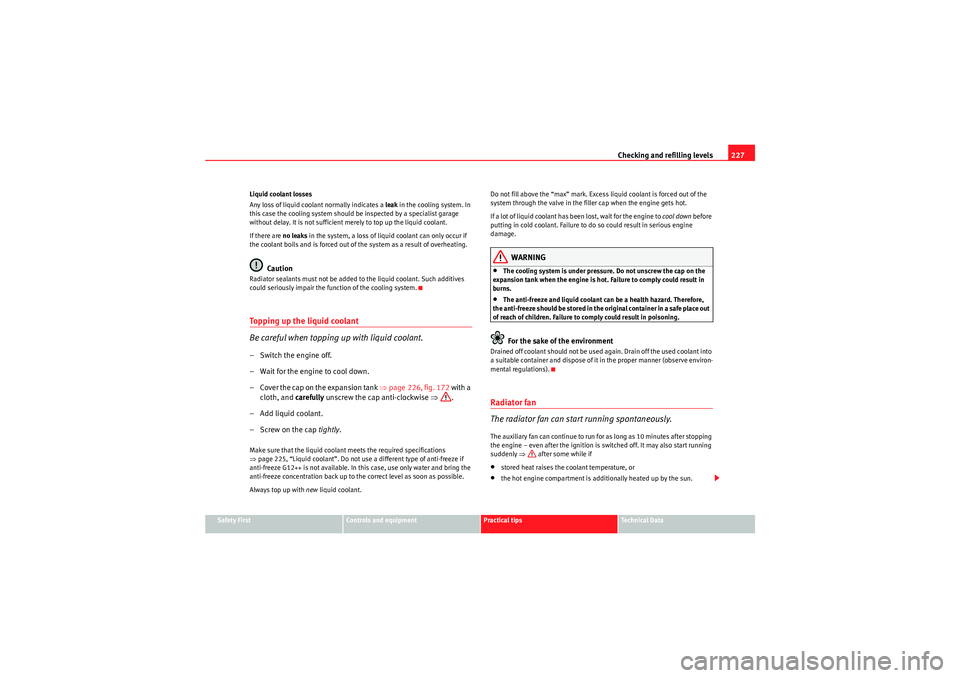
– Cover the cap on the expansion tank ⇒page 226, fig. 172 with a
cloth, and carefully unscrew the cap anti-clockwise ⇒.
– Add liquid coolant.
– Screw on the cap tightly.Make sure that the liquid coolant meets the required specifications
⇒page 225, “Liquid coolant”. Do not use a different type of anti-freeze if
anti-freeze G12++ is not available. In this case, use only water and bring the
anti-freeze concentration back up to the correct level as soon as possible.
Always top up with new liquid coolant. Do not fill above the “max” mark. Excess liquid coolant is forced out of the
system through the valve in the filler cap when the engine gets hot.
If a lot of liquid coolant has been lost, wait for the engine to
cool down before
putting in cold coolant. Failure to do so could result in serious engine
damage.
WARNING
•The cooling system is under pressure. Do not unscrew the cap on the
expansion tank when the engine is hot. Failure to comply could result in
burns.•The anti-freeze and liquid coolant can be a health hazard. Therefore,
the anti-freeze should be stored in the original container in a safe place out
of reach of children. Failure to comply could result in poisoning.For the sake of the environment
Drained off coolant should not be used again. Drain off the used coolant into
a suitable container and dispose of it in the proper manner (observe environ-
mental regulations).Radiator fan
The radiator fan can start running spontaneously.The auxiliary fan can continue to run for as long as 10 minutes after stopping
the engine – even after the ignition is switched off. It may also start running
suddenly ⇒ after some while if•stored heat raises the coolant temperature, or•the hot engine compartment is additionally heated up by the sun.
Exeo_EN.book Seite 227 Freitag, 28. August 2009 10:14 10
Page 231 of 310
Checking and refilling levels229
Safety First
Controls and equipment
Practical tips
Technical Data
Changing windscreen wiper blades
If the windscreen wiper blades are in perfect condition, you
will benefit from an improved visibility. Damaged wiper
blades should be replaced immediately.
Removing the wiper blade
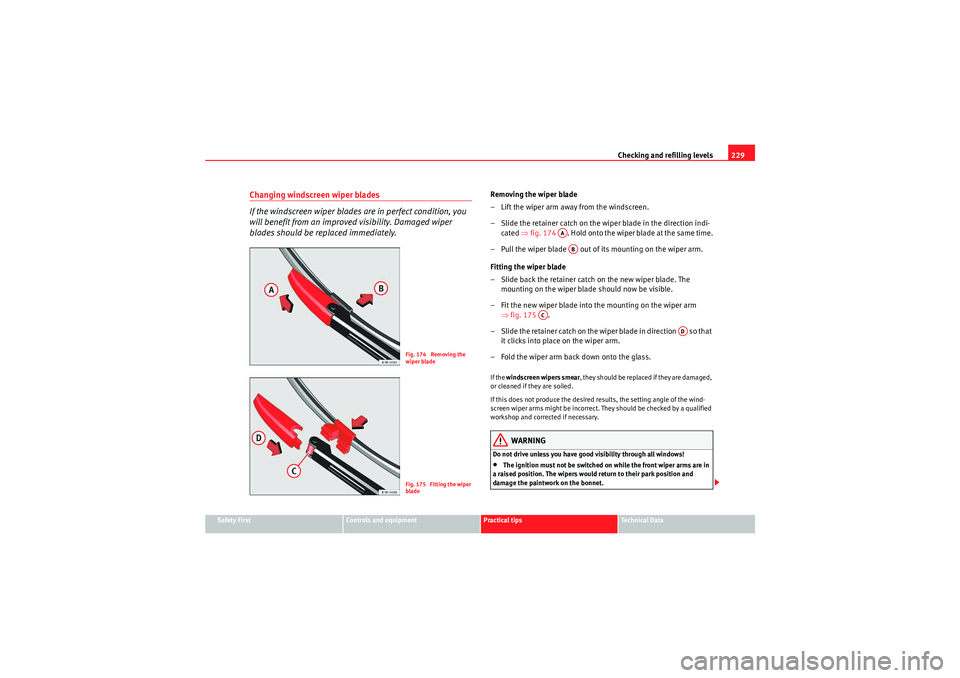
– Lift the wiper arm away from the windscreen.
– Slide the retainer catch on the wiper blade in the direction indi-
cated ⇒fig. 174 . Hold onto the wiper blade at the same time.
– Pull the wiper blade out of its mounting on the wiper arm.
Fitting the wiper blade
– Slide back the retainer catch on the new wiper blade. The mounting on the wiper blade should now be visible.
– Fit the new wiper blade into the mounting on the wiper arm ⇒fig. 175 .
– Slide the retainer catch on the wiper blade in direction so that it clicks into place on the wiper arm.
– Fold the wiper arm back down onto the glass.If the windscreen wipers smear , t h e y s h o u l d b e r e p la ce d i f t h e y a r e d a m a ge d ,
or cleaned if they are soiled.
If this does not produce the desired results, the setting angle of the wind-
screen wiper arms might be incorrect. They should be checked by a qualified
workshop and corrected if necessary.
WARNING
Do not drive unless you have good visibility through all windows!•The ignition must not be switched on while the front wiper arms are in
a raised position. The wipers would return to their park position and
damage the paintwork on the bonnet.
Fig. 174 Removing the
wiper bladeFig. 175 Fitting the wiper
blade
AAAB
AC
AD
Exeo_EN.book Seite 229 Freitag, 28. August 2009 10:14 10
Page 233 of 310
Checking and refilling levels231
Safety First
Controls and equipment
Practical tips
Technical Data
Topping up and changing the brake fluid
It is best to have the brake fluid changed by a professional.Brake fluid absorbs damp. Therefore, in the course of time it will absorb water
from the ambient air. If the water content in the brake fluid is too high, the
brake system could corrode. In addition, the boiling point of the brake fluid
will be considerably reduced. This could adversely affect the braking ability in
certain circumstances.
For this reason the brake fluid must be changed periodically.
Your vehicle's Service Schedule will tell you when the brake fluid has to be
renewed.
We recommend you have the brake fluid changed as part of a regular Inspec-
tion Service at your garage. They are familiar with the procedure and have the
necessary special tools and spare parts as well as the proper facilities for
disposing of the old fluid.
Use only the genuine brake fluid specified by the factory Specialist garages
know that the brake fluid -DOT 4- is factory approved. The brake fluid must be
new.
WARNING
•Therefore, it must always be kept closed in its original container. Keep
out of the reach of children. Failure to comply could result in poisoning.•Heavy use of the brakes may cause a vapour lock if the brake fluid is left
in the system for too long. This would seriously affect the efficiency of the
brakes and the safety of the car, leading to the risk of accident.Caution
Please note that brake fluid will attack the paintwork on contact.
For the sake of the environment
If the fluid has to be drained out of the brake system, use an appropriate
container to catch the used brake fluid and dispose of it in the proper
manner.BatteryGeneral notes
All work on batteries requires specialist knowledge.The battery is virtually maintenance-free and is checked in the Inspection
Services.
We recommend that you replace a battery once it is older than 5 years.
Disconnecting the battery
If the battery is disconnected, some of the vehicle's functions will become
inoperative (e.g. electric windows). These functions will require resetting
after the battery is reconnected. For this reason, the battery should only be
disconnected from the vehicle's electrical system when absolutely necessary.
Long periods of non-use
The battery will gradually lose its charge because certain electrical equip-
ment continues to draw current even when the ignition is off. If you park the
vehicle for long periods of time in winter you should take the battery out of
the vehicle and keep it in a frost-proof room. Store the battery in a place
where it cannot “freeze up” and become damaged. At warm outside temper-
atures it is sufficient to disconnect the negative terminal of the battery. Even
when the battery is not connected you should charge it from time to time.
Exeo_EN.book Seite 231 Freitag, 28. August 2009 10:14 10
Page 237 of 310
Wheels and tyres235
Safety First
Controls and equipment
Practical tips
Technical Data
Wheels and tyresWheelsGeneral notesAvoiding damage
– If you have to drive over a kerb or similar obstacle, drive very
slowly and as near as possible at a right angle to the kerb.
– Keep grease, oil and fuel off the tyres.
– Inspect the tyres regularly for da mage (cuts, cracks or blisters,
etc.). Remove any foreign objects embedded in the treads.
Storing tyres
– Mark tyres when you remove them to indicate the direction of rotation. This ensures you will be able to install them correctly
when you replace them.
– When removed, the wheels and/or tyres should be stored in a cool, dry and preferably dark location.
– Store tyres in a vertical position if they are not fitted on wheel
rims.New tyres
New tyres have to be run-in.
The tread depth of new tyres may vary, according to the type and make of tyre
and the tread pattern. Concealed damage
Damage to tyres and rims is often not readily visible. If you notice unusual
vibrations or the car pulling to one side, this may indicate that one of the tyres
is damaged. The tyres should be checked immediately by an Authorised
Service Centre.
Tyres with directional tread pattern
An arrow on the tyre sidewall indicates the direction of rotation on tyres with
directional tread. Always observe the direction of rotation indicated when
fitting the wheel. This guarantees optimum grip and helps to avoid aqua-
planing, excessive noise and wear.
WARNING
•New tyres do not have maximum grip in the first 500 km. Drive particu-
larly carefully to avoid risk of accident.•Never drive with damaged tyres. This may cause an accident.•If you notice unusual vibration or if the vehicle pulls to one side when
driving, stop the vehicle immediately and check the tyres for damage.
Checking tyre pressure
The correct tyre pressure can be seen on the sticker on the
inside of the tank flap.1. Read the required tyre inflatio n pressure from the sticker. The
values refer to Summer tyres. For Winter tyres, you must add 0.2
bar to the values given on the sticker.
Exeo_EN.book Seite 235 Freitag, 28. August 2009 10:14 10
Page 241 of 310
Wheels and tyres239
Safety First
Controls and equipment
Practical tips
Technical Data
Wear indicators
The original tyres on your vehicle have 1.6 mm high “tread wear indicators”
⇒
page 238, fig. 178 , running across the tread. Depending on the make,
there will be six to eight of them evenly spaced around the tyre. Markings on
the tyre sidewall (for instance the letters “TWI” or other symbols) indicate the
positions of the tread wear indicators. The minimum tread depth required by
law is 1.6 mm (measured in the tread grooves next to the tread wear indica-
tors). Worn tyres must be replaced. Different figures may apply in export
countries ⇒.
Tyre pressure
Under-inflation or over-inflation will reduce the life of the tyres considerably
and also impair the car's handling. The inflation pressures are listed on a
sticker on the inside of the fuel tank flap.
Correct inflation pressures are very important, especially at high speeds. The
pressure should therefore be checked at least once a month and before
starting any long journey.
Tyre pressure monitoring (RKA+ )*
Monitoring of the tyre pressures is based on the tyre pressures you have
stored. The tyre pressure monitoring system cannot function as intended if
you store tyre pressure settings for a normal load, but then drive with the
vehicle fully laden. The tyre pressure must be adapted to the actual load and
stored accordingly in the tyre pressure monitoring system ⇒page 237.
Driving style
Fast cornering, heavy acceleration and hard braking all increase tyre wear.
Changing wheels around
If the front tyres are worn considerably more than the rear ones it is advisable
to cha nge t he m ar oun d as sh own ⇒ page 238, fig. 179. All the tyres will then
last for about the same time. Wheel balance
The wheels on new vehicles are balanced. However, various factors encoun-
tered in normal driving can cause them to become unbalanced, which results
in steering vibration.
Unbalanced wheels should be rebalanced, as they otherwise cause excessive
wear on steering, suspension and tyres. A wheel must also be rebalanced
when a new tyre is fitted.
Incorrect wheel alignment
Incorrect wheel alignment causes excessive tyre wear, impairing the safety of
the vehicle. If tyres show excessive wear, you should have the wheel align-
ment checked by an Authorised Service Centre.
WARNING
There is a serious danger of accidents if a tyre bursts during driving!•The tyres must be replaced at the latest when the tread is worn down to
the tread wear indicators. Failure to do so could result in an accident. Worn
tyres do not grip well at high speeds on wet roads. There is also a greater
risk of “aquaplaning” •At continuously high speeds, a tyre with insufficient pressure flexes
more. This causes it to overheat. This can cause tread separation and tyre
blow-out. Risk of accident. Always observe the recommended tyre pres-
sures.•If tyres show excessive wear, you should have the running gear checked
by an Authorised Service Centre.•Keep chemicals such as oil, fuel and brake fluid away from tyres.•Damaged wheels and tyres must be replaced immediately!For the sake of the environment
Under-inflated tyres will increase fuel consumption.
Exeo_EN.book Seite 239 Freitag, 28. August 2009 10:14 10
Page 255 of 310
If and when253
Safety First
Controls and equipment
Practical tips
Technical Data
Repairing a tyrePreparations
– If you have a flat tyre or punctu re, park the car as far away from
the flow of traffic as possible.
–Apply the handbrake firmly to prevent the vehicle from moving
accidentally on slopes.
– Engage 1st gear .
– Check whether a repair is possibl e using the Tyre Mobility System
⇒ page 251.
– Ensure that all passengers leave the vehicle and move away from
the danger area ⇒ .
–Take the tyre sealant can and the compressor out of the luggage
compartment. – Stick the “max. 80 km/h” adhesive, which is included with the
tyre sealant can, onto the instrument panel where the driver will
see it.
Filling the tyre
– Shake the tyre sealant can well.
– Screw the enclosed filling hose onto the sealant can as far as it will go. This will automatically pierce the foil sealing the can.
– Take the valve cap off the tyre valve and use the enclosed valve insert tool to unscrew the valve insert ⇒fig. 189 .
– Place the valve insert onto a clean surface.
– Remove the sealing plug from the filling hose and insert the hose into the tyre valve.
– Hold the tyre sealant can upside down and fill the complete contents of the can into the tyre.
– Then disconnect the hose and screw the valve insert firmly back into the tyre valve.
Inflating the tyre
– Screw the compressor filling hose onto the tyre valve and plug the connector into the cigarette lighter.
– Pump the tyre up to 2.0 to 2.5 bar and monitor the pressure shown on the pressure gauge.
Fig. 189 Repairing a tyre
Exeo_EN.book Seite 253 Freitag, 28. August 2009 10:14 10