engine oil Seat Exeo 2009 User Guide
[x] Cancel search | Manufacturer: SEAT, Model Year: 2009, Model line: Exeo, Model: Seat Exeo 2009Pages: 310, PDF Size: 8.54 MB
Page 192 of 310
Driving and the environment
190your vehicle has automatic transmission). This makes use of engine
braking and relieves the brakes.•Never let the brakes “slip” by applying light pressure. Continuous
braking will cause the brakes to overheat and the braking distance will
increase. Apply and then release the brakes alternately.•Never let the vehicle run with the engine switched off. The braking
distance is increased considerably when the brake servo is not active.•Very heavy use of the brakes may cause a vapour lock if the brake fluid
is left in the system for too long. This impairs the braking effect.•Non-standard or damaged front spoilers could restrict the airflow to the
brakes and cause them to overheat. Observe the relevant instructions
before purchasing accessories ⇒ page 214, “Technical modifications”.•If a brake circuit fails, the braking distance will be increased consider-
ably. Contact a qualified workshop immediately and avoid unnecessary
journeys.
Exhaust gas purification systemCatalytic converter*To conserve the useful life of the catalytic converter
– Always use unleaded petrol.
– Do not let the fuel get too low in the tank.
– For engine oil changes, do not replenish with too much engine oil ⇒page 224. – Never tow the vehicle to start it, use jump leads if necessary
⇒page 279.
If you notice misfiring, uneven running or loss of power when the vehicle is
moving, reduce speed immediately and have the vehicle inspected at the
nearest qualified workshop. In general, the exhaust warning lamp will light
up when any of the described symptoms occur ⇒page 66. If this happens,
unburnt fuel can enter the exhaust system and escape into the environment.
The catalytic converter can also be damaged by overheating.
WARNING
The catalytic converter reaches very high temperatures! Fire hazard!•Never park where the catalytic converter could come into contact with
dry grass or inflammable materials under the vehicle.•Do not apply additional underseal or anti-corrosion coatings to the
exhaust pipes, catalytic converter or the heat shields on the exhaust
system. These materials could catch fire when the vehicle is being driven.Caution
Never fully drain the fuel tank because the irregularity of the fuel supply may
cause ignition problems. This allows unburnt fuel to enter the exhaust
system, which could cause overheating and damage the catalytic converter.
For the sake of the environment
Even when the emission control system is working perfectly, there may be a
smell of sulphur from the exhaust under some conditions. This depends on
the sulphur content of the fuel used. Quite often the problem can be solved
by changing to another brand of fuel.
WARNING (continued)
Exeo_EN.book Seite 190 Freitag, 28. August 2009 10:14 10
Page 207 of 310
Your vehicle maintenance and cleaning205
Safety First
Controls and equipment
Practical tips
Technical Data
Your vehicle maintenance and cleaningGeneral notesRegular washing and care help maintain the value of your
vehicle.Yo u r v e h i c l e m a i n te n a n ce
Regular care and washing help to maintain the value of the vehicle. This may
also be one of the requirements for acknowledging warranty claims in the
event of bodywork corrosion or paint defects.
The best way to protect your car against the harmful effects of the environ-
ment is through correct maintenance and frequent washing. The longer
substances such as insects remains, bird droppings, resinous tree sap, road
dirt, industrial deposits, tar, soot or road salt and other aggressive materials
remain on the vehicle, the more damage they do to the paintwork. High
temperatures (for instance in strong sunlight) further intensify the corrosive
effect.
After winter, a period when salt is put on the roads, it is impor tant to have the
underside of the vehicle washed thoroughly.
Products for vehicle maintenance
Car care products are available in your Authorised Service Centre. Keep the
product instructions until you have used them up.
WARNING
•Car care products can be toxic. For this, they must always be kept
closed in their original container. Keep them out of the reach of children.
Failure to comply could result in poisoning.•Always read and observe the instructions and warnings on the package
before using car care products. Improper use could damage your health or your vehicle. The use of certain products may produce noxious vapours;
they should be used in well ventilated areas.
•Never use fuel, turpentine, engine oil, nail varnish remover or other
volatile fluids. These are toxic and highly flammable. Risk of fire and explo-
sion.•Before washing your vehicle, or carrying out any maintenance, switch
the engine off, apply your handbrake firmly and remove the key from the
ignition.Caution
Never attempt to remove dirt, mud or dust if the surface of the vehicle is dry.
Never use a dry cloth or sponge for cleaning purposes. This could damage the
paintwork or the windows of your vehicle. Soak dirt, mud or dust with plenty
of water.
For the sake of the environment
•When purchasing products for your vehicle maintenance, select the ones
which are not harmful to the environment.•The leftovers of the car care products should not be disposed of with ordi-
nary household waste. Observe the disposal information on the package.WARNING (continued)
Exeo_EN.book Seite 205 Freitag, 28. August 2009 10:14 10
Page 213 of 310
Your vehicle maintenance and cleaning211
Safety First
Controls and equipment
Practical tips
Technical Data
Cleaning the engine compartment
Take special care when cleaning the engine compartment.Anti-corrosion treatment
The engine compartment and the surface of the power unit are given anti-
corrosion treatment at the factory.
Good corrosion protection is particularly important in winter when the car is
frequently driven on salted roads. To prevent the salt corroding the vehicle,
the entire engine compartment should be thoroughly cleaned before and
after winter.
Yo u r A u t h o r i s e d S e r v i ce Ce n t re has got the necessary equipment to provide
the correct cleaning and preserving products. For this reason, we recommend
having this work performed by them.
The anti-corrosion protection is usually removed if the engine compartment
is cleaned with grease removing solutions, or if you have the engine cleaned.
On commissioning this work, ensure that all surfaces, seams, joints and
components in the engine compartment are given anti-corrosion treatment.
WARNING
•When working in the engine compartment, always observe the safety
warnings ⇒page 221•Before opening the bonnet, switch the engine off, apply the parking
brake firmly and always remove the key from the ignition.•Allow the engine to cool before you clean the engine compartment.•Do not clean the vehicle underbody, wheel arches without protecting
your hands and arms. You may cut yourself on sharp-edged metal parts.
Failure to comply could result in injury.•Moisture, ice and salt on the brakes may affect braking efficiency. Risk
of accident. Directly after washing, avoid sudden and sharp braking.
•Never touch the radiator fan. It is temperature-controlled and could
start automatically, even when the key is removed from the ignition!For the sake of the environment
Fuel, grease and oil deposits could be removed when the engine is washed.
The polluted water must be cleaned in an oil separator. For this reason,
engine washing should be carried out only by a qualified workshop or a petrol
station.Vehicle interior maintenancePlastic parts and dash panel cleaning– Use a clean, damp cloth to clean plastic parts and the dash panel.
– If this does not provide satisfactory results, use a special solvent-free plastic cleaning product.
WARNING
Never clean the dash panel and the airbag module surface with cleansers
containing solvents. Solvents cause the surface to become porous. If the
airbag triggered, disintegrating plastic parts could cause substantial inju-
ries.
WARNING (continued)
Exeo_EN.book Seite 211 Freitag, 28. August 2009 10:14 10
Page 220 of 310
Checking and refilling levels
218PetrolPetrol types
The recommended fuel types are listed on a sticker inside the
fuel tank flap.Only unleaded petrol, corresponding to the standard DIN EN 228 , may be
used for vehicles with catalytic converters (EN = “European Standard”).
Fuel types are differentiated by the octane rating, e.g: 91, 95, 98 RON (RON
= “Regulation Octane Number, unit for determining the knock resistance of
petrol”). You may use petrol with a higher octane number than the one recom-
mended for your engine. However, this has no advantage in terms of fuel
consumption and engine power.
The correct fuel type for your vehicle is given in the technical table for the
engine. Section “Technical Data”
Caution
•Petrol that follows EN 228 may be mixed with small quantities of ethanol.
However, the so-called “bioethanol fuels” available at commercial establish-
ments, e.g. with reference E50 or E85, which contain a high percentage of
ethanol, may not be used, as they will damage the fuel system.•Even one tankful of leaded fuel would permanently impair the efficiency
of the catalytic converter.•High engine speed and full throttle can damage the engine when using
petrol with an octane rating lower than the correct grade for the engine.For the sake of the environment
Just one full tank of leaded fuel would seriously impair the efficiency of the
catalytic converter.
Petrol additives
Petrol additives improve the quality of the petrol.The quality of the petrol influences running behaviour, performance and
service life of the engine. For this reason, you should use good quality petrol
containing additives. These additives will help to prevent corrosion, keep the
fuel system clean and prevent deposits from building up in the engine.
If good quality petrol with additives is not available or engine problems occur,
the required additives must be added during refuelling.DieselDiesel*Diesel fuel must correspond to DIN EN 590 (EN = “European standard”). It
must have a cetane number (CN) of at least 51. The cetane number indicates
the ignition quality of the diesel fuel.
Notes on refuelling ⇒page 216.Biodiesel*The biodiesel fuel must comply with the DIN EN 14.214 (FAME) Standard.•Biodiesel is a methyl ester obtained from rapeseed oil.•DIN is the German abbreviation for “ Deutsches Institut für N ormung e.V.”,
the German standards institute.•EN means European Norm.•FAME is the English abbreviation for “ Fatty Acid Methyl Ester”.
Exeo_EN.book Seite 218 Freitag, 28. August 2009 10:14 10
Page 223 of 310
Checking and refilling levels221
Safety First
Controls and equipment
Practical tips
Technical Data
WARNING
Never open the bonnet if you see steam or drips of coolant being released
from t he engine com par t ment . Fail ure to com ply could resul t in burns . Wait
until no steam or coolant can be seen before opening the bonnet.Work in the engine compartment
Extra caution is necessary when working on components in
the engine compartment.Always be aware of the danger of injury and scalding as well as the risk of
accident or even fire when working in the engine compartment (e.g. when
checking and refilling fluids). Therefore, always observe the warnings listed
below and follow all general safety precautions. The engine compartment of
any motor vehicle is a potentially hazardous area ⇒
WARNING
•Switch the engine off.•Remove the ignition key.•Apply handbrake firmly.•If your vehicle is equipped with a manual gearbox, place the gearshift
lever in neutral. If you are driving an automatic vehicle, place the selector
lever in the position P.•Wait for the engine to cool down.•Children should not be allowed to approach the engine compartment•Never spill liquids involved in vehicle operations on the engine
compartment, as these may catch fire (e.g. anti-freeze containing liquid
coolant).
•Take care not to cause short circuits in the electrical system, especially
when working on the battery.•Never touch the radiator fan while the engine is hot, as the fan could
start up suddenly.•Never open the expansion tank when the engine is hot. The cooling
system is under pressure.•Protect face, hands and arms from any hot steam or hot liquid coolant
released by covering the cap with a large, thick rag when opening the
expansion tank.•If any tests have to be performed with the engine running, there is an
extra safety risk from the rotating parts, such as the drive belts, alternator
and radiator fan, etc., and from the high-voltage ignition system.•Observe the following additional warnings if work on the fuel system or
the electrical system is necessary:
−Always disconnect the battery.
− Do not smoke.
− Never work near open flames
− Always keep an approved fire extinguisher immediately available.Caution
When topping up fluids, make sure the correct fluid is put into the correct
filler opening. This can otherwise cause serious malfunctions or engine
damage.
For the sake of the environment
Inspect the ground underneath your vehicle regularly so that any leaks are
detected at an early stage. If you find spots of oil or other fluids, have your
vehicle inspected in the garage.
WARNING (continued)
Exeo_EN.book Seite 221 Freitag, 28. August 2009 10:14 10
Page 224 of 310
Checking and refilling levels
222
NoteOn right-hand drive vehicles some of the containers/ reservoirs mentioned
below are located on the other side of the engine compartment.Closing the bonnet– To close the bonnet, pull it down to overcome the spring pres- sure.
– Leave the bonnet secured in the locking part. Do not tighten
⇒ .
WARNING
•For safety reasons the bonnet must always be completely closed when
the vehicle is moving. After closing it always check that it is properly
secured. The bonnet must be flush with the adjacent body panels.•Should you notice that the bonnet is not safely secured when the
vehicle is moving, stop the vehicle immediately and close the bonnet.
Failure to do so could result in an accident.
Engine oilGeneral notesWe recommend that the oil change should be performed by an Authorised
Service Centre or a qualified workshop, according to the Maintenance
Program. The correct oil specifications for your engine are listed in the
⇒page 223,
“Oil properties”.
Check that the specifications quoted (VW standards) appear on the container
either singly or in combination with other specifications.
Flexible maintenance intervals (Extended Service Intervals*)
Special lubricating oils ⇒page 223 have been developed in the framework
of the SEAT “Extended Service Intervals” ⇒Booklet “Maintenance Program”
This type of oil must be used if you intend to take advantage of the prolonga-
tion of the maintenance intervals in the framework of the “Extended Service
Intervals” program.
•Do not mix the LongLife oil with oil intended for fixed service intervals, as
the requirements for the extended service intervals are then no longer guar-
anteed.•Only in exceptional circumstances, if the engine oil level is too low
⇒ page 224 and LongLife oil is not available, it is permitted to top up (once)
with oil for fixed service intervals ⇒ page 223 (up to a maximum of 0.5
litres).
Fixed service intervals*
If “Extended Service Intervals” are not applied to your vehicle, you can use
oils for fixed service intervals ⇒ page 223. In this case, your vehicle must be
serviced after a fixed interval of 1 year / 15,000 km (10,000 miles) (see the
Maintenance Program).•In exceptional circumstances, if the engine oil level is too low
⇒ page 224 and you cannot obtain the oil specified for your vehicle, you can
put in a small quantity of oil conforming to the specification ACEA A2 or
ACEA A3 (petrol engines) or ACEA B3 or ACEA B4 (diesel engines) (up to 0.5l).
Vehicles with diesel particulate filter*
The Maintenance Program states whether your vehicle is fitted with a diesel
particulate filter.
Exeo_EN.book Seite 222 Freitag, 28. August 2009 10:14 10
Page 225 of 310
Checking and refilling levels223
Safety First
Controls and equipment
Practical tips
Technical Data
•Vehicles with a diesel particulate filter must only b e fille d with VW 507 00
engine oil.•Avoid mixing this oil with other engine oils.•Only in exceptional circumstances, if the engine oil level is too low
⇒ page 224 and you cannot obtain the oil specified for your vehicle, can you
put in a small quantity of oil (once) conforming to the VW 506 00, VW 506 01,
VW 505 00, VW 505 01 or ACEA B3 / ACEA B4 specification. (up to 0.5l).Oil propertiesViscosity
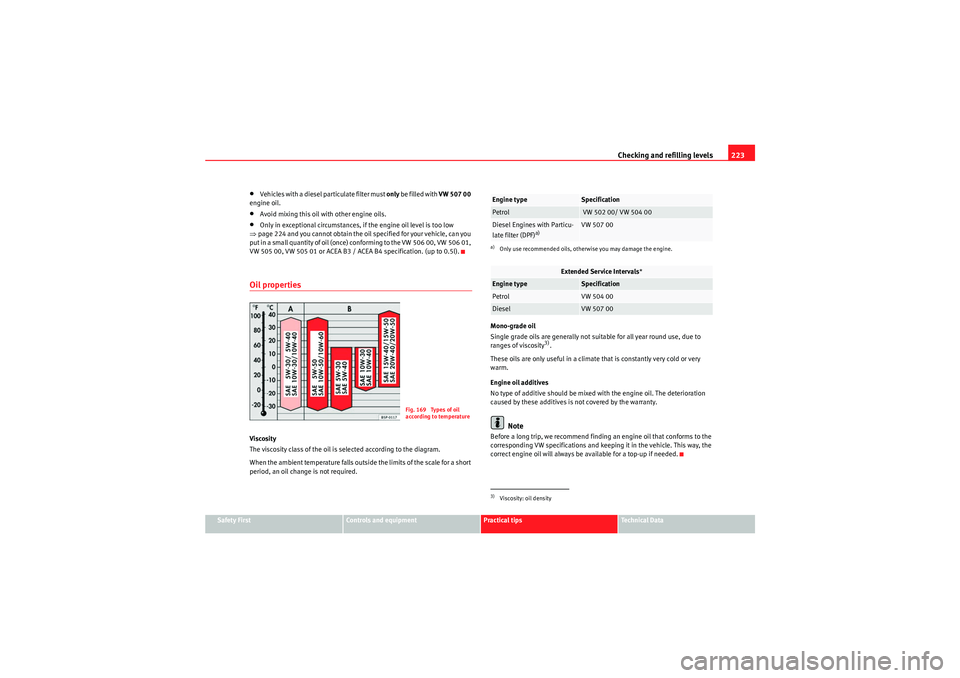
The viscosity class of the oil is selected according to the diagram.
When the ambient temperature falls outside the limits of the scale for a short
period, an oil change is not required. Mono-grade oil
Single grade oils are generally not suitable for all year round use, due to
ranges of viscosity
3).
These oils are only useful in a climate that is constantly very cold or very
warm.
Engine oil additives
No type of additive should be mixed with the engine oil. The deterioration
caused by these additives is not covered by the warranty.
Note
Before a long trip, we recommend finding an engine oil that conforms to the
corresponding VW specifications and keeping it in the vehicle. This way, the
correct engine oil will always be available for a top-up if needed.
Fig. 169 Types of oil
according to temperature
Engine type
Specification
Petrol
VW 502 00/ VW 504 00
Diesel Engines with Particu-
late filter (DPF)
a)
a)Only use recommended oils, otherwise you may damage the engine.
VW 507 00
Extended Service Intervals *
Engine type
Specification
Petrol
VW 504 00
Diesel
VW 507 00
3)Viscosity: oil density
Exeo_EN.book Seite 223 Freitag, 28. August 2009 10:14 10
Page 226 of 310
Checking and refilling levels
224Checking the oil levelChecking oil level
– Park the vehicle in a horizontal position.
– Briefly run the engine at idle speed until the service temperature
is reached then stop.
– Wait two minutes.
– Pull out the dipstick. Wipe the dipstick with a clean cloth and insert it again, pushing it in as far as it will go.
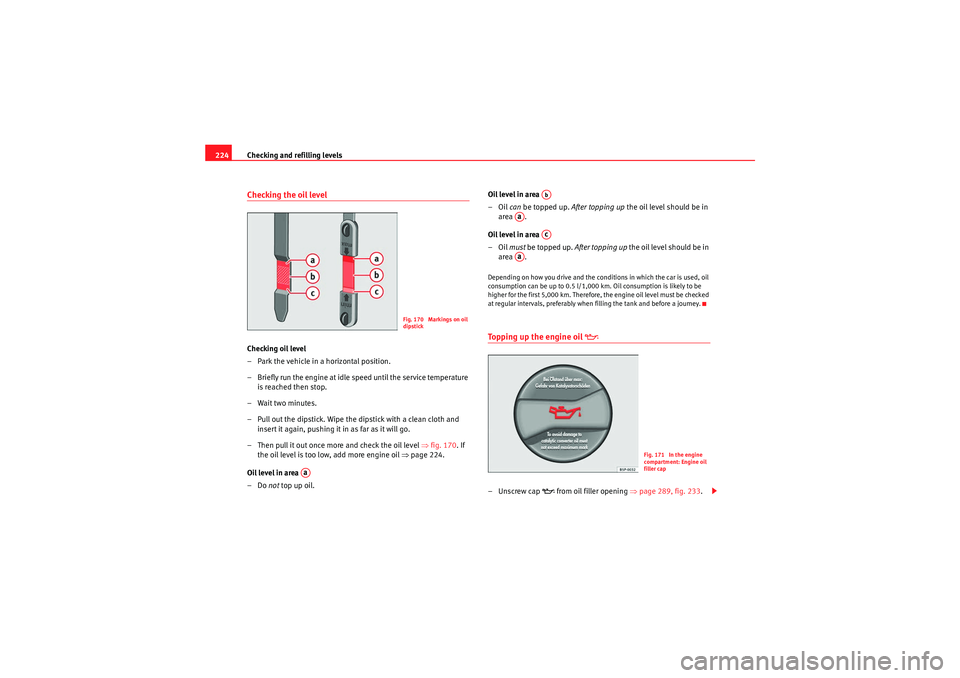
– Then pull it out once more and check the oil level ⇒fig. 170 . If
the oil level is too low, add more engine oil ⇒page 224.
Oil level in area
–Do not top up oil. Oil level in area
–Oil
can be topped up. After topping up the oil level should be in
area .
Oil level in area
–Oil must be topped up. After topping up the oil level should be in
area .
Depending on how you drive and the conditions in which the car is used, oil
consumption can be up to 0.5 l/1,000 km. Oil consumption is likely to be
higher for the first 5,000 km. Therefore, the engine oil level must be checked
at regular intervals, preferably when filling the tank and before a journey.Topping up the engine oil
–Unscrew cap
from oil filler opening ⇒page 289, fig. 233 .
Fig. 170 Markings on oil
dipstick
Aa
Ab
Aa
Ac
Aa
Fig. 171 In the engine
compartment: Engine oil
filler cap
Exeo_EN.book Seite 224 Freitag, 28. August 2009 10:14 10
Page 227 of 310
Checking and refilling levels225
Safety First
Controls and equipment
Practical tips
Technical Data
– Carefully put in the specified grade of oil ⇒page 223, adding
0.5 litres at a time.
– After two minutes, check the oil level once again ⇒page 224.
– Where necessary, add more engine oil.
– Replace the oil filler cap carefully and push the dipstick all the way in.
WARNING
•When refilling with oil, make sure no oil falls onto hot engine parts.
Failure to comply could result in fire.•Wash your skin thoroughly if it comes into contact with engine oil.Caution
•The oil level must never be above area . This could damage the cata-
lytic converter or the engine. Contact a specialist garage to drain the engine
oil if necessary.•No additives should be used with engine oil. Any damage caused by the
use of such additives would not be covered by the factory warranty.For the sake of the environment
•Oil must not be disposed of into the drains or onto the ground.•Always observe legal requirements when disposing of empty oil
canisters.
Cooling systemLiquid coolant
The purpose of the liquid coolant is to carry heat away from
the engine. The correct amount of antifreeze is decisive in
preventing the cooling system from freezing in winter.The your vehicle's engine cooling system is filled for life at the factory, so no
coolant needs to be changed. The liquid coolant consists of a mixture of water
and anti-freeze G12++. This is a glycol-based antifreeze with anti-corrosion
additives.
Liquid coolant additive
The amount of antifreeze required depends on the temperatures to be
expected in the winter season. If the antifreeze concentration is too low the
coolant can freeze, resulting in failure of the cooling system and heater.
The cooling system is filled at the factory with the correct amount of anti-
freeze for the country concerned.
In most cases, the mixture consists of 60% water and 40% anti-freeze . This
mixture gives the required anti-freeze protection at temperatures down to
-25°C and particularly protects the metal parts of the cooling system against
corrosion. It also prevents scaling and significantly raises the boiling point of
the liquid coolant.
Countries with warm climate
The liquid coolant concentration must not be reduced by adding plain water,
even in the summer or in warm climates. The concentration of the anti-freeze
must always be at least 40%.
Countries with cold climate
If greater frost protection is required in very cold climates, the proportion of
the anti-freeze G12++ can be increased. A concentration of 60% offers anti-
Aa
Exeo_EN.book Seite 225 Freitag, 28. August 2009 10:14 10
Page 229 of 310
Checking and refilling levels227
Safety First
Controls and equipment
Practical tips
Technical Data
Liquid coolant losses
Any loss of liquid coolant normally indicates a
leak in the cooling system. In
this case the cooling system should be inspected by a specialist garage
without delay. It is not sufficient merely to top up the liquid coolant.
If there are no leaks in the system, a loss of liquid coolant can only occur if
the coolant boils and is forced out of the system as a result of overheating.
Caution
Radiator sealants must not be added to the liquid coolant. Such additives
could seriously impair the function of the cooling system.Topping up the liquid coolant
Be careful when topping up with liquid coolant.– Switch the engine off.
– Wait for the engine to cool down.
– Cover the cap on the expansion tank ⇒page 226, fig. 172 with a
cloth, and carefully unscrew the cap anti-clockwise ⇒.
– Add liquid coolant.
– Screw on the cap tightly.Make sure that the liquid coolant meets the required specifications
⇒page 225, “Liquid coolant”. Do not use a different type of anti-freeze if
anti-freeze G12++ is not available. In this case, use only water and bring the
anti-freeze concentration back up to the correct level as soon as possible.
Always top up with new liquid coolant. Do not fill above the “max” mark. Excess liquid coolant is forced out of the
system through the valve in the filler cap when the engine gets hot.
If a lot of liquid coolant has been lost, wait for the engine to
cool down before
putting in cold coolant. Failure to do so could result in serious engine
damage.
WARNING
•The cooling system is under pressure. Do not unscrew the cap on the
expansion tank when the engine is hot. Failure to comply could result in
burns.•The anti-freeze and liquid coolant can be a health hazard. Therefore,
the anti-freeze should be stored in the original container in a safe place out
of reach of children. Failure to comply could result in poisoning.For the sake of the environment
Drained off coolant should not be used again. Drain off the used coolant into
a suitable container and dispose of it in the proper manner (observe environ-
mental regulations).Radiator fan
The radiator fan can start running spontaneously.The auxiliary fan can continue to run for as long as 10 minutes after stopping
the engine – even after the ignition is switched off. It may also start running
suddenly ⇒ after some while if•stored heat raises the coolant temperature, or•the hot engine compartment is additionally heated up by the sun.
Exeo_EN.book Seite 227 Freitag, 28. August 2009 10:14 10