winter tyres Seat Exeo 2009 Owner's manual
[x] Cancel search | Manufacturer: SEAT, Model Year: 2009, Model line: Exeo, Model: Seat Exeo 2009Pages: 310, PDF Size: 8.54 MB
Page 85 of 310
Cockpit83
Safety First
Controls and equipment
Practical tips
Technical Data
The speed limit warning symbol
for speed warning 1
⇒page 82, fig. 56
will appear in the display if you exceed the pre-set speed. It goes out again if
the speed is reduced below the set speed limit.
The symbol also goes out if the speed is increased to more than about 40
km/h above the set speed for at least 10 seconds. However, this does not
cancel the speed limit that was originally set.
Setting speed limit warning 1 ⇒page 83.
Speed limit warning 2
With speed limit warning 2, the speed limit can only be changed or cleared
when the ignition is switched off. You are recommended to store this speed
limit warning if you always wish to be reminded of a particular speed limit.
This could be when driving in countries with general speed limits, or if a
particular speed should not be exceeded when winter tyres are fitted etc.
The speed limit warning symbol
for speed warning 2 will appear in the
display if you exceed the pre-set speed. Unlike speed limit warning 1, the
warning symbol only goes out once the road speed has dropped below the
set value again.
Setting speed limit warning 2 ⇒page 84.
Note
Please bear in mind that, even with the speed warning function, it is still
important to keep a eye on the car's speed with the speedometer and to
observe the legal speed limits.
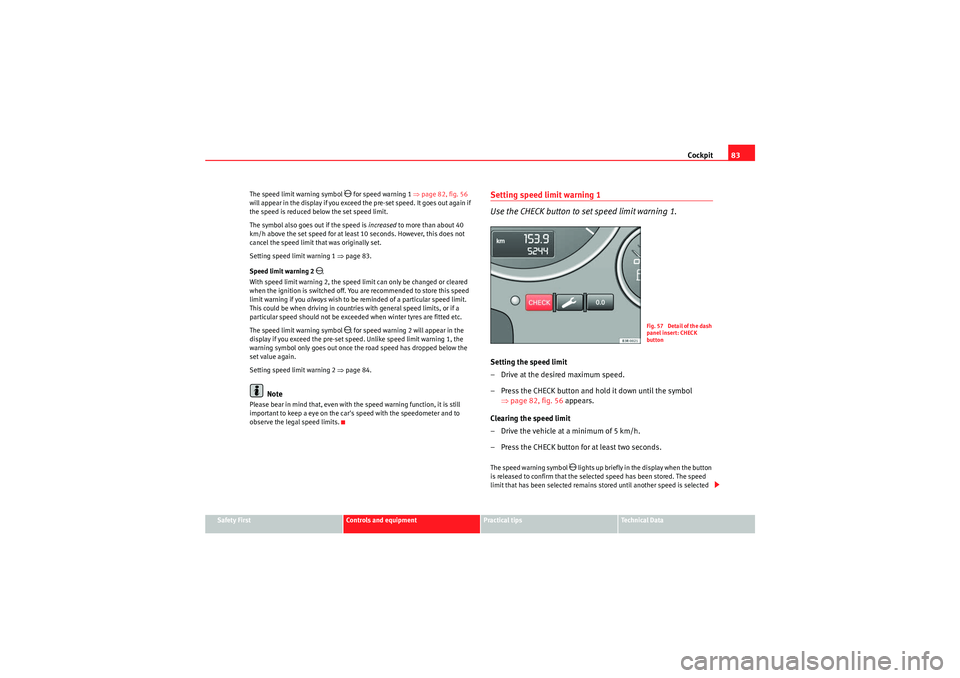
Setting speed limit warning 1
Use the CHECK button to set speed limit warning 1.Setting the speed limit
– Drive at the desired maximum speed.
– Press the CHECK button and hold it down until the symbol
⇒page 82, fig. 56 appears.
Clearing the speed limit
– Drive the vehicle at a minimum of 5 km/h.
– Press the CHECK button for at least two seconds.The speed warning symbol
lights up briefly in the display when the button
is released to confirm that the selected speed has been stored. The speed
limit that has been selected remains stored until another speed is selected
F ig. 57 Detail of th e dash
panel insert: CHECK
button
Exeo_EN.book Seite 83 Freitag, 28. August 2009 10:14 10
Page 188 of 310
Intelligent technology
186Traction control system (TCS)
The traction control system prevents the drive wheels from
spinning when the car is accelerating.General notes
The traction control system (TCS) is one of the functions incorporated in the
electronic stabilisation programme (ESP).
The traction control system (TCS) helps the car to start moving, accelerate or
climb a gradient in slippery conditions where this may otherwise be difficult
or even impossible.
How it works
The TCS acts automatically, i.e. without the driver's intervention. With the aid
of the ABS sensors ⇒page 184, the TCS monitors the speed of the driven
wheels. If the wheels start to spin, the engine power is reduced automatically
to match the amount of grip available. The system is active across the entire
speed range.
The TCS works in conjunction with the ABS. If a malfunction occurs in the ABS,
the TCS will also be inoperative.
Note
To ensure that the TCS works properly, all four wheels must be fitted with
identical tyres. The difference in size of the wheels may lead to an undesired
reduction in engine power. Also see ⇒page 241.
BrakesGeneral notesNew brake pads
New brake pads do not provide optimal performance during the first 200 km
they must be “run in”. However, the reduced braking capacity may be
compensated by pressing on the brake pedal a little harder. Avoid over-
loading the brakes during run-in.
Wear
T h e r a t e o f we a r o n t h e brake pads depends a great deal on how you drive and
the conditions in which the vehicle is operated. Negative factors are, for
instance, city traffic, frequent short trips or hard driving with abrupt starts
and stops.
Wet roads; road salt
In certain conditions, such as in heavy rain, or after washing the car or driving
through water, the full braking effect can be delayed by moisture (or in winter
by ice) on the discs and brake pads. The brakes should be “dried” by pressing
the pedal to restore full braking effect.
When the velocity is over 80 km/h windscreen wipers are on, the brake
system moves the pads towards the brake discs for a few seconds. This
occurs - without warning to the driver - at regular intervals and requires a
more rapid response from the brakes when driving on wet roads.
The effectiveness of the brakes can also be temporarily reduced if the car is
driven for some distance without using the brakes when there is a lot of salt
on the road in winter. In this case, the layer of salt on the brake discs and pads
has to wear off before braking.
Exeo_EN.book Seite 186 Freitag, 28. August 2009 10:14 10
Page 194 of 310
Driving and the environment
192Periodic maintenance
Periodic maintenance work guarantees that, before beginning a journey, you
will not consume more than the required amount of fuel. A well-serviced
engine gives you the benefit of improved fuel efficiency as well as maximum
reliability and an enhanced resale value.
A badly serviced engine can consume up to 10% more fuel than necessary.
Avoid short journeys
To reduce the consumption and emission of polluting gases, the engine and
the exhaust filtration systems should reach the optimum service tempera-
ture .
With the engine cold, fuel consumption is proportionally higher. The engine
does not warm up and fuel consumption does not regularise until having
driven some four kilometres. This is the reason why we recommend avoiding
short trips wherever possible.
Maintain the correct tyre pressures
Bear in mind that keeping the tyres at an adequate pressure saves fuel. If the
tyre pressures are just 1 bar too low, this can put the fuel consumption up by
as much as 5%. Due to the greater rolling resistance, under-inflation also
increases tyre wear and impairs handling.
The tyre pressures should always be checked when the tyres are cold.
Do not use winter tyres all year round: they will increase fuel consumption by
up to 10%.
Avoid unnecessary weight
Every kilo of extra weight will put up the fuel consumption, so it is worth
checking the luggage compartment occasionally to make sure that no unnec-
essary loads are being transported.
A roof carrier is often left in place for the sake of convenience, even when it is
no longer needed. At a speed of 100-120 km/h your car will use about 12%
more fuel as a result of the extra wind resistance caused by the roof carrier
even when it is not in use. Saving electrical energy
The engine activates the alternator, which produces electricity. With the need
for electricity, fuel consumption is also increased. Because of this, always
turn off electrical equipment when you do not need them. Examples of equip-
ment that use a lot of electricity are: the fan at high speeds, the rear window
heating or the seat heaters*.
Environmental friendlinessEnvironmental protection is a top priority in the design, choice of materials
and production of your new Seat.
Design measures for economical recycling•Joints and connections designed for ease of dismantling•Modular construction to facilitate dismantling•Increased use of single-grade materials•Plastic parts and elastomers are labelled in accordance with ISO 1043,
ISO 11469 and ISO 1629
Choice of materials•Nearly all materials used can be recycled•Similar types of plastics grouped together for easy recycling•Recycled materials used in manufacture•Reduction of volatile compounds in plastics•CFC-free refrigerant in air conditioning
Compliance with prohibited materials laws : cadmium, lead, mercury, chrome
VI.
Manufacturing methods•Use of recycled material for manufacturing plastic parts•Solvent-free cavity sealing
Exeo_EN.book Seite 192 Freitag, 28. August 2009 10:14 10
Page 212 of 310
Your vehicle maintenance and cleaning
210Steel wheel rims– Clean steel wheel rims regularly using a separate sponge.Use an industrial cleanser to remove brake dust. Any damage to the paint on
steel wheel rims should be repaired before starting to rust.
WARNING
•Never wash tyres with a cylindrical jet. Even at large spraying distances
and short cleaning times, visible and invisible damage can occur to the
tyres. This may cause an accident.•Water, ice and salt on the brakes can reduce braking efficiency. Risk of
accident. Directly after washing, avoid sudden and sharp braking. “Dry”
⇒ page 189 the brakes by braking several times.
Cleaning alloy wheel rimsEvery two weeks
– Wash salt and brake dust from alloy wheels.
– Use an acid free detergent to clean the wheel rims.
Every three months
– Apply a hard wax compound to the wheels.Alloy wheels require regular attention to preserve their appearance. If road
salt and brake dust are not often removed, the aluminium finish will be
impaired.
Always use an acid-free detergent for alloy wheel rims. Car polish or other abrasive agents should not be used. If the protective
coating is damaged, e.g. by stone impact, the damaged area should be
repaired immediately.
WARNING
•Never wash tyres with a cylindrical jet. Even at large spraying distances
and short cleaning times, visible and invisible damage can occur to the
tyres. This may cause an accident.•Water, ice and salt on the brakes can reduce braking efficiency. Risk of
accident. Directly after washing, avoid sudden and sharp braking. “Dry”
⇒ page 189 the brakes by braking several times.
Underbody maintenance
The vehicle underbody is coated to protect it from chemical
and mechanical damage.The protective coating can be damaged when driving. We recommend you to
check the protective coating under the body and on the running gear, and
reinstated if necessary, before and after the winter season.
We recommend you to go to your Authorised Service Centre to carry out repair
work and additional anti-corrosion work.
WARNING
Do not apply underseal or anti-corrosion coatings to the exhaust pipes,
catalytic converter or the heat shields on the exhaust system. The heat of
the exhaust system or the engine could cause them to ignite! Fire hazard.
Exeo_EN.book Seite 210 Freitag, 28. August 2009 10:14 10
Page 237 of 310
Wheels and tyres235
Safety First
Controls and equipment
Practical tips
Technical Data
Wheels and tyresWheelsGeneral notesAvoiding damage
– If you have to drive over a kerb or similar obstacle, drive very
slowly and as near as possible at a right angle to the kerb.
– Keep grease, oil and fuel off the tyres.
– Inspect the tyres regularly for da mage (cuts, cracks or blisters,
etc.). Remove any foreign objects embedded in the treads.
Storing tyres
– Mark tyres when you remove them to indicate the direction of rotation. This ensures you will be able to install them correctly
when you replace them.
– When removed, the wheels and/or tyres should be stored in a cool, dry and preferably dark location.
– Store tyres in a vertical position if they are not fitted on wheel
rims.New tyres
New tyres have to be run-in.
The tread depth of new tyres may vary, according to the type and make of tyre
and the tread pattern. Concealed damage
Damage to tyres and rims is often not readily visible. If you notice unusual
vibrations or the car pulling to one side, this may indicate that one of the tyres
is damaged. The tyres should be checked immediately by an Authorised
Service Centre.
Tyres with directional tread pattern
An arrow on the tyre sidewall indicates the direction of rotation on tyres with
directional tread. Always observe the direction of rotation indicated when
fitting the wheel. This guarantees optimum grip and helps to avoid aqua-
planing, excessive noise and wear.
WARNING
•New tyres do not have maximum grip in the first 500 km. Drive particu-
larly carefully to avoid risk of accident.•Never drive with damaged tyres. This may cause an accident.•If you notice unusual vibration or if the vehicle pulls to one side when
driving, stop the vehicle immediately and check the tyres for damage.
Checking tyre pressure
The correct tyre pressure can be seen on the sticker on the
inside of the tank flap.1. Read the required tyre inflatio n pressure from the sticker. The
values refer to Summer tyres. For Winter tyres, you must add 0.2
bar to the values given on the sticker.
Exeo_EN.book Seite 235 Freitag, 28. August 2009 10:14 10
Page 244 of 310
Wheels and tyres
242
For the sake of the environmentOld tyres must be disposed of according to the laws in the country concerned.
Note
•For technical reasons, it is not generally possible to use the wheels from
other vehicles. This can also apply to wheels of the same model. The use of
wheels or tyres which have not been approved by SEAT for use with your
model may invalidate the vehicle's type approval for use on public roads.•If the spare tyre is not the same as the tyres that are mounted on the
vehicle - for example with winter tyres - you should only use the spare tyre for
a short period of time and drive with extra care. Refit the normal road wheel
as soon as possible.Wheel bolts
Wheel bolts must be tightened to the correct torque.The design of wheel bolts is matched to the rims. If different wheel rims are
fitted, the correct wheel bolts with the right length and correctly shaped bolt
heads must be used. This ensures that wheels are fitted securely and that the
brake system functions correctly.
In certain circumstances, you may not use wheel bolts from a different car -
even if it is the same model ⇒page 214.
After the wheels have been changed, the tightening torque of the wheel bolts
s ho uld b e che cke d as s o on as p ossible wit h a to rqu e w re nch. ⇒ The tight-
ening torque for steel and alloy wheels is 120 Nm.
WARNING
If the wheel bolts are not tightened correctly, the wheel could become
loose while driving. Risk of accident.•The wheel bolts must be clean and turn easily. Never apply grease or oil
to them.•Use only wheel bolts which belong to the wheel.•If the torque of the wheel bolts is too low, they could loosen whilst the
vehicle is in motion. Risk of accident! If the tightening torque is too high,
the wheel bolts and threads can be damaged.Caution
The prescribed torque for wheel bolts for steel and alloy wheels is 120 Nm.Winter tyres
Winter tyres will improve the vehicles handling on snow and
ice.In winter conditions winter tyres will considerably improve the vehicles
handling. The design of summer tyres (width, rubber compound, tread
pattern) gives less grip on ice and snow.
Winter tyres must be inflated to a pressure 0.2 bar higher than the pressures
specified for summer tyres (see sticker on tank flap).
Winter tyres must be fitted on all four wheels.
Information on permitted winter tyre sizes can be found in the vehicle's regis-
tration documents. Use only radial winter tyres. All tyre sizes listed in the
vehicle documentation also apply to winter tyres.
Exeo_EN.book Seite 242 Freitag, 28. August 2009 10:14 10
Page 245 of 310
Wheels and tyres243
Safety First
Controls and equipment
Practical tips
Technical Data
Winter tyres lose their effectiveness when the tread is worn down to a depth
of 4 mm.
The speed rating code
⇒page 241, “New tyres and wheels” determines the
following speed limits for winter tyres: ⇒
Q max. 160 km/h
S max. 180 km/h
T max. 190 km/h
H max. 210 km/h
In some countries, vehicles which can exceed the speed rating of the fitted
tyre must have an appropriate sticker in the driver's field of view. These
stickers are available from your Authorised Service Centre. The legal require-
ments of each country must be followed.
Do not have winter tyres fitted for unnecessarily long periods. Vehicles with
summer tyres handle better when the roads are free of snow and ice.
If you have a flat tyre, please refer to the notes on the spare wheel
⇒ page 241, “New tyres and wheels”.
WARNING
The maximum speed for the winter tyres must not be exceeded. Otherwise,
this could lead to tyre damage and thus, an accident risk.
For the sake of the environment
Fit your summer tyres in good time. They are quieter, do not wear so quickly
and reduce fuel consumption.
Snow chainsSnow chains may be fitted only to the front wheels, and only to certain tyre
sizes ⇒page 288.
Remove wheel hub covers and trim rings before fitting snow chains. For safety
reasons cover caps, available in any Authorised Service Centre, must then be
fitted over the wheel bolts.
WARNING
Observe the fitting instructions provid ed by the snow chain manufacturer.
Caution
You must remove the snow chains to drive on roads which are free of snow.
Otherwise they will impair handling, damage the tyres and wear out very
quickly.
Note
•In some countries, the speed limit for using snow chains is 50 km/h. The
legal requirements of the country should be followed.•We recommend that you ask your Approved Service Centre for information
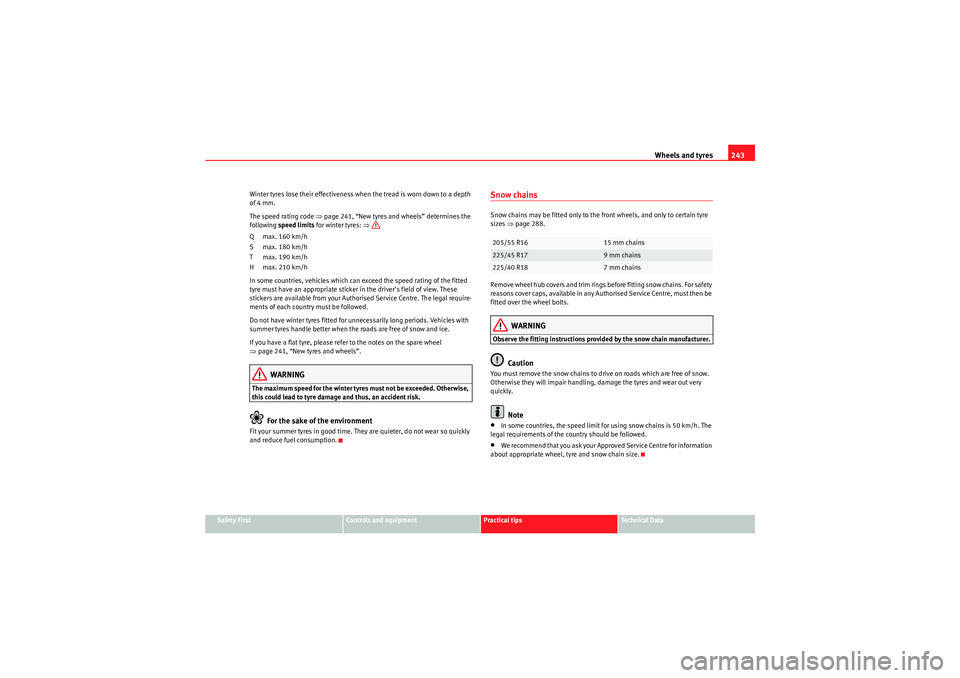
about appropriate wheel, tyre and snow chain size.205/55 R16
15 mm chains
225/45 R17
9 mm chains
225/40 R18
7 mm chains
Exeo_EN.book Seite 243 Freitag, 28. August 2009 10:14 10
Page 300 of 310
Technical Data
298Dimensions and capacities
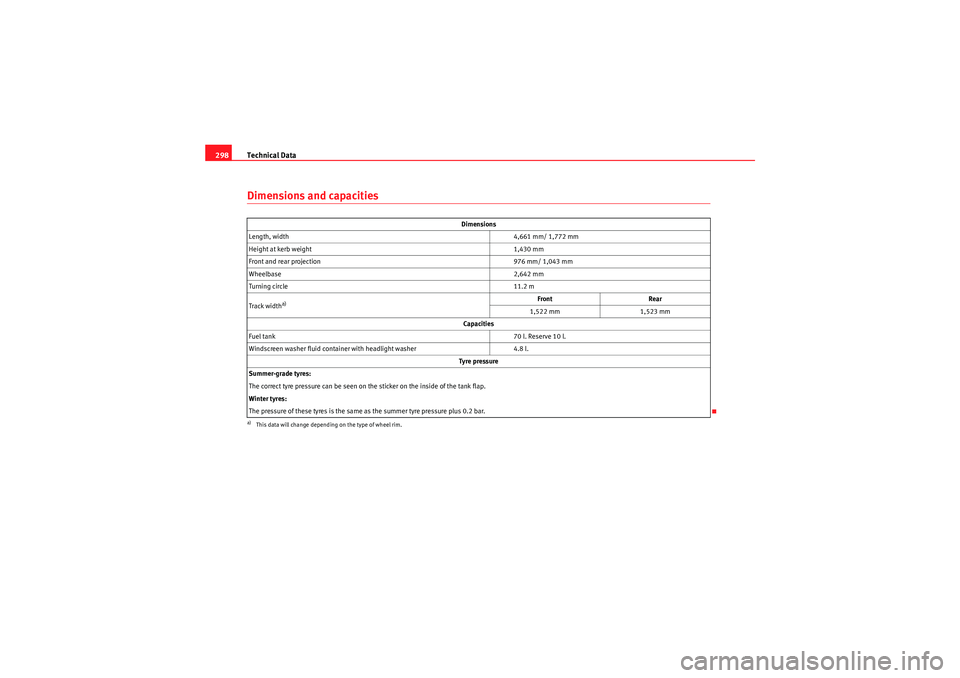
Dimensions
Length, width 4,661 mm/ 1,772 mm
Height at kerb weight 1,430 mm
Front and rear projection 976 mm/ 1,043 mm
Wheelbase 2,642 mm
Turning circle 11.2 m
Track width
a)
a)This data will change depending on the type of wheel rim.
Front Rear
1,522 mm 1,523 mm
Capacities
Fuel tank 70 l. Reserve 10 l.
Windscreen washer fluid container with headlight washer 4.8 l.
Ty re p re ss u re
Summer-grade tyres:
The correct tyre pressure can be seen on the sticker on the inside of the tank flap.
Winter tyres:
The pressure of these tyres is the same as the summer tyre pressure plus 0.2 bar.
Exeo_EN.book Seite 298 Freitag, 28. August 2009 10:14 10
Page 301 of 310
Index299
Index
AAccessories . . . . . . . . . . . . . . . . . . . . . . . . . . . . 214
Towing . . . . . . . . . . . . . . . . . . . . . . . . . . . . . 196
Adaptive headlights . . . . . . . . . . . . . . . . . . . . . 121
Air conditioner 2C-Climatronic . . . . . . . . . . . . . . . . . . . . . . . 154
Defrosting . . . . . . . . . . . . . . . . . . . . . . . . . . . 158
Solar-powered blower/solar roof . . . . . . . . 163
Air duct Fitting . . . . . . . . . . . . . . . . . . . . . . . . . 259, 266
Removing . . . . . . . . . . . . . . . . . . . . . . 258, 265
Air purity sensor . . . . . . . . . . . . . . . . . . . . . . . . . 159
Airbag Warning lamp . . . . . . . . . . . . . . . . . . . . . . . . . 66
Airbag covers . . . . . . . . . . . . . . . . . . . . . . . . . . . . 33
Airbag system . . . . . . . . . . . . . . . . . . . . . . . . . . . 28 Curtain airbags . . . . . . . . . . . . . . . . . . . . . . . 41
Front airbags . . . . . . . . . . . . . . . . . . . . . . . . . 31
Side airbags . . . . . . . . . . . . . . . . . . . . . . . . . . 37
Warning lamp . . . . . . . . . . . . . . . . . . . . . . . . . 29
Alternator Warning lamp . . . . . . . . . . . . . . . . . . . . . . . . . 69
Ambient temperature display . . . . . . . . . . . . . . . 72
Anti-freeze . . . . . . . . . . . . . . . . . . . . . . . . . . . . . 225
Anti-lock brake system How it works . . . . . . . . . . . . . . . . . . . . . . . . . 184
Anti-puncture tyres . . . . . . . . . . . . . . . . . . . . . . 240 Anti-theft alarm system . . . . . . . . . . . . . . . . . . . 106
Interior monitoring . . . . . . . . . . . . . . . . . . . 107
Aquaplaning . . . . . . . . . . . . . . . . . . . . . . . . . . . 239
Armrest Storage compartment in front armrest . . . . 141
Armrests Adjusting the front armrest . . . . . . . . . . . . . 141
Ashtray Front . . . . . . . . . . . . . . . . . . . . . . . . . . . . . . . 148
Rear . . . . . . . . . . . . . . . . . . . . . . . . . . . . . . . 149
Athermic windscreen . . . . . . . . . . . . . . . . . . . . . 215
Auto-check system . . . . . . . . . . . . . . . . . . . . . . . 75
Automatic car wash tunnel . . . . . . . . . . . . . . . . 206
Automatic gearbox Dynamic gear control program . . . . . . . . . . 180
Kick-down feature . . . . . . . . . . . . . . . . . . . . 179
multitronic® . . . . . . . . . . . . . . . . . . . . . . . . 175
Paddle levers (tiptronic mode) . . . . . . . . . . 182
Safety interlock for ignition key . . . . . . . . . 165
Selector lever lock . . . . . . . . . . . . . . . . . . . . 179
Selector lever positions . . . . . . . . . . . . . . . . 177
Steering wheel with paddle levers . . . . . . . 182
tiptronic . . . . . . . . . . . . . . . . . . . . . . . 175, 181
Automatic headlight control . . . . . . . . . . . . . . . 115
BBackground lighting . . . . . . . . . . . . . . . . . . . . . 124 Battery . . . . . . . . . . . . . . . . . . . . . . . . . . . . . . . . 231
Battery voltage . . . . . . . . . . . . . . . . . . . . . . . . 81
Charging . . . . . . . . . . . . . . . . . . . . . . . . . . . . 233
Disconnection . . . . . . . . . . . . . . . . . . . . . . . 231
Long periods of non-use . . . . . . . . . . . . . . . 231
Replacing . . . . . . . . . . . . . . . . . . . . . . 231, 232
Testing . . . . . . . . . . . . . . . . . . . . . . . . . . . . . 231
Winter operations . . . . . . . . . . . . . . . 231, 232
Belt tension device Disposal . . . . . . . . . . . . . . . . . . . . . . . . . . . . . 27
Warning lamp . . . . . . . . . . . . . . . . . . . . . . . . 29
Belt tension devices . . . . . . . . . . . . . . . . . . . . . . 26
Bicycle rack Towing . . . . . . . . . . . . . . . . . . . . . . . . . . . . . 196
Biodiesel . . . . . . . . . . . . . . . . . . . . . . . . . . . . . . 218
Biodiesel fuel . . . . . . . . . . . . . . . . . . . . . . . . . . . 218
Bonnet . . . . . . . . . . . . . . . . . . . . . . . . . . . . . . . . 220 Closing . . . . . . . . . . . . . . . . . . . . . . . . . . . . . 222
Opening . . . . . . . . . . . . . . . . . . . . . . . . . . . . 220
Releasing . . . . . . . . . . . . . . . . . . . . . . . . . . . 220
Brake light Failure control . . . . . . . . . . . . . . . . . . . . . . . . 80
Brake pads . . . . . . . . . . . . . . . . . . . . . . . . . . . . . 189
Brake servo . . . . . . . . . . . . . . . . . . . . . . . . . . . . 189
Brake system Brake servo . . . . . . . . . . . . . . . . . . . . . . . . . 186
Brakes . . . . . . . . . . . . . . . . . . . . . . . . . . . . . 186
Malfunction . . . . . . . . . . . . . . . . . . . . . . . . . . 77
Exeo_EN.book Seite 299 Freitag, 28. August 2009 10:14 10
Page 309 of 310
Index307
Red symbols in central display . . . . . . . . . . . 77
Seat belt warning lamp . . . . . . . . . . . . . . . . . 68
Yellow symbols in central display . . . . . . . . 79
Warning lamps - overview . . . . . . . . . . . . . . . . . . 65
Washer fluid level . . . . . . . . . . . . . . . . . . . . . . . . 81
Washing by hand . . . . . . . . . . . . . . . . . . . . . . . . 206
Washing with high pressure cleaners . . . . . . . 207
Wear indicators . . . . . . . . . . . . . . . . . . . . . . . . . 239
Wheel bolts . . . . . . . . . . . . . . . . . . . . . . . . . . . . 288 Torque . . . . . . . . . . . . . . . . . . . . . . . . . . . . . 242
Wheels . . . . . . . . . . . . . . . . . . . . . . . . . . . 235, 288 Changing a wheel . . . . . . . . . . . . . . . . . . . . 246
Why assume the correct sitting position? . . . . . 28
Why should head restraints be correctly adjusted? 13
Why wear seat belts? . . . . . . . . . . . . . . . . . . . 19, 28
Why wear seatbelts? . . . . . . . . . . . . . . . . . . . . . . 18
Windows Defrosting . . . . . . . . . . . . . . . . . . . . . . . . . . . 158
Windscreen washer system . . . . . . . . . . . . . . . 228
Windscreen wiper blades Cleaning . . . . . . . . . . . . . . . . . . . . . . . . . . . . 209
Windscreen wipers . . . . . . . . . . . . . . . . . . . . . . 128 Changing blades . . . . . . . . . . . . . . . . . . . . . 229
Rain sensor . . . . . . . . . . . . . . . . . . . . . . . . . 128
Washer jets . . . . . . . . . . . . . . . . . . . . . . . . . 128
Winter Battery . . . . . . . . . . . . . . . . . . . . . . . . . . . . . 231
Winter conditions Defrost function . . . . . . . . . . . . . . . . . . . . . . 158 Winter driving
Diesel engine . . . . . . . . . . . . . . . . . . . . . . . . 219
Winter operations Battery . . . . . . . . . . . . . . . . . . . . . . . . . . . . . 232
Winter tyres . . . . . . . . . . . . . . . . . . . . . . . . . . . . 242
Wiper and washer system . . . . . . . . . . . . . . . . . 128
Wooden trim cleaning . . . . . . . . . . . . . . . . . . . . 212
Exeo_EN.book Seite 307 Freitag, 28. August 2009 10:14 10