roof Seat Exeo 2009 Owner's Guide
[x] Cancel search | Manufacturer: SEAT, Model Year: 2009, Model line: Exeo, Model: Seat Exeo 2009Pages: 310, PDF Size: 8.54 MB
Page 209 of 310
Your vehicle maintenance and cleaning207
Safety First
Controls and equipment
Practical tips
Technical Data
Caution
•Never remove dirt, mud or dust if the vehicle surface is dry. Never use a
dry cloth or sponge for cleaning purposes. This could scratch the paintwork
or glass on your vehicle.•Washing the vehicle in low temperatures: when washing the vehicle with
a hose, do not direct water into the lock cylinders or the gaps around the
doors, tailgate, or sunroof. Risk of freezing.For the sake of the environment
To protect environment, the car should be washed only in specially provided
wash bays. This prevents toxic, oil-laden waste water entering the sewerage
system. In some districts, washing vehicles outside wash bays is prohibited.
Note
Do not wash the vehicle in direct sunlight.Washing the car with a high pressure cleaner
Be particularly careful when using a high pressure cleaner!– Always observe the instructions for the high-pressure cleaner, particularly those concerning the pressure and the spraying
distance.
– Increase the spraying distance for soft materials and painted
bumpers.
– Do not use a high pressure cleaner to remove ice or snow from windows ⇒page 208. – Never use concentrated jet nozzles (“rotating jets”)
⇒.
– Directly after washing, avoid sudden and sharp braking. “Dry” ⇒page 189 the brakes by braking several times.
WARNING
•Never wash tyres with a concentrated jet (“rotating nozzle”). Even at
large spraying distances and short cleaning times, visible and invisible
damage can occur to the tyres. This may cause an accident.•Water, ice and salt on the brakes can reduce braking efficiency. Risk of
accident.Caution
•Do not use water hotter than 60°C. This could damage the vehicle.•To avoid damage to the vehicle, keep a sufficient distance from sensitive
materials such as flexible hoses, plastic, soundproofing material, etc. This is
also important for bumpers painted as the paintwork. The closer the nozzle is
to the surface, the greater the wear on the material.Vehicle paint maintenance requirements
Regular waxing protects the paintwork.You need to apply wax to your car if water does not form small drops and run
off the paintwork when it is clean.
A good quality hard wax product is available from your Authorised Service
Centre.
Exeo_EN.book Seite 207 Freitag, 28. August 2009 10:14 10
Page 233 of 310
Checking and refilling levels231
Safety First
Controls and equipment
Practical tips
Technical Data
Topping up and changing the brake fluid
It is best to have the brake fluid changed by a professional.Brake fluid absorbs damp. Therefore, in the course of time it will absorb water
from the ambient air. If the water content in the brake fluid is too high, the
brake system could corrode. In addition, the boiling point of the brake fluid
will be considerably reduced. This could adversely affect the braking ability in
certain circumstances.
For this reason the brake fluid must be changed periodically.
Your vehicle's Service Schedule will tell you when the brake fluid has to be
renewed.
We recommend you have the brake fluid changed as part of a regular Inspec-
tion Service at your garage. They are familiar with the procedure and have the
necessary special tools and spare parts as well as the proper facilities for
disposing of the old fluid.
Use only the genuine brake fluid specified by the factory Specialist garages
know that the brake fluid -DOT 4- is factory approved. The brake fluid must be
new.
WARNING
•Therefore, it must always be kept closed in its original container. Keep
out of the reach of children. Failure to comply could result in poisoning.•Heavy use of the brakes may cause a vapour lock if the brake fluid is left
in the system for too long. This would seriously affect the efficiency of the
brakes and the safety of the car, leading to the risk of accident.Caution
Please note that brake fluid will attack the paintwork on contact.
For the sake of the environment
If the fluid has to be drained out of the brake system, use an appropriate
container to catch the used brake fluid and dispose of it in the proper
manner.BatteryGeneral notes
All work on batteries requires specialist knowledge.The battery is virtually maintenance-free and is checked in the Inspection
Services.
We recommend that you replace a battery once it is older than 5 years.
Disconnecting the battery
If the battery is disconnected, some of the vehicle's functions will become
inoperative (e.g. electric windows). These functions will require resetting
after the battery is reconnected. For this reason, the battery should only be
disconnected from the vehicle's electrical system when absolutely necessary.
Long periods of non-use
The battery will gradually lose its charge because certain electrical equip-
ment continues to draw current even when the ignition is off. If you park the
vehicle for long periods of time in winter you should take the battery out of
the vehicle and keep it in a frost-proof room. Store the battery in a place
where it cannot “freeze up” and become damaged. At warm outside temper-
atures it is sufficient to disconnect the negative terminal of the battery. Even
when the battery is not connected you should charge it from time to time.
Exeo_EN.book Seite 231 Freitag, 28. August 2009 10:14 10
Page 257 of 310
If and when255
Safety First
Controls and equipment
Practical tips
Technical Data
FusesChanging fuses
If a fuse has blown, it must be replaced.
– Switch off the ignition and its failed electrical component.
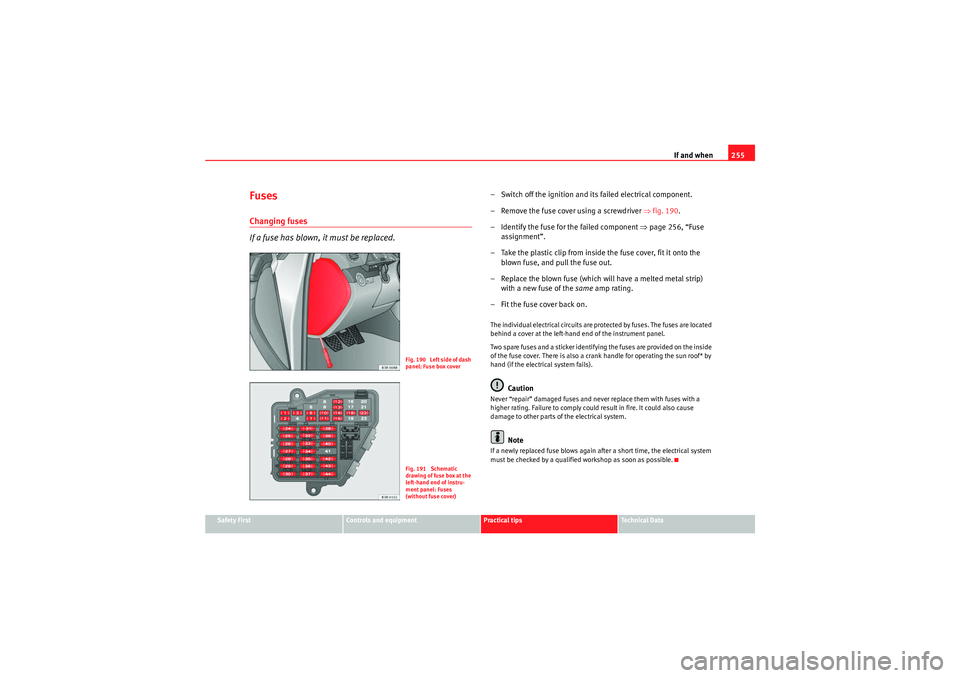
– Remove the fuse cover using a screwdriver ⇒fig. 190 .
– Identify the fuse for the failed component ⇒page 256, “Fuse
assignment”.
– Take the plastic clip from inside the fuse cover, fit it onto the blown fuse, and pull the fuse out.
– Replace the blown fuse (which will have a melted metal strip) with a new fuse of the same amp rating.
–Fit the fuse cover back on.The individual electrical circuits are protected by fuses. The fuses are located
behind a cover at the left-hand end of the instrument panel.
Two spare fuses and a sticker identifying the fuses are provided on the inside
of the fuse cover. There is also a crank handle for operating the sun roof* by
hand (if the electrical system fails).
Caution
Never “repair” damaged fuses and never replace them with fuses with a
higher rating. Failure to comply could result in fire. It could also cause
damage to other parts of the electrical system.
Note
If a newly replaced fuse blows again after a short time, the electrical system
must be checked by a qualified workshop as soon as possible.
Fig. 190 Left side of dash
panel: Fuse box coverFig. 191 Schematic
drawing of fuse box at the
left-hand end of instru-
ment panel: Fuses
(without fuse cover)
Exeo_EN.book Seite 255 Freitag, 28. August 2009 10:14 10
Page 258 of 310
If and when
256Fuse assignment
This list shows the fuses which can be replaced relatively
easily by the owner.No.
Consumer
Amps
1
Climate control
10
2
Footwell lamps
5
3
Heated washer jets
5
4
Radiator fan
5
5
Parking aid, automatic gearbox
10
6
Air conditioner (air purity sensor), pressure sensor
5
7
Electronic Stabilisation Program (ESP), brake light
switch, clutch pedal switch, steering angle sensor
10
8
Tele ph one
5
9
Va can t
10
Self-directing headlights (adaptive light) right
5
11
Airbag and disconnection of the front passenger air-
bag
5
12
Diagnostic socket
10
13
Steering column unit
10
14
Brake lights
10
15
Instrument panel
10
16
Va can t
17
Tyre pressure control, rain/light sensor
10
18
Self-directing headlights (adaptive light) left
5
19
Va can t
20
Va can t
21
Va can t
22
Driver's door / front passenger's door
15
23
Rear doors
15
24
Central electrics unit for convenience equipment
20
25
Heater blower
30
26
Rear window heater
30
27
Electrical socket for trailer (control unit)
30
28
Fuel pump, auxiliary pump for diesel
20
29
Va can t
30
Sliding/tilting sunroof
20
31
Diagnosis connection, automatic anti-dazzle interior
mirror, reverse light, automatic gearbox
15
32
Towing socket
15
33
Lighter
20
34
Diesel lambda-probe
5
35
Luggage compartment power point*
20
36
Wiper system
30
37
Pump for windscreen washer and headlight washer
system
30
38
Luggage compartment illumination, alarm
15
39
Radio, Amplifier
20
40
Horn
25
No.
Consumer
Amps
Exeo_EN.book Seite 256 Freitag, 28. August 2009 10:14 10
Page 281 of 310
If and when279
Safety First
Controls and equipment
Practical tips
Technical Data
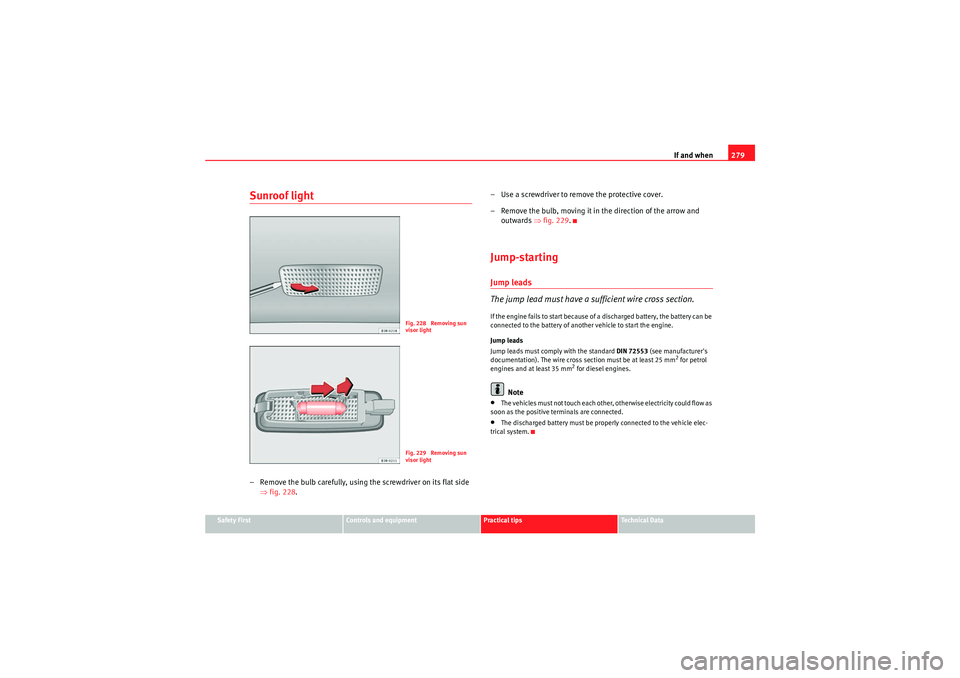
Sunroof light– Remove the bulb carefully, using the screwdriver on its flat side
⇒fig. 228 . – Use a screwdriver to remove the protective cover.
– Remove the bulb, moving it in the direction of the arrow and
outwards ⇒fig. 229 .
Jump-startingJump leads
The jump lead must have a su fficient wire cross section.If the engine fails to start because of a discharged battery, the battery can be
connected to the battery of another vehicle to start the engine.
Jump leads
Jump leads must comply with the standard DIN 72553 (see manufacturer's
documentation). The wire cross section must be at least 25 mm
2 for petrol
engines and at least 35 mm
2 for diesel engines.
Note
•The vehicles must not touch each other, otherwise electricity could flow as
soon as the positive terminals are connected.•The discharged battery must be properly connected to the vehicle elec-
trical system.
Fig. 228 Removing sun
visor lightFig. 229 Removing sun
visor light
Exeo_EN.book Seite 279 Freitag, 28. August 2009 10:14 10
Page 292 of 310
Technical Data
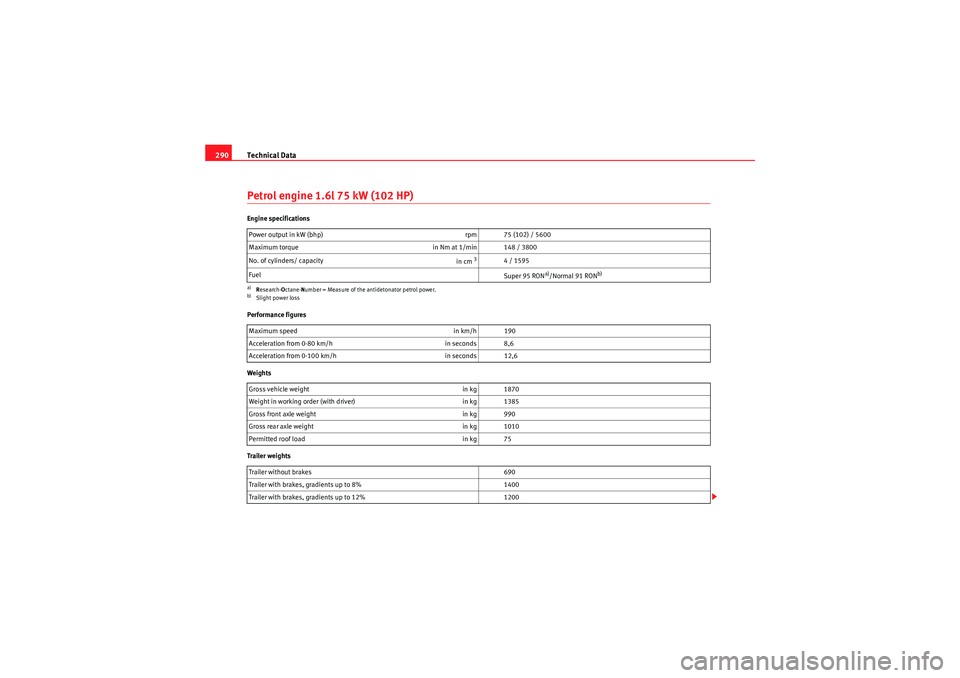
290Petrol engine 1.6l 75 kW (102 HP)Engine specifications
Performance figures
Weights
Trailer weights Power output in kW (bhp)
rpm 75 (102) / 5600
Maximum torque in Nm at 1/min 148 / 3800
No. of cylinders/ capacity in cm
3
4 / 1595
Fuel Super 95 RON
a)/Normal 91 RON
b)
a)Research- Octane- Number = Measure of the antidetonator petrol power.b)Slight power lossMaximum speed in km/h 190
Acceleration from 0-80 km/h in seconds 8,6
Acceleration from 0-100 km/h in seconds 12,6
Gross vehicle weight in kg 1870
Weight in working order (with driver) in kg 1385
Gross front axle weight in kg 990
Gross rear axle weight in kg 1010
Permitted roof load in kg 75
Trailer without brakes 690
Trailer with brakes, gradients up to 8% 1400
Trailer with brakes, gradients up to 12% 1200
Exeo_EN.book Seite 290 Freitag, 28. August 2009 10:14 10
Page 293 of 310
Technical Data291
Safety First
Controls and equipment
Practical tips
Technical Data
Engine oil capacity
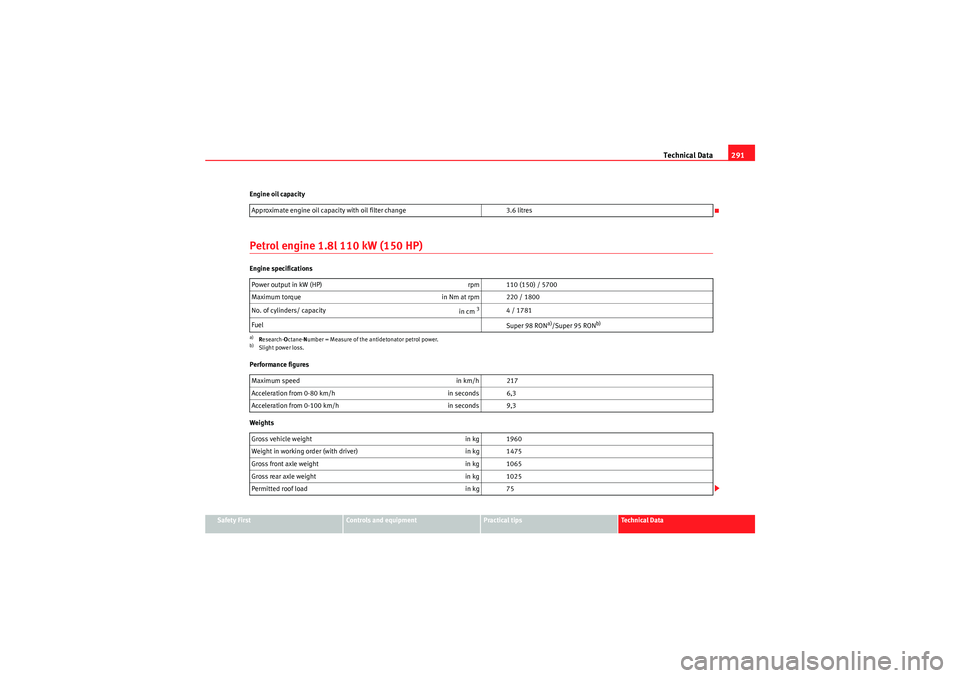
Petrol engine 1.8l 110 kW (150 HP)Engine specifications
Performance figures
Weights
Approximate engine oil capacity with oil filter change
3.6 litres
Power output in kW (HP) rpm 110 (150) / 5700
Maximum torque in Nm at rpm 220 / 1800
No. of cylinders/ capacity in cm
3
4 / 1781
Fuel Super 98 RON
a)/Super 95 RON
b)
a)Research- Octane- Number = Measure of the antidetonator petrol power.b)Slight power loss.Maximum speed in km/h 217
Acceleration from 0-80 km/h in seconds 6,3
Acceleration from 0-100 km/h in seconds 9,3
Gross vehicle weight in kg 1960
Weight in working order (with driver) in kg 1475
Gross front axle weight in kg 1065
Gross rear axle weight in kg 1025
Permitted roof load in kg 75
Exeo_EN.book Seite 291 Freitag, 28. August 2009 10:14 10
Page 295 of 310
Technical Data293
Safety First
Controls and equipment
Practical tips
Technical Data
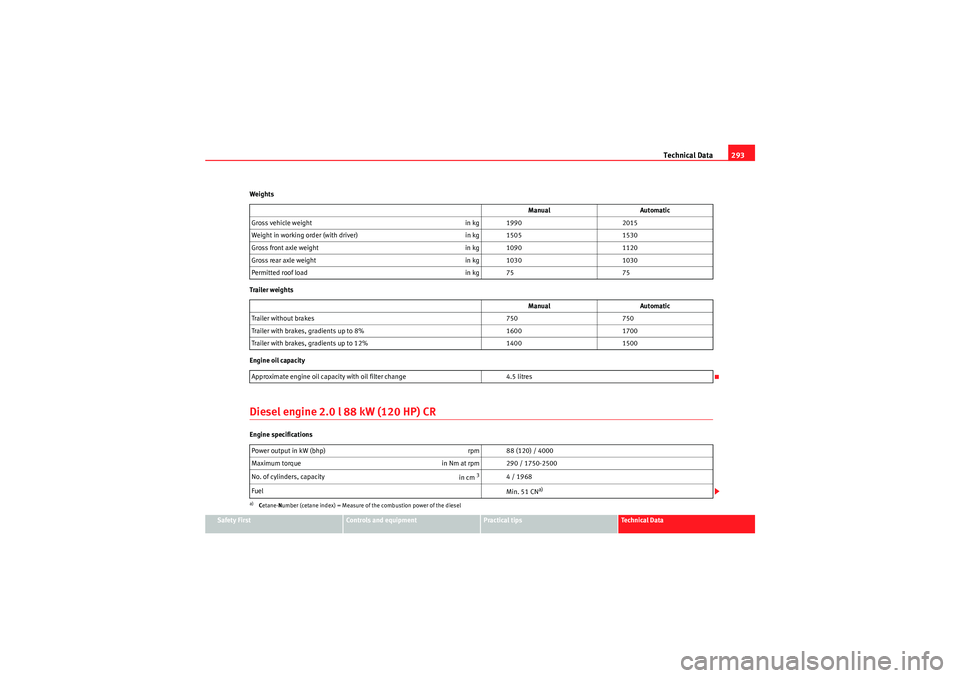
Weights
Trailer weights
Engine oil capacity
Diesel engine 2.0 l 88 kW (120 HP) CREngine specifications
Manual
Automatic
Gross vehicle weight in kg 19902015
Weight in working order (with driver) in kg 15051530
Gross front axle weight in kg 10901120
Gross rear axle weight in kg 10301030
Permitted roof load in kg 7575
Manual Automatic
Trailer without brakes 750750
Trailer with brakes, gradients up to 8% 16001700
Trailer with brakes, gradients up to 12% 14001500
Approximate engine oil capacity with oil filter change 4.5 litres
Power output in kW (bhp) rpm 88 (120) / 4000
Maximum torque in Nm at rpm 290 / 1750-2500
No. of cylinders, capacity in cm
3
4 / 1968
Fuel Min. 51 CN
a)
a)Cetane- Number (cetane index) = Measure of the combustion power of the diesel
Exeo_EN.book Seite 293 Freitag, 28. August 2009 10:14 10
Page 296 of 310
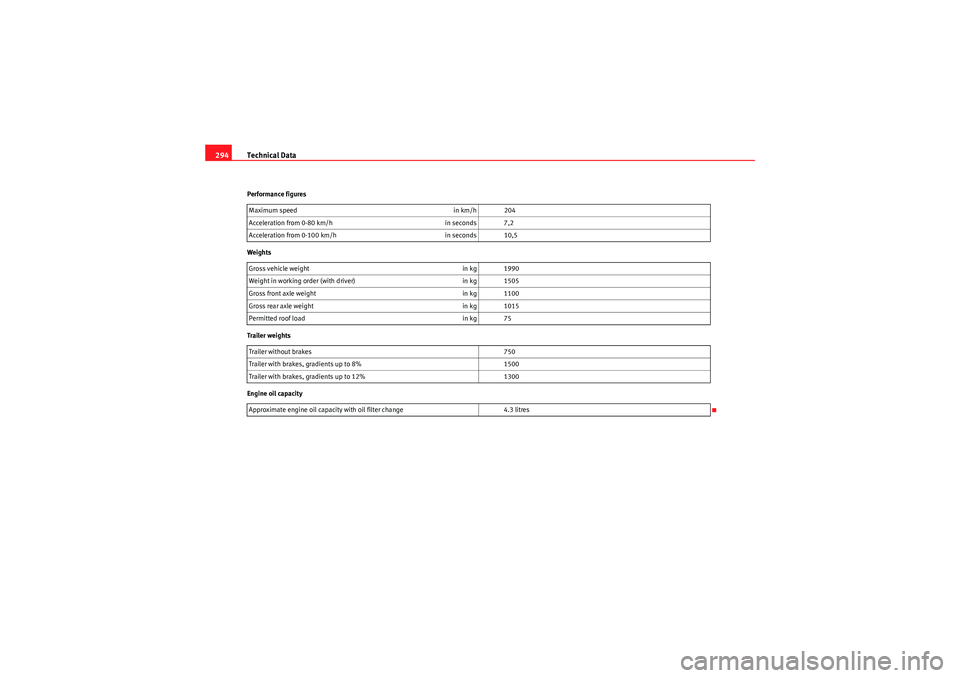
Technical Data
294Performance figures
Weights
Trailer weights
Engine oil capacity Maximum speed
in km/h 204
Acceleration from 0-80 km/h in seconds 7,2
Acceleration from 0-100 km/h in seconds 10,5
Gross vehicle weight in kg 1990
Weight in working order (with driver) in kg 1505
Gross front axle weight in kg 1100
Gross rear axle weight in kg 1015
Permitted roof load in kg 75
Trailer without brakes 750
Trailer with brakes, gradients up to 8% 1500
Trailer with brakes, gradients up to 12% 1300
Approximate engine oil capacity with oil filter change 4.3 litres
Exeo_EN.book Seite 294 Freitag, 28. August 2009 10:14 10
Page 297 of 310
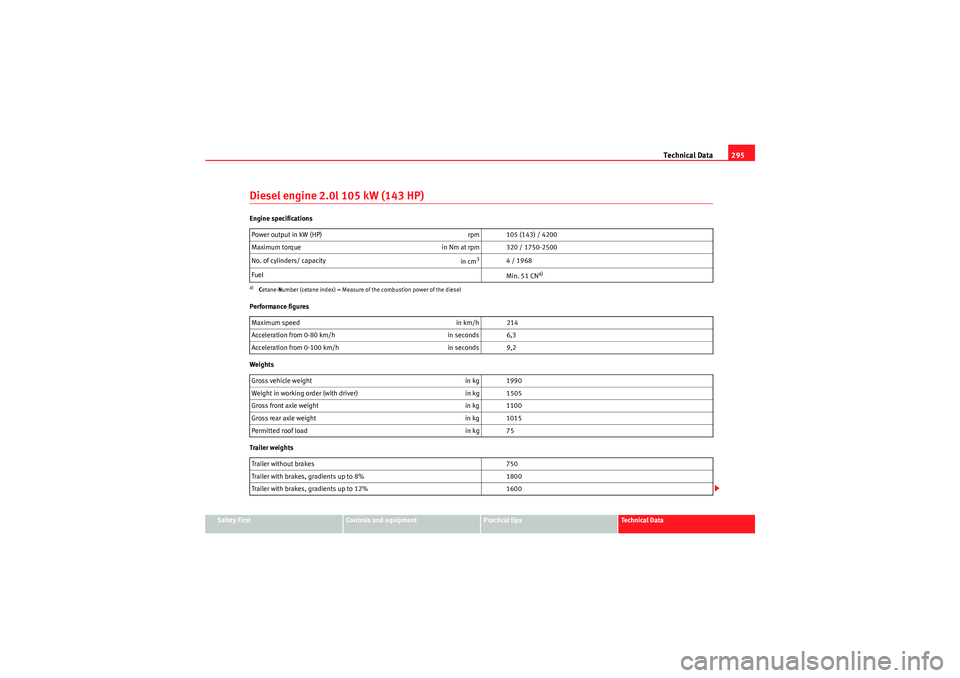
Technical Data295
Safety First
Controls and equipment
Practical tips
Technical Data
Diesel engine 2.0l 105 kW (143 HP)Engine specifications
Performance figures
Weights
Trailer weightsPower output in kW (HP)
rpm 105 (143) / 4200
Maximum torque in Nm at rpm 320 / 1750-2500
No. of cylinders/ capacity in cm
3
4 / 1968
Fuel Min. 51 CN
a)
a)Cetane- Number (cetane index) = Measure of the combustion power of the dieselMaximum speed in km/h 214
Acceleration from 0-80 km/h in seconds 6,3
Acceleration from 0-100 km/h in seconds 9,2
Gross vehicle weight in kg 1990
Weight in working order (with driver) in kg 1505
Gross front axle weight in kg 1100
Gross rear axle weight in kg 1015
Permitted roof load in kg 75
Trailer without brakes 750
Trailer with brakes, gradients up to 8% 1800
Trailer with brakes, gradients up to 12% 1600
Exeo_EN.book Seite 295 Freitag, 28. August 2009 10:14 10