roof Seat Exeo 2009 User Guide
[x] Cancel search | Manufacturer: SEAT, Model Year: 2009, Model line: Exeo, Model: Seat Exeo 2009Pages: 310, PDF Size: 8.54 MB
Page 114 of 310
Unlocking and locking
112
– With the control in position 0, press the control briefly to make
the roof tilt open all the way.
– To open the roof as far as an intermediate setting, press and hold
the control until the roof has moved to the desired position.When you release the switch it will automatically spring back from position
to position .
The sliding sun blind in the headliner automatically opens when the sunroof
is slid open. If required, it can be closed by hand when the sunroof is closed.
It is advisable to close the sun blind when the vehicle is left standing in the
sun. It is important to remember to close the sunroof when parking the
vehicle or if it suddenly starts raining – especially when the sun blind is
extended.
For further information on the automatic close function, see ⇒page 112.ClosingClosing
– Turn the control to position ⇒page 111, fig. 81 to close the
sunroof ⇒.
Closing the sunroof from the tilt position
– Pull the specially formed rear end of the control and hold it until
the sunroof has moved down to the desired position.
– Pull the switch briefly to lower the sunroof automatically to the
fully closed position. If required, the sunroof can be stopped in
any position by briefly pulling the control again ⇒.
WARNING
Take care when closing the sliding/tilting roof. There is a risk of suffering
injury. For this reason, always take out the ignition key when leaving the
vehicle.Automatic close function
The sun roof can also be closed from outside the vehicle.– Turn the key in the lock on the driver's door and hold it in the lock
position or press the lock button on the remote control until the
roof has closed all the way ⇒.
WARNING
Take care when closing the sunroof. There is a risk of suffering injury.Sunroof / deflector*The solar cells in the roof power the climate control fan.
The solar roof is operated in the same way as the normal sliding/tilting sun
roof.
The interior trim is fixed to the solar roof and cannot be opened and closed
separately.
A2
A1
A0
Exeo_EN.book Seite 112 Freitag, 28. August 2009 10:14 10
Page 115 of 310
Unlocking and locking113
Safety First
Controls and equipment
Practical tips
Technical Data
Closing the sunroof by overriding the safety cut-out
It is possible to override the safety cut-out to close the
sunroof.The sliding sunroof mechanism is equipped with a safety cut-out. If
the roof should fail to close normally, it can be closed by overriding
the safety cut-out.
– Turn the control to position ⇒page 111, fig. 81 .
– Pull on the control switch until the roof closes.
WARNING
Take care when closing the sunroof. There is a risk of suffering injury. For
this reason, always take out the ignition key when leaving the vehicle.
Closing the sunroof manually
The sunroof can be closed by hand if the electrical system
should fail to operate.
A0
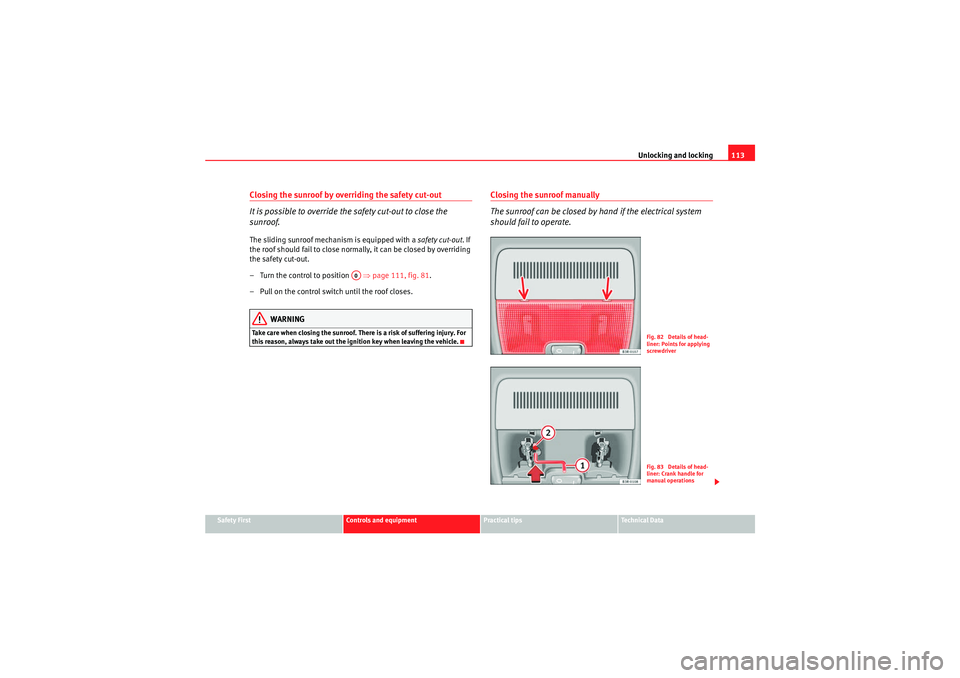
Fig. 82 Details of head-
liner: Points for applying
screwdriverFig. 83 Details of head-
liner: Crank handle for
manual operations
Exeo_EN.book Seite 113 Freitag, 28. August 2009 10:14 10
Page 116 of 310
Unlocking and locking
114
– Carefully insert the flat end of a screwdriver (from the car's tool kit) at the rear of the glass cover on the interior light ⇒page 113,
fig. 82 .
–Carefully lever off the glass cover.
– Take the crank handle from its mounting on the inside of the fuse box cover ⇒ page 255.
– Insert the crank handle all the way into the hexagonal socket ⇒ page 113, fig. 83 .
– Hold the crank handle in position and turn it to close the sun roof.
– Reinstall the glass cover: insert the plastic lugs first and then press the cover upwards.
– Have the fault repaired.
NoteYou can use the screwdriver handle to make it easier to turn the crank. Detach
the handle from the screwdriver and then fit the handle onto the crank.
A1
A2
Exeo_EN.book Seite 114 Freitag, 28. August 2009 10:14 10
Page 148 of 310
Seats and stowage
146
WARNING
The ski bag must be secured in place with the fastening belt after it has
been loaded.
Note
Do not fold away the ski bag after use if it is still damp.Roof carrierDescription
Additional luggage can be carried on the roof carrier.Note the following points if you intend to carry loads on the roof:•There are aerodynamic drainage channels on the roof of the vehicle and,
therefore, normal roof racks cannot be used. We recommend using the carrier
units from the range of original SEAT accessories.•These carrier units are the basis of a complete roof carrier system. For
safety reasons, however, the corresponding additional fastenings must be
fitted to carry luggage, bicycles, surfboards, skis and boats. All the parts of
this system are available from SEAT Dealers.Caution
Any damage to the vehicle caused by the use of other types of roof rack or
incorrect installation will not be covered by the factory warranty. The roof
carrier system must therefore be installed exactly according to the instruc-
tions provided.
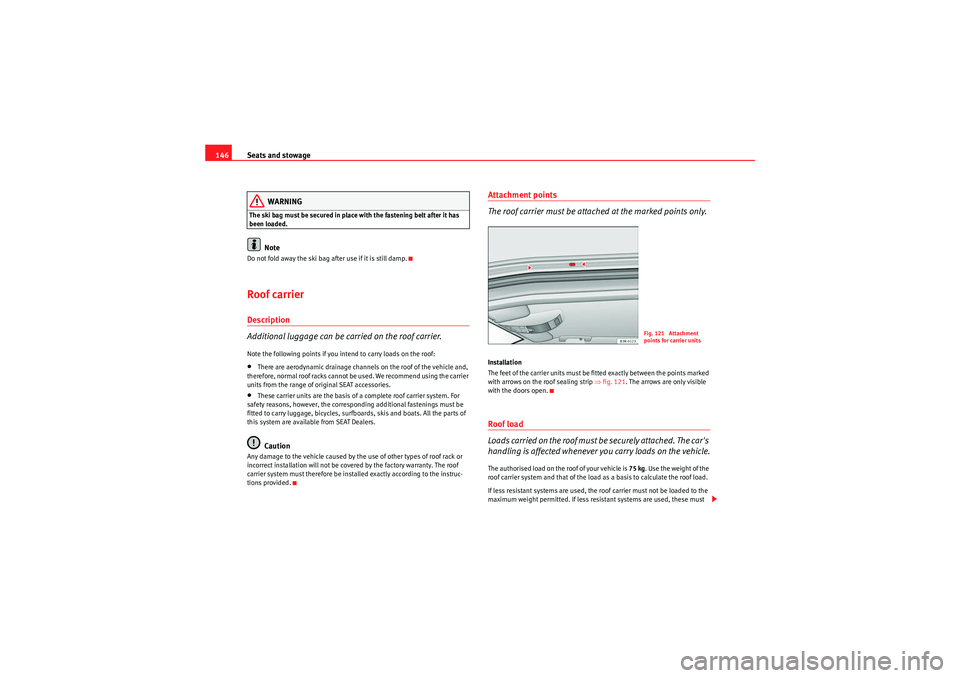
Attachment points
The roof carrier must be attached at the marked points only.Installation
The feet of the carrier units must be fitted exactly between the points marked
with arrows on the roof sealing strip ⇒fig. 121 . The arrows are only visible
with the doors open.Roof load
Loads carried on the roof must be securely attached. The car's
handling is affected whenever you carry loads on the vehicle.The authorised load on the roof of your vehicle is 75 kg. Use the weight of the
roof carrier system and that of the load as a basis to calculate the roof load.
If less resistant systems are used, the roof carrier must not be loaded to the
maximum weight permitted. If less resistant systems are used, these must
Fig. 121 Attachment
points for carrier units
Exeo_EN.book Seite 146 Freitag, 28. August 2009 10:14 10
Page 149 of 310
Seats and stowage147
Safety First
Controls and equipment
Practical tips
Technical Data
only be loaded to the maximum weight permitted indicated in the assembly
instructions.
WARNING
•Loads carried on the roof must be securely attached. Failure to do so
could result in an accident.•Do not exceed the maximum roof load for the vehicle, the maximum
axle loads or the maximum gross vehicle weight. Failure to do so could
result in an accident.•When transporting heavy or bulky loads on the roof, bear in mind that
the car's handling is affected by the extra weight on the roof and a possible
susceptibility to cross winds. Adjust your speed and driving style accord-
ingly to avoid accidents.For the sake of the environment
Roof carriers are often left attached for convenience, even when they are not
being used. However, the increased air resistance means that the vehicle
uses more fuel. For this reason you should always take off the roof carrier
when it is not in use.
Drink holdersFront drink holders
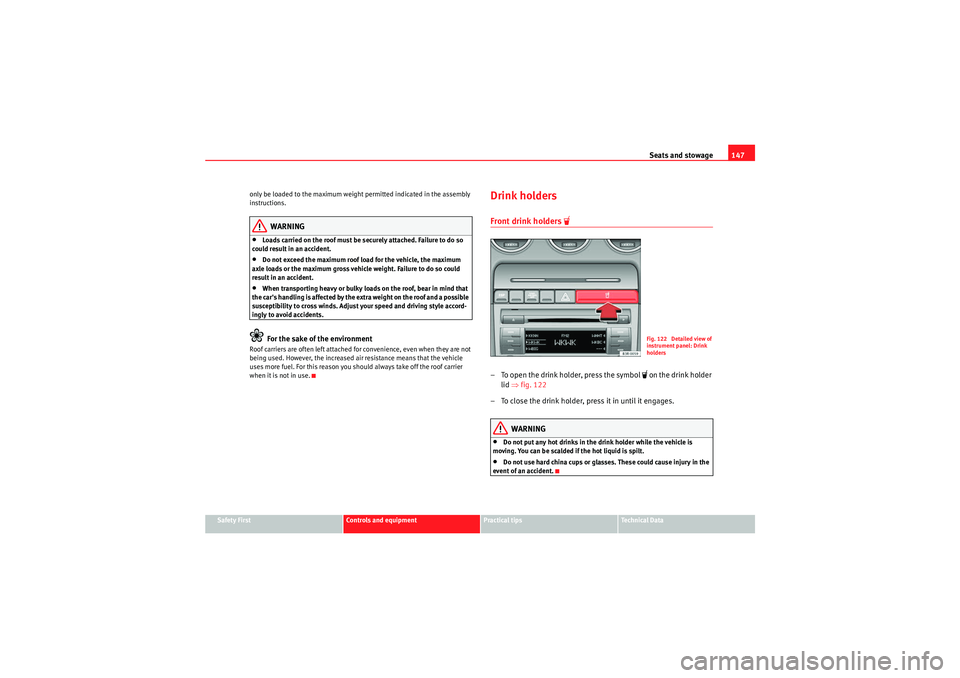
– To open the drink holder, press the symbol
on the drink holder
lid ⇒fig. 122
– To close the drink holder, press it in until it engages.
WARNING
•Do not put any hot drinks in the drink holder while the vehicle is
moving. You can be scalded if the hot liquid is spilt.•Do not use hard china cups or glasses. These could cause injury in the
event of an accident.
Fig. 122 Detailed view of
instrument panel: Drink
holders
Exeo_EN.book Seite 147 Freitag, 28. August 2009 10:14 10
Page 157 of 310
Heating, Ventilation and Air conditioning155
Safety First
Controls and equipment
Practical tips
Technical Data
Note
•Keep the air intake slots in front of the windscreen clear of snow, ice and
leaves to ensure unimpaired heating and cooling and to prevent the windows
misting over.•The air from the outlets flows through the passenger compartment and
out through the slots below the rear window. Therefore, do not cover these
slots with items of clothing or other objects.•The air conditioning system operates most effectively with the windows
and the sliding/tilting roof* closed. However, if the vehicle has heated up
after standing in the sun for some time, the air inside can be cooled more
quickly by opening the windows briefly.
Exeo_EN.book Seite 155 Freitag, 28. August 2009 10:14 10
Page 164 of 310
Heating, Ventilation and Air conditioning
162Each of the three buttons has a specific function. The numbers relate to the
air outlets ⇒page 161, fig. 134.
Air directed to windows
This setting directs all the air to outlets 1 and 2. Unlike in setting , the
volume of air delivery remains the same.
Air to the driver/front passenger
All the air comes from outlets 3 and 4 in the dash panel and from the rear of
the centre console.
Air to the footwells
Most of the air emerges from outlets 5 and the outlets under the front seats.
Some of the air will also be issued from outlets 3 and 4.
Note
In all of the above air distribution settings, a small amount of air will still
come from the other outlets.Economical use of the climate control
Economical use of the climate control will help save fuel.Engine power is reduced and fuel consumption increases when the
climate control is in cooling mode. To ensure that the system is only
switched on when it is really necessary, please note the following
points:
– Select ECON mode if you wish to save fuel.
– Select ECON mode if you decide to open the windows or sun roof* while driving. – If the vehicle has heated up after standing in the sun, open the
windows and doors for a short time to cool the vehicle.
For the sake of the environment
By saving fuel you also reduce the amount of pollutants emitted from your
vehicle.Key settings
When the ignition is switched on, the climate control settings
assigned to the key are selected automatically.The climate control settings selected are automatically stored and assigned
to the key in use. When the vehicle is started, the climate control automati-
cally selects the settings assigned to the key. Hence, every driver automati-
cally obtains his/her preferred settings without having to select them manu-
ally.
Note
Should another driver use the key and enter other settings, the previous
settings will be deleted.
Exeo_EN.book Seite 162 Freitag, 28. August 2009 10:14 10
Page 165 of 310
Heating, Ventilation and Air conditioning163
Safety First
Controls and equipment
Practical tips
Technical Data
Solar-powered blower/solar roof*
If the vehicle is parked in sufficiently strong sunlight, the
blower will operate in solar-powered mode when the ignition
is switched off.After the ignition is switched off, the blower is supplied with electrical power
from the solar roof. Please ensure that outlets 3 and 4 are open ⇒page 161,
fig. 134 to ensure the best possible ventilation.
The blower only works when the sun roof is closed or tilted open at the rear.
If the air recirculation mode is on when you switch off the engine, the climate
control will automatically switch to fresh air ventilation.Supplementary heating*Diesel vehicles are fitted with supplementary heating
2) to raise the tempera-
ture of the interior as quickly as possible. At outdoor temperatures below
+5°C and with the engine running, the supplementary heating will switch on
and off automatically depending on the temperature of the coolant.
In order to save fuel, the supplementary heating can be can be switched off
by briefly pressing the button on the climate control.
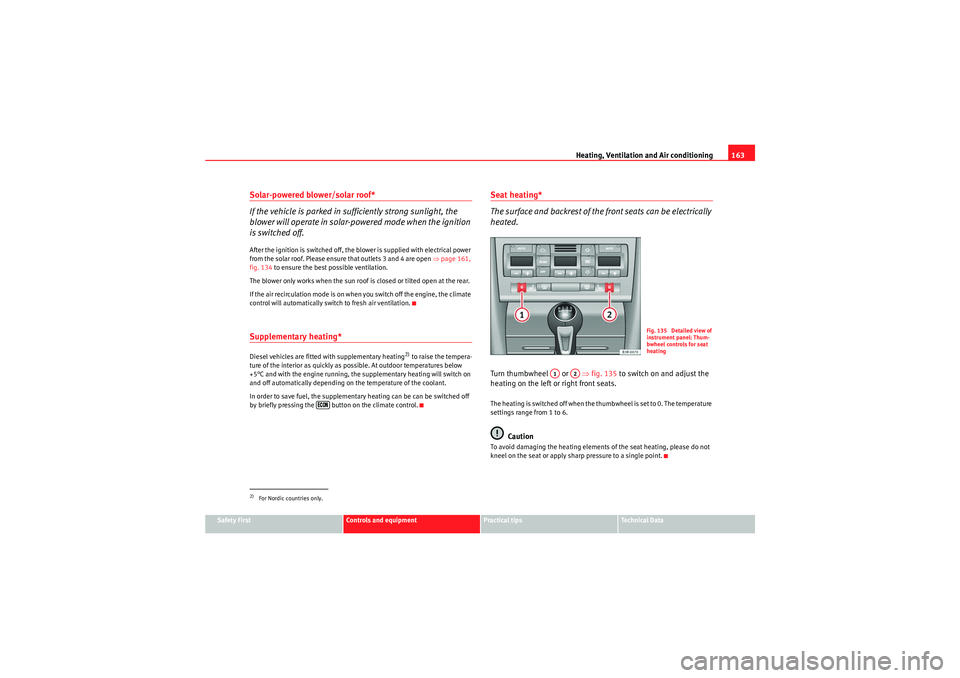
Seat heating*
The surface and backrest of the front seats can be electrically
heated.Turn thumbwheel or ⇒fig. 135 to switch on and adjust the
heating on the left or right front seats.The heating is switched off when the thumbwheel is set to 0. The temperature
settings range from 1 to 6.
Caution
To avoid damaging the heating elements of the seat heating, please do not
kneel on the seat or apply sharp pressure to a single point.
2)For Nordic countries only.
Fig. 135 Detailed view of
instrument panel: Thum-
bwheel controls for seat
heating
A1
A2
Exeo_EN.book Seite 163 Freitag, 28. August 2009 10:14 10
Page 194 of 310
Driving and the environment
192Periodic maintenance
Periodic maintenance work guarantees that, before beginning a journey, you
will not consume more than the required amount of fuel. A well-serviced
engine gives you the benefit of improved fuel efficiency as well as maximum
reliability and an enhanced resale value.
A badly serviced engine can consume up to 10% more fuel than necessary.
Avoid short journeys
To reduce the consumption and emission of polluting gases, the engine and
the exhaust filtration systems should reach the optimum service tempera-
ture .
With the engine cold, fuel consumption is proportionally higher. The engine
does not warm up and fuel consumption does not regularise until having
driven some four kilometres. This is the reason why we recommend avoiding
short trips wherever possible.
Maintain the correct tyre pressures
Bear in mind that keeping the tyres at an adequate pressure saves fuel. If the
tyre pressures are just 1 bar too low, this can put the fuel consumption up by
as much as 5%. Due to the greater rolling resistance, under-inflation also
increases tyre wear and impairs handling.
The tyre pressures should always be checked when the tyres are cold.
Do not use winter tyres all year round: they will increase fuel consumption by
up to 10%.
Avoid unnecessary weight
Every kilo of extra weight will put up the fuel consumption, so it is worth
checking the luggage compartment occasionally to make sure that no unnec-
essary loads are being transported.
A roof carrier is often left in place for the sake of convenience, even when it is
no longer needed. At a speed of 100-120 km/h your car will use about 12%
more fuel as a result of the extra wind resistance caused by the roof carrier
even when it is not in use. Saving electrical energy
The engine activates the alternator, which produces electricity. With the need
for electricity, fuel consumption is also increased. Because of this, always
turn off electrical equipment when you do not need them. Examples of equip-
ment that use a lot of electricity are: the fan at high speeds, the rear window
heating or the seat heaters*.
Environmental friendlinessEnvironmental protection is a top priority in the design, choice of materials
and production of your new Seat.
Design measures for economical recycling•Joints and connections designed for ease of dismantling•Modular construction to facilitate dismantling•Increased use of single-grade materials•Plastic parts and elastomers are labelled in accordance with ISO 1043,
ISO 11469 and ISO 1629
Choice of materials•Nearly all materials used can be recycled•Similar types of plastics grouped together for easy recycling•Recycled materials used in manufacture•Reduction of volatile compounds in plastics•CFC-free refrigerant in air conditioning
Compliance with prohibited materials laws : cadmium, lead, mercury, chrome
VI.
Manufacturing methods•Use of recycled material for manufacturing plastic parts•Solvent-free cavity sealing
Exeo_EN.book Seite 192 Freitag, 28. August 2009 10:14 10
Page 208 of 310
Your vehicle maintenance and cleaning
206Vehicle exterior maintenanceAutomatic car wash tunnel
The car can normally be washed without problem in an auto-
matic car wash.The vehicle paintwork is so durable that the car can normally be washed
without problems in an automatic car washing tunnel. However, the paint-
work wear depends to a large extent, on the kind of the car washing tunnel,
the brushes used, its water filtering and the type of cleaning and preservative
products.
Before going through a car wash, be sure to take the usual precautions such
as closing the windows and sunroof. There is nothing to note apart from that.
If the vehicle has special accessories such as spoilers or a roof carrier or two-
way radio aerial, etc., it is advisable to consult the car washing tunnel oper-
ator.
After washing, the brakes could hesitate to respond as the brake discs and
pads could be wet, or even frozen in winter. “Dry” the brakes by braking
several times.
WARNING
Water, ice and salt on the brakes can reduce braking efficiency. Risk of
accident.Washing by handVehicle washing
– First soften the dirt with plenty of water and rinse it off. – Clean your vehicle from top to bottom with a soft sponge, a glove
or a brush. Use very light pressure.
– Rinse the sponge or glove often with clean water.
– Special car shampoo should only be used for very stubborn dirt.
– Clean the wheels, sill panels etc. until last with a different sponge or glove.
– Rinse the vehicle thoroughly with water.
– Dry your vehicle surface gently with a chamois leather.
–When temperature is cold , dry the rubber seals and its surfaces
to prevent them from freezing. Apply silicone spray to the rubber
seals.
After washing
– Directly after washing, avoid sudden and sharp braking. “Dry” ⇒page 189, “Braking effect and braking distance”the brakes by
braking several times.
WARNING
•Wash your car with the ignition switched off.•Protect your hands and arms from cuts on sharp metal edges when
cleaning the underbody, the inside of the wheel housings etc. Risk of
injury.•Water, ice and salt on the brakes can reduce braking efficiency. Risk of
accident.
Exeo_EN.book Seite 206 Freitag, 28. August 2009 10:14 10