steering Seat Exeo 2009 Owner's Guide
[x] Cancel search | Manufacturer: SEAT, Model Year: 2009, Model line: Exeo, Model: Seat Exeo 2009Pages: 310, PDF Size: 8.54 MB
Page 190 of 310
Intelligent technology
188Power steeringThe power steering assists the driver when turning the
steering wheel (with the engine running).The power steering assists the driver by reducing the force needed to turn the
steering wheel.
The power steering does not work if the engine is off. In this case the steering
wheel is very hard to turn.
If the steering is held at its turning limit when the car is stationary, this will
place an excessive load on the power steering system. Turning the steering
wheel to its limit places a load on the system, which causes noise. It will also
reduce the idling speed of the engine.
Caution
When the engine is running, do not turn the steering wheel to its limit for
more than 15 seconds. Otherwise, there is a risk of damaging the power
steering.
Note
•If the power steering should fail at any time or the engine is switched off
(for instance when being towed), the car can still be steered. However, more
effort will be required to turn the steering wheel.•If the system is leaking or malfunctioning, please take the car to a quali-
fied workshop as soon as possible.•The power steering requires a special hydraulic fluid. The fluid reservoir is
located at the front of the engine compartment on the left ⇒ page 289. The
correct fluid level in the reservoir is important for the power steering to func-
tion properly. The hydraulic fluid level is checked at the Inspection Service.
ServotronicThe servotronic system electronically adjusts the degree of
power assistanceIn cars equipped with servotronic power steering the degree of power assist-
ance ⇒page 188 is adjusted electronically according to road speed.
If a fault should occur in the servotronic system, the power steering will still
operate. The degree of power assistance will, however, no longer adapt to
different speeds. If the electronic regulating system is not working properly,
this is most noticeable when turning the steering wheel at low speeds (for
instance when parking) – more effort will be required than usual. The fault
should be corrected by a qualified workshop as soon as possible.
Exeo_EN.book Seite 188 Freitag, 28. August 2009 10:14 10
Page 240 of 310
Wheels and tyres
238display TMPS (Tyre Pressure Monitoring System). Please contact the nearest
specialist garage as soon as possible.
The tyre pressure warning lamp
lights up if the tyre pressure on one or
more wheels is significantly lower than the tyre pressure setting which was
confirmed by the driver ⇒ .
WARNING
•If the tyre pressure warning lamp lights up
you must slow down
immediately and avoid any severe braking or steering manoeuvres. Stop
the vehicle as soon as possible and check the tyres and their pressure.
•The driver is responsible for maintaining correct tyre pressures. There-
fore, the tyre pressure must be regularly checked.•Under certain conditions (e.g. driving at high speeds, on ice and snow
or on poor road surfaces) the tyre pressure warning lamp
may not light
up immediately or not at all.
•Please ask your Dealer or specialist garage whether run-flat tyres can
be used on your vehicle. Fitting this type of tyre in an undue manner could
lead to your driving licence being taken away from you. Furthermore, it may
led to damage to the vehicle or, under certain circumstances, may cause
accidents.•If you change normal tyres for run-flat tyres or vice versa, the control
unit must be reprogrammed by the Dealer or a specialist garage.Note
If you did not press the button for the tyre pressure monitoring system to
confirm a new tyre pressure setting after making changes to the tyre pres-
sures or changing one or more wheels, the warning lamp
may light up
although the tyre pressures are correct. In this case, stop the vehicle as soon
as possible and, after examining the tyres, press the button for the tyre pres-
sure monitoring system.
Tyre ser vice life
The service life of tyres is dependent on tyre pressure, driving
style and fitting.
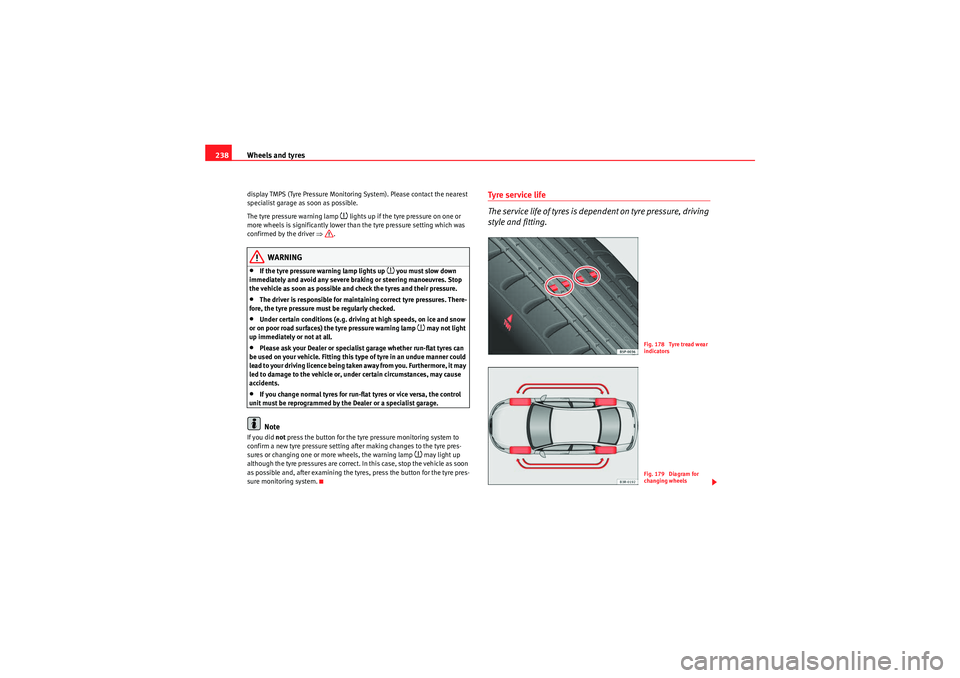
Fig. 178 Tyre tread wear
indicatorsFig. 179 Diagram for
changing wheels
Exeo_EN.book Seite 238 Freitag, 28. August 2009 10:14 10
Page 241 of 310
Wheels and tyres239
Safety First
Controls and equipment
Practical tips
Technical Data
Wear indicators
The original tyres on your vehicle have 1.6 mm high “tread wear indicators”
⇒
page 238, fig. 178 , running across the tread. Depending on the make,
there will be six to eight of them evenly spaced around the tyre. Markings on
the tyre sidewall (for instance the letters “TWI” or other symbols) indicate the
positions of the tread wear indicators. The minimum tread depth required by
law is 1.6 mm (measured in the tread grooves next to the tread wear indica-
tors). Worn tyres must be replaced. Different figures may apply in export
countries ⇒.
Tyre pressure
Under-inflation or over-inflation will reduce the life of the tyres considerably
and also impair the car's handling. The inflation pressures are listed on a
sticker on the inside of the fuel tank flap.
Correct inflation pressures are very important, especially at high speeds. The
pressure should therefore be checked at least once a month and before
starting any long journey.
Tyre pressure monitoring (RKA+ )*
Monitoring of the tyre pressures is based on the tyre pressures you have
stored. The tyre pressure monitoring system cannot function as intended if
you store tyre pressure settings for a normal load, but then drive with the
vehicle fully laden. The tyre pressure must be adapted to the actual load and
stored accordingly in the tyre pressure monitoring system ⇒page 237.
Driving style
Fast cornering, heavy acceleration and hard braking all increase tyre wear.
Changing wheels around
If the front tyres are worn considerably more than the rear ones it is advisable
to cha nge t he m ar oun d as sh own ⇒ page 238, fig. 179. All the tyres will then
last for about the same time. Wheel balance
The wheels on new vehicles are balanced. However, various factors encoun-
tered in normal driving can cause them to become unbalanced, which results
in steering vibration.
Unbalanced wheels should be rebalanced, as they otherwise cause excessive
wear on steering, suspension and tyres. A wheel must also be rebalanced
when a new tyre is fitted.
Incorrect wheel alignment
Incorrect wheel alignment causes excessive tyre wear, impairing the safety of
the vehicle. If tyres show excessive wear, you should have the wheel align-
ment checked by an Authorised Service Centre.
WARNING
There is a serious danger of accidents if a tyre bursts during driving!•The tyres must be replaced at the latest when the tread is worn down to
the tread wear indicators. Failure to do so could result in an accident. Worn
tyres do not grip well at high speeds on wet roads. There is also a greater
risk of “aquaplaning” •At continuously high speeds, a tyre with insufficient pressure flexes
more. This causes it to overheat. This can cause tread separation and tyre
blow-out. Risk of accident. Always observe the recommended tyre pres-
sures.•If tyres show excessive wear, you should have the running gear checked
by an Authorised Service Centre.•Keep chemicals such as oil, fuel and brake fluid away from tyres.•Damaged wheels and tyres must be replaced immediately!For the sake of the environment
Under-inflated tyres will increase fuel consumption.
Exeo_EN.book Seite 239 Freitag, 28. August 2009 10:14 10
Page 258 of 310
If and when
256Fuse assignment
This list shows the fuses which can be replaced relatively
easily by the owner.No.
Consumer
Amps
1
Climate control
10
2
Footwell lamps
5
3
Heated washer jets
5
4
Radiator fan
5
5
Parking aid, automatic gearbox
10
6
Air conditioner (air purity sensor), pressure sensor
5
7
Electronic Stabilisation Program (ESP), brake light
switch, clutch pedal switch, steering angle sensor
10
8
Tele ph one
5
9
Va can t
10
Self-directing headlights (adaptive light) right
5
11
Airbag and disconnection of the front passenger air-
bag
5
12
Diagnostic socket
10
13
Steering column unit
10
14
Brake lights
10
15
Instrument panel
10
16
Va can t
17
Tyre pressure control, rain/light sensor
10
18
Self-directing headlights (adaptive light) left
5
19
Va can t
20
Va can t
21
Va can t
22
Driver's door / front passenger's door
15
23
Rear doors
15
24
Central electrics unit for convenience equipment
20
25
Heater blower
30
26
Rear window heater
30
27
Electrical socket for trailer (control unit)
30
28
Fuel pump, auxiliary pump for diesel
20
29
Va can t
30
Sliding/tilting sunroof
20
31
Diagnosis connection, automatic anti-dazzle interior
mirror, reverse light, automatic gearbox
15
32
Towing socket
15
33
Lighter
20
34
Diesel lambda-probe
5
35
Luggage compartment power point*
20
36
Wiper system
30
37
Pump for windscreen washer and headlight washer
system
30
38
Luggage compartment illumination, alarm
15
39
Radio, Amplifier
20
40
Horn
25
No.
Consumer
Amps
Exeo_EN.book Seite 256 Freitag, 28. August 2009 10:14 10
Page 284 of 310
If and when
282Towing and tow-startingTo w - s t a r t i n g
The use of jump leads is preferable to tow-starting.We recommend that you do not tow-start your vehicle. Jump-starting
is preferable ⇒ page 279.
However, if your vehicle has to be tow-started:
– Engage the 2
nd or the 3
rd gear.
– Keep the clutch pressed down.
– Switch the ignition on.
– Once both vehicles are moving, release the clutch.
– As soon as the engine starts, press the clutch and move the gear lever into neutral. This helps to prevent driving into the towing
vehicle.
WARNING
The risk of accidents is high when tow-starting. The vehicle being towed
can easily collide with the towing vehicle.
Caution
When tow-starting, fuel could enter the catalytic converter and damage it.
CommentsPlease observe the following points if you use a tow-rope:
Notes for the driver of the towing vehicle
– Drive slowly at first until the tow-rope is taut. Then accelerate gradually.
– Begin and change gears cautiously. If you are driving an auto- matic vehicle, accelerate gently.
– Remember that the brake servo and power steering are not working in the vehicle you are towing. Brake earlier than you
would normally, but with a more gentle pressure on the brake.
Notes for the driver of the towed vehicle
– Ensure that the tow-rope remains taut at all times when towing.Tow-rope or tow-bar
It is easier and safer to tow a vehicle with a tow-bar. You should only use a
tow-rope if you do not have a tow-bar.
A tow-rope should be slightly elastic to reduce the loading on both vehicles.
It is advisable to use a tow-rope made of synthetic fibre or similarly elastic
material.
Attach the tow-rope or the tow-bar only to the towing eyes provided or a
towing bracket.
Driving style
Towing requires some experience, especially when using a tow-rope. Both
drivers should be familiar with the technique required for towing. Inexperi-
enced drivers should not attempt to tow-start or tow away another vehicle.
Exeo_EN.book Seite 282 Freitag, 28. August 2009 10:14 10
Page 285 of 310
If and when283
Safety First
Controls and equipment
Practical tips
Technical Data
Do not pull too hard with the towing vehicle and take care to avoid jerking the
tow-rope. When towing on an unpaved road, there is always a risk of over-
loading and damaging the anchorage points.
The ignition of the vehicle being towed must be switched on to prevent the
steering wheel from locking and also to allow the use of the indicators, horn,
windscreen wipers and washers.
As the brake servo does not work if the engine is not running, you must apply
considerably more pressure to the brake pedal than you normally would.
As the power assisted steering does not work if the engine is not running, you
will need more strength to steer than you normally would.
Towing vehicles with an automatic gearbox
•Put the selector lever into position “N”.•Do not drive faster than 50 km/h when towing a vehicle.•Do not tow further than 50 km.•If a breakdown vehicle is used, the vehicle must be towed with the front
wheels raised.Note
•Observe legal requirements when towing or tow-starting.•Switch on the hazard warning lights of both vehicles. However, observe
any regulations to the contrary.•For technical reasons, vehicles with an automatic gearbox must not be
tow-started.•If damage to your vehicle means that there is no lubricant in the gearbox,
you must raise the drive wheels while the vehicle is being towed.•If the vehicle has to be towed more than 50 km, the front wheels must be
raised during towing, and towing should be carried out by a qualified person.•The steering wheel is locked when the vehicle has no electrical power. The
vehicle must then be towed with the front wheels raised. Towing should be
carried out by a qualified person.
•The towing eye should always be kept in the vehicle. Please refer to the
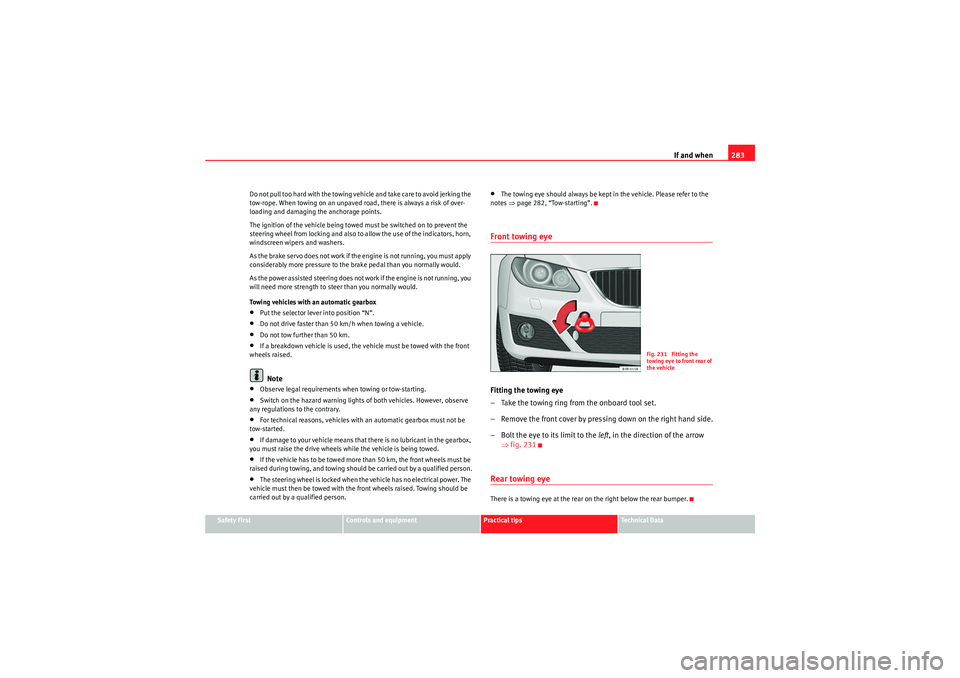
notes ⇒page 282, “Tow-starting”.Front towing eyeFitting the towing eye
– Take the towing ring from the onboard tool set.
– Remove the front cover by pressing down on the right hand side.
– Bolt the eye to its limit to the left, in the direction of the arrow
⇒ fig. 231Rear towing eyeThere is a towing eye at the rear on the right below the rear bumper.
Fig. 231 Fitting the
towing eye to front rear of
the vehicle
Exeo_EN.book Seite 283 Freitag, 28. August 2009 10:14 10
Page 291 of 310
Technical Data289
Safety First
Controls and equipment
Practical tips
Technical Data
Te c h n i c a l D a t aChecking fluid levelsFrom time to time, the levels of the different fluids in the
vehicle must be checked. Never fill with incorrect fluids,
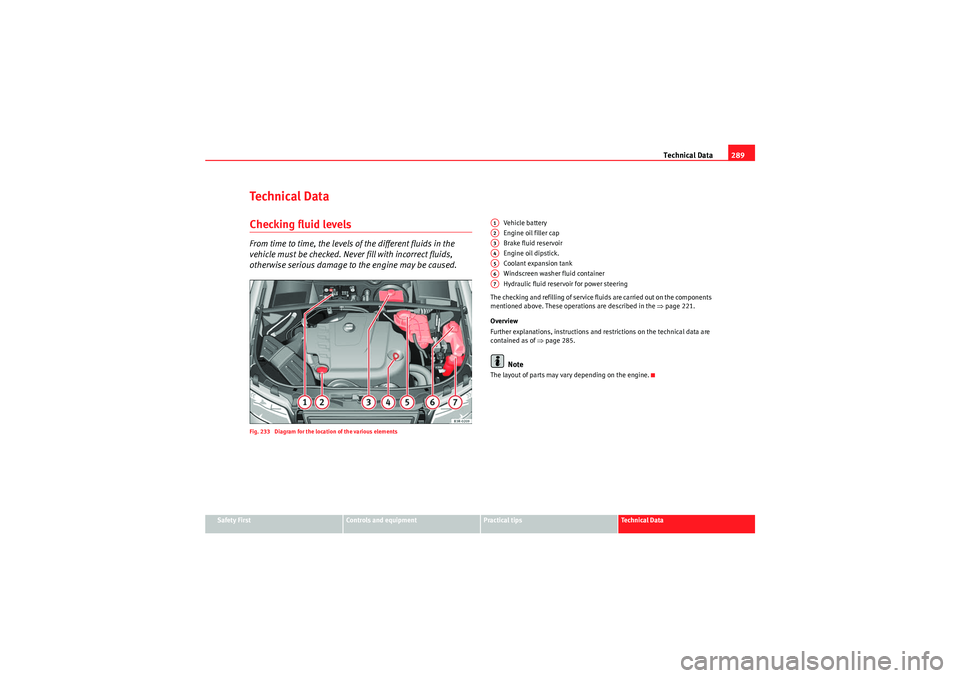
otherwise serious damage to the engine may be caused.Fig. 233 Diagram for the location of the various elements
Vehicle battery
Engine oil filler cap
Brake fluid reservoir
Engine oil dipstick.
Coolant expansion tank
Windscreen washer fluid container
Hydraulic fluid reservoir for power steering
The checking and refilling of service fluids are carried out on the components
mentioned above. These operations are described in the ⇒page 221.
Overview
Further explanations, instructions and restrictions on the technical data are
contained as of ⇒page 285.Note
The layout of parts may vary depending on the engine.A1A2A3A4A5A6A7
Exeo_EN.book Seite 289 Freitag, 28. August 2009 10:14 10
Page 301 of 310
Index299
Index
AAccessories . . . . . . . . . . . . . . . . . . . . . . . . . . . . 214
Towing . . . . . . . . . . . . . . . . . . . . . . . . . . . . . 196
Adaptive headlights . . . . . . . . . . . . . . . . . . . . . 121
Air conditioner 2C-Climatronic . . . . . . . . . . . . . . . . . . . . . . . 154
Defrosting . . . . . . . . . . . . . . . . . . . . . . . . . . . 158
Solar-powered blower/solar roof . . . . . . . . 163
Air duct Fitting . . . . . . . . . . . . . . . . . . . . . . . . . 259, 266
Removing . . . . . . . . . . . . . . . . . . . . . . 258, 265
Air purity sensor . . . . . . . . . . . . . . . . . . . . . . . . . 159
Airbag Warning lamp . . . . . . . . . . . . . . . . . . . . . . . . . 66
Airbag covers . . . . . . . . . . . . . . . . . . . . . . . . . . . . 33
Airbag system . . . . . . . . . . . . . . . . . . . . . . . . . . . 28 Curtain airbags . . . . . . . . . . . . . . . . . . . . . . . 41
Front airbags . . . . . . . . . . . . . . . . . . . . . . . . . 31
Side airbags . . . . . . . . . . . . . . . . . . . . . . . . . . 37
Warning lamp . . . . . . . . . . . . . . . . . . . . . . . . . 29
Alternator Warning lamp . . . . . . . . . . . . . . . . . . . . . . . . . 69
Ambient temperature display . . . . . . . . . . . . . . . 72
Anti-freeze . . . . . . . . . . . . . . . . . . . . . . . . . . . . . 225
Anti-lock brake system How it works . . . . . . . . . . . . . . . . . . . . . . . . . 184
Anti-puncture tyres . . . . . . . . . . . . . . . . . . . . . . 240 Anti-theft alarm system . . . . . . . . . . . . . . . . . . . 106
Interior monitoring . . . . . . . . . . . . . . . . . . . 107
Aquaplaning . . . . . . . . . . . . . . . . . . . . . . . . . . . 239
Armrest Storage compartment in front armrest . . . . 141
Armrests Adjusting the front armrest . . . . . . . . . . . . . 141
Ashtray Front . . . . . . . . . . . . . . . . . . . . . . . . . . . . . . . 148
Rear . . . . . . . . . . . . . . . . . . . . . . . . . . . . . . . 149
Athermic windscreen . . . . . . . . . . . . . . . . . . . . . 215
Auto-check system . . . . . . . . . . . . . . . . . . . . . . . 75
Automatic car wash tunnel . . . . . . . . . . . . . . . . 206
Automatic gearbox Dynamic gear control program . . . . . . . . . . 180
Kick-down feature . . . . . . . . . . . . . . . . . . . . 179
multitronic® . . . . . . . . . . . . . . . . . . . . . . . . 175
Paddle levers (tiptronic mode) . . . . . . . . . . 182
Safety interlock for ignition key . . . . . . . . . 165
Selector lever lock . . . . . . . . . . . . . . . . . . . . 179
Selector lever positions . . . . . . . . . . . . . . . . 177
Steering wheel with paddle levers . . . . . . . 182
tiptronic . . . . . . . . . . . . . . . . . . . . . . . 175, 181
Automatic headlight control . . . . . . . . . . . . . . . 115
BBackground lighting . . . . . . . . . . . . . . . . . . . . . 124 Battery . . . . . . . . . . . . . . . . . . . . . . . . . . . . . . . . 231
Battery voltage . . . . . . . . . . . . . . . . . . . . . . . . 81
Charging . . . . . . . . . . . . . . . . . . . . . . . . . . . . 233
Disconnection . . . . . . . . . . . . . . . . . . . . . . . 231
Long periods of non-use . . . . . . . . . . . . . . . 231
Replacing . . . . . . . . . . . . . . . . . . . . . . 231, 232
Testing . . . . . . . . . . . . . . . . . . . . . . . . . . . . . 231
Winter operations . . . . . . . . . . . . . . . 231, 232
Belt tension device Disposal . . . . . . . . . . . . . . . . . . . . . . . . . . . . . 27
Warning lamp . . . . . . . . . . . . . . . . . . . . . . . . 29
Belt tension devices . . . . . . . . . . . . . . . . . . . . . . 26
Bicycle rack Towing . . . . . . . . . . . . . . . . . . . . . . . . . . . . . 196
Biodiesel . . . . . . . . . . . . . . . . . . . . . . . . . . . . . . 218
Biodiesel fuel . . . . . . . . . . . . . . . . . . . . . . . . . . . 218
Bonnet . . . . . . . . . . . . . . . . . . . . . . . . . . . . . . . . 220 Closing . . . . . . . . . . . . . . . . . . . . . . . . . . . . . 222
Opening . . . . . . . . . . . . . . . . . . . . . . . . . . . . 220
Releasing . . . . . . . . . . . . . . . . . . . . . . . . . . . 220
Brake light Failure control . . . . . . . . . . . . . . . . . . . . . . . . 80
Brake pads . . . . . . . . . . . . . . . . . . . . . . . . . . . . . 189
Brake servo . . . . . . . . . . . . . . . . . . . . . . . . . . . . 189
Brake system Brake servo . . . . . . . . . . . . . . . . . . . . . . . . . 186
Brakes . . . . . . . . . . . . . . . . . . . . . . . . . . . . . 186
Malfunction . . . . . . . . . . . . . . . . . . . . . . . . . . 77
Exeo_EN.book Seite 299 Freitag, 28. August 2009 10:14 10
Page 306 of 310
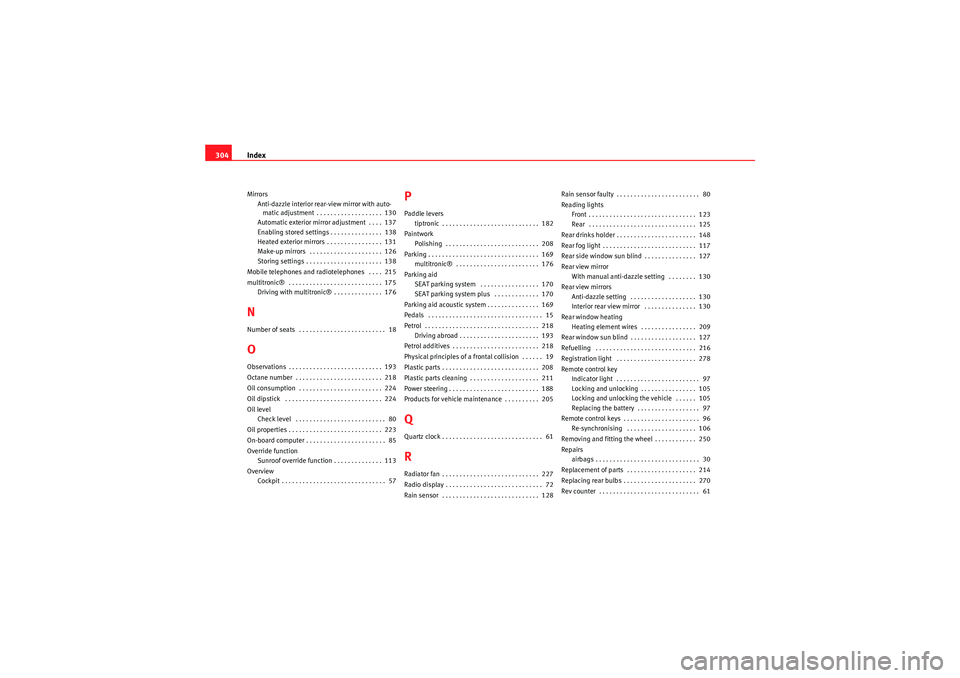
Index
304Mirrors
Anti-dazzle interior rear-view mirror with auto-matic adjustment . . . . . . . . . . . . . . . . . . . 130
Automatic exterior mirror adjustment . . . . 137
Enabling stored settings . . . . . . . . . . . . . . . 138
Heated exterior mirrors . . . . . . . . . . . . . . . . 131
Make-up mirrors . . . . . . . . . . . . . . . . . . . . . 126
Storing settings . . . . . . . . . . . . . . . . . . . . . . 138
Mobile telephones and radiotelephones . . . . 215
multitronic® . . . . . . . . . . . . . . . . . . . . . . . . . . . 175 Driving with multitronic® . . . . . . . . . . . . . . 176NNumber of seats . . . . . . . . . . . . . . . . . . . . . . . . . 18OObservations . . . . . . . . . . . . . . . . . . . . . . . . . . . 193
Octane number . . . . . . . . . . . . . . . . . . . . . . . . . 218
Oil consumption . . . . . . . . . . . . . . . . . . . . . . . . 224
Oil dipstick . . . . . . . . . . . . . . . . . . . . . . . . . . . . 224
Oil level
Check level . . . . . . . . . . . . . . . . . . . . . . . . . . 80
Oil properties . . . . . . . . . . . . . . . . . . . . . . . . . . . 223
On-board computer . . . . . . . . . . . . . . . . . . . . . . . 85
Override function Sunroof override function . . . . . . . . . . . . . . 113
Overview Cockpit . . . . . . . . . . . . . . . . . . . . . . . . . . . . . . 57
PPaddle levers
tiptronic . . . . . . . . . . . . . . . . . . . . . . . . . . . . 182
Paintwork Polishing . . . . . . . . . . . . . . . . . . . . . . . . . . . 208
Parking . . . . . . . . . . . . . . . . . . . . . . . . . . . . . . . . 169 multitronic® . . . . . . . . . . . . . . . . . . . . . . . . 176
Parking aid SEAT parking system . . . . . . . . . . . . . . . . . 170
SEAT parking system plus . . . . . . . . . . . . . 170
Parking aid acoustic system . . . . . . . . . . . . . . . 169
Pedals . . . . . . . . . . . . . . . . . . . . . . . . . . . . . . . . . 15
Petrol . . . . . . . . . . . . . . . . . . . . . . . . . . . . . . . . . 218 Driving abroad . . . . . . . . . . . . . . . . . . . . . . . 193
Petrol additives . . . . . . . . . . . . . . . . . . . . . . . . . 218
Physical principles of a frontal collision . . . . . . 19
Plastic parts . . . . . . . . . . . . . . . . . . . . . . . . . . . . 208
Plastic parts cleaning . . . . . . . . . . . . . . . . . . . . 211
Power steering . . . . . . . . . . . . . . . . . . . . . . . . . . 188
Products for vehicle maintenance . . . . . . . . . . 205QQuartz clock . . . . . . . . . . . . . . . . . . . . . . . . . . . . . 61RRadiator fan . . . . . . . . . . . . . . . . . . . . . . . . . . . . 227
Radio display . . . . . . . . . . . . . . . . . . . . . . . . . . . . 72
Rain sensor . . . . . . . . . . . . . . . . . . . . . . . . . . . . 128 Rain sensor faulty . . . . . . . . . . . . . . . . . . . . . . . . 80
Reading lights
Front . . . . . . . . . . . . . . . . . . . . . . . . . . . . . . . 123
Rear . . . . . . . . . . . . . . . . . . . . . . . . . . . . . . . 125
Rear drinks holder . . . . . . . . . . . . . . . . . . . . . . . 148
Rear fog light . . . . . . . . . . . . . . . . . . . . . . . . . . . 117
Rear side window sun blind . . . . . . . . . . . . . . . 127
Rear view mirror With manual anti-dazzle setting . . . . . . . . 130
Rear view mirrors Anti-dazzle setting . . . . . . . . . . . . . . . . . . . 130
Interior rear view mirror . . . . . . . . . . . . . . . 130
Rear window heating Heating element wires . . . . . . . . . . . . . . . . 209
Rear window sun blind . . . . . . . . . . . . . . . . . . . 127
Refuelling . . . . . . . . . . . . . . . . . . . . . . . . . . . . . 216
Registration light . . . . . . . . . . . . . . . . . . . . . . . 278
Remote control key Indicator light . . . . . . . . . . . . . . . . . . . . . . . . 97
Locking and unlocking . . . . . . . . . . . . . . . . 105
Locking and unlocking the vehicle . . . . . . 105
Replacing the battery . . . . . . . . . . . . . . . . . . 97
Remote control keys . . . . . . . . . . . . . . . . . . . . . . 96 Re-synchronising . . . . . . . . . . . . . . . . . . . . 106
Removing and fitting the wheel . . . . . . . . . . . . 250
Repairs airbags . . . . . . . . . . . . . . . . . . . . . . . . . . . . . . 30
Replacement of parts . . . . . . . . . . . . . . . . . . . . 214
Replacing rear bulbs . . . . . . . . . . . . . . . . . . . . . 270
Rev counter . . . . . . . . . . . . . . . . . . . . . . . . . . . . . 61
Exeo_EN.book Seite 304 Freitag, 28. August 2009 10:14 10
Page 307 of 310
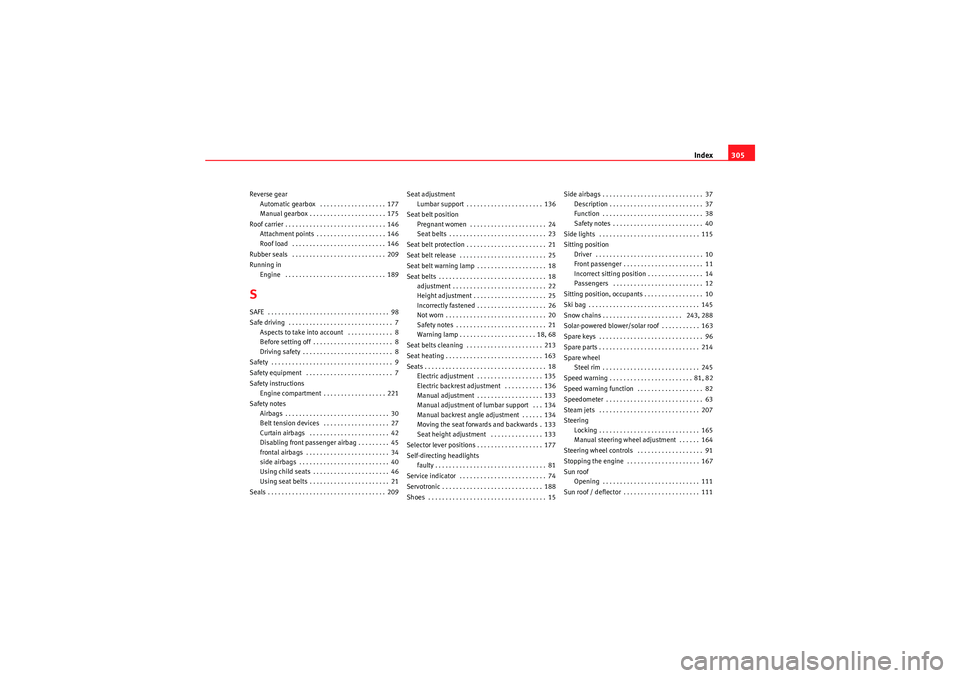
Index305
Reverse gear
Automatic gearbox . . . . . . . . . . . . . . . . . . . 177
Manual gearbox . . . . . . . . . . . . . . . . . . . . . . 175
Roof carrier . . . . . . . . . . . . . . . . . . . . . . . . . . . . . 146 Attachment points . . . . . . . . . . . . . . . . . . . . 146
Roof load . . . . . . . . . . . . . . . . . . . . . . . . . . . 146
Rubber seals . . . . . . . . . . . . . . . . . . . . . . . . . . . 209
Running in Engine . . . . . . . . . . . . . . . . . . . . . . . . . . . . . 189SSAFE . . . . . . . . . . . . . . . . . . . . . . . . . . . . . . . . . . . 98
Safe driving . . . . . . . . . . . . . . . . . . . . . . . . . . . . . . 7Aspects to take into account . . . . . . . . . . . . . 8
Before setting off . . . . . . . . . . . . . . . . . . . . . . . 8
Driving safety . . . . . . . . . . . . . . . . . . . . . . . . . . 8
Safety . . . . . . . . . . . . . . . . . . . . . . . . . . . . . . . . . . . 9
Safety equipment . . . . . . . . . . . . . . . . . . . . . . . . . 7
Safety instructions Engine compartment . . . . . . . . . . . . . . . . . . 221
Safety notes Airbags . . . . . . . . . . . . . . . . . . . . . . . . . . . . . . 30
Belt tension devices . . . . . . . . . . . . . . . . . . . 27
Curtain airbags . . . . . . . . . . . . . . . . . . . . . . . 42
Disabling front passenger airbag . . . . . . . . . 45
frontal airbags . . . . . . . . . . . . . . . . . . . . . . . . 34
side airbags . . . . . . . . . . . . . . . . . . . . . . . . . . 40
Using child seats . . . . . . . . . . . . . . . . . . . . . . 46
Using seat belts . . . . . . . . . . . . . . . . . . . . . . . 21
Seals . . . . . . . . . . . . . . . . . . . . . . . . . . . . . . . . . . 209 Seat adjustment
Lumbar support . . . . . . . . . . . . . . . . . . . . . . 136
Seat belt position Pregnant women . . . . . . . . . . . . . . . . . . . . . . 24
Seat belts . . . . . . . . . . . . . . . . . . . . . . . . . . . . 23
Seat belt protection . . . . . . . . . . . . . . . . . . . . . . . 21
Seat belt release . . . . . . . . . . . . . . . . . . . . . . . . . 25
Seat belt warning lamp . . . . . . . . . . . . . . . . . . . . 18
Seat belts . . . . . . . . . . . . . . . . . . . . . . . . . . . . . . . 18 adjustment . . . . . . . . . . . . . . . . . . . . . . . . . . . 22
Height adjustment . . . . . . . . . . . . . . . . . . . . . 25
Incorrectly fastened . . . . . . . . . . . . . . . . . . . . 26
Not worn . . . . . . . . . . . . . . . . . . . . . . . . . . . . . 20
Safety notes . . . . . . . . . . . . . . . . . . . . . . . . . . 21
Warning lamp . . . . . . . . . . . . . . . . . . . . . . 18, 68
Seat belts cleaning . . . . . . . . . . . . . . . . . . . . . . 213
Seat heating . . . . . . . . . . . . . . . . . . . . . . . . . . . . 163
Seats . . . . . . . . . . . . . . . . . . . . . . . . . . . . . . . . . . . 18 Electric adjustment . . . . . . . . . . . . . . . . . . . 135
Electric backrest adjustment . . . . . . . . . . . 136
Manual adjustment . . . . . . . . . . . . . . . . . . . 133
Manual adjustment of lumbar support . . . 134
Manual backrest angle adjustment . . . . . . 134
Moving the seat forwards and backwards . 133
Seat height adjustment . . . . . . . . . . . . . . . 133
Selector lever positions . . . . . . . . . . . . . . . . . . . 177
Self-directing headlights faulty . . . . . . . . . . . . . . . . . . . . . . . . . . . . . . . . 81
Service indicator . . . . . . . . . . . . . . . . . . . . . . . . . 74
Servotronic . . . . . . . . . . . . . . . . . . . . . . . . . . . . . 188
Shoes . . . . . . . . . . . . . . . . . . . . . . . . . . . . . . . . . . 15 Side airbags . . . . . . . . . . . . . . . . . . . . . . . . . . . . . 37
Description . . . . . . . . . . . . . . . . . . . . . . . . . . . 37
Function . . . . . . . . . . . . . . . . . . . . . . . . . . . . . 38
Safety notes . . . . . . . . . . . . . . . . . . . . . . . . . . 40
Side lights . . . . . . . . . . . . . . . . . . . . . . . . . . . . . 115
Sitting position Driver . . . . . . . . . . . . . . . . . . . . . . . . . . . . . . . 10
Front passenger . . . . . . . . . . . . . . . . . . . . . . . 11
Incorrect sitting position . . . . . . . . . . . . . . . . 14
Passengers . . . . . . . . . . . . . . . . . . . . . . . . . . 12
Sitting position, occupants . . . . . . . . . . . . . . . . . 10
Ski bag . . . . . . . . . . . . . . . . . . . . . . . . . . . . . . . . 145
Snow chains . . . . . . . . . . . . . . . . . . . . . . . 243, 288
Solar-powered blower/solar roof . . . . . . . . . . . 163
Spare keys . . . . . . . . . . . . . . . . . . . . . . . . . . . . . . 96
Spare parts . . . . . . . . . . . . . . . . . . . . . . . . . . . . . 214
Spare wheel Steel rim . . . . . . . . . . . . . . . . . . . . . . . . . . . . 245
Speed warning . . . . . . . . . . . . . . . . . . . . . . . . 81, 82
Speed warning function . . . . . . . . . . . . . . . . . . . 82
Speedometer . . . . . . . . . . . . . . . . . . . . . . . . . . . . 63
Steam jets . . . . . . . . . . . . . . . . . . . . . . . . . . . . . 207
Steering Locking . . . . . . . . . . . . . . . . . . . . . . . . . . . . . 165
Manual steering wheel adjustment . . . . . . 164
Steering wheel controls . . . . . . . . . . . . . . . . . . . 91
Stopping the engine . . . . . . . . . . . . . . . . . . . . . 167
Sun roof Opening . . . . . . . . . . . . . . . . . . . . . . . . . . . . 111
Sun roof / deflector . . . . . . . . . . . . . . . . . . . . . . 111
Exeo_EN.book Seite 305 Freitag, 28. August 2009 10:14 10