ESP Seat Exeo 2009 Workshop Manual
[x] Cancel search | Manufacturer: SEAT, Model Year: 2009, Model line: Exeo, Model: Seat Exeo 2009Pages: 310, PDF Size: 8.54 MB
Page 216 of 310
Accessories, replacement of parts and modifications
214Accessories, replacement of parts and modificationsAccessories and spare partsAlways consult an Authorised Service Centre before
purchasing accessories and parts.Your vehicle is designed to offer a high standard of active and passive safety.
Before purchasing accessories and parts, and before making technical
changes to your car, we recommend you consult your Authorised Service
Centre.
SEAT dealerships will be happy to provide you with the latest information
about the use, legal requirements and recommendations from the manufac-
turer regarding accessories and parts.
We recommend you use only SEAT Approved Accessories
® and SEAT
Approved Spare Parts
®. This way, SEAT can guarantee that the product in
question is suitable, reliable and safe. SEAT Authorised Service Centres have
the necessary experience and facilities to ensure that parts are correctly and
professionally installed.
Despite a continuous observation of the market, SEAT is not able to assess
the reliability, safety and suitability of those parts SEAT has not approved. For
this reason, SEAT cannot assume responsibility for any non-genuine parts
used, even if these parts have been approved by an official testing agency or
are covered by an official approval certificate.
Any equipment subsequently installed which has a direct effect on the
ve hi cle a nd/ or the way i t is d ri ve n ( e. g. cr u is e co ntrol s ys te m o r e lec tro ni ca lly-
controlled suspension) must be approved by SEAT and bear the e mark (the
European Union's authorisation symbol).
If any additional electrical components are fitted so that they do not ser ve to
control the vehicle itself (for instance a refrigerator box, laptop or ventilator fan, etc.), then they must bear the
CE mark (European Union manufacturer
conformity declaration).
WARNING
Accessories, for example telephone holders or drink holders, should never
be fitted on the covers of, or within the working range of the airbags. Other-
wise, there is a danger of injury if the airbag is triggered in an accident.Technical modificationsModifications must always be carried out according to our
specifications.Unauthorised modifications to the electronic components or software in the
vehicle may cause malfunctions. Due to the way the electronic components
are linked together in networks, other indirect systems may be affected by the
faults. This can seriously impair safety, lead to excessive wear of compo-
nents, and also invalidate your vehicle registration documents.
SEAT Authorised Service Centres cannot be held liable for any damage
caused by modifications and/or work incorrectly performed.
For this reason, we recommend you that all work should be performed by an
Authorised Service Centre using genuine and SEAT
® approved parts and
accessories .
Exeo_EN.book Seite 214 Freitag, 28. August 2009 10:14 10
Page 220 of 310
Checking and refilling levels
218PetrolPetrol types
The recommended fuel types are listed on a sticker inside the
fuel tank flap.Only unleaded petrol, corresponding to the standard DIN EN 228 , may be
used for vehicles with catalytic converters (EN = “European Standard”).
Fuel types are differentiated by the octane rating, e.g: 91, 95, 98 RON (RON
= “Regulation Octane Number, unit for determining the knock resistance of
petrol”). You may use petrol with a higher octane number than the one recom-
mended for your engine. However, this has no advantage in terms of fuel
consumption and engine power.
The correct fuel type for your vehicle is given in the technical table for the
engine. Section “Technical Data”
Caution
•Petrol that follows EN 228 may be mixed with small quantities of ethanol.
However, the so-called “bioethanol fuels” available at commercial establish-
ments, e.g. with reference E50 or E85, which contain a high percentage of
ethanol, may not be used, as they will damage the fuel system.•Even one tankful of leaded fuel would permanently impair the efficiency
of the catalytic converter.•High engine speed and full throttle can damage the engine when using
petrol with an octane rating lower than the correct grade for the engine.For the sake of the environment
Just one full tank of leaded fuel would seriously impair the efficiency of the
catalytic converter.
Petrol additives
Petrol additives improve the quality of the petrol.The quality of the petrol influences running behaviour, performance and
service life of the engine. For this reason, you should use good quality petrol
containing additives. These additives will help to prevent corrosion, keep the
fuel system clean and prevent deposits from building up in the engine.
If good quality petrol with additives is not available or engine problems occur,
the required additives must be added during refuelling.DieselDiesel*Diesel fuel must correspond to DIN EN 590 (EN = “European standard”). It
must have a cetane number (CN) of at least 51. The cetane number indicates
the ignition quality of the diesel fuel.
Notes on refuelling ⇒page 216.Biodiesel*The biodiesel fuel must comply with the DIN EN 14.214 (FAME) Standard.•Biodiesel is a methyl ester obtained from rapeseed oil.•DIN is the German abbreviation for “ Deutsches Institut für N ormung e.V.”,
the German standards institute.•EN means European Norm.•FAME is the English abbreviation for “ Fatty Acid Methyl Ester”.
Exeo_EN.book Seite 218 Freitag, 28. August 2009 10:14 10
Page 223 of 310
Checking and refilling levels221
Safety First
Controls and equipment
Practical tips
Technical Data
WARNING
Never open the bonnet if you see steam or drips of coolant being released
from t he engine com par t ment . Fail ure to com ply could resul t in burns . Wait
until no steam or coolant can be seen before opening the bonnet.Work in the engine compartment
Extra caution is necessary when working on components in
the engine compartment.Always be aware of the danger of injury and scalding as well as the risk of
accident or even fire when working in the engine compartment (e.g. when
checking and refilling fluids). Therefore, always observe the warnings listed
below and follow all general safety precautions. The engine compartment of
any motor vehicle is a potentially hazardous area ⇒
WARNING
•Switch the engine off.•Remove the ignition key.•Apply handbrake firmly.•If your vehicle is equipped with a manual gearbox, place the gearshift
lever in neutral. If you are driving an automatic vehicle, place the selector
lever in the position P.•Wait for the engine to cool down.•Children should not be allowed to approach the engine compartment•Never spill liquids involved in vehicle operations on the engine
compartment, as these may catch fire (e.g. anti-freeze containing liquid
coolant).
•Take care not to cause short circuits in the electrical system, especially
when working on the battery.•Never touch the radiator fan while the engine is hot, as the fan could
start up suddenly.•Never open the expansion tank when the engine is hot. The cooling
system is under pressure.•Protect face, hands and arms from any hot steam or hot liquid coolant
released by covering the cap with a large, thick rag when opening the
expansion tank.•If any tests have to be performed with the engine running, there is an
extra safety risk from the rotating parts, such as the drive belts, alternator
and radiator fan, etc., and from the high-voltage ignition system.•Observe the following additional warnings if work on the fuel system or
the electrical system is necessary:
−Always disconnect the battery.
− Do not smoke.
− Never work near open flames
− Always keep an approved fire extinguisher immediately available.Caution
When topping up fluids, make sure the correct fluid is put into the correct
filler opening. This can otherwise cause serious malfunctions or engine
damage.
For the sake of the environment
Inspect the ground underneath your vehicle regularly so that any leaks are
detected at an early stage. If you find spots of oil or other fluids, have your
vehicle inspected in the garage.
WARNING (continued)
Exeo_EN.book Seite 221 Freitag, 28. August 2009 10:14 10
Page 225 of 310
Checking and refilling levels223
Safety First
Controls and equipment
Practical tips
Technical Data
•Vehicles with a diesel particulate filter must only b e fille d with VW 507 00
engine oil.•Avoid mixing this oil with other engine oils.•Only in exceptional circumstances, if the engine oil level is too low
⇒ page 224 and you cannot obtain the oil specified for your vehicle, can you
put in a small quantity of oil (once) conforming to the VW 506 00, VW 506 01,
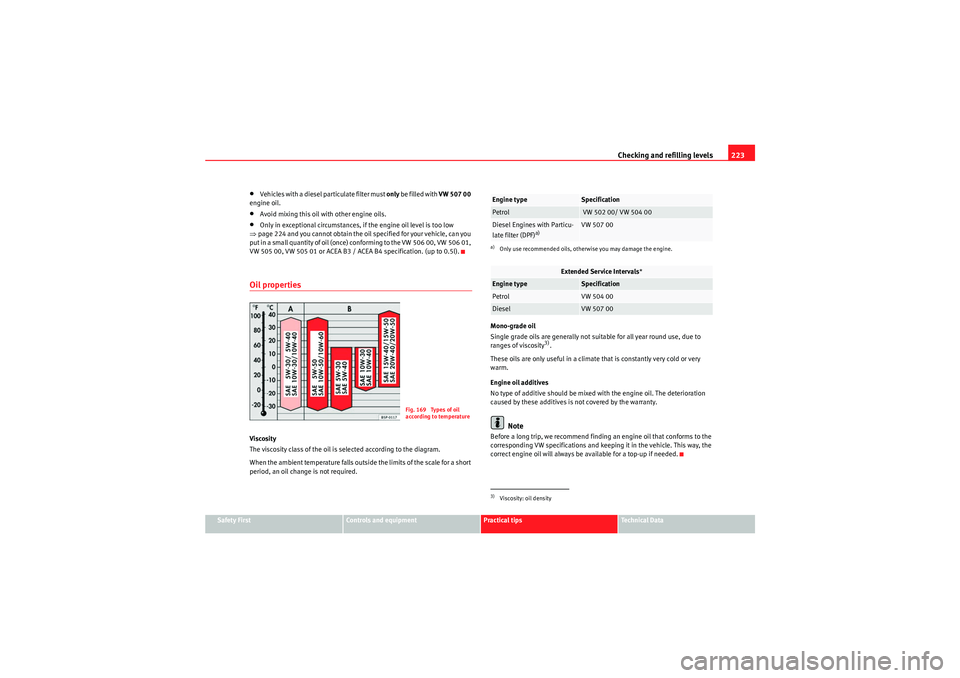
VW 505 00, VW 505 01 or ACEA B3 / ACEA B4 specification. (up to 0.5l).Oil propertiesViscosity
The viscosity class of the oil is selected according to the diagram.
When the ambient temperature falls outside the limits of the scale for a short
period, an oil change is not required. Mono-grade oil
Single grade oils are generally not suitable for all year round use, due to
ranges of viscosity
3).
These oils are only useful in a climate that is constantly very cold or very
warm.
Engine oil additives
No type of additive should be mixed with the engine oil. The deterioration
caused by these additives is not covered by the warranty.
Note
Before a long trip, we recommend finding an engine oil that conforms to the
corresponding VW specifications and keeping it in the vehicle. This way, the
correct engine oil will always be available for a top-up if needed.
Fig. 169 Types of oil
according to temperature
Engine type
Specification
Petrol
VW 502 00/ VW 504 00
Diesel Engines with Particu-
late filter (DPF)
a)
a)Only use recommended oils, otherwise you may damage the engine.
VW 507 00
Extended Service Intervals *
Engine type
Specification
Petrol
VW 504 00
Diesel
VW 507 00
3)Viscosity: oil density
Exeo_EN.book Seite 223 Freitag, 28. August 2009 10:14 10
Page 228 of 310
Checking and refilling levels
226freeze protection of temperatures down to approx. -40°C. However, the
concentration of anti-freeze must not exceed 60%, as the anti-freeze protec-
tion would then drop and the performance of the coolant system would suffer.
Vehicles for countries with cold climates (e.g. Sweden, Norway and Finland)
have factory-filled anti-freeze protection for temperatures down to -35°C. In
these countries, the concentration of anti-freeze should always be at least
50%.
Caution
•It is advisable to have the cooling system checked before the winter
season to make sure that the antifreeze concentration is adequate for the
conditions to be expected. This applies particularly if you intend to take the
car into a colder climate zone. If necessary, have the antifreeze concentration
increased to 50 - 60% as required.•Use only anti-freeze G12++ , an additive meeting the “TL-VW 774G” spec-
ification. Other anti-freezes may give considerably inferior corrosion protec-
tion. The damage caused by the use of these anti-freezes may lead to a loss
of liquid coolant, causing serious damage to the engine.•The anti-freeze G12++ can be mixed only with anti-freeze additives G11,
G12 and G12+.
Checking the liquid coolant level
The liquid coolant level can be checked at a glance.– Switch the ignition off.
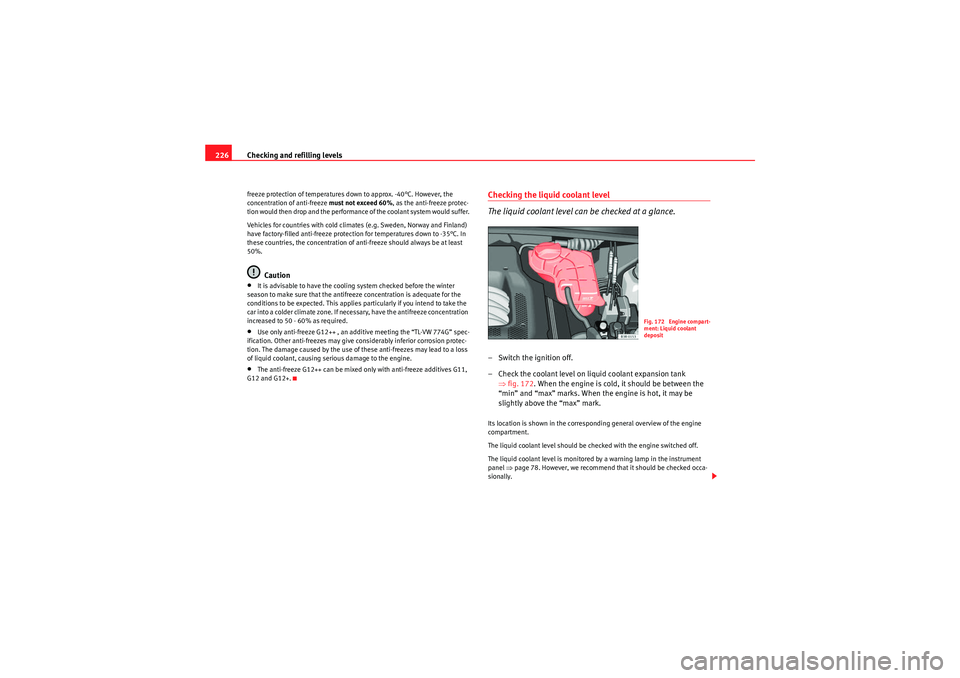
– Check the coolant level on liquid coolant expansion tank ⇒fig. 172 . When the engine is cold, it should be between the
“min” and “max” marks. When the engine is hot, it may be
slightly above the “max” mark.Its location is shown in the corresponding general overview of the engine
compartment.
The liquid coolant level should be checked with the engine switched off.
The liquid coolant level is monitored by a warning lamp in the instrument
panel ⇒ page 78. However, we recommend that it should be checked occa-
sionally.
Fig. 172 Engine compart-
ment: Liquid coolant
deposit
Exeo_EN.book Seite 226 Freitag, 28. August 2009 10:14 10
Page 236 of 310
Checking and refilling levels
234special charger and the corresponding level of knowledge. We therefore
recommend that this work should only be performed by a specialist garage.
A flat battery can freeze at temperatures of around 0°C. The battery must be
defrosted before charging ⇒. It is advisable to replace the battery if it has
frozen, because the ice can crack the battery casing and allow the battery
acid to escape.
The battery caps should not be opened while the battery is being charged.
WARNING
Never charge a frozen battery. Failure to comply could result in an
explosion.
Exeo_EN.book Seite 234 Freitag, 28. August 2009 10:14 10
Page 238 of 310
Wheels and tyres
236
2. The tyre pressures should only be checked when the tyres are cold. The slightly raised pressu res of warm tyres must not be
reduced.
3. Adjust the tyre pressure to the load you are carrying.Tyre pressure
The correct tyre pressure is especially important at high speeds. The pressure
should therefore be checked at least once a month and before starting a
journey.
The sticker with the tyre pressure values can be found on the inside of the
tank flap. The tyre pressure values given are for cold tyres. Do not reduce the
slightly raised pressures of warm tyres ⇒.
WARNING
•Check the tyre pressure at least once per month. Checking tyre pressure
value is very important. If the tyre pressure is too high or too low, there is
an increased danger of accidents - particularly at high speeds.•A tyre can easily burst if the pressure is too low, causing an accident!•At continuously high speeds, a tyre with insufficient pressure flexes
more. In this way it becomes too hot, and this can cause tread separation
and tyre blow-out. Always observe the recommended tyre pressures.•If the tyre pressure is too low or too high, the tyres will wear prema-
turely and the vehicle will not handle well. Risk of accident!For the sake of the environment
Under-inflated tyres will increase fuel consumption.
Tyre pressure monitoring*
The tyre pressure monitoring system constantly checks the
pressure of the tyres.The system warns the driver in the event of a loss of pressure by means of
symbols and messages in the instrument cluster display.
Note that tyre pressure also depends on tyre temperature. Tyre pressure
increases about 0.1 bar for each 10°C in tyre temperature increase. The tyre
heats up while the vehicle is being driven and the tyre pressure will rise
accordingly. For this reason, you should only adjust the tyre pressures when
they are cold (i.e. approximately at ambient temperature).
To ensure that the tyre pressure monitoring system works reliably, you should
check and, if necessary, adjust the tyre pressures at regular intervals and
store the correct pressures (reference values) in the system.
A tyre pressure information label is attached to the inside of the fuel tank flap.
WARNING
•Never adjust tyre pressure when the tyres are hot. This may damage or
even burst the tyres. Risk of accident!•An insufficiently inflated tyre flexes a lot more at high speeds and
causes significant heating of the tyre. Under these conditions, the tyre
bead may be released or the tyre may burst. Risk of accident!For the sake of the environment
Under-inflated tyres lead to increased fuel consumption and tyre wear.
Exeo_EN.book Seite 236 Freitag, 28. August 2009 10:14 10
Page 240 of 310
Wheels and tyres
238display TMPS (Tyre Pressure Monitoring System). Please contact the nearest
specialist garage as soon as possible.
The tyre pressure warning lamp
lights up if the tyre pressure on one or
more wheels is significantly lower than the tyre pressure setting which was
confirmed by the driver ⇒ .
WARNING
•If the tyre pressure warning lamp lights up
you must slow down
immediately and avoid any severe braking or steering manoeuvres. Stop
the vehicle as soon as possible and check the tyres and their pressure.
•The driver is responsible for maintaining correct tyre pressures. There-
fore, the tyre pressure must be regularly checked.•Under certain conditions (e.g. driving at high speeds, on ice and snow
or on poor road surfaces) the tyre pressure warning lamp
may not light
up immediately or not at all.
•Please ask your Dealer or specialist garage whether run-flat tyres can
be used on your vehicle. Fitting this type of tyre in an undue manner could
lead to your driving licence being taken away from you. Furthermore, it may
led to damage to the vehicle or, under certain circumstances, may cause
accidents.•If you change normal tyres for run-flat tyres or vice versa, the control
unit must be reprogrammed by the Dealer or a specialist garage.Note
If you did not press the button for the tyre pressure monitoring system to
confirm a new tyre pressure setting after making changes to the tyre pres-
sures or changing one or more wheels, the warning lamp
may light up
although the tyre pressures are correct. In this case, stop the vehicle as soon
as possible and, after examining the tyres, press the button for the tyre pres-
sure monitoring system.
Tyre ser vice life
The service life of tyres is dependent on tyre pressure, driving
style and fitting.
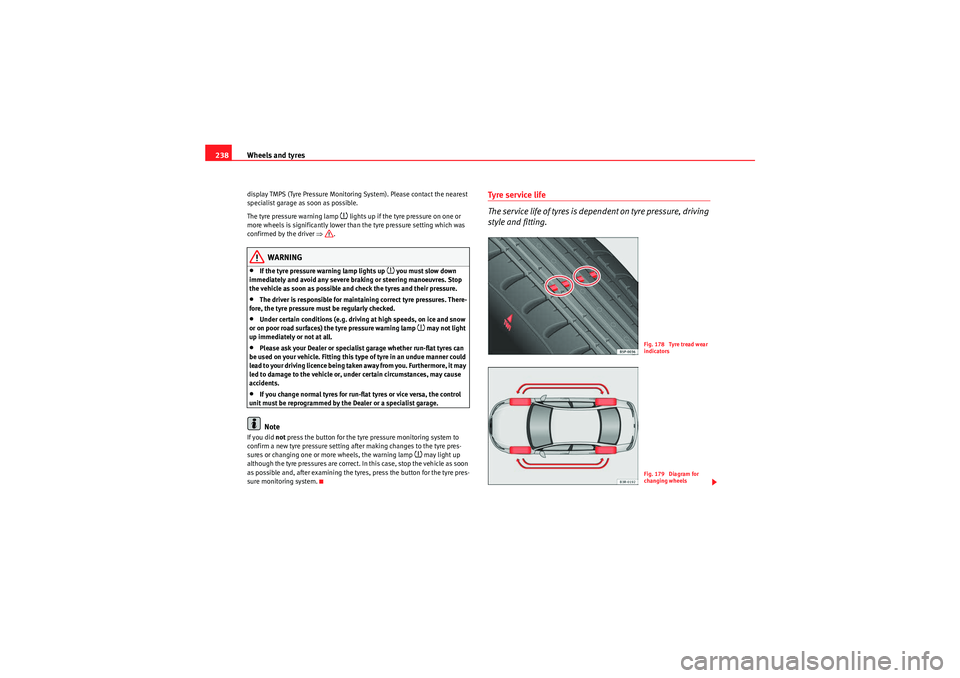
Fig. 178 Tyre tread wear
indicatorsFig. 179 Diagram for
changing wheels
Exeo_EN.book Seite 238 Freitag, 28. August 2009 10:14 10
Page 241 of 310
Wheels and tyres239
Safety First
Controls and equipment
Practical tips
Technical Data
Wear indicators
The original tyres on your vehicle have 1.6 mm high “tread wear indicators”
⇒
page 238, fig. 178 , running across the tread. Depending on the make,
there will be six to eight of them evenly spaced around the tyre. Markings on
the tyre sidewall (for instance the letters “TWI” or other symbols) indicate the
positions of the tread wear indicators. The minimum tread depth required by
law is 1.6 mm (measured in the tread grooves next to the tread wear indica-
tors). Worn tyres must be replaced. Different figures may apply in export
countries ⇒.
Tyre pressure
Under-inflation or over-inflation will reduce the life of the tyres considerably
and also impair the car's handling. The inflation pressures are listed on a
sticker on the inside of the fuel tank flap.
Correct inflation pressures are very important, especially at high speeds. The
pressure should therefore be checked at least once a month and before
starting any long journey.
Tyre pressure monitoring (RKA+ )*
Monitoring of the tyre pressures is based on the tyre pressures you have
stored. The tyre pressure monitoring system cannot function as intended if
you store tyre pressure settings for a normal load, but then drive with the
vehicle fully laden. The tyre pressure must be adapted to the actual load and
stored accordingly in the tyre pressure monitoring system ⇒page 237.
Driving style
Fast cornering, heavy acceleration and hard braking all increase tyre wear.
Changing wheels around
If the front tyres are worn considerably more than the rear ones it is advisable
to cha nge t he m ar oun d as sh own ⇒ page 238, fig. 179. All the tyres will then
last for about the same time. Wheel balance
The wheels on new vehicles are balanced. However, various factors encoun-
tered in normal driving can cause them to become unbalanced, which results
in steering vibration.
Unbalanced wheels should be rebalanced, as they otherwise cause excessive
wear on steering, suspension and tyres. A wheel must also be rebalanced
when a new tyre is fitted.
Incorrect wheel alignment
Incorrect wheel alignment causes excessive tyre wear, impairing the safety of
the vehicle. If tyres show excessive wear, you should have the wheel align-
ment checked by an Authorised Service Centre.
WARNING
There is a serious danger of accidents if a tyre bursts during driving!•The tyres must be replaced at the latest when the tread is worn down to
the tread wear indicators. Failure to do so could result in an accident. Worn
tyres do not grip well at high speeds on wet roads. There is also a greater
risk of “aquaplaning” •At continuously high speeds, a tyre with insufficient pressure flexes
more. This causes it to overheat. This can cause tread separation and tyre
blow-out. Risk of accident. Always observe the recommended tyre pres-
sures.•If tyres show excessive wear, you should have the running gear checked
by an Authorised Service Centre.•Keep chemicals such as oil, fuel and brake fluid away from tyres.•Damaged wheels and tyres must be replaced immediately!For the sake of the environment
Under-inflated tyres will increase fuel consumption.
Exeo_EN.book Seite 239 Freitag, 28. August 2009 10:14 10
Page 242 of 310
Wheels and tyres
240Anti-puncture tyres*
Anti-puncture tyres allow you to continue driving even with a
punctured tyre, in the majority of cases.Vehicles equipped with anti-puncture
4) tyres from the factory indi-
cate the loss of tyre pressure on the instrument panel.
Driving with anti-puncture tyres (emergency gear)
– Leave the ESP/TCS (electronic stabilisation programme) switched on, or switch on ⇒page 68.
– Continue driving carefully and slowly (80 km/h maximum).
– Avoid sudden manoeuvres and sharp turns.
– Avoid driving over obstacles (for example kerbs) or potholes.
– Look out for the ESP/TCS intervening often, smoke coming from the tyres or the smell of rubber, the vehicle vibrating or a clat-
tering noise. If any of these occur, stop the vehicle.
The anti-puncture tyres have a tag on the side of the tyre, with the description:
“DSST”, “Eufonia”, “RFT”, “ROF”, “RSC”, “SSR” or “ZP”.
The sides of this type of tyre are reinforced. When the tyres lose air they are
supported on the sides (emergency driving).
The loss of pressure in the tyre is shown on the instrument panel. You can
then drive a maximum of 80 km and if the circumstances are favourable (for
example, low load), even more.
The damaged tyre should be changed as soon as possible. The rim should be
checked in a specialist workshop to detect possible damage and replace it if necessary. We recommend you contact Technical Service. If more than one
tyre is being used under emergency co
nditions, this reduces the distance
which can be travelled.
Starting driving in emergency conditions
When loss in tyre pressure is displayed on the instrument panel, this means
that at least one tyre is being driven in emergency conditions ⇒.
End of emergency operation
Do not drive on if:
•smoke is coming from one of the tyres,•there is a smell of rubber,•the vehicle vibrates,•there is a rattling noise.
When is it no longer possible to continue driving even using anti-puncture
tyres?•If the Electronic Stabilisation Program (ESP) is out of operation.•If the tyre pressure monitoring system is out of operation.•If one of the tyres has been severely damaged in an accident, etc. If a tyre
has been badly damaged there is a risk that parts of the tread can be thrown
off and cause damage to the fuel lines, brake pipes or fuel filler.•It is also advisable to stop driving if severe vibrations occur, or if the wheel
starts overheating and gives off smoke.WARNING
When driving in emergency conditions, the driving quality of the vehicle is
considerably impaired.•The maximum permitted speed of 80 km/h is subject to road and
weather conditions. Please observe legal requirements when doing so.•Avoid sharp turns and rapid manoeuvres, and brake earlier than usual.
4)Depending upon version and country.
Exeo_EN.book Seite 240 Freitag, 28. August 2009 10:14 10