ESP Seat Exeo 2009 Repair Manual
[x] Cancel search | Manufacturer: SEAT, Model Year: 2009, Model line: Exeo, Model: Seat Exeo 2009Pages: 310, PDF Size: 8.54 MB
Page 258 of 310
If and when
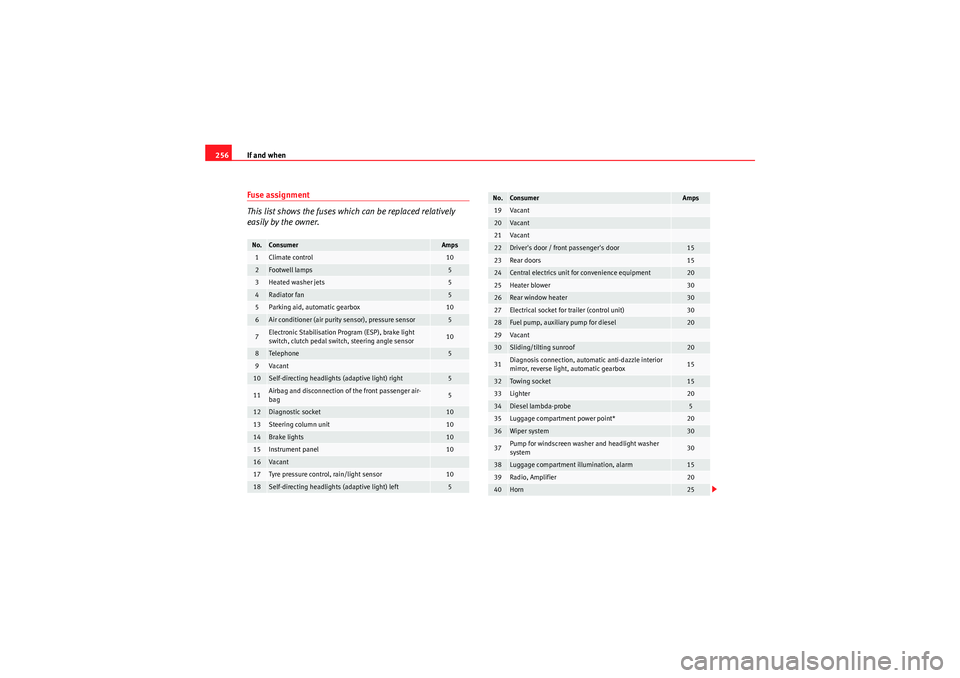
256Fuse assignment
This list shows the fuses which can be replaced relatively
easily by the owner.No.
Consumer
Amps
1
Climate control
10
2
Footwell lamps
5
3
Heated washer jets
5
4
Radiator fan
5
5
Parking aid, automatic gearbox
10
6
Air conditioner (air purity sensor), pressure sensor
5
7
Electronic Stabilisation Program (ESP), brake light
switch, clutch pedal switch, steering angle sensor
10
8
Tele ph one
5
9
Va can t
10
Self-directing headlights (adaptive light) right
5
11
Airbag and disconnection of the front passenger air-
bag
5
12
Diagnostic socket
10
13
Steering column unit
10
14
Brake lights
10
15
Instrument panel
10
16
Va can t
17
Tyre pressure control, rain/light sensor
10
18
Self-directing headlights (adaptive light) left
5
19
Va can t
20
Va can t
21
Va can t
22
Driver's door / front passenger's door
15
23
Rear doors
15
24
Central electrics unit for convenience equipment
20
25
Heater blower
30
26
Rear window heater
30
27
Electrical socket for trailer (control unit)
30
28
Fuel pump, auxiliary pump for diesel
20
29
Va can t
30
Sliding/tilting sunroof
20
31
Diagnosis connection, automatic anti-dazzle interior
mirror, reverse light, automatic gearbox
15
32
Towing socket
15
33
Lighter
20
34
Diesel lambda-probe
5
35
Luggage compartment power point*
20
36
Wiper system
30
37
Pump for windscreen washer and headlight washer
system
30
38
Luggage compartment illumination, alarm
15
39
Radio, Amplifier
20
40
Horn
25
No.
Consumer
Amps
Exeo_EN.book Seite 256 Freitag, 28. August 2009 10:14 10
Page 259 of 310
If and when257
Safety First
Controls and equipment
Practical tips
Technical Data
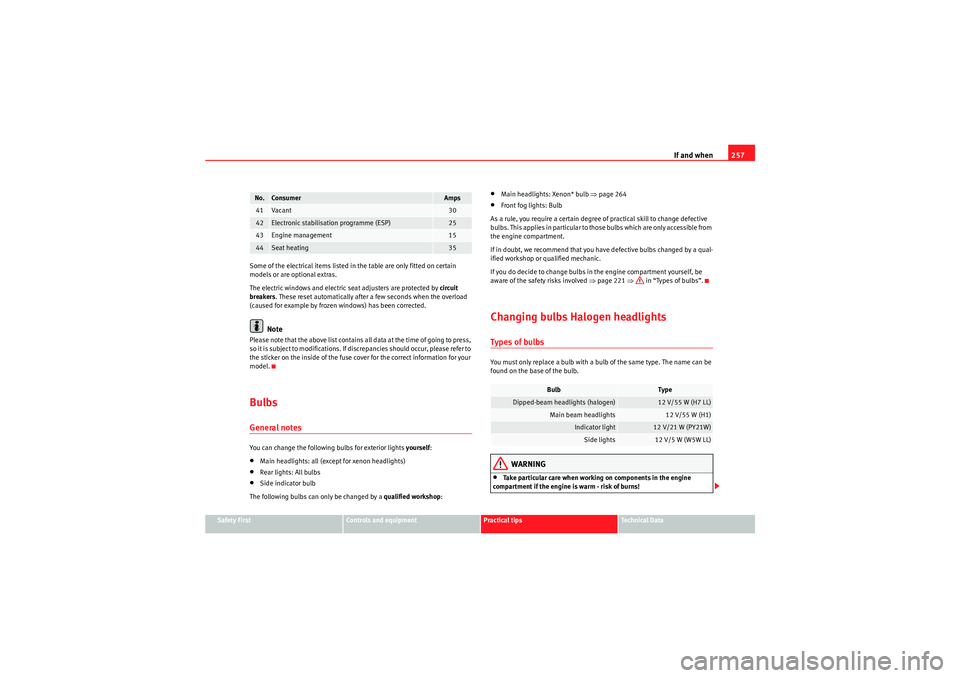
Some of the electrical items listed in the table are only fitted on certain
models or are optional extras.
The electric windows and electric seat adjusters are protected by circuit
breakers
. These reset automatically after a few seconds when the overload
(caused for example by frozen windows) has been corrected.
Note
Please note that the above list contains all data at the time of going to press,
so it is subject to modifications. If discrepancies should occur, please refer to
the sticker on the inside of the fuse cover for the correct information for your
model.BulbsGeneral notesYou can change the following bulbs for exterior lights yourself:•Main headlights: all (except for xenon headlights)•Rear lights: All bulbs•Side indicator bulb
The following bulbs can only be changed by a qualified workshop:
•Main headlights: Xenon* bulb ⇒page 264•Front fog lights: Bulb
As a rule, you require a certain degree of practical skill to change defective
bulbs. This applies in particular to those bulbs which are only accessible from
the engine compartment.
If in doubt, we recommend that you have defective bulbs changed by a qual-
ified workshop or qualified mechanic.
If you do decide to change bulbs in the engine compartment yourself, be
aware of the safety risks involved ⇒page 221 ⇒ in “Types of bulbs”.Changing bulbs Halogen headlightsTypes of bulbsYou must only replace a bulb with a bulb of the same type. The name can be
found on the base of the bulb.
WARNING
•Take particular care when working on components in the engine
compartment if the engine is warm - risk of burns!
41
Va can t
30
42
Electronic stabilisation programme (ESP)
25
43
Engine management
15
44
Seat heating
35
No.
Consumer
Amps
Bulb
Type
Dipped-beam headlights (halogen)
12 V/55 W (H7 LL)
Main beam headlights
12 V/55 W (H1)
Indicator light
12 V/21 W (PY21W)
Side lights
12 V/5 W (W5W LL)
Exeo_EN.book Seite 257 Freitag, 28. August 2009 10:14 10
Page 260 of 310
If and when
258•Bulbs are highly sensitive to pressure. The glass can break when you
touch the bulb, causing injury.•The high voltage element of gas discharge lamps* (xenon light) must
be handled correctly. Otherwise, there is a risk of death.•When changing bulbs, please take care not to injure yourself on sharp
parts in the headlight housing.Caution
•Remove the ignition key before working on the electric system. If not, a
short circuit could occur.•Switch off the lights or parking lights before you change a bulb.For the sake of the environment
Please ask your specialist retailer how to dispose of used bulbs in the proper
manner.
Note
•Depending on weather conditions (cold or wet), the front lights, the fog
lights, the rear lights and the indicators may be temporarily misted. This does
not affect the useful life of the lighting system. By switching on the lights, the
area through which the beam of light is projected will quickly be demisted.
However, the edges may continue to be misted.•Please check at regular intervals that all lighting (especially the exterior
lighting) on your vehicle is functioning properly. This is not only in the interest
of your own safety, but also in that of all other road users.•Before changing a bulb, make sure you have the correct new bulb.•Do not touch the glass part of the bulb with your bare hands, use a cloth
or paper towel instead. Otherwise, the fingerprints left on the glass will vaporise as a result of the heat generated by the bulb, be deposited on the
reflector and impair its surface.
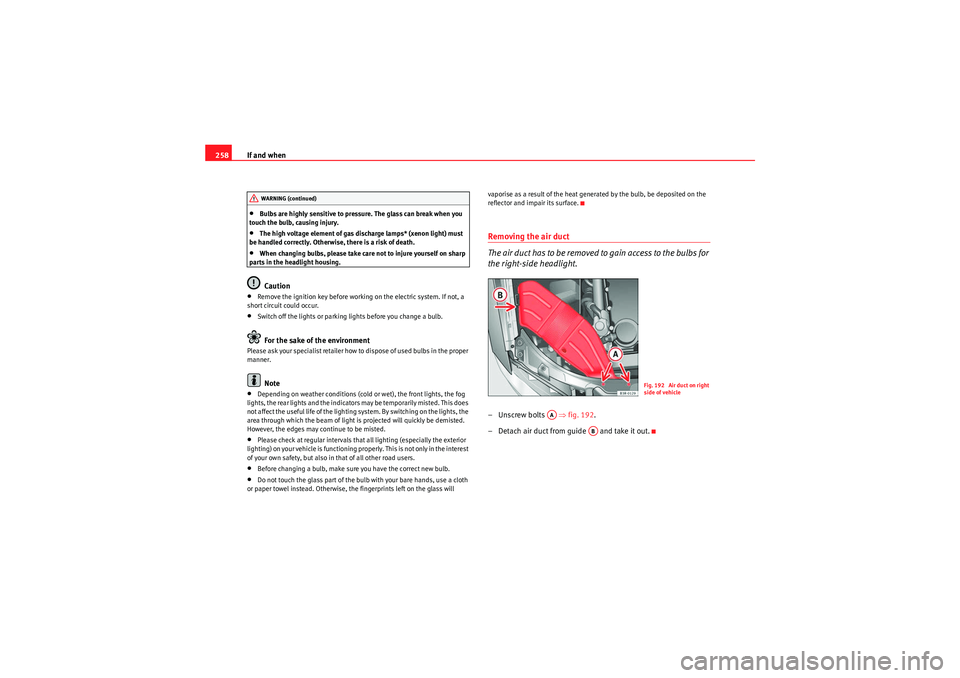
Removing the air duct
The air duct has to be removed to gain access to the bulbs for
the right-side headlight.–Unscrew bolts ⇒
fig. 192.
– Detach air duct from guide and take it out.
WARNING (continued)
Fig. 192 Air duct on right
side of vehicle
AA
AB
Exeo_EN.book Seite 258 Freitag, 28. August 2009 10:14 10
Page 267 of 310
If and when265
Safety First
Controls and equipment
Practical tips
Technical Data
WARNING
•Take particular care when working on components in the engine
compartment if the engine is warm - risk of burns!•Bulbs are highly sensitive to pressure. The glass can break when you
touch the bulb, causing injury.•The high voltage element of gas discharge lamps* (xenon light) must
be handled correctly. Otherwise, there is a risk of death.•When changing bulbs, please take care not to injure yourself on sharp
parts in the headlight housing.Caution
•Remove the ignition key before working on the electric system. If not, a
short circuit could occur.•Switch off the lights or parking lights before you change a bulb.For the sake of the environment
Please ask your specialist retailer how to dispose of used bulbs in the proper
manner.
Note
•Depending on weather conditions (cold or wet), the front lights, the fog
lights, the rear lights and the indicators may be temporarily misted. This does not affect the useful life of the lighting system. By switching on the lights, the
area through which the beam of light is projected will quickly be demisted.
However, the edges may continue to be misted.
•Please check at regular intervals that all lighting (especially the exterior
lighting) on your vehicle is functioning pr operly. This is not only in the interest
of your own safety, but also in that of all other road users.•Before changing a bulb, make sure you have the correct new bulb.•Do not touch the glass part of the bulb with your bare hands, use a cloth
or paper towel instead. Otherwise, the fingerprints left on the glass will
vaporise as a result of the heat generated by the bulb, be deposited on the
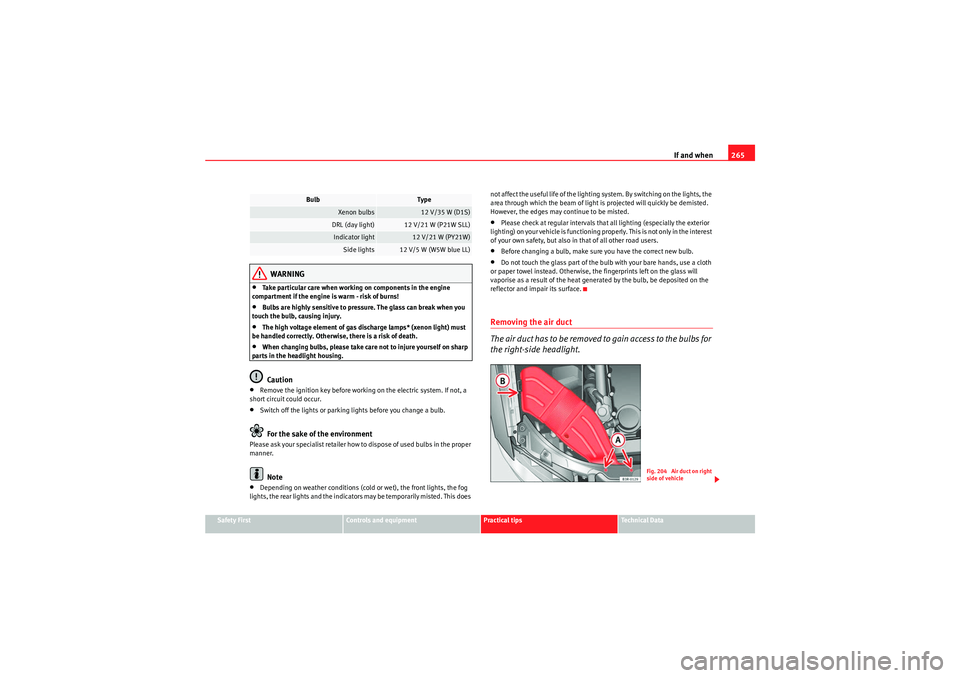
reflector and impair its surface.Removing the air duct
The air duct has to be removed to gain access to the bulbs for
the right-side headlight.
Bulb
Type
Xenon bulbs
12 V/35 W (D1S)
DRL (day light)
12 V/21 W (P21W SLL)
Indicator light
12 V/21 W (PY21W)
Side lights
12 V/5 W (W5W blue LL)
Fig. 204 Air duct on right
side of vehicle
Exeo_EN.book Seite 265 Freitag, 28. August 2009 10:14 10
Page 284 of 310
If and when
282Towing and tow-startingTo w - s t a r t i n g
The use of jump leads is preferable to tow-starting.We recommend that you do not tow-start your vehicle. Jump-starting
is preferable ⇒ page 279.
However, if your vehicle has to be tow-started:
– Engage the 2
nd or the 3
rd gear.
– Keep the clutch pressed down.
– Switch the ignition on.
– Once both vehicles are moving, release the clutch.
– As soon as the engine starts, press the clutch and move the gear lever into neutral. This helps to prevent driving into the towing
vehicle.
WARNING
The risk of accidents is high when tow-starting. The vehicle being towed
can easily collide with the towing vehicle.
Caution
When tow-starting, fuel could enter the catalytic converter and damage it.
CommentsPlease observe the following points if you use a tow-rope:
Notes for the driver of the towing vehicle
– Drive slowly at first until the tow-rope is taut. Then accelerate gradually.
– Begin and change gears cautiously. If you are driving an auto- matic vehicle, accelerate gently.
– Remember that the brake servo and power steering are not working in the vehicle you are towing. Brake earlier than you
would normally, but with a more gentle pressure on the brake.
Notes for the driver of the towed vehicle
– Ensure that the tow-rope remains taut at all times when towing.Tow-rope or tow-bar
It is easier and safer to tow a vehicle with a tow-bar. You should only use a
tow-rope if you do not have a tow-bar.
A tow-rope should be slightly elastic to reduce the loading on both vehicles.
It is advisable to use a tow-rope made of synthetic fibre or similarly elastic
material.
Attach the tow-rope or the tow-bar only to the towing eyes provided or a
towing bracket.
Driving style
Towing requires some experience, especially when using a tow-rope. Both
drivers should be familiar with the technique required for towing. Inexperi-
enced drivers should not attempt to tow-start or tow away another vehicle.
Exeo_EN.book Seite 282 Freitag, 28. August 2009 10:14 10
Page 290 of 310
General notes on the technical data
288Towing a trailerTrailer weightsTrailer weights
The trailer weights and drawbar loads approved are selected in intensive
trials according to precisely defined criteria. The approved trailer weights are
valid for vehicles in the EU for maximum speeds of 80 km/h (in certain
circumstances up to 100 km/h). The figures may be different in other coun-
tries. All data in the official vehicle documents take precedence over these
data ⇒ .
Drawbar load
The maximum permitted weight exerted by the trailer drawbar on the ball joint
of the towing bracket must not exceed 75 kg.
In the interest of road safety, we recommend that you always tow
approaching the maximum drawbar load. The response of the trailer on the
road will be poor if the drawbar load is too small.
If the maximum permissible drawbar load cannot be met (e.g. with small,
empty and light-weight single axle trailers o r ta n d e m a x l e t r a i l e r s wi t h a n a x le
base of less than 1 metre), at least 4% of the actual trailer weight is a legal
stipulation for a drawbar load.
WARNING
•For safet y reas ons , d o not excee d the 8 0 k m/h limit . Th is is als o valid in
countries where higher speeds are permitted.•Never exceed the maximum trailer weights or the draw bar loading. If
the permissible axle load or the permissible total weight is exceeded, the
driving characteristics of the vehicle may change, leading to accidents,
injuries and damage to the vehicle.
WheelsTyre pressure, snow chains, wheel boltsTyre pressures
The sticker with the tyre pressure values can be found on the inside of the
tank flap. The tyre pressure values given there are for cold tyres. The slightly
raised pressures of warm tyres must not be reduced. ⇒
Snow chains
Snow chains may be fitted only to the front wheels.
Consult the chapter “wheels” of this manual.
Wheel bolts
After the wheels have been changed, the tightening torque of the wheel bolts
s ho uld b e che cke d as s o on as p ossible wit h a to rqu e w re nch ⇒ . The tight-
ening torque for steel and alloy wheels is 120 Nm.
WARNING
•Check the tyre pressure at least once per month. Checking tyre pressure
value is very important. If the tyre pressure is too high or too low, there is
an increased danger of accidents, particularly at high speeds.•If the torque of the wheel bolts is too low, they could loosen while the
vehicle is in motion. Risk of accident! If the tightening torque is too high,
the wheel bolts and threads can be damaged.Note
We recommend that you ask your Authorised Service Centre for information
about appropriate wheel, tyre and snow chain size.
Exeo_EN.book Seite 288 Freitag, 28. August 2009 10:14 10
Page 303 of 310
Index301
DDanger of fitting a child seat on the front passenger
seat . . . . . . . . . . . . . . . . . . . . . . . . . . . . . . . 29
Dash panel cleaning . . . . . . . . . . . . . . . . . . . . . 211
Data entry control . . . . . . . . . . . . . . . . . . . . . . . . 88
Date display . . . . . . . . . . . . . . . . . . . . . . . . . . . . . 61
Daytime running lights . . . . . . . . . . . . . . . . . . . 120
Diesel . . . . . . . . . . . . . . . . . . . . . . . . . . . . . . . . . 218
Diesel engine Winter driving . . . . . . . . . . . . . . . . . . . . . . . . 219
Diesel engine particulate filter . . . . . . . . . . . . . 191
Diesel particulate filter . . . . . . . . . . . . . . . . . . . . 80 Engine oil . . . . . . . . . . . . . . . . . . . . . . . . . . . 222
Digital clock . . . . . . . . . . . . . . . . . . . . . . . . . . . . . 61
Dipped headlights . . . . . . . . . . . . . . . . . . . . . . . 115
DIS Average fuel consumption . . . . . . . . . . . . . . 85
Average speed . . . . . . . . . . . . . . . . . . . . . . . . 85
Driving time . . . . . . . . . . . . . . . . . . . . . . . . . . 85
Instantaneous fuel consumption . . . . . . . . . 85
Disabling front passenger airbag Safety notes . . . . . . . . . . . . . . . . . . . . . . . . . . 45
Disabling the airbag Disabling front passenger airbag . . . . . . . . . 44
Disposal Airbags . . . . . . . . . . . . . . . . . . . . . . . . . . . . . . 30
Distance covered . . . . . . . . . . . . . . . . . . . . . . . . . 86
Distance display . . . . . . . . . . . . . . . . . . . . . . . . . 63
Door catch/ tailgate warning . . . . . . . . . . . . . . . 74 Door lock cylinders . . . . . . . . . . . . . . . . . . . . . . 209
Doors
Childproof lock . . . . . . . . . . . . . . . . . . . . . . 104
Locking the doors manually if the central lock-ing fails to work . . . . . . . . . . . . . . . . . . . . 102
Driver information system . . . . . . . . . . . . . . . . . . 71 Ambient temperature display . . . . . . . . . . . . 72
Auto-check system . . . . . . . . . . . . . . . . . . . . 75
CD, radio and telephone display . . . . . . . . . 72
Door catch/ tailgate warning . . . . . . . . . . . . 74
Driver messages . . . . . . . . . . . . . . . . . . . . . . 76
Handbrake warning . . . . . . . . . . . . . . . . . . . . 76
Menu display . . . . . . . . . . . . . . . . . . . . . . . . . 87
On-board computer . . . . . . . . . . . . . . . . . . . . 85
Red symbols . . . . . . . . . . . . . . . . . . . . . . . . . . 77
Speed warning . . . . . . . . . . . . . . . . . . . . . . . . 82
Warning messages . . . . . . . . . . . . . . . . . . . . 76
Yellow symbols . . . . . . . . . . . . . . . . . . . . . . . 79
Driver messages . . . . . . . . . . . . . . . . . . . . . . . . . 76
Driver's seat Assigning the key to the seat . . . . . . . . . . . 139
Enabling stored settings . . . . . . . . . . . . . . . 138
With memory . . . . . . . . . . . . . . . . . . . . . . . . 137
Driving Driving abroad . . . . . . . . . . . . . . . . . . . . . . . 193
Economically / With Respect for the Environment . . . . . . . . . . . . . . . . . . . . . . . 191
Driving abroad . . . . . . . . . . . . . . . . . . . . . . . . . . 193 Headlights . . . . . . . . . . . . . . . . . . . . . . . . . . 193
Driving safety . . . . . . . . . . . . . . . . . . . . . . . . . . . . . 9
Dynamic gear control program . . . . . . . . . . . . . 180
EEconomical driving . . . . . . . . . . . . . . . . . . . . . . 191
Electric windows . . . . . . . . . . . . . . . . . . . . . . . . 108 Central locking system . . . . . . . . . . . . . . . . 110
Possible malfunctions . . . . . . . . . . . . . . . . . 110
Switch on font passenger's door . . . . . . . . 109
Switch on rear doors . . . . . . . . . . . . . . . . . . 109
Switches in the driver's door . . . . . . . . . . . 109
Electrical power point . . . . . . . . . . . . . . . 149, 150
Electronic differential lock How it works . . . . . . . . . . . . . . . . . . . . . . . . 185
Electronic immobiliser . . . . . . . . . . . . . . . . . . . . 98
Electronic stabilisation programme Description . . . . . . . . . . . . . . . . . . . . . . . . . . 164
How the system works . . . . . . . . . . . . . . . . 183
Warning light . . . . . . . . . . . . . . . . . . . . . . . . 165
Emergencies Changing a wheel . . . . . . . . . . . . . . . . . . . . 246
Disconnecting the battery . . . . . . . . . . . . . . 231
Jack . . . . . . . . . . . . . . . . . . . . . . . . . . . 244, 249
Tools . . . . . . . . . . . . . . . . . . . . . . . . . . . . . . . 244
tyre mobility system . . . . . . . . . . . . . . . . . . 245
Engine Running in . . . . . . . . . . . . . . . . . . . . . . . . . . 189
Starting . . . . . . . . . . . . . . . . . . . . . . . . . . . . 166
Stop . . . . . . . . . . . . . . . . . . . . . . . . . . . . . . . 167
Engine compartment Safety instructions . . . . . . . . . . . . . . . . . . . 221
Exeo_EN.book Seite 301 Freitag, 28. August 2009 10:14 10