lock Seat Exeo 2009 Manual Online
[x] Cancel search | Manufacturer: SEAT, Model Year: 2009, Model line: Exeo, Model: Seat Exeo 2009Pages: 310, PDF Size: 8.54 MB
Page 262 of 310
If and when
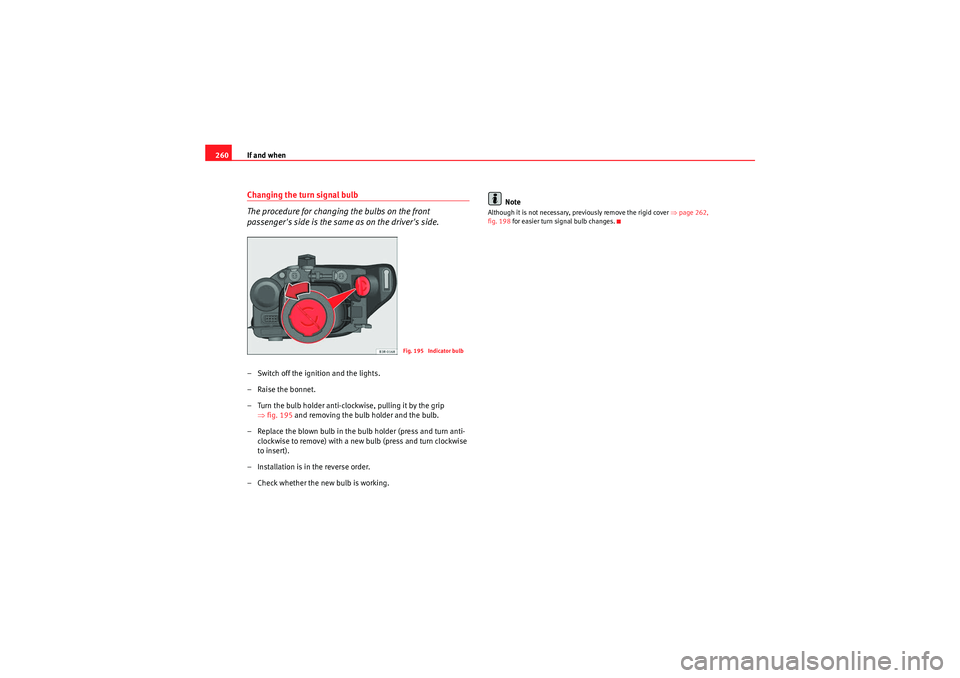
260Changing the turn signal bulb
The procedure for changing the bulbs on the front
passenger's side is the same as on the driver's side.– Switch off the ignition and the lights.
– Raise the bonnet.
– Turn the bulb holder anti-clockwise, pulling it by the grip
⇒fig. 195 and removing the bulb holder and the bulb.
– Replace the blown bulb in the bulb holder (press and turn anti- clockwise to remove) with a new bulb (press and turn clockwise
to insert).
– Installation is in the reverse order.
– Check whether the new bulb is working. Note
Although it is not necessary, previously remove the rigid cover
⇒page 262,
fig. 198 for easier turn signal bulb changes.
Fig. 195 Indicator bulb
Exeo_EN.book Seite 260 Freitag, 28. August 2009 10:14 10
Page 264 of 310
If and when
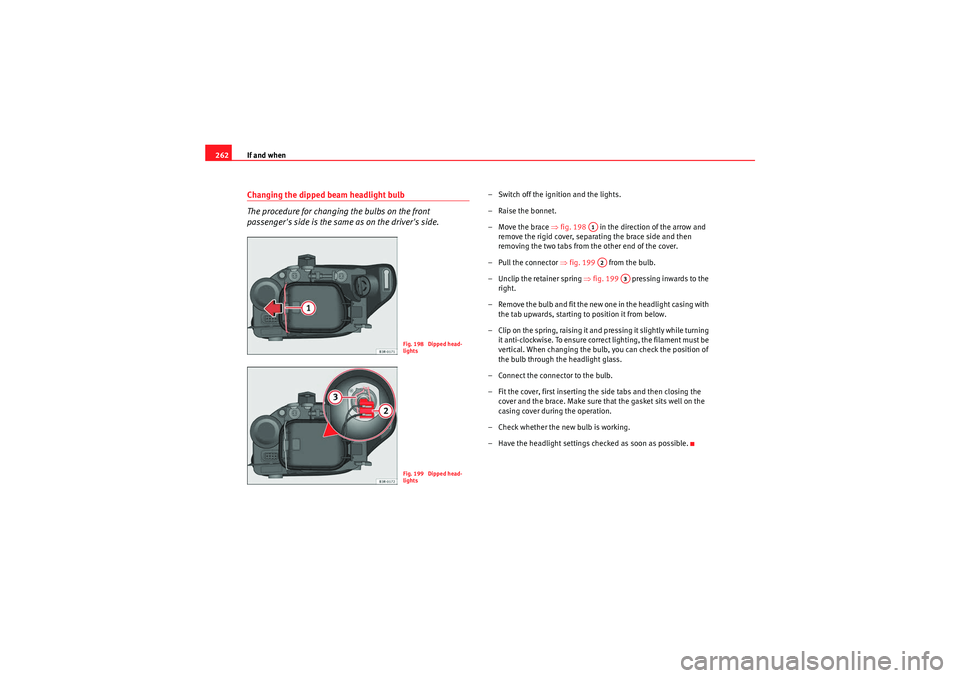
262Changing the dipped beam headlight bulb
The procedure for changing the bulbs on the front
passenger's side is the same as on the driver's side.
– Switch off the ignition and the lights.
– Raise the bonnet.
– Move the brace ⇒ fig. 198 in the direction of the arrow and
remove the rigid cover, separating the brace side and then
removing the two tabs from the other end of the cover.
– Pull the connector ⇒ fig. 199 from the bulb.
– Unclip the retainer spring ⇒fig. 199 pressing inwards to the
right.
– Remove the bulb and fit the new one in the headlight casing with the tab upwards, starting to position it from below.
– Clip on the spring, raising it and pressing it slightly while turning
it anti-clockwise. To ensure correct lighting, the filament must be
vertical. When changing the bulb, you can check the position of
the bulb through the headlight glass.
– Connect the connector to the bulb.
– Fit the cover, first inserting the side tabs and then closing the cover and the brace. Make sure that the gasket sits well on the
casing cover during the operation.
– Check whether the new bulb is working.
– Have the headlight settings checked as soon as possible.
Fig. 198 Dipped head-
lightsFig. 199 Dipped head-
lights
A1A2
A3
Exeo_EN.book Seite 262 Freitag, 28. August 2009 10:14 10
Page 265 of 310
If and when263
Safety First
Controls and equipment
Practical tips
Technical Data
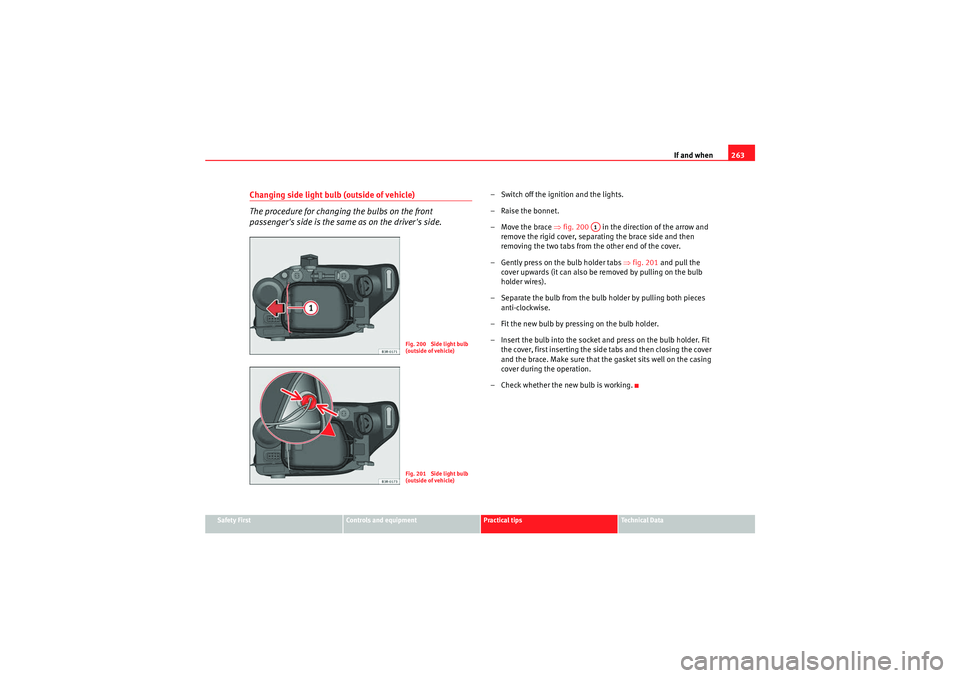
Changing side light bulb (outside of vehicle)
The procedure for changing the bulbs on the front
passenger's side is the same as on the driver's side.
– Switch off the ignition and the lights.
– Raise the bonnet.
– Move the brace ⇒fig. 200 in the direction of the arrow and
remove the rigid cover, separating the brace side and then
removing the two tabs from the other end of the cover.
– Gently press on the bulb holder tabs ⇒fig. 201 and pull the
cover upwards (it can also be removed by pulling on the bulb
holder wires).
– Separate the bulb from the bulb holder by pulling both pieces anti-clockwise.
– Fit the new bulb by pressing on the bulb holder.
– Insert the bulb into the socket and press on the bulb holder. Fit the cover, first inserting the side tabs and then closing the cover
and the brace. Make sure that the gasket sits well on the casing
cover during the operation.
– Check whether the new bulb is working.
Fig. 200 Side light bulb
(outside of vehicle)Fig. 201 Side light bulb
(outside of vehicle)
A1
Exeo_EN.book Seite 263 Freitag, 28. August 2009 10:14 10
Page 266 of 310
If and when
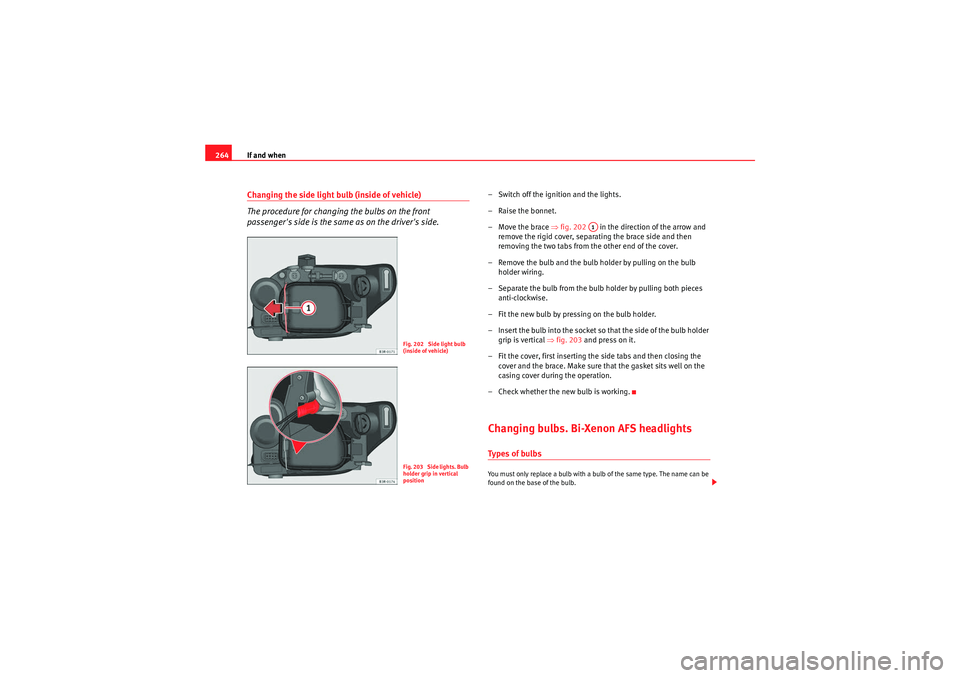
264Changing the side light bulb (inside of vehicle)
The procedure for changing the bulbs on the front
passenger's side is the same as on the driver's side.
– Switch off the ignition and the lights.
– Raise the bonnet.
– Move the brace ⇒ fig. 202 in the direction of the arrow and
remove the rigid cover, separating the brace side and then
removing the two tabs from the other end of the cover.
– Remove the bulb and the bulb holder by pulling on the bulb holder wiring.
– Separate the bulb from the bulb holder by pulling both pieces anti-clockwise.
– Fit the new bulb by pressing on the bulb holder.
– Insert the bulb into the socket so that the side of the bulb holder grip is vertical ⇒fig. 203 and press on it.
– Fit the cover, first inserting the side tabs and then closing the cover and the brace. Make sure that the gasket sits well on the
casing cover during the operation.
– Check whether the new bulb is working.Changing bulbs. Bi-Xenon AFS headlightsTypes of bulbsYou must only replace a bulb with a bulb of the same type. The name can be
found on the base of the bulb.
Fig. 202 Side light bulb
(inside of vehicle)Fig. 203 Side lights. Bulb
holder grip in vertical
position
A1
Exeo_EN.book Seite 264 Freitag, 28. August 2009 10:14 10
Page 269 of 310
If and when267
Safety First
Controls and equipment
Practical tips
Technical Data
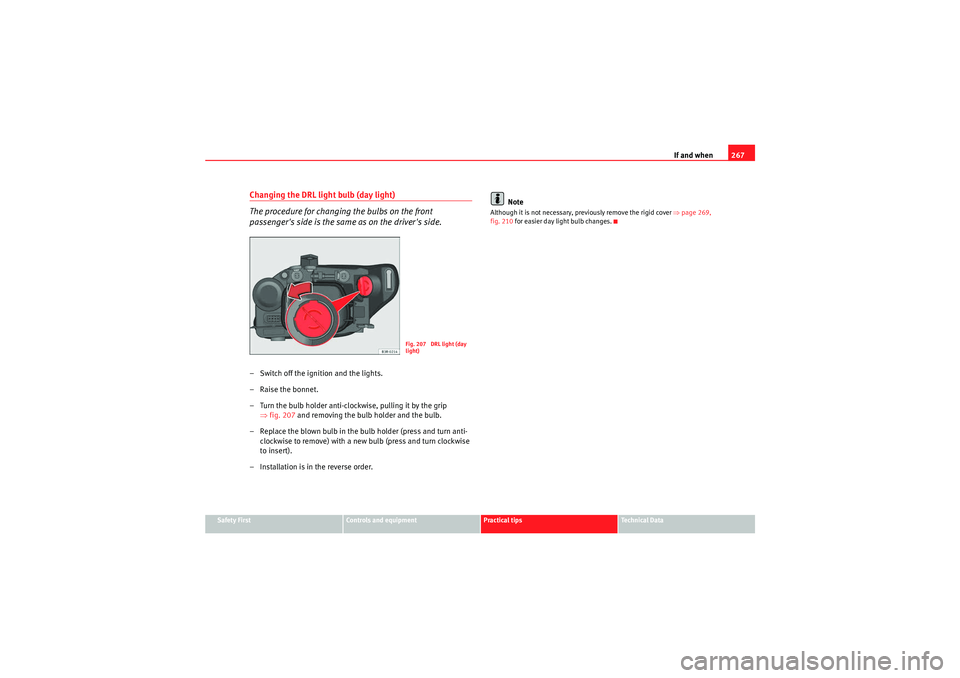
Changing the DRL light bulb (day light)
The procedure for changing the bulbs on the front
passenger's side is the same as on the driver's side.– Switch off the ignition and the lights.
– Raise the bonnet.
– Turn the bulb holder anti-clockwise, pulling it by the grip
⇒fig. 207 and removing the bulb holder and the bulb.
– Replace the blown bulb in the bulb holder (press and turn anti- clockwise to remove) with a new bulb (press and turn clockwise
to insert).
– Installation is in the reverse order. Note
Although it is not necessary, previously remove the rigid cover
⇒page 269,
fig. 210 for easier day light bulb changes.
Fig. 207 DRL light (day
light)
Exeo_EN.book Seite 267 Freitag, 28. August 2009 10:14 10
Page 270 of 310
If and when
268Changing the turn signal bulb
The procedure for changing the bulbs on the front
passenger's side is the same as on the driver's side.
– Switch off the ignition and the lights.
– Raise the bonnet.
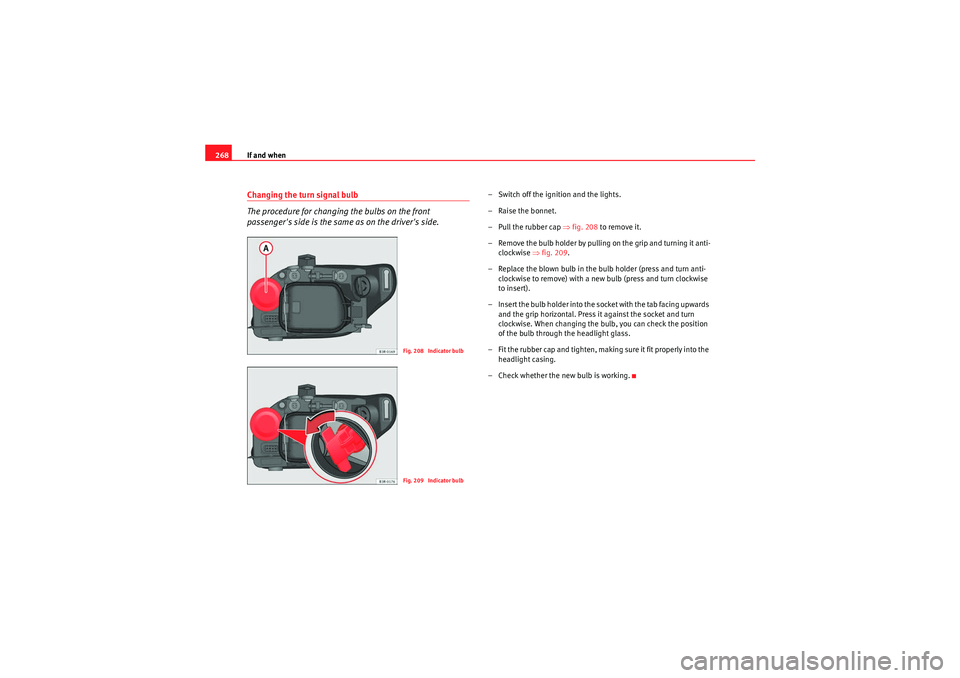
– Pull the rubber cap ⇒ fig. 208 to remove it.
– Remove the bulb holder by pulling on the grip and turning it anti- clockwise ⇒fig. 209 .
– Replace the blown bulb in the bulb holder (press and turn anti- clockwise to remove) with a new bulb (press and turn clockwise
to insert).
– Insert the bulb holder into the socket with the tab facing upwards and the grip horizontal. Press it against the socket and turn
clockwise. When changing the bulb, you can check the position
of the bulb through the headlight glass.
– Fit the rubber cap and tighten, making sure it fit properly into the headlight casing.
– Check whether the new bulb is working.
Fig. 208 Indicator bulbFig. 209 Indicator bulb
Exeo_EN.book Seite 268 Freitag, 28. August 2009 10:14 10
Page 271 of 310
If and when269
Safety First
Controls and equipment
Practical tips
Technical Data
Changing the side light bulb
The procedure for changing the bulbs on the front
passenger's side is the same as on the driver's side.
– Switch off the ignition and the lights.
– Raise the bonnet.
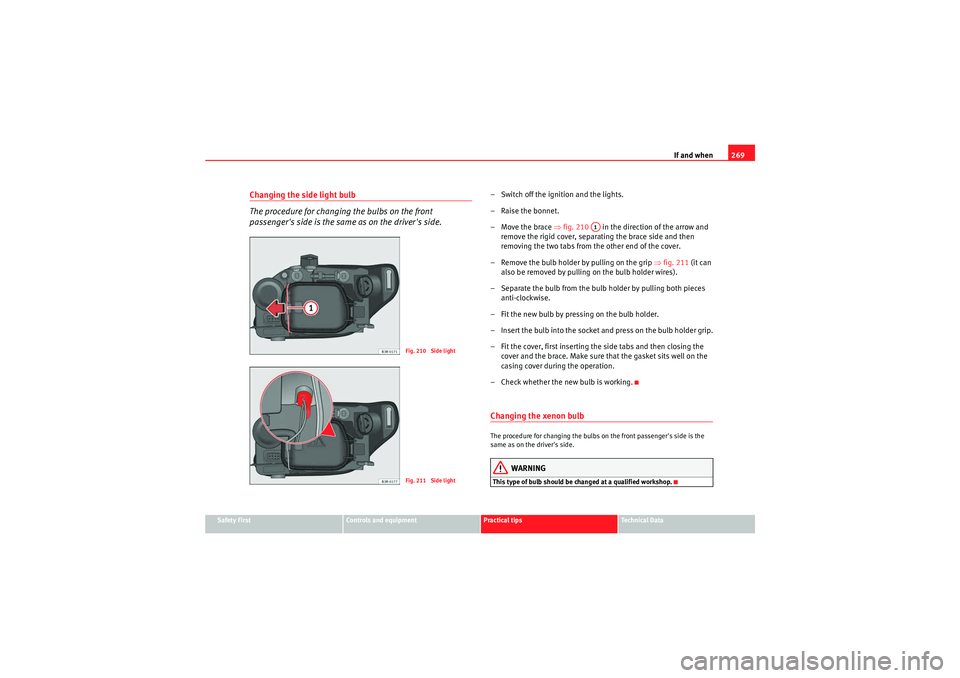
– Move the brace ⇒fig. 210 in the direction of the arrow and
remove the rigid cover, separating the brace side and then
removing the two tabs from the other end of the cover.
– Remove the bulb holder by pulling on the grip ⇒fig. 211 (it can
also be removed by pulling on the bulb holder wires).
– Separate the bulb from the bulb holder by pulling both pieces anti-clockwise.
– Fit the new bulb by pressing on the bulb holder.
– Insert the bulb into the socket and press on the bulb holder grip.
– Fit the cover, first inserting the side tabs and then closing the cover and the brace. Make sure that the gasket sits well on the
casing cover during the operation.
– Check whether the new bulb is working.Changing the xenon bulbThe procedure for changing the bulbs on the front passenger's side is the
same as on the driver's side.
WARNING
This type of bulb should be changed at a qualified workshop.
Fig. 210 Side lightFig. 211 Side light
A1
Exeo_EN.book Seite 269 Freitag, 28. August 2009 10:14 10
Page 282 of 310
If and when
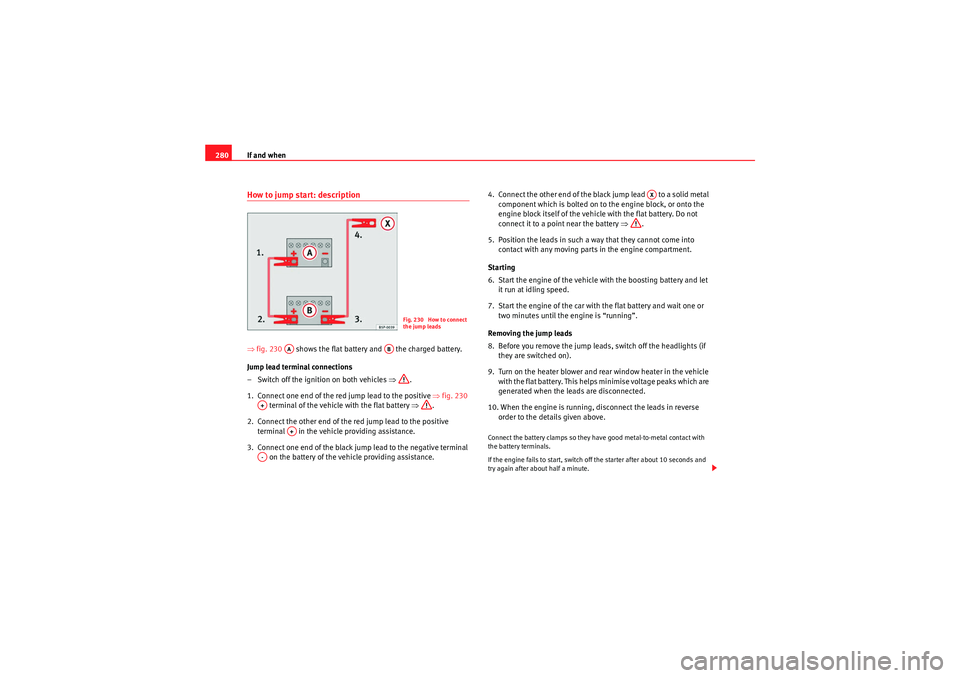
280How to jump start: description⇒ fig. 230 shows the flat battery and the charged battery.
Jump lead terminal connections
– Switch off the ignition on both vehicles ⇒.
1. Connect one end of the red jump lead to the positive ⇒fig. 230
terminal of the vehicle with the flat battery ⇒.
2. Connect the other end of the red jump lead to the positive terminal in the vehicle providing assistance.
3. Connect one end of the black jump lead to the negative terminal on the battery of the vehicle providing assistance. 4. Connect the other end of the black jump lead to a solid metal
component which is bolted on to the engine block, or onto the
engine block itself of the vehicle with the flat battery. Do not
connect it to a point near the battery ⇒.
5. Position the leads in such a way that they cannot come into contact with any moving parts in the engine compartment.
Starting
6. Start the engine of the vehicle with the boosting battery and let it run at idling speed.
7. Start the engine of the car with the flat battery and wait one or two minutes until the engine is “running”.
Removing the jump leads
8. Before you remove the jump lead s, switch off the headlights (if
they are switched on).
9. Turn on the heater blower and rear window heater in the vehicle with the flat battery. This helps minimise voltage peaks which are
generated when the leads are disconnected.
10. When the engine is running, disconnect the leads in reverse order to the details given above.
Connect the battery clamps so they have good metal-to-metal contact with
the battery terminals.
If the engine fails to start, switch off the starter after about 10 seconds and
try again after about half a minute.
Fig. 230 How to connect
the jump leads
AA
AB
A+
A+
A-
AX
Exeo_EN.book Seite 280 Freitag, 28. August 2009 10:14 10
Page 285 of 310
If and when283
Safety First
Controls and equipment
Practical tips
Technical Data
Do not pull too hard with the towing vehicle and take care to avoid jerking the
tow-rope. When towing on an unpaved road, there is always a risk of over-
loading and damaging the anchorage points.
The ignition of the vehicle being towed must be switched on to prevent the
steering wheel from locking and also to allow the use of the indicators, horn,
windscreen wipers and washers.
As the brake servo does not work if the engine is not running, you must apply
considerably more pressure to the brake pedal than you normally would.
As the power assisted steering does not work if the engine is not running, you
will need more strength to steer than you normally would.
Towing vehicles with an automatic gearbox
•Put the selector lever into position “N”.•Do not drive faster than 50 km/h when towing a vehicle.•Do not tow further than 50 km.•If a breakdown vehicle is used, the vehicle must be towed with the front
wheels raised.Note
•Observe legal requirements when towing or tow-starting.•Switch on the hazard warning lights of both vehicles. However, observe
any regulations to the contrary.•For technical reasons, vehicles with an automatic gearbox must not be
tow-started.•If damage to your vehicle means that there is no lubricant in the gearbox,
you must raise the drive wheels while the vehicle is being towed.•If the vehicle has to be towed more than 50 km, the front wheels must be
raised during towing, and towing should be carried out by a qualified person.•The steering wheel is locked when the vehicle has no electrical power. The
vehicle must then be towed with the front wheels raised. Towing should be
carried out by a qualified person.
•The towing eye should always be kept in the vehicle. Please refer to the
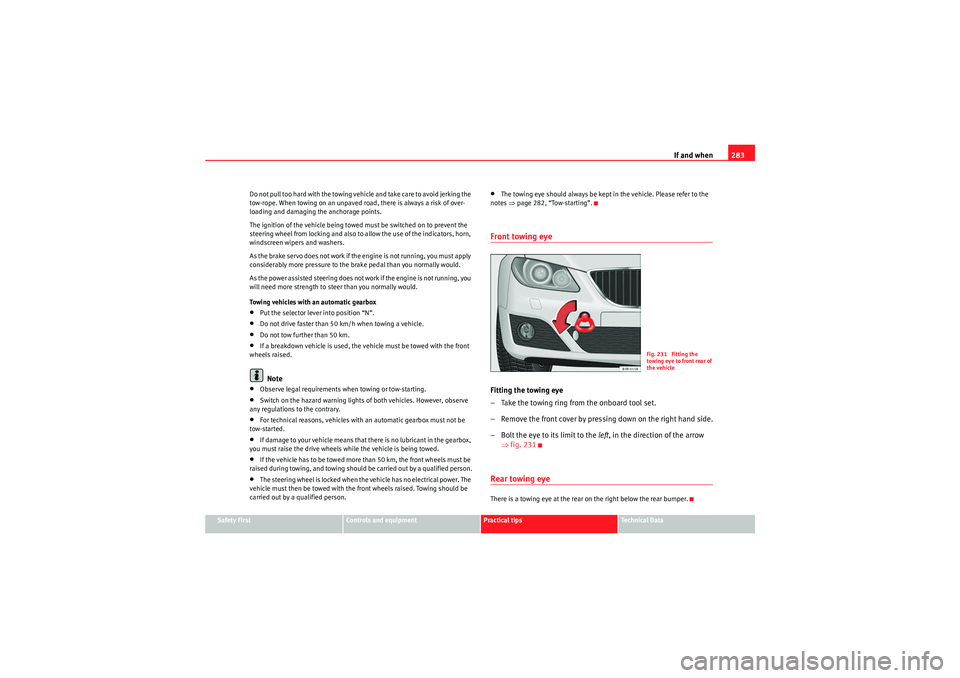
notes ⇒page 282, “Tow-starting”.Front towing eyeFitting the towing eye
– Take the towing ring from the onboard tool set.
– Remove the front cover by pressing down on the right hand side.
– Bolt the eye to its limit to the left, in the direction of the arrow
⇒ fig. 231Rear towing eyeThere is a towing eye at the rear on the right below the rear bumper.
Fig. 231 Fitting the
towing eye to front rear of
the vehicle
Exeo_EN.book Seite 283 Freitag, 28. August 2009 10:14 10
Page 301 of 310
Index299
Index
AAccessories . . . . . . . . . . . . . . . . . . . . . . . . . . . . 214
Towing . . . . . . . . . . . . . . . . . . . . . . . . . . . . . 196
Adaptive headlights . . . . . . . . . . . . . . . . . . . . . 121
Air conditioner 2C-Climatronic . . . . . . . . . . . . . . . . . . . . . . . 154
Defrosting . . . . . . . . . . . . . . . . . . . . . . . . . . . 158
Solar-powered blower/solar roof . . . . . . . . 163
Air duct Fitting . . . . . . . . . . . . . . . . . . . . . . . . . 259, 266
Removing . . . . . . . . . . . . . . . . . . . . . . 258, 265
Air purity sensor . . . . . . . . . . . . . . . . . . . . . . . . . 159
Airbag Warning lamp . . . . . . . . . . . . . . . . . . . . . . . . . 66
Airbag covers . . . . . . . . . . . . . . . . . . . . . . . . . . . . 33
Airbag system . . . . . . . . . . . . . . . . . . . . . . . . . . . 28 Curtain airbags . . . . . . . . . . . . . . . . . . . . . . . 41
Front airbags . . . . . . . . . . . . . . . . . . . . . . . . . 31
Side airbags . . . . . . . . . . . . . . . . . . . . . . . . . . 37
Warning lamp . . . . . . . . . . . . . . . . . . . . . . . . . 29
Alternator Warning lamp . . . . . . . . . . . . . . . . . . . . . . . . . 69
Ambient temperature display . . . . . . . . . . . . . . . 72
Anti-freeze . . . . . . . . . . . . . . . . . . . . . . . . . . . . . 225
Anti-lock brake system How it works . . . . . . . . . . . . . . . . . . . . . . . . . 184
Anti-puncture tyres . . . . . . . . . . . . . . . . . . . . . . 240 Anti-theft alarm system . . . . . . . . . . . . . . . . . . . 106
Interior monitoring . . . . . . . . . . . . . . . . . . . 107
Aquaplaning . . . . . . . . . . . . . . . . . . . . . . . . . . . 239
Armrest Storage compartment in front armrest . . . . 141
Armrests Adjusting the front armrest . . . . . . . . . . . . . 141
Ashtray Front . . . . . . . . . . . . . . . . . . . . . . . . . . . . . . . 148
Rear . . . . . . . . . . . . . . . . . . . . . . . . . . . . . . . 149
Athermic windscreen . . . . . . . . . . . . . . . . . . . . . 215
Auto-check system . . . . . . . . . . . . . . . . . . . . . . . 75
Automatic car wash tunnel . . . . . . . . . . . . . . . . 206
Automatic gearbox Dynamic gear control program . . . . . . . . . . 180
Kick-down feature . . . . . . . . . . . . . . . . . . . . 179
multitronic® . . . . . . . . . . . . . . . . . . . . . . . . 175
Paddle levers (tiptronic mode) . . . . . . . . . . 182
Safety interlock for ignition key . . . . . . . . . 165
Selector lever lock . . . . . . . . . . . . . . . . . . . . 179
Selector lever positions . . . . . . . . . . . . . . . . 177
Steering wheel with paddle levers . . . . . . . 182
tiptronic . . . . . . . . . . . . . . . . . . . . . . . 175, 181
Automatic headlight control . . . . . . . . . . . . . . . 115
BBackground lighting . . . . . . . . . . . . . . . . . . . . . 124 Battery . . . . . . . . . . . . . . . . . . . . . . . . . . . . . . . . 231
Battery voltage . . . . . . . . . . . . . . . . . . . . . . . . 81
Charging . . . . . . . . . . . . . . . . . . . . . . . . . . . . 233
Disconnection . . . . . . . . . . . . . . . . . . . . . . . 231
Long periods of non-use . . . . . . . . . . . . . . . 231
Replacing . . . . . . . . . . . . . . . . . . . . . . 231, 232
Testing . . . . . . . . . . . . . . . . . . . . . . . . . . . . . 231
Winter operations . . . . . . . . . . . . . . . 231, 232
Belt tension device Disposal . . . . . . . . . . . . . . . . . . . . . . . . . . . . . 27
Warning lamp . . . . . . . . . . . . . . . . . . . . . . . . 29
Belt tension devices . . . . . . . . . . . . . . . . . . . . . . 26
Bicycle rack Towing . . . . . . . . . . . . . . . . . . . . . . . . . . . . . 196
Biodiesel . . . . . . . . . . . . . . . . . . . . . . . . . . . . . . 218
Biodiesel fuel . . . . . . . . . . . . . . . . . . . . . . . . . . . 218
Bonnet . . . . . . . . . . . . . . . . . . . . . . . . . . . . . . . . 220 Closing . . . . . . . . . . . . . . . . . . . . . . . . . . . . . 222
Opening . . . . . . . . . . . . . . . . . . . . . . . . . . . . 220
Releasing . . . . . . . . . . . . . . . . . . . . . . . . . . . 220
Brake light Failure control . . . . . . . . . . . . . . . . . . . . . . . . 80
Brake pads . . . . . . . . . . . . . . . . . . . . . . . . . . . . . 189
Brake servo . . . . . . . . . . . . . . . . . . . . . . . . . . . . 189
Brake system Brake servo . . . . . . . . . . . . . . . . . . . . . . . . . 186
Brakes . . . . . . . . . . . . . . . . . . . . . . . . . . . . . 186
Malfunction . . . . . . . . . . . . . . . . . . . . . . . . . . 77
Exeo_EN.book Seite 299 Freitag, 28. August 2009 10:14 10