child restraint Seat Exeo 2010 User Guide
[x] Cancel search | Manufacturer: SEAT, Model Year: 2010, Model line: Exeo, Model: Seat Exeo 2010Pages: 319, PDF Size: 9.64 MB
Page 51 of 319
Child safety49
Safety First
Operating Instructions
Practical Tips
Technical Specifications
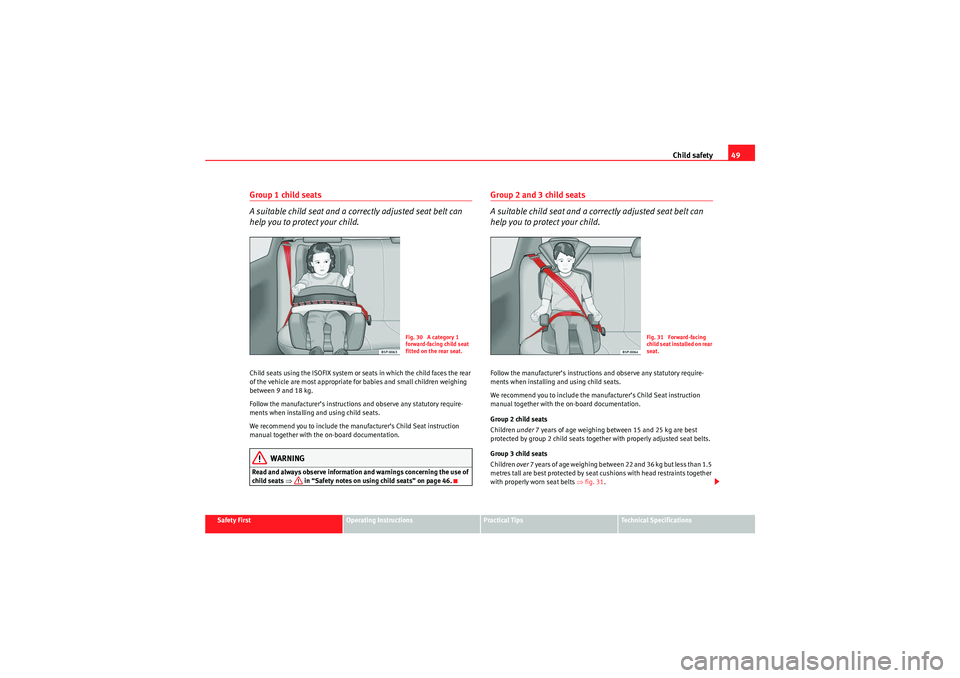
Group 1 child seats
A suitable child seat and a correctly adjusted seat belt can
help you to protect your child.Child seats using the ISOFIX system or seats in which the child faces the rear
of the vehicle are most appropriate for babies and small children weighing
between 9 and 18 kg.
Follow the manufacturer’s instructions and observe any statutory require-
ments when installing and using child seats.
We recommend you to include the manufacturer’s Child Seat instruction
manual together with the on-board documentation.
WARNING
Read and always observe information and warnings concerning the use of
child seats ⇒ in “Safety notes on using child seats” on page 46.
Group 2 and 3 child seats
A suitable child seat and a correctly adjusted seat belt can
help you to protect your child.Follow the manufacturer’s instructions and observe any statutory require-
ments when installing and using child seats.
We recommend you to include the manufacturer’s Child Seat instruction
manual together with the on-board documentation.
Group 2 child seats
Children under 7 years of age weighing between 15 and 25 kg are best
protected by group 2 child seats together with properly adjusted seat belts.
Group 3 child seats
Children over 7 years of age weighing between 22 and 36 kg but less than 1.5
metres tall are best protected by seat cushions with head restraints together
with properly worn seat belts ⇒fig. 31 .
Fig. 30 A category 1
forward-facing child seat
fitted on the rear seat.
Fig. 31 Forward-facing
child seat installed on rear
seat.
exeo_EN.book Seite 49 Montag, 30. August 2010 4:45 16
Page 53 of 319
Child safety51
Safety First
Operating Instructions
Practical Tips
Technical Specifications
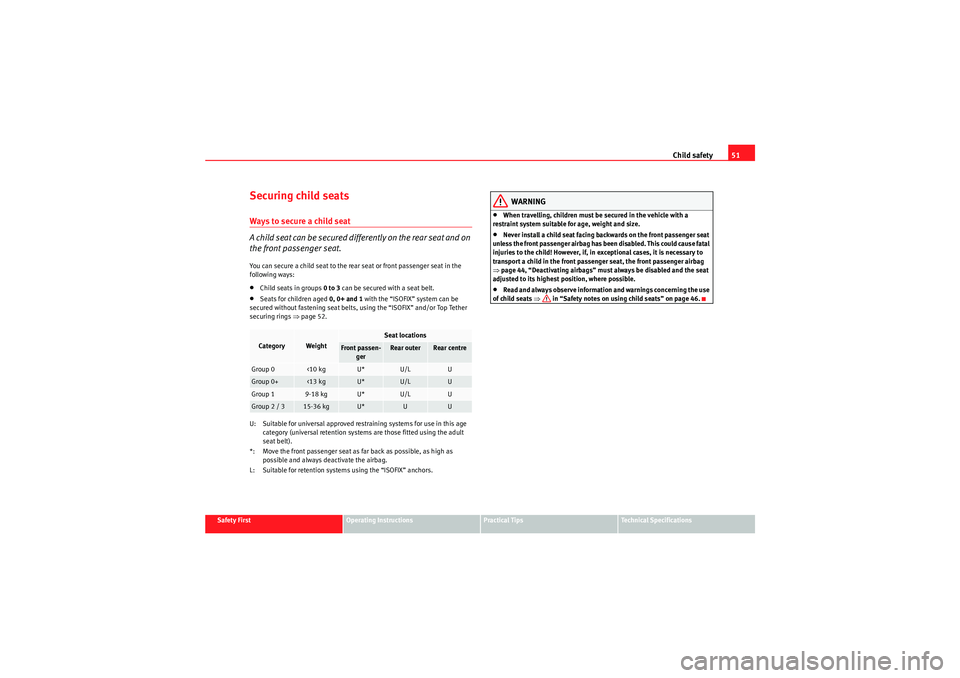
Securing child seatsWays to secure a child seat
A child seat can be secured differently on the rear seat and on
the front passenger seat.You can secure a child seat to the rear seat or front passenger seat in the
following ways:•Child seats in groups 0 to 3 can be secured with a seat belt.•Seats for children aged 0, 0+ and 1 with the “ISOFIX” system can be
secured without fastening seat belts, using the “ISOFIX” and/or Top Tether
securing rings ⇒page 52.
U: Suitable for universal approved restraining systems for use in this age category (universal retention systems are those fitted using the adult
seat belt).
*: Move the front passenger seat as far back as possible, as high as possible and always deactivate the airbag.
L: Suitable for retention systems using the “ISOFIX” anchors.
WARNING
•When travelling, children must be secured in the vehicle with a
restraint system suitable for age, weight and size.•Never install a child seat facing backwards on the front passenger seat
unless the front passenger airbag has been disabled. This could cause fatal
injuries to the child! However, if, in exceptional cases, it is necessary to
transport a child in the front passenger seat, the front passenger airbag
⇒ page 44, “Deactivating airbags” must always be disabled and the seat
adjusted to its highest position, where possible.•Read and always observe information and warnings concerning the use
of child seats ⇒ in “Safety notes on using child seats” on page 46.
Category
Weight
Seat locations
Front passen-
ger
Rear outer
Rear centre
Group 0
<10 kg
U*
U/L
U
Group 0+
<13 kg
U*
U/L
U
Group 1
9-18 kg
U*
U/L
U
Group 2 / 3
15-36 kg
U*
U
U
exeo_EN.book Seite 51 Montag, 30. August 2010 4:45 16
Page 55 of 319
Child safety53
Safety First
Operating Instructions
Practical Tips
Technical Specifications
WARNING
The retainers employed for this child safety seat are specially designed for
the “ISOFIX” system. Never secure other child seats, seat belts or other
items into the retainers. If you do, you increase the risk of sustaining
severe or fatal injuries.To p Te t h e r r e t a i n e r s t r a p s
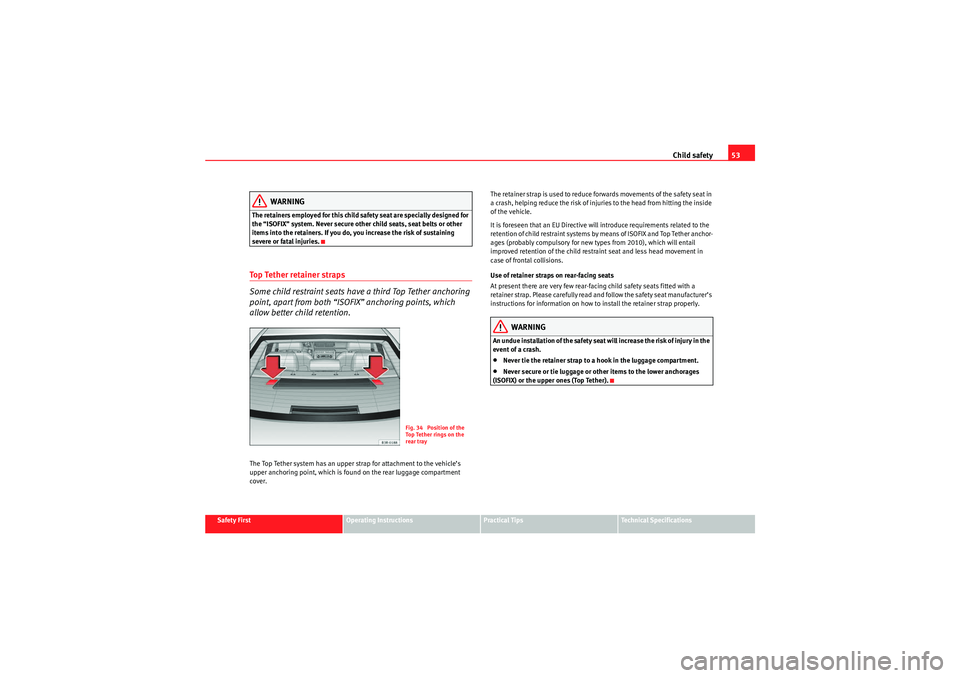
Some child restraint seats have a third Top Tether anchoring
point, apart from both “ISOFIX” anchoring points, which
allow better child retention.The Top Tether system has an upper strap for attachment to the vehicle’s
upper anchoring point, which is found on the rear luggage compartment
cover. The retainer strap is used to reduce forwards movements of the safety seat in
a crash, helping reduce the risk of injuries to the head from hitting the inside
of the vehicle.
It is foreseen that an EU Directive will introduce requirements related to the
retention of child restraint systems by means of ISOFIX and Top Tether anchor-
ages (probably compulsory for new types from 2010), which will entail
improved retention of the child restraint seat and less head movement in
case of frontal collisions.
Use of retainer straps on rear-facing seats
At present there are very few rear-facing child safety seats fitted with a
r etai ner st rap. P lease ca re fully r ead a nd follow the sa fe ty seat man ufa ctu re r’ s
instructions for information on how to install the retainer strap properly.
WARNING
An undue installation of the safety seat will increase the risk of injury in the
event of a crash.•Never tie the retainer strap to a hook in the luggage compartment.•Never secure or tie luggage or other items to the lower anchorages
(ISOFIX) or the upper ones (Top Tether).
Fig. 34 Position of the
Top Tether rings on the
rear tray
exeo_EN.book Seite 53 Montag, 30. August 2010 4:45 16
Page 56 of 319
Child safety
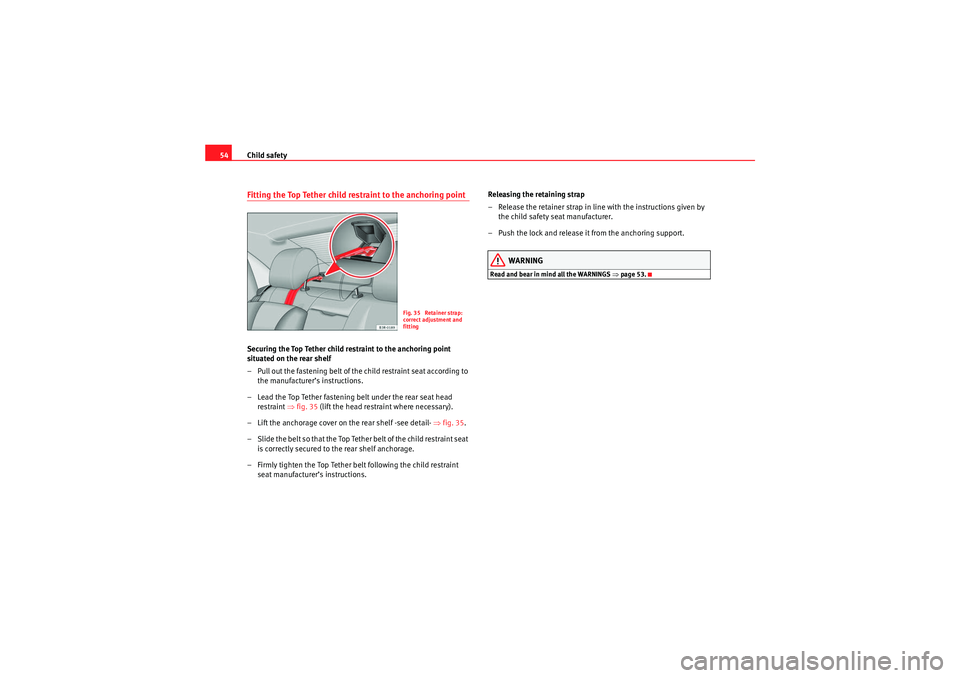
54Fitting the Top Tether child restraint to the anchoring pointSecuring the Top Tether child restraint to the anchoring point
situated on the rear shelf
– Pull out the fastening belt of the child restraint seat according to
the manufacturer’s instructions.
– Lead the Top Tether fastening belt under the rear seat head restraint ⇒fig. 35 (lift the head restraint where necessary).
– Lift the anchorage cover on the rear shelf -see detail- ⇒fig. 35 .
– Slide the belt so that the Top Tether belt of the child restraint seat is correctly secured to the rear shelf anchorage.
– Firmly tighten the Top Tether belt following the child restraint seat manufacturer’s instructions. Releasing the retaining strap
– Release the retainer strap in line with the instructions given by
the child safety seat manufacturer.
– Push the lock and release it from the anchoring support.
WARNING
Read and bear in mind all the WARNINGS ⇒page 53.
Fig. 35 Retainer strap:
correct adjustment and
fitting
exeo_EN.book Seite 54 Montag, 30. August 2010 4:45 16
Page 310 of 319
Index
308Bonnet . . . . . . . . . . . . . . . . . . . . . . . . . . . . . . . . 223
Closing . . . . . . . . . . . . . . . . . . . . . . . . . . . . . 225
Opening . . . . . . . . . . . . . . . . . . . . . . . . . . . . 223
Releasing . . . . . . . . . . . . . . . . . . . . . . . . . . . 223
Brake light Failure control . . . . . . . . . . . . . . . . . . . . . . . . 80
Brake pads . . . . . . . . . . . . . . . . . . . . . . . . . . . . . 192
Brake servo . . . . . . . . . . . . . . . . . . . . . . . . . . . . 192
Brake system Brake servo . . . . . . . . . . . . . . . . . . . . . . . . . 189
Brakes . . . . . . . . . . . . . . . . . . . . . . . . . . . . . 189
Malfunction . . . . . . . . . . . . . . . . . . . . . . . . . . 77
Brakes . . . . . . . . . . . . . . . . . . . . . . . . . . . . . . . . 192 Brake assist system . . . . . . . . . . . . . . . . . . 187
Brake fluid . . . . . . . . . . . . . . . . . . . . . . . . . . 233
Worn brake pads . . . . . . . . . . . . . . . . . . . . . . 81
Braking distance . . . . . . . . . . . . . . . . . . . . . . . . 192
Bulb change General notes . . . . . . . . . . . . . . . . . . . . . . . 260CCatalytic converter . . . . . . . . . . . . . . . . . . . . . . 193
Central locking . . . . . . . . . . . . . . . . . . . . . . . . . . 98
Manual locking . . . . . . . . . . . . . . . . . . . . . . 102
Sunroof: opening and closing . . . . . . . . . . 112
Central locking system Anti-theft security system . . . . . . . . . . . . . . 100
Locking . . . . . . . . . . . . . . . . . . . . . . . . . . . . . 99
Locking and unlocking the vehicle from inside100 Opening and closing the windows . . . . . . 110
Security central locking . . . . . . . . . . . . . . . 101
Switch on the driver door . . . . . . . . . . . . . . 100
Tailgate . . . . . . . . . . . . . . . . . . . . . . . . . . . . 103
Unlocking . . . . . . . . . . . . . . . . . . . . . . . . . . . 99
Cetane number . . . . . . . . . . . . . . . . . . . . . . . . . 222
Changing tail light bulbs . . . . . . . . . . . . . . . . . 273
Changing the main headlight bulb Main headlight . . . . . . . . . . . . . . . . . . . . . . 264
Changing the main headlight bulbs Dipped beam headlight . . . . . . . . . . . . . . . 265
Changing the tail lights Luggage compartment lights . . . . . . . . . . . 282
Changing windscreen wiper blades . . . . . . . . . 232
Chassis number . . . . . . . . . . . . . . . . . . . . . . . . 292
Child safety . . . . . . . . . . . . . . . . . . . . . . . . . . . . . 46
Child safety seat ISOFIX system . . . . . . . . . . . . . . . . . . . . . . . . 52
Child seat . . . . . . . . . . . . . . . . . . . . . . . . . . . . . . . 48 Categorisation in groups . . . . . . . . . . . . . . . 48
Group 1 . . . . . . . . . . . . . . . . . . . . . . . . . . . . . 49
Group 2 . . . . . . . . . . . . . . . . . . . . . . . . . . . . . 49
Group 3 . . . . . . . . . . . . . . . . . . . . . . . . . . . . . 49
Groups 0 and 0+ . . . . . . . . . . . . . . . . . . . . . . 48
Safety notes . . . . . . . . . . . . . . . . . . . . . . . . . . 46
Securing . . . . . . . . . . . . . . . . . . . . . . . . . . . . . 51
Child seats on the front passenger seat . . . . . . . . . . . . . 29
Childproof lock Rear doors . . . . . . . . . . . . . . . . . . . . . . . . . . 104
Cigarette lighter . . . . . . . . . . . . . . . . . . . . . . . . 149 Cleaning alloy wheel rims . . . . . . . . . . . . . . . . 214
Cleaning chrome . . . . . . . . . . . . . . . . . . . . . . . . 213
Cleaning engine compartment . . . . . . . . . . . . . 215
Cleaning steel wheel rims . . . . . . . . . . . . . . . . 214
Cleaning windows . . . . . . . . . . . . . . . . . . . . . . . 212
Clock, setting . . . . . . . . . . . . . . . . . . . . . . . . . . . 61
Cloth seat covers cleaning . . . . . . . . . . . . . . . . 216
Coat hooks . . . . . . . . . . . . . . . . . . . . . . . . . . . . 154
Cockpit . . . . . . . . . . . . . . . . . . . . . . . . . . . . . . . . . 57
Overview . . . . . . . . . . . . . . . . . . . . . . . . . . . . 57
Compartments . . . . . . . . . . . . . . . . . . . . . . . . . . 153 In the door trim . . . . . . . . . . . . . . . . . . . . . . 154
In the front seats . . . . . . . . . . . . . . . . . . . . . 155
Coolant Checking the level . . . . . . . . . . . . . . . . . . . 229
Coolant fluid Antifreeze . . . . . . . . . . . . . . . . . . . . . . . . . . 228
Coolant fluid additive . . . . . . . . . . . . . . . . . 228
Topping up . . . . . . . . . . . . . . . . . . . . . . . . . 229
Cooling system Coolant temperature gauge . . . . . . . . . . . . . 60
Malfunction . . . . . . . . . . . . . . . . . . . . . . . . . . 78
Correct adjustment of front seat head restraints . . 13
Correct adjustment of rear seat head restraints In-use and non-use positions . . . . . . . . . . . 14
Correct sitting position Front passenger . . . . . . . . . . . . . . . . . . . . . . 12
Incorrect sitting position . . . . . . . . . . . . . . . 14
Cruise control . . . . . . . . . . . . . . . . . . . . . . . . . . 174
exeo_EN.book Seite 308 Montag, 30. August 2010 4:45 16