engine oil Seat Exeo 2011 Owner's Guide
[x] Cancel search | Manufacturer: SEAT, Model Year: 2011, Model line: Exeo, Model: Seat Exeo 2011Pages: 313, PDF Size: 5.02 MB
Page 229 of 313

227
Checking and refilling levels
– Check the coolant level on coolant fluid expansion tank
⇒ fig. 168. When the engine is cold, it should be between the
“min” and “max” marks. When the engine is hot, it may be
slightly above the “max” mark.
Its location is shown in the corresponding general overview of the engine
compartment.
The coolant level should be checked with the engine switched off.
The coolant level is monitored by a warning lamp on the instrument panel
display ⇒ page 78. However, we recommend that it should be checked oc-
casionally.
Coolant fluid loss
Any loss of coolant fluid normally indicates a leak in the cooling system. In
this case the cooling system should be inspected by a qualified workshop
without delay. It is not sufficient merely to top up the coolant fluid.
If there are no leaks in the system, a loss of coolant fluid can only occur if
the coolant boils and is forced out of the system as a result of overheating.
CAUTION
Radiator sealants must not be added to the coolant fluid. Such additives
could seriously impair the function of the cooling system.
Topping up the coolant fluid
Be careful when topping up with coolant fluid. – Switch the engine off.
– Wait for the engine to cool down. –
Cover the cap on the expansion tank ⇒ fig. 168 with a cloth,
and carefully unscrew the cap anti-clockwise ⇒
.
– Add coolant fluid.
– Screw on the cap tightly.
Make sure that the coolant fluid meets the required specifications
⇒ page 225, Coolant fluid. Do not use a different type of antifreeze if G12++
antifreeze is not available. In this case, use only water and bring the anti-
freeze concentration back up to the correct level as soon as possible.
Always top up with new coolant fluid.
Do not fill above the “max” mark. Excess coolant fluid is forced out of the
system through the valve in the filler cap when the engine gets hot.
If a lot of coolant fluid has been lost, wait for the engine to cool down before
putting in cold coolant. Failure to do so could result in serious engine dam-
age.
WARNING
● The cooling system is under pressure. Do not unscrew the cap on the
expansion tank when the engine is hot. Failure to comply could result in
burns.
● The antifreeze and coolant fluid can be a health hazard. Therefore,
the antifreeze should be stored in the original container in a safe place
out of reach of children. Failure to comply could result in poisoning.
For the sake of the environment
Drained off coolant should not be used again. Drain off the used coolant in-
to a suitable container and dispose of it in the proper manner (observe envi-
ronmental regulations).
Safety FirstOperating InstructionsPractical TipsTechnical Specifications
Page 232 of 313
230Checking and refilling levels
If the windscreen wipers smear , they should be replaced if they are dam-
aged, or cleaned if they are soiled.
If this does not produce the desired results, the setting angle of the wind-
screen wiper arms might be incorrect. They should be checked by a special-
ised workshop and corrected if necessary.
WARNING
Do not drive unless you have good visibility through all windows!
● The ignition must not be switched on while the front wiper arms are
in a raised position. The wipers would return to their park position and
damage the paintwork on the bonnet.
● To prevent smearing on the windscreen, the wiper blades should be
cleaned regularly using a window cleaner solution. If the wiper blades
are very dirty (e.g. insects etc.), they should be cleaned using a sponge
or cloth. Failure to do so could result in an accident.
● For safety reasons, the wiper blades should be changed once or twice
a year.
CAUTION
● Damaged or dirty windscreen wipers could scratch the windscreen.
● Never use fuel, nail varnish remover, paint thinner or similar products to
clean the windows. This could damage the windscreen wiper blades.
● Never move the windscreen wiper or windscreen wiper arm manually.
This could cause damage.
● Do not pull the windscreen wipers forward unless they are in the service
position. Otherwise the bonnet could be damaged. Brake fluid
Checking the brake fluid level
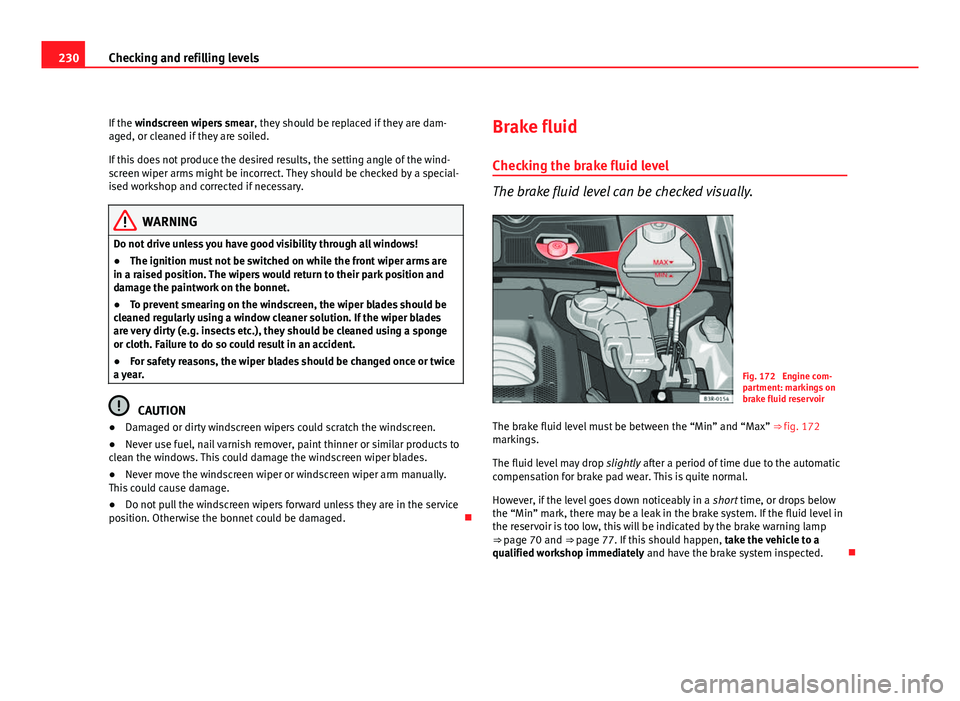
The brake fluid level can be checked visually.
Fig. 172 Engine com-
partment: markings on
brake fluid reservoir
The brake fluid level must be between the “Min” and “Max” ⇒ fig. 172
markings.
The fluid level may drop slightly after a period of time due to the automatic
compensation for brake pad wear. This is quite normal.
However, if the level goes down noticeably in a short time, or drops below
the “Min” mark, there may be a leak in the brake system. If the fluid level in
the reservoir is too low, this will be indicated by the brake warning lamp
⇒ page 70 and ⇒ page 77. If this should happen, take the vehicle to a
qualified workshop immediately and have the brake system inspected.
Page 292 of 313
290Technical specifications
Technical specifications
Engine specifications Checking fluid levels
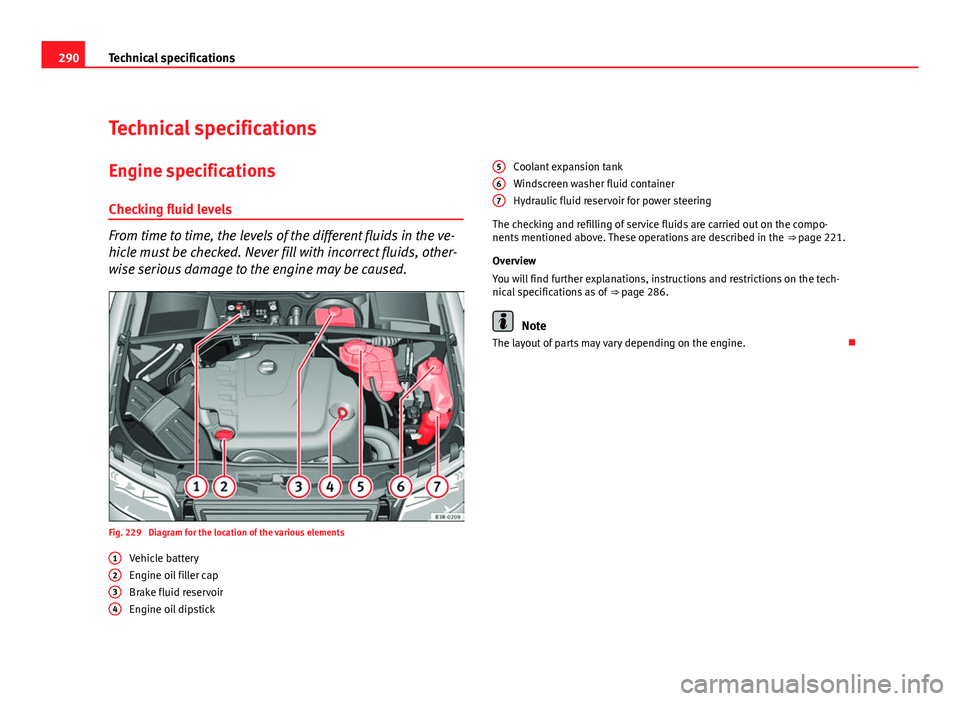
From time to time, the levels of the different fluids in the ve-
hicle must be checked. Never fill with incorrect fluids, other-
wise serious damage to the engine may be caused.
Fig. 229 Diagram for the location of the various elements Vehicle battery
Engine oil filler cap
Brake fluid reservoir
Engine oil dipstick
1
234
Coolant expansion tank
Windscreen washer fluid container
Hydraulic fluid reservoir for power steering
The checking and refilling of service fluids are carried out on the compo-
nents mentioned above. These operations are described in the ⇒ page 221.
Overview
You will find further explanations, instructions and restrictions on the tech-
nical specifications as of ⇒ page 286.
Note
The layout of parts may vary depending on the engine.
567
Page 293 of 313

291
Technical specifications
Petrol engine 1.8 88 kW (120 PS)
Engine specifications Power output in kW (PS) rpm 88 (120) / 3650-6200
Maximum torque in Nm at rpm 230 / 1500-3650
No. of cylinders/capacity in cm3
4 / 1798
Fuel Super 95 RON a)
/ Super 91 RON b)
a)
Research Octane Number = Anti-detonation rating of the petrol.
b) Slight power loss.
Performance Maximum speed in km/h 202
Acceleration from 0-80 km/h in sec. 7
Acceleration from 0-100 km/h in sec. 10.6
Weights
Gross vehicle weight in kg 1980
Weight in running order (with driver) in kg 1495
Gross front axle weight in kg 1075
Gross rear axle weight in kg 1030
Permitted roof load in kg 75
Trailer weight
Trailer without brakes in kg 740
Trailer with brakes, gradients up to 8% in kg 1500
Trailer with brakes, gradients up to 12% in kg 1300
Engine oil capacity
Approximate engine oil capacity with oil filter change 4.6 litres
Safety FirstOperating InstructionsPractical TipsTechnical Specifications
Page 294 of 313

292Technical specifications
Petrol engine 1.8 118 kW (160 PS)
Engine specifications
Power output in kW (PS) rpm 118 (160) / 4500-6200
Maximum torque in Nm at rpm 250 / 1500-4500
No. of cylinders/capacity in cm3
4 / 1798
Fuel Super 95 RON a)
/ Super 91 RON b)
a)
Research Octane Number = Anti-detonation rating of the petrol.
b) Slight power loss.
Performance Maximum speed in km/h 225
Acceleration from 0-80 km/h in sec. 5.9
Acceleration from 0-100 km/h in sec. 8.6
Weights
Gross vehicle weight in kg 1980
Weight in running order (with driver) in kg 1495
Gross front axle weight in kg 1075
Gross rear axle weight in kg 1030
Permitted roof load in kg 75
Trailer weight
Trailer without brakes in kg 740
Trailer with brakes, gradients up to 8% in kg 1500
Trailer with brakes, gradients up to 12% in kg 1300
Engine oil capacity
Approximate engine oil capacity with oil filter change 4.6 litres
Page 296 of 313

294Technical specifications
Engine oil capacity Approximate engine oil capacity with oil filter change 4.5 litres
Petrol engine 2.0 155 kW (211 PS)
Engine specifications Power output in kW (PS) rpm 155 (211) / 4600-6000
Maximum torque in Nm at rpm 320 / 1500-4600
No. of cylinders/capacity in cm3
4 / 1984
Fuel Super 95 RON a)
/ Super 91 RON b)
a)
Research Octane Number = Anti-detonation rating of the petrol.
b) Slight power loss.
Performance Maximum speed in km/h 244
Acceleration from 0-80 km/h in sec. 5.3
Acceleration from 0-100 km/h in sec. 7.1
Weights
Gross vehicle weight in kg 1990
Weight in running order (with driver) in kg 1505
Gross front axle weight in kg 1090
Gross rear axle weight in kg 1030
Permitted roof load in kg 75
Trailer weight
Trailer without brakes in kg 750
Trailer with brakes, gradients up to 8% in kg 1700
Trailer with brakes, gradients up to 12% in kg 1500
Page 297 of 313

295
Technical specifications
Engine oil capacity Approximate engine oil capacity with oil filter change 4.6 litres
Diesel engine 2.0 TDI CR 88 kW (120 PS)
Engine specifications Power output in kW (PS) rpm 88 (120) / 4000
Maximum torque in Nm at rpm 290 / 1750-2500
No. of cylinders/capacity in cm3
4 / 1968
Fuel Min. 51 CN a)
a)
Cetane Number (cetane index) = Measure of the combustion power of the diesel
Performance Maximum speed in km/h 204
Acceleration from 0-80 km/h in sec. 7.2
Acceleration from 0-100 km/h in sec. 10.5
Weights
Gross vehicle weight in kg 1990
Weight in running order (with driver) in kg 1505
Gross front axle weight in kg 1100
Gross rear axle weight in kg 1015
Permitted roof load in kg 75
Trailer weight
Trailer without brakes in kg 750
Trailer with brakes, gradients up to 8% in kg 1500
Trailer with brakes, gradients up to 12% in kg 1300
Safety FirstOperating InstructionsPractical TipsTechnical Specifications
Page 298 of 313

296Technical specifications
Engine oil capacity Approximate engine oil capacity with oil filter change 4.3 litres
Diesel engine 2.0 TDI CR 105 kW (143 PS)
Engine specifications Power output in kW (PS) rpm 105 (143) / 4200
Maximum torque in Nm at rpm 320 / 1750-2500
No. of cylinders/capacity in cm3
4 / 1968
Fuel Min. 51 CN a)
a)
Cetane Number (cetane index) = Measure of the combustion power of the diesel
Performance ManualAutomatic
Maximum speed in km/h 215 208
Acceleration from 0-80 km/h in sec. 6.3 6.3
Acceleration from 0-100 km/h in sec. 9.2 9.3
Weights
Manual Automatic
Gross vehicle weight in kg 1990 2030
Weight in running order (with driver) in kg 1505 1545
Gross front axle weight in kg 1100 1135
Gross rear axle weight in kg 1015 1030
Permitted roof load in kg 75 75
Page 299 of 313

297
Technical specifications
Trailer weight ManualAutomatic
Trailer without brakes in kg 750 750
Trailer with brakes, gradients up to 8% in kg 1800 1900
Trailer with brakes, gradients up to 12% in kg 1400 1700
Engine oil capacity
Approximate engine oil capacity with oil filter change 4.3 litres
Diesel engine 2.0 TDI CR 125 kW (170 PS)
Engine specifications Power output in kW (PS) rpm 125 (170) / 4200
Maximum torque in Nm at rpm 350 / 1750-2500
No. of cylinders/capacity in cm3
4 / 1968
Fuel Min. 51 CN a)
a)
Cetane Number (cetane index) = Measure of the combustion power of the diesel
Performance Maximum speed in km/h 229
Acceleration from 0-80 km/h in sec. 5.9
Acceleration from 0-100 km/h in sec. 8.4
Weights
Gross vehicle weight in kg 2015
Weight in running order (with driver) in kg 1530
Gross front axle weight in kg 1115
Gross rear axle weight in kg 1030
Permitted roof load in kg 75
Safety FirstOperating InstructionsPractical TipsTechnical Specifications
Page 300 of 313

298Technical specifications
Trailer weight Trailer without brakes in kg 750
Trailer with brakes, gradients up to 8% in kg 1800
Trailer with brakes, gradients up to 12% in kg 1600
Engine oil capacity
Approximate engine oil capacity with oil filter change 4.3 litres