tyre pressure Seat Exeo 2011 Owner's Guide
[x] Cancel search | Manufacturer: SEAT, Model Year: 2011, Model line: Exeo, Model: Seat Exeo 2011Pages: 313, PDF Size: 5.02 MB
Page 243 of 313
241
Wheels and tyres
it if necessary. We recommend you contact Technical Service. If more than
one tyre is being used under emergency conditions, this reduces the dis-
tance which can be travelled.
Starting driving in emergency conditions
When loss in tyre pressure is displayed on the instrument panel, this means
that at least one tyre is being driven in emergency conditions ⇒
.
End of emergency operation
Do not drive on if:
● smoke is coming from one of the tyres,
● there is a smell of rubber,
● the vehicle vibrates,
● there is a rattling noise.
When is it no longer possible to continue driving even using run-flat tyres?
● If the Electronic Stability Programme (ESP) is out of operation.
● If the tyre pressure monitoring system* does not work.
● If one of the tyres has been severely damaged in an accident, etc. If a
tyre has been badly damaged there is a risk that parts of the tread can be
thrown off and cause damage to the fuel lines, brake pipes or fuel filler.
● It is also advisable to stop driving if severe vibrations occur, or if the
wheel starts overheating and gives off smoke.
WARNING
When driving in emergency conditions, the driving quality of the vehicle
is considerably impaired.
● The maximum permitted speed of 80 km/h is subject to road and
weather conditions. Please observe legal requirements when doing so.
● Avoid sharp turns and rapid manoeuvres, and brake earlier than usu-
al.
WARNING (Continued)
● Avoid driving over obstacles (for example kerbs) or potholes.
● If one or more tyres are being driven in emergency conditions, the
driving quality of the vehicle is impaired and there is a risk of accident.
Note
● The run-flat tyres do not “deflate” on losing pressure because they are
supported on the reinforced sides. Therefore defects in the tyre cannot be
detected with a visual inspection.
● Snow chains must not be used on front tyres used in emergency condi-
tions.
New tyres and wheels
New tyres and wheels have to be run in.
The tyres and wheel rims are an essential part of the vehicle's design. The
tyres and rims approved by SEAT are specially matched to the characteris-
tics of the vehicle and make a major contribution to good road holding and
safe handling ⇒
.
Tyres should be replaced at least in pairs and not individually (i.e. both front
tyres or both rear tyres together). A knowledge of tyre designations makes it
easier to choose the correct tyres. Radial tyres have the tyre designations
marked on the sidewall, for example: 195/65 R15 91T
This contains the following information: Tyre width in mm
Height/width ratio in %
Tyre construction: Radial
195
65
R
Safety FirstOperating InstructionsPractical TipsTechnical Specifications
Page 245 of 313
243
Wheels and tyres
WARNING
If the wheel bolts are not tightened correctly, the wheel could become
loose while driving. Risk of accident.
● The wheel bolts must be clean and turn easily. Never apply grease or
oil to them.
● Use only wheel bolts which belong to the wheel.
● If the torque of the wheel bolts is too low, they could loosen whilst
the vehicle is in motion. Risk of accident! If the tightening torque is too
high, the wheel bolts and threads can be damaged.
CAUTION
The prescribed torque for wheel bolts for steel and alloy wheels is 120 Nm.
Winter tyres
Winter tyres will improve the vehicles handling on snow and
ice.
In winter conditions winter tyres will considerably improve the vehicle's han-
dling. The design of summer tyres (width, rubber compound, tread pattern)
gives less grip on ice and snow.
Winter tyres must be inflated to a pressure 0.2 bar higher than the pres-
sures specified for summer tyres (see sticker on tank flap).
Winter tyres must be fitted on all four wheels.
Information on permitted winter tyre sizes can be found in the vehicle's reg-
istration documents. Use only radial winter tyres. All tyre sizes listed in the
vehicle documentation also apply to winter tyres.
Winter tyres lose their effectiveness when the tread is worn down to a depth
of 4 mm. The speed rating code ⇒
page 241, New tyres and wheels determines the
following speed limits for winter tyres: ⇒
max. 160 km/h
max. 180 km/h
max. 190 km/h
max. 210 km/h
In some countries, vehicles which can exceed the speed rating of the fitted
tyre must have an appropriate sticker in the driver's field of view. These
stickers are available from your Authorised Service Centre. The legal require-
ments of each country must be followed.
Do not have winter tyres fitted for unnecessarily long periods. Vehicles with
summer tyres handle better when the roads are free of snow and ice.
If you have a flat tyre, please refer to the notes on the spare wheel
⇒ page 241, New tyres and wheels.
WARNING
The maximum speed for the winter tyres must not be exceeded. Other-
wise, this could lead to tyre damage and risk of accident.
For the sake of the environment
Fit your summer tyres again as soon as possible. They are quieter, do not
wear so quickly and reduce fuel consumption.
Snow chains
Snow chains may be fitted only to the front wheels, and only to certain tyre
sizes ⇒ page 289.
Q
S
T
H
Safety FirstOperating InstructionsPractical TipsTechnical Specifications
Page 248 of 313
246If and when
Tyre mobility system
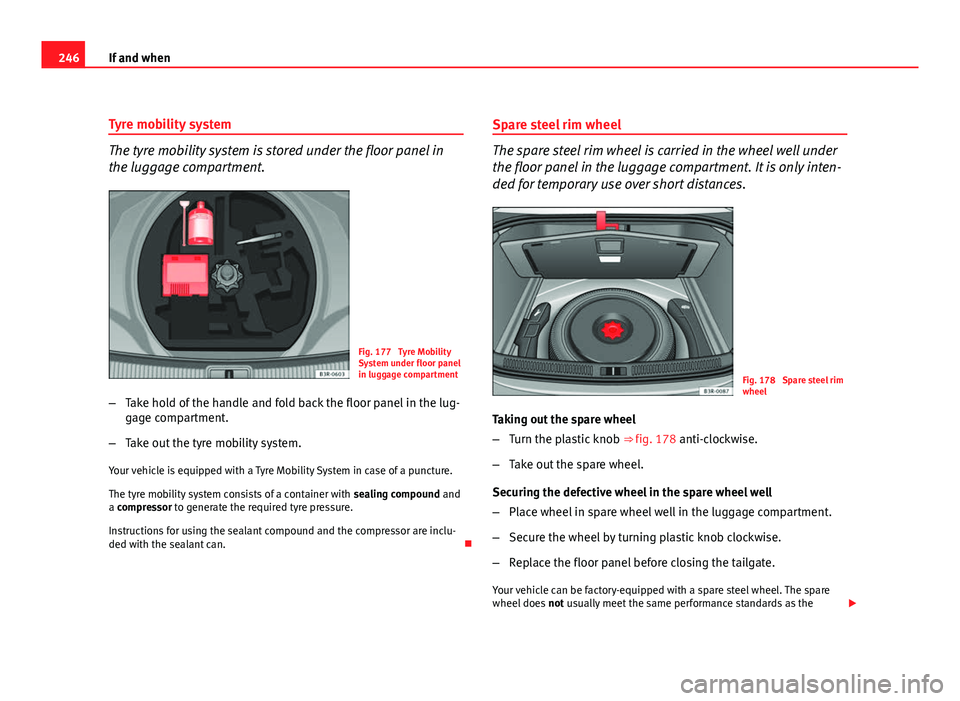
The tyre mobility system is stored under the floor panel in
the luggage compartment.
Fig. 177 Tyre Mobility
System under floor panel
in luggage compartment
– Take hold of the handle and fold back the floor panel in the lug-
gage compartment.
– Take out the tyre mobility system.
Your vehicle is equipped with a Tyre Mobility System in case of a puncture.
The tyre mobility system consists of a container with sealing compound and
a compressor to generate the required tyre pressure.
Instructions for using the sealant compound and the compressor are inclu-
ded with the sealant can. Spare steel rim wheel
The spare steel rim wheel is carried in the wheel well under
the floor panel in the luggage compartment. It is only inten-
ded for temporary use over short distances.
Fig. 178 Spare steel rim
wheel
Taking out the spare wheel
– Turn the plastic knob ⇒ fig. 178 anti-clockwise.
– Take out the spare wheel.
Securing the defective wheel in the spare wheel well
– Place wheel in spare wheel well in the luggage compartment.
– Secure the wheel by turning plastic knob clockwise.
– Replace the floor panel before closing the tailgate.
Your vehicle can be factory-equipped with a spare steel wheel. The spare
wheel does not usually meet the same performance standards as the
Page 249 of 313
247
If and when
wheels fitted on the vehicle because of the wheel/tyre dimensions, rubber
composition, tread pattern, etc. Therefore, note the following restrictions:
● The spare steel wheel is designed only for your vehicle model. Do not
attempt to mount the wheel on any vehicle but your own.
● Your vehicle will have different driving characteristics when the spare
steel rim wheel is mounted ⇒
.
● The spare wheel is only intended for temporary use after having a flat
tyre. Replace the spare wheel with a normal wheel that has the proper tyre
dimensions as soon as possible.
● If the size of the spare steel rim wheel is different to that of the other
wheels, it is unlikely that snow chains suitable for the other wheels will fit it.
WARNING
● After mounting the spare steel rim wheel, the tyre pressure must be
checked and corrected as soon as possible. The tyre pressure must corre-
spond to the vehicle load (consult the table containing the inflation pres-
sures). Otherwise there is danger of causing an accident. Use the highest
tyre pressure as indicated in the table.
● Do not drive faster than 80 km/h, as higher speeds can cause an acci-
dent.
● Avoid heavy acceleration, hard braking and fast cornering, as this
could cause an accident.
Changing a wheel
Preparation work
What you must do before changing a wheel. – If you have a flat tyre or puncture, park the vehicle as far away
from the flow of traffic as possible. Choose a location that is as
level as possible.
– All passengers should leave the vehicle. They should wait in a
safe place (e.g. behind the roadside crash barrier).
– Apply the handbrake firmly.
– Engage first gear .
– When towing a trailer: Unhitch the trailer from your vehicle.
– Take the tools and the spare wheel ⇒ page 245 out of the lug-
gage compartment.
WARNING
If you have a puncture in heavy traffic, switch on the hazard warning
lights and place the warning triangle in a visible location. This is for your
own safety and also warns other road users.
CAUTION
If you have to change the tyre on a gradient, block the wheel opposite the
wheel being changed by placing a stone or similar object under it to prevent
the vehicle from rolling away.
Safety FirstOperating InstructionsPractical TipsTechnical Specifications
Page 250 of 313
248If and when
Note
Please observe legal requirements when doing so.
Changing a wheel
Change the wheel as described below.
– Remove the wheel cover .
– Loosen the wheel bolts ⇒ page 249.
– Raise the vehicle with the jack ⇒ page 250.
– Take off the wheel with the flat tyre and then put on the spare
wheel ⇒ page 251.
– Lower the vehicle.
– Tighten the wheel bolts firmly in diagonal sequence with the
box spanner ⇒ page 249.
– Replace the cover.
After changing a wheel
After changing the wheel, there are still tasks to complete. – Place the wheel with the defective tyre in the spare wheel well
and secure it.
– Put the tools and jack back in the luggage compartment. –
The inflation pressure of the newly fitted spare tyre must be
checked as soon as possible.
– Have the tightening torque of the wheel bolts checked as soon
as possible with a torque wrench. It must be 120 Nm (always
when cold)
– Have the flat tyre replaced as quickly as possible.
Note
● If you notice that the wheel bolts are rusty and difficult to turn when
changing a wheel, they must be replaced before having the tightening tor-
que checked.
● For safety reasons, drive at moderate speeds until the wheel bolt tight-
ening torque has been checked.
Page 255 of 313

253
If and when
The sealing compound must not be used in the following cases:
● If the cuts and punctures on the tyre are longer than 4 mm ⇒ fig. 183 1
●
If the wheel rim has been damaged 2●
If you have been driving with very low pressure or a completely flat tyre
3
How to use the TMS (tyre mobility system) is described in the section Re-
pairing a tyre ⇒ page 254 and in the instructions supplied with the tyre
sealant can.
The TMS (tyre mobility system) can be used at outside temperatures down
to -20 °C.
WARNING
After repairing a tyre please note the following points:
● Do not drive faster than 80 km/h.
● Avoid heavy acceleration, hard braking and fast cornering.
● Vehicle handling could be impaired.
● Tyres which have been sealed using the Tyre Mobility System are only
suitable for temporary use over a short period.
● After using the tyre sealant the tyre pressure monitoring system* may
malfunction. Therefore, please drive carefully to the next available quali-
fied workshop.
● The Tyre Mobility System must NOT be used:
– If the cuts and punctures on the tyre are longer or wider than
4 mm.
– if the wheel rim has been damaged.
– if you have been driving with very low pressure or a completely flat
tyre.
● Seek professional assistance if the repair of a tyre puncture is not
possible with the sealing compound.
WARNING (Continued)
● Do not allow the sealant to come into contact with your eyes, skin or
clothing.
● If you do come into contact with the sealant immediately rinse the
eyes or skin affected with clean water.
● Change clothing immediately if it becomes soiled with the tyre seal-
ant.
● Make sure you do not breathe in the fumes!
● If any of the tyre sealant is accidentally ingested, immediately rinse
the mouth thoroughly and drink lots of water.
–Do not induce vomiting. Seek medical assistance if needed.
● If any allergic reactions should occur get medical help immediately.
● Keep the sealant away from children.
For the sake of the environment
If you have to dispose of a sealant can, go to a specialised waste service or
to a SEAT Technical Service, where the product can be recycled in an appro-
priate waste container.
Note
● If sealant should leak out, leave it to dry. This way you can pull it off like
a piece of foil.
● Observe the expiry date stated on the sealing compound can. Have the
sealing compound exchanged by a specialised workshop.
Safety FirstOperating InstructionsPractical TipsTechnical Specifications
Page 256 of 313
254If and when
Repairing a tyre
Fig. 184 Repairing a tyre
Preparations
– If you have a flat tyre or puncture, park the vehicle as far away
from the flow of traffic as possible.
– Apply the handbrake firmly to prevent the vehicle from moving
accidentally on slopes.
– Engage first gear .
– Check whether a repair is possible using the Tyre Mobility Sys-
tem ⇒ page 252.
– Ensure that all passengers leave the vehicle and move away
from the danger area ⇒
.
– Take the tyre sealant can and the compressor out of the lug-
gage compartment. –
Stick the “max. 80 km/h” adhesive, which is included with the
tyre sealant can, onto the instrument panel where the driver will
see it.
Filling the tyre
– Shake the tyre sealant can well.
– Screw the enclosed filling hose onto the sealant can as far as it
will go. This will automatically pierce the foil sealing the can.
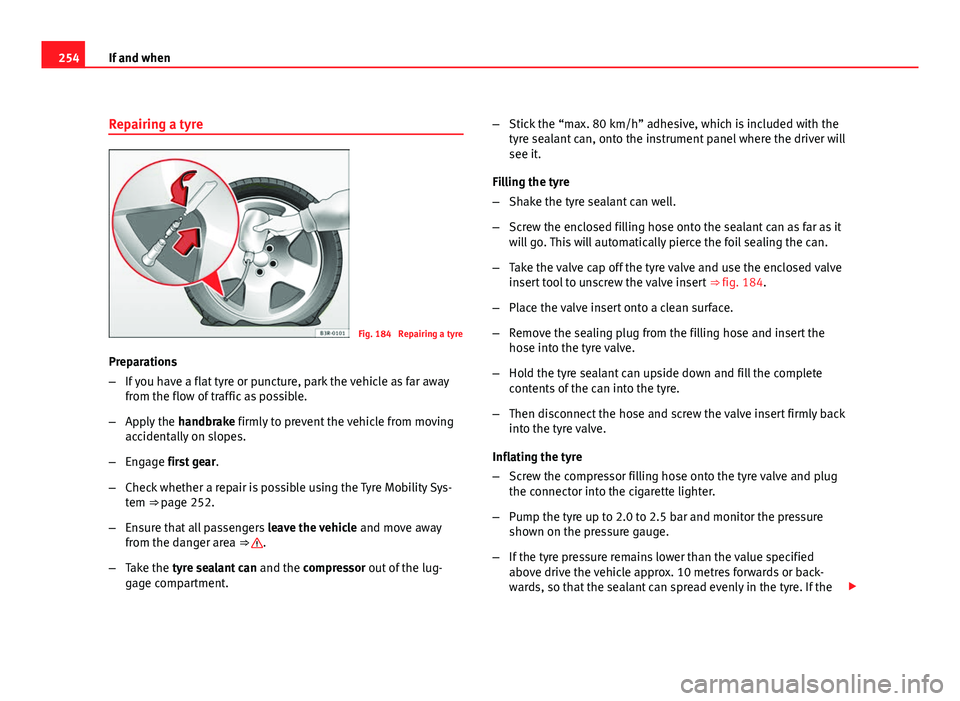
– Take the valve cap off the tyre valve and use the enclosed valve
insert tool to unscrew the valve insert ⇒ fig. 184.
– Place the valve insert onto a clean surface.
– Remove the sealing plug from the filling hose and insert the
hose into the tyre valve.
– Hold the tyre sealant can upside down and fill the complete
contents of the can into the tyre.
– Then disconnect the hose and screw the valve insert firmly back
into the tyre valve.
Inflating the tyre
– Screw the compressor filling hose onto the tyre valve and plug
the connector into the cigarette lighter.
– Pump the tyre up to 2.0 to 2.5 bar and monitor the pressure
shown on the pressure gauge.
– If the tyre pressure remains lower than the value specified
above drive the vehicle approx. 10 metres forwards or back-
wards, so that the sealant can spread evenly in the tyre. If the
Page 257 of 313

255
If and when
pressure is still lower than the specification the tyre is too badly
damaged and cannot be repaired using the tyre sealant.
Final check
– After about 10 minutes, stop to check the tyre pressure.
– If tyre pressure is less than 1.3 bar, the tyre is too badly dam-
aged. Do not drive on! You should obtain professional assis-
tance.
WARNING
● If you have a puncture in heavy traffic, switch on the hazard warning
lights and place the warning triangle in a visible location. This is for your
own safety and also warns other road users.
● Make sure your passengers wait in a safe place (for instance behind
the roadside crash barrier).
● Please observe the manufacturer's safety notes on the compressor
and the instructions supplied with the tyre sealant can.
● If it is not possible to build up a tyre pressure of 2.0 bar within 6 mi-
nutes this means that the tyre is too badly damaged. Do not drive on!
● Seek professional assistance if the repair of a tyre puncture is not
possible with the sealing compound.
● If tyre pressure is less than 1.3 bar after driving about 10 minutes,
the tyre is too badly damaged. Do not drive on! Obtain technical assis-
tance.
CAUTION
Take special care if you have to repair a tyre on a slope.
Note
● Do not use the compressor for longer than 6 minutes. Otherwise, it
might overheat. When the compressor has cooled down, you can use it
again.
● If tyre sealant should leak out, leave it to dry and then pull it off like foil.
● After carrying out a tyre repair remember to buy a new tyre sealant can at
a qualified workshop. This will ensure that the Tyre Mobility System is oper-
ative again.
● Please observe legal requirements when doing so.
Safety FirstOperating InstructionsPractical TipsTechnical Specifications
Page 259 of 313
257
If and when
Fuse assignment
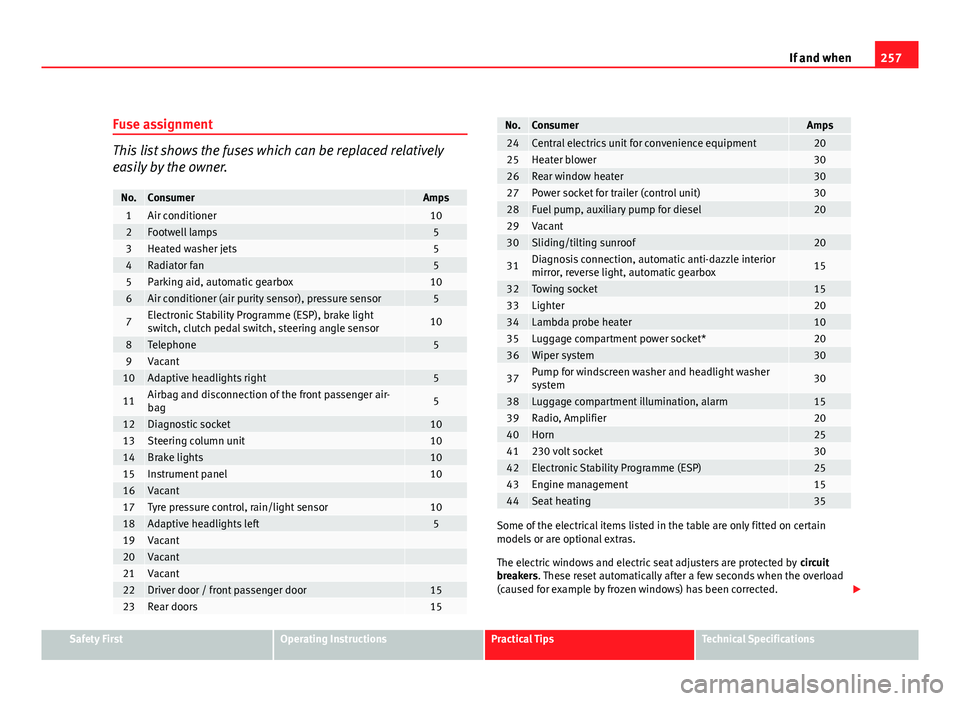
This list shows the fuses which can be replaced relatively
easily by the owner.
No.ConsumerAmps1Air conditioner102Footwell lamps53Heated washer jets54Radiator fan55Parking aid, automatic gearbox106Air conditioner (air purity sensor), pressure sensor5
7Electronic Stability Programme (ESP), brake light
switch, clutch pedal switch, steering angle sensor10
8Telephone59Vacant 10Adaptive headlights right5
11Airbag and disconnection of the front passenger air-
bag5
12Diagnostic socket1013Steering column unit1014Brake lights1015Instrument panel1016Vacant 17Tyre pressure control, rain/light sensor1018Adaptive headlights left519Vacant 20Vacant 21Vacant 22Driver door / front passenger door1523Rear doors15
No.ConsumerAmps24Central electrics unit for convenience equipment2025Heater blower3026Rear window heater3027Power socket for trailer (control unit)3028Fuel pump, auxiliary pump for diesel2029Vacant 30Sliding/tilting sunroof20
31Diagnosis connection, automatic anti-dazzle interior
mirror, reverse light, automatic gearbox15
32Towing socket1533Lighter2034Lambda probe heater1035Luggage compartment power socket*2036Wiper system30
37Pump for windscreen washer and headlight washer
system30
38Luggage compartment illumination, alarm1539Radio, Amplifier2040Horn2541230 volt socket3042Electronic Stability Programme (ESP)2543Engine management1544Seat heating35
Some of the electrical items listed in the table are only fitted on certain
models or are optional extras.
The electric windows and electric seat adjusters are protected by circuit
breakers. These reset automatically after a few seconds when the overload
(caused for example by frozen windows) has been corrected.
Safety FirstOperating InstructionsPractical TipsTechnical Specifications
Page 291 of 313
289
Description of specifications
Drawbar load
The maximum permitted drawbar load on the ball joint of the towing bracket
must not exceed 75 kg.
In the interest of road safety, we recommend that you always tow approach-
ing the maximum drawbar load. The response of the trailer on the road will
be poor if the drawbar load is too small.
If the maximum permissible drawbar load cannot be met (e.g. with small,
empty and light-weight single axle trailers or tandem axle trailers with a
wheelbase of less than 1 metre), a minimum of 4% of the actual trailer
weight is legally required for the drawbar load.
WARNING
● For safety reasons, do not exceed the 80 km/h limit. This is also valid
in countries where higher speeds are permitted.
● Never exceed the maximum trailer weights or the drawbar load. If the
permissible axle load or the permissible total weight is exceeded, the
driving characteristics of the vehicle may change, leading to accidents,
injuries and damage to the vehicle.
Wheels
Tyre pressure, snow chains, wheel bolts
Tyre pressures
The sticker with the tyre pressure values can be found on the inside of the
tank flap. The tyre pressure values given there are for cold tyres. The slightly
raised pressures of warm tyres must not be reduced. ⇒
Snow chains
Snow chains may be fitted only to the front wheels. Consult the chapter “wheels” of this manual.
Wheel bolts
After the wheels have been changed, the
tightening torque of the wheel
bolts should be checked as soon as possible with a torque wrench ⇒
.
The tightening torque for steel and alloy wheels is 120 Nm.
WARNING
● Check the tyre pressure at least once per month. Checking the tyre
pressure is very important. If the tyre pressure is too high or too low,
there is an increased danger of accidents, particularly at high speeds.
● If the torque of the wheel bolts is too low, they could loosen while the
vehicle is in motion. Risk of accident! If the tightening torque is too high,
the wheel bolts and threads can be damaged.
Note
We recommend that you ask your Authorised Service Centre for information
about appropriate wheel, tyre and snow chain size.
Safety FirstOperating InstructionsPractical TipsTechnical Specifications